
Tackling the BHIC 131 Question Paper effectively requires more than just memorizing dates; it demands a solid strategy for answer writing and a clear understanding of what the examiner is actually looking for. We have taken the time to dig deep into the June 2025 paper to give you a roadmap that actually works. We know that history isn't just about events; it is about connecting the dots between economy, society, and politics. In this guide, we are going to break down the paper section by section, offer real-world advice on how to structure your answers, and provide the specific guidance you need to crush your upcoming exams. For more IGNOU papers or support, you may visit: https://www.unnatieducations.com/ignou.
BHIC 131 Question Paper June 2025 – Quick Overview
Before we get into the heavy lifting of analysis, let’s look at the cold, hard facts of this specific examination. Knowing the pattern is half the battle won.
| Feature | Details |
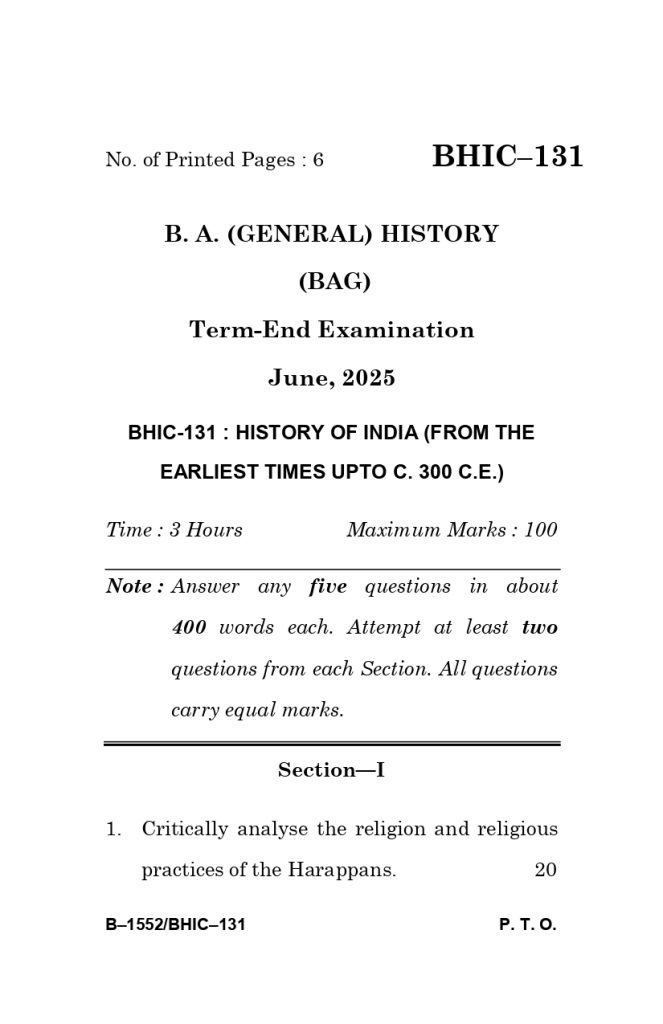
| Course Code | BHIC-131 |
| Course Title | History of India (From the Earliest Times up to c. 300 C.E.) |
| Exam Session | June 2025 |
| Maximum Marks | 100 Marks |
| Time Duration | 3 Hours |
| Word Limit | 400 Words (Long Answers), 200 Words (Short Notes) |
| Paper Structure | Two Sections (Attempt at least 2 from each) |
This paper was balanced, covering major eras from the Harappan civilization to the Mauryan Empire and the post-Mauryan phase. The questions were direct but required analytical thinking rather than rote memorization. Many students actively search for resources like the BHIC 131 question paper, hoping to find a clear layout of the exam format. Others specifically look for the BHIC 131 solved question paper to get a benchmark for quality answers. We also see a high volume of queries for the BHIC 131 question paper solution to help speed up revision time. Finding a curated list of IGNOU History of India Important Question topics is essentially a survival tactic for last-minute cramming. Ultimately, reviewing the specific BHIC 131 question paper June 2025 is the best way to align your preparation with the latest academic trends.
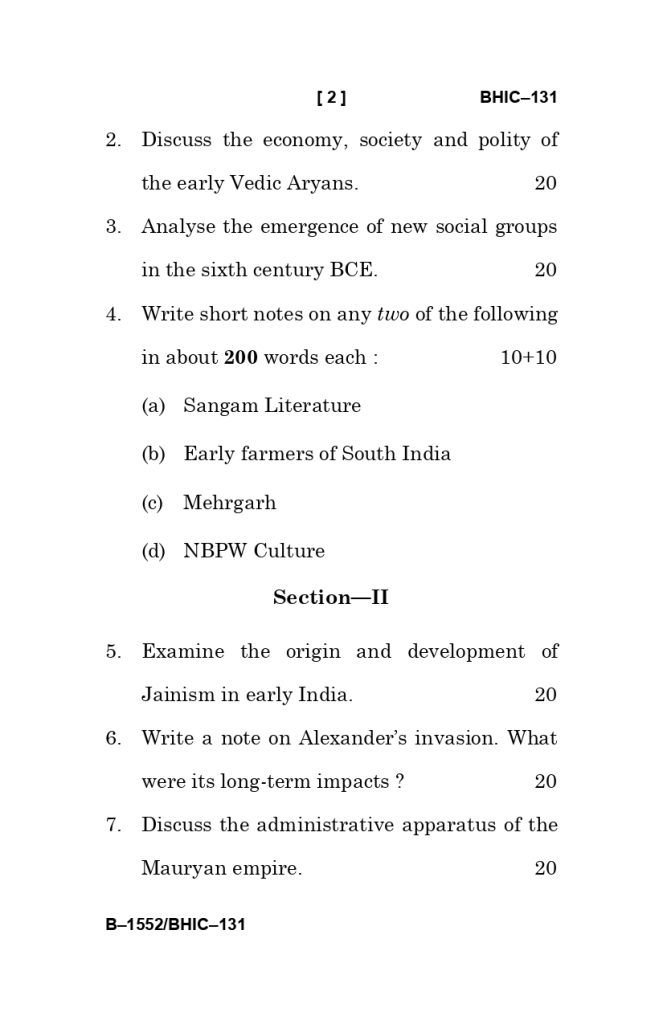
BHIC 131 Question Paper June 2025 Sample Pages
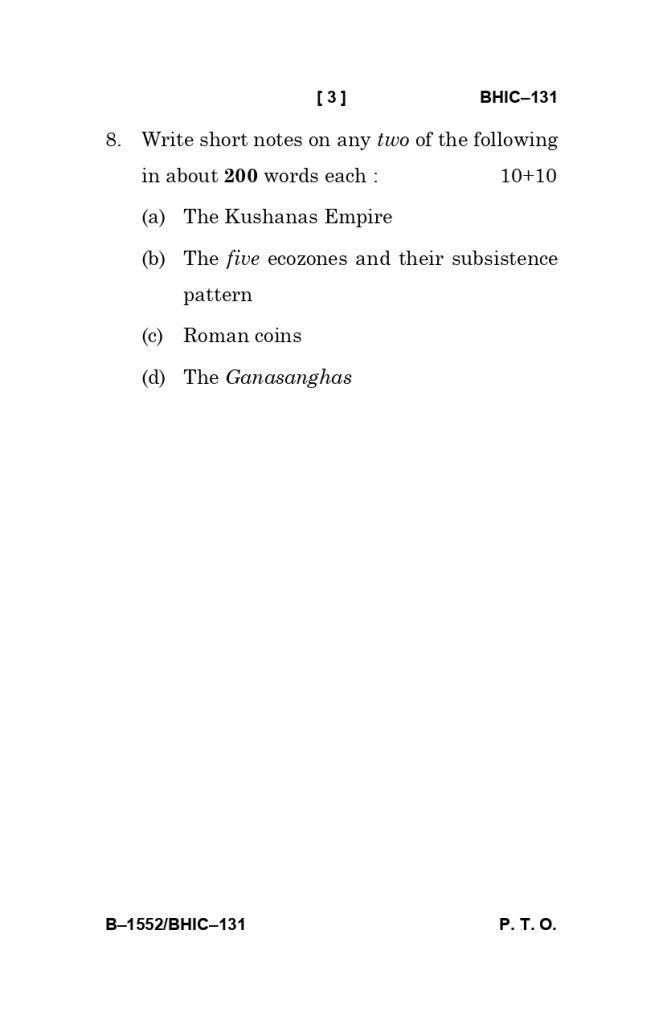
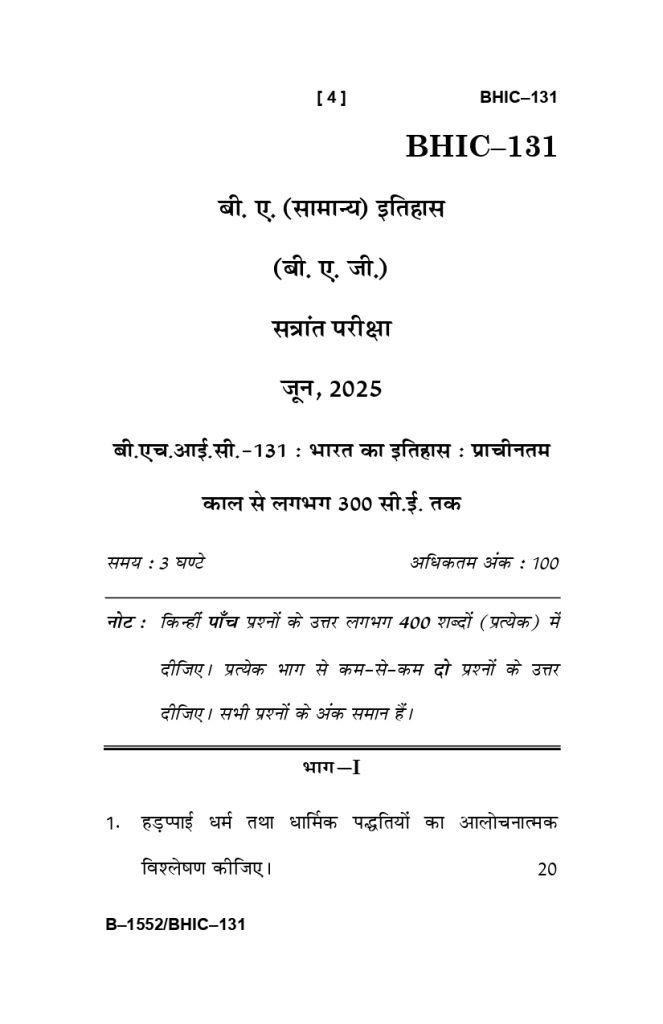
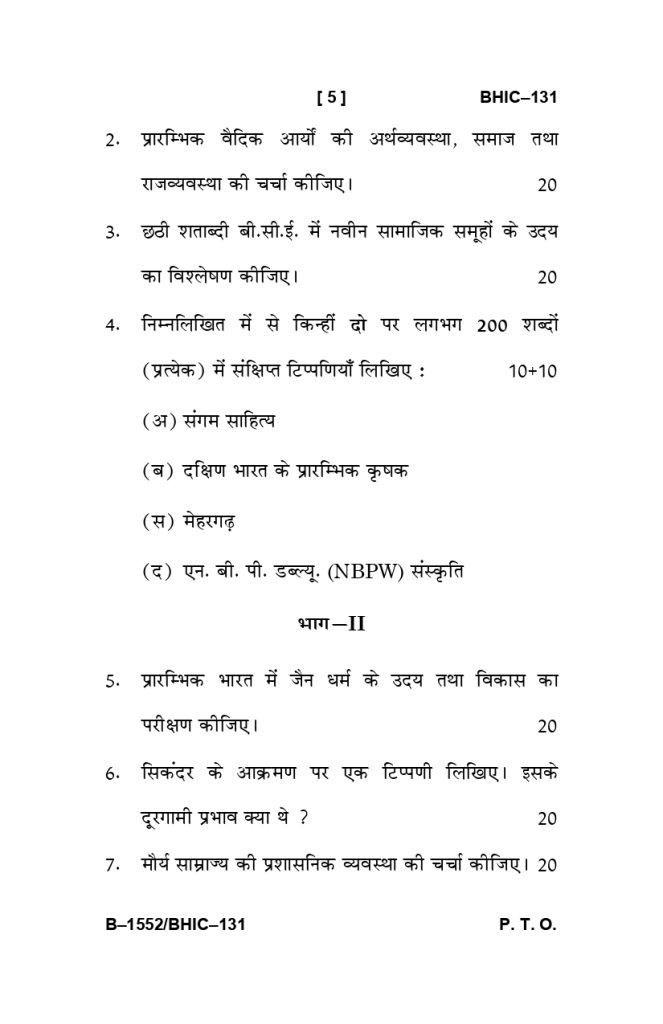
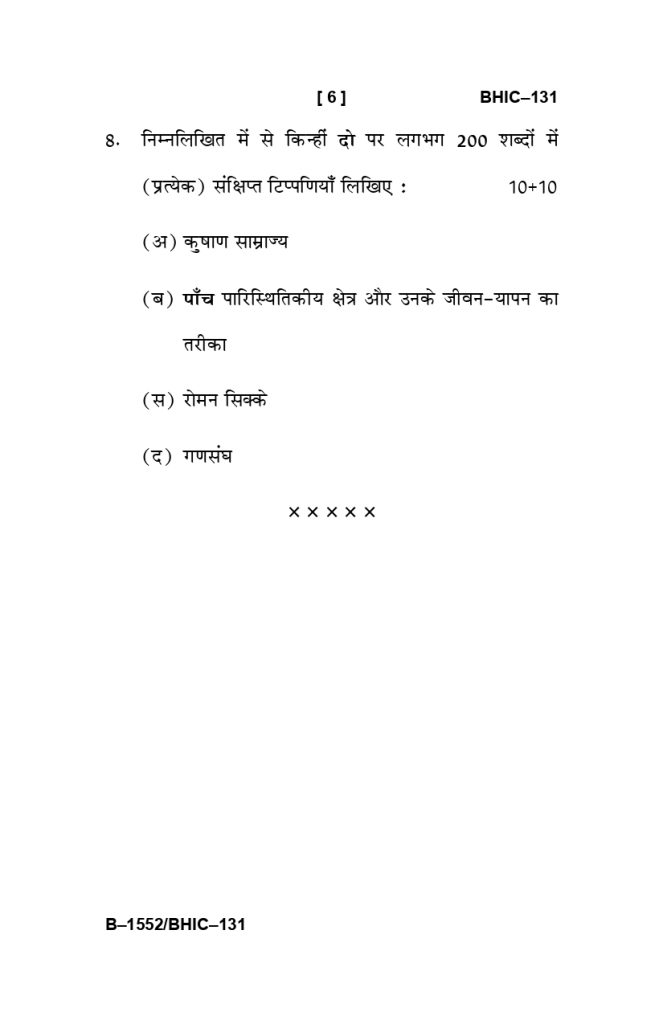 Want BHIC 131 Question Paper Solutions? Reading through a blog analysis is super helpful, but let's be real—sometimes you just want the answers written out in the correct format so you can memorize them and move on. We get it. Finding accurate, point-wise solutions that strictly adhere to the IGNOU word limit is tough. Students who need complete solutions or personalised help for BHIC 131 can reach out to our team. We support learners with notes, solutions, and exam guidance. Contact Us for Personalized Support:
- Website: https://www.unnatieducations.com/ignou
- WhatsApp: 9899436384
- Telegram: Unnati Education IGNOU
Why BHIC 131 Seems to be Easy for Students
When we chat with students about the BHIC 131 Question Paper, the general vibe is that it feels "easier" than other heavy subjects like Political Science or Sociology. But why is that?
- Story-Based Learning: The syllabus follows a chronological story—from stone tools to the great empires. It flows naturally. If you know the story of India, you can often bluff your way through a question logically even if you forget the specific year.
- High Choice Ratio: The paper offers 8 questions in total, and you only need to answer 5. This internal choice is a lifesaver. You can completely skip a topic you hate (like maybe the intricate details of stone age tools) and focus on big, meaty topics like the Mauryan Empire.
- Predictable Questions: Unlike some subjects that ask for your abstract opinion, History questions here are standard. Asking about the "Harappan Religion" or "Mauryan Administration" is expected. There are no curveballs.
- Tangible Concepts: Topics like "Trade," "Agriculture," and "Coins" are real things you can visualize. It’s easier to write 400 words on how people traded goods than it is to write about abstract political theories.
BHIC 131 Question Paper June 2025 – Question-Wise Analysis
Let’s rip apart the actual questions asked in the June 2025 session. We will explain what the question demanded, why it was asked, and how we would approach it to get maximum marks.
Section I Analysis
- Critically analyse the religion and religious practices of the Harappans.
- The Demand: The keyword here is "Critically analyse." This means you can't just list a bunch of gods. You need to talk about the nature of their belief system. Was it organized? Was it nature-based?
- Our Approach: We would start by mentioning that we haven't deciphered their script, so everything is based on archaeological evidence like seals and statues. We'd touch upon the Great Bath (ritual purity), the Mother Goddess figures, and the Proto-Shiva seal. The "critical" part comes in by discussing the lack of massive temples compared to Mesopotamia.
- Discuss the economy, society and polity of the early Vedic Aryans.
- The Demand: This is a monster question because it asks for three things: Economy, Society, AND Polity. You have to be super disciplined with your word count here.
- Our Approach: For economy, we'd focus on the pastoral nature—cows were currency, not land. For society, we'd highlight the tribal structure (Jana) and the relatively better status of women compared to later periods. For polity, we'd explain that the King (Rajan) wasn't an absolute dictator yet; he was checked by assemblies like the Sabha and Samiti.
- Analyse the emergence of new social groups in the sixth century BCE.
- The Demand: This is about the "Second Urbanization." The examiner wants to know how society changed when people started living in cities again and using iron tools.
- Our Approach: We would link the rise of iron ploughshare agriculture to surplus production. Surplus leads to trade. Trade leads to a new rich class (Setthis/Merchants) and landholders (Gahapatis). We’d also mention the rise of urban labor and how the caste system started getting more rigid to organize these new groups.
- Write short notes on any two of the following (200 words each):
- (a) Sangam Literature: Insight: Don't just say "old Tamil books." Mention the three assemblies (Sangams), the themes of Love (Akam) and War (Puram), and the text Tolkappiyam.
- (b) Early farmers of South India: Insight: This refers to the Neolithic cultures. Mention ash mounds, cattle herding, and millet farming in the Deccan plateau.
- (c) Mehrgarh: Insight: This is the precursor to the Indus Valley. It’s in Baluchistan. Crucial because it shows the transition from hunting to farming (wheat/barley) very early on.
- (d) NBPW Culture: Insight: Northern Black Polished Ware. This pottery is the hallmark of the Second Urbanization and the Mauryan era—shiny, luxury pottery used by the elites.
Section II Analysis
- Examine the origin and development of Jainism in early India.
- The Demand: Why did Jainism pop up when it did? And how did it grow?
- Our Approach: We would start with the socio-economic context—the Kshatriyas and Vaishyas were unhappy with Brahmanical dominance and animal sacrifices (which hurt cattle-based agriculture). Then, we'd discuss Mahavira’s role in organizing the sect and how royal patronage helped it spread.
- Write a note on Alexander's invasion. What were its long-term impacts?
- The Demand: A two-parter. Briefly describe the invasion, then focus heavily on the "So What?" factor.
- Our Approach: We wouldn't spend too much time on the battles. The marks are in the impacts: opening trade routes between India and Europe, the influence on Gandhara art, and how his destruction of small tribes paved the way for the Mauryan Empire to take over easily.
- Discuss the administrative apparatus of the Mauryan empire.
- The Demand: How did the Mauryas run such a huge show?
- Our Approach: This answer needs structure. We'd break it down: Central Admin (King + Mantriparishad), Provincial Admin (Viceroys), City Admin (the 6 committees Megasthenes talked about), and the Espionage system (Spies). Citing the Arthashastra here is a power move.
- Write short notes on any two of the following:
- (a) The Kushanas Empire: Insight: Focus on Kanishka, the Silk Road control, and the patronage of Mahayana Buddhism.
- (b) The five ecozones and their subsistence pattern: Insight: This is the Tinai concept from Sangam literature (Mountains, Forests, Fields, Coast, Desert). Very specific to South Indian history.
- (c) Roman coins: Insight: Found mostly in South India. Shows massive trade balance in India's favor (spices/textiles for gold).
- (d) The Ganasanghas: Insight: The republican states (like Vajji). They were run by assemblies, not a single king.
For more IGNOU papers or support, you may visit: https://www.unnatieducations.com/ignou.
Important Topics for BHIC 131 Based on Previous Papers
We have crunched the data from the last five years of exams. If you are short on time and want the highest return on investment for your study hours, these are the topics you simply cannot ignore.
| Topic Category | Specific Concepts to Master | Probability |
| Harappan Civilization | Town Planning, Religion, Decline Theories | ⭐⭐⭐⭐⭐ |
| Vedic Period | Comparison of Early vs. Later Vedic (Society/Economy) | ⭐⭐⭐⭐⭐ |
| Mauryan Empire | Ashoka’s Dhamma, Administration, Decline | ⭐⭐⭐⭐ |
| New Religious Movements | Buddhism vs. Jainism (Causes of rise) | ⭐⭐⭐⭐ |
| South India | Sangam Age (Tinai concept), Megalithic Cultures | ⭐⭐⭐ |
| Post-Mauryan | Kushanas (Kanishka), Satavahanas | ⭐⭐⭐ |
If you master the top three rows of this table, you can easily attempt 60-80 marks worth of questions without breaking a sweat.
Answer Writing Strategy of Unnati Education
Knowing the answer is one thing; putting it down on paper in a way that makes the IGNOU evaluator happy is a whole different ball game. Here is the strategy we swear by at Unnati Education.
- Structure is King: Every 20-mark answer needs a skeleton. Start with an Introduction (2-3 lines), move to the Body (divided into sub-headings or bullet points), and end with a Conclusion (summary). Never write in one giant, scary block of text.
- Use Bullet Points: As you saw in our analysis, breaking down "Social Groups" or "Mauryan Administration" into bullet points makes it readable. Evaluators are human; they appreciate scannable content.
- Mental Map Work: You don't have to be an artist, but describing locations helps. When writing about Mehrgarh, mentioning it is in "Present-day Baluchistan, near the Bolan Pass" makes you look like an expert.
- Cite Sources: You don't need a bibliography, but dropping names adds weight. For Mauryan stuff, mention "Kautilya's Arthashastra." For Sangam notes, mention "The Tolkappiyam." It shows you actually read the book.
- Stick to the Limits: Writing 800 words for one question means you will run out of time for the last one. Stick to the 400-word limit. Quality over quantity always wins.
Common Mistakes Students Should Avoid
We see the same blunders happen year after year. Let’s make sure you don’t make them.
- Misinterpreting "Critically Analyse": Many students just write a summary. If the question says "Critically analyse," you need to look at the pros and cons, or the debates surrounding a topic. Don't just tell the story; explain the why and the issues.
- Ignoring Section Rules: You must attempt at least two questions from each section. If you do four questions from Section I and only one from Section II, that fifth answer gets zero marks. It’s a tragic way to lose 20 marks.
- Leaving Short Notes for Last: Short notes (Question 4 and 8) are actually the easiest way to score. They are small (10 marks each) and factual. If you know the facts, attempting them can often get you better marks than a vague long answer.
- Poor Time Division: Spending 1 hour on the first question because you know it well is a recipe for disaster. You will rush the rest and your handwriting will look like a spider walked across the page.
Time Management while Taking the Exam
You have 180 minutes for 100 marks. Here is the breakdown we suggest:
- First 10 Minutes: Read the BHIC 131 Question Paper thoroughly. Choose your 5 questions. Mark the ones you are most confident about. Don't start writing yet.
- Next 160 Minutes: You have roughly 32 minutes per 20-mark question.
- Spend 2 minutes planning the answer (scribble points).
- Spend 25 minutes writing.
- Spend 5 minutes reviewing and underlining key terms.
- Last 10 Minutes: Revise. Check if you have written your enrollment number correctly and tied your supplementary sheets (if any).
BHIC 131 Question Paper – See full question paper video
For a visual walkthrough of the paper, including a detailed discussion on how to frame your answers for the June 2025 session, watch our detailed analysis below. We highly recommend watching this to understand the nuances of the Hindi and English terminology used in the paper.
Where to Find More IGNOU Help
At Unnati Education, we are obsessed with helping IGNOU students succeed. Whether you need solved assignments, guess papers, or detailed notes, we have resources tailored for you.
- Visit our Resource Hub: https://www.unnatieducations.com/ignou
- Join our Community: Connect with us on Telegram for real-time updates on hall tickets, date sheets, and results.
- Call Us: If you are stuck, give us a call at 9899436384 or 9899436384.
Frequently Asked Questions
What is the passing mark for BHIC 131?
For the Bachelor’s program (BAG), you typically need to score at least 35% to pass the theory exam. This means you need 35 marks out of 100. However, always aim higher to improve your overall grade card.
Are the questions repeated in IGNOU exams?
Yes, IGNOU frequently repeats themes. While the exact wording might change, topics like Harappan urbanization, Mauryan administration, and Vedic society appear in almost every alternate exam cycle. Solving the last 3 years of papers is highly recommended.
Can I write answers in Hindi if I chose English medium?
Technically, you should write in the medium you opted for. However, IGNOU sometimes allows students to change their medium, but you must stick to one language throughout the paper. Do not mix Hindi and English in the same answer script.
How long should a 20-mark answer be?
IGNOU specifies approx 400 words. This translates to roughly 2.5 to 3 sides of the standard answer sheet provided in the exam. Focus on covering all parts of the question rather than just filling pages.
Is it necessary to attempt questions in order?
No, you can attempt questions in any order. However, it is good practice to write the Question Number clearly (e.g., "Answer to Question 5") and center it. We suggest starting with your strongest answer to make a good first impression on the evaluator.
Final Thoughts on BHIC 131 Question Paper June 2025
The BHIC 131 Question Paper for June 2025 serves as an excellent benchmark for understanding the depth of Ancient Indian history required for your degree. By focusing on the core civilizations—Harappa, Vedic, and Mauryan—and structuring your answers with clear introductions and conclusions, you can secure a high score. Remember, history is not just about memorizing the past; it is about articulating how that past functioned. We hope this guide helps you prepare effectively. If you need the full solved paper or further assistance, do not hesitate to reach out to us at Unnati Education. Good luck with your preparation!