BSOC 102 Question Paper June 2025 – Complete Student Guide with Analysis
The BSOC 102 Question Paper is a core exam for BA Sociology students because it focuses on Indian society, its structure, and long-term social change. Many students get nervous about this paper before taking it, not because the syllabus is huge, but because they do not know how the questions should be understood and answered within the word limit. We created this guide to give clear direction on the BSOC 102 Question Paper June 2025, explain the exam pattern, highlight important themes, and help students understand what examiners actually expect. Our aim is to ensure there is no more confusion, only clarity. For other IGNOU papers or support related to it, click: https://www.unnatieducations.com/ignou
Why the BSOC 102 Question Paper Feels Difficult to Students
Students tend to say that this paper is tougher than they thought it would be. The reason for that is not the difficulty level, but the nature of the questions. This paper:
- Relates theory to Indian realities
- Demands sociological language
- Requires well-structured answers
- Tests comprehension, not memory
Many answers fail because students write everything they know instead of what they are asked. Once this gap is understood, the paper becomes much more manageable.
BSOC 102 Question Paper June 2025 – Quick Overview
Understanding the format of the paper saves time and stress during the exam.
| Component | Details |
| Course Code | BSOC-102 |
| Course Title | Sociology of India – I |
| Exam Duration | 3 Hours |
| Maximum Marks | 100 |
| Questions to Attempt | Any 5 |
| Word Limit | Around 400 words each |
| Question Type | Descriptive |
The June 2025 paper follows this exact structure.
BSOC-102: What Examiners Are Looking For
BSOC-102 is not about fancy writing. Examiners mainly look for:
- Clear definitions
- Application of Sociological concepts
- Thinker-based understanding
- Indian context
- Logical flow
Long introductions and using emotional language generally decrease clarity. Simple, well-structured answers score better.
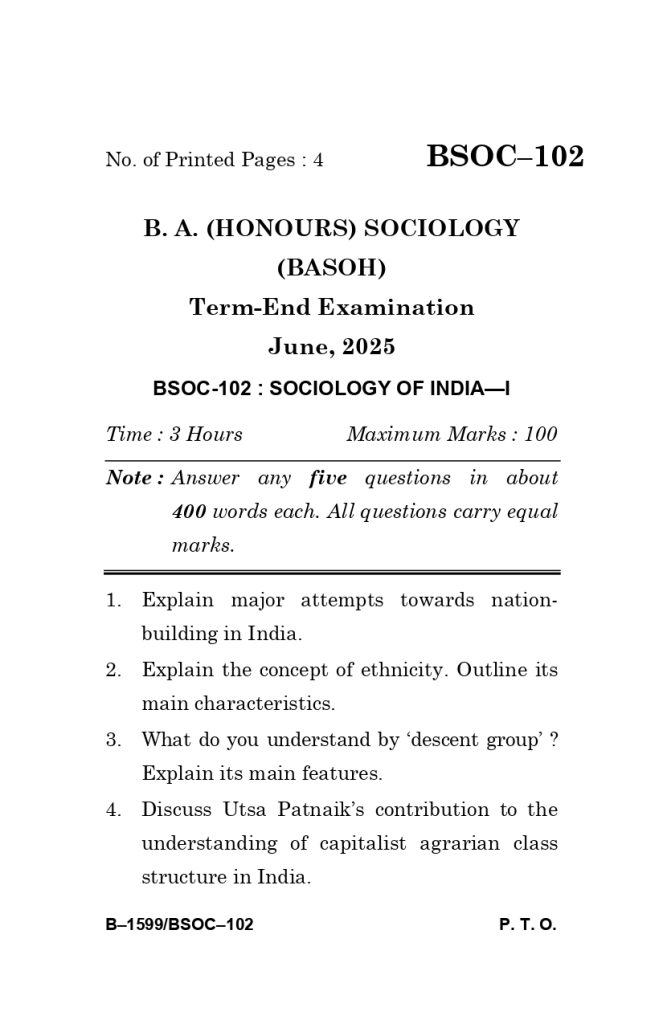
IGNOU BSOC 102 Sociology of India Question Paper June 2025
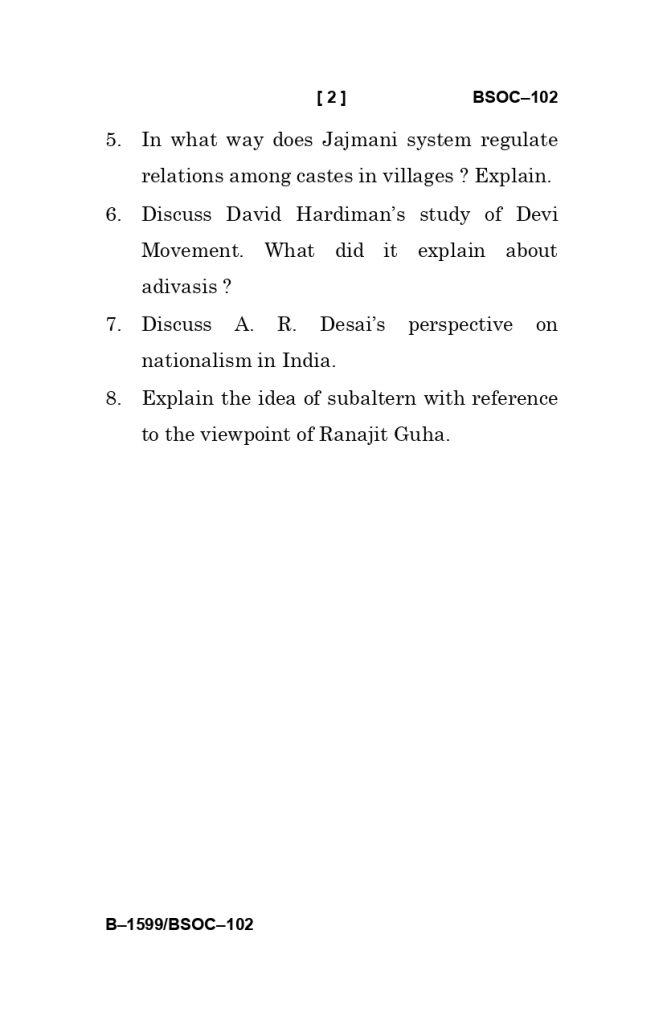
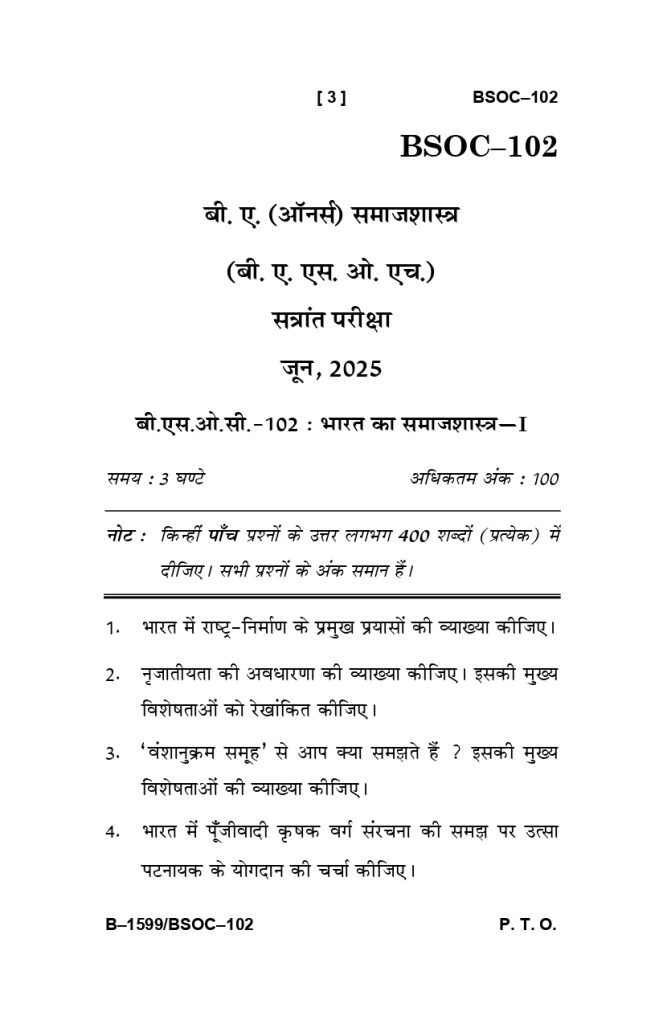
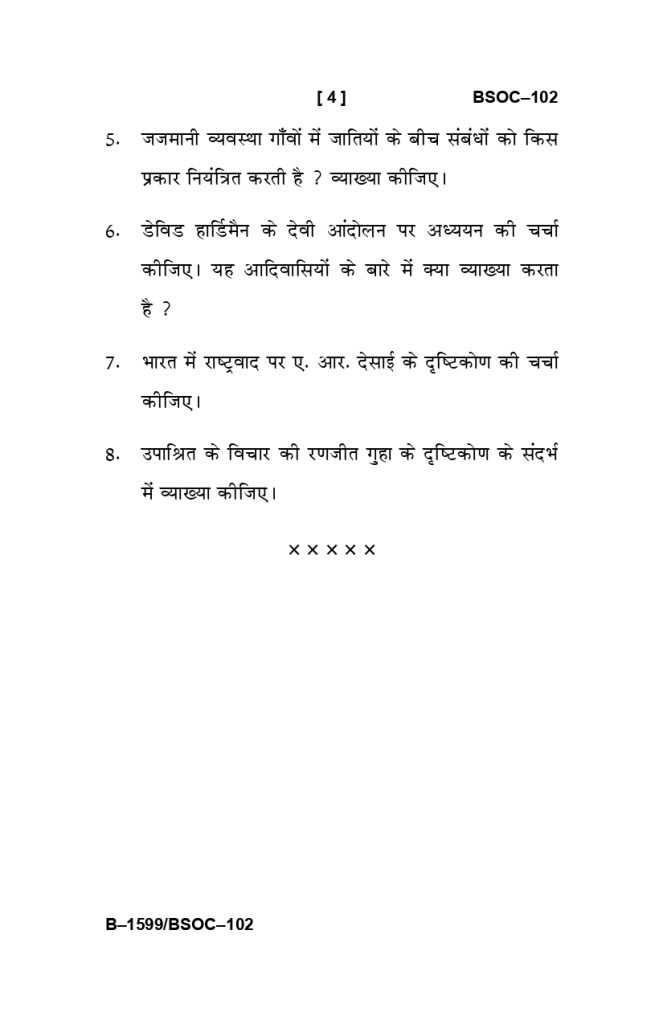
Want BSOC 102 Question Paper Solutions?
Students seeking full solutions, marking answers, or personalised academic support often seek out structured guidance. Those who feel insecure about their presentation or depth can reach out for focused help. Support is provided for concept clarity, answer structure, and exam readiness. For other IGNOU papers or support related to it, click: https://www.unnatieducations.com/ignou
Why BSOC 102 Seems Easier When You Understand The Pattern
Many students feel relieved once they realize one thing: the BSOC 102 Question Paper is predictable in structure, not random. Every question has an obvious demand:
- Either in the form of a concept explanation
- Or a thinker-based discussion
- Or an Indian social institution analysis
Once you stop guessing and start matching your answer to the demand, half the stress disappears. This is the reason why students who know the pattern often perform better than students who just read notes.
BSOC 102 Question Paper June 2025 – Question-Wise Analysis
Below is only a directional analysis. We are not writing whole answers, just explaining what each question asks for. Question 1: Major Attempts towards Nation-Building in India (BSOC-102) This question checks whether students understand:
- Post-independence challenges
- Diversity in Indian society
- Constitutional and political distinctiveness
- Tip: Do not be overly detailed with history; write about major attempts. Balance unity and diversity.
Question 2: Concept of Ethnicity and its Characteristics (BSOC-102) This is a concept-based question. Students should focus on:
- Meaning of ethnicity
- Social construction of identity
- Shared culture and history
- Tip: Don't confuse ethnicity with caste or race.
Question 3: Descent Group and Main Features (BSOC-102) This question tests understanding of kinship. Key areas include:
- Meaning of descent group
- Lineage and ancestry
- Social continuity
- Tip: Clarity in definition is more important than examples here.
Question 4: Utsa Patnaik and Capitalist Agrarian Class Structure (BSOC-102) This is a thinker-based analytical question. Students should highlight:
- Differentiation of classes in agriculture
- Capitalist relations
- Rural inequality
- Tip: Avoid generic Marxist theory. You have to stick to Patnaik's contribution.
Question 5: Jajmani System and Caste Relations in Villages (BSOC-102) This question focuses on:
- Inter-caste relations
- Exchange of services
- Village social order
- Tip: A balanced explanation is better than just praise or criticism.
Question 6: David Hardiman Study of the Devi Movement (BSOC-102) This question examines:
- Tribal resistance in Colonial India
- Role of religion in Social Movements
- Agency of Adivasi communities
- Tip: Students should not get bogged down in the historical background but pay attention to what the movement shows about Adivasis.
Question 7: A. R. Desai's Approach towards Nationalism in India (BSOC-102) This is a classic thinker-based question. Key focus areas:
- Marxist understanding of nationalism
- Interconnection of colonialism with class
- Role of the middle class and Capitalism
- Tip: Avoid emotional or cultural formulations of nationalism here.
Question 8: Idea of the Subaltern: Ranajit Guha (BSOC-102) This question tests:
- Understanding of Power and Exclusion
- Criticism of elite-centered history
- Agency of peasants and marginal groups
- Tip: Students should make a clear distinction between elite vs. subaltern perspectives.
BSOC-102 Question Types Explained Simply
| Question Type | What Examiner Expects |
| Concept-based | Definition + features |
| Thinker-based | Core argument + relevance |
| Institution-based | Structure + function |
| Movement-based | Meaning + implication |
Being able to make sense of this table can help students make quick decisions when it comes to structuring answers in the exam hall.
Important Topics for BSOC 102 Based on Previous Papers
Some themes are central and are seen repeatedly in varying forms. Prioritizing them saves time.
- Nation-building and diversity
- Ethnicity and identity
- Kinship and descent groups
- Agrarian class structure
- Caste relations in villages
- Tribal movements
- Nationalism theories
- Subaltern studies
These topics are the backbone of Sociology of India - I.
How to Read Questions Intelligently in BSOC-102
Many students lose marks because they interpret the question wrong. Example approach:
- "Explain" -> Definition + explanation
- "Discuss" -> Arguments + evaluation
- "What do you understand by" -> Concept clarity
Reading the directive word carefully can change your whole answer quality.
Answer Writing Strategy That Works (BSOC-102)
A good answer is not just lengthy; it is well-structured. Use this structure:
- Direct introduction (2–3 lines)
- Basic definition / thinker references
- Organized points (5–6)
- Indian context
- Logical conclusion
Avoid storytelling. Stick to sociology.
Common Mistakes That Students Should Avoid
These are mistakes that many students make every year, resulting in immediate mark deductions:
- Writing memorized answers that are not relevant
- Ignoring the word limit
- Mixing up thinkers
- Repeating things with different words
- Leaving answers without conclusions
Correcting these alone can make a lot of difference in improving marks.
Time Management While Taking The BSOC-102 Exam
Time pressure is a factor even for the well-prepared student.
| Exam Stage | Time Allocation |
| Reading questions | 10 minutes |
| Writing each answer | 30 minutes |
| Final revision | 10 minutes |
Following this helps keep answers balanced.
BSOC 102 Question Paper – See Full Question Paper Video
This video helps students have a visual idea of question demand and answer structure.
Where to Find More IGNOU Help
Students who are preparing for several papers may require one reliable place for guidance. If anyone needs help regarding IGNOU exams or wants to look for further solved papers, they may visit: https://www.unnatieducations.com/ignou This ensures consistency for students across semesters.
Frequently Asked Questions on BSOC 102 Question Paper June 2025
Is BSOC-102 a scoring paper? Yes. BSOC-102 is scoring if concepts are clear and answers are structured. Students who define terms appropriately, use sociological language, and stay under the word limit are likely to do well. Should we write answers in point form or paragraphs? Points are recommended. They enhance legibility and make it easier for examiners to assess the answers in less time. A mix of a few short paragraphs and points is also a good option. Is example material important in BSOC 102 answers? Examples are helpful when used briefly. One relevant Indian example reinforces an answer, but too many instances can be a waste of space and time. Do you need to mention thinkers in every answer? Not in every answer. Thinkers are necessary in thinker-based questions, of course, but forcing names into concept questions can lead to a loss of clarity. How many questions should we be preparing completely? Students must prepare all the major themes but must practice at least 6-7 questions well so that they can confidently make choices in the examination. For other IGNOU papers or support related to it, click: https://www.unnatieducations.com/ignou
Final Thoughts on BSOC 102 Question Paper June 2025
The BSOC 102 Question Paper is designed to test how well students understand Indian society through a sociological lens. It rewards clarity, structure, and relevance—not length. Students who pay attention to the question's demand, manage their time well, and write disciplined answers usually perform with confidence. This guide is aimed at enabling pupils to move from confusion to control. Prepare smartly, write eloquently, and trust that you understand.