
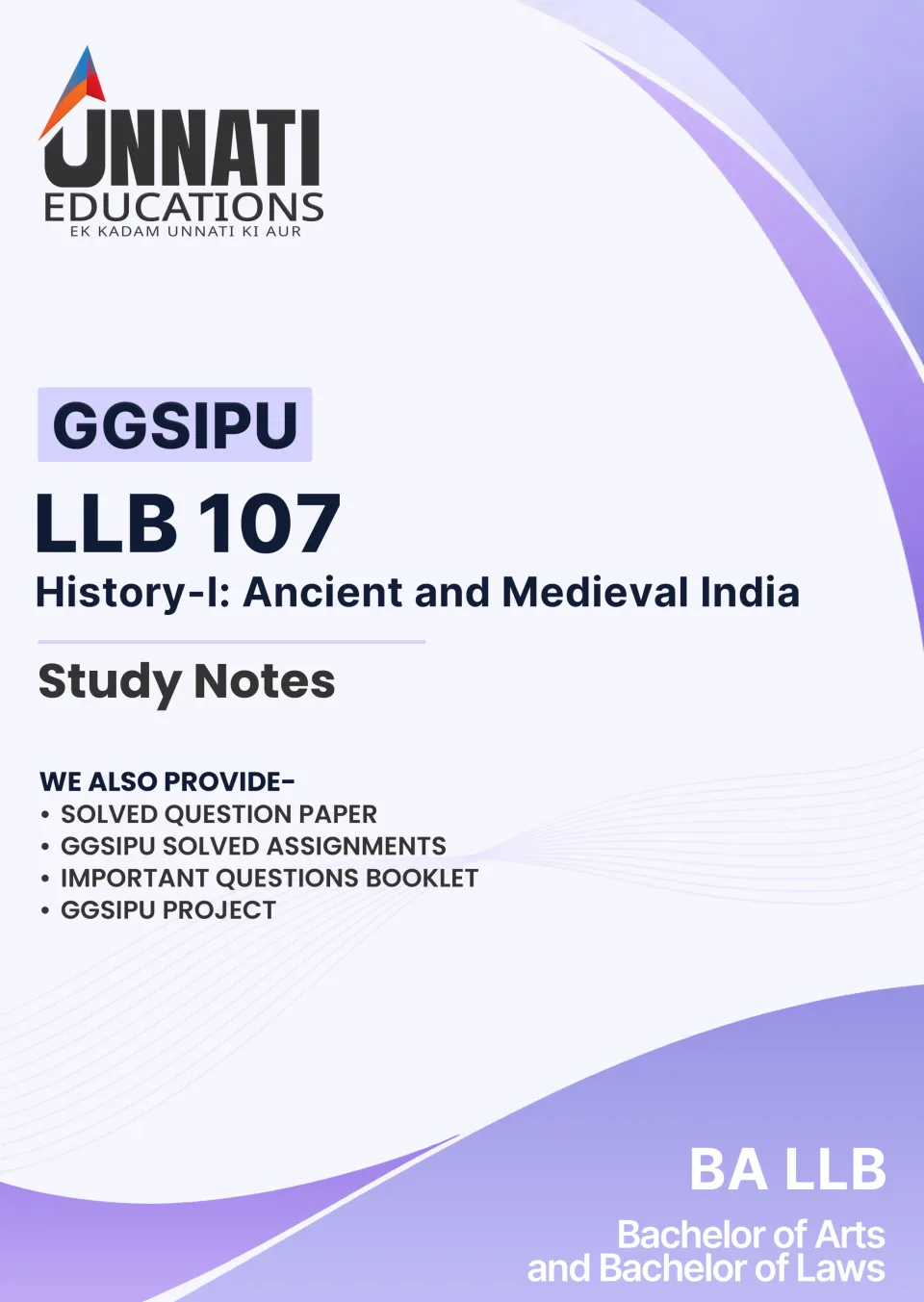
BA LLB 107 History-I Ancient and Medieval India Notes are a 58-page English study book for BA LLB (Hons) Semester 1 at GGSIPU. They cover all 4 official units in 54 content pages, with 19 diagrams, 14 law-connection boxes and 87 exam-style questions, mapped to the USLLS scheme printed for the Batch of 2021-2026.
Written by Unnati Educations Editorial Team · Reviewed by Sheetal Kirola, M.Ed., Academic Head (academic review) · Checked against syllballb300924.pdf (ipu.ac.in) · Updated 17 November 2026 · Editorial policy
Scheme: Integrated BA LLB (Honours) Five Year Course, USLLS | Applies to: Batch of 2021-2026 onwards, as printed on the cover | Verified against: syllballb300924.pdf, ipu.ac.in
BA LLB 107 History-I: Ancient and Medieval India at a glance: GGSIPU BA LLB Sem 1 credits, units and exam pattern
BA LLB 107 shows a law student dharma, kingship, the iqta and the qazi. It sits with six other GGSIPU BA LLB Semester 1 papers. Figures below are from the official USLLS scheme PDF.
| Code and title | BA LLB 107 · History-I: Ancient and Medieval India |
|---|---|
| Course and semester | Integrated BA LLB (Honours), five-year course · First Semester |
| Credits and hours | 5 credits · 5 lectures a week (L5 C5) · category label not printed in the official PDF |
| Marks | 100: 75 end-term written + 25 internal (10 internal written test + 15 PSDA) |
| Lecture plan | 40 lectures: Unit I 8, Unit II 10, Unit III 10, Unit IV 12 |
| End-term pattern | 75-mark written paper conducted by the University; paper-setter instructions are not printed in the official PDF |
| Paired lab | None. PSDA activities (Rashomon screening, a museum visit, historical walks) run inside lecture hours in Semester 1 |
BA LLB 107 History-I Ancient and Medieval India Notes unit-wise: 19 diagrams and 87 exam questions across 4 units
The book follows the official unit order, so these GGSIPU BA LLB Sem 1 History-I notes can be studied one unit at a time. Other papers are under GGSIPU BA LLB notes. One page per unit is in the sample PDF above.
BA LLB 107 Unit 1: History and Law
Pages 4 to 19 (16 pages, the longest unit). It opens with why law needs history, from Holmes to Savigny, then sets out historical method. Sources run from the Vedas, Epics and Puranas through Sangam poems, Banabhatta and Kalhana to seven medieval writers, ending with time-reckoning and a critique of communal history. 6 sections, 7 diagrams, 22 questions.
| Writer | Work and language | How to read it |
|---|---|---|
| Al-Biruni | Kitab-ul-Hind, Arabic, c. 1030 | Scholarly and fairly objective |
| Abul Fazl | Akbarnama and Ain-i-Akbari, Persian | Official and pro-Akbar, rich in statistics |
| Badauni | Muntakhab-ut-Tawarikh, 1595 | Orthodox, critical of Akbar's religious policy |
Quick look: who wrote what about medieval India (from page 16)
- Writer
- Al-Biruni
- Work and language
- Kitab-ul-Hind, Arabic, c. 1030
- How to read it
- Scholarly and fairly objective
- Writer
- Abul Fazl
- Work and language
- Akbarnama and Ain-i-Akbari, Persian
- How to read it
- Official and pro-Akbar, rich in statistics
- Writer
- Badauni
- Work and language
- Muntakhab-ut-Tawarikh, 1595
- How to read it
- Orthodox, critical of Akbar's religious policy
BA LLB 107 Unit 2: Ancient India
Pages 20 to 32 (13 pages). It traces tribe to state, compares Mauryan and Gupta rule, and reads kingship through Brahminic texts, the Buddhist Mahasammata story, the Arthashastra and the Nitisara. Varna, jati, gotra, slavery and untouchability follow, then women's education, marriage and stridhana. 6 sections, 4 diagrams, 21 questions.
| Basis | Early Vedic | Later Vedic |
|---|---|---|
| Polity | Tribal (jana) | Territorial kingdom (rashtra or janapada) |
| Taxes | Bali as a voluntary gift | Bali and bhaga regular and compulsory |
| Assemblies | Sabha, samiti and vidatha matter | Vidatha gone; sabha and samiti weaken |
Quick look: Early Vedic vs Later Vedic polity (from page 21)
- Basis
- Polity
- Early Vedic
- Tribal (jana)
- Later Vedic
- Territorial kingdom (rashtra or janapada)
- Basis
- Taxes
- Early Vedic
- Bali as a voluntary gift
- Later Vedic
- Bali and bhaga regular and compulsory
- Basis
- Assemblies
- Early Vedic
- Sabha, samiti and vidatha matter
- Later Vedic
- Vidatha gone; sabha and samiti weaken
BA LLB 107 Unit 3: Medieval India
Pages 33 to 44 (12 pages). It starts with Chola village assemblies, then the Sultanate and the iqta, the Vijayanagara Nayankara and Ayagar systems, and Mughal zabt revenue, mansabdari and offices. It closes with Sultanate and Mughal kingship and the Bhakti-Sufi effect on state polity. 7 sections, 3 diagrams, 22 questions.
| Class | Sawar rank compared with zat rank |
|---|---|
| First class | Sawar equal to zat |
| Second class | Sawar at least half of zat |
| Third class | Sawar less than half of zat |
Quick look: the three classes of mansabdars (from page 39)
- Class
- First class
- Sawar rank compared with zat rank
- Sawar equal to zat
- Class
- Second class
- Sawar rank compared with zat rank
- Sawar at least half of zat
- Class
- Third class
- Sawar rank compared with zat rank
- Sawar less than half of zat
BA LLB 107 Unit 4: The Concept of Justice and Judicial Institutions in Ancient and Medieval India
Pages 45 to 57 (13 pages), the heaviest in the lecture plan (12 lectures). It defines dharma, ranks its sources, explains the court ladder from kula to the king and the four stages of a suit, then reads Manu, Yajnavalkya and the Mitakshara. The medieval half covers Quran, Hadis, Ijma, Qiyas, the Islamic schools and justice under the Sultans and Mughals. 7 sections, 5 diagrams, 22 questions.
| Basis | Dharmasutras | Dharmashastras (Smritis) |
|---|---|---|
| Form | Prose aphorisms | Verse (shlokas) |
| Period | c. 600 to 200 BCE | c. 200 BCE to 600 CE |
| Legal content | Brief and scattered | Systematic law and procedure |
Quick look: Dharmasutras vs Dharmashastras (from page 47)
- Basis
- Form
- Dharmasutras
- Prose aphorisms
- Dharmashastras (Smritis)
- Verse (shlokas)
- Basis
- Period
- Dharmasutras
- c. 600 to 200 BCE
- Dharmashastras (Smritis)
- c. 200 BCE to 600 CE
- Basis
- Legal content
- Dharmasutras
- Brief and scattered
- Dharmashastras (Smritis)
- Systematic law and procedure
BA LLB 107 exam corner: 56 short-answer and 31 long-answer questions by unit
Each unit ends with a revision table and a question list. The questions come without model answers; the pages of each unit answer them.
| Unit | Short-answer | Long-answer | Diagrams |
|---|---|---|---|
| I: History and Law | 14 | 8 | 7 |
| II: Ancient India | 14 | 7 | 4 |
| III: Medieval India | 14 | 8 | 3 |
| IV: Justice and Judicial Institutions | 14 | 8 | 5 |
| Total | 56 | 31 | 19 |
Exam-style questions in the BA LLB 107 notes, unit by unit
- Unit
- I: History and Law
- Short-answer
- 14
- Long-answer
- 8
- Diagrams
- 7
- Unit
- II: Ancient India
- Short-answer
- 14
- Long-answer
- 7
- Diagrams
- 4
- Unit
- III: Medieval India
- Short-answer
- 14
- Long-answer
- 8
- Diagrams
- 3
- Unit
- IV: Justice and Judicial Institutions
- Short-answer
- 14
- Long-answer
- 8
- Diagrams
- 5
- Unit
- Total
- Short-answer
- 56
- Long-answer
- 31
- Diagrams
- 19
One question per unit, with the points an answer needs:
- Unit I: What is meant by a communal reading of history? Define it as reading the past as permanent Hindu-Muslim conflict, trace it to James Mill and Elliot and Dowson, then counter it with Todar Mal and the Bhakti-Sufi exchange.
- Unit II: What is the mandala theory of Kautilya? The vijigishu sits at the centre, the neighbour is ari and the enemy's neighbour is mitra.
- Unit III: Explain the Nayankara system of Vijayanagara. Nayakas held amaram territory, kept troops for the king and paid tribute; many later broke away.
- Unit IV: Distinguish between hadd, qisas and tazir. Hadd is fixed by the Quran or Sunnah, qisas is retaliation (or diya), and tazir is the judge's choice.
The BA LLB 107 notes list 56 short-answer and 31 long-answer exam-style questions across 4 units, backed by 19 diagrams.
Chola village assemblies and the Uttaramerur elections in medieval India: excerpt from page 34 of the BA LLB 107 notes
Excerpt from page 34
Local self-government under the Cholas
The most striking part of Chola rule was how much the villages ran themselves: assemblies handled land, irrigation, temples, local justice and taxes, with little royal interference. There were three kinds. The ur was the general body of tax-paying landholders in ordinary villages. The sabha or mahasabha met in brahmadeya villages granted to Brahmins and worked through committees with wide powers. The nagaram was the body of merchants in trading towns and looked after markets and guild matters.
The Uttaramerur rules
Two inscriptions of Parantaka I, dated 919 and 921 CE, at Uttaramerur in the Kanchipuram district record how the sabha was chosen. The village was split into 30 wards (kudumbus), and each ward sent one member. Names of eligible men were written on palm-leaf tickets and dropped into a pot, and a young boy drew one out. This lottery method was called kudavolai.
To stand, a man had to own at least a quarter veli of taxed land and a house on his own plot, be aged 35 to 70, know the Vedas or one Veda with its commentary, and be of good conduct and able in business. Anyone who had sat on a committee in the last three years was barred, as was anyone who had failed to submit accounts, along with his relatives. Bribery, forgery and serious crime also disqualified a candidate.
Members served one year and could be removed for misconduct. The work was split among committees (variyams): the annual committee for general affairs and justice, the eri variyam for tanks and irrigation, the thotta variyam for gardens and the pon variyam for gold and finance.
Why it matters for a law student
These assemblies are often cited as an early root of Indian local democracy. A fixed term, wards, qualifications and disqualification for corruption all reappear in Article 40 and the 73rd Constitutional Amendment, 1992. The limits are just as clear: membership stayed with landholding men, mostly Brahmins, while women, the landless and lower castes were left out.
Do the BA LLB 107 notes cover the full GGSIPU syllabus?
Yes for all four units: every lettered topic (a to d) of the official BA LLB 107 syllabus has its own section. Only the PSDA class activities are outside the book.
| Official unit | Official topics | Where in the notes | Status |
|---|---|---|---|
| Unit I: History and Law | Law and history; historical method; ancient and medieval sources; time and communal reading | Sections 1 to 6, pages 4 to 17 | Covered |
| Unit II: Ancient India | Vedic, Mauryan and Gupta polity; kingship; Arthashastra and Nitisara; social differentiation; women and society | Sections 1 to 6, pages 20 to 31 | Covered |
| Unit III: Medieval India | Chola local self-government; Sultanate, iqtadari, Vijayanagara; Mughal revenue and mansabdari; kingship and Bhakti-Sufi | Sections 1 to 7, pages 33 to 43 | Covered |
| Unit IV: Justice and Judicial Institutions | Dharma and courts; Manu and Yajnavalkya; Islamic sources and schools; Sultanate and Mughal justice | Sections 1 to 7, pages 45 to 56 | Covered |
| PSDA (1 hour a week) | Rashomon screening, museum visit, historical walks, seminar on dharma | Not in the book | Not in notes (class activity) |
BA LLB 107 official syllabus mapped to the notes
- Official unit
- Unit I: History and Law
- Official topics
- Law and history; historical method; ancient and medieval sources; time and communal reading
- Where in the notes
- Sections 1 to 6, pages 4 to 17
- Status
- Covered
- Official unit
- Unit II: Ancient India
- Official topics
- Vedic, Mauryan and Gupta polity; kingship; Arthashastra and Nitisara; social differentiation; women and society
- Where in the notes
- Sections 1 to 6, pages 20 to 31
- Status
- Covered
- Official unit
- Unit III: Medieval India
- Official topics
- Chola local self-government; Sultanate, iqtadari, Vijayanagara; Mughal revenue and mansabdari; kingship and Bhakti-Sufi
- Where in the notes
- Sections 1 to 7, pages 33 to 43
- Status
- Covered
- Official unit
- Unit IV: Justice and Judicial Institutions
- Official topics
- Dharma and courts; Manu and Yajnavalkya; Islamic sources and schools; Sultanate and Mughal justice
- Where in the notes
- Sections 1 to 7, pages 45 to 56
- Status
- Covered
- Official unit
- PSDA (1 hour a week)
- Official topics
- Rashomon screening, museum visit, historical walks, seminar on dharma
- Where in the notes
- Not in the book
- Status
- Not in notes (class activity)
Check it yourself in the official BA LLB (Hons) scheme and syllabus, Batch of 2021-2026 on ipu.ac.in (BA LLB 107 is on pages 7 and 8).
The PDF prints no question pattern, so the notes simply follow unit order. Every course under GGSIPU notes is mapped to its official PDF in the same way.
Who writes and checks the BA LLB 107 History notes?
- Unnati Educations Editorial Team: wrote the BA LLB 107 notes and built its 19 diagrams and question banks. The team writes these History-I notes in English simple enough for a first-semester student. Process: editorial policy.
- Sheetal Kirola: academic review of structure, clarity and syllabus coverage. Academic Head, Unnati Educations · M.Ed. · 7 years of experience · bio.
Mapped to the USLLS scheme for the Batch of 2021-2026. The 2026-27 edition carries 14 law-connection boxes. Last updated 17 November 2026.
BA LLB 107 and the GGSIPU BA LLB Sem 1 papers it connects to
BA LLB 107 has no lab; its practical side is the PSDA list in the official PDF, which teachers run in class.
Unit IV's custom and dharma, and Unit I's Savigny and Maine, feed the custom and historical-school topics in LLB 101 Legal Method. Unit II's varna and jati pages pair with social stratification in BA LLB 109 Sociology-I: Introduction to Sociology. The Mahasammata story and the saptanga theory sit next to the theories of the state in BA LLB 111 Political Science-I: Introduction to Political Science.
The other Semester 1 papers are LLB 103 Law of Contract-I, LLB 105 English I and BA LLB 113 Economics-I. History continues in LLB 108 Legal History (Semester 2) and BA LLB 207 History-II (Semester 3).
How to write BA LLB 107 answers: source-based short notes and law-linked long answers
History-I rewards answers that read like a brief, not a story. The 9 exam-tip boxes share one shape: define, trace the origin, give evidence, weigh merits and limits, and end with present-day law.
For a short note on a source, use author, period, work, contents, value and limits. Bana praises his patron Harsha; Kalhana checked inscriptions and earlier records.
Worked example (from page 37): "Was the iqta a feudal system?" Define the iqta as revenue assigned for service, then give four contrasts with a fief: it was not hereditary, it was transferable, it gave no ownership of land and no independent judicial rights, and it was held under a strong central Sultan. Close with the Mughal jagir and the Nayankara grant.
Take dates from the revision tables, such as the Rajatarangini (1148-49), and add one diagram and one line on Article 17, Article 40 or a case to each long answer. Practise this format on the 31 long-answer questions in the book.
BA LLB 107 History notes FAQs
How do I get the full BA LLB 107 notes?
Message the GGSIPU desk on WhatsApp at 9899436384 and ask for the BA LLB 107 History-I notes. The full notes come as a printed book, not a PDF, delivered to your address. Delivery takes at most 5 to 7 days, and the exact time depends on your location.
What are the passing marks for BA LLB 107?
BA LLB 107 is marked out of 100: 75 for the end-term written paper and 25 internal, split as 10 for written tests and 15 for PSDA. The official BA LLB (Hons) scheme PDF does not print a pass percentage for the paper. For end-term minimums and re-appear rules, follow GGSIPU Ordinance 11 on ipu.ac.in.
Which unit of BA LLB 107 needs the most time?
In the official plan, Unit IV on justice and judicial institutions has the most lectures (12 of 40). In the notes, Unit I is longest at 16 pages because it covers 15 ancient and medieval sources one by one; Units II and IV run 13 pages and Unit III 12.
Do the BA LLB 107 notes link history topics to present-day law?
Yes. The book has 14 law-connection boxes and 2 case boxes. They link untouchability to Article 17, Chola assemblies to Article 40 and the 73rd Amendment, and the sources of Islamic law to Shayara Bano (2017). The Ayodhya judgment (2019) shows courts testing historical claims as evidence.
Are the BA LLB 107 notes as per the latest GGSIPU syllabus?
They are mapped to syllballb300924.pdf on ipu.ac.in, the USLLS scheme printed for the Batch of 2021-2026. All four units and every lettered topic match, from historical method in Unit I to Mughal justice in Unit IV. Only the PSDA activity list, run in class, is not in the book.
Is BA LLB 107 the same paper as LLB 108 Legal History?
No. BA LLB 107 History-I covers ancient and medieval India up to the Mughals, with dharma, kingship and Islamic law. LLB 108 Legal History is a Semester 2 paper on colonial and post-colonial legal developments in India. Unit IV ends with Warren Hastings' 1772 plan, a bridge into LLB 108.
Get the full BA LLB 107 History-I Ancient and Medieval India Notes on WhatsApp
| Unit | Pages | Exam questions |
|---|---|---|
| I: History and Law | 16 | 22 |
| II: Ancient India | 13 | 21 |
| III: Medieval India | 12 | 22 |
| IV: Justice and Judicial Institutions | 13 | 22 |
What is inside the full BA LLB 107 notes book
- Unit
- I: History and Law
- Pages
- 16
- Exam questions
- 22
- Unit
- II: Ancient India
- Pages
- 13
- Exam questions
- 21
- Unit
- III: Medieval India
- Pages
- 12
- Exam questions
- 22
- Unit
- IV: Justice and Judicial Institutions
- Pages
- 13
- Exam questions
- 22
Format: printed book of 58 pages with 19 diagrams, a two-page index and four revision tables; not sold as a PDF. Delivery: at most 5 to 7 days, depending on your location. The BA LLB 107 History-I IPU notes are ordered only through the WhatsApp desk below.
Order the BA LLB 107 notes book on WhatsApp (4 units, 58 pages)
Unnati Educations is an independent education provider based in Vikaspuri, Delhi. We are not affiliated with, authorised by, or endorsed by Guru Gobind Singh Indraprastha University (GGSIPU). 'GGSIPU' and 'IPU' are used only to describe the syllabus our notes follow. For official information, visit ipu.ac.in.
Ready for the full notes?
Discuss coverage and delivery with our team.