
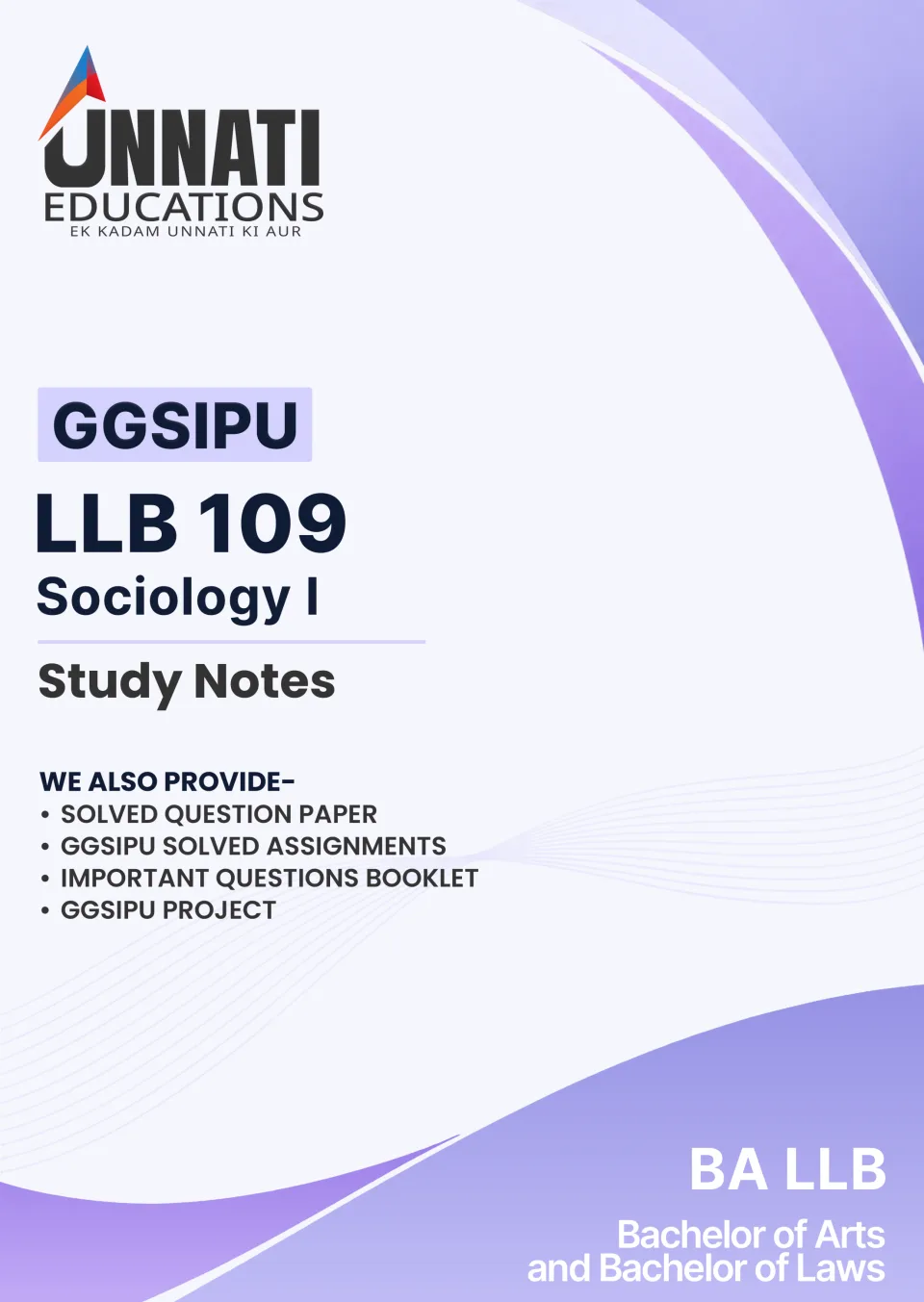
BA LLB 109 Sociology-I Introduction to Sociology Notes cover all 4 units of the GGSIPU BA LLB (Hons) Semester 1 paper in 60 pages: 25 diagrams, 12 law and case-law boxes, 2 case studies, 4 quick revision tables and 85 exam-style questions. They follow the USLLS scheme for the Batch of 2021-2026 and come as a printed book.
Written by Unnati Educations Editorial Team · Reviewed by Sheetal Kirola, M.Ed., Academic Head (academic review) · Checked against Scheme of Examination & Detailed Syllabus, Integrated BA LLB (Honours), ipu.ac.in · Updated 17 November 2026 · Editorial policy
Scheme: Integrated BA LLB (Honours) scheme of examination and detailed syllabus | Applies to: Batch of 2021-2026 (as printed on the PDF cover) | Verified against: syllballb300924.pdf on ipu.ac.in, checked 17 November 2026
BA LLB 109 Sociology-I Introduction to Sociology at a glance: GGSIPU BA LLB Sem 1 credits, units and exam pattern
BA LLB 109 is the first of three sociology papers in the GGSIPU five-year BA LLB (Hons). It sits with six other GGSIPU BA LLB Semester 1 papers, next to Legal Method and Law of Contract-I.
| Code and title | BA LLB 109 · Sociology-I: Introduction to Sociology |
|---|---|
| Course and semester | Integrated BA LLB (Honours), five-year · Semester 1 |
| Hours and credits | L 5 · 5 credits; PSDA activities run inside lecture hours in Semester 1 |
| Marks | 100: 25 internal (10 written + 15 PSDA) + 75 end-term |
| Applies to | Batch of 2021-2026, as printed on the PDF cover |
| End-term pattern | 75-mark written exam by the University's Examination Division; paper-setter instructions are not printed in the official PDF |
| Units | 4 units, 10 lectures each |
| Paired lab | None; six PSDA activities are listed with the paper |
The scheme PDF prints no pass percentage; pass and re-appear rules sit in Ordinance 11 (examinations and results).
BA LLB 109 Sociology-I Introduction to Sociology Notes unit-wise: 85 exam questions and 25 diagrams across 4 units
These Introduction to Sociology notes in English end every unit with a "Unit at a Glance" table and a question list, and tie each idea to an Article, Act or judgment in "Law and Society" boxes. Notes for the other papers sit under GGSIPU BA LLB notes; the sample PDF above shows one page per unit.
BA LLB 109 Unit 1: Field of Study and Basic Concepts
Pages 4-22, 10 sections. From socius + logos and Comte's 1838 coinage to Mills' sociological imagination, Bierstedt's eight features and the formal versus synthetic schools of scope. Sociology is then set against history, political science, economics, anthropology, psychology and law (Ehrlich, Pound), before society, community, association, social groups and Linton's status and role. 10 figures, 3 law boxes, 26 questions.
| Basis | Ascribed | Achieved |
|---|---|---|
| Comes from | Birth: age, sex, caste | Own effort: education, work |
| Change | Difficult | Possible |
| Common in | Caste (closed) society | Class (open) society |
| Example | Son, prince | Advocate, judge |
Quick look: ascribed vs achieved status, Ralph Linton (from page 19)
- Basis
- Comes from
- Ascribed
- Birth: age, sex, caste
- Achieved
- Own effort: education, work
- Basis
- Change
- Ascribed
- Difficult
- Achieved
- Possible
- Basis
- Common in
- Ascribed
- Caste (closed) society
- Achieved
- Class (open) society
- Basis
- Example
- Ascribed
- Son, prince
- Achieved
- Advocate, judge
BA LLB 109 Unit 2: Social Stratification
Pages 23-34, 9 sections. Tumin's five features, four systems, mobility and ten key factors lead into difference versus inequality, Rousseau, and Michael Young's meritocracy tested against Indra Sawhney (1992) and the EWS case (2022). Parsons, Davis-Moore with Tumin's critique, Marx and Weber follow, then class, race, gender, caste, intersectionality and Djilas's "New Class". 4 figures, 3 law boxes, 20 questions.
| Basis | Parsons | Marx | Weber |
|---|---|---|---|
| Stratification is | Useful | Exploitative | Competition for scarce resources |
| Rests on | Shared values | Means of production | Class, status, power |
| Inevitable? | Yes | No | Likely |
Quick look: three views of stratification (from page 30)
- Basis
- Stratification is
- Parsons
- Useful
- Marx
- Exploitative
- Weber
- Competition for scarce resources
- Basis
- Rests on
- Parsons
- Shared values
- Marx
- Means of production
- Weber
- Class, status, power
- Basis
- Inevitable?
- Parsons
- Yes
- Marx
- No
- Weber
- Likely
BA LLB 109 Unit 3: Social Change
Pages 35-47, 7 sections. Features and nine factors of change, Ogburn's cultural lag (linked to the IT Act, 2000 and Puttaswamy), the 1991 LPG reforms, Ritzer's McDonaldization and glocalization. Then urbanization (Wirth, Census 2011), modernization (Srinivas, Yogendra Singh) and post-modernization (Lyotard, Baudrillard), HDI and the SDGs, planning up to NITI Aayog, and Aberle's four types of movement. 5 figures, 3 law boxes, 1 case study, 20 questions.
| Basis | Urbanization | Suburbanization | Exurbanization |
|---|---|---|---|
| Direction | Village to city | Centre to fringe | Beyond the suburbs |
| Density | High | Medium | Low |
| Example | Migrants in Delhi | Dwarka, Noida | NCR farmhouses |
Quick look: three kinds of settlement change (from page 40)
- Basis
- Direction
- Urbanization
- Village to city
- Suburbanization
- Centre to fringe
- Exurbanization
- Beyond the suburbs
- Basis
- Density
- Urbanization
- High
- Suburbanization
- Medium
- Exurbanization
- Low
- Basis
- Example
- Urbanization
- Migrants in Delhi
- Suburbanization
- Dwarka, Noida
- Exurbanization
- NCR farmhouses
BA LLB 109 Unit 4: Environment and Society
Pages 48-59, 7 sections. The Environment (Protection) Act definition, four approaches from determinism to the New Ecological Paradigm, and Articles 48A and 51A(g). Then Vidyarthi's Maler study, culture as an adaptive screen (johads, kuhls, Apatani farming), JFM, FRA 2006 and PESA, the forest, water and land movements, biopiracy, the TKDL and a PSDA page. 6 figures, 3 law boxes, 1 case study, 19 questions.
| Element | In Maler life |
|---|---|
| Nature | Hills, forests, streams; shifting cultivation and forest produce |
| Man | Family, clan, headman, marriage and inheritance rules |
| Spirit | Spirits of hills and trees, kept happy through rituals |
Quick look: the Nature-Man-Spirit complex of the Maler tribe (from page 50)
- Element
- Nature
- In Maler life
- Hills, forests, streams; shifting cultivation and forest produce
- Element
- Man
- In Maler life
- Family, clan, headman, marriage and inheritance rules
- Element
- Spirit
- In Maler life
- Spirits of hills and trees, kept happy through rituals
BA LLB 109 exam corner: 55 short-answer and 30 long-answer questions by unit
The BA LLB 109 notes print no marks labels or year tags, so these are exam-style questions, answered from each unit's own sections.
| Unit | Short-answer | Long-answer |
|---|---|---|
| Unit 1 | 17 | 9 |
| Unit 2 | 13 | 7 |
| Unit 3 | 13 | 7 |
| Unit 4 | 12 | 7 |
BA LLB 109 exam-style questions by unit
- Unit
- Unit 1
- Short-answer
- 17
- Long-answer
- 9
- Unit
- Unit 2
- Short-answer
- 13
- Long-answer
- 7
- Unit
- Unit 3
- Short-answer
- 13
- Long-answer
- 7
- Unit
- Unit 4
- Short-answer
- 12
- Long-answer
- 7
- Distinguish between association and institution (Unit 1). We belong to an association but follow an institution: family versus marriage (page 16).
- What is meritocracy? Who coined the term? (Unit 2) Michael Young, 1958: Merit = IQ + Effort; add one criticism (page 26).
- What is cultural lag? (Unit 3) Ogburn, 1922: non-material culture trails technology; data protection law as the example (page 36).
- What is biopiracy? (Unit 4) Patenting indigenous knowledge without consent or benefit-sharing; the turmeric patent revoked in 1997 (page 57).
The BA LLB 109 notes list 55 short-answer and 30 long-answer exam-style questions across 4 units.
Who writes and checks the BA LLB 109 Sociology notes?
- Unnati Educations Editorial Team, author: writes the BA LLB 109 notes, maps them to the official topics and adds the law boxes.
- Sheetal Kirola, reviewer (academic review: structure, clarity, syllabus coverage): Academic Head, Unnati Educations · M.Ed. · 7 years of experience · bio.
Mapped to the BA LLB (Honours) scheme for the Batch of 2021-2026. The 2026-27 edition covers all 20 unit topics, the six PSDA activities and four revision tables; last updated 17 November 2026 under our editorial policy.
How to write BA LLB 109 answers: thinker-quoted definitions, comparison tables and law-linked examples
Sociology answers in a law paper need the right thinker, a clean comparison and one Indian or legal example. These BA LLB 109 Sociology IPU notes build every unit on those three, and five exam tip boxes give the order.
Definition answers. Page 5: meaning of the word (socius + logos), Comte in 1838, at least four definitions each with its thinker, then a two-line conclusion. The same order works for society, community and social change.
Diagram answers. For status and role (page 20), quote Linton, explain ascribed and achieved status with Indian examples, then draw Merton's status-set and role-set. For Vidyarthi (page 51), write the book title, the tribe, the Rajmahal hills and 1963, then draw the triangle.
Movement answers. Page 45: definition, features, Aberle's types, the four stages, then four Indian movements, each tied to the Act it produced (RTI Act 2005, Forest Rights Act 2006).
Distinguish questions. The notes carry 26 comparison tables; turn each row into a numbered point: basis, then both sides.
Worked example: "What is Sanskritization?" Name M. N. Srinivas; define it as lower castes adopting the customs and rituals of higher castes to rise in status; pair it with Westernization; close by noting that Indian modernization is selective (pages 40-41).
BA LLB 109 and the GGSIPU BA LLB Sem 1 papers it connects to
BA LLB 109 has no lab; its PSDA activities are covered on page 58 of the notes.
The GGSIPU BA LLB Sem 1 Sociology-I notes feed the other first-semester papers:
- LLB 101 Legal Method: Unit 1, section 4.1 (living law, social engineering, PIL).
- BA LLB 111 Political Science-I: Unit 1, section 5.2 and Weber's "party" in Unit 2.
- BA LLB 113 Economics-I: Micro Economic Analysis: Marx's surplus value (Unit 2) and the LPG reforms (Unit 3).
- BA LLB 107 History-I: Ancient and Medieval India: section 5.1 and the varna and caste discussion.
- LLB 103 Law of Contract-I: Tönnies' Gesellschaft and registered associations as legal persons (Unit 1).
LLB 105 English I completes Semester 1. The subject continues in BA LLB 110 Sociology II: Indian Society (Semester 2) and BA LLB 311 Sociology III (Semester 5).
Chipko, Appiko and Silent Valley in environmental sociology: excerpt from page 54 of the BA LLB 109 notes
Excerpt from page 54
Forest-based movements
Indian environmental movements are grouped by the resource in conflict: forest, water and land. The forest-based group begins with the Bishnoi stand at Khejarli in 1730, when soldiers of the Maharaja of Jodhpur came to cut khejri trees. Amrita Devi Bishnoi hugged a tree to protect it, and she, her daughters and 363 Bishnois gave their lives. The Maharaja then banned tree-felling in Bishnoi villages.
Chipko movement (1973 onwards), Uttarakhand
"Chipko" means to hug or stick to. It began in March 1973 in Mandal village, Chamoli district, when the forest department refused ash trees to the local cooperative, Dasholi Gram Swarajya Mandal, but gave them to a sports-goods company. In March 1974, women of Reni village led by Gaura Devi hugged trees and turned the contractors back while the men were away.
Its leaders were Chandi Prasad Bhatt, Sunderlal Bahuguna (whose padyatras carried the line "ecology is permanent economy") and Gaura Devi. The causes were commercial felling by outside contractors, loss of fodder, fuel and water, the 1970 Alaknanda floods and denial of local forest rights.
In 1980 the Centre imposed a 15-year ban on green felling in the Himalayan forests of Uttar Pradesh, and the movement shaped the Forest (Conservation) Act, 1980 and the people-centred forest policy of 1988. Ramachandra Guha showed that Chipko grew out of a long history of peasant resistance to state forest control: a struggle for livelihood, not only for trees. Vandana Shiva reads it as eco-feminism.
Appiko movement (1983), Karnataka
Known as the "Chipko of the South", it began in September 1983 when villagers of Salkani in Uttara Kannada hugged trees to stop commercial felling in the Western Ghats. Panduranga Hegde led it with the slogan "Ulisu, Belesu, Balasu": save, grow and use rationally.
Silent Valley movement (1970s to 1984), Kerala
A hydro-electric dam was planned on the Kunthipuzha river in one of the last tropical evergreen rainforests of the Western Ghats, home of the lion-tailed macaque. The Kerala Sastra Sahitya Parishad, scientists and poets such as Sugathakumari campaigned against it; the project was dropped and Silent Valley became a National Park in 1984.
Do the BA LLB 109 notes cover the full GGSIPU syllabus?
Yes. All 20 official topics of BA LLB 109 are covered, and the PSDA activities get their own page (page 58).
| Official unit | Official topics | Where in the notes | Status |
|---|---|---|---|
| I: Field of Study and Basic Concepts | Definition, aim, scope and application of Sociology; relation with other social sciences; society, community, association, social groups, status and role | Sections 1-10, pp 4-20 | Covered |
| II: Social Stratification | Key factors; differences and inequality, natural and social inequality, meritocracy; Parsons, Marx, Weber; class, race, gender; capitalist and socialist societies | Sections 1-9, pp 23-33 | Covered |
| III: Social Change | Causes and features; liberalization, privatization, globalization; urbanization, exurbanization, suburbanization; modernization, post modernization; resulting changes; development and planning; social movements | Sections 1-7, pp 35-45 | Covered |
| IV: Environment and Society | Society and environment, Nature-Man-Spirit Complex; culture as adaptive screen; community participation; forest, water and land movements; indigenous knowledge | Sections 1-6, pp 48-58 | Covered |
BA LLB 109 official topics mapped to the notes
- Official unit
- I: Field of Study and Basic Concepts
- Official topics
- Definition, aim, scope and application of Sociology; relation with other social sciences; society, community, association, social groups, status and role
- Where in the notes
- Sections 1-10, pp 4-20
- Status
- Covered
- Official unit
- II: Social Stratification
- Official topics
- Key factors; differences and inequality, natural and social inequality, meritocracy; Parsons, Marx, Weber; class, race, gender; capitalist and socialist societies
- Where in the notes
- Sections 1-9, pp 23-33
- Status
- Covered
- Official unit
- III: Social Change
- Official topics
- Causes and features; liberalization, privatization, globalization; urbanization, exurbanization, suburbanization; modernization, post modernization; resulting changes; development and planning; social movements
- Where in the notes
- Sections 1-7, pp 35-45
- Status
- Covered
- Official unit
- IV: Environment and Society
- Official topics
- Society and environment, Nature-Man-Spirit Complex; culture as adaptive screen; community participation; forest, water and land movements; indigenous knowledge
- Where in the notes
- Sections 1-6, pp 48-58
- Status
- Covered
Verify the topic list in the official Integrated BA LLB (Honours) scheme and syllabus, Batch of 2021-2026 (ipu.ac.in), printed pages 10-11.
Every course in GGSIPU notes is mapped to its official PDF the same way.
BA LLB 109 Sociology notes FAQs
How do I get the full BA LLB 109 notes?
Tap "Get Full Notes" at the top of this page to message us on WhatsApp at 9899436384. The BA LLB 109 notes are sold as a printed book, not a PDF. After your order is confirmed, the book reaches you within 5-7 days at the most, depending on your location. The sample PDF shows the layout first.
Are the BA LLB 109 notes available as a PDF?
No. The full BA LLB 109 Sociology-I notes come only as a printed book. The one PDF on this page is the watermarked sample: the cover, the index and one page from each unit. It is a preview, not the book. The unit summaries, quick looks and coverage table on this page are free to read.
How is BA LLB 109 marked, and what is the passing mark?
BA LLB 109 is marked out of 100: 25 internal (10 written and 15 for PSDA) and 75 in the semester-end written exam. The BA LLB (Hons) scheme PDF on ipu.ac.in does not print a pass percentage for this paper, so we do not state one. End-term minimums and re-appear rules are in Ordinance 11.
Which BA LLB 109 unit is the longest in the notes?
Unit 1, Field of Study and Basic Concepts, at 19 pages (pages 4-22). It holds 10 of the 25 figures and 26 of the 85 exam-style questions, because it covers ten basic concepts from the meaning of sociology to status and role. Unit 3 runs to 13 pages, and Units 2 and 4 to 12 each.
Do the BA LLB 109 notes cover the PSDA activities?
Yes. Page 58 has short notes on all six: the symposium on judicial activism and social action litigation, a group-formation study such as a laughing club, reviews of Soldiers in Sarong, Neem ka Ped and New Delhi Times, and law as an agency of social transformation. PSDA carries 15 of BA LLB 109's 25 internal marks.
Why do the BA LLB 109 notes cite court cases?
The official objective of BA LLB 109 is to study law and the normative structures of society through sociology. So the notes carry 12 law and case-law boxes, such as Vishaka (1997) in Unit 1, Indra Sawhney (1992) in Unit 2, Olga Tellis (1985) in Unit 3 and Niyamgiri (2013) in Unit 4, each tied to a concept.
Get the full BA LLB 109 Sociology-I Introduction to Sociology Notes on WhatsApp
| Unit | Pages | Figures | Questions |
|---|---|---|---|
| Unit 1 | 19 | 10 | 26 |
| Unit 2 | 12 | 4 | 20 |
| Unit 3 | 13 | 5 | 20 |
| Unit 4 | 12 | 6 | 19 |
| Book (with cover and index) | 60 | 25 | 85 |
Inside the BA LLB 109 notes book
- Unit
- Unit 1
- Pages
- 19
- Figures
- 10
- Questions
- 26
- Unit
- Unit 2
- Pages
- 12
- Figures
- 4
- Questions
- 20
- Unit
- Unit 3
- Pages
- 13
- Figures
- 5
- Questions
- 20
- Unit
- Unit 4
- Pages
- 12
- Figures
- 6
- Questions
- 19
- Unit
- Book (with cover and index)
- Pages
- 60
- Figures
- 25
- Questions
- 85
Format: printed book in English, not available as a PDF. Delivery: within 5-7 days at the most after your order is confirmed, depending on your location.
Order the BA LLB 109 notes book on WhatsApp (4 units, 60 pages)
Unnati Educations is an independent education provider based in Vikaspuri, Delhi. We are not affiliated with, authorised by, or endorsed by Guru Gobind Singh Indraprastha University (GGSIPU). 'GGSIPU' and 'IPU' are used only to describe the syllabus our notes follow. For official information, visit ipu.ac.in.
Ready for the full notes?
Discuss coverage and delivery with our team.