
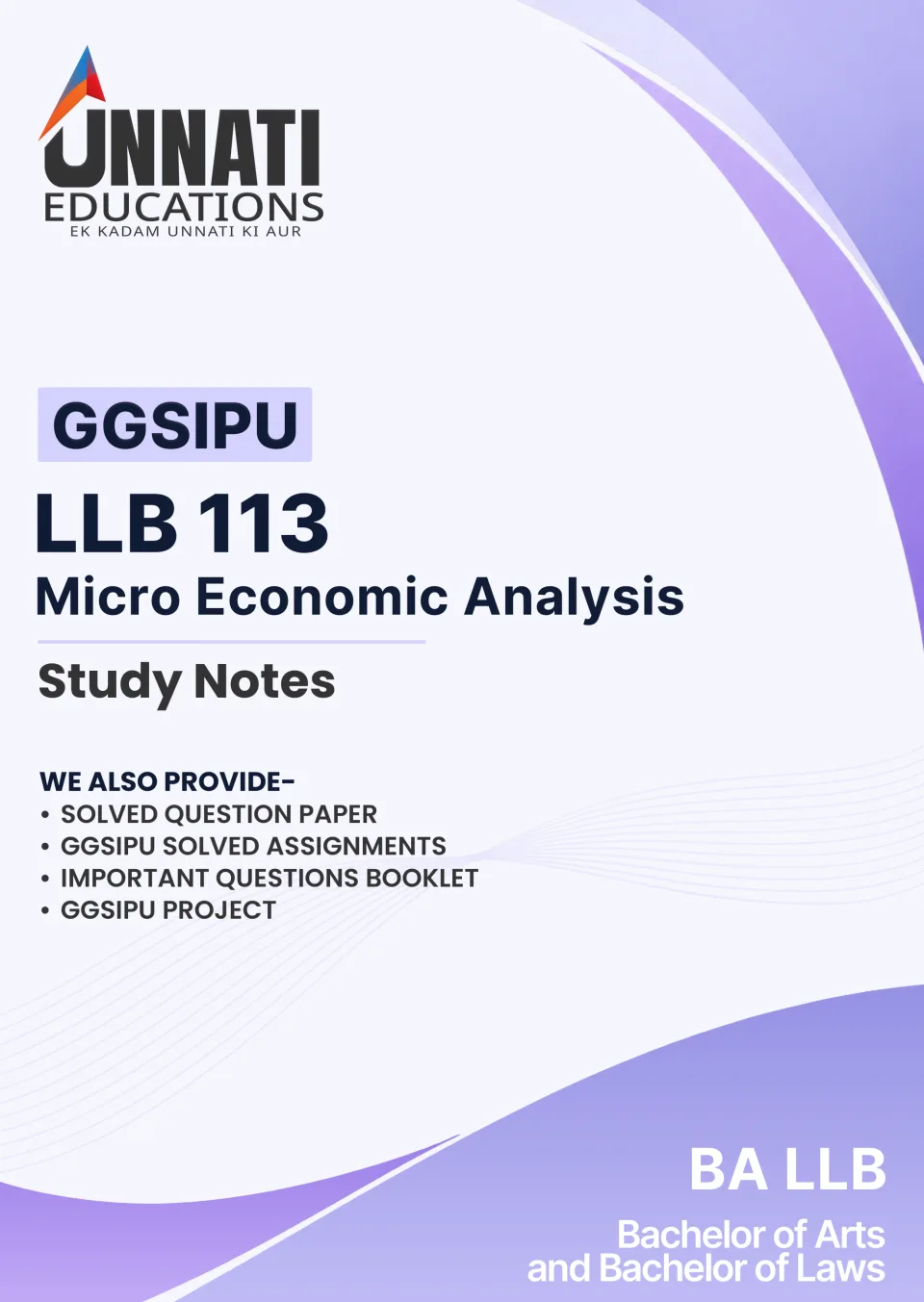
BA LLB 113 Economics-I: Micro Economic Analysis Notes from Unnati Educations run to 78 pages across 4 units, with 34 labelled diagrams, 12 worked illustrations, 12 case-law boxes and 82 exam-style questions. They follow the official BA LLB (Honours) scheme for the batch of 2021-2026 and link each economic idea to an Indian law.
Written by Prateek Talwar, Company Secretary (ACS 58704), Founder · Reviewed by Sheetal Kirola, M.Ed., Academic Head (academic review) · Checked against the official BA LLB (H) scheme and syllabus PDF on ipu.ac.in · Updated 17 November 2026 · Editorial policy
Scheme: Integrated BA LLB (Honours), USLLS | Applies to: batch of 2021-2026 onwards (as printed on the official PDF) | Verified against: syllballb300924.pdf, ipu.ac.in
BA LLB 113 Economics-I: Micro Economic Analysis at a glance: GGSIPU BA LLB Sem 1 credits, units and exam pattern
Economics-I is the only economics paper in Semester 1 and leads to Economics-II (Macro) in Semester 3. It sits with six other GGSIPU BA LLB Semester 1 papers.
| Code and title | BA LLB 113, Economics-I: Micro Economic Analysis |
|---|---|
| Course and semester | Integrated BA LLB (Honours), First Semester |
| Lectures and credits | L 5, Credit 5 |
| Marks | 100: 75 end-term + 10 internal written + 15 PSDA |
| Applies to | Batch of 2021-2026 onwards |
| End-term pattern | Not printed in the official PDF |
| Units | 4 units of 10 lectures each, plus PSDA activities |
| Paired lab | None (theory paper) |
BA LLB 113 Economics-I: Micro Economic Analysis Notes unit-wise: 34 diagrams, 12 worked illustrations and 12 case-law boxes across 4 units
These BA LLB 113 Economics-I IPU notes follow the syllabus order, and every unit closes with a revision table and a question list. Notes for the other first-year law papers sit under GGSIPU BA LLB notes. The sample PDF above has a page from each unit.
BA LLB 113 Unit 1: Introduction to Economics
Unit 1 compares four definitions of economics and five pairs of analysis, from micro vs macro to short run vs long run. It builds the production possibility curve and Pareto optimality, compares economic systems and ends on law and economics.
Pages 4 to 22 · 5 sections · 9 diagrams · 2 worked illustrations · 20 exam-style questions.
Quick look: the Coase theorem with a factory and a laundry (from page 19)
- Factory smoke costs a laundry ₹50,000 a year; a filter costs ₹20,000.
- If the laundry has the right to clean air, the factory fits the filter.
- If the factory has the right to pollute, the laundry pays it to fit one.
- The filter goes in either way: the law only decides who pays, when bargaining is cheap.
BA LLB 113 Unit 2: Demand and Supply
The unit runs from cardinal utility and indifference curves to supply, equilibrium and shifts, then price, income and cross elasticity with consumer surplus. Applications cover tax incidence, price ceilings and floors under Indian statutes, and the income-leisure choice.
Pages 23 to 41 · 6 sections · 10 diagrams · 5 worked illustrations · 19 exam-style questions.
| Change | Price ₹500 to ₹400; copies 100 to 150 |
|---|---|
| Percentage method | 50% ÷ 20% = 2.5 (elastic) |
| Expenditure check | ₹50,000 rises to ₹60,000 as price falls, so e > 1 |
BA LLB 113 Unit 3: Production Analysis, Costs and Market Structure
Unit 3 covers the law of variable proportions, isoquants, returns to scale, cost and revenue curves and the MR = MC rule. Markets run from perfect competition to oligopoly, with a prisoners' dilemma between two cement firms, then cartels and dumping.
Pages 42 to 60 · 6 sections · 9 diagrams · 2 worked illustrations · 22 exam-style questions.
Quick look: why a monopolist avoids inelastic demand (from page 49)
MR = AR x (1 - 1/e)
AR = Rs 60, e = 3  ->  MR = Rs 40
AR = Rs 60, e = 1 -> MR = Rs 0Below e = 1, MR turns negative, so a monopolist never produces there.
BA LLB 113 Unit 4: Theory of Determination of Factor Prices, Rent, Interest, Wages and Profit
The unit applies marginal productivity theory to rent, interest and profit, then covers the backward-bending labour supply, wages under monopsony, trade unions, and exploitation as Pigou, Joan Robinson and Marx see it, plus money and capital markets.
Pages 61 to 78 · 8 sections · 6 diagrams · 3 worked illustrations · 21 exam-style questions.
| Worker | Extra shirts | MRP | Hire? |
|---|---|---|---|
| 3rd | 6 | ₹1,200 | Yes |
| 4th | 4 | ₹800 | Yes (MRP = wage) |
| 5th | 2 | ₹400 | No |
Quick look: hiring by the MRP rule at ₹200 a shirt and ₹800 wage (from page 61)
- Worker
- 3rd
- Extra shirts
- 6
- MRP
- ₹1,200
- Hire?
- Yes
- Worker
- 4th
- Extra shirts
- 4
- MRP
- ₹800
- Hire?
- Yes (MRP = wage)
- Worker
- 5th
- Extra shirts
- 2
- MRP
- ₹400
- Hire?
- No
Trade union law and minimum wage legislation in labour economics: excerpt from page 72 of the BA LLB 113 notes
Excerpt from page 72
Legal framework for trade unions in India
Article 19(1)(c) of the Constitution gives the right to form associations or unions, and Article 43A asks the State to bring workers into management. The Trade Unions Act, 1926 (registration of unions and immunity from civil and criminal liability for union activity) and the Industrial Disputes Act, 1947 now sit inside the Industrial Relations Code, 2020, which came into force in November 2025 together with the other three labour codes.
Under the IR Code, a union with 51% or more of the workers becomes the negotiating union; otherwise a negotiating council of unions is formed. A 14-day notice is needed before a strike in every industrial establishment, and disputes go through conciliation, arbitration and Industrial Tribunals.
Case law: B.R. Singh v. Union of India, (1989) 4 SCC 710
The Supreme Court accepted that the right to strike is an important weapon of collective bargaining, recognised by the Trade Unions Act and the Industrial Disputes Act, but held that it is not a fundamental right. In T.K. Rangarajan v. Government of Tamil Nadu (2003) the Court went further for government employees, and in Kameshwar Prasad v. State of Bihar (1962) it protected peaceful demonstration while denying a fundamental right to strike.
Minimum wage legislation
A minimum wage is the lowest wage an employer must legally pay. In economic terms it is a price floor in the labour market. It aims to stop exploitation, secure a decent standard of living, cut poverty and inequality, and protect workers who have little bargaining power.
Minimum wages in India
- The Minimum Wages Act, 1948 covered only scheduled employments. The Code on Wages, 2019 replaced it and extends minimum wages to all employees, organised and unorganised.
- Under Section 9 of the Code, the Central Government fixes a national floor wage, and no State may fix a minimum wage below it. Rates depend on skill level (unskilled to highly skilled) and area, and are revised at least every five years.
- The Code also absorbs the Payment of Wages Act, 1936, the Payment of Bonus Act, 1965 and the Equal Remuneration Act, 1976, so gender discrimination in pay is barred.
- The 15th Indian Labour Conference (1957) set need-based norms: 2,700 calories per adult, 72 yards of cloth per family a year, rent, fuel and lighting. In Workmen v. Reptakos Brett & Co. (1992), the Supreme Court added children's education, medical needs, recreation, old age and marriage, roughly 25% more.
BA LLB 113 exam corner: 49 two-to-five-mark and 33 ten-to-fifteen-mark questions by unit
Each unit ends with questions marked "2–5 Marks" and "10–15 Marks" for practice; the unit text answers them.
| Unit | 2–5 Marks | 10–15 Marks | Worked illustrations |
|---|---|---|---|
| 1. Introduction to Economics | 12 | 8 | 2 |
| 2. Demand and Supply | 12 | 7 | 5 |
| 3. Production, Costs and Markets | 13 | 9 | 2 |
| 4. Factor Prices | 12 | 9 | 3 |
BA LLB 113 questions and worked illustrations by unit
- Unit
- 1. Introduction to Economics
- 2–5 Marks
- 12
- 10–15 Marks
- 8
- Worked illustrations
- 2
- Unit
- 2. Demand and Supply
- 2–5 Marks
- 12
- 10–15 Marks
- 7
- Worked illustrations
- 5
- Unit
- 3. Production, Costs and Markets
- 2–5 Marks
- 13
- 10–15 Marks
- 9
- Worked illustrations
- 2
- Unit
- 4. Factor Prices
- 2–5 Marks
- 12
- 10–15 Marks
- 9
- Worked illustrations
- 3
The BA LLB 113 notes list 49 short-answer and 33 long-answer questions across 4 units, plus 12 worked illustrations.
- Unit 1: Compare market, command and mixed economies. Why is India called a mixed economy? Pointer: solve what, how and for whom in a table, then name India's public sector, private sector and NITI Aayog.
- Unit 2: Distinguish between a price ceiling and a price floor with examples. Pointer: a ceiling below equilibrium causes shortage (drug price control, rent control); a floor above it causes surplus (MSP).
- Unit 3: Discuss cartels and dumping with reference to the Competition Act, 2002 and anti-dumping law in India. Pointer: Section 3(3) and the cement cartel case; Section 9A of the Customs Tariff Act and DGTR.
- Unit 4: Critically examine the classical, loanable funds and liquidity preference theories of interest. Pointer: end with Keynes' three motives and the liquidity trap.
Who writes and checks the BA LLB 113 Economics-I notes?
- Prateek Talwar, author. Founder, Unnati Educations; Associate Company Secretary (ACS), ICSI, membership no. 58704, since 15 May 2019; B.Com, University of Delhi (School of Open Learning), 2012. Author bio
- Sheetal Kirola, academic reviewer. Academic Head, Unnati Educations; M.Ed.; 7 years of experience. She checks structure, clarity and syllabus coverage. Reviewer bio
The 2026-27 edition uses the four labour codes now in force and cites the 2022 CCI order against Google on Android. Last updated 17 November 2026. See our editorial policy.
Do the BA LLB 113 notes cover the full GGSIPU syllabus?
Yes. Every topic in the four official units and every listed PSDA activity has its own section.
| Official unit | Official topics | Where in the notes | Status |
|---|---|---|---|
| Unit I: Introduction to Economics | Definition, methodology, scope; forms of economic analysis; rationality, optimality; market, command, mixed economy; economics and law | Sections 1-5, pages 4-20 | Covered |
| Unit II: Demand and Supply | Demand, utility and indifference curves; supply; price determination; elasticity, consumer surplus; tax, floors, ceilings, work | Sections 1-6, pages 23-39 | Covered |
| Unit III: Production Analysis, costs and market structure | Isoquants, returns; cost and revenue; competition, monopoly, duopoly, oligopoly; cartels; dumping | Sections 1-6, pages 42-58 | Covered |
| Unit IV: Factor prices, rent, interest, wages and profit | Labour supply and wages; trade unions, collective bargaining, minimum wage legislation; exploitation | Sections 1-7, pages 61-75 | Covered |
| PSDA | Floors, ceilings, taxes by law; professions; elasticity cases; CCI; money and capital markets | Unit II 4.3, 5.4, 5.5; Unit III 6.3; Unit IV 8 | Covered |
BA LLB 113 official units mapped to the notes
- Official unit
- Unit I: Introduction to Economics
- Official topics
- Definition, methodology, scope; forms of economic analysis; rationality, optimality; market, command, mixed economy; economics and law
- Where in the notes
- Sections 1-5, pages 4-20
- Status
- Covered
- Official unit
- Unit II: Demand and Supply
- Official topics
- Demand, utility and indifference curves; supply; price determination; elasticity, consumer surplus; tax, floors, ceilings, work
- Where in the notes
- Sections 1-6, pages 23-39
- Status
- Covered
- Official unit
- Unit III: Production Analysis, costs and market structure
- Official topics
- Isoquants, returns; cost and revenue; competition, monopoly, duopoly, oligopoly; cartels; dumping
- Where in the notes
- Sections 1-6, pages 42-58
- Status
- Covered
- Official unit
- Unit IV: Factor prices, rent, interest, wages and profit
- Official topics
- Labour supply and wages; trade unions, collective bargaining, minimum wage legislation; exploitation
- Where in the notes
- Sections 1-7, pages 61-75
- Status
- Covered
- Official unit
- PSDA
- Official topics
- Floors, ceilings, taxes by law; professions; elasticity cases; CCI; money and capital markets
- Where in the notes
- Unit II 4.3, 5.4, 5.5; Unit III 6.3; Unit IV 8
- Status
- Covered
Check the topics in the BA LLB (Honours) scheme and syllabus, batch of 2021-2026 (BA LLB 113 is on printed pages 14 and 15).
Every course in GGSIPU notes is mapped to its official PDF the same way.
How to write BA LLB 113 answers: diagram-led economics answers tied to Indian law
The GGSIPU BA LLB Sem 1 Economics-I notes train two habits for every answer: draw the curve, then name the statute.
- Diagram first. Label both axes of the production possibility curve and mark points on, inside and outside it.
- State both conditions. For indifference-curve equilibrium, write MRS = Px/Py and convexity, then give the five properties with reasons.
- Compare in a table. Ricardian vs modern rent reads best as four rows: cause, scope, measurement and effect on price.
- Close with the law. Cartels go with Section 3(3) of the Competition Act; dumping goes with Section 9A of the Customs Tariff Act and the three tests of dumping, material injury and causal link.
Worked example (Unit 2): Qd = 100 − 2P, Qs = 20 + 2P, and a ₹4 tax falls on sellers. Solving 100 − 2P = 12 + 2P gives a buyer price of ₹22, a seller price of ₹18 and 56 units, so each side bears ₹2. Revenue is ₹224; deadweight loss is ₹8.
BA LLB 113 and the GGSIPU BA LLB Sem 1 papers it connects to
BA LLB 113 is a theory paper with no lab, and it shares Semester 1 with six other papers.
They are LLB 101, LLB 103 Law of Contract-I, LLB 105, BA LLB 107, BA LLB 109 and BA LLB 111 Political Science-I.
- Unit 1 → LLB 103: enforcing contracts lowers risk and makes exchange possible, the idea behind the Indian Contract Act, 1872.
- Unit 1 → BA LLB 111: economic systems show how far the state steps in, which BA LLB 111 studies under "State, government and law".
- Units 3 and 4 → later years: the Competition Act returns in LLB 403 Competition Law, and the labour codes in LLB 401 and LLB 406.
BA LLB 113 Economics-I notes FAQs
How do I get the full BA LLB 113 notes?
Tap "Get Full Notes" to message the desk on WhatsApp at 9899436384 and mention BA LLB 113. The full notes come only as a printed book; they are not sold as a PDF. Delivery takes up to 5-7 days, and the exact time depends on your location. Price and payment details are shared on WhatsApp after you message.
How is BA LLB 113 marked, and what is the passing mark?
BA LLB 113 is marked out of 100: 75 in the end-term written exam, 10 in an internal written test and 15 for PSDA, both assessed by the subject teacher. The BA LLB (Honours) scheme PDF on ipu.ac.in does not print a pass percentage. For end-term minimums and re-appear rules, read Ordinance 11 on ipu.ac.in.
Do the BA LLB 113 notes answer the 82 exam questions?
Not as separate model answers. The 82 questions at the end of the units are a practice list, and each one is answered by a section of the unit text, its diagrams or its revision table. The 12 worked illustrations, such as tax incidence, MRP hiring and exploitation measured in rupees, are solved step by step.
Do the BA LLB 113 notes cover the PSDA activities?
Yes. Each PSDA activity in the syllabus has a section: floors, ceilings and taxes set by legislation, demand for professions and institutions, elasticity case studies, market structures with the Competition Commission of India, and money and capital markets. The scheme says that in Semesters 1 and 2 these activities run within the normal lecture hours.
Which BA LLB 113 unit has the most law in it?
Unit 4 holds 5 of the 12 case-law boxes, including B.R. Singh on the right to strike and Sanjit Roy on minimum wages and forced labour under Article 23. Unit 3 follows with competition law: the cement cartel case, Excel Crop Care on penalties based on relevant turnover, and the 2022 CCI order against Google on Android.
Which batch do the BA LLB 113 notes follow?
They follow the Integrated BA LLB (Honours) scheme printed for the batch of 2021-2026 by USLLS. Some later papers in that PDF carry a 2024-25 revision note, but the BA LLB 113 pages do not, so the unit list here is the one printed for this paper. Check with your college if your batch received a newer scheme.
Get the full BA LLB 113 Economics-I: Micro Economic Analysis Notes on WhatsApp
| Unit | Pages | Diagrams | Questions |
|---|---|---|---|
| 1. Introduction to Economics | 4-22 | 9 | 20 |
| 2. Demand and Supply | 23-41 | 10 | 19 |
| 3. Production, Costs and Market Structure | 42-60 | 9 | 22 |
| 4. Factor Prices | 61-78 | 6 | 21 |
What the full BA LLB 113 notes contain
- Unit
- 1. Introduction to Economics
- Pages
- 4-22
- Diagrams
- 9
- Questions
- 20
- Unit
- 2. Demand and Supply
- Pages
- 23-41
- Diagrams
- 10
- Questions
- 19
- Unit
- 3. Production, Costs and Market Structure
- Pages
- 42-60
- Diagrams
- 9
- Questions
- 22
- Unit
- 4. Factor Prices
- Pages
- 61-78
- Diagrams
- 6
- Questions
- 21
The full set is a 78-page printed book of Economics-I notes in English, with 12 worked illustrations and 12 case-law boxes. It is not sold as a PDF. Delivery takes up to 5-7 days, depending on your location.
Order the full BA LLB 113 notes book on WhatsApp (4 units, 78 pages)
Unnati Educations is an independent education provider based in Vikaspuri, Delhi. We are not affiliated with, authorised by, or endorsed by Guru Gobind Singh Indraprastha University (GGSIPU). 'GGSIPU' and 'IPU' are used only to describe the syllabus our notes follow. For official information, visit ipu.ac.in.
Ready for the full notes?
Discuss coverage and delivery with our team.