
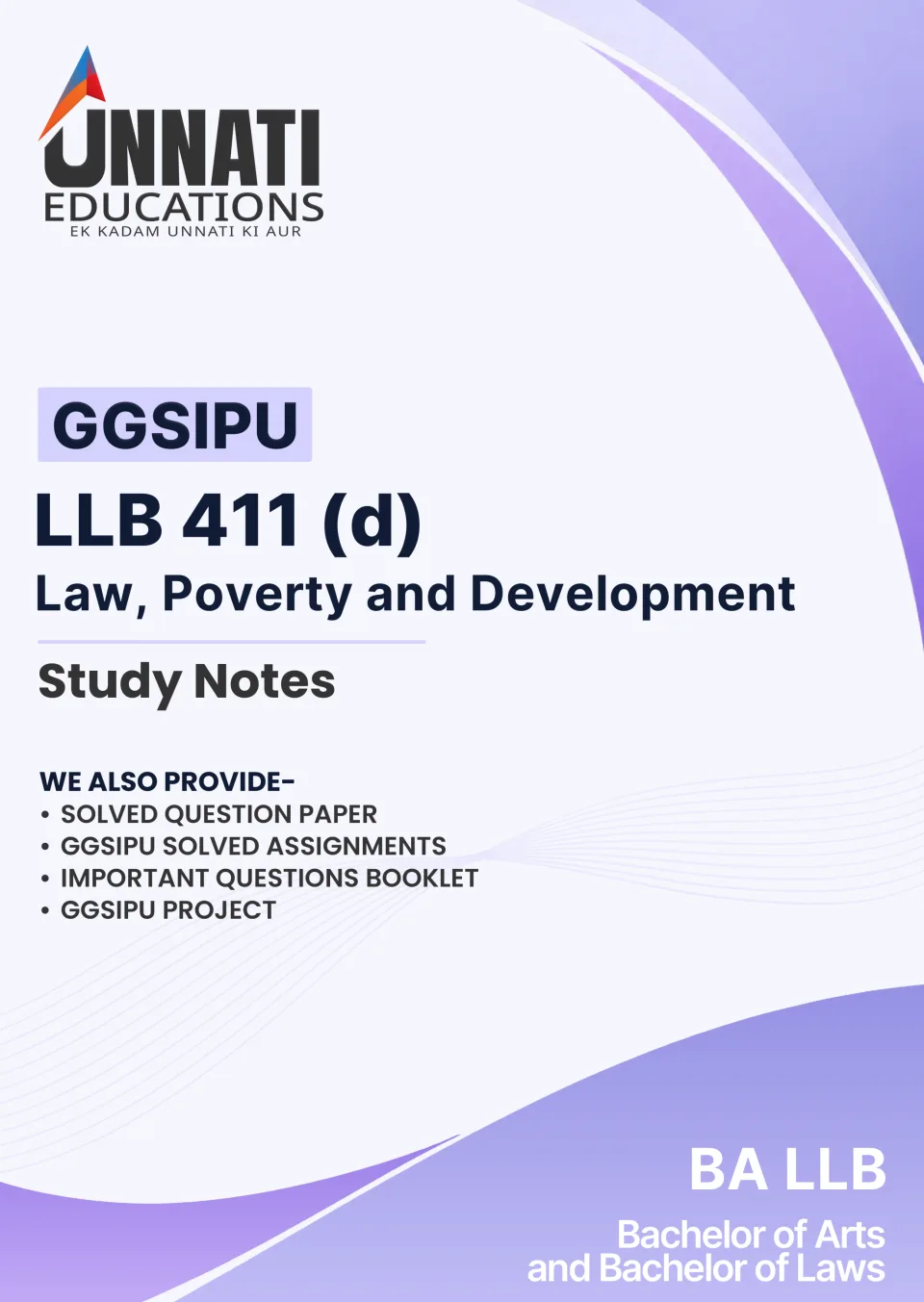
LLB 411(d) Law, Poverty and Development Notes cover all four units of the GGSIPU BA LLB/BBA LLB Semester 7 elective in one 63-page printed book, with 15 diagrams, 29 case-law boxes, 3 case studies and 65 exam questions (40 short-answer, 25 long-answer). They follow the Integrated BA LLB (Honours) syllabus, w.e.f. Batch of 2021-2026.
Written by Unnati Educations Editorial Team · Reviewed by Sheetal Kirola, Academic Head, M.Ed., 7 years of experience (academic review) · Checked against Scheme of Examination and Detailed Syllabus, Integrated BA LLB (Honours) · Updated 17 November 2026 · Editorial policy
Scheme: Integrated BA LLB (Honours) | Applies to: w.e.f. Batch of 2021-2026 | Verified against: USLLS scheme and syllabus PDF
LLB 411(d) Law, Poverty and Development at a glance: GGSIPU BA LLB/BBA LLB Sem 7 credits, units and exam pattern
LLB 411(d) is option (d) of Elective Paper-I in the fourth year. These LLB 411(d) law and poverty IPU notes follow a syllabus that ties poverty data to Articles 14, 15, 38 and 39-A and to the bail courts and legal aid offices poor people actually face.
| Code and title | LLB 411 (d) Law, Poverty and Development |
|---|---|
| Course and semester | BA LLB (Hons) / BBA LLB, Semester 7, Elective Paper-I |
| Lectures and credits | L5, PSDA 1 hour a week, 5 credits; 40 lectures (10, 12, 8, 10) |
| Marks split | 100 = 75 end-term written + 10 internal written + 15 PSDA |
| End-term pattern | Not printed in the official PDF |
| Units | 4 |
| Applies to | Integrated BA LLB (Honours), w.e.f. Batch of 2021-2026 |
| Paired lab | None |
Compare it with the compulsory papers of the term in GGSIPU BA LLB Semester 7 papers.
LLB 411(d) Law, Poverty and Development Notes unit-wise: 65 exam questions and 29 case-law boxes across 4 units
These GGSIPU BA LLB/BBA LLB Sem 7 Law, Poverty and Development notes run from page 4 to page 62, and each unit closes with a revision table and a question list. Notes for the other subjects of the course are grouped under GGSIPU BA LLB notes.
LLB 411(d) Unit 1: Introduction to the Terms Poverty and Development
Pages 4 to 19 (16 pages): Amartya Sen's capability approach, Nurkse's vicious circle, the Alagh to Rangarajan poverty lines, NITI Aayog's National MPI, schemes from MGNREGA to the VB-G RAM G Act, 2025, and the HDI. 5 diagrams, 2 case-law boxes (PUCL Right to Food, Vellore Citizens), Kerala Model case study.
| Year | Committee | Key point |
|---|---|---|
| 1979 | Y.K. Alagh Task Force | 2400 kcal rural, 2100 kcal urban |
| 1993 | D.T. Lakdawala Expert Group | State-specific poverty lines |
| 2009 | Suresh D. Tendulkar Expert Group | Basket of goods; 21.9% poor in 2011-12 (26.9 crore) |
| 2014 | C. Rangarajan Expert Group | 29.5% poor in 2011-12; not adopted |
Quick look: poverty line committees in India (from page 10)
- Year
- 1979
- Committee
- Y.K. Alagh Task Force
- Key point
- 2400 kcal rural, 2100 kcal urban
- Year
- 1993
- Committee
- D.T. Lakdawala Expert Group
- Key point
- State-specific poverty lines
- Year
- 2009
- Committee
- Suresh D. Tendulkar Expert Group
- Key point
- Basket of goods; 21.9% poor in 2011-12 (26.9 crore)
- Year
- 2014
- Committee
- C. Rangarajan Expert Group
- Key point
- 29.5% poor in 2011-12; not adopted
LLB 411(d) Unit 2: Constitutional Commitments for the Poor including Women Children and Specially Abled Person
Pages 20 to 36 (17 pages), the largest unit: Articles 14, 15, 38 and 39-A, protective discrimination up to Davinder Singh (2024), Olga Tellis, the PCR Act, 1955, women workers, child labour and RTE, the RPwD Act, 2016 and the RFCTLARR Act, 2013. 3 diagrams, 15 case-law boxes, SEWA case study.
| Provision | What it says |
|---|---|
| Types of disability | Raised from 7 to 21 |
| Sec. 2(r) | Benchmark disability: at least 40% |
| Sec. 34 | 4% reservation in government establishments |
| Sec. 32 | 5% seats in government and aided higher education |
Quick look: RPwD Act, 2016 in four numbers (from page 31)
- Provision
- Types of disability
- What it says
- Raised from 7 to 21
- Provision
- Sec. 2(r)
- What it says
- Benchmark disability: at least 40%
- Provision
- Sec. 34
- What it says
- 4% reservation in government establishments
- Provision
- Sec. 32
- What it says
- 5% seats in government and aided higher education
LLB 411(d) Unit 3: International Dimensions of Poverty: Policies, Programs and Mechanism
Pages 37 to 48 (12 pages): SDG 1, the Alkire-Foster Global MPI and its 2025 report (1.1 billion poor), the UNO, ILO Conventions 138 and 182, WTO Special and Differential Treatment, the World Bank Group, the OECD DAC Guidelines, 2001 and the Fourth World. 3 diagrams, Sardar Sarovar Inspection Panel case study.
| Item | Rule |
|---|---|
| Health and education | 1/3 each, two indicators of 1/6 each |
| Standard of living | 1/3, six indicators of 1/18 each |
| Poor | Deprivation score of 33.3% or more |
| Severely poor / vulnerable | 50% or more / 20% to 33.3% |
Quick look: how the Global MPI weights and cut-offs work (from page 38)
- Item
- Health and education
- Rule
- 1/3 each, two indicators of 1/6 each
- Item
- Standard of living
- Rule
- 1/3, six indicators of 1/18 each
- Item
- Poor
- Rule
- Deprivation score of 33.3% or more
- Item
- Severely poor / vulnerable
- Rule
- 50% or more / 20% to 33.3%
LLB 411(d) Unit 4: Judicial System and the Poor
Pages 49 to 62 (14 pages): D.K. Basu, Section 309 IPC to Section 226 BNS, bail under Sections 478 to 483 BNSS with Moti Ram and Satender Kumar Antil, Section 479 BNSS for undertrials, and the Legal Services Authorities Act, 1987. 4 diagrams, 12 case-law boxes, 14-case syllabus map.
Quick look: how a case moves through a Lok Adalat (from page 59)
- Section 19: organised by NALSA, SLSA, DLSA or TLSC; no non-compoundable offences.
- Section 20: a court refers the case when parties agree or settlement looks likely.
- Section 21: the award is a civil court decree, final, with no appeal.
- No settlement: the case goes back to the court.
Attempt to suicide and the poor in criminal law: excerpt from page 52 of the LLB 411(d) notes
Excerpt from page 52
Section 309 IPC, 1860
Under the Indian Penal Code, an attempt to commit suicide was itself an offence. Section 309 punished it with simple imprisonment of up to one year, a fine, or both, so a person who survived could be prosecuted for having tried.
Rathinam and Gian Kaur
In P. Rathinam v. Union of India (1994) 3 SCC 394, a two-judge bench called Section 309 cruel and irrational because it punished someone who was already suffering, and read Article 21 as including a right not to live a forced life. Two years later, a five-judge Constitution Bench in Gian Kaur v. State of Punjab (1996) 2 SCC 648 overruled Rathinam.
Gian Kaur held that the right to life is a natural right that does not include a right to die, and upheld Sections 306 and 309 IPC. It did, however, accept a right to die with dignity at the natural end of life, which later supported passive euthanasia in Common Cause v. Union of India (2018).
From punishment to care
The Law Commission's 210th Report (2008) recommended deleting Section 309, treating attempted suicide as a cry for help rather than a crime. Parliament moved in that direction through Section 115 of the Mental Healthcare Act, 2017.
Section 115(1) says that, despite Section 309, a person who attempts suicide is presumed, unless the contrary is proved, to be under severe stress, and shall not be tried or punished. Section 115(2) puts a duty on the appropriate Government to provide care, treatment and rehabilitation to reduce the risk of the attempt being repeated. In most cases this decriminalised the act and replaced punishment with care.
Position under the BNS, 2023
The Bharatiya Nyaya Sanhita, in force from 1 July 2024, has no general offence matching Section 309. Section 226 BNS punishes only an attempt to commit suicide made to compel or restrain a public servant from discharging official duty, with imprisonment of up to one year, a fine, or community service. Abetment of suicide is still an offence under Section 108 BNS, which takes the place of Section 306 IPC.
Do the LLB 411(d) notes cover the full GGSIPU syllabus?
Yes for all four units; partly for the PSDA field visits and the list of cases, where 7 of the 14 judgments are left for students to read in full.
| Official unit | Official topics | Where in the notes | Status |
|---|---|---|---|
| I: Poverty and Development | Poverty concepts, measurement, MPI, schemes; development indices | Pages 4 to 19 | Covered |
| II: Constitutional Commitments | Articles 14, 15, 38, 39-A; women, children, Divyang; displacement | Pages 20 to 36 | Covered |
| III: International Dimensions | Global MPI; UNO, ILO, WTO, World Bank; OECD; Fourth World | Pages 37 to 48 | Covered |
| IV: Judicial System and the Poor | Police, attempt to suicide, bail, undertrials, legal aid, Lok Adalat | Pages 49 to 60 | Covered |
| PSDA (1 hour a week) | Scheme analysis, poverty data, police and jail visits | Activity guide, page 60 | Partly covered: visits are yours |
| List of cases (14) | Syllabus list | Pages 60 to 61 | Partly covered: 7 discussed, 7 marked "read from judgment" |
LLB 411(d) official syllabus mapped to the notes
- Official unit
- I: Poverty and Development
- Official topics
- Poverty concepts, measurement, MPI, schemes; development indices
- Where in the notes
- Pages 4 to 19
- Status
- Covered
- Official unit
- II: Constitutional Commitments
- Official topics
- Articles 14, 15, 38, 39-A; women, children, Divyang; displacement
- Where in the notes
- Pages 20 to 36
- Status
- Covered
- Official unit
- III: International Dimensions
- Official topics
- Global MPI; UNO, ILO, WTO, World Bank; OECD; Fourth World
- Where in the notes
- Pages 37 to 48
- Status
- Covered
- Official unit
- IV: Judicial System and the Poor
- Official topics
- Police, attempt to suicide, bail, undertrials, legal aid, Lok Adalat
- Where in the notes
- Pages 49 to 60
- Status
- Covered
- Official unit
- PSDA (1 hour a week)
- Official topics
- Scheme analysis, poverty data, police and jail visits
- Where in the notes
- Activity guide, page 60
- Status
- Partly covered: visits are yours
- Official unit
- List of cases (14)
- Official topics
- Syllabus list
- Where in the notes
- Pages 60 to 61
- Status
- Partly covered: 7 discussed, 7 marked "read from judgment"
Verify each topic in the official BA LLB (Honours) scheme and syllabus PDF on ipu.ac.in (LLB 411(d) is on pages 111 to 114).
Papers from other courses and semesters are listed under GGSIPU notes.
How to write LLB 411(d) answers: Articles, case law and BNSS sections in sequence
The exam-tip boxes in the notes repeat one habit: put the law in time order and back each step with a named case. For attempt to suicide (page 53) that means Section 309 IPC to Section 226 BNS; for legal aid (page 58), the NALSA to TLSC diagram, the Section 12 categories, Khatri (II) and Suk Das.
Cite the Article or section first, then the case with its year, then the rule in one line. An outline from pages 21 to 23:
Outline: "Protective discrimination is a facet of equality." Discuss with decided cases.
- Introduction: formal versus substantive equality, and why special measures serve Article 14 (page 23).
- Provisions: Articles 15(3) to 15(6), 16(4) to 16(6), 46 and 330 to 342 (pages 21 to 23).
- Cases in order: Champakam Dorairajan (1951), M.R. Balaji (1963), N.M. Thomas (1976), Indra Sawhney (1992), Janhit Abhiyan (2022), Davinder Singh (2024).
- Conclusion: the balance between equality and efficiency under Article 335.
LLB 411(d) exam corner: 40 short-answer and 25 long-answer questions by unit
The notes list these without model answers, so treat them as practice questions.
| Unit | Short-answer | Long-answer | Case studies | Diagrams |
|---|---|---|---|---|
| I | 12 | 7 | 1 | 5 |
| II | 10 | 8 | 1 | 3 |
| III | 9 | 5 | 1 | 3 |
| IV | 9 | 5 | 0 | 4 |
| Total | 40 | 25 | 3 | 15 |
LLB 411(d) exam questions and study aids by unit
- Unit
- I
- Short-answer
- 12
- Long-answer
- 7
- Case studies
- 1
- Diagrams
- 5
- Unit
- II
- Short-answer
- 10
- Long-answer
- 8
- Case studies
- 1
- Diagrams
- 3
- Unit
- III
- Short-answer
- 9
- Long-answer
- 5
- Case studies
- 1
- Diagrams
- 3
- Unit
- IV
- Short-answer
- 9
- Long-answer
- 5
- Case studies
- 0
- Diagrams
- 4
- Unit
- Total
- Short-answer
- 40
- Long-answer
- 25
- Case studies
- 3
- Diagrams
- 15
The LLB 411(d) notes list 40 short-answer and 25 long-answer exam questions across 4 units, plus 3 case studies and 29 case-law boxes.
- Unit I: How is poverty measured? Critically examine the poverty line estimates in India. Pages 9 to 11.
- Unit II: Explain the approaches to disability and the main features of the RPwD Act, 2016 with case law. Pages 30 to 32.
- Unit III: Critically examine the role of the WTO and the World Bank in poverty reduction. Pages 42 to 44.
- Unit IV: "Bail is the rule and jail is the exception, but not for the poor." Discuss bail and the problems of undertrials. Pages 53 to 55.
Who writes and checks the LLB 411(d) law and poverty notes?
- Unnati Educations Editorial Team: author of the notes, tables and question lists.
- Sheetal Kirola: Academic Head, M.Ed., 7 years of experience. Academic review of structure, clarity and syllabus coverage. Bio
The notes are mapped to the Integrated BA LLB (Honours) scheme, w.e.f. Batch of 2021-2026. The 2026-27 edition uses the World Bank $3.00 a day line (June 2025), the Global MPI 2025 report, the VB-G RAM G Act, 2025 and BNS and BNSS section numbers beside the old IPC and CrPC ones. Updated 17 November 2026. Read our editorial policy.
LLB 411(d) and the GGSIPU BA LLB/BBA LLB Sem 7 papers it connects to
LLB 411(d) is a theory paper with no lab; its practical side is the weekly PSDA hour. It sits beside LLB 401 Labour Law-I, LLB 403 Competition Law, LLB 405 Company Law, LLB 407 Law and Emerging Technology and LLB 409 Intellectual Property Rights-I, in place of LLB 411(a) Election Laws, (b) Socio-Economic Offences or (c) Private International Laws.
Unit II builds on LLB 205 Constitution Law-II and LLB 307 Human Rights; Unit IV reuses bail from LLB 305 Code of Criminal Procedure-I. BA LLB students met the HDI and MPI in BA LLB 210 Economics-III. The women and disability material returns in LLB 412(c) Women and Law (Semester 8) and LLB 511(d) Law and Empowerment of the Marginalized People (Semester 9).
LLB 411(d) law and poverty notes FAQs
How do I get the full LLB 411(d) notes?
Message Unnati Educations on WhatsApp at 9899436384 and mention the code LLB 411(d). The full notes come only as a printed notes book, not a PDF, and delivery takes a maximum of 5-7 days, depending on your location. Price and payment details are shared on WhatsApp. To check the layout first, use the View Sample PDF button at the top of this page.
How is LLB 411(d) marked, and what is the pass mark?
LLB 411(d) carries 100 marks: 75 in the semester-end written examination conducted by the university, 10 in internal written tests and 15 for PSDA work assessed by your subject teacher. The scheme does not print a pass percentage for this paper, so check Ordinance 11 or ask your institute for the current passing rule before you plan your score.
Which unit of LLB 411(d) is the biggest?
Unit II is the biggest, at 17 pages (pages 20 to 36), with 15 of the 29 case-law boxes and 18 exam questions (10 short-answer, 8 long-answer). It also gets the most lectures in the syllabus, 12 out of 40. Its cases run from Olga Tellis on livelihood to Davinder Singh (2024) on sub-classification and Indore Development Authority on land acquisition.
Do the LLB 411(d) notes include model answers?
No. The 65 questions at the end of the four units are practice questions without written answers. Instead, the notes give 9 exam-tip boxes that set out the order of an answer, such as the chain from Section 309 IPC to Section 226 BNS for attempt to suicide, plus a quick revision table for every unit to read before the paper.
Which Acts and cases are in the LLB 411(d) notes?
The notes cover the Protection of Civil Rights Act, 1955, the SC and ST (Prevention of Atrocities) Act, 1989, the RPwD Act, 2016, the RFCTLARR Act, 2013, the Legal Services Authorities Act, 1987 and the matching BNS and BNSS sections. Of the 14 syllabus cases, 7 are discussed, such as Siddaraju and Ankush Maruti Shinde, and 7 are marked to be read from the judgment.
Is LLB 411(d) a compulsory paper in Semester 7?
No. LLB 411 is Elective Paper-I, and Law, Poverty and Development is option (d) beside Election Laws, Socio-Economic Offences and Private International Laws. Every option carries L5, PSDA 1 and 5 credits. The Academic Programme Committee decides which electives each batch is offered, so confirm with your college that option (d) is running before you start preparing.
Get the full LLB 411(d) Law, Poverty and Development Notes on WhatsApp
| Unit | Pages |
|---|---|
| Cover and index | 1 to 3 |
| Unit I | 4 to 19 (16) |
| Unit II | 20 to 36 (17) |
| Unit III | 37 to 48 (12) |
| Unit IV | 49 to 62 (14) |
| Total with back cover | 63 |
LLB 411(d) notes book page map
- Unit
- Cover and index
- Pages
- 1 to 3
- Unit
- Unit I
- Pages
- 4 to 19 (16)
- Unit
- Unit II
- Pages
- 20 to 36 (17)
- Unit
- Unit III
- Pages
- 37 to 48 (12)
- Unit
- Unit IV
- Pages
- 49 to 62 (14)
- Unit
- Total with back cover
- Pages
- 63
The book runs to 63 pages with 15 diagrams, 29 case-law boxes, 3 case studies and 65 exam questions. It is written as Law, Poverty and Development notes in English, with a table for every Article, Act and committee. It is a printed book only, not a PDF, and delivery takes a maximum of 5-7 days, depending on your location. Price and payment are shared on WhatsApp.
Get the full LLB 411(d) notes book on WhatsApp (4 units, 63 pages)
Unnati Educations is an independent education provider based in Vikaspuri, Delhi. We are not affiliated with, authorised by, or endorsed by Guru Gobind Singh Indraprastha University (GGSIPU). 'GGSIPU' and 'IPU' are used only to describe the syllabus our notes follow. For official information, visit ipu.ac.in.
Ready for the full notes?
Discuss coverage and delivery with our team.