
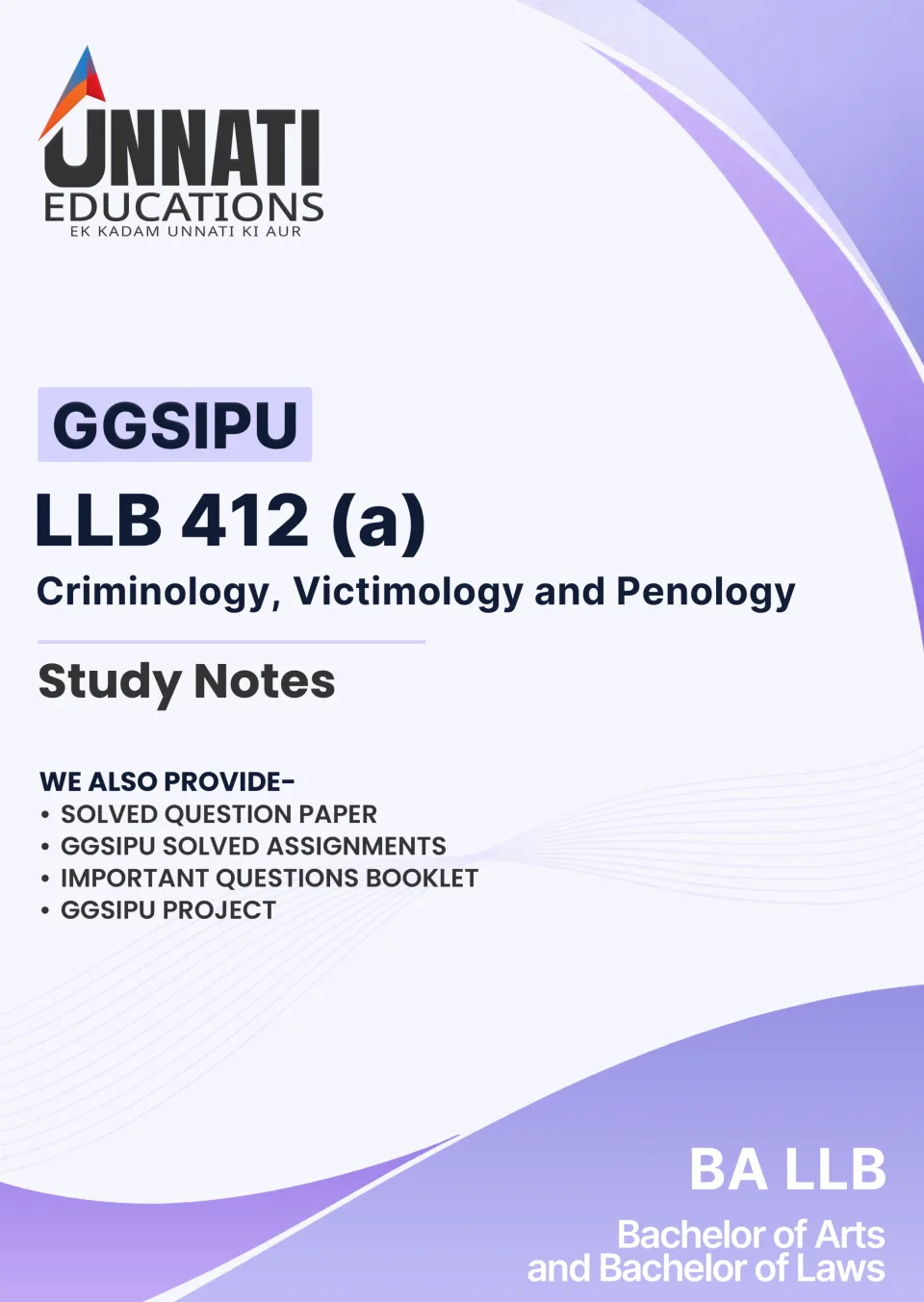
LLB 412 (a) Criminology, Victimology and Penology Notes cover all 4 units of this BA LLB/BBA LLB Semester 8 elective in a 65-page printed book, with 24 diagrams, 71 case-law boxes and 67 exam questions. The official syllabus they follow applies to the Integrated BA LLB (Honours) w.e.f. Batch of 2021-2026.
Written by Unnati Educations Editorial Team · Reviewed by Sheetal Kirola, Academic Head, M.Ed., 7 years of experience (academic review) · Checked against USLLS BA LLB (Honours) scheme PDF · Updated 17 November 2026 · Editorial policy
Scheme: Integrated BA LLB (Honours), Five Year Integrated Course | Applies to: w.e.f. Batch of 2021-2026 | Verified against: syllballb300924.pdf (USLLS)
LLB 412 (a) Criminology, Victimology and Penology at a glance: GGSIPU BA LLB/BBA LLB Sem 8 credits, units and exam pattern
LLB 412 (a) is option (a) of Elective Paper-II in Semester 8. It asks why crime happens, how the State punishes and what a victim is owed. These LLB 412 (a) Criminology IPU notes follow the four official units in order; the semester table calls the paper "Criminology and Victimology".
| Item | Detail |
|---|---|
| Code and title | LLB 412 (a) · Criminology, Victimology and Penology |
| Course and semester | Integrated BA LLB (Honours), Sem 8, Elective-II |
| Lectures and credits | L5 · PSDA 1 · 5 credits; 40 lectures (12, 12, 8, 8 by unit) |
| Marks split | 100 marks: 75 end-term written + 10 internal written + 15 PSDA |
| End-term pattern | Not printed in the official PDF |
| Units | 4 |
| Applies to | w.e.f. Batch of 2021-2026 |
| Paired lab | None (theory paper with PSDA activities) |
LLB 412 (a) snapshot from the official scheme PDF
- Item
- Code and title
- Detail
- LLB 412 (a) · Criminology, Victimology and Penology
- Item
- Course and semester
- Detail
- Integrated BA LLB (Honours), Sem 8, Elective-II
- Item
- Lectures and credits
- Detail
- L5 · PSDA 1 · 5 credits; 40 lectures (12, 12, 8, 8 by unit)
- Item
- Marks split
- Detail
- 100 marks: 75 end-term written + 10 internal written + 15 PSDA
- Item
- End-term pattern
- Detail
- Not printed in the official PDF
- Item
- Units
- Detail
- 4
- Item
- Applies to
- Detail
- w.e.f. Batch of 2021-2026
- Item
- Paired lab
- Detail
- None (theory paper with PSDA activities)
Core papers for this semester are on the GGSIPU BA LLB Semester 8 papers page.
LLB 412 (a) Criminology, Victimology and Penology Notes unit-wise: 61 pages, 24 diagrams and 71 case-law boxes across 4 units
The GGSIPU BA LLB/BBA LLB Sem 8 Criminology, Victimology and Penology notes run from page 4 to page 64, each unit ending with a revision table and question list. Other papers are on the GGSIPU BA LLB notes hub.
LLB 412 (a) Unit 1: Criminology – Definition, Terminology and Criminal Process
Pages 4 to 20. Crime, deviance and the dark figure of crime, then the schools: Beccaria and Bentham (Classical), Lombroso, Ferri and Garofalo (Positive). Causation covers Bandura, Freud, the Chicago School, Sutherland, Durkheim, Merton, labelling and Gary Becker. 17 pages, 8 diagrams, 2 case-law boxes, 17 exam questions.
Quick look: Merton's five modes of adaptation (from page 17)
- Conformity: accepts goals and means (law-abiding student or employee).
- Innovation: accepts goals, rejects means (thief, fraudster, corrupt official).
- Ritualism: rejects goals, keeps means (clerk who follows rules without ambition).
- Retreatism: rejects both (addicts, vagrants, drop-outs).
- Rebellion: rejects and replaces both (revolutionaries, radical movements).
LLB 412 (a) Unit 2: Understanding Typology of Crimes and Related Legal Provisions
Pages 21 to 36. Homicide under BNS (S. 100 culpable homicide, S. 101 murder), honour killing, mob lynching under S. 103(2) BNS, crimes against women and children (IT Act, POCSO), the JJ Act, 2015 and Lombroso and Ferrero's The Female Offender. 16 pages, 6 diagrams, 27 case-law boxes, 17 exam questions.
| Provision | What it says |
|---|---|
| Bail (S. 12) | Bail is the rule, with narrow exceptions |
| Preliminary assessment (S. 15) | Heinous offence, child aged 16 to 18; case may go to the Children's Court |
| Orders (S. 18) | Admonition, community service, probation or special home up to 3 years |
| Bar (S. 21) | No death sentence or life imprisonment without possibility of release |
Quick look: key JJ Act, 2015 provisions (from page 33)
- Provision
- Bail (S. 12)
- What it says
- Bail is the rule, with narrow exceptions
- Provision
- Preliminary assessment (S. 15)
- What it says
- Heinous offence, child aged 16 to 18; case may go to the Children's Court
- Provision
- Orders (S. 18)
- What it says
- Admonition, community service, probation or special home up to 3 years
- Provision
- Bar (S. 21)
- What it says
- No death sentence or life imprisonment without possibility of release
LLB 412 (a) Unit 3: Penology – Evolution and Latest Trends
Pages 37 to 52. Deterrent, retributive, preventive, reformative and expiatory theories; kinds of punishment under S. 4 BNS; the rarest of rare line from Jagmohan Singh to Bachan Singh and Machhi Singh; Articles 72 and 161; open prisons; prison and police reform (Prakash Singh, D.K. Basu). 16 pages, 6 diagrams, 28 case-law boxes, 17 exam questions.
| Basis | Parole | Furlough |
|---|---|---|
| Meaning | Temporary release for a specific reason | Periodic release as a reward for good conduct |
| Reason needed | Yes: illness or death in family, marriage, harvest | No specific reason |
| Counted in sentence | Generally not | Yes |
Quick look: parole vs furlough (from page 47)
- Basis
- Meaning
- Parole
- Temporary release for a specific reason
- Furlough
- Periodic release as a reward for good conduct
- Basis
- Reason needed
- Parole
- Yes: illness or death in family, marriage, harvest
- Furlough
- No specific reason
- Basis
- Counted in sentence
- Parole
- Generally not
- Furlough
- Yes
LLB 412 (a) Unit 4: Victimology
Pages 53 to 64. Scope of victimology, victim precipitation and routine activity theories, the UN Victims' Declaration, 1985, public law compensation in Rudal Sah and Nilabati Behera, victim rights under BNSS (Ss. 395 to 397) and the NALSA compensation scheme, 2018. 12 pages, 4 diagrams, 14 case-law boxes, 16 exam questions.
| Stage | Right of the victim | Provision or case |
|---|---|---|
| Reporting | FIR, Zero FIR, free copy | S. 173 BNSS; Lalita Kumari (2014) |
| Bail | Right to be heard at the bail stage | Jagjeet Singh v. Ashish Mishra (2022) |
| Appeal | Appeal against acquittal | S. 413 BNSS; Mallikarjun Kodagali (2018) |
| Protection | Witness protection scheme | S. 398 BNSS; Mahender Chawla (2018) |
Quick look: victims' rights at each stage (from page 59)
- Stage
- Reporting
- Right of the victim
- FIR, Zero FIR, free copy
- Provision or case
- S. 173 BNSS; Lalita Kumari (2014)
- Stage
- Bail
- Right of the victim
- Right to be heard at the bail stage
- Provision or case
- Jagjeet Singh v. Ashish Mishra (2022)
- Stage
- Appeal
- Right of the victim
- Appeal against acquittal
- Provision or case
- S. 413 BNSS; Mallikarjun Kodagali (2018)
- Stage
- Protection
- Right of the victim
- Witness protection scheme
- Provision or case
- S. 398 BNSS; Mahender Chawla (2018)
LLB 412 (a) exam corner: 40 five-mark and 27 fifteen-mark questions by unit
These are exam questions without model answers, listed at the end of each unit. The five-mark and fifteen-mark labels are the notes' own; the official PDF prints no paper-setter pattern.
| Unit | Five-mark (short) | Fifteen-mark (long) | Worked items | Diagrams | Case-law boxes |
|---|---|---|---|---|---|
| Unit 1: Criminology | 10 | 7 | None | 8 | 2 |
| Unit 2: Typology of crimes | 10 | 7 | None | 6 | 27 |
| Unit 3: Penology | 10 | 7 | None | 6 | 28 |
| Unit 4: Victimology | 10 | 6 | None | 4 | 14 |
| Total | 40 | 27 | None | 24 | 71 |
LLB 412 (a) exam questions, diagrams and case-law boxes by unit
- Unit
- Unit 1: Criminology
- Five-mark (short)
- 10
- Fifteen-mark (long)
- 7
- Worked items
- None
- Diagrams
- 8
- Case-law boxes
- 2
- Unit
- Unit 2: Typology of crimes
- Five-mark (short)
- 10
- Fifteen-mark (long)
- 7
- Worked items
- None
- Diagrams
- 6
- Case-law boxes
- 27
- Unit
- Unit 3: Penology
- Five-mark (short)
- 10
- Fifteen-mark (long)
- 7
- Worked items
- None
- Diagrams
- 6
- Case-law boxes
- 28
- Unit
- Unit 4: Victimology
- Five-mark (short)
- 10
- Fifteen-mark (long)
- 6
- Worked items
- None
- Diagrams
- 4
- Case-law boxes
- 14
- Unit
- Total
- Five-mark (short)
- 40
- Fifteen-mark (long)
- 27
- Worked items
- None
- Diagrams
- 24
- Case-law boxes
- 71
The LLB 412 (a) notes list 40 short-answer and 27 long-answer exam questions across 4 units, plus 71 case-law boxes.
- Unit 1 (fifteen-mark): Trace the evolution of the various schools of criminology. Compare the Classical and Positive Schools. Pages 10 to 13.
- Unit 2 (five-mark): Write a short note on the guidelines in Tehseen S. Poonawalla v. Union of India. Page 26.
- Unit 3 (fifteen-mark): "Death penalty should be abolished." Discuss with reference to the rarest of rare doctrine. Pages 42 to 44.
- Unit 4 (five-mark): Write a note on Rudal Sah v. State of Bihar. Page 57.
Mendelsohn, von Hentig and Schafer victim typologies in victimology: excerpt from page 55 of the LLB 412 (a) notes
Excerpt from page 55
Victim typologies sort victims by how far their own conduct or situation played a part in the crime. Three thinkers give the classifications you are expected to know.
Benjamin Mendelsohn: degree of culpability
Mendelsohn ranked victims on a scale of guilt. The completely innocent or ideal victim plays no role at all, such as a child, an unconscious person or someone hit in a random attack. The victim with minor guilt contributes through ignorance or carelessness, for example a person who leaves the house unlocked. The victim as guilty as the offender is a voluntary participant, as in a suicide pact, euthanasia or a person cheated in an illegal deal.
Next is the victim more guilty than the offender: the provoker who pushes the offender into the crime. The most guilty victim starts the attack and is killed by the "offender" acting in self-defence. Last is the simulating or imaginary victim, who only pretends to be a victim, as in false complaints.
Hans von Hentig: vulnerability
Von Hentig argued that the victim often shapes and moulds the criminal. His general classes are the young, the female, the old, the mentally defective and deranged, immigrants, minorities and dull normals. His psychological types are the depressed, the acquisitive (greedy and easily cheated), the wanton (seeking excitement), the lonesome and heartbroken, the tormentor who abuses others until they hit back, and the blocked, exempted or fighting victim.
Stephen Schafer: functional responsibility
Schafer looked at responsibility for the crime. Unrelated victims carry none. Provocative victims share it. Precipitative victims carry some through careless conduct. Biologically weak victims (children, the elderly) and socially weak victims (immigrants, minorities) carry none. Self-victimising victims such as drug addicts and gamblers carry total responsibility, and political victims of State power carry none.
Writing it in the exam
For a short note on Mendelsohn, write all six types with one example each and add a line of criticism: these scales can slide into victim-blaming, especially in sexual offences.
Do the LLB 412 (a) notes cover the full GGSIPU syllabus?
Yes for all four official units and all 10 cases in the official list; the PSDA field activities are only partly covered.
| Official unit | Official topics (short) | Where in the notes | Status |
|---|---|---|---|
| Unit 1 | Crime, deviance, misconceptions; four schools; psychological, sociological, economic causation | Pages 4 to 20, sections 1 to 9 | Covered |
| Unit 2 | Homicide, honour killing, mob lynching; women and children, physical and cyber; juvenile delinquency; female criminality | Pages 21 to 36, sections 1 to 9 | Covered |
| Unit 3 | Punishment theories; penal policy, commutation, remission; alternatives; prison and police reform | Pages 37 to 52, sections 1 to 9 | Covered |
| Unit 4 | Scope, theories; abuse of power; access to justice; assistance initiatives | Pages 53 to 64, sections 1 to 8 | Covered |
| List of Cases | 10 listed cases | Case boxes on pages 23, 27, 43, 44, 57, 58, 59, 61 | Covered (10 of 10) |
| PSDA | Jail visits, shelter house visits, sentencing comparison, DLSA talk | Background only (pages 61 to 62) | Partly covered |
LLB 412 (a) official syllabus vs the notes
- Official unit
- Unit 1
- Official topics (short)
- Crime, deviance, misconceptions; four schools; psychological, sociological, economic causation
- Where in the notes
- Pages 4 to 20, sections 1 to 9
- Status
- Covered
- Official unit
- Unit 2
- Official topics (short)
- Homicide, honour killing, mob lynching; women and children, physical and cyber; juvenile delinquency; female criminality
- Where in the notes
- Pages 21 to 36, sections 1 to 9
- Status
- Covered
- Official unit
- Unit 3
- Official topics (short)
- Punishment theories; penal policy, commutation, remission; alternatives; prison and police reform
- Where in the notes
- Pages 37 to 52, sections 1 to 9
- Status
- Covered
- Official unit
- Unit 4
- Official topics (short)
- Scope, theories; abuse of power; access to justice; assistance initiatives
- Where in the notes
- Pages 53 to 64, sections 1 to 8
- Status
- Covered
- Official unit
- List of Cases
- Official topics (short)
- 10 listed cases
- Where in the notes
- Case boxes on pages 23, 27, 43, 44, 57, 58, 59, 61
- Status
- Covered (10 of 10)
- Official unit
- PSDA
- Official topics (short)
- Jail visits, shelter house visits, sentencing comparison, DLSA talk
- Where in the notes
- Background only (pages 61 to 62)
- Status
- Partly covered
Check the topic list yourself in the official BA LLB (Honours) scheme and syllabus PDF on ipu.ac.in (paper pages 131 and 132).
Notes for other courses are on the GGSIPU notes page.
Who writes and checks the LLB 412 (a) criminology notes?
- Unnati Educations Editorial Team, author: wrote the 65 pages and question lists.
- Sheetal Kirola, Academic Head, M.Ed., 7 years of experience, academic review: structure, clarity and syllabus coverage.
Mapped to the Integrated BA LLB (Honours) scheme, w.e.f. Batch of 2021-2026. The 2026-27 edition cites BNS and BNSS sections with old IPC and CrPC numbers in brackets, and 2024 rulings such as Sukanya Shantha v. Union of India. Updated 17 November 2026; see our editorial policy.
LLB 412 (a) and the GGSIPU BA LLB/BBA LLB Sem 8 papers it connects to
LLB 412 (a) is a theory paper with no lab; its practical side is the PSDA list (jail and shelter house visits, a DLSA talk). Semester 8 also has LLB 402 IPR-II, LLB 404 Interpretation of Statutes, LLB 406 Labour Law-II, LLB 408 International Trade Law, LLB 410 Income Tax Law and sister electives LLB 412 (b) to (e).
Unit 2 builds on LLB 203 and LLB 204 Law of Crimes, now read through BNS. Units 1 and 4 reuse LLB 305 and LLB 306 Code of Criminal Procedure as BNSS. Custodial cases (D.K. Basu, Nilabati Behera) link back to LLB 307 Human Rights.
How to write LLB 412 (a) answers: theory, statute and case in one frame
The notes' exam tips give one pattern. For a school or theory: founder, main ideas, criticism, and the chart (Figure 1.4). For a crime typology: typology table, statute, institutional mechanism, cases, suggestions.
Cite the section and code with the old number in brackets, as in S. 103(2) BNS (earlier S. 302 read with S. 149 IPC). Give each case with its year and one line of holding, and name the Article, such as Article 21 for choice of partner.
Answer outline: "What is honour killing? Discuss its causes and the role of the judiciary. Is a separate law needed?" (Unit 2, page 36)
- Define it as gender and caste-based violence (pages 23 to 24).
- Draw Figure 2.3 on causes: caste purity, patriarchy, khap panchayats (page 24).
- Law: S. 101 and S. 103 BNS, Article 21, Special Marriage Act, 1954 (page 24).
- Cases: Lata Singh (2006), Bhagwan Dass (2011), Shakti Vahini (2018) (pages 24 to 25).
- Separate law: Law Commission 242nd Report (2012), then your view (page 24).
LLB 412 (a) criminology notes FAQs
How do I get the full LLB 412 (a) notes?
Message us on WhatsApp at 9899436384 and ask for the LLB 412 (a) notes book. The notes come only as a printed book, not as a PDF, and delivery takes a maximum of 5-7 days, depending on your location. Price and payment details are shared on WhatsApp. The sample PDF is in the page header.
How is LLB 412 (a) marked, and what is the pass mark?
LLB 412 (a) carries 100 marks: 75 for the end-term written exam, 10 for internal written tests and 15 for PSDA evaluation by your teacher. The BA LLB (Honours) scheme does not print a pass percentage for the paper, so check the internal rules in GGSIPU Ordinance 11 or ask your institute for the current pass rule.
Which LLB 412 (a) unit takes the most time?
Unit 1 is the longest at 17 pages, with 8 of the 24 diagrams, because it carries every school and causation theory from Beccaria to Gary Becker. Units 2 and 3 are lighter on theory but heavier on law, with 27 and 28 case-law boxes, so give them extra time for case names and holdings.
Do the LLB 412 (a) notes give model answers to the exam questions?
No. The 67 questions in LLB 412 (a), 40 short and 27 long, are listed at the end of each unit without model answers. Each question matches content inside that unit, so you build the answer from the sections, tables and case boxes before it. Page 36, for example, closes Unit 2 with 17 questions.
Do the LLB 412 (a) notes use BNS and BNSS or the old IPC and CrPC?
They use the new criminal laws in force from 1 July 2024 and give the old number in brackets. Mob lynching is S. 103(2) BNS, the kinds of punishment are in S. 4 BNS, victim compensation is S. 396 BNSS and undertrial release is S. 479 BNSS. This keeps your LLB 412 (a) answers current.
Are all 10 cases in the official LLB 412 (a) list covered?
Yes. LLB 412 (a) notes carry case boxes for NHRC v. State of Gujarat, Arvind Yadav, Delhi Domestic Working Women's Forum, Rudal Sah, Nilabati Behera, D.K. Basu, Vishaka, Shatrughan Chauhan, Dhananjoy Chatterjee and Machhi Singh. Beyond the official list, the case boxes add rulings such as Bachan Singh, Shakti Vahini and Tehseen Poonawalla across Units 2 to 4.
Get the full LLB 412 (a) Criminology, Victimology and Penology Notes on WhatsApp
| Unit | Pages |
|---|---|
| Unit 1: Criminology, terminology and criminal process | 4 to 20 (17 pages) |
| Unit 2: Typology of crimes and legal provisions | 21 to 36 (16 pages) |
| Unit 3: Penology, evolution and latest trends | 37 to 52 (16 pages) |
| Unit 4: Victimology | 53 to 64 (12 pages) |
LLB 412 (a) notes book: pages by unit
- Unit
- Unit 1: Criminology, terminology and criminal process
- Pages
- 4 to 20 (17 pages)
- Unit
- Unit 2: Typology of crimes and legal provisions
- Pages
- 21 to 36 (16 pages)
- Unit
- Unit 3: Penology, evolution and latest trends
- Pages
- 37 to 52 (16 pages)
- Unit
- Unit 4: Victimology
- Pages
- 53 to 64 (12 pages)
The book runs 65 pages with 24 diagrams, 71 case-law boxes and 67 exam questions. These are Criminology, Victimology and Penology notes in English, sold as a printed book only, not a PDF, with delivery in a maximum of 5-7 days depending on your location. Price and payment are shared on WhatsApp.
Get the full LLB 412 (a) notes book on WhatsApp (4 units, 65 pages)
Unnati Educations is an independent education provider based in Vikaspuri, Delhi. We are not affiliated with, authorised by, or endorsed by Guru Gobind Singh Indraprastha University (GGSIPU). 'GGSIPU' and 'IPU' are used only to describe the syllabus our notes follow. For official information, visit ipu.ac.in.
Ready for the full notes?
Discuss coverage and delivery with our team.