
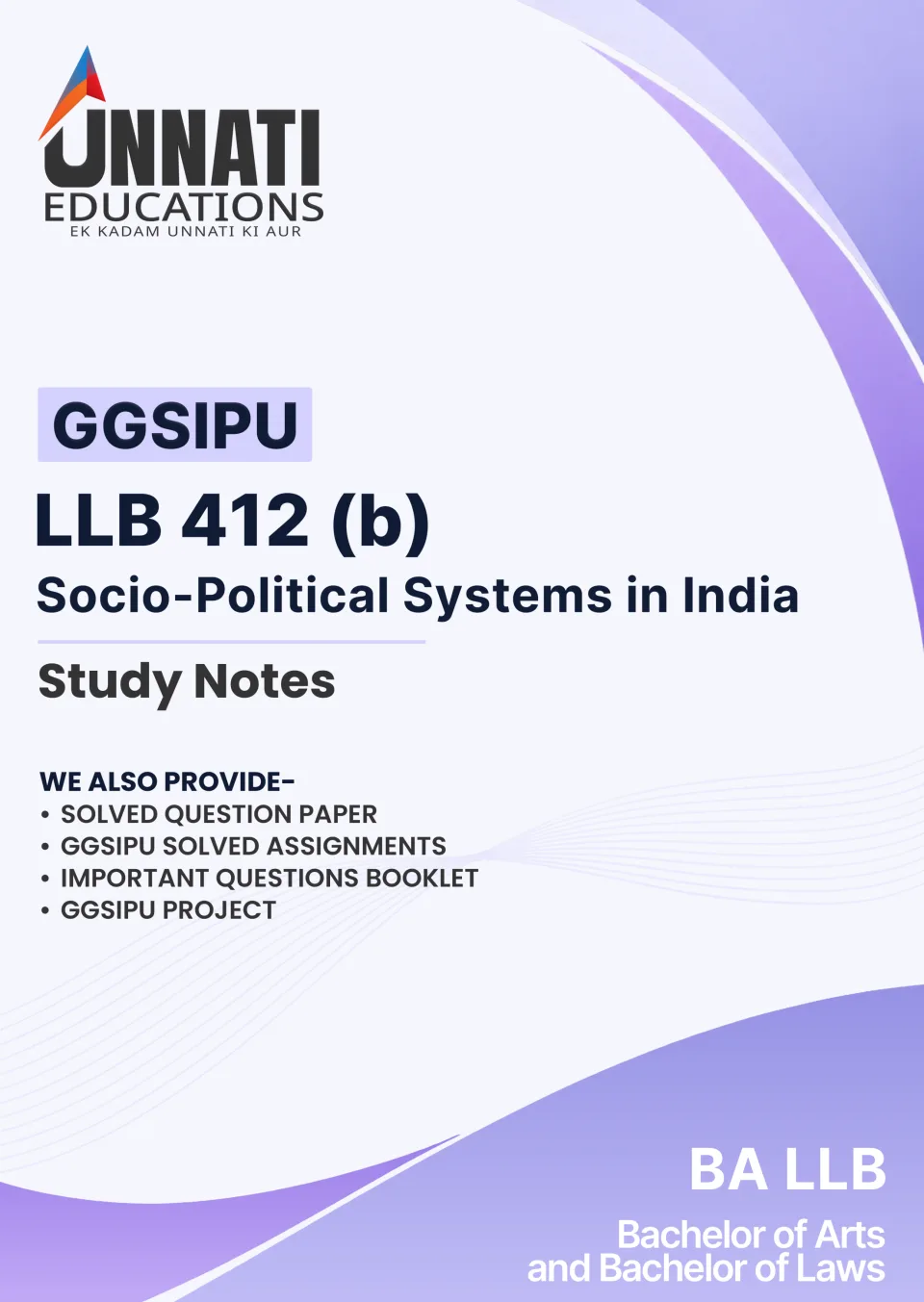
LLB 412 (b) Socio-Political Systems in India Notes cover the Semester 8 elective of GGSIPU BA LLB/BBA LLB (Hons), batch 2021-2026 scheme, in 4 units and 72 pages: 31 diagrams, 10 case-law boxes, over 75 named cases and 92 exam questions, from family, caste and tribes to judicial review, federalism and the UN.
Written by Unnati Educations Editorial Team · Reviewed by Sheetal Kirola, Academic Head, M.Ed., 7 years of experience (Academic review: structure, clarity, syllabus coverage) · Checked against the Integrated BA LLB (Honours) scheme and the Integrated BBA LLB (Honours) scheme · Updated 17 November 2026 · Editorial policy
Scheme: Integrated BA LLB (Honours) and Integrated BBA LLB (Honours), Five Year Integrated Course | Applies to: w.e.f. Batch of 2021-2026 | Verified against: syllballb300924.pdf and syllbballb300924.pdf
LLB 412 (b) Socio-Political Systems in India at a glance: GGSIPU BA LLB/BBA LLB Sem 8 credits, units and exam pattern
LLB 412 is Elective Paper II of Semester 8; option (b) brings sociology and political science into the final law year. These LLB 412 (b) Socio-Political Systems IPU notes follow the same four official units that both the BA LLB and the BBA LLB schemes print for this paper.
| Item | Detail |
|---|---|
| Code and title | LLB 412 (b) Socio-Political Systems in India (Elective Paper II, option b) |
| Course and semester | BA LLB (Hons) Semester 8 and BBA LLB (Hons) Semester 8 |
| Lectures and credits | L5, PSDA 1, 5 credits; 10 lectures per unit; PSDA 1 hour a week |
| Marks split | 100 marks: 75 end-term written + 10 internal written + 15 PSDA |
| End-term pattern | Not printed in the official PDF |
| Units | 4 |
| Applies to | w.e.f. Batch of 2021-2026 |
| Paired lab | None (PSDA activities instead) |
LLB 412 (b) snapshot from the official GGSIPU schemes
- Item
- Code and title
- Detail
- LLB 412 (b) Socio-Political Systems in India (Elective Paper II, option b)
- Item
- Course and semester
- Detail
- BA LLB (Hons) Semester 8 and BBA LLB (Hons) Semester 8
- Item
- Lectures and credits
- Detail
- L5, PSDA 1, 5 credits; 10 lectures per unit; PSDA 1 hour a week
- Item
- Marks split
- Detail
- 100 marks: 75 end-term written + 10 internal written + 15 PSDA
- Item
- End-term pattern
- Detail
- Not printed in the official PDF
- Item
- Units
- Detail
- 4
- Item
- Applies to
- Detail
- w.e.f. Batch of 2021-2026
- Item
- Paired lab
- Detail
- None (PSDA activities instead)
See where this elective sits next to the other final-year papers on the GGSIPU BA LLB Semester 8 papers page.
LLB 412 (b) Socio-Political Systems in India Notes unit-wise: 92 exam questions, 31 diagrams and 10 case-law boxes across 4 units
These GGSIPU BA LLB/BBA LLB Sem 8 Socio-Political Systems in India notes run from page 4 to page 71, and every unit closes with a quick revision table and a question list. Other course papers sit under GGSIPU BA LLB notes.
LLB 412 (b) Unit 1: Human Society
Pages 4 to 22 run from Savigny, Maine and Roscoe Pound on law and society, through social reform laws from Sati (1829) onwards, to family, Hindu Marriage Act 1955, Irawati Karve's kinship zones, secularism (S.R. Bommai, 1994) and Bipan Chandra's stages of communalism. 7 sections, 9 diagrams, 3 case-law boxes, 23 questions.
| Rule | Meaning | Example |
|---|---|---|
| Endogamy | Marriage within one's own group | Within caste, sub-caste or religion |
| Exogamy | Marriage outside a certain group | Gotra, sapinda and village exogamy |
| Hypergamy (Anuloma) | Woman marries a man of higher caste or status | Approved in classical Hindu texts |
| Hypogamy (Pratiloma) | Woman marries a man of lower caste or status | Disapproved in classical Hindu texts |
Quick look: rules of mate selection (from page 13)
- Rule
- Endogamy
- Meaning
- Marriage within one's own group
- Example
- Within caste, sub-caste or religion
- Rule
- Exogamy
- Meaning
- Marriage outside a certain group
- Example
- Gotra, sapinda and village exogamy
- Rule
- Hypergamy (Anuloma)
- Meaning
- Woman marries a man of higher caste or status
- Example
- Approved in classical Hindu texts
- Rule
- Hypogamy (Pratiloma)
- Meaning
- Woman marries a man of lower caste or status
- Example
- Disapproved in classical Hindu texts
LLB 412 (b) Unit 2: Indian Society
Pages 23 to 39 compare Marx and Weber on class, then cover Ghurye's features of caste, Srinivas's Sanskritisation, the Lokur Committee criteria, SC and ST safeguards, violence against women (Vishaka, 1997) and child protection under POCSO 2012. 8 sections, 8 diagrams, 4 case-law boxes, 23 questions.
| Basis | Scheduled Castes | Scheduled Tribes |
|---|---|---|
| Constitutional article | Article 341 | Article 342 |
| National Commission | NCSC, Article 338 | NCST, Article 338A |
| Reservation in central jobs | 15% | 7.5% |
| Special law | PCR Act 1955; SC/ST (PoA) Act 1989 | PESA 1996; FRA 2006; SC/ST (PoA) Act 1989 |
Quick look: Scheduled Castes vs Scheduled Tribes (from page 32)
- Basis
- Constitutional article
- Scheduled Castes
- Article 341
- Scheduled Tribes
- Article 342
- Basis
- National Commission
- Scheduled Castes
- NCSC, Article 338
- Scheduled Tribes
- NCST, Article 338A
- Basis
- Reservation in central jobs
- Scheduled Castes
- 15%
- Scheduled Tribes
- 7.5%
- Basis
- Special law
- Scheduled Castes
- PCR Act 1955; SC/ST (PoA) Act 1989
- Scheduled Tribes
- PESA 1996; FRA 2006; SC/ST (PoA) Act 1989
LLB 412 (b) Unit 3: Concept of State and its Organs
Pages 40 to 55 cover social contract theories, separation of powers (Ram Jawaya Kapur, 1955), classification of constitutions, Parliament under Article 79, the executive (Shamsher Singh, 1974) and judicial review from Marbury v. Madison to the NJAC case (2015). 8 sections, 7 diagrams, 2 case-law boxes, 23 questions.
| Basis | State | Government |
|---|---|---|
| Nature | Abstract, cannot be seen | Concrete: ministers, officials, judges |
| Permanence | Permanent | Changes after elections or revolutions |
| Sovereignty | Sovereign | Exercises sovereignty on behalf of the State |
| Membership | All citizens | Only a few persons |
Quick look: State vs Government (from page 42)
- Basis
- Nature
- State
- Abstract, cannot be seen
- Government
- Concrete: ministers, officials, judges
- Basis
- Permanence
- State
- Permanent
- Government
- Changes after elections or revolutions
- Basis
- Sovereignty
- State
- Sovereign
- Government
- Exercises sovereignty on behalf of the State
- Basis
- Membership
- State
- All citizens
- Government
- Only a few persons
LLB 412 (b) Unit 4: Forms of Government and International Processes
Pages 56 to 71 explain democracy, India as "quasi-federal" (K.C. Wheare) with the GST Council under Article 279A, parliamentary and presidential systems, diplomacy under the Vienna Convention 1961, the UN's six principal organs and NGOs under Article 71 of the UN Charter. 9 sections, 7 diagrams, 1 case-law box, 23 questions.
| Basis | Parliamentary | Presidential |
|---|---|---|
| Executive | Dual: nominal head and real head (PM) | Single: President is both |
| Responsibility | Responsible to the legislature | Not responsible to the legislature |
| Removal | No-confidence motion | Impeachment only |
| Examples | UK, India, Japan, Canada | USA, Brazil, Argentina |
Quick look: parliamentary vs presidential government (from page 62)
- Basis
- Executive
- Parliamentary
- Dual: nominal head and real head (PM)
- Presidential
- Single: President is both
- Basis
- Responsibility
- Parliamentary
- Responsible to the legislature
- Presidential
- Not responsible to the legislature
- Basis
- Removal
- Parliamentary
- No-confidence motion
- Presidential
- Impeachment only
- Basis
- Examples
- Parliamentary
- UK, India, Japan, Canada
- Presidential
- USA, Brazil, Argentina
LLB 412 (b) exam corner: 60 short-answer and 32 long-answer questions by unit
Questions are listed without model answers; the unit pages give the material.
| Unit | Short-answer | Long-answer | Worked items | Diagrams |
|---|---|---|---|---|
| Unit 1: Human Society | 15 | 8 | 0 | 9 |
| Unit 2: Indian Society | 15 | 8 | 0 | 8 |
| Unit 3: Concept of State and its Organs | 15 | 8 | 0 | 7 |
| Unit 4: Forms of Government and International Processes | 15 | 8 | 0 | 7 |
| Total | 60 | 32 | 0 | 31 |
LLB 412 (b) exam questions and diagrams per unit
- Unit
- Unit 1: Human Society
- Short-answer
- 15
- Long-answer
- 8
- Worked items
- 0
- Diagrams
- 9
- Unit
- Unit 2: Indian Society
- Short-answer
- 15
- Long-answer
- 8
- Worked items
- 0
- Diagrams
- 8
- Unit
- Unit 3: Concept of State and its Organs
- Short-answer
- 15
- Long-answer
- 8
- Worked items
- 0
- Diagrams
- 7
- Unit
- Unit 4: Forms of Government and International Processes
- Short-answer
- 15
- Long-answer
- 8
- Worked items
- 0
- Diagrams
- 7
- Unit
- Total
- Short-answer
- 60
- Long-answer
- 32
- Worked items
- 0
- Diagrams
- 31
The LLB 412 (b) notes list 60 short-answer and 32 long-answer exam questions across 4 units, plus 31 diagrams and 10 case-law boxes.
- Unit 1: "Compare Hindu marriage as a sacrament with Muslim marriage as a contract. How has law changed the nature of marriage in India?" Use pages 13 and 14.
- Unit 2: "Discuss the constitutional and legal safeguards for Scheduled Castes and Scheduled Tribes in India. How far have they been successful?" Use pages 31 to 33.
- Unit 3: "What is government? Explain its relation with the State and the doctrine of separation of powers with reference to India." Use pages 42 and 43.
- Unit 4: "India is a federation with a strong unitary bias." Discuss with reference to constitutional provisions and judicial decisions. Use pages 58 to 60.
Judicial review in the Indian political system: excerpt from page 51 of the LLB 412 (b) notes
Excerpt from page 51
Judicial review was not written into the US Constitution; the court created it in Marbury v. Madison (1803). India took a different route: the power is expressly provided in the text of its Constitution.
Where the power comes from
Article 13 makes any law that is inconsistent with Fundamental Rights void. Articles 32 and 226 give the Supreme Court and the High Courts their writ jurisdiction. Articles 131 to 136 add original and appellate jurisdiction, while Articles 245 and 246 divide legislative power between the Union and the States. Articles 251 and 254 settle repugnancy between Central and State laws, and Article 372 makes pre-constitutional laws conform to the Constitution.
Three things courts can review
First, legislative action: does a law violate Fundamental Rights or go beyond the legislature's competence? Second, executive and administrative action, tested on illegality, irrationality and procedural impropriety, the Wednesbury principles applied in Tata Cellular v. Union of India (1994). Third, constitutional amendments, which are checked against the basic structure.
How the courts built the doctrine
A.K. Gopalan v. State of Madras (1950) read "procedure established by law" narrowly and kept each Fundamental Right in a separate compartment. Shankari Prasad (1951) let Parliament amend Fundamental Rights, while I.C. Golaknath (1967) said it could not. Kesavananda Bharati (1973), decided by thirteen judges, settled the matter: Parliament may amend any part of the Constitution but cannot alter its basic structure.
Indira Nehru Gandhi v. Raj Narain (1975) struck down clause 4 of the 39th Amendment. Maneka Gandhi (1978) required procedure under Article 21 to be just, fair and reasonable, linking Articles 14, 19 and 21. Minerva Mills (1980) struck down clauses (4) and (5) of Article 368 and named judicial review a basic feature.
L. Chandra Kumar (1997) protected the review power of the High Courts and the Supreme Court, I.R. Coelho (2007) opened Ninth Schedule laws placed after 24 April 1973 to review, and the NJAC case (2015) struck down the 99th Amendment to protect judicial independence.
Do the LLB 412 (b) notes cover the full GGSIPU syllabus?
Yes for all four units: every official topic has its own numbered section. The four PSDA activities are not written up in the notes.
| Official unit | Official topics | Where in the notes | Status |
|---|---|---|---|
| Unit I: Human Society | Society and law; social transformation; family, marriage, kinship; religion, secularism, fundamentalism, communalism | Sections 1 to 7, pages 4 to 20 | Covered |
| Unit II: Indian Society | Class (Marx, Weber); caste, varna; tribes; SCs and STs; gender; violence against women; children | Sections 1 to 8, pages 23 to 37 | Covered |
| Unit III: Concept of State and its Organs | Government and State; constitution; legislature; executive; judiciary, judicial review, independence | Sections 1 to 8, pages 40 to 53 | Covered |
| Unit IV: Forms of Government and International Processes | Democracy; unitary and federal; parliamentary and presidential; diplomacy, UN; international organisations, NGOs | Sections 1 to 9, pages 56 to 69 | Covered |
| PSDA (1 hour a week) | NGO visit report; film screening; seminar; parliamentary discussions | Not written up | Partly covered |
LLB 412 (b) official topics mapped to the notes
- Official unit
- Unit I: Human Society
- Official topics
- Society and law; social transformation; family, marriage, kinship; religion, secularism, fundamentalism, communalism
- Where in the notes
- Sections 1 to 7, pages 4 to 20
- Status
- Covered
- Official unit
- Unit II: Indian Society
- Official topics
- Class (Marx, Weber); caste, varna; tribes; SCs and STs; gender; violence against women; children
- Where in the notes
- Sections 1 to 8, pages 23 to 37
- Status
- Covered
- Official unit
- Unit III: Concept of State and its Organs
- Official topics
- Government and State; constitution; legislature; executive; judiciary, judicial review, independence
- Where in the notes
- Sections 1 to 8, pages 40 to 53
- Status
- Covered
- Official unit
- Unit IV: Forms of Government and International Processes
- Official topics
- Democracy; unitary and federal; parliamentary and presidential; diplomacy, UN; international organisations, NGOs
- Where in the notes
- Sections 1 to 9, pages 56 to 69
- Status
- Covered
- Official unit
- PSDA (1 hour a week)
- Official topics
- NGO visit report; film screening; seminar; parliamentary discussions
- Where in the notes
- Not written up
- Status
- Partly covered
Verify the topics yourself in the official Integrated BA LLB (Honours) scheme and Integrated BBA LLB (Honours) scheme PDFs; the scheme table spells the title "System", the paper page "Systems".
Notes for other courses and papers sit in the GGSIPU notes section.
Who writes and checks the LLB 412 (b) socio-political systems notes?
- Unnati Educations Editorial Team, author: unit text, tables, diagrams and question lists.
- Sheetal Kirola, Academic Head, M.Ed., 7 years of experience: academic review of structure, clarity and syllabus coverage.
The notes are mapped to the 2021-2026 BA LLB and BBA LLB schemes. The 2026-27 edition cites BNS and BNSS 2023 sections, Dr. Balram Singh (2024), State of Punjab v. Davinder Singh (2024) and Uttarakhand's UCC (2025). Updated 17 November 2026; read our editorial policy.
LLB 412 (b) and the GGSIPU BA LLB/BBA LLB Sem 8 papers it connects to
LLB 412 (b) is a theory paper with no lab, plus one PSDA hour a week. Both schemes list LLB 402 Intellectual Property Rights-II, LLB 404 Interpretation of Statutes, LLB 406 Labour Law-II, LLB 408 International Trade Law and LLB 410 Income Tax Law beside it. The other LLB 412 options are (a) Criminology, Victimology and Penology, (c) Women and Law, (d) International Commercial Laws and (e) Comparative Constitutional Law.
BA LLB students met caste and tribes in BA LLB 110 Sociology II: Indian Society and diplomacy in BA LLB 212 Political Science III: International Relations. Unit 3's judicial review builds on LLB 106 Constitutional Law-I and LLB 205 Constitutional Law-II.
How to write LLB 412 (b) answers: thinker quotes, Articles and Supreme Court cases
The notes' exam tips give a pattern: define the term, explain it with Indian examples, then quote thinkers such as Savigny, Pound and Durkheim. For secularism, fundamentalism and communalism, write each under its own heading as definition, features, causes and remedies, and cite S.R. Bommai (1994).
Write Articles with their clause, such as Art. 124(4), and cases with the year in brackets. Close Marx versus Weber or parliamentary versus presidential answers with a comparison table, and end the second with Ambedkar's responsibility versus stability argument.
Worked outline: "An independent judiciary is the cornerstone of democracy." Discuss (Unit 3, pages 52 and 53)
- Meaning: freedom from the legislature, executive and parties; Hamilton's "least dangerous" branch (page 52).
- Need: rights, rule of law, Centre-State disputes (page 52).
- Safeguards: at least 8 Articles, including 124(2), 124(4), 112(3)(d), 121, 125 and 50 (pages 52 and 53).
- Judges cases and challenges: S.P. Gupta (1981) to the NJAC case (2015), collegium transparency and pendency, then a conclusion that independence is part of the basic structure (page 53).
LLB 412 (b) socio-political systems notes FAQs
How do I get the full LLB 412 (b) notes?
Message us on WhatsApp at 9899436384 and ask for the LLB 412 (b) notes book. The full notes come only as a printed book, not as a PDF. Delivery takes a maximum of 5-7 days, depending on your location. Price and payment details are shared on WhatsApp. You can check the style first through the "View Sample PDF" button above.
How is LLB 412 (b) marked, and what is the pass mark?
LLB 412 (b) carries 100 marks: 75 in the semester-end written exam run by the Examination Division, 10 for internal written tests and 15 for PSDA evaluation by your subject teacher. Neither scheme PDF prints a pass percentage or a paper-setting pattern for this paper, so check the pass rule in Ordinance 11 or with your institute.
Which LLB 412 (b) unit is the biggest?
Unit 1, Human Society, is the biggest: 19 pages (4 to 22), 7 sections and 9 diagrams. It packs four official topics, from Durkheim's repressive and restitutive law to marriage, kinship and secularism. Unit 2 follows with 17 pages and 8 sections, while Units 3 and 4 run to 16 pages each, with 7 diagrams apiece.
Do the LLB 412 (b) notes give model answers to the exam questions?
No. The LLB 412 (b) notes list 92 exam questions, 15 short-answer and 8 long-answer per unit, without model answers. Each question matches a numbered section, so you build the answer from that section's tables, thinker definitions and case-law boxes. The how-to section above shows one outline built this way for the independence of the judiciary.
Which Articles and cases do the LLB 412 (b) notes use?
The notes name over 75 cases. Unit 1 leans on Navtej Singh Johar (2018) and Shayara Bano (2017); Unit 2 on Indra Sawhney (1992) and Vishaka (1997); Unit 3 on Kesavananda Bharati (1973) and Minerva Mills (1980); Unit 4 on S.R. Bommai (1994). Key Articles include 17, 32, 226, 279A, 341, 342 and 368, each cited with its clause.
Is LLB 412 (b) the same paper for BA LLB and BBA LLB students?
Yes. The BA LLB and BBA LLB schemes for the 2021-2026 batch onwards both list LLB 412 (b) Socio-Political Systems in India in Semester 8, with L5, PSDA 1 and 5 credits, the same four units and the same PSDA activities. So one notes book serves both courses, and the course outcome even mentions business administration students by name.
Get the full LLB 412 (b) Socio-Political Systems in India Notes on WhatsApp
| Unit | Pages |
|---|---|
| Unit 1: Human Society | 4 to 22 (19 pages) |
| Unit 2: Indian Society | 23 to 39 (17 pages) |
| Unit 3: Concept of State and its Organs | 40 to 55 (16 pages) |
| Unit 4: Forms of Government and International Processes | 56 to 71 (16 pages) |
LLB 412 (b) notes book: pages per unit
- Unit
- Unit 1: Human Society
- Pages
- 4 to 22 (19 pages)
- Unit
- Unit 2: Indian Society
- Pages
- 23 to 39 (17 pages)
- Unit
- Unit 3: Concept of State and its Organs
- Pages
- 40 to 55 (16 pages)
- Unit
- Unit 4: Forms of Government and International Processes
- Pages
- 56 to 71 (16 pages)
The 72-page book holds 31 diagrams, 10 case-law boxes, 4 quick revision tables and 92 exam questions. These are Socio-Political Systems in India notes in English. It is a printed book only, not a PDF, and delivery takes a maximum of 5-7 days, depending on your location. Price and payment are shared on WhatsApp.
Get the full LLB 412 (b) notes book on WhatsApp (4 units, 72 pages)
Unnati Educations is an independent education provider based in Vikaspuri, Delhi. We are not affiliated with, authorised by, or endorsed by Guru Gobind Singh Indraprastha University (GGSIPU). 'GGSIPU' and 'IPU' are used only to describe the syllabus our notes follow. For official information, visit ipu.ac.in.
Ready for the full notes?
Discuss coverage and delivery with our team.