
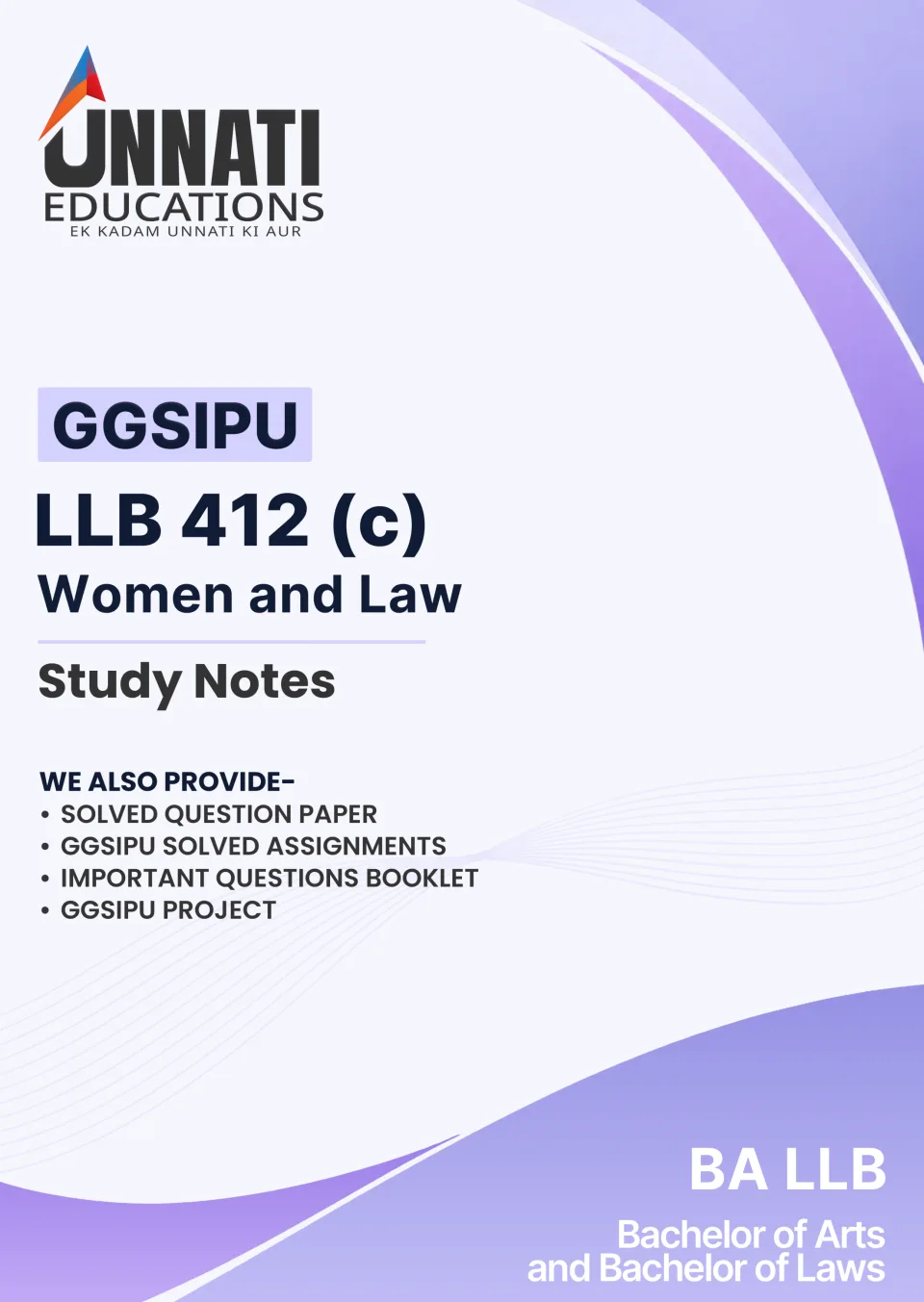
LLB 412 C Women and Law Notes for GGSIPU BA LLB/BBA LLB Semester 8 cover all 4 units in a 73-page printed book: women and the Constitution, personal laws, law of crimes and special enactments. They hold 41 case-law boxes, 18 diagrams and 80 exam questions, mapped to the Integrated BA LLB (Honours) scheme for the Batch of 2021-2026.
Written by Unnati Educations Editorial Team · Reviewed by Sheetal Kirola, Academic Head, M.Ed., 7 years of experience (academic review) · Checked against USLLS Scheme of Examination and Detailed Syllabus for Integrated BA LLB (Honours) · Updated 17 November 2026 · Editorial policy
Scheme: Integrated BA LLB (Honours), Five Year Integrated Course | Applies to: Batch of 2021-2026 | Verified against: USLLS Scheme of Examination and Detailed Syllabus for Integrated BA LLB (Honours)
LLB 412 C Women and Law at a glance: GGSIPU BA LLB/BBA LLB Sem 8 credits, units and exam pattern
LLB 412 (c) is one of five Elective Paper-II options in Semester 8. These LLB 412 C Women and Law IPU notes follow the four official units, from CEDAW to the POSH Act.
| Code and title | LLB 412 (c) Women and Law (Elective Paper-II, Cluster 2) |
|---|---|
| Course and semester | Integrated BA LLB (Honours), Semester 8 (notes cover: BA LLB/BBA LLB) |
| Lectures and credits | L5, PSDA 1 hour a week, 5 credits; 10 lectures per unit |
| Marks split | 100 = 75 end-term + 10 internal written + 15 PSDA |
| End-term pattern | Not printed in the official PDF |
| Units | 4 |
| Applies to | Batch of 2021-2026 |
| Paired lab | None (theory elective with PSDA) |
See where this elective sits beside LLB 402 to LLB 410 in the GGSIPU BA LLB Semester 8 papers.
LLB 412 C Women and Law Notes unit-wise: 41 case-law boxes, 18 diagrams and 80 exam questions across 4 units
The GGSIPU BA LLB/BBA LLB Sem 8 Women and Law notes run from page 4 to page 72; each unit ends with a revision table and question list. Other papers of the course sit in the GGSIPU BA LLB notes.
LLB 412 C Unit 1: Women and Constitution
Pages 4-23 trace women's status from the Vedic period to today, four religions, the UN conventions, CEDAW, DEVAW 1993, Articles 15(3), 39(d) and 51A(e), and the 73rd, 74th and 106th Amendments. Counts: 5 case-law boxes, 6 diagrams, 23 questions.
| Article | Right |
|---|---|
| Article I | Vote in all elections on equal terms with men |
| Article II | Stand for all publicly elected bodies |
| Article III | Hold public office and exercise public functions |
| Articles IV-XI | Procedure: ratification, reservations, ICJ disputes |
Quick look: Convention on the Political Rights of Women, 1953 (from page 11)
- Article
- Article I
- Right
- Vote in all elections on equal terms with men
- Article
- Article II
- Right
- Stand for all publicly elected bodies
- Article
- Article III
- Right
- Hold public office and exercise public functions
- Article
- Articles IV-XI
- Right
- Procedure: ratification, reservations, ICJ disputes
LLB 412 C Unit 2: Women and Personal Laws
Pages 24-40 compare divorce, guardianship, adoption, maintenance and inheritance across four communities (Githa Hariharan, Shah Bano, Vineeta Sharma), then Article 44, Sarla Mudgal, Seema v. Ashwani Kumar and the Uttarakhand UCC 2024. Counts: 12 case-law boxes, 3 diagrams, 20 questions.
| HAMA section | 1956 position | After the 2010 amendment |
|---|---|---|
| Section 7 | Husband adopts with wife's consent | Unchanged |
| Section 8 | Married woman could not adopt | Can adopt with husband's consent |
| Section 9 | Father alone gives in adoption | Father or mother, with the other's consent |
Quick look: Hindu adoption rules before and after 2010 (from page 29)
- HAMA section
- Section 7
- 1956 position
- Husband adopts with wife's consent
- After the 2010 amendment
- Unchanged
- HAMA section
- Section 8
- 1956 position
- Married woman could not adopt
- After the 2010 amendment
- Can adopt with husband's consent
- HAMA section
- Section 9
- 1956 position
- Father alone gives in adoption
- After the 2010 amendment
- Father or mother, with the other's consent
LLB 412 C Unit 3: Women and Law of Crimes
Pages 41-54 cover Section 497 IPC up to Joseph Shine, rape law from the Mathura case to the 2018 amendment and BNS sections 63-72, rape versus attempt (Madan Lal), the victim's character, and Sections 354 and 509 IPC. Counts: 14 case-law boxes, 3 diagrams, 19 questions.
| Basis | s. 354 IPC (s. 74 BNS) | s. 509 IPC (s. 79 BNS) |
|---|---|---|
| Nature | Assault or criminal force | Words, gestures, sounds, objects |
| Mental element | Intent or knowledge to outrage modesty | Intent to insult modesty |
| Punishment | 1 to 5 years and fine | Simple imprisonment up to 3 years and fine |
| Bail | Cognizable, non-bailable | Cognizable, bailable |
Quick look: Section 354 IPC versus Section 509 IPC (from page 51)
- Basis
- Nature
- s. 354 IPC (s. 74 BNS)
- Assault or criminal force
- s. 509 IPC (s. 79 BNS)
- Words, gestures, sounds, objects
- Basis
- Mental element
- s. 354 IPC (s. 74 BNS)
- Intent or knowledge to outrage modesty
- s. 509 IPC (s. 79 BNS)
- Intent to insult modesty
- Basis
- Punishment
- s. 354 IPC (s. 74 BNS)
- 1 to 5 years and fine
- s. 509 IPC (s. 79 BNS)
- Simple imprisonment up to 3 years and fine
- Basis
- Bail
- s. 354 IPC (s. 74 BNS)
- Cognizable, non-bailable
- s. 509 IPC (s. 79 BNS)
- Cognizable, bailable
LLB 412 C Unit 4: Women and Special Enactments/Legislations
Pages 55-72 explain the Immoral Traffic (Prevention) Act, 1956, Vishaka and the POSH Act, 2013, the Protection of Women from Domestic Violence Act, 2005 (Hiral Harsora) and all 17 schemes in the syllabus. Counts: 10 case-law boxes, 6 diagrams, 18 questions.
Quick look: reliefs a Magistrate can grant under the PWDVA, 2005 (from page 63)
- Section 18: protection order against further violence or contact.
- Section 19: residence order so she is not thrown out of the shared household.
- Section 20: monetary relief, over and above s. 144 BNSS maintenance.
- Section 21: temporary custody of the children.
- Section 22: compensation, including for mental torture.
LLB 412 C exam corner: 52 short-answer and 28 long-answer questions by unit
The notes list these questions without model answers, so use them as practice questions with the page pointers below.
| Unit | Short-answer | Long-answer | Case-law boxes | Diagrams |
|---|---|---|---|---|
| Unit 1 | 15 | 8 | 5 | 6 |
| Unit 2 | 13 | 7 | 12 | 3 |
| Unit 3 | 12 | 7 | 14 | 3 |
| Unit 4 | 12 | 6 | 10 | 6 |
| Total | 52 | 28 | 41 | 18 |
LLB 412 C exam questions, case-law boxes and diagrams per unit
- Unit
- Unit 1
- Short-answer
- 15
- Long-answer
- 8
- Case-law boxes
- 5
- Diagrams
- 6
- Unit
- Unit 2
- Short-answer
- 13
- Long-answer
- 7
- Case-law boxes
- 12
- Diagrams
- 3
- Unit
- Unit 3
- Short-answer
- 12
- Long-answer
- 7
- Case-law boxes
- 14
- Diagrams
- 3
- Unit
- Unit 4
- Short-answer
- 12
- Long-answer
- 6
- Case-law boxes
- 10
- Diagrams
- 6
- Unit
- Total
- Short-answer
- 52
- Long-answer
- 28
- Case-law boxes
- 41
- Diagrams
- 18
The LLB 412 C notes list 52 short-answer and 28 long-answer exam questions across 4 units, plus 41 case-law boxes and 18 diagrams.
- Unit 1: "Article 15(3) is a source of protective discrimination in favour of women." Discuss with case law. Pointer: pages 17-18 (Air India v. Nergesh Meerza).
- Unit 2: Muslim women's right to maintenance has been shaped by judicial activism. Discuss. Pointer: pages 30-31 (Shah Bano, Danial Latifi).
- Unit 3: Distinguish between rape and attempt to rape. Pointer: comparison table on page 48.
- Unit 4: What is domestic violence? Explain its types, effects and the reliefs under the PWDVA, 2005. Pointer: pages 61-63.
Joseph Shine and Section 497 IPC in women and criminal law: excerpt from page 44 of the LLB 412 C notes
Excerpt from page 44
The case at a glance
In Joseph Shine v. Union of India, (2019) 3 SCC 39, decided on 27 September 2018, a non-resident Keralite filed a public interest petition under Article 32 against Section 497 IPC and Section 198(2) CrPC. A five-judge Constitution Bench of CJI Dipak Misra, with Justice A.M. Khanwilkar, and Justices R.F. Nariman, D.Y. Chandrachud and Indu Malhotra heard it. All five agreed.
What the Court held
Section 497 was struck down as unconstitutional, and Section 198(2) CrPC fell to the extent it applied to adultery. The earlier rulings in Yusuf Abdul Aziz, Sowmithri Vishnu and V. Revathi were overruled. Adultery still remains a ground for divorce as a civil wrong, and if it drives a spouse to suicide, abetment of suicide under Section 306 IPC can apply.
The five grounds
- Article 14: the law treated the wife as her husband's property, since his consent made the act lawful. That is manifestly arbitrary.
- Article 15(1): it rested on the stereotype that the man always seduces and the woman is a passive victim. Article 15(3) protects beneficial laws, not laws that keep women subordinate.
- Article 21: it denied a woman dignity and sexual autonomy. After Puttaswamy, choosing a sexual partner is part of personal liberty.
- Criminal law principles: adultery is a private wrong between spouses, not a public wrong, so it fails the test for making conduct a crime.
- Marriage as equal partnership: a woman does not hand her autonomy to her husband on marriage.
Critical evaluation
The judgment treats women as equal and autonomous persons and builds the anti-stereotyping principle under Article 15. Critics said it could weaken marriage, and some preferred a gender-neutral offence.
In January 2023 the Supreme Court clarified that service personnel can still face disciplinary action under the Army, Navy and Air Force Acts. A 2023 Parliamentary Standing Committee suggested bringing back a gender-neutral offence, but the BNS left adultery out, while Section 84 BNS (old Section 498 IPC) on enticing a married woman remains.
Do the LLB 412 C notes cover the full GGSIPU syllabus?
Yes for all four units; the PSDA activities are partly covered with guidance only.
| Official unit | Official topics | Where in the notes | Status |
|---|---|---|---|
| Unit I: Women and Constitution | Status by period; religions; UN conventions; CEDAW; DEVAW; Preamble, FRs, DPSP, duties; 73rd and 74th Amendments | Pages 4-20 | Covered |
| Unit II: Women and Personal Laws | Divorce, guardianship, adoption, maintenance, inheritance; UCC, marriage registration, Law Commission | Pages 24-38 | Covered |
| Unit III: Women and Law of Crimes | Adultery; rape law and 2013 changes; Sections 354 and 509 | Pages 41-52 | Covered |
| Unit IV: Women and Special Enactments/Legislations | ITPA; workplace sexual harassment; domestic violence; 17 schemes | Pages 55-70 | Covered |
| PSDA | NCW visit; judgment analysis; research paper | Page 71 (how-to guidance) | Partly covered |
LLB 412 C official syllabus mapped to the notes
- Official unit
- Unit I: Women and Constitution
- Official topics
- Status by period; religions; UN conventions; CEDAW; DEVAW; Preamble, FRs, DPSP, duties; 73rd and 74th Amendments
- Where in the notes
- Pages 4-20
- Status
- Covered
- Official unit
- Unit II: Women and Personal Laws
- Official topics
- Divorce, guardianship, adoption, maintenance, inheritance; UCC, marriage registration, Law Commission
- Where in the notes
- Pages 24-38
- Status
- Covered
- Official unit
- Unit III: Women and Law of Crimes
- Official topics
- Adultery; rape law and 2013 changes; Sections 354 and 509
- Where in the notes
- Pages 41-52
- Status
- Covered
- Official unit
- Unit IV: Women and Special Enactments/Legislations
- Official topics
- ITPA; workplace sexual harassment; domestic violence; 17 schemes
- Where in the notes
- Pages 55-70
- Status
- Covered
- Official unit
- PSDA
- Official topics
- NCW visit; judgment analysis; research paper
- Where in the notes
- Page 71 (how-to guidance)
- Status
- Partly covered
Verify every topic yourself in the official BA LLB (Honours) syllabus PDF on ipu.ac.in, pages 135-137.
Notes for other courses and semesters are listed under GGSIPU notes.
Who writes and checks the LLB 412 C women's rights law notes?
- Unnati Educations Editorial Team (author): writes the four units against the official LLB 412 (c) syllabus and adds IPC to BNS mapping.
- Sheetal Kirola (reviewer): Academic Head, Unnati Educations · M.Ed. · 7 years of experience. Role: academic review of structure, clarity and syllabus coverage.
Mapped to the Integrated BA LLB (Honours) scheme for the Batch of 2021-2026. New in the 2026-27 edition: BNS and BNSS numbers, the 106th Amendment (2023), Mohd. Abdul Samad (2024) and the Uttarakhand UCC 2024. Updated 17 November 2026. Read our editorial policy.
LLB 412 C and the GGSIPU BA LLB/BBA LLB Sem 8 papers it connects to
LLB 412 C is a theory elective with no lab; its practical side is the PSDA hour. Semester 8 also has LLB 402 Intellectual Property Rights-II, LLB 404 Interpretation of Statutes, LLB 406 Labour Law-II, LLB 408 International Trade Law and LLB 410 Income Tax Law.
Units 2 and 3 build on LLB 201 and LLB 202 Family Law and LLB 203 Law of Crimes-I. In Semester 9, the elective LLB 509 (c) Socio Legal Dimensions of Gender Justice takes the CEDAW and equality material of Unit 1 further.
How to write LLB 412 C answers: Articles, IPC and BNS sections and landmark judgments
Answers in this paper rest on three things: the provision, the case and the reform. Name the Article or section first (Section 354 IPC, now Section 74 BNS), then a case with its year, then what changed. The notes' exam tips also suggest a four-community comparison table for personal law questions.
Worked outline: "What is a Uniform Civil Code? Discuss judicial trends." (pages 33-39)
- Meaning, Article 44 and Entry 5 of List III (pages 33-34).
- Background: Lex Loci Report 1840 and the Constituent Assembly debate of 23 November 1948 (pages 33-34).
- Constitutional angle: Articles 14, 15, 21 and 25(2)(b) against Articles 25, 26 and 29 (page 34).
- Cases: Shah Bano, Sarla Mudgal, Lily Thomas, Ahmedabad Women Action Group, John Vallamattom (pages 35-36).
- End with the 2018 Law Commission view, the Uttarakhand UCC 2024 and your own conclusion (pages 35, 38).
LLB 412 C women's rights law notes FAQs
How do I get the full LLB 412 C notes?
Message the Unnati Educations desk on WhatsApp at 9899436384 and ask for the LLB 412 C notes book. The full notes come only as a printed book, not as a PDF. Delivery takes a maximum of 5-7 days, depending on your location. Price and payment details are shared on WhatsApp. You can check the quality first with the View Sample PDF button at the top of this page.
How is LLB 412 C marked, and what is the pass mark?
LLB 412 C carries 100 marks: 75 for the semester-end written exam, 10 for internal written tests and 15 for PSDA work, as the official scheme states. The scheme PDF does not print a pass percentage for this paper. Check the passing rules in Ordinance 11 or ask your institute, since rules can change between batches.
Which is the biggest unit in LLB 412 C?
Unit 1, Women and Constitution, is the biggest at 20 pages (pages 4-23) with 6 diagrams and 23 exam questions. It covers status by period, women under four religions, the UN conventions, CEDAW with India's reservation on Article 29(1), DEVAW 1993 and the constitutional provisions. Unit 3 has the most case-law boxes, 14, because rape, adultery and modesty law rests heavily on judgments.
Do the LLB 412 C notes give model answers to the exam questions?
No. The LLB 412 C notes list 80 exam questions at the end of the units but do not print model answers for them. What they give instead is the material to answer each one: 41 case-law boxes with facts and holdings, 11 exam-tip boxes on how to structure answers, and a quick revision table for every unit. Use the page pointers on this page to locate each topic.
Do the LLB 412 C notes follow IPC or BNS section numbers?
Both. Since most judgments in the LLB 412 C syllabus were decided under the IPC, the notes keep IPC numbers and add the Bharatiya Nyaya Sanhita, 2023 equivalent beside them. Examples: Section 354 IPC is Section 74 BNS, Section 509 is Section 79 BNS, rape under Sections 375-376 is Sections 63-64 BNS, and Section 125 CrPC maintenance is Section 144 BNSS.
Which earlier papers help with LLB 412 C?
LLB 412 C reuses three earlier papers. Family Law-I and II (LLB 201 and LLB 202) help with the divorce, adoption and inheritance rules in Unit 2. Law of Crimes-I (LLB 203) gives the base for Sections 354, 375 and 497 in Unit 3. Constitutional Law-I (LLB 106) supports the Articles 14, 15(3) and 21 reasoning used across Units 1 and 3.
Do the LLB 412 C notes cover the PSDA activities?
Partly. Page 71 of the LLB 412 C notes explains how to do the three PSDA activities in the syllabus: a visit to the National Commission for Women or a State Commission, a judgment analysis (for example Joseph Shine or Vishaka) and a research paper on a topic such as the marital rape exception. It gives structures and topic ideas, not a ready-made report to submit.
Get the full LLB 412 C Women and Law Notes on WhatsApp
| Unit | Pages |
|---|---|
| Unit 1: Women and Constitution | 4-23 (20 pages) |
| Unit 2: Women and Personal Laws | 24-40 (17 pages) |
| Unit 3: Women and Law of Crimes | 41-54 (14 pages) |
| Unit 4: Women and Special Enactments/Legislations | 55-72 (18 pages) |
LLB 412 C notes book: pages per unit
- Unit
- Unit 1: Women and Constitution
- Pages
- 4-23 (20 pages)
- Unit
- Unit 2: Women and Personal Laws
- Pages
- 24-40 (17 pages)
- Unit
- Unit 3: Women and Law of Crimes
- Pages
- 41-54 (14 pages)
- Unit
- Unit 4: Women and Special Enactments/Legislations
- Pages
- 55-72 (18 pages)
The full book runs to 73 pages with 80 exam questions, 41 case-law boxes and 18 diagrams, as Women and Law notes in English. It is a printed book only, not a PDF, and delivery takes a maximum of 5-7 days, depending on your location. Price and payment are shared on WhatsApp.
Get the full LLB 412 C notes book on WhatsApp (4 units, 73 pages)
Unnati Educations is an independent education provider based in Vikaspuri, Delhi. We are not affiliated with, authorised by, or endorsed by Guru Gobind Singh Indraprastha University (GGSIPU). 'GGSIPU' and 'IPU' are used only to describe the syllabus our notes follow. For official information, visit ipu.ac.in.
Ready for the full notes?
Discuss coverage and delivery with our team.