
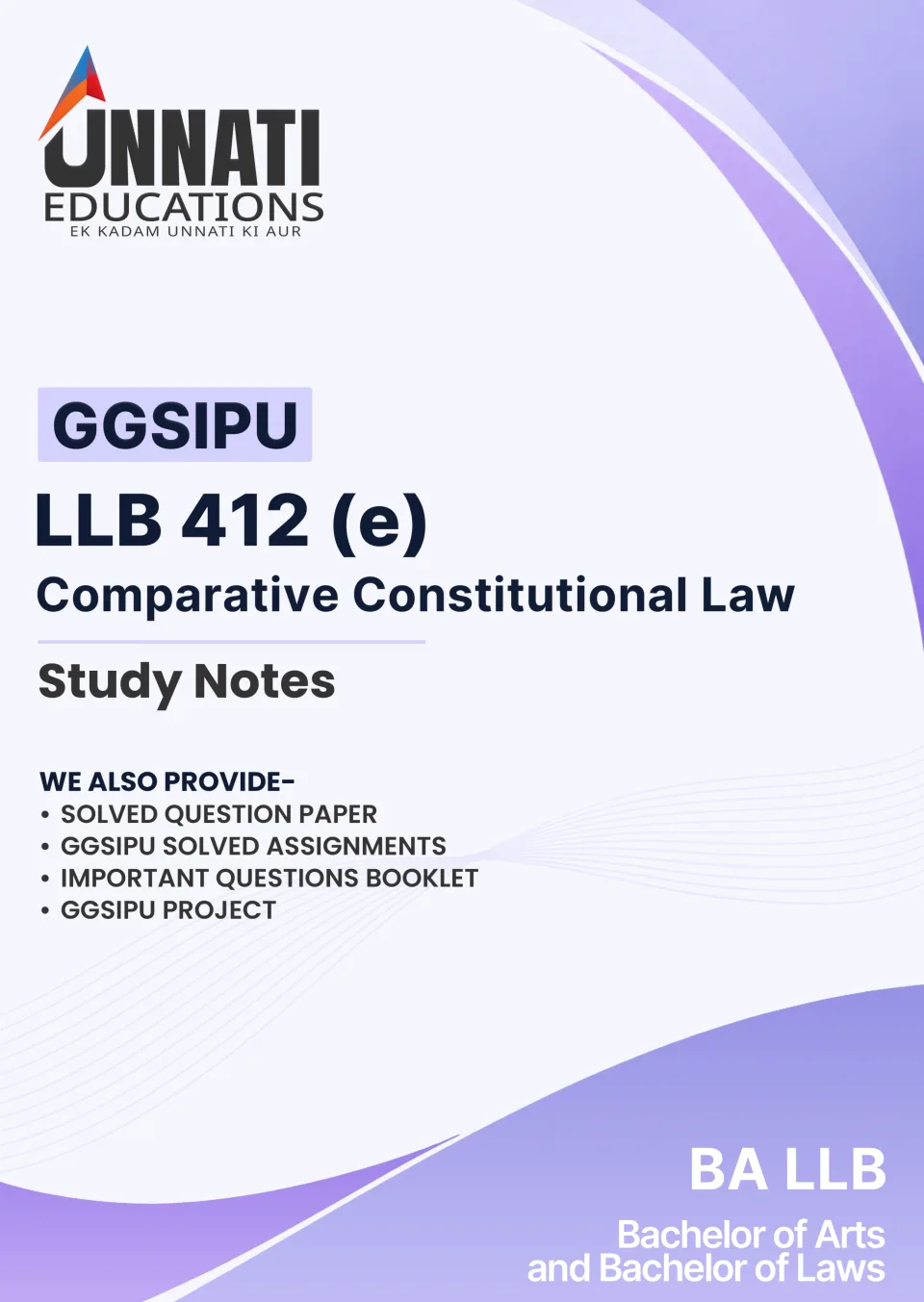
LLB 412 (e) Comparative Constitutional Law Notes cover all 4 units of the Semester 8 elective for GGSIPU BA LLB/BBA LLB in a 56-page printed book: 30 sections, 40 case-law boxes, 16 diagrams, 9 comparative tables and 75 exam questions. They follow the Integrated BA LLB (Honours) syllabus for the Batch of 2021-2026.
Written by Unnati Educations Editorial Team · Reviewed by Prateek Talwar, Associate Company Secretary (ACS), ICSI (legal concepts review) · Checked against Scheme of Examination and Detailed Syllabus for Integrated BA LLB (Honours), USLLS · Updated 17 November 2026 · Editorial policy
Scheme: Integrated BA LLB (Honours) | Applies to: Batch of 2021-2026 | Verified against: Scheme of Examination and Detailed Syllabus for Integrated BA LLB (Honours)
LLB 412 (e) Comparative Constitutional Law at a glance: GGSIPU BA LLB/BBA LLB Sem 8 credits, units and exam pattern
LLB 412 (e) is option (e) of Elective Paper-II in Semester 8. It sets the Indian Constitution beside the USA, UK, Canada, France, Switzerland, Sweden and South Africa, and these LLB 412 (e) Comparative Constitutional Law IPU notes follow its four-unit plan.
| Code and title | LLB 412 (e) Comparative Constitutional Law (Elective Paper-II) |
|---|---|
| Course and semester | Integrated BA LLB (Honours), Semester 8 in the official scheme; the notes cover also lists BBA LLB |
| Lectures and credits | L5, PSDA 1 hour per week, 5 credits |
| Marks split | 100 marks: 75 end-term written + 10 internal written + 15 PSDA |
| End-term pattern | Not printed in the official PDF |
| Units | 4 (General · Specific Themes · Review of Constitution · Transparency and Accountability in Governance) |
| Applies to | Batch of 2021-2026 |
| Paired lab | None |
The other electives and core papers of this term are listed on the GGSIPU BA LLB Semester 8 papers page.
LLB 412 (e) Comparative Constitutional Law Notes unit-wise: 30 sections, 40 case-law boxes and 16 diagrams across 4 units
These Comparative Constitutional Law notes in English go country by country, and every unit ends with a quick revision table and exam questions. Other papers of the course sit under GGSIPU BA LLB notes.
LLB 412 (e) Unit 1: General
Pages 4 to 19. Covers methods of comparison (Zweigert and Kötz, Kahn-Freund on legal transplants), parliamentary vs presidential government with Ram Jawaya Kapur, and federalism in the USA, Canada and India through McCulloch v. Maryland, the Quebec Secession Reference and S. R. Bommai. 7 sections, 12 case-law boxes, 6 diagrams.
| Basis | USA | Canada | India |
|---|---|---|---|
| Residuary power | States (10th Amendment) | Centre (POGG) | Union (Art. 248) |
| Citizenship | Double | Single | Single |
| Judiciary | Dual | Integrated | Integrated |
| Boundary change | Not without State consent | Not without provincial consent | By Parliament under Art. 3 |
Quick look: federalism in the USA, Canada and India (from page 15)
- Basis
- Residuary power
- USA
- States (10th Amendment)
- Canada
- Centre (POGG)
- India
- Union (Art. 248)
- Basis
- Citizenship
- USA
- Double
- Canada
- Single
- India
- Single
- Basis
- Judiciary
- USA
- Dual
- Canada
- Integrated
- India
- Integrated
- Basis
- Boundary change
- USA
- Not without State consent
- Canada
- Not without provincial consent
- India
- By Parliament under Art. 3
LLB 412 (e) Unit 2: Specific Themes
Pages 20 to 32. Moves from Dicey to formal (Raz, Fuller) and substantive (Bingham) rule of law, separation of powers in the USA (Youngstown), UK, France and India, secularism from the Lemon test to laïcité, and social justice through Grootboom and Indra Sawhney. 6 sections, 14 case-law boxes, 4 diagrams.
| Basis | USA | France | India |
|---|---|---|---|
| Constitutional basis | First Amendment | Art. 1, Constitution 1958; Law of 1905 | Preamble; Arts. 14-16, 25-30 |
| Nature | Separation; State neutral | Strict separation; religion private | Equal respect; principled distance |
| Religious symbols in public | Generally allowed | Restricted (2004 and 2010 laws) | Allowed, subject to reasonable rules |
| State intervention for reform | Very limited | Limited | Expressly allowed (Art. 25(2)) |
Quick look: three models of secularism (from page 28)
- Basis
- Constitutional basis
- USA
- First Amendment
- France
- Art. 1, Constitution 1958; Law of 1905
- India
- Preamble; Arts. 14-16, 25-30
- Basis
- Nature
- USA
- Separation; State neutral
- France
- Strict separation; religion private
- India
- Equal respect; principled distance
- Basis
- Religious symbols in public
- USA
- Generally allowed
- France
- Restricted (2004 and 2010 laws)
- India
- Allowed, subject to reasonable rules
- Basis
- State intervention for reform
- USA
- Very limited
- France
- Limited
- India
- Expressly allowed (Art. 25(2))
LLB 412 (e) Unit 3: Review of Constitution
Pages 33 to 42. Compares Marbury v. Madison's diffuse model with the Kelsenian court, Indian review (L. Chandra Kumar, I. R. Coelho), Swiss Article 190 and the French QPC, then amendment under Article 368, Article V and section 74. 8 sections, 7 case-law boxes, 3 diagrams.
| Provision amended | Majority required |
|---|---|
| Section 1 founding values and s. 74(1) | 75% of the National Assembly + six of nine provinces in the NCOP |
| Chapter 2, Bill of Rights | Two-thirds of the National Assembly + six provinces |
| NCOP or provincial matters | Two-thirds + six provinces; an affected province's legislature must approve |
| Any other provision | Two-thirds of the National Assembly |
Quick look: graded amendment under section 74 of the South African Constitution (from page 40)
- Provision amended
- Section 1 founding values and s. 74(1)
- Majority required
- 75% of the National Assembly + six of nine provinces in the NCOP
- Provision amended
- Chapter 2, Bill of Rights
- Majority required
- Two-thirds of the National Assembly + six provinces
- Provision amended
- NCOP or provincial matters
- Majority required
- Two-thirds + six provinces; an affected province's legislature must approve
- Provision amended
- Any other provision
- Majority required
- Two-thirds of the National Assembly
LLB 412 (e) Unit 4: Transparency and Accountability in Governance
Pages 43 to 55. Studies the Swedish Justitieombudsman (1809), the UK MP filter, the Lokpal Act, 2013, RTI under the US FOIA, UK FOIA 2000 and India's RTI Act, 2005, then the Judges Cases, Sirros v. Moore and judicial accountability. 9 sections, 7 case-law boxes, 3 diagrams.
| Basis | USA | UK | India |
|---|---|---|---|
| Who can ask | Any person | Any person | Citizens only |
| Time limit | 20 working days | 20 working days | 30 days; 48 hours for life and liberty |
| Appeal body | Federal courts | Information Commissioner, then Tribunal | Information Commissions (CIC / SIC) |
| Penalty on officers | Limited | No personal penalty | Up to ₹25,000 (s. 20) |
Quick look: right to information compared (from page 50)
- Basis
- Who can ask
- USA
- Any person
- UK
- Any person
- India
- Citizens only
- Basis
- Time limit
- USA
- 20 working days
- UK
- 20 working days
- India
- 30 days; 48 hours for life and liberty
- Basis
- Appeal body
- USA
- Federal courts
- UK
- Information Commissioner, then Tribunal
- India
- Information Commissions (CIC / SIC)
- Basis
- Penalty on officers
- USA
- Limited
- UK
- No personal penalty
- India
- Up to ₹25,000 (s. 20)
LLB 412 (e) exam corner: 48 short-answer and 27 long-answer questions by unit
The notes list exam questions at the end of each unit without model answers; you build each answer from that unit's sections, case-law boxes and comparison tables.
| Unit | Short-answer | Long-answer | Case-law boxes | Diagrams |
|---|---|---|---|---|
| 1. General | 12 | 7 | 12 | 6 |
| 2. Specific Themes | 12 | 7 | 14 | 4 |
| 3. Review of Constitution | 12 | 6 | 7 | 3 |
| 4. Transparency and Accountability | 12 | 7 | 7 | 3 |
| Total | 48 | 27 | 40 | 16 |
LLB 412 (e) exam questions and study aids by unit
- Unit
- 1. General
- Short-answer
- 12
- Long-answer
- 7
- Case-law boxes
- 12
- Diagrams
- 6
- Unit
- 2. Specific Themes
- Short-answer
- 12
- Long-answer
- 7
- Case-law boxes
- 14
- Diagrams
- 4
- Unit
- 3. Review of Constitution
- Short-answer
- 12
- Long-answer
- 6
- Case-law boxes
- 7
- Diagrams
- 3
- Unit
- 4. Transparency and Accountability
- Short-answer
- 12
- Long-answer
- 7
- Case-law boxes
- 7
- Diagrams
- 3
- Unit
- Total
- Short-answer
- 48
- Long-answer
- 27
- Case-law boxes
- 40
- Diagrams
- 16
The LLB 412 (e) notes list 48 short-answer and 27 long-answer exam questions across 4 units, plus 40 case-law boxes and 9 comparative tables.
- Unit 1: "Critically compare the models of federalism in USA, Canada and India." Pages 12-17.
- Unit 2: "Compare the American, French and Indian models of secularism." Pages 26-29.
- Unit 3: "Critically compare the systems of constitutional review in India, USA, Switzerland and France." Pages 33-37.
- Unit 4: "Compare the methods of appointment of judges to the higher judiciary in India, UK and USA." Pages 50-52.
Swiss and French constitutional review compared: excerpt from page 36 of the LLB 412 (e) notes
Excerpt from page 36
Constitutional review in Switzerland
Switzerland is a federal state that runs on direct democracy. Its present Constitution is the Federal Constitution of 18 April 1999, in force from 2000. Swiss constitutional review is limited and unusual, because the people, not the judges, are treated as the final guardians of the Constitution.
Under Article 190, the Federal Supreme Court and every other authority must apply federal Acts and international law, even where they think a federal Act is unconstitutional. So a statute passed by the Federal Assembly cannot be struck down by a Swiss court.
Review still exists at other levels. The Federal Supreme Court at Lausanne can review and annul cantonal laws that break the Federal Constitution or federal law. Federal ordinances made by the executive can be reviewed, unless the federal Act itself authorises the unconstitutional content. Courts can also test a federal Act against the European Convention on Human Rights and refuse to apply it in that case, which works as indirect review.
The real check is popular. Citizens can challenge any federal Act through an optional referendum with 50,000 signatures collected within 100 days, and can propose amendments through a popular initiative with 100,000 signatures. Democracy takes the place of judicial review, out of respect for popular sovereignty and distrust of "government by judges". Proposals to let the Federal Supreme Court review federal Acts were rejected by Parliament in 2012.
Constitutional review in France
France long rejected judicial review. Law was seen as the "expression of the general will" (Rousseau; Article 6 of the 1789 Declaration), and judges were distrusted. The Constitution of 1958 created the Conseil constitutionnel, which has grown into a true constitutional court.
Composition of the Conseil constitutionnel
- Nine appointed members serve a nine-year term that cannot be renewed; one-third are replaced every three years.
- Three each are appointed by the President of the Republic, the President of the National Assembly and the President of the Senate.
- Former Presidents of the Republic are members by right, for life.
- The President of the Council is chosen by the President of the Republic and has a casting vote.
Do the LLB 412 (e) notes cover the full GGSIPU syllabus?
Yes for all four theory units; the PSDA activities are only partly covered. Each official topic has its own numbered section, and all 11 cases in the official case list appear in the notes, from Ram Jawaya Kapur to Sirros v. Moore.
| Official unit | Official topics | Where in the notes | Status |
|---|---|---|---|
| Unit I: General | Relevance, methodology, issues; presidential and parliamentary; unitary and federal; federalism in USA, Canada, India; cooperative federalism | Sections 1-7, pages 4-17 | Covered |
| Unit II: Specific Themes | Rule of law (formal, substantive); separation of powers (India, UK, USA, France); secularism (USA, France, India); social justice (USA, South Africa, India) | Sections 1-6, pages 20-30 | Covered |
| Unit III: Review of Constitution | Constitutional review (India, USA, Switzerland, France); amendment (India, USA, South Africa) | Sections 1-8, pages 33-40 | Covered |
| Unit IV: Transparency and Accountability in governance | Ombudsman (Sweden, UK, India); RTI (USA, UK, India); judicial appointments, activism, accountability | Sections 1-9, pages 43-53 | Covered |
| PSDA (1 hour per week) | Case comments, Parliament visit, moot court, intra-parliamentary proceedings, research paper | Not written up; the 40 case-law boxes support case comments | Partly covered |
Official LLB 412 (e) syllabus mapped to the notes
- Official unit
- Unit I: General
- Official topics
- Relevance, methodology, issues; presidential and parliamentary; unitary and federal; federalism in USA, Canada, India; cooperative federalism
- Where in the notes
- Sections 1-7, pages 4-17
- Status
- Covered
- Official unit
- Unit II: Specific Themes
- Official topics
- Rule of law (formal, substantive); separation of powers (India, UK, USA, France); secularism (USA, France, India); social justice (USA, South Africa, India)
- Where in the notes
- Sections 1-6, pages 20-30
- Status
- Covered
- Official unit
- Unit III: Review of Constitution
- Official topics
- Constitutional review (India, USA, Switzerland, France); amendment (India, USA, South Africa)
- Where in the notes
- Sections 1-8, pages 33-40
- Status
- Covered
- Official unit
- Unit IV: Transparency and Accountability in governance
- Official topics
- Ombudsman (Sweden, UK, India); RTI (USA, UK, India); judicial appointments, activism, accountability
- Where in the notes
- Sections 1-9, pages 43-53
- Status
- Covered
- Official unit
- PSDA (1 hour per week)
- Official topics
- Case comments, Parliament visit, moot court, intra-parliamentary proceedings, research paper
- Where in the notes
- Not written up; the 40 case-law boxes support case comments
- Status
- Partly covered
Official syllabus for verification: Integrated BA LLB (Honours) scheme and syllabus PDF on ipu.ac.in (LLB 412 (e) is on printed page 140).
Notes for the rest of the university's courses are grouped under GGSIPU notes.
Who writes and checks the LLB 412 (e) comparative law notes?
- Unnati Educations Editorial Team, author: unit sections, comparison tables, diagrams and question lists.
- Prateek Talwar, legal concepts review: Founder, Unnati Educations; Associate Company Secretary (ACS), ICSI, membership no. 58704, since 15 May 2019; B.Com, University of Delhi (School of Open Learning), 2012. Bio
The notes are mapped to the Integrated BA LLB (Honours) scheme for the Batch of 2021-2026. The 2026-27 edition carries Students for Fair Admissions v. Harvard (2023), State of Punjab v. Davinder Singh (2024), Union of India v. Mohit Minerals (2022) and the Digital Personal Data Protection Act, 2023 change to section 8(1)(j) of the RTI Act. Updated 17 November 2026. Read our editorial policy.
LLB 412 (e) and the GGSIPU BA LLB/BBA LLB Sem 8 papers it connects to
LLB 412 (e) is a theory paper with no lab. In the BA LLB (Hons) scheme it sits beside LLB 402 Intellectual Property Rights-II, LLB 404 Interpretation of Statutes, LLB 406 Labour Law-II, LLB 408 International Trade Law and LLB 410 Income Tax Law. Other Elective Paper-II options: LLB 412 (a) Criminology, Victimology and Penology, (b) Socio-Political Systems in India, (c) Women and Law and (d) International Commercial Laws.
It builds on LLB 106 Constitutional Law-I (Sem 2) and LLB 205 Constitution Law-II (Sem 3), which teach Article 368 and judicial review from the Indian side. LLB 206 Administrative Law (Sem 4) feeds the rule of law and Ombudsman topics.
How to write LLB 412 (e) answers: country-wise comparisons, case citations and comparative tables
The exam tips in the notes follow one pattern: define the concept, give each country its own sub-heading, cite the exact provision, and close with a comparison table. Write Articles with their clause (Art. 368(2)), foreign provisions with their source (Article V, section 74), and cases with name and year, plus the AIR citation where the syllabus case list gives one.
Worked outline: "Trace the evolution of the basic structure doctrine from Shankari Prasad to I. R. Coelho" (Unit 3, long answer)
- Open with Article 368 and the three methods of amendment (page 38).
- Run the case chain in order: Shankari Prasad (1951), Sajjan Singh (1965), Golak Nath, AIR 1967 SC 1643, the 24th Amendment, Kesavananda Bharati, AIR 1973 SC 1461 (page 39).
- Show the doctrine at work: Indira Nehru Gandhi v. Raj Narain (1975), Minerva Mills, AIR 1980 SC 1789 and I. R. Coelho, AIR 2007 SC 861 (page 39).
- Draw Figure 3.3 on elements of the basic structure (page 39).
- Close with the comparison: no implied limits under Article V (page 40); the doctrine's adoption in Bangladesh and Pakistan (page 39).
LLB 412 (e) comparative law notes FAQs
How do I get the full LLB 412 (e) notes?
Message us on WhatsApp at 9899436384 to order the full LLB 412 (e) notes. They are sold only as a printed notes book, not as a PDF, and delivery takes maximum 5-7 days, depending on your location. Price and payment details are shared on WhatsApp. To check the writing style first, open the View Sample PDF button at the top of this page.
How is LLB 412 (e) marked, and what is the pass mark?
LLB 412 (e) carries 100 marks: 75 in the end-term written exam, 10 in internal written tests and 15 for PSDA work. The official BA LLB scheme does not print a pass percentage or a paper-setter pattern for this elective, so do not rely on figures quoted elsewhere. For pass rules, check Ordinance 11 on ipu.ac.in or ask your institute.
Which LLB 412 (e) unit is the biggest?
Unit 1 (General) is the biggest, at 16 pages from page 4 to page 19. It has 7 sections, 12 case-law boxes, 6 diagrams and 19 exam questions, because it covers methodology, forms of government and three models of federalism. Unit 3 is the shortest at 10 pages, but it carries the basic structure doctrine and four review systems.
Do the LLB 412 (e) notes give model answers?
No. The notes list 75 exam questions, 48 short-answer and 27 long-answer, without written model answers. Each question maps to a numbered section, so you build the answer from that section, its case-law boxes and its comparison table. Each unit also ends with a quick revision table, and there are 8 exam-tip boxes on answer structure.
Are all cases from the LLB 412 (e) official case list covered?
Yes. All 11 cases in the official list are explained, including Atheist Society of India, Golak Nath, I. R. Coelho, Indira Nehru Gandhi v. Raj Narain, Kesavananda Bharati, Kuldip Nayar, Maneka Gandhi, Minerva Mills, Ram Jawaya Kapur, SC Advocates-on-Record Association and Sirros v. Moore. They sit among 40 case-law boxes that also cover US, Canadian, UK, French and South African decisions.
What should I revise before starting LLB 412 (e)?
Revise LLB 106 Constitutional Law-I and LLB 205 Constitution Law-II first, mainly Articles 13, 14, 21, 32, 226 and 368. LLB 412 (e) assumes you know the Indian position and then asks you to set it against the USA, UK, France, Switzerland, Sweden, Canada and South Africa. Administrative Law (LLB 206) helps with the rule of law and Ombudsman topics.
Get the full LLB 412 (e) Comparative Constitutional Law Notes on WhatsApp
| Unit | Pages |
|---|---|
| Unit 1: General | 4-19 (16 pages) |
| Unit 2: Specific Themes | 20-32 (13 pages) |
| Unit 3: Review of Constitution | 33-42 (10 pages) |
| Unit 4: Transparency and Accountability in Governance | 43-55 (13 pages) |
| Whole book (with cover and index) | 56 pages |
Pages per unit in the LLB 412 (e) notes book
- Unit
- Unit 1: General
- Pages
- 4-19 (16 pages)
- Unit
- Unit 2: Specific Themes
- Pages
- 20-32 (13 pages)
- Unit
- Unit 3: Review of Constitution
- Pages
- 33-42 (10 pages)
- Unit
- Unit 4: Transparency and Accountability in Governance
- Pages
- 43-55 (13 pages)
- Unit
- Whole book (with cover and index)
- Pages
- 56 pages
The book runs to 56 pages with 30 sections, 40 case-law boxes, 16 diagrams, 9 comparative tables, 4 quick revision tables and 75 exam questions. It is the complete set of GGSIPU BA LLB/BBA LLB Sem 8 Comparative Constitutional Law notes, sold as a printed book only, not a PDF. Delivery takes maximum 5-7 days, depending on your location. Price and payment are shared on WhatsApp.
Get the full LLB 412 (e) notes book on WhatsApp (4 units, 56 pages)
Unnati Educations is an independent education provider based in Vikaspuri, Delhi. We are not affiliated with, authorised by, or endorsed by Guru Gobind Singh Indraprastha University (GGSIPU). 'GGSIPU' and 'IPU' are used only to describe the syllabus our notes follow. For official information, visit ipu.ac.in.
Ready for the full notes?
Discuss coverage and delivery with our team.