
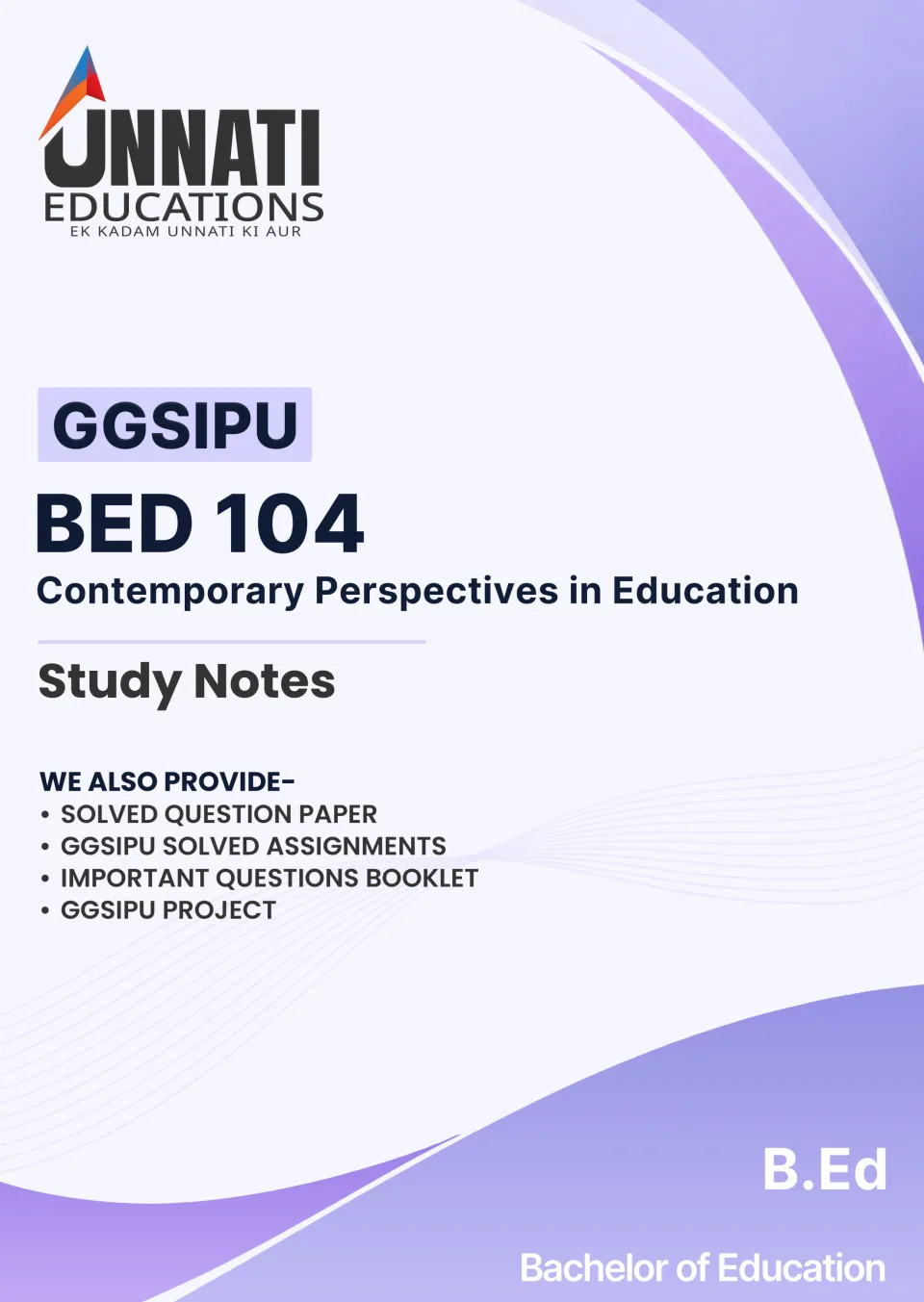
BED 104 Contemporary Perspectives in Education Notes cover all four GGSIPU B.Ed Semester 2 units in one 87-page English book: 35 topics, 24 definition boxes, a quick revision table for every unit and 101 exam questions (60 short-answer, 41 long-answer). They follow the B.Ed curriculum that applies from session 2023-24 onwards.
Written by Sheetal Kirola, Academic Head · Reviewed by Prateek Talwar, Founder, Unnati Educations (B.Ed counselling since 2020) · Checked against B.Ed Course Curriculum (Two Years), Session 2023-24 onwards · Updated 14 October 2026 · Editorial policy
Scheme: B.Ed Course Curriculum (Two Years) | Applies to: session 2023-24 onwards | Verified against: syllBEd210823.pdf on ipu.ac.in, 13 October 2026
BED 104 Contemporary Perspectives in Education at a glance: GGSIPU B.Ed Sem 2 credits, units and exam pattern
Values from the official B.Ed curriculum PDF. BED 104 is one of seven theory slots among the GGSIPU B.Ed Semester 2 papers.
Code and title | BED 104 · Contemporary Perspectives in Education |
|---|---|
Course and semester | B.Ed (two years), Semester 2 |
Credits | 4: 3 theory credits (3 teaching hours a week) + 1 credit for practical assignments or field work |
Marks | 100: 75 theory exam + 15 practical assignments / field engagement + 10 minors |
Passing mark | 40% in the course, which is 40 out of 100 (end-term and re-appear rules: GGSIPU Ordinance 11) |
Units | 4 |
End-term pattern | Paper-setter instructions not printed in the official PDF |
Field engagement | Community work report (guide in Unit IV) |
Paired lab | None |
BED 104 Contemporary Perspectives in Education Notes unit-wise: 35 topics and 101 exam questions across 4 units
Each unit closes with a quick revision table and its own exam questions. Notes for other papers sit under GGSIPU B.Ed notes.
BED 104 Unit 1: Contemporary Development of Indian Education
Pages 7 to 26, 8 topics. From the Gurukul to NEP 2020, then the 5+3+3+4 stages (old-versus-new table), ECCE, UEE and RTE, RMSA, RUSA (now PM-USHA), 13 current issues with NEP remedies and vocational education (Paras 16.1 to 16.8). 5 definition boxes; 15 short and 10 long exam questions.
Access | Primary school within 1 km, upper primary within 3 km |
|---|---|
Enrolment | Every child of 6 to 14 years enrolled |
Retention | Every child stays till Class VIII |
Achievement | Every child reaches minimum levels of learning |
BED 104 Unit 2: Issues and Debates on Globalization, Liberalization and Privatization
Pages 27 to 43, 7 topics. The 1991 LPG reforms and their effect on colleges, a For-versus-Against privatisation table, decentralised administration, autonomy and accountability, student unrest with the Lyngdoh Committee, and six agencies from UGC to RCI. 7 definition boxes; 15 short and 10 long exam questions.
Deconcentration | DEO and Block Education Officer get more powers |
|---|---|
Delegation | Boards, SCERT, autonomous colleges |
Devolution | Panchayats and municipalities run schools (73rd, 74th Amendments) |
Community | SMCs, VECs, PTAs, NGOs |
BED 104 Unit 3: Education and Socio-Cultural Context
Pages 44 to 69, 11 topics, the longest unit. An article table (Art. 14 to 351), RTE sections and norms, eleven Fundamental Duties with school activities, SDG 4, NEP Paras 3, 6, 14 and 21, four social processes, social change and Sanskritization. 8 definition boxes; 15 short and 11 long exam questions.
Conservative | Preserves and passes on culture and values |
|---|---|
Creative | Brings new ideas and technology; starts change |
Adaptive | Helps people adjust to change, such as digital literacy |
BED 104 Unit 4: Social Issues in Education
Pages 70 to 87, 9 topics. Democracy, socialism and secularism with school-practice tables, marginalisation by class, caste, gender and religion as challenge-and-measure tables, NEP teacher education (Paras 15.1 to 15.11, 5.22 to 5.29, 5.8 to 5.14) and a 12-part community work report guide. 4 definition boxes; 15 short and 10 long exam questions.
Separation | West: strict wall · India: equal respect for all religions |
|---|---|
Reform | West: State stays out · India: State may step in, such as temple entry |
Minorities | West: religion is private · India: State may aid minority institutions |
BED 104 exam corner: 60 two-to-five-mark and 41 ten-to-fifteen-mark questions by unit
Each unit ends with two practice lists, labelled "2–5 Marks" and "10–15 Marks" in the notes.
Unit | 2–5 Marks | 10–15 Marks | Definitions |
|---|---|---|---|
I (pages 25 to 26) | 15 | 10 | 5 |
II (page 43) | 15 | 10 | 7 |
III (pages 68 to 69) | 15 | 11 | 8 |
IV (pages 86 to 87) | 15 | 10 | 4 |
BED 104 exam questions in the notes, unit by unit
Unit
I (pages 25 to 26)
2–5 Marks
15
10–15 Marks
10
Definitions
5
Unit
II (page 43)
2–5 Marks
15
10–15 Marks
10
Definitions
7
Unit
III (pages 68 to 69)
2–5 Marks
15
10–15 Marks
11
Definitions
8
Unit
IV (pages 86 to 87)
2–5 Marks
15
10–15 Marks
10
Definitions
4
The BED 104 notes list 60 short-answer and 41 long-answer exam questions across 4 units, plus 24 definition boxes.
Unit I: Name the four modes of delivery of ECCE as per NEP 2020. Pointer: Para 1.5, page 13.
Unit II: What is graded autonomy? Pointer: page 33 (UGC Regulations 2018, Categories I to III).
Unit III: Differentiate between vertical and horizontal social mobility. Pointer: the five-type table with examples on page 62.
Unit IV: What is ITEP? Pointer: pages 80 to 81: the 4-year dual-major B.Ed, minimum teaching degree by 2030.
More practice sits in the BED 104 important questions.
Who writes and checks the BED 104 Contemporary Perspectives notes?
Sheetal Kirola (author): Academic Head, Unnati Educations · M.Ed. · 7 years of experience · profile
Prateek Talwar (reviewer): Founder, Unnati Educations · B.Ed counselling since 2020 · ACS (ICSI) · B.Com, University of Delhi · profile
Mapped topic by topic to the 2023-24 B.Ed curriculum, with a heading for each of the ten NEP ranges the BED 104 syllabus names. The 2026-27 edition adds PM-USHA, ITEP and NAAC binary accreditation. Updated 14 October 2026; see our editorial policy.
The same team prepares GGSIPU important questions for every course it covers.
How to write BED 104 answers: NEP 2020 paragraph numbers, article tables and For-versus-Against debates
BED 104 rewards answers that name the exact source: the NEP paragraph range ("Paras 16.3 to 16.8"), the article (Art. 21A, 30, 350A) or the committee and year (Lyngdoh 2005-06). The notes print these references in their headings.
The exam tips in the notes fix an order for each long-answer type:
System answers (page 10): meaning, history, constitution, stages table, admin flow, NEP changes.
Issues answers (page 21): one heading per issue, one line each, a data point (GER, share of GDP, ASER), then NEP remedies.
Social processes (page 62): definition, types, agencies or factors, then the role of education.
Democracy, socialism, secularism (page 72): meaning, principles, constitutional basis, school practices table.
Worked example: "'Privatization of education is a boon as well as a bane.' Discuss." Define privatisation (page 28), add the forms table (page 29) and draw the For-versus-Against table (page 30), five rows a side. End with the balanced conclusion the notes advise: regulation plus public investment, private participation without commercialisation.
Practise these formats on GGSIPU B.Ed important questions.
BED 104 and the GGSIPU B.Ed Sem 2 papers it connects to
No lab is paired with BED 104; its practical credit is the community work report, and every paper of both years is on the GGSIPU B.Ed syllabus page.
Unit I, 5+3+3+4 stages (page 11) → BED 108 Experiential Learning: studies the same school stages.
Unit III, RTE no-detention rule (page 46) → BED 106 Assessment of Learning: evaluation under no-detention.
Unit II, privatisation forms and agencies (pages 29, 38 to 41) → BED 110 Entrepreneurship in Education: school financing and support bodies.
Unit IV, caste marginalisation (page 77) → BED 152 Reading and Reflecting on Texts: a documentary on caste exclusion.
Fundamental Duties activities (page 49) and democratic practices (pages 71 to 72) → BED 154 PSE-II: co-curricular activities in school.
The other Semester 2 papers are BED 102 Learning and Teaching and two Pedagogy of School Subject papers (BED 116 to BED 150). Unit IV's gender and inclusion themes return in Semester 4 in BED 210 Gender, School and Society and BED 218 Creating an Inclusive School.
How schools reproduce dominance in Indian education: excerpt from page 76 of the BED 104 notes
Excerpt from page 76
4. Role of Education in Reproducing Dominance
We usually think of education as a tool of equality and upward mobility. Many sociologists argue the opposite: the school system often re-creates the inequalities that already exist. Dominant groups (upper class, upper castes, men, the majority religion) stay on top, and marginalised groups stay at the bottom. This is called the reproduction role of education.
Definition. Reproduction of dominance means that education, through its structure, curriculum, language, evaluation and hidden messages, passes the advantages of dominant groups on to their children and keeps disadvantaged groups in lower positions, while making this inequality look natural and fair.
Important theories
Karl Marx (conflict theory): education is part of the superstructure controlled by the ruling class and spreads ruling-class ideology.
Antonio Gramsci: cultural hegemony; dominant groups rule by winning consent through ideas taught in schools, media and religion.
Bowles and Gintis, Schooling in Capitalist America (1976): the correspondence principle; school mirrors the workplace, training working-class children to obey and elite children to lead.
Pierre Bourdieu (with Passeron): elite children arrive with the cultural capital and habitus the school rewards, so they succeed; this is symbolic violence.
Basil Bernstein: the school uses the elaborated language code of the middle class, not the restricted code.
Philip Jackson (1968): the hidden curriculum of obedience, gender roles and hierarchy.
Paulo Freire, Pedagogy of the Oppressed: the banking concept keeps the oppressed passive; problem-posing, dialogic teaching leads to conscientization.
Ivan Illich, Deschooling Society (1971): schools create dependence on institutions and certify privilege.
Dr. B.R. Ambedkar: education as a weapon for the liberation of the depressed classes: "Educate, Agitate, Organise".
How schools reproduce dominance
An unequal school system: elite private and international schools beside under-resourced government schools.
Language of instruction: English as the language of power, which leaves children from non-English homes behind.
Do the BED 104 notes cover the full GGSIPU syllabus?
Yes. Every topic in the four official BED 104 units has its own section in the notes; nothing is missing. The syllabus spells the Unit II committee "Lingdoh"; the notes use the correct name, Lyngdoh.
Official unit | Official topics | Where in the notes | Status |
|---|---|---|---|
I: Contemporary development of Indian Education | System; 5+3+3+4; ECCE; UEE; RMSA; RUSA; Issues; Vocational | Topics 1 to 8, pages 8 to 23 | Covered |
II: Issues and debates on Globalization, Liberalization and privatization | Decentralization (Administrative Hierarchy); Autonomy & Accountability; Student Unrest (Lingdoh); UGC, NCERT, NCTE, NAAC, CBSE, RCI | Topics 1 to 7, pages 28 to 42 | Covered |
III: Education & Socio-Cultural Context | Constitution, RTE; Fundamental duties; equity and quality (SDG 4, NEP); Society; Social Process; Sanskritization | Topics 1 to 11, pages 45 to 66 | Covered |
IV: Social Issues in Education | Democracy, Socialism & Secularism; dominance and marginalization; Teacher & Society (NEP); practical assignment | Topics 1 to 9, pages 71 to 84 | Covered |
BED 104 official syllabus topics mapped to the notes
Official unit
I: Contemporary development of Indian Education
Official topics
System; 5+3+3+4; ECCE; UEE; RMSA; RUSA; Issues; Vocational
Where in the notes
Topics 1 to 8, pages 8 to 23
Status
Covered
Official unit
II: Issues and debates on Globalization, Liberalization and privatization
Official topics
Decentralization (Administrative Hierarchy); Autonomy & Accountability; Student Unrest (Lingdoh); UGC, NCERT, NCTE, NAAC, CBSE, RCI
Where in the notes
Topics 1 to 7, pages 28 to 42
Status
Covered
Official unit
III: Education & Socio-Cultural Context
Official topics
Constitution, RTE; Fundamental duties; equity and quality (SDG 4, NEP); Society; Social Process; Sanskritization
Where in the notes
Topics 1 to 11, pages 45 to 66
Status
Covered
Official unit
IV: Social Issues in Education
Official topics
Democracy, Socialism & Secularism; dominance and marginalization; Teacher & Society (NEP); practical assignment
Where in the notes
Topics 1 to 9, pages 71 to 84
Status
Covered
Verify it yourself: GGSIPU B.Ed Course Curriculum (Two Years), Session 2023-24 onwards (PDF). BED 104 is on pages 27 to 28; marks and the pass rule are under "Scheme of Examination".
Every course in GGSIPU notes is mapped to its official PDF the same way.
BED 104 Contemporary Perspectives notes FAQs
How do I get the full BED 104 notes?
The full BED 104 notes come as a printed book only; they are not available as a PDF. Message WhatsApp 9899436384 with the paper code; the team shares price, payment and dispatch details. Delivery takes a maximum of 5 to 7 days, depending on your location.
How is the GGSIPU BED 104 paper marked, and what is the passing mark?
BED 104 is marked out of 100: 75 for the theory exam, 15 for practical assignments or field engagement and 10 for minors. The B.Ed scheme of examination states pass marks as 40%, which is 40 out of 100 for BED 104. For end-term minimums, re-appear and result rules, read GGSIPU Ordinance 11 on ipu.ac.in.
Do the BED 104 notes follow the NEP 2020 paragraph numbers named in the syllabus?
Yes. The BED 104 syllabus names ten NEP 2020 paragraph ranges, such as 1.1 to 1.5 for ECCE and 5.22 to 5.29 for the approach to teacher education. Each range has its own heading in the notes, and several are set out as tables, so you can quote the exact paragraph in an answer. Page 13 (ECCE, para by para) shows this layout.
Which BED 104 unit is the longest in the notes?
Unit III, Education and Socio-Cultural Context, is the longest: 26 pages (44 to 69) and 11 topics, with 8 definition boxes and 26 exam questions. It is long because the syllabus packs the Constitution, the RTE Act, Fundamental Duties, SDG 4, four NEP chapters and sociology into one BED 104 unit. Unit II is the shortest, at 17 pages.
Do the BED 104 notes help with the community work report?
Yes. Page 84 of the BED 104 notes gives a 12-part format for the field engagement report the syllabus asks for, from title page and objectives to tools, data presentation, case studies and reflection. It suggests sample objectives, such as studying dropout of girls or SC children, and reminds you to take consent and avoid real names. Unit IV supplies the theory.
Are the BED 104 exam questions in the notes solved?
The BED 104 notes list 101 exam-style questions as practice lists at the end of each unit: 60 short-answer and 41 long-answer. They are not printed with separate model answers. Every question maps to a topic in the same unit, and the exam tips on pages 10, 21, 30, 62, 66 and 72 show how to arrange that topic into a full answer.
Get the full BED 104 Contemporary Perspectives in Education Notes on WhatsApp
These BED 104 Contemporary Perspectives in Education IPU notes are sold as a printed book only, not as a PDF. As GGSIPU B.Ed Sem 2 Contemporary Perspectives in Education notes, the book serves both the 75-mark theory exam and the 15-mark field report.
Unit | Pages | Topics | Exam questions |
|---|---|---|---|
Cover and index | 1 to 6 | - | - |
Unit I | 7 to 26 | 8 | 25 |
Unit II | 27 to 43 | 7 | 25 |
Unit III | 44 to 69 | 11 | 26 |
Unit IV | 70 to 87 | 9 | 25 |
Total | 87 | 35 | 101 |
What the full BED 104 notes book contains
Unit
Cover and index
Pages
1 to 6
Topics
-
Exam questions
-
Unit
Unit I
Pages
7 to 26
Topics
8
Exam questions
25
Unit
Unit II
Pages
27 to 43
Topics
7
Exam questions
25
Unit
Unit III
Pages
44 to 69
Topics
11
Exam questions
26
Unit
Unit IV
Pages
70 to 87
Topics
9
Exam questions
25
Unit
Total
Pages
87
Topics
35
Exam questions
101
Format: Contemporary Perspectives in Education notes in English, printed as a book, with NEP paragraph references in every unit. Order on WhatsApp 9899436384; price and payment are shared on chat. Delivery: maximum 5 to 7 days, depending on your location.
Order the full BED 104 notes book on WhatsApp (4 units, 87 pages)
Unnati Educations is an independent education provider based in Vikaspuri, Delhi. We are not affiliated with, authorised by, or endorsed by Guru Gobind Singh Indraprastha University (GGSIPU). 'GGSIPU' and 'IPU' are used only to describe the syllabus our notes follow. For official information, visit ipu.ac.in.
Ready for the full notes?
Discuss coverage and delivery with our team.