
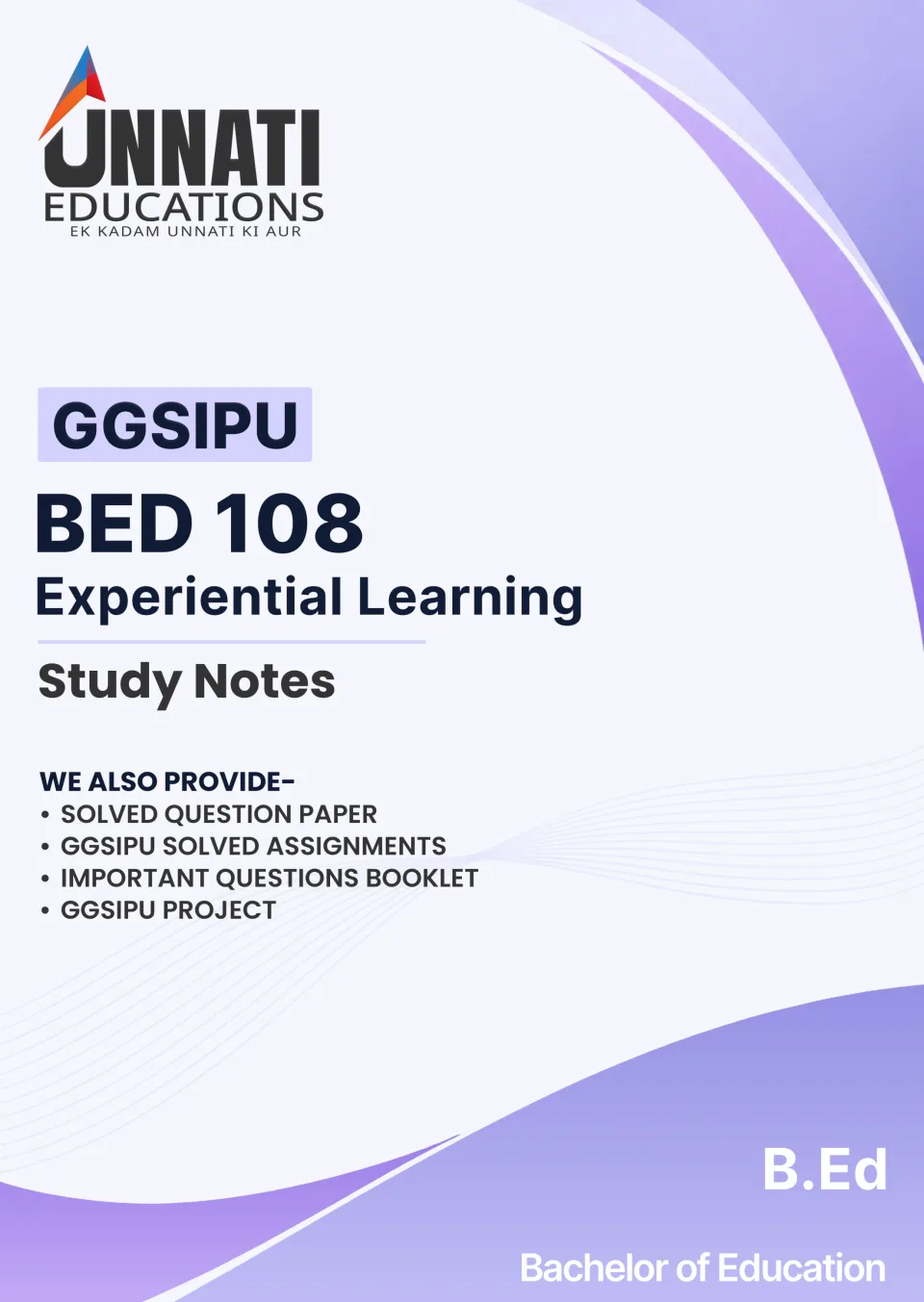
BED 108 Experiential Learning Notes cover all 4 units of the GGSIPU B.Ed Semester 2 paper in a 76-page printed book: 37 main sections, 12 worked classroom examples and 96 exam questions (57 short-answer, 39 long-answer). They follow the B.Ed Course Curriculum (Two Years) for session 2023-24 onwards.
Written by Sheetal Kirola, Academic Head, M.Ed. · Reviewed by Prateek Talwar, Founder, Unnati Educations (B.Ed counselling since 2020) · Checked against syllBEd210823.pdf (ipu.ac.in) · Updated 14 October 2026 · Editorial policy
Scheme: B.Ed Course Curriculum (Two Years) | Applies to: session 2023-24 onwards | Verified against: syllBEd210823.pdf, 13 October 2026
BED 108 Experiential Learning at a glance: GGSIPU B.Ed Sem 2 credits, units and exam pattern
BED 108 is one of two 2-credit theory papers in GGSIPU B.Ed Semester 2 (with BED 110), yet it is marked out of 100. It sits with the other GGSIPU B.Ed Semester 2 papers.
Item | Official detail |
|---|---|
Code and title | BED 108 (printed BED108) · Experiential Learning |
Course and semester | B.Ed (Two Years), Semester 2 |
Category and credits | Theory · 2 credits: 1 theory + 1 practical assignments or field work |
Marks | 100: 75 theory exam + 15 practical assignments / field engagement + 10 minors |
Pass mark | 40%, which is 40 out of 100; end-term rules in Ordinance 11 |
Applies to | Session 2023-24 onwards |
End-term pattern | 75-mark theory exam; question pattern not printed in the official PDF |
Units | 4, with official titles |
Practical assignment | Any one of 5 listed tasks |
Paired lab | None |
BED 108 Experiential Learning: official facts from the B.Ed scheme (syllBEd210823.pdf)
Item
Code and title
Official detail
BED 108 (printed BED108) · Experiential Learning
Item
Course and semester
Official detail
B.Ed (Two Years), Semester 2
Item
Category and credits
Official detail
Theory · 2 credits: 1 theory + 1 practical assignments or field work
Item
Marks
Official detail
100: 75 theory exam + 15 practical assignments / field engagement + 10 minors
Item
Pass mark
Official detail
40%, which is 40 out of 100; end-term rules in Ordinance 11
Item
Applies to
Official detail
Session 2023-24 onwards
Item
End-term pattern
Official detail
75-mark theory exam; question pattern not printed in the official PDF
Item
Units
Official detail
4, with official titles
Item
Practical assignment
Official detail
Any one of 5 listed tasks
Item
Paired lab
Official detail
None
BED 108 Experiential Learning Notes unit-wise: 12 worked classroom examples and 96 exam questions across 4 units
These GGSIPU B.Ed Sem 2 Experiential Learning notes keep the official unit order; each unit ends with a revision table and question bank.
BED 108 Unit 1: Fundamentals of Experiential Learning
Pages 6 to 21, 9 sections. It builds the paper's vocabulary: Kolb's 1984 definition, head, heart and hands, and Dewey's mis-educative experience.
It covers Rogers' five elements, the AEE principles, teacher and student roles, the five-step Pfeiffer and Jones cycle, limits in large classes, and six Indian thinkers from Gandhi to Krishnamurti. Exam bank: 13 short, 9 long.
Quick look: experiential learning vs experiential education (from page 9)
Basis | Experiential learning | Experiential education |
|---|---|---|
Nature | A process of learning | A philosophy of teaching |
Who drives it | The learner | The educator or institution |
Planning | Can be accidental | Always purposeful |
Reflection | May not happen | Deliberately guided |
Quick look: experiential learning vs experiential education (from page 9)
Basis
Nature
Experiential learning
A process of learning
Experiential education
A philosophy of teaching
Basis
Who drives it
Experiential learning
The learner
Experiential education
The educator or institution
Basis
Planning
Experiential learning
Can be accidental
Experiential education
Always purposeful
Basis
Reflection
Experiential learning
May not happen
Experiential education
Deliberately guided
BED 108 Unit 2: Theories of Experiential Learning
Pages 22 to 39, 10 sections. Kolb gets five: six propositions, the four-stage cycle and its two dimensions, four learning styles, the Learning Style Inventory up to KLSI 4.0, and criticism citing Coffield and Pashler.
Kiser's six steps, ORID's four question levels, Ash and Clayton's DEAL and the content-based model follow, each with a school example, then a table mapping all of them onto Kolb. Exam bank: 15 short, 10 long.
Quick look: Kolb's four learning styles (from page 26)
Style | Combination | Preferred methods |
|---|---|---|
Diverging | CE + RO | Group work, brainstorming |
Assimilating | AC + RO | Lectures, reading, models |
Converging | AC + AE | Experiments, lab work |
Accommodating | CE + AE | Field work, projects |
Quick look: Kolb's four learning styles (from page 26)
Style
Diverging
Combination
CE + RO
Preferred methods
Group work, brainstorming
Style
Assimilating
Combination
AC + RO
Preferred methods
Lectures, reading, models
Style
Converging
Combination
AC + AE
Preferred methods
Experiments, lab work
Style
Accommodating
Combination
CE + AE
Preferred methods
Field work, projects
BED 108 Unit 3: Types of Experience-based Methods and Techniques
Pages 40 to 60, 10 sections, the longest unit. Dewey's problem-solving steps run on a waterlogging survey; Kilpatrick's Project Method on a canteen survey of percentages.
Then come games, simulation, Shaftel's nine-step role play, constructivism, reciprocal teaching, inquiry (Suchman, 5E, Bruner) and cooperative learning with Jigsaw and STAD. Exam bank: 14 short, 10 long.
Quick look: three types of constructivism (from page 51)
Type | Main thinker | Key concepts |
|---|---|---|
Cognitive | Jean Piaget | Schema, assimilation, accommodation |
Social | Lev Vygotsky | ZPD, scaffolding, More Knowledgeable Other |
Radical | Ernst von Glasersfeld | Viability, not truth |
Quick look: three types of constructivism (from page 51)
Type
Cognitive
Main thinker
Jean Piaget
Key concepts
Schema, assimilation, accommodation
Type
Social
Main thinker
Lev Vygotsky
Key concepts
ZPD, scaffolding, More Knowledgeable Other
Type
Radical
Main thinker
Ernst von Glasersfeld
Key concepts
Viability, not truth
BED 108 Unit 4: Nature of Experiential Learning at Different School Levels
Pages 61 to 76, 8 sections. School levels are matched to the NEP 2020 5+3+3+4 stages and Piaget: pre-primary (Jadui Pitara), lower primary (NIPUN Bharat), upper primary (bagless days) and secondary (Atal Tinkering Labs).
It closes with 12 implementation strategies, a Kolb lesson plan on water absorption and an 8-point lab report guide. Exam bank: 15 short, 10 long.
Quick look: how experiential learning changes across stages (from page 70)
Stage | Main nature | Reflection |
|---|---|---|
Pre-primary | Play, senses, stories, toys | Oral, through talk and drawing |
Lower primary | Activity, manipulatives | Oral questions, sharing |
Upper primary | Experiments, guided inquiry | Group discussion, journals |
Secondary | Research, labs, internships | Critical written reflection |
Quick look: how experiential learning changes across stages (from page 70)
Stage
Pre-primary
Main nature
Play, senses, stories, toys
Reflection
Oral, through talk and drawing
Stage
Lower primary
Main nature
Activity, manipulatives
Reflection
Oral questions, sharing
Stage
Upper primary
Main nature
Experiments, guided inquiry
Reflection
Group discussion, journals
Stage
Secondary
Main nature
Research, labs, internships
Reflection
Critical written reflection
Teaching non-projectable topics in experiential learning: excerpt from page 16 of the BED 108 notes
Excerpt from page 16 (Unit 1, section 8)
Projectable vs non-projectable content
The content of any school subject falls into two groups. Projectable topics can be shown, demonstrated or projected before the class through charts, models, specimens, experiments, maps or videos, so the learner can see the content: the parts of a flower, the map of India, the structure of the heart.
Non-projectable topics are abstract. They deal with ideas, processes, values, feelings, relationships or social concepts that have to be lived or felt before they make sense: democracy, honesty, cooperation, empathy, supply and demand, the feeling of discrimination, or the mood of a poem.
Basis | Projectable topics | Non-projectable topics |
|---|---|---|
Nature | Concrete, visible, tangible | Abstract, invisible, intangible |
Main domain | Mostly cognitive | Cognitive + affective (values, attitudes) |
Suitable methods | Demonstration, audio-visual aids | Role play, simulation, games, projects, field work |
Science example | Parts of a plant | Interdependence in an ecosystem |
Excerpt from page 16: projectable vs non-projectable topics
Basis
Nature
Projectable topics
Concrete, visible, tangible
Non-projectable topics
Abstract, invisible, intangible
Basis
Main domain
Projectable topics
Mostly cognitive
Non-projectable topics
Cognitive + affective (values, attitudes)
Basis
Suitable methods
Projectable topics
Demonstration, audio-visual aids
Non-projectable topics
Role play, simulation, games, projects, field work
Basis
Science example
Projectable topics
Parts of a plant
Non-projectable topics
Interdependence in an ecosystem
Why the experiential mode suits them
Abstract ideas become concrete when learners live through a situation. Values and attitudes are caught, not taught: they grow through experience and reflection. Because learners build the meaning themselves, it lasts, and because feelings are involved, affective objectives are actually reached.
Steps to teach a non-projectable topic
Identify a topic from your methodology subject that cannot be shown directly, such as "Democracy".
Set cognitive, affective and skill objectives.
Design the experience: role play, simulation, game, mock parliament, project, field visit or survey.
Conduct it, with learners taking part and the teacher facilitating and observing.
Debrief: What happened? How did you feel? Why? What is fair or unfair?
Conceptualise by linking the reflections to the textbook concept and definitions.
Apply the concept to new real-life situations, such as class rules or a home project.
The notes continue on page 17 with the evaluation step and subject-wise activities for Social Science, Science, Mathematics, Economics and Languages.
BED 108 exam corner: 57 short-answer and 39 long-answer questions by unit
Each unit's bank has short-answer (printed "2 to 5 marks") and long-answer (printed "10 to 15 marks") questions. They are for practice; answers come from the unit's sections, not printed model answers.
Unit | Short-answer | Long-answer | Worked examples |
|---|---|---|---|
Unit 1 | 13 | 9 | 1 |
Unit 2 | 15 | 10 | 4 |
Unit 3 | 14 | 10 | 3 |
Unit 4 | 15 | 10 | 4 |
Total | 57 | 39 | 12 |
BED 108 exam question bank and worked examples by unit
Unit
Unit 1
Short-answer
13
Long-answer
9
Worked examples
1
Unit
Unit 2
Short-answer
15
Long-answer
10
Worked examples
4
Unit
Unit 3
Short-answer
14
Long-answer
10
Worked examples
3
Unit
Unit 4
Short-answer
15
Long-answer
10
Worked examples
4
Unit
Total
Short-answer
57
Long-answer
39
Worked examples
12
Unit 1 (short): "Explain Dewey's principles of continuity and interaction." Pointer: each experience shapes later ones; inner and outer conditions interact (page 10).
Unit 2 (short): "What is Kolb's Learning Style Inventory? How is it scored?" Pointer: 12 items ranked 4 to 1; AC minus CE and AE minus RO plotted on the grid (page 27).
Unit 3 (long): Teaching one topic of your subject through Discovery Learning and Inquiry-based Learning. Pointer: triangle angle sum, then the 5E "day and night" lesson (pages 54 and 55).
Unit 4 (long): "What are the challenges in implementing experiential learning in Indian schools? Suggest solutions." Pointer: the challenge table on pages 71 and 72.
The BED 108 notes list 57 short-answer and 39 long-answer exam questions across 4 units, plus 12 worked classroom examples.
More practice sits in the BED 108 important questions.
Who writes and checks the BED 108 EL notes?
Sheetal Kirola, author: Academic Head · M.Ed. · 7 years of experience. Bio.
Prateek Talwar, reviewer: Founder, Unnati Educations · B.Ed counselling since 2020 · ACS, ICSI · B.Com, University of Delhi. Bio.
The BED 108 Experiential Learning IPU notes were mapped topic by topic to the 2023-24 curriculum. The 2026-27 edition adds a Kolb lesson plan format and a lab report guide. Updated 14 October 2026; see our editorial policy.
The same team prepares GGSIPU important questions for every course.
Do the BED 108 notes cover the full GGSIPU syllabus?
Yes. Every official topic has its own section, and all 5 practical options get a guide.
Official unit | Official topics | Where in the notes | Status |
|---|---|---|---|
I: Fundamentals of Experiential Learning | Concept to limitations; non-projectable topics; Indian thinkers | Sections 1 to 9, pp 7 to 19 | Covered |
II: Theories of Experiential Learning | Kolb (model, styles, inventory, criticism); Kiser, ORID, DEAL, content-based; appraisal | Sections 1 to 10, pp 23 to 37 | Covered |
III: Types of Experience-based Methods and Techniques | Traditional methods made experiential; games, simulation, role play; constructivist models | Sections 1 to 10, pp 41 to 58 | Covered |
IV: Nature of Experiential Learning at Different School Levels | Pre-primary; primary (lower and upper); secondary; proper implementation | Sections 1 to 7, pp 62 to 72 | Covered |
Practical assignments (any one) | Lab report; Project Method; Kolb; IPM/ORID/DEAL; Discovery and Inquiry | pp 25, 30 to 35, 46, 55, 73 | Covered as guidance; the assignment is your own work |
BED 108 official syllabus mapped to the notes
Official unit
I: Fundamentals of Experiential Learning
Official topics
Concept to limitations; non-projectable topics; Indian thinkers
Where in the notes
Sections 1 to 9, pp 7 to 19
Status
Covered
Official unit
II: Theories of Experiential Learning
Official topics
Kolb (model, styles, inventory, criticism); Kiser, ORID, DEAL, content-based; appraisal
Where in the notes
Sections 1 to 10, pp 23 to 37
Status
Covered
Official unit
III: Types of Experience-based Methods and Techniques
Official topics
Traditional methods made experiential; games, simulation, role play; constructivist models
Where in the notes
Sections 1 to 10, pp 41 to 58
Status
Covered
Official unit
IV: Nature of Experiential Learning at Different School Levels
Official topics
Pre-primary; primary (lower and upper); secondary; proper implementation
Where in the notes
Sections 1 to 7, pp 62 to 72
Status
Covered
Official unit
Practical assignments (any one)
Official topics
Lab report; Project Method; Kolb; IPM/ORID/DEAL; Discovery and Inquiry
Where in the notes
pp 25, 30 to 35, 46, 55, 73
Status
Covered as guidance; the assignment is your own work
Official source: B.Ed Course Curriculum (Two Years), session 2023-24 onwards (syllBEd210823.pdf), pages 31 and 32.
Every course in GGSIPU notes is mapped to its official PDF the same way.
How to write BED 108 answers: Kolb cycle diagrams, model comparisons and fifteen-mark implementation answers
Most BED 108 questions ask you to explain a model, then apply it to your teaching subject, so structure earns marks. The notes carry eight exam tips; these and the page 36 model mapping matter most.
Draw the cycle: four boxes with arrows plus the grasping and transforming axes. The notes say this fetches extra marks (page 25).
Features, ten marks: open with Kolb's definition, give at least 8 one-line features, close with head, heart and hands (page 8).
Limitations: end with 2 or 3 remedies, such as group work and low-cost materials (page 15).
Criticism of Kolb: stay balanced; close by calling it still the most practical planning framework (page 29).
Model comparisons: map Kiser, ORID and DEAL onto Kolb's four stages (page 36).
Worked example: a fifteen-mark answer on "proper implementation"
Introduction with the NEP 2020 para 4.6 line on experiential learning in all stages.
8 to 10 strategies: school policy, topic mapping, teacher training, flexible time-table, community, assessment reform.
Challenges with solutions, such as cooperative learning for large classes.
Stage-wise points, pre-primary to secondary.
A two-line conclusion.
This five-part plan comes from the exam tip on page 72. Practise it on GGSIPU B.Ed important questions.
BED 108 and the GGSIPU B.Ed Sem 2 papers it connects to
BED 108 has no paired lab; its 15 practical marks come from one field assignment. All semesters are in the GGSIPU B.Ed syllabus.
Unit 2 → the Kolb illustration and the IPM, ORID or DEAL plan.
Unit 3 → the Project Method plan and the Discovery and Inquiry plan.
Unit 4 → the lab or subject room report.
Other Semester 2 links: BED 102 Learning and Teaching (social constructivism, Unit 3), BED 106 Assessment of Learning (portfolios and rubrics), Pedagogy of School Subject (I) and (II), BED 116 to 150 (your methodology topic), and BED 154 PSE-II (Kiser suits field reflection).
BED 104 Contemporary Perspectives in Education, BED 110 Entrepreneurship in Education and BED 152 Reading and Reflecting on Texts complete the semester.
BED 108 EL notes FAQs
How do I get the full BED 108 notes?
Send a WhatsApp message to 9899436384 with the code BED 108 and your delivery address. The full notes come as a printed book of 76 pages covering all 4 units; they are not available as a PDF. Delivery takes a maximum of 5 to 7 days, depending on your location.
What is the passing mark in BED 108 Experiential Learning?
BED 108 is marked out of 100: 75 for the theory exam, 15 for practical assignments or field engagement, and 10 for minors. The B.Ed scheme of examination states pass marks as 40%, which is 40 out of 100. For end-term minimums, re-appear and result rules, read GGSIPU Ordinance 11 on ipu.ac.in before you plan any re-attempt.
Why is BED 108 only 2 credits when it carries 100 marks?
Under the GGSIPU B.Ed scheme, a 2-credit course has one credit for theory and one for practical assignments or field work, while 4-credit papers have three theory credits. Every theory course is still marked out of 100. So BED 108 needs less classroom time than BED 102 or BED 106, but it counts the same in your Semester 2 total.
Which BED 108 unit takes the most study time?
Unit 3 is the longest in the BED 108 notes at 21 pages and 10 sections, because it covers ten methods, from the question-answer technique to cooperative learning. Unit 2 needs the most diagram practice: Kolb's cycle, his style grid and the Kiser, ORID and DEAL flows. Units 2 and 4 have 25 questions each.
Do the BED 108 notes help with the practical assignment?
Yes, as guidance. The BED 108 syllabus asks for any one of five practical tasks, and the notes give a guide or example for each: an 8-point lab report structure, Project Method steps, a Kolb floating and sinking lesson, IPM, ORID and DEAL examples, and discovery and inquiry lessons. The assignment you submit must be your own work on your own topic.
Are the BED 108 notes updated for NEP 2020?
Yes. The BED 108 syllabus itself refers to the national policy, and Unit 4 of the notes maps school levels to the NEP 2020 5+3+3+4 stages. It quotes para 4.6 on experiential learning in all stages and covers NCF-FS 2022, Jadui Pitara, NIPUN Bharat, Vidya Pravesh, bagless days, coding from Class 6 and the Holistic Progress Card.
Get the full BED 108 Experiential Learning Notes on WhatsApp
The BED 108 book runs to 76 pages, including 5 pages of cover and index.
Unit | Pages in the book | Exam questions |
|---|---|---|
Unit 1: Fundamentals | 6 to 21 (16 pages) | 22 |
Unit 2: Theories | 22 to 39 (18 pages) | 25 |
Unit 3: Methods and techniques | 40 to 60 (21 pages) | 24 |
Unit 4: School levels | 61 to 76 (16 pages) | 25 |
Pages per unit in the full BED 108 notes
Unit
Unit 1: Fundamentals
Pages in the book
6 to 21 (16 pages)
Exam questions
22
Unit
Unit 2: Theories
Pages in the book
22 to 39 (18 pages)
Exam questions
25
Unit
Unit 3: Methods and techniques
Pages in the book
40 to 60 (21 pages)
Exam questions
24
Unit
Unit 4: School levels
Pages in the book
61 to 76 (16 pages)
Exam questions
25
Format: a printed book of Experiential Learning notes in English, not available as a PDF. Delivery: maximum 5 to 7 days, depending on location.
Get the full BED 108 notes on WhatsApp (4 units, 76 pages)
Unnati Educations is an independent education provider based in Vikaspuri, Delhi. We are not affiliated with, authorised by, or endorsed by Guru Gobind Singh Indraprastha University (GGSIPU). 'GGSIPU' and 'IPU' are used only to describe the syllabus our notes follow. For official information, visit ipu.ac.in.
Ready for the full notes?
Discuss coverage and delivery with our team.