
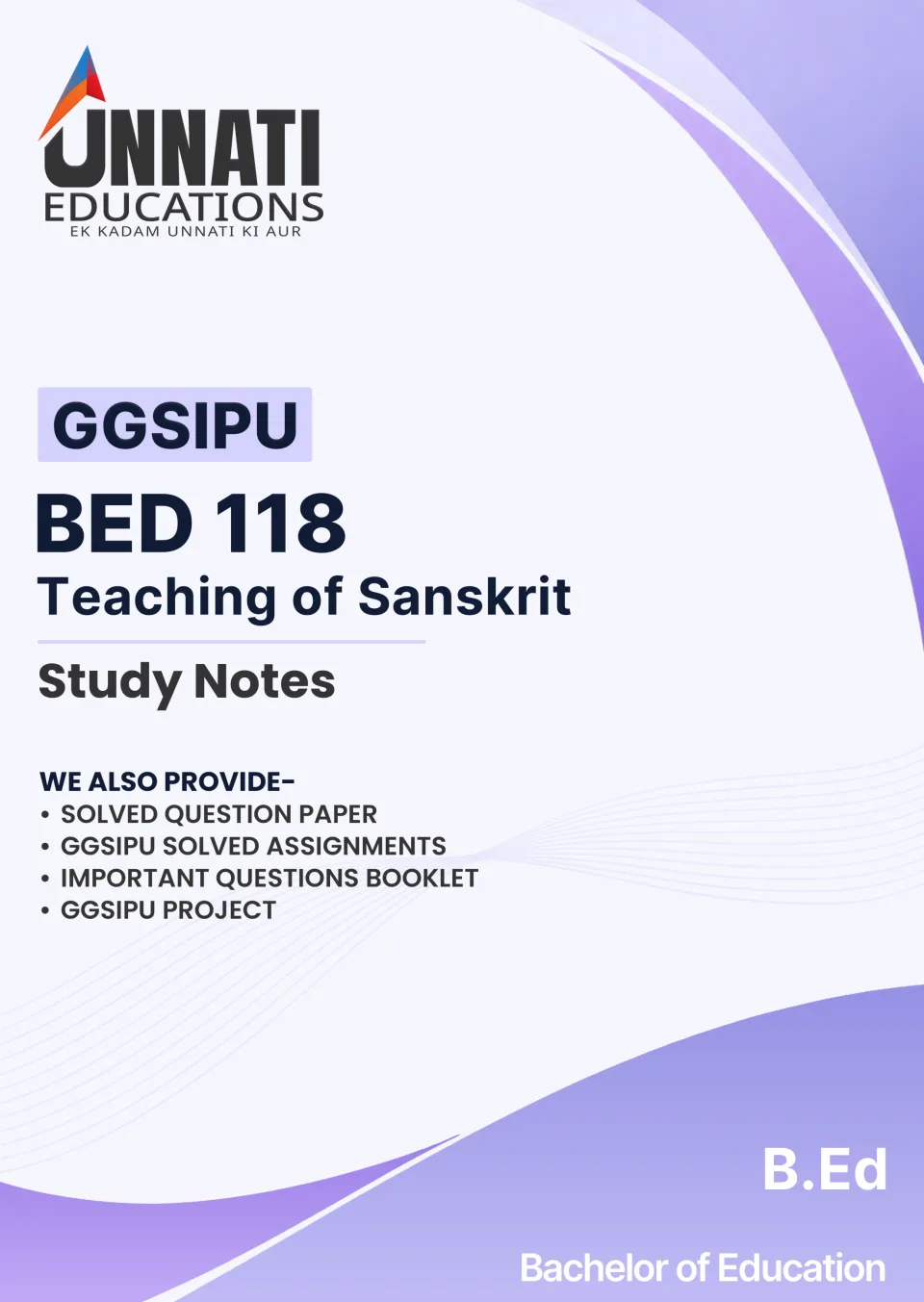
BED 118 Teaching of Sanskrit Notes by Unnati Educations cover all 4 units of the GGSIPU B.Ed Semester 2 pedagogy paper in one 62-page printed book: 36 topics, 3 sample lesson plans, a revision table per unit and 100 exam questions (60 short, 40 long). They follow the B.Ed curriculum for session 2023-24 onwards.
Written by Sheetal Kirola, Academic Head · Reviewed by Prateek Talwar, Founder, Unnati Educations · Checked against B.Ed Course Curriculum (Two Years), syllBEd210823.pdf · Updated 14 October 2026 · Editorial policy
Scheme: B.Ed two-year curriculum | Applies to: session 2023-24 onwards | Verified against: syllBEd210823.pdf (ipu.ac.in), 13 October 2026
BED 118 Teaching of Sanskrit at a glance: GGSIPU B.Ed Sem 2 credits, units and exam pattern
BED 118 (printed as BED118) is one of eighteen pedagogy options for the two "Pedagogy of School Subject" slots in Semester 2. These GGSIPU B.Ed Sem 2 Teaching of Sanskrit notes are for students who pick it. It sits with the other GGSIPU B.Ed Semester 2 papers.
Item | Official detail |
|---|---|
Code and title | BED 118 Teaching of Sanskrit |
Course and semester | B.Ed (two years), Semester 2, Pedagogy of School Subject (I) or (II), codes BED116 to BED150 |
Credits | 4: 3 theory (1 credit = 1 hour of teaching) + 1 for practical assignments or field work (1 credit = 2 hours of engagement) |
Marks | 100: 75 theory exam + 15 practical assignments / field engagement + 10 minors |
Pass mark | Minimum 40%, which is 40 out of 100 |
Applies to | Session 2023-24 onwards |
End-term pattern | Paper-setter instructions not printed in the official PDF |
Units | 4 units + practical/assignment list (any two of five tasks) |
Paired lab | None; the 15-mark practical work sits inside this paper |
BED 118 snapshot from the official B.Ed curriculum (session 2023-24 onwards)
Item
Code and title
Official detail
BED 118 Teaching of Sanskrit
Item
Course and semester
Official detail
B.Ed (two years), Semester 2, Pedagogy of School Subject (I) or (II), codes BED116 to BED150
Item
Credits
Official detail
4: 3 theory (1 credit = 1 hour of teaching) + 1 for practical assignments or field work (1 credit = 2 hours of engagement)
Item
Marks
Official detail
100: 75 theory exam + 15 practical assignments / field engagement + 10 minors
Item
Pass mark
Official detail
Minimum 40%, which is 40 out of 100
Item
Applies to
Official detail
Session 2023-24 onwards
Item
End-term pattern
Official detail
Paper-setter instructions not printed in the official PDF
Item
Units
Official detail
4 units + practical/assignment list (any two of five tasks)
Item
Paired lab
Official detail
None; the 15-mark practical work sits inside this paper
BED 118 Teaching of Sanskrit Notes unit-wise: 36 topics, 100 exam questions and 3 lesson plans across 4 units
Each unit has nine numbered topics, a Quick Revision Table and a bank of 15 short and 10 long questions. These are Teaching of Sanskrit notes in English, with every Sanskrit term in Devanāgarī and roman letters. Page numbers are the book's own.
Notes for every other B.Ed paper sit under GGSIPU B.Ed notes.
BED 118 Unit 1: Theoretical Aspects of Linguistics
Pages 4 to 19 (16 pages). The unit opens with theories of how language began, from the divine view linked to the 14 Māheśvara Sūtras to the evolutionary view. It then builds the Sanskrit sound system: 13 vowels, 33 consonants (25 sparśa + 4 antaḥstha + 4 ūṣma) and places of articulation.
Then come Pāṇini and the Munitraya, types of language, LSRW, the commissions from 1948-49 to 2014-15, and NEP 2020.
Element | Count in the notes |
|---|---|
Liṅga (gender) | 3: puṃliṅga, strīliṅga, napuṃsakaliṅga |
Vacana (number) | 3, including dvivacana (dual) |
Vibhakti (case-ending) | 7 + sambodhana (vocative) |
Lakāra / Upasarga | 10 lakāras / 22 upasargas |
Quick look: core counts in Sanskrit grammar (from page 11)
Element
Liṅga (gender)
Count in the notes
3: puṃliṅga, strīliṅga, napuṃsakaliṅga
Element
Vacana (number)
Count in the notes
3, including dvivacana (dual)
Element
Vibhakti (case-ending)
Count in the notes
7 + sambodhana (vocative)
Element
Lakāra / Upasarga
Count in the notes
10 lakāras / 22 upasargas
BED 118 Unit 2: Teaching of Language Skills
Pages 20 to 36 (17 pages), the longest unit. It covers listening problems, speaking methods and their practical problems, the lesson plan with Herbart's steps, its tools and techniques, writing stages and reading.
All three sample lesson plans are here: a Class VI listening lesson on the thirsty crow, a Class VII leave application in Sanskrit and a Class VIII lesson on two subhāṣitas.
Type | What it builds |
|---|---|
Loud reading (सस्वर पाठ) | Pronunciation and rhythm; ślokas |
Silent reading (मौन पाठ) | Speed and comprehension; senior prose |
Intensive reading | Close study of a short passage |
Extensive reading | Wide reading for pleasure |
Quick look: four types of reading (from page 31)
Type
Loud reading (सस्वर पाठ)
What it builds
Pronunciation and rhythm; ślokas
Type
Silent reading (मौन पाठ)
What it builds
Speed and comprehension; senior prose
Type
Intensive reading
What it builds
Close study of a short passage
Type
Extensive reading
What it builds
Wide reading for pleasure
BED 118 Unit 3: Evaluation of Sanskrit Language Teaching in School Education
Pages 37 to 50 (14 pages). It explains why schools teach Sanskrit, lists Bloom-based secondary objectives, and compares the pāṭhaśālā, Bhandarkar and direct methods.
Evaluation follows: the evaluation triangle, tools such as rating scales and anecdotal records, formative versus summative, CCE, question paper design and the ten steps of an achievement test.
Index | Formula and rule of thumb |
|---|---|
Difficulty index (P) | P = (R / N) × 100; keep items between about 25% and 75% |
Discrimination index (D) | D = (RU − RL) / (N/2); about 0.3 and above is good |
Quick look: item analysis formulas (from page 48)
Index
Difficulty index (P)
Formula and rule of thumb
P = (R / N) × 100; keep items between about 25% and 75%
Index
Discrimination index (D)
Formula and rule of thumb
D = (RU − RL) / (N/2); about 0.3 and above is good
BED 118 Unit 4: Online-Virtual Teaching of Language (MOOCs)
Pages 51 to 62 (12 pages). It defines online-virtual teaching and its four forms, explains why Sanskrit needs it, and breaks MOOCs down letter by letter with Indian platforms.
Tools, techniques, approaches, merits, demerits and the ideal teacher follow. Pages 59-60 guide all five practical tasks.
Quick look: SWAYAM's four quadrants (from page 54)
Video lecture
E-text / reading material
Self-assessment (quizzes, assignments)
Discussion forum for doubts
Listening methods and the three listening stages in Sanskrit teaching: excerpt from page 22 of the BED 118 notes
Excerpt from page 22 (Unit 2, Topics 1.4 and 1.5)
Teaching methodology for listening
Listening improves only when the teacher plans for it. These are the methods used in a Sanskrit class:
Model reading or recitation (ādarśa pāṭha): the teacher reads or recites the lesson slowly, clearly and with correct pronunciation, while students only listen.
Imitation (anukaraṇa): students listen and repeat after the teacher, word by word and then line by line, as in the traditional pāṭhaśālā.
Story-telling (kathā): a simple Pañcatantra or Hitopadeśa story in easy Sanskrit, followed by oral questions.
Śloka recitation and antyākṣarī: students recite a śloka beginning with the last letter of the previous one.
Dictation (śrutalekha): the teacher dictates words or sentences, which checks listening and spelling together.
Audio and ICT aids: Sanskrit news bulletins on All India Radio or DD News, songs, cartoons, podcasts and short video clips.
Instruction games: "Guruḥ vadati", a Sanskrit version of Simon says, where students follow commands such as हस्तम् उन्नयत.
Listening comprehension: a short passage is read aloud and students answer who, what, where and why questions.
Teaching strategies: three stages
Pre-listening. Prepare the learners: arouse interest, give background, explain new words and set a purpose. For example, show a picture of a crow and a pot, introduce kākaḥ, ghaṭaḥ, jalam, and say "listen and tell me the name of the clever animal".
While-listening. Students listen with a task: tick the words they hear, fill a table, arrange pictures or raise a hand at a given word. While the teacher reads the story Pipāsitaḥ Kākaḥ, students put four picture cards in order.
Post-listening. Check and extend through oral questions, retelling, role-play, drawing or a few written lines. The teacher asks काकः किम् अपश्यत्? and students retell the story in three Sanskrit sentences.
Exam tip from the notes: write the three stages with one Sanskrit example each. This structure is the simplest way to answer a question on the teaching strategy of listening.
BED 118 exam corner: 60 short-answer and 40 long-answer questions by unit
Every BED 118 unit ends with short answer questions labelled "2–5 marks" and long answer questions labelled "10–15 marks". Answers are built from the topic pages.
Unit | Short (2–5 Marks) | Long (10–15 Marks) |
|---|---|---|
Unit 1 (p18-19) | 15 | 10 |
Unit 2 (p35-36) | 15 | 10 |
Unit 3 (p49-50) | 15 | 10 |
Unit 4 (p61-62) | 15 | 10 |
BED 118 exam questions in the notes, by unit
Unit
Unit 1 (p18-19)
Short (2–5 Marks)
15
Long (10–15 Marks)
10
Unit
Unit 2 (p35-36)
Short (2–5 Marks)
15
Long (10–15 Marks)
10
Unit
Unit 3 (p49-50)
Short (2–5 Marks)
15
Long (10–15 Marks)
10
Unit
Unit 4 (p61-62)
Short (2–5 Marks)
15
Long (10–15 Marks)
10
Unit 1: Distinguish between alpaprāṇa and mahāprāṇa consonants. Alpaprāṇa (less breath): 1st, 3rd, 5th of each varga + य र ल व. Mahāprāṇa: 2nd and 4th + श ष स ह. Add the paper-strip test (page 10).
Unit 2: Write Herbart's five steps of lesson planning. Preparation, presentation, comparison and association, generalisation, application (page 27).
Unit 3: Describe the steps of constructing a Sanskrit question paper and prepare a blueprint for a 40-mark unit test. Use the steps on page 45 and the Class IX blueprint on page 46.
Unit 4: "Online teaching can supplement but not replace classroom teaching." Discuss. Set merits against demerits (pages 57-58) and close with blended learning as the best model for Sanskrit.
The BED 118 notes list 60 short-answer and 40 long-answer exam questions across 4 units, plus 3 sample lesson plans and a guide to all 5 practical tasks.
More practice sits in the BED 118 important questions.
Who writes and checks the BED 118 Sanskrit notes?
Sheetal Kirola, author: Academic Head, Unnati Educations · M.Ed. · 7 years of experience.
Prateek Talwar, reviewer: Founder, Unnati Educations · B.Ed counselling since 2020 · ACS, ICSI · B.Com, University of Delhi.
Sheetal wrote the BED 118 Teaching of Sanskrit IPU notes against the official unit list, adding lesson plans and a practical guide. Prateek checked each official topic and every count here.
This 2026-27 edition maps to the curriculum for session 2023-24 onwards, last checked 13 October 2026, under our editorial policy. The same team prepares GGSIPU important questions for every course.
Do the BED 118 notes cover the full GGSIPU syllabus?
Yes. Every topic under the four official BED 118 units has a section in the notes, and the practical list has its own guide.
Official unit | Official topics | Where in the notes | Status |
|---|---|---|---|
Unit I: Theoretical Aspects of Linguistics | Origin and structure of language; Sanskrit language and grammar; nature and types of language; language skills; need in school, committee recommendations; new education policy | Topics 1-9, p5-17 | Covered |
Unit II: Teaching of language skills | Listening, speaking, writing and reading skills with lesson plans; tools and techniques for lesson plans | Topics 1-9, p21-34 | Covered |
Unit III: Evaluation of Sanskrit Language Teaching in School Education | Need in school; secondary objectives and methods; evaluation tools; types of evaluation, question paper; achievement test | Topics 1-9, p38-48 | Covered |
Unit IV: Online-Virtual Teaching of Language (MOOCs) | Concept and need; tools and techniques; approaches and smooth evaluation; merits and demerits; qualities of an ideal teacher | Topics 1-8, p52-59 | Covered |
Practical / Assignment (any two) | Five listed tasks | Topic 9, p59-60 | Covered |
BED 118 official syllabus mapped to the notes
Official unit
Unit I: Theoretical Aspects of Linguistics
Official topics
Origin and structure of language; Sanskrit language and grammar; nature and types of language; language skills; need in school, committee recommendations; new education policy
Where in the notes
Topics 1-9, p5-17
Status
Covered
Official unit
Unit II: Teaching of language skills
Official topics
Listening, speaking, writing and reading skills with lesson plans; tools and techniques for lesson plans
Where in the notes
Topics 1-9, p21-34
Status
Covered
Official unit
Unit III: Evaluation of Sanskrit Language Teaching in School Education
Official topics
Need in school; secondary objectives and methods; evaluation tools; types of evaluation, question paper; achievement test
Where in the notes
Topics 1-9, p38-48
Status
Covered
Official unit
Unit IV: Online-Virtual Teaching of Language (MOOCs)
Official topics
Concept and need; tools and techniques; approaches and smooth evaluation; merits and demerits; qualities of an ideal teacher
Where in the notes
Topics 1-8, p52-59
Status
Covered
Official unit
Practical / Assignment (any two)
Official topics
Five listed tasks
Where in the notes
Topic 9, p59-60
Status
Covered
Verify it in the official B.Ed Course Curriculum (Two Years), session 2023-24 onwards; BED 118 is on printed pages 42-43.
Every course in GGSIPU notes is mapped to its official PDF the same way.
How to write BED 118 answers: lesson-plan tables, LSRW comparisons and commission timelines
The notes push three habits. First, put comparisons in tables: receptive versus productive skills, Bhandarkar versus direct method, formative versus summative. The page 11 tip says a 5-mark grammar answer should run vyākaraṇa, Munitraya, six elements in a table, then why grammar matters.
Second, add a Sanskrit example to every method, such as कुत्र गच्छति भवान्? under conversation. Third, keep one lesson plan frame (page 24): objectives, aids, previous knowledge, introduction, aim, skill-specific presentation, evaluation, home work.
Avoid two flagged mistakes: Unit 2 methodology in a Unit 1 skills answer (page 14), and an achievement test answer without a blueprint.
Worked example: a 10-mark answer on NEP 2020 and Sanskrit
Opening: NEP 2020 treats Sanskrit as part of Indian languages, culture and Indian Knowledge Systems.
Six sub-headings (page 17): all levels; Simple Standard Sanskrit; classical languages; IKS; higher education and research; teacher education.
Your own evaluation: teacher shortage, outdated methods, need for ICT.
Practise this format on GGSIPU B.Ed important questions.
BED 118 and the GGSIPU B.Ed Sem 2 papers it connects to
BED 118 has no separate lab; its practical work is part of the paper. All Semester 2 courses are listed in the GGSIPU B.Ed syllabus.
Alongside it you study BED 102 Learning and Teaching, BED 104 Contemporary Perspectives in Education, BED 106 Assessment of Learning, BED 108 Experiential Learning, BED 110 Entrepreneurship in Education, BED 152 Reading and Reflecting on Texts, BED 154 PSE-II and a second pedagogy paper.
Unit 2 lesson planning (pages 26-28) uses ideas from BED 102 Learning and Teaching.
Unit 3 blueprint and item analysis (pages 45-48) apply BED 106 Assessment of Learning to Sanskrit.
Unit 2 reading types (pages 30-32) pair with BED 152 Reading and Reflecting on Texts.
BED 118 Sanskrit notes FAQs
How do I get the full BED 118 notes?
Message Unnati Educations on WhatsApp at 9899436384 and ask for the BED 118 Teaching of Sanskrit book. The full notes come as a printed book only, not as a PDF. Delivery takes a maximum of 5 to 7 days, depending on your location.
Is BED 118 Teaching of Sanskrit a Semester 1 or Semester 2 paper?
BED 118 is a Semester 2 paper. The B.Ed curriculum for session 2023-24 onwards has two "Pedagogy of School Subject" slots in Semester 2, each worth 4 credits and 100 marks, filled from the list BED116 to BED150. Students who plan to teach Sanskrit choose BED 118 for one slot and another subject for the second.
What is the passing mark in BED 118?
BED 118 is marked out of 100 in total: 75 for the theory exam, 15 for practical assignments or field engagement and 10 for minors. The B.Ed scheme of examination states pass marks as 40%, which is 40 out of 100. For rules on end-term minimums, re-appear and results, read GGSIPU Ordinance 11 on ipu.ac.in or ask your college exam cell.
Are the BED 118 notes written in English or Sanskrit?
This edition of the BED 118 notes is written in English, which matches the curriculum's statement that the medium of instruction is English. Every Sanskrit term, sūtra and example is printed in Devanāgarī and in roman letters with diacritics, for example उच्चारण-स्थान (uccāraṇa-sthāna), so you can copy the Sanskrit examples straight into your exam answers and lesson plans.
Which BED 118 unit has the lesson plans?
All three sample lesson plans are in Unit 2 of the BED 118 notes: a Class VI listening lesson on the thirsty crow (pages 23-24), a Class VII writing lesson on a leave application (pages 29-30) and a Class VIII reading lesson on two subhāṣitas (pages 32-33). Each has objectives, aids, timed steps, evaluation and home work you can adapt.
Do the BED 118 notes help with the practical assignment?
Yes. The official BED 118 practical list has five tasks and students do any two, which feed the 15 marks for practical assignments or field engagement. Pages 59-60 give a how-to for all five: teaching aids from waste material, a 40-minute recorded lecture, a virtual dictation contest, Google Forms assessment and a Sanskrit YouTube channel.
Get the full BED 118 Teaching of Sanskrit Notes on WhatsApp
Unit | Pages | Topics | Exam questions |
|---|---|---|---|
Unit 1 | 16 (p4-19) | 9 | 25 |
Unit 2 | 17 (p20-36) | 9 + 3 lesson plans | 25 |
Unit 3 | 14 (p37-50) | 9 | 25 |
Unit 4 | 12 (p51-62) | 9 incl. practical guide | 25 |
What is inside the full BED 118 printed notes (62 pages)
Unit
Unit 1
Pages
16 (p4-19)
Topics
9
Exam questions
25
Unit
Unit 2
Pages
17 (p20-36)
Topics
9 + 3 lesson plans
Exam questions
25
Unit
Unit 3
Pages
14 (p37-50)
Topics
9
Exam questions
25
Unit
Unit 4
Pages
12 (p51-62)
Topics
9 incl. practical guide
Exam questions
25
Format: printed book only (not available as a PDF)
Delivery: maximum 5 to 7 days, depending on your location
Order the BED 118 book on WhatsApp (4 units, 62 pages)
Unnati Educations is an independent education provider based in Vikaspuri, Delhi. We are not affiliated with, authorised by, or endorsed by Guru Gobind Singh Indraprastha University (GGSIPU). 'GGSIPU' and 'IPU' are used only to describe the syllabus our notes follow. For official information, visit ipu.ac.in.
Ready for the full notes?
Discuss coverage and delivery with our team.