
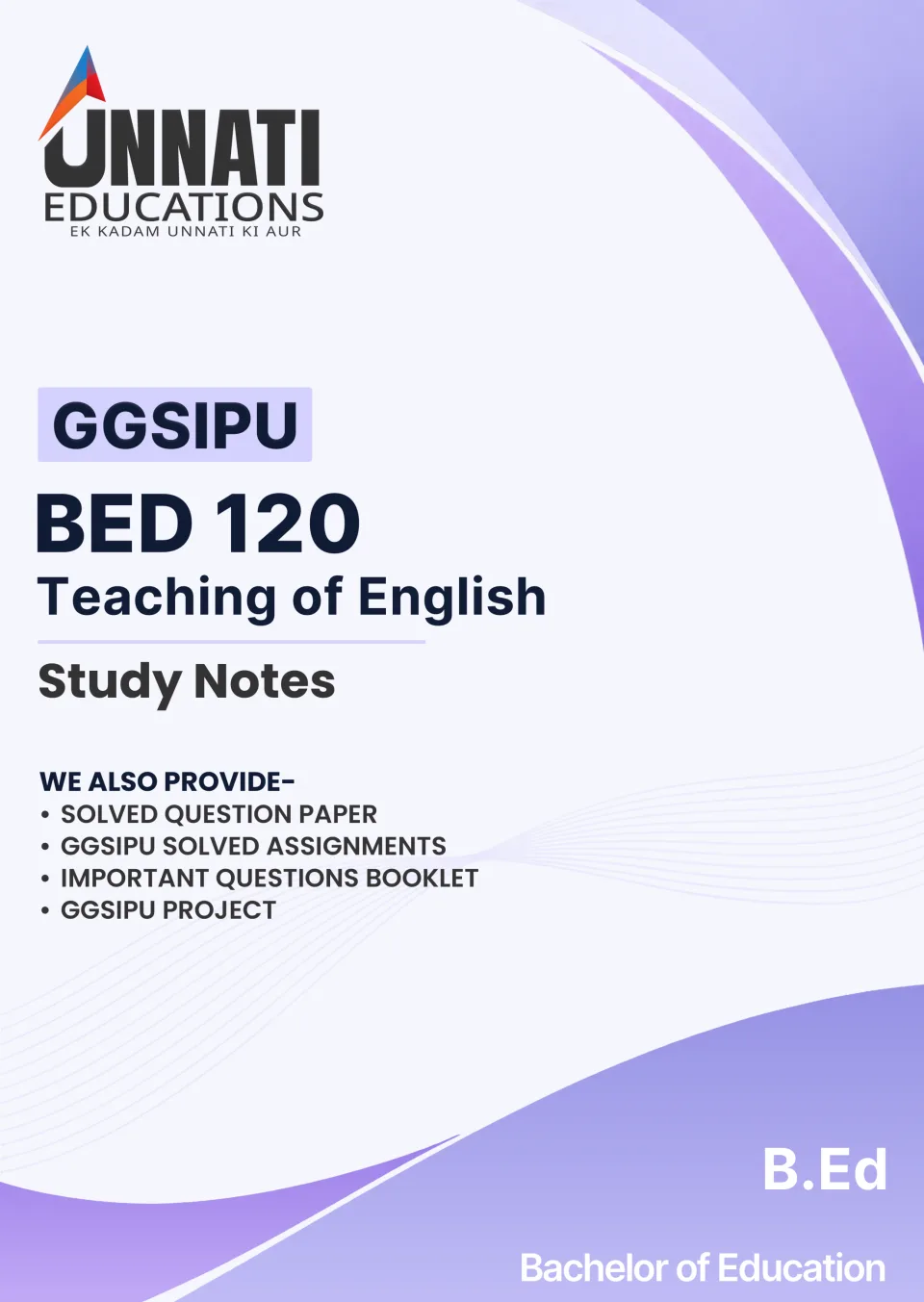
BED 120 Teaching of English Notes cover all four units of the GGSIPU B.Ed Semester 2 English pedagogy paper in a 76-page book: 35 sections, 12 step-flow diagrams, four Quick Revision Tables and 104 exam questions (64 short, 40 long). They follow the B.Ed syllabus for session 2023-24 onwards.
Written by Sheetal Kirola, Academic Head (M.Ed., 7 years of experience) · Reviewed by Prateek Talwar, Founder, Unnati Educations (B.Ed counselling since 2020; ACS, ICSI; B.Com, University of Delhi) · Checked against B.Ed Course Curriculum (Two Years), syllBEd210823.pdf · Updated 14 October 2026 · Editorial policy
Scheme: B.Ed Course Curriculum (Two Years) | Applies to: session 2023-24 onwards | Verified against: syllBEd210823.pdf on ipu.ac.in
BED 120 Teaching of English at a glance: GGSIPU B.Ed Sem 2 credits, units and exam pattern
BED 120 is the English option among eighteen Semester 2 pedagogy papers (BED 116 to BED 150), listed with the other GGSIPU B.Ed Semester 2 papers.
Code and title | BED 120 Teaching of English (notes title: Pedagogy of English) |
|---|---|
Course and semester | B.Ed (two years), Semester 2, Pedagogy of School Subject (I) or (II) |
Credits | 4: three theory, one practical assignments or field work |
Marks | 100: 75 theory exam + 15 practical assignments / field engagement + 10 minors |
Pass mark | 40%, which is 40 out of 100 |
Applies to | Session 2023-24 onwards |
End-term pattern | Paper-setter instructions not printed in the official PDF |
Units | 4 |
Paired lab | None |
Our GGSIPU B.Ed Sem 2 Teaching of English notes use the marks split and pass rule from page 6 of the official PDF; re-appear rules sit in Ordinance 11 on ipu.ac.in.
BED 120 Teaching of English Notes unit-wise: 104 exam questions and 12 step flows across 4 units
In these BED 120 Teaching of English IPU notes, every unit ends with a Quick Revision Table plus 16 short and 10 long exam questions. Notes for the other papers are listed under GGSIPU B.Ed notes.
BED 120 Unit 1: Fundamentals of Language
Definitions from Sapir to Chomsky, Hockett's design features, Halliday's and Jakobson's functions, then the four levels of English (phonology to semantics), psycholinguistic and sociolinguistic views, multilingualism, LAC from the Bullock Report and a timeline of English in India from 1600 to NEP 2020. Pages 4 to 22, 9 sections.
Quick look: maxims of teaching (from page 16)
Maxim | In class |
|---|---|
Known to unknown | Start from school, bus; then new words |
Simple to complex | Simple sentences before complex ones |
Concrete to abstract | Real pen before a word like honesty |
Particular to general | Examples first, then the rule |
Quick look: four maxims in an English class (from page 16)
Maxim
Known to unknown
In class
Start from school, bus; then new words
Maxim
Simple to complex
In class
Simple sentences before complex ones
Maxim
Concrete to abstract
In class
Real pen before a word like honesty
Maxim
Particular to general
In class
Examples first, then the rule
BED 120 Unit 2: Language Development Skills: Listening, Speaking, Reading and Writing Skills
Also covered as "Language Development Skills: LSRW". Each skill runs concept, types, factors, activities, evaluation. Speaking covers stress, rhythm, four intonation tones and modulation; reading covers three process models, phonic versus whole word and five speed techniques; writing goes from mechanics to notices, reports and a 10-mark rubric. Pages 23 to 39, 7 sections.
Quick look: connected speech (from page 28)
Feature | Example |
|---|---|
Linking | turn off sounds like "tur-noff" |
Assimilation | ten boys sounds like "tem boys" |
Elision | next day sounds like "nex day" |
Weak forms | to becomes /tə/ |
Quick look: how spoken English joins words (from page 28)
Feature
Linking
Example
turn off sounds like "tur-noff"
Feature
Assimilation
Example
ten boys sounds like "tem boys"
Feature
Elision
Example
next day sounds like "nex day"
Feature
Weak forms
Example
to becomes /tə/
BED 120 Unit 3: English Language Pedagogy and Learning resources
The classroom unit: eight micro teaching skills, the 36-minute cycle, then Direct, Structural, Communicative and Constructivist approaches compared in one table, with a 5E lesson on a letter to the editor. Lesson planning, prose, poetry and grammar methods follow, then AV aids, CALL, language games, four types of language lab and language clubs. Pages 40 to 57, 9 sections.
Quick look: teaching grammar (from page 50)
Basis | Inductive | Deductive |
|---|---|---|
Order | Examples, then rule | Rule, then examples |
Learner | Discovers the rule | Receives the rule |
Best for | Lower classes, new concepts | Higher classes, revision |
Quick look: inductive versus deductive method (from page 50)
Basis
Order
Inductive
Examples, then rule
Deductive
Rule, then examples
Basis
Learner
Inductive
Discovers the rule
Deductive
Receives the rule
Basis
Best for
Inductive
Lower classes, new concepts
Deductive
Higher classes, revision
BED 120 Unit 4: Professional Growth and Evaluation
The longest unit by sections: measurement versus evaluation, oral and written strategies skill by skill, rubrics, e-portfolios and an "I can" checklist. Then textbook appraisal, an action research plan on article errors in Class VII, NCTE's ten competency areas, CCE, cloze, diagnostic and achievement tests with a 50-mark blueprint, and remedial teaching. Pages 58 to 76, 10 sections.
Quick look: Hindi interference in English (from page 71)
Area | Hindi vs English | Likely error |
|---|---|---|
Word order | S-O-V vs S-V-O | "I school go." |
Articles | None vs a, an, the | "He is teacher." |
Questions | kya vs auxiliary first | "Where you are going?" |
Quick look: contrastive analysis, Hindi and English (from page 71)
Area
Word order
Hindi vs English
S-O-V vs S-V-O
Likely error
"I school go."
Area
Articles
Hindi vs English
None vs a, an, the
Likely error
"He is teacher."
Area
Questions
Hindi vs English
kya vs auxiliary first
Likely error
"Where you are going?"
Krashen's acquisition versus learning in English pedagogy: excerpt from page 12 of the BED 120 notes
Excerpt from page 12
Stephen Krashen drew a line between two ways of getting a language in his Monitor Model of second language acquisition (1981 to 1982). Language acquisition is subconscious and natural. A child picks up the mother tongue by using it in real communication, without anyone explaining the rules. Language learning is conscious and formal. It means knowing the rules of a language, usually in a classroom, with grammar lessons and correction.
How the two differ
Acquisition happens in informal places such as home, the playground and society. Its focus is meaning and communication, grammar is felt rather than explained, and errors are mostly accepted. It belongs mainly to early childhood and gives fluency with natural accuracy. The motive is simply the need to communicate, as when a child picks up Hindi or Punjabi at home.
Learning happens in a classroom with a textbook. Its focus is form, rules and grammar, the rules are taught openly and errors are corrected regularly. It usually comes later, for a second or foreign language, and gives knowledge about the language that may not turn into fluency. The motive is often exams, marks or a career, as when a student studies English grammar at school.
Krashen's five hypotheses
1. Acquisition-learning: the two are separate systems, and only acquisition leads to real fluency.
2. Monitor: rules we have learnt work only as an editor that checks our output when there is time and a focus on form.
3. Natural order: grammar structures are acquired in a predictable order, for example -ing comes before the third person -s.
4. Input (i+1): we acquire language when we understand input slightly above our present level, called comprehensible input.
5. Affective filter: anxiety, fear and low motivation act as a filter that blocks input, and a relaxed class lowers it.
For an English teacher, the message is to give plenty of input that pupils can understand and to keep the class free of fear, while still adding some conscious learning for accuracy.
How to write BED 120 answers: definition-to-table long answers, format questions and lesson-plan answers
The 75-mark theory exam rewards a fixed skeleton plus one table or diagram, which most of the book's 9 exam tips name.
Long theory answers. For "nature, scope and functions of language", the tip on page 6 gives the order: definition, at least eight characteristics, scope, Halliday's functions with examples, conclusion. For listening, page 25 says follow the syllabus order (concept, types, importance, factors, activities, evaluation) and draw the five-stage listening flow.
Name the source. Page 15 suggests writing "Every teacher is a teacher of language", Bullock Report (1975), in any LAC answer. Hockett (1960), Krashen's i+1 and Corder (1967) do the same job elsewhere.
Format and method questions. Write the layout of a notice, circular or report before its content. In prose answers, keep the lists apart, as page 48 warns: story-telling and dramatization are methods; discussion, narration and questioning are techniques.
Assessment answers. Draw a rubric in any answer on constructive assessment (page 61). For remedial teaching, page 73 gives the chain: diagnostic test, error analysis, contrastive analysis, remedial teaching, re-test.
Worked example: 10-mark plan for "Discuss the nature, scope and functions of language"
Definition: Sapir (1921), Bloch and Trager (1942).
Eight characteristics in a table, with "dog" and "kutta" for arbitrariness.
Scope: personal, education, social, cultural, professional.
Halliday's seven functions with a child's sentence each.
Conclusion: language as the medium of all learning.
Practise this skeleton on GGSIPU B.Ed important questions.
BED 120 exam corner: 64 short and 40 long exam questions on language, LSRW, pedagogy and assessment
Unit | Short (2–5 Marks) | Long (10–15 Marks) | Exam tips |
|---|---|---|---|
1: Fundamentals of Language | 16 | 10 | 3 |
2: LSRW skills | 16 | 10 | 2 |
3: Pedagogy and resources | 16 | 10 | 2 |
4: Growth and evaluation | 16 | 10 | 2 |
BED 120 exam questions in the notes, by unit
Unit
1: Fundamentals of Language
Short (2–5 Marks)
16
Long (10–15 Marks)
10
Exam tips
3
Unit
2: LSRW skills
Short (2–5 Marks)
16
Long (10–15 Marks)
10
Exam tips
2
Unit
3: Pedagogy and resources
Short (2–5 Marks)
16
Long (10–15 Marks)
10
Exam tips
2
Unit
4: Growth and evaluation
Short (2–5 Marks)
16
Long (10–15 Marks)
10
Exam tips
2
Labels as printed in the notes; one question per unit:
Unit 1 (long): What is Language across the Curriculum? Explain its need and strategies. Pointer: Bullock Report, BICS and CALP, six strategies (page 15).
Unit 2 (long): "Writing is a process, not a product." Discuss its stages. Pointer: pre-writing to publishing, plus four writing stages (pages 33 to 34).
Unit 3 (short): Differentiate between approach, method and technique. Pointer: Edward Anthony (1963): theory, plan, classroom activity (page 42).
Unit 4 (short): What is a cloze test? Give an example. Pointer: Wilson Taylor (1953), every nth word deleted, exact or acceptable-word scoring (page 68).
The BED 120 notes list 64 short-answer and 40 long-answer exam questions across 4 units. More practice sits in the BED 120 important questions.
BED 120 and the GGSIPU B.Ed Sem 2 papers it connects to
BED 120 has no lab; its practical side is one field assignment from the list in the GGSIPU B.Ed syllabus. The units that support each option:
Achievement Test in English: Unit 4 steps and blueprint (page 69)
Five LSRW activities: Unit 2 activity lists (pages 25 and 29)
Evaluating ICT resources: Unit 3 online resources (page 52)
These are study notes for the tasks, not a ready-made assignment.
Other Semester 2 papers (BED 106 shares Unit 4's assessment theme): BED 102 Learning and Teaching, BED 104 Contemporary Perspectives in Education, BED 106 Assessment of Learning, BED 108 Experiential Learning, BED 110 Entrepreneurship in Education, BED 152 Reading and Reflecting on Texts, BED 154 PSE-II, and a second pedagogy paper.
Who writes and checks the BED 120 English pedagogy notes?
Sheetal Kirola, author: Academic Head, Unnati Educations · M.Ed. · 7 years of experience.
Prateek Talwar, reviewer: Founder, Unnati Educations · B.Ed counselling since 2020 · ACS, ICSI · B.Com, University of Delhi.
The 2026-27 edition maps all 35 topic headings to the session 2023-24 curriculum, from Hockett to Corder. Updated 14 October 2026 under our editorial policy.
The team also prepares GGSIPU important questions.
Do the BED 120 notes cover the full GGSIPU syllabus?
Yes for Units I to IV: every listed topic has its own section. The practical assignment options have no separate section.
Official unit | Official topics | In the notes | Status |
|---|---|---|---|
I: Fundamentals of Language | Nature, scope, functions; linguistic structure; psycho- and sociolinguistics; acquisition vs learning; multilingualism; Language across Curriculum; maxims; English in India | Sections 1 to 9, pages 5 to 19 | Covered |
II: Language Development Skills | Listening; speaking and connected speech; reading methods, types, speed, study skills; writing mechanics, process, formats, feedback | Sections 1 to 7, pages 24 to 36 | Covered |
III: English Language Pedagogy and Learning resources | Micro teaching; four approaches; lesson planning for prose, poetry, grammar; AV aids, CALL, library; ICT and games; language lab and clubs | Sections 1 to 9, pages 41 to 54 | Covered |
IV: Professional Growth and Evaluation | Assessing skills; constructive assessment; course material; action research; textbook appraisal; competencies; CCE; elicitation tests; remedial teaching, contrastive and error analysis | Sections 1 to 10, pages 59 to 72 | Covered |
Practical assignments (any one) | Five options | Pages 25, 29, 52, 69 | Partly covered: no assignment section |
Official BED 120 syllabus mapped to the notes
Official unit
I: Fundamentals of Language
Official topics
Nature, scope, functions; linguistic structure; psycho- and sociolinguistics; acquisition vs learning; multilingualism; Language across Curriculum; maxims; English in India
In the notes
Sections 1 to 9, pages 5 to 19
Status
Covered
Official unit
II: Language Development Skills
Official topics
Listening; speaking and connected speech; reading methods, types, speed, study skills; writing mechanics, process, formats, feedback
In the notes
Sections 1 to 7, pages 24 to 36
Status
Covered
Official unit
III: English Language Pedagogy and Learning resources
Official topics
Micro teaching; four approaches; lesson planning for prose, poetry, grammar; AV aids, CALL, library; ICT and games; language lab and clubs
In the notes
Sections 1 to 9, pages 41 to 54
Status
Covered
Official unit
IV: Professional Growth and Evaluation
Official topics
Assessing skills; constructive assessment; course material; action research; textbook appraisal; competencies; CCE; elicitation tests; remedial teaching, contrastive and error analysis
In the notes
Sections 1 to 10, pages 59 to 72
Status
Covered
Official unit
Practical assignments (any one)
Official topics
Five options
In the notes
Pages 25, 29, 52, 69
Status
Partly covered: no assignment section
Official source: B.Ed Course Curriculum (Two Years), session 2023-24 onwards, pages 43 to 46.
Every B.Ed paper in GGSIPU notes is checked against this same file.
BED 120 English pedagogy notes FAQs
How do I get the full BED 120 notes?
Tap "Get Full Notes" to message us on WhatsApp at 9899436384. The full BED 120 notes come only as a printed book; they are not available as a PDF. Delivery takes a maximum of 5 to 7 days, depending on your location.
Is BED 120 Teaching of English the same as BED 120 Pedagogy of English?
Yes. The official curriculum prints the title as Teaching of English, while our book cover says Pedagogy of English. Both mean the same code, BED 120, and the same four units, from Fundamentals of Language to Professional Growth and Evaluation. Students search with both names, and either title leads to the same paper, the same syllabus and the same book.
What is the passing mark in BED 120?
BED 120 is marked out of 100: 75 for the theory exam, 15 for practical assignments or field engagement and 10 for minors. The B.Ed scheme of examination states pass marks as 40%, which is 40 out of 100. For end-term minimums and re-appear rules, check GGSIPU Ordinance 11 on ipu.ac.in, since the curriculum PDF does not repeat them.
Which BED 120 unit needs the most study time?
Unit 4 has the most sections (10) and, with Unit 1, the most pages (19 each). Every unit carries the same 16 short and 10 long exam questions, so none can be skipped. Unit 2 needs practice for intonation and connected speech, while Unit 3 needs time for the lesson plan format and the four teaching approaches.
Do the BED 120 notes help with the practical assignment?
They help you understand it. The syllabus asks for any one of five tasks, and the notes explain the steps and blueprint for an Achievement Test in English (page 69), list listening and speaking activities (pages 25 and 29) and review online English resources (page 52). Your file and activities should still be your own work.
Which batch does the BED 120 syllabus in these notes apply to?
The notes follow the B.Ed Course Curriculum (Two Years) for session 2023-24 onwards, the file syllBEd210823.pdf on ipu.ac.in. In that scheme, Semester 2 has two pedagogy papers picked from BED 116 to BED 150, and BED 120 is the English option. If your institute gives a newer syllabus, compare it with our syllabus map above.
Get the full BED 120 Teaching of English Notes on WhatsApp
Part | Pages | Sections | Exam questions |
|---|---|---|---|
Cover and index | 3 | - | - |
Unit 1 | 19 | 9 | 26 |
Unit 2 | 17 | 7 | 26 |
Unit 3 | 18 | 9 | 26 |
Unit 4 | 19 | 10 | 26 |
Total | 76 | 35 | 104 |
Inside the full BED 120 notes book
Part
Cover and index
Pages
3
Sections
-
Exam questions
-
Part
Unit 1
Pages
19
Sections
9
Exam questions
26
Part
Unit 2
Pages
17
Sections
7
Exam questions
26
Part
Unit 3
Pages
18
Sections
9
Exam questions
26
Part
Unit 4
Pages
19
Sections
10
Exam questions
26
Part
Total
Pages
76
Sections
35
Exam questions
104
Format: Teaching of English notes in English, as a printed book only, not available as a PDF. Delivery: maximum 5 to 7 days, depending on your location.
Order the full BED 120 notes book on WhatsApp (4 units, 76 pages)
Unnati Educations is an independent education provider based in Vikaspuri, Delhi. We are not affiliated with, authorised by, or endorsed by Guru Gobind Singh Indraprastha University (GGSIPU). 'GGSIPU' and 'IPU' are used only to describe the syllabus our notes follow. For official information, visit ipu.ac.in.
Ready for the full notes?
Discuss coverage and delivery with our team.