
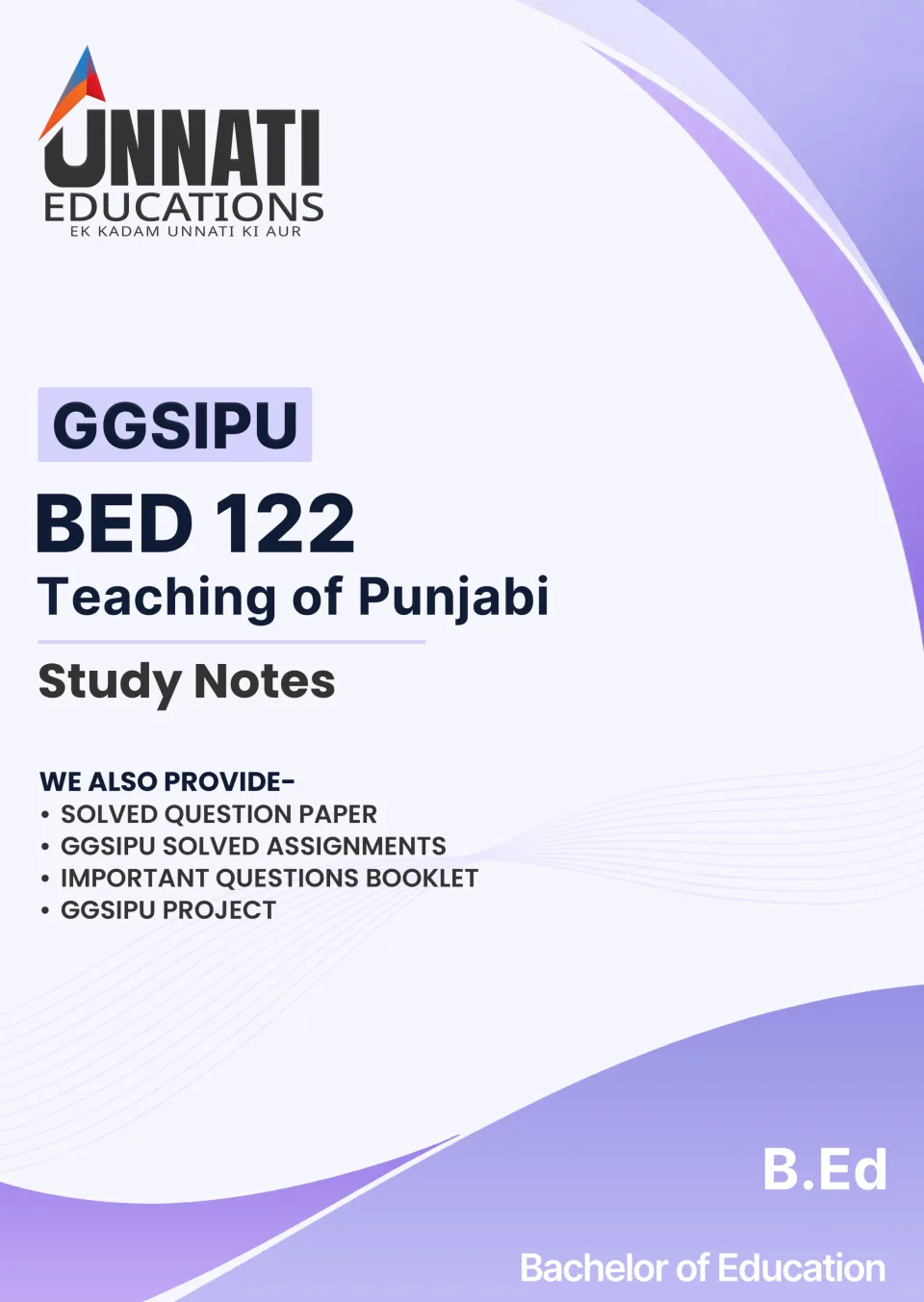
BED 122 Teaching of Punjabi Notes cover all 4 units of this GGSIPU B.Ed Semester 2 pedagogy paper in 87 pages: 29 topics from mother tongue and the Gurmukhi script to micro teaching, CCE and achievement tests, plus 48 short and 30 long exam questions. They follow the B.Ed curriculum for session 2023-24 onwards.
Written by Sheetal Kirola, Academic Head, M.Ed. · Reviewed by Prateek Talwar, Founder, Unnati Educations (B.Ed counselling since 2020) · Checked against syllBEd210823.pdf (ipu.ac.in) · Updated 14 October 2026 · Editorial policy
Scheme: B.Ed. Course Curriculum (Two Years) | Applies to: Session 2023-24 onwards | Verified against: syllBEd210823.pdf, checked 13 October 2026
BED 122 Teaching of Punjabi at a glance: GGSIPU B.Ed Sem 2 credits, units and exam pattern
Code and title | BED 122 · Teaching of Punjabi |
|---|---|
Course and semester | B.Ed (two years), Semester 2, Pedagogy of School Subject (BED116 to BED150) |
Credits | 4: 3 theory + 1 practical assignments or field work |
Marks | 100: 75 theory exam + 15 practical assignments / field engagement + 10 minors |
Pass mark | 40%, which is 40 out of 100 (other rules: Ordinance 11) |
Applies to | Session 2023-24 onwards |
End-term pattern | Paper-setter instructions not printed in the official PDF |
Units | 4, plus 4 practical assignments |
Paired lab | None |
English is the programme's medium of instruction, so these Teaching of Punjabi notes in English explain every idea and keep Gurmukhi terms such as ਪੈਂਤੀ (Painti) beside it. BED 122 shares the timetable with the other GGSIPU B.Ed Semester 2 papers.
BED 122 Teaching of Punjabi Notes unit-wise: 29 topics and 78 exam questions across 4 units
These GGSIPU B.Ed Sem 2 Teaching of Punjabi notes close every unit with a Quick Revision Table and exam questions. Other B.Ed papers are under GGSIPU B.Ed notes.
BED 122 Unit 1: Fundamentals of Language
Pages 6 to 25, 7 topics. Language gets three definitions, twelve characteristics shown in Punjabi and nine origin theories from Bow-Wow to Révész. Mother tongue gets UNESCO's 1953 definition and twelve teaching maxims.
Later topics: Cummins' BICS and CALP, Punjabi as first and second language, NEP 2020 and making a language kit. Exam questions: 12 short, 8 long.
Dialect | Districts | Note |
|---|---|---|
Majhi | Amritsar, Gurdaspur, Tarn Taran | Standard; base of textbook Punjabi |
Doabi | Jalandhar, Hoshiarpur, Kapurthala | Between the Beas and the Sutlej |
Malwai | Ludhiana, Bathinda, Patiala, Sangrur | South of the Sutlej |
Puadhi | Ropar, Mohali, parts of Haryana | Haryanvi and Hindi influence |
Quick look: Punjabi dialects of Punjabi in India (from page 14)
Dialect
Majhi
Districts
Amritsar, Gurdaspur, Tarn Taran
Note
Standard; base of textbook Punjabi
Dialect
Doabi
Districts
Jalandhar, Hoshiarpur, Kapurthala
Note
Between the Beas and the Sutlej
Dialect
Malwai
Districts
Ludhiana, Bathinda, Patiala, Sangrur
Note
South of the Sutlej
Dialect
Puadhi
Districts
Ropar, Mohali, parts of Haryana
Note
Haryanvi and Hindi influence
BED 122 Unit 2: Language Acquisition
Pages 26 to 47, 8 topics, the longest unit. It takes LSRW one skill at a time: listening, Punjabi's tonal letters and speech defects, reading as decoding plus comprehension with six initial methods, and eleven writing defects in Gurmukhi.
It closes with précis and elaboration, essay and letter formats, note making with SQ3R and reference skills. Exam questions: 12 short, 8 long.
Defect | Remedy |
|---|---|
Reading letter by letter | Word and phrase practice with flash cards |
Skipping or adding words | Pointer-guided, slow reading |
Lip movement in silent reading | Timed silent reading, lips closed |
Poor comprehension | Pre-reading questions and discussion |
Quick look: reading defects and remedies (from page 34)
Defect
Reading letter by letter
Remedy
Word and phrase practice with flash cards
Defect
Skipping or adding words
Remedy
Pointer-guided, slow reading
Defect
Lip movement in silent reading
Remedy
Timed silent reading, lips closed
Defect
Poor comprehension
Remedy
Pre-reading questions and discussion
BED 122 Unit 3: Aspects of Language Teaching and Recent Trends in Teaching
Pages 48 to 68, 8 topics. Micro teaching (the 36-minute Indian cycle, ten skills), Morrison's unit plan and a Herbartian Class VI prose lesson come first, then Bloom's domains and teaching aids.
Prose, poetry (recitation, song-action, ras) and grammar methods follow, ending with e-learning, OER, SWAYAM MOOCs and social media. Exam questions: 12 short, 8 long.
Basis | Inductive | Deductive |
|---|---|---|
Order | Examples, then rule | Rule, then examples |
Pupil role | Discovers the rule | Receives the rule |
Learning | Deep, long-lasting | Quick, can become rote |
Suits | Lower classes, new concepts | Higher classes, revision |
Quick look: inductive and deductive grammar teaching (from page 63)
Basis
Order
Inductive
Examples, then rule
Deductive
Rule, then examples
Basis
Pupil role
Inductive
Discovers the rule
Deductive
Receives the rule
Basis
Learning
Inductive
Deep, long-lasting
Deductive
Quick, can become rote
Basis
Suits
Inductive
Lower classes, new concepts
Deductive
Higher classes, revision
BED 122 Unit 4: Professional Growth and Evaluation
Pages 69 to 87, 6 topics and a practical guide. Teacher qualities come in five groups, with growth routes such as NISHTHA and NEP 2020's 50 hours of CPD. CCE, action research (Corey) and a textbook checklist follow.
Test items carry Punjabi examples, and a Class VIII achievement test gets a blueprint. Exam questions: 12 short, 6 long.
Index | Formula | Acceptable |
|---|---|---|
Difficulty (P) | (RU + RL) ÷ (NU + NL) × 100 | About 25% to 75% |
Discrimination (D) | (RU − RL) ÷ NU | 0.20 and above; reject if negative |
Quick look: item analysis of a Punjabi test (from page 84)
Index
Difficulty (P)
Formula
(RU + RL) ÷ (NU + NL) × 100
Acceptable
About 25% to 75%
Index
Discrimination (D)
Formula
(RU − RL) ÷ NU
Acceptable
0.20 and above; reject if negative
BED 122 exam corner: 48 two-to-five-mark and 30 ten-to-fifteen-mark exam questions by unit
Unit | Short (2–5 marks) | Long (10–15 marks) | Worked examples |
|---|---|---|---|
Unit 1 | 12 | 8 | 1 |
Unit 2 | 12 | 8 | 3 |
Unit 3 | 12 | 8 | 2 |
Unit 4 | 12 | 6 | 1 |
BED 122 exam questions by unit in the notes
Unit
Unit 1
Short (2–5 marks)
12
Long (10–15 marks)
8
Worked examples
1
Unit
Unit 2
Short (2–5 marks)
12
Long (10–15 marks)
8
Worked examples
3
Unit
Unit 3
Short (2–5 marks)
12
Long (10–15 marks)
8
Worked examples
2
Unit
Unit 4
Short (2–5 marks)
12
Long (10–15 marks)
6
Worked examples
1
The BED 122 notes list 48 two-to-five-mark and 30 ten-to-fifteen-mark exam questions across 4 units, plus 7 worked examples. The questions have no model answers. One exam-style question per unit:
Unit 1: Describe the present position of Punjabi in the Indian school curriculum in the light of NEP 2020. Pointer: Punjab Act 2008, then NEP paras 4.11 to 4.13 and the challenges on page 21.
Unit 2: What are the common defects in the writing skills of pupils in Punjabi? Suggest measures for improvement. Pointer: addhak and bindi errors, causes, then dictation and error analysis.
Unit 3: What is micro teaching? Explain its cycle, phases and merits. Pointer: Allen's definition, the 6-6-12-6-6 minute cycle, then questioning and reinforcement.
Unit 4: What is action research? Explain its steps and plan one for a Punjabi classroom problem. Pointer: Corey's 1953 definition, seven steps, then a pre-test and post-test plan.
More practice sits in the BED 122 important questions.
Origin of Punjabi from Vedic Sanskrit to Modern Punjabi in Punjabi pedagogy: excerpt from page 13 of the BED 122 notes
Excerpt from page 13
Introduction
Punjabi (ਪੰਜਾਬੀ) is the language of the land of five rivers: Punj means five and ab means water or rivers. It belongs to the Indo-Aryan branch of the Indo-European family of languages. It is spoken in Indian Punjab, in parts of Haryana, Himachal Pradesh, Delhi, Jammu and Rajasthan, and in Pakistani Punjab. The Punjabi diaspora in Canada, the UK, the USA and Australia also speaks it widely.
Key point: Punjabi at a glance
Family: Indo-European, then Indo-Iranian, then Indo-Aryan.
Scripts: Gurmukhi in India and Shahmukhi (Perso-Arabic) in Pakistan.
Punjabi is one of the 22 languages in the Eighth Schedule of the Indian Constitution, and it was among the original 14.
It is the official language of Punjab and an additional official language in Delhi.
Special feature: Punjabi is a tonal language, so a rising or falling pitch can change the meaning of a word.
Origin of Punjabi: the stages
Vedic Sanskrit, Classical Sanskrit, the Prakrits (Paishachi and Shauraseni), Apabhramsha (Takki), Old Punjabi (around the 10th to 11th century) and Modern Punjabi.
Vedic and Classical Sanskrit stage: the Rigveda is believed to have been composed largely in the Sapta Sindhu region, the land of seven rivers, which is the present-day Punjab region.
Prakrit stage: common people spoke simpler spoken forms called Prakrits. Scholars connect Punjabi mainly with Paishachi and Shauraseni Prakrit.
Apabhramsha stage: the Prakrits changed further into Apabhramsha. The Apabhramsha of this region is often called Takki or Takka Apabhramsha.
Old Punjabi: by around the 10th to 11th century a recognisable early Punjabi had developed. The writings of the Nath Jogis, such as Gorakhnath and Charpatnath, show its early forms.
A literary language: Baba Sheikh Farid (1173 to 1266) is regarded as the first great poet of Punjabi, and his shaloks are included in Sri Guru Granth Sahib.
Modern Punjabi: shaped by Persian, Arabic, Urdu, Hindi and English, and standardised in the 19th and 20th centuries through printing, newspapers, schools and universities.
Periods of development
The first period in the notes' table is the Early Period (Adi Kaal), up to about 1500: religious and spiritual verses with Nath and Sufi influence, represented by the Nath Jogis and Baba Farid. The table continues on page 14 with the Guru period, the kissa and Sufi period and the modern period.
Do the BED 122 notes cover the full GGSIPU syllabus?
Yes. Every official BED 122 topic has its own section, and page 85 covers the practical assignments.
Official unit | Official topics | In the notes | Status |
|---|---|---|---|
I: Fundamentals of Language | Language; mother tongue; origin of Punjabi; Punjabi as mother tongue; first/second language problems; NEP 2020 position; language kit | Topics 01 to 07, pp. 7 to 23 | Covered |
II: Language Acquisition | LSRW; types of reading; writing defects; elaboration and summarization; essay and letter; study and reference skills | Topics 01 to 08, pp. 27 to 45 | Covered |
III: Aspects of Language Teaching and Recent Trends in Teaching | Micro teaching, unit and lesson planning; objectives and aids for prose, poetry, grammar; e-learning, OER, MOOCs, social media | Topics 01 to 08, pp. 49 to 66 | Covered |
IV: Professional Growth and Evaluation | Teacher qualities; CCE; action research; textbook; test items and achievement test | Topics 01 to 06, pp. 70 to 84 | Covered |
BED 122 official syllabus mapped to the notes
Official unit
I: Fundamentals of Language
Official topics
Language; mother tongue; origin of Punjabi; Punjabi as mother tongue; first/second language problems; NEP 2020 position; language kit
In the notes
Topics 01 to 07, pp. 7 to 23
Status
Covered
Official unit
II: Language Acquisition
Official topics
LSRW; types of reading; writing defects; elaboration and summarization; essay and letter; study and reference skills
In the notes
Topics 01 to 08, pp. 27 to 45
Status
Covered
Official unit
III: Aspects of Language Teaching and Recent Trends in Teaching
Official topics
Micro teaching, unit and lesson planning; objectives and aids for prose, poetry, grammar; e-learning, OER, MOOCs, social media
In the notes
Topics 01 to 08, pp. 49 to 66
Status
Covered
Official unit
IV: Professional Growth and Evaluation
Official topics
Teacher qualities; CCE; action research; textbook; test items and achievement test
In the notes
Topics 01 to 06, pp. 70 to 84
Status
Covered
Official source: B.Ed. Course Curriculum (Two Years), Session 2023-24 onwards (PDF), where BED 122 sits on pages 46 to 48.
The notes keep the four official unit titles. Every course in GGSIPU notes is mapped to its official PDF the same way.
Who writes and checks the BED 122 Punjabi pedagogy notes?
Sheetal Kirola, author of these notes: Academic Head, Unnati Educations · M.Ed. · 7 years of experience.
Prateek Talwar, reviewer against the official syllabus: Founder, Unnati Educations · B.Ed counselling since 2020 · ACS (ICSI) · B.Com, University of Delhi.
The BED 122 Teaching of Punjabi IPU notes are mapped to the B.Ed curriculum for session 2023-24 onwards. The 2026-27 edition has 87 pages and was last updated 14 October 2026. See our editorial policy.
The same team prepares GGSIPU important questions for every course.
BED 122 and the GGSIPU B.Ed Sem 2 papers it connects to
BED 122 has no lab paper; its practical work is four field-engagement tasks worth 15 marks, and all course codes are on the GGSIPU B.Ed syllabus page.
Unit 1 acquisition theories and Unit 3 Bloom's taxonomy → BED 102 Learning and Teaching.
Unit 4 CCE, test items and blueprint → BED 106 Assessment of Learning.
Unit 2 reading and note making → BED 152 Reading and Reflecting on Texts.
Unit 3 micro teaching and lesson plans → BED 154 PSE-II.
Also in Semester 2: BED 104 Contemporary Perspectives in Education, BED 108 Experiential Learning, BED 110 Entrepreneurship in Education and your second pedagogy paper.
How to write BED 122 answers: definitions with authors, Punjabi examples and test blueprints
A pedagogy answer in BED 122 is marked on two things: whether you know the theory, and whether you can show it in a Punjabi classroom. The notes build both into every topic, and their own exam tips point to a few habits worth copying.
Start with named definitions. The tip on page 7 asks for at least two definitions with the author's name in a long answer. The notes give them ready: Sapir (1921) for language, UNESCO (1953) for mother tongue, Allen (1966) for micro teaching, Corey (1953) for action research.
Add a Punjabi example to every point. A plain list of characteristics reads like any language paper. The notes pair each point with a Punjabi case: ਪਾਣੀ for arbitrariness, ਪਤਾ and ਪੱਤਾ for gemination, Shiv Kumar Batalvi for creativity.
Use headings for list questions. Page 78 suggests writing textbook qualities under Physical, Content, Language, Organisation, Exercises and Values with two or three points each, rather than one long list.
Draw the format questions. A note-making answer needs a title, headings, indented points, at least four abbreviations and a key (page 43). A blueprint answer should be ruled neatly and show the item type in each cell, as in the Class VIII 40-mark example on pages 83 and 84.
Worked example: "Explain the meaning and nature of language."
Meaning: Latin lingua (tongue); in Punjabi, bhasha or boli.
Two definitions: Sapir (1921) and Bloch and Trager.
Nature: five or six characteristics, each with a Punjabi example (human, arbitrary, systematic with SOV order, vocal, dynamic with words like "mobile" and "bus").
Conclusion: language is human, social and always changing, so a Punjabi teacher must teach it as living speech, not only as rules.
Practise this format on GGSIPU B.Ed important questions.
BED 122 Punjabi pedagogy notes FAQs
How do I get the full BED 122 notes?
Send a WhatsApp message to 9899436384 using the "Get Full Notes" button on this page. The full BED 122 notes come as a printed book only; they are not sold as a PDF. Delivery takes a maximum of 5 to 7 days, depending on your location.
What is the passing mark in BED 122 Teaching of Punjabi?
BED 122 is marked out of 100: 75 for the theory exam, 15 for practical assignments or field engagement and 10 for minors. The B.Ed scheme of examination states pass marks as 40%, which is 40 out of 100. For end-term minimums, re-appear and other result rules, read GGSIPU Ordinance 11 on ipu.ac.in or ask your institute's examination cell.
Are the BED 122 notes written in English or in Punjabi?
The explanations are in English, which is the medium of instruction for the B.Ed programme. Gurmukhi words and examples sit beside the English where they help: the Painti alphabet, lagan-matras, tonal letters, a sample leave application and Punjabi test items with answers. You can write your answers in English and still quote the Punjabi examples correctly.
Which BED 122 unit is the longest in the notes?
Unit 2, Language Acquisition, is the longest: 22 pages and 8 topics, from listening and speaking to dictionary and thesaurus skills. It also holds 3 of the book's 7 worked examples. Unit 1 runs 20 pages, Unit 3 runs 21 pages and Unit 4 runs 19 pages, closing with the practical guide on page 85.
Do the BED 122 notes help with the practical assignments?
Yes. Page 85 gives key points for all four BED 122 field-engagement tasks: a multimedia lesson taught to peers, a folder of Punjabi reading material, a critical study of a textbook or literary book, and an evaluation of ICT resources for Punjabi. It also lists what a practical file should contain. These tasks carry the 15 practical marks.
Do the BED 122 notes match the 2023-24 B.Ed syllabus?
Yes. The notes follow the B.Ed. Course Curriculum (Two Years) for session 2023-24 onwards, published on ipu.ac.in as syllBEd210823.pdf. The four unit titles match the official ones, and the syllabus map above gives the notes pages for every official topic. The date this page was last checked against the PDF is shown at the top.
Get the full BED 122 Teaching of Punjabi Notes on WhatsApp
Unit | Pages | Topics | Exam questions |
|---|---|---|---|
Unit 1 | 6 to 25 (20) | 7 | 20 |
Unit 2 | 26 to 47 (22) | 8 | 20 |
Unit 3 | 48 to 68 (21) | 8 | 20 |
Unit 4 | 69 to 87 (19) | 6 | 18 |
Pages per unit in the full BED 122 notes
Unit
Unit 1
Pages
6 to 25 (20)
Topics
7
Exam questions
20
Unit
Unit 2
Pages
26 to 47 (22)
Topics
8
Exam questions
20
Unit
Unit 3
Pages
48 to 68 (21)
Topics
8
Exam questions
20
Unit
Unit 4
Pages
69 to 87 (19)
Topics
6
Exam questions
18
The full BED 122 notes are a printed book, not a PDF; order on WhatsApp and delivery takes a maximum of 5 to 7 days, depending on your location.
Get the full BED 122 notes on WhatsApp (4 units, 87 pages)
Unnati Educations is an independent education provider based in Vikaspuri, Delhi. We are not affiliated with, authorised by, or endorsed by Guru Gobind Singh Indraprastha University (GGSIPU). 'GGSIPU' and 'IPU' are used only to describe the syllabus our notes follow. For official information, visit ipu.ac.in.
Ready for the full notes?
Discuss coverage and delivery with our team.