
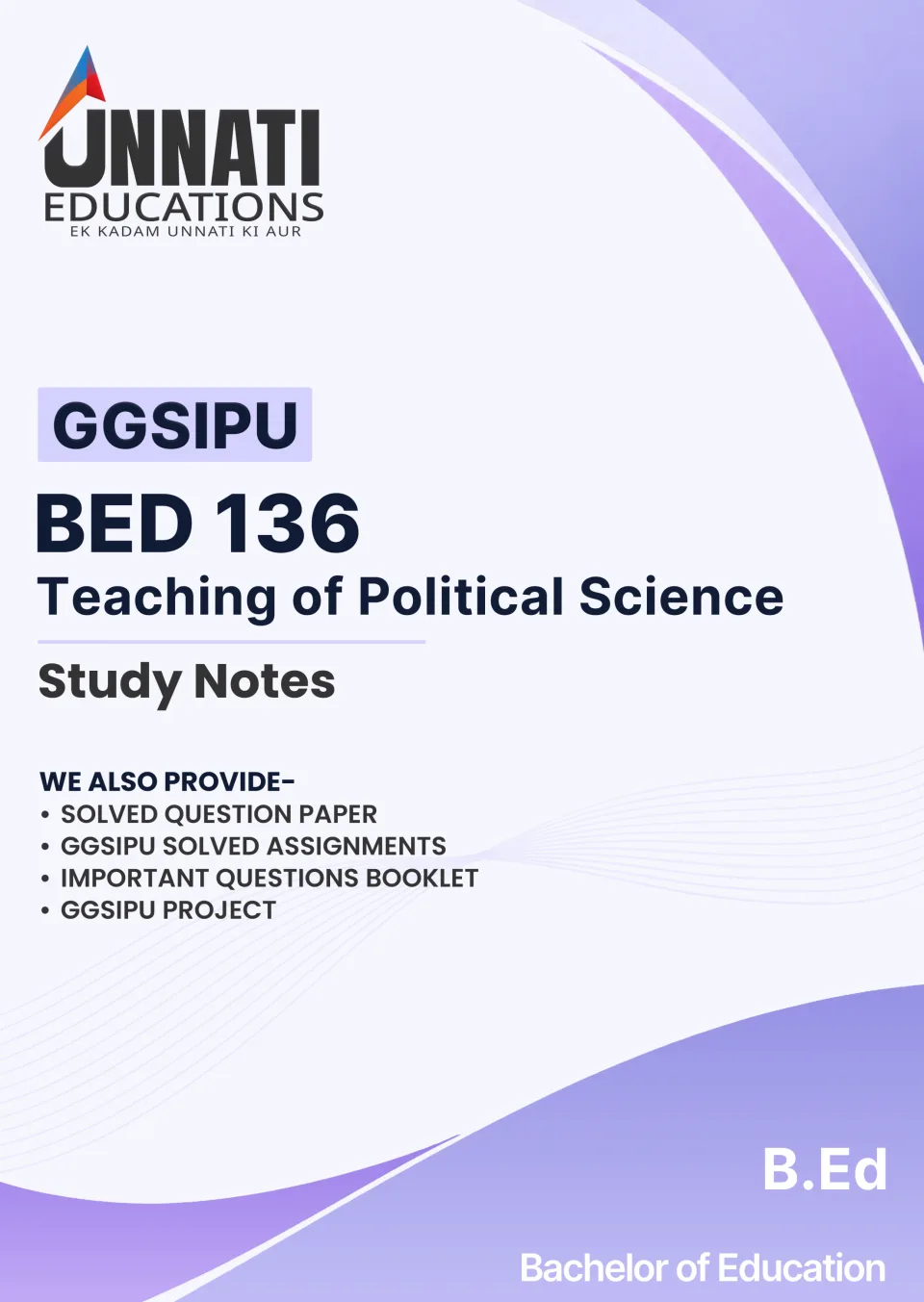
BED 136 Teaching of Political Science Notes cover all 4 units of the GGSIPU B.Ed Semester 2 pedagogy paper in 86 pages: 34 topic sections, 15 worked classroom examples, 4 quick revision tables and 104 exam questions (64 short, 40 long). They follow the official B.Ed curriculum for session 2023-24 onwards.
Written by Sheetal Kirola, Academic Head · Reviewed by Prateek Talwar, Founder, Unnati Educations · Checked against B.Ed Course Curriculum (Two Years), session 2023-24 onwards · Updated 14 October 2026 · Editorial policy
Scheme: B.Ed Course Curriculum (Two Years) | Applies to: session 2023-24 onwards | Verified against: syllBEd210823.pdf, ipu.ac.in
BED 136 Teaching of Political Science at a glance: GGSIPU B.Ed Sem 2 credits, units and exam pattern
BED 136 trains pupil teachers to teach Political Science in Classes XI and XII. It is one of 18 pedagogy options and sits with the other GGSIPU B.Ed Semester 2 papers.
| Item | BED 136 detail |
|---|---|
| Course and semester | B.Ed (two years), Semester 2 |
| Category | Pedagogy of School Subject (two papers taken from BED 116 to BED 150) |
| Credits | 4: three theory, one practical assignments or field work |
| Marks | 100: 75 theory exam + 15 practical assignments / field engagement + 10 minors |
| Pass mark | Minimum 40%, which is 40 out of 100 |
| Applies to | Session 2023-24 onwards |
| End-term pattern | Paper-setter instructions not printed in the official PDF |
| Units | 4 (official titles under each unit below) |
| Practicum | Any one of 9 tasks, e.g. action research or a Parliament Museum visit |
| Paired lab | None (theory pedagogy paper) |
BED 136 Teaching of Political Science: official facts from the B.Ed curriculum
- Item
- Course and semester
- BED 136 detail
- B.Ed (two years), Semester 2
- Item
- Category
- BED 136 detail
- Pedagogy of School Subject (two papers taken from BED 116 to BED 150)
- Item
- Credits
- BED 136 detail
- 4: three theory, one practical assignments or field work
- Item
- Marks
- BED 136 detail
- 100: 75 theory exam + 15 practical assignments / field engagement + 10 minors
- Item
- Pass mark
- BED 136 detail
- Minimum 40%, which is 40 out of 100
- Item
- Applies to
- BED 136 detail
- Session 2023-24 onwards
- Item
- End-term pattern
- BED 136 detail
- Paper-setter instructions not printed in the official PDF
- Item
- Units
- BED 136 detail
- 4 (official titles under each unit below)
- Item
- Practicum
- BED 136 detail
- Any one of 9 tasks, e.g. action research or a Parliament Museum visit
- Item
- Paired lab
- BED 136 detail
- None (theory pedagogy paper)
For end-term minimums and re-appear rules, read Ordinance 11.
BED 136 Teaching of Political Science Notes unit-wise: 34 topics, 15 worked examples and 104 exam questions across 4 units
Each unit follows the official topic order and ends with a Quick Revision Table plus 26 exam questions (16 short, 10 long). Every other B.Ed paper sits under GGSIPU B.Ed notes.
BED 136 Unit 1: Political Science in School Curriculum at Senior Secondary School level
Pages 3 to 23, 9 sections. It traces the discipline from Aristotle and Kautilya to the behavioural revolution, then covers Easton's and Lasswell's definitions, Saptanga as an indigenous source, Freire's critical pedagogy, Preamble-based aims, Bloom and RCEM objectives, and a 100-mark textbook rating scale. 2 worked examples; 16 short and 10 long questions.
| Objective | What the Class XI student does |
|---|---|
| Knowledge | Recalls the three lists of the Seventh Schedule |
| Understanding | Classifies subjects into Union, State and Concurrent lists |
| Application | Predicts the result when Union and State laws clash |
| Creativity | Suggests ways to improve Centre-State relations |
Quick look: RCEM objectives for the topic Federalism (from page 17)
- Objective
- Knowledge
- What the Class XI student does
- Recalls the three lists of the Seventh Schedule
- Objective
- Understanding
- What the Class XI student does
- Classifies subjects into Union, State and Concurrent lists
- Objective
- Application
- What the Class XI student does
- Predicts the result when Union and State laws clash
- Objective
- Creativity
- What the Class XI student does
- Suggests ways to improve Centre-State relations
BED 136 Unit 2: Planning, Designing and Transaction
Pages 24 to 47, 8 sections, the longest unit. It covers micro teaching (Allen, 1963) with the 36-minute Indian cycle and five skills, Morrison's unit plan, a full Herbartian lesson on the Right to Equality, seven approaches, over twenty methods, concept mapping and Dale's Cone. 8 worked examples; 16 short and 10 long questions.
Quick look: a 5E lesson flow on Local Self-Government (from page 32)
- Engage: a photo of a broken streetlight: who will fix it?
- Explore: groups read cases of a Gram Panchayat and a Municipal Ward.
- Explain: the 73rd and 74th Amendments and the three-tier system.
- Elaborate: a petition to the local councillor on a real problem.
- Evaluate: an exit slip on two Gram Sabha functions.
BED 136 Unit 3: Evaluation in Political Science
Pages 48 to 69, 9 sections (page 58 is blank). It separates measurement, assessment and evaluation, links CCE to RTE Section 29(2)(h), and builds tools on Political Science content: an anecdotal record on Article 15, a mock Parliament rating scale, a 50-mark Class XI blueprint and remedial work for Fundamental Rights versus DPSP. 4 worked examples; 16 short and 10 long questions.
| Step | Working | Result |
|---|---|---|
| Data | RU = 16, RL = 8, N = 40 | Right answers per group |
| Difficulty index | P = (16 + 8) / 40 x 100 | 60%: moderate |
| Discrimination index | D = (16 - 8) / 20 | 0.40: very good |
| Decision | P in 25-75%, D at 0.40 | Retain the item |
Quick look: item analysis, upper and lower groups of 20 (from page 61)
- Step
- Data
- Working
- RU = 16, RL = 8, N = 40
- Result
- Right answers per group
- Step
- Difficulty index
- Working
- P = (16 + 8) / 40 x 100
- Result
- 60%: moderate
- Step
- Discrimination index
- Working
- D = (16 - 8) / 20
- Result
- 0.40: very good
- Step
- Decision
- Working
- P in 25-75%, D at 0.40
- Result
- Retain the item
BED 136 Unit 4: Professional Development of a Political Science Teacher
Pages 70 to 86, 8 sections. It covers development at three levels (NEP 2020's 50 CPD hours a year), Stenhouse's neutral-chairperson stance on controversial issues, reflective practice (Schön, Gibbs), MOOCs on SWAYAM, field visits and action research (Lewin 1946, Corey 1953), ending with a practicum guide. 1 worked action research project; 16 short and 10 long questions.
| Tool | How it is used |
|---|---|
| Reflective journal | Daily notes on what worked and what did not |
| Peer observation | A colleague observes and gives feedback |
| Video recording | Checking one's own questioning and voice |
| Critical incident analysis | Studying one event, such as a heated debate on reservation |
Quick look: tools of reflective practice (from page 75)
- Tool
- Reflective journal
- How it is used
- Daily notes on what worked and what did not
- Tool
- Peer observation
- How it is used
- A colleague observes and gives feedback
- Tool
- Video recording
- How it is used
- Checking one's own questioning and voice
- Tool
- Critical incident analysis
- How it is used
- Studying one event, such as a heated debate on reservation
The shift from Civics to Political Science in school curriculum: excerpt from page 8 of the BED 136 notes
Excerpt from page 8
Meaning of Civics
Civics comes from the Latin words 'Civis' (citizen) and 'Civitas' (city-state or citizenship). Traditionally, Civics meant the study of citizens, their rights and duties, and the local and national government. In Indian schools it was taught from the colonial period up to the early 2000s.
Why the shift was needed
- Colonial origin: introduced by the British to create loyal and obedient subjects, not questioning citizens.
- Narrow focus: only the structures of government, such as how a bill is passed or the number of MPs, learnt mostly as rote facts.
- Duty-heavy: discipline and duties were stressed more than rights, participation and debate.
- Ideal picture: government was shown as it should work, ignoring inequality, caste, gender bias and corruption.
- Boring and examination-oriented: no link with students' own lives or the politics around them.
- Passive learner: no space for discussion, questioning or critical thinking in the classroom.
NCF 2005 and the new Political Science
The National Curriculum Framework 2005 and its Position Paper on Teaching of Social Sciences recommended replacing 'Civics' with 'Political Science'. NCERT then wrote new textbooks that look at democracy as it actually works in people's lives: Social and Political Life for Classes VI to VIII, Democratic Politics for Classes IX and X, Indian Constitution at Work and Political Theory for Class XI, and Contemporary World Politics and Politics in India since Independence for Class XII.
Civics and Political Science compared
| Basis | Old Civics | Political Science |
|---|---|---|
| Aim | Loyal, obedient citizen | Active, informed, critical, participating citizen |
| Content | Structure of government, rules, duties | Democracy, power, rights, equality, justice, diversity, social movements |
| Approach | Descriptive, factual, ideal | Analytical, critical, real-life, issue-based |
| Learner | Passive receiver | Active constructor of knowledge |
| Method | Lecture and rote learning | Discussion, case study, debate, project, story, field work |
Old Civics versus the new Political Science approach (excerpt, page 8)
- Basis
- Aim
- Old Civics
- Loyal, obedient citizen
- Political Science
- Active, informed, critical, participating citizen
- Basis
- Content
- Old Civics
- Structure of government, rules, duties
- Political Science
- Democracy, power, rights, equality, justice, diversity, social movements
- Basis
- Approach
- Old Civics
- Descriptive, factual, ideal
- Political Science
- Analytical, critical, real-life, issue-based
- Basis
- Learner
- Old Civics
- Passive receiver
- Political Science
- Active constructor of knowledge
- Basis
- Method
- Old Civics
- Lecture and rote learning
- Political Science
- Discussion, case study, debate, project, story, field work
Do the BED 136 notes cover the full GGSIPU syllabus?
Yes. Every topic under the four official BED 136 units has its own section, and the practicum list has a one-page guide. Two course outcomes, programmed learning (CEO2) and pedagogical analysis of content (CEO3), are not unit topics and have no separate section.
| Official unit | Official topics | Where in the notes | Status |
|---|---|---|---|
| Unit I | All 9 topics, evolution to textbook evaluation | Sections 1-9, pages 4-21 | Covered |
| Unit II | Micro teaching and skills; planning; approaches; methods; media | Sections 1-8, pages 25-45 | Covered |
| Unit III | All 9 topics, evaluation to diagnostic tests | Sections 1-9, pages 49-67 | Covered |
| Unit IV | All topics, three levels to action research | Sections 1-7, pages 71-83 | Covered |
| Practicum | 9 suggested tasks | Section 8, page 84 | Covered |
BED 136 official units mapped to sections and pages of the notes
- Official unit
- Unit I
- Official topics
- All 9 topics, evolution to textbook evaluation
- Where in the notes
- Sections 1-9, pages 4-21
- Status
- Covered
- Official unit
- Unit II
- Official topics
- Micro teaching and skills; planning; approaches; methods; media
- Where in the notes
- Sections 1-8, pages 25-45
- Status
- Covered
- Official unit
- Unit III
- Official topics
- All 9 topics, evaluation to diagnostic tests
- Where in the notes
- Sections 1-9, pages 49-67
- Status
- Covered
- Official unit
- Unit IV
- Official topics
- All topics, three levels to action research
- Where in the notes
- Sections 1-7, pages 71-83
- Status
- Covered
- Official unit
- Practicum
- Official topics
- 9 suggested tasks
- Where in the notes
- Section 8, page 84
- Status
- Covered
Official source: B.Ed Course Curriculum (Two Years), session 2023-24 onwards.
These BED 136 Teaching of Political Science IPU notes keep the official unit titles, so topics can be ticked off against the PDF. Every course in GGSIPU notes is mapped to its official PDF the same way.
How to write BED 136 answers: thinker-dated definitions, comparison tables and Political Science classroom examples
The BED 136 notes write each idea in a pattern that doubles as an answer plan. Open with a one-line definition carrying the thinker and year: D.W. Allen (1963) for micro teaching, Kilpatrick (1918) for the project method, Corey (1953) for action research in education.
Most "differentiate" questions already have a comparison table in the notes, such as inductive versus deductive or checklist versus rating scale. Write four to six rows under a "Basis" column; it is faster to mark than two paragraphs.
Attach a real Political Science example, such as the Election Commission or a Gram Sabha, to every method; without one, a pedagogy answer reads like a general one. Show processes as an arrow flow, like the micro teaching cycle. The notes also warn that "know" and "appreciate" belong in aims; behavioural objectives need observable verbs such as "lists" or "classifies" (page 17).
Worked example: "Write the steps of Morrison's unit plan."
- Definition: H.C. Morrison's plan teaches a whole unit, built around a central idea, in five steps.
- Flow: Exploration → Presentation → Assimilation → Organisation → Recitation.
- Example, unit "Federalism": pre-test on central and state governments; overview of the Indian model; study of the Seventh Schedule; charts of the three lists; debate on "Is India truly federal?"
Practise this four-part format on GGSIPU B.Ed important questions.
BED 136 exam corner: 64 short-answer and 40 long-answer questions by unit
Each unit ends with Short Answer (2-5 marks) and Long Answer (10-15 marks) questions, listed for practice.
| Unit | Short answer (2-5 marks) | Long answer (10-15 marks) | Worked examples |
|---|---|---|---|
| Unit 1 | 16 | 10 | 2 |
| Unit 2 | 16 | 10 | 8 |
| Unit 3 | 16 | 10 | 4 |
| Unit 4 | 16 | 10 | 1 |
BED 136 exam questions and worked examples per unit
- Unit
- Unit 1
- Short answer (2-5 marks)
- 16
- Long answer (10-15 marks)
- 10
- Worked examples
- 2
- Unit
- Unit 2
- Short answer (2-5 marks)
- 16
- Long answer (10-15 marks)
- 10
- Worked examples
- 8
- Unit
- Unit 3
- Short answer (2-5 marks)
- 16
- Long answer (10-15 marks)
- 10
- Worked examples
- 4
- Unit
- Unit 4
- Short answer (2-5 marks)
- 16
- Long answer (10-15 marks)
- 10
- Worked examples
- 1
- Unit 1: "Explain Paulo Freire's 'banking concept of education'." Pointer: deposit model versus problem-posing (page 13).
- Unit 2: "What is micro teaching? Explain its cycle, phases, merits and limitations." Pointer: Allen 1963, 6-6-12-6-6 cycle (pages 25-26).
- Unit 3: "Differentiate between a checklist and a rating scale." Pointer: presence versus degree (pages 54-56).
- Unit 4: "Differentiate between fundamental research and action research." Pointer: five-row table (page 81).
The BED 136 notes list 64 short-answer and 40 long-answer exam questions across 4 units, plus 15 worked classroom examples.
More practice sits in the BED 136 important questions.
Who writes and checks the BED 136 Political Science notes?
- Sheetal Kirola, author: Academic Head, Unnati Educations · M.Ed. · 7 years of experience · bio
- Prateek Talwar, reviewer: Founder, Unnati Educations · B.Ed counselling since 2020 · ACS (ICSI) · B.Com, University of Delhi · bio
The 2026-27 edition maps BED 136 to the session 2023-24 curriculum, with examples built on NCERT Class XI and XII topics. Last updated 14 October 2026 under our editorial policy.
The same team prepares GGSIPU important questions for every course it covers.
BED 136 and the GGSIPU B.Ed Sem 2 papers it connects to
BED 136 has no paired lab; its practicum and marks are set in the GGSIPU B.Ed syllabus.
Unit 3 runs parallel to BED 106 Assessment of Learning, Unit 2 builds on BED 102 Learning and Teaching, and Unit 1's critical pedagogy links to BED 104 Contemporary Perspectives in Education. Unit 4's field visits suit BED 108 Experiential Learning, and the Unit 2 lesson plans feed BED 154 PSE-II. BED 110 Entrepreneurship in Education and BED 152 Reading and Reflecting on Texts complete the GGSIPU semester.
Students using GGSIPU B.Ed Sem 2 Teaching of Political Science notes often pair BED 136 with BED 142 Teaching of History or BED 140 Teaching of Geography, since the source and case study methods carry across.
BED 136 Political Science notes FAQs
How do I get the full BED 136 Teaching of Political Science notes?
Send a WhatsApp message to 9899436384 using the "Get Full Notes" button on this page. The full BED 136 notes come only as a printed book, not as a PDF, so the team confirms your address and order details on the chat. Delivery takes a maximum of 5 to 7 days, and the exact time depends on your delivery location.
Is BED 136 compulsory in GGSIPU B.Ed Semester 2?
No. BED 136 is one of 18 Pedagogy of School Subject options, coded BED 116 to BED 150, and every Semester 2 student studies two of them. The list of options is printed in the official B.Ed curriculum. Each pedagogy paper carries 4 credits and 100 marks, so BED 136 counts exactly like any other Semester 2 theory paper.
What is the passing mark for BED 136 at GGSIPU?
BED 136 is marked out of 100: 75 for the theory exam, 15 for practical assignments or field engagement, and 10 for minors. The B.Ed scheme of examination states pass marks as 40%, which is 40 out of 100. For end-term minimums, re-appear and other examination rules, check GGSIPU Ordinance 11 on ipu.ac.in or ask your institute.
Which BED 136 unit is the longest in the notes?
Unit 2, Planning, Designing and Transaction, is the longest: 24 pages (pages 24 to 47) in 8 sections. It also holds 8 of the 15 worked examples, including a full Herbartian lesson plan on the Right to Equality and a 5E flow on local self-government. Revise it first if lesson planning or micro teaching feels weak.
Do the BED 136 notes help with the practicum task?
Yes. The BED 136 syllabus asks for any one of nine practicum tasks, and page 84 of the notes gives a one-line plan for each, from a SWAYAM refresher course to a Parliament Museum visit. For action research, pages 81 to 83 add the steps, a sample project on Fundamental Rights versus DPSP and an 11-section report format.
Do the BED 136 notes include answers to the exam questions?
No. The 104 BED 136 exam questions, 64 short and 40 long, are listed at the end of each unit for self-testing, not answered one by one. The answers come from the sections of the same unit, which already use definitions, comparison tables and Political Science examples, so writing a full answer under time is easy to practise.
Get the full BED 136 Teaching of Political Science Notes on WhatsApp
| Part | Pages | Count |
|---|---|---|
| Cover and index | 1-2 | 2 |
| Unit 1 | 3-23 | 21 |
| Unit 2 | 24-47 | 24 |
| Unit 3 | 48-69 | 22 |
| Unit 4 | 70-86 | 17 |
Pages per unit in the BED 136 notes book (86 pages)
- Part
- Cover and index
- Pages
- 1-2
- Count
- 2
- Part
- Unit 1
- Pages
- 3-23
- Count
- 21
- Part
- Unit 2
- Pages
- 24-47
- Count
- 24
- Part
- Unit 3
- Pages
- 48-69
- Count
- 22
- Part
- Unit 4
- Pages
- 70-86
- Count
- 17
These are printed Teaching of Political Science notes in English, in syllabus unit order.
Format: printed book only, not available as a PDF. Delivery: a maximum of 5 to 7 days, depending on your location.
Order the BED 136 notes book on WhatsApp (4 units, 86 pages)Unnati Educations is an independent education provider based in Vikaspuri, Delhi. We are not affiliated with, authorised by, or endorsed by Guru Gobind Singh Indraprastha University (GGSIPU). 'GGSIPU' and 'IPU' are used only to describe the syllabus our notes follow. For official information, visit ipu.ac.in.
Ready for the full notes?
Discuss coverage and delivery with our team.