
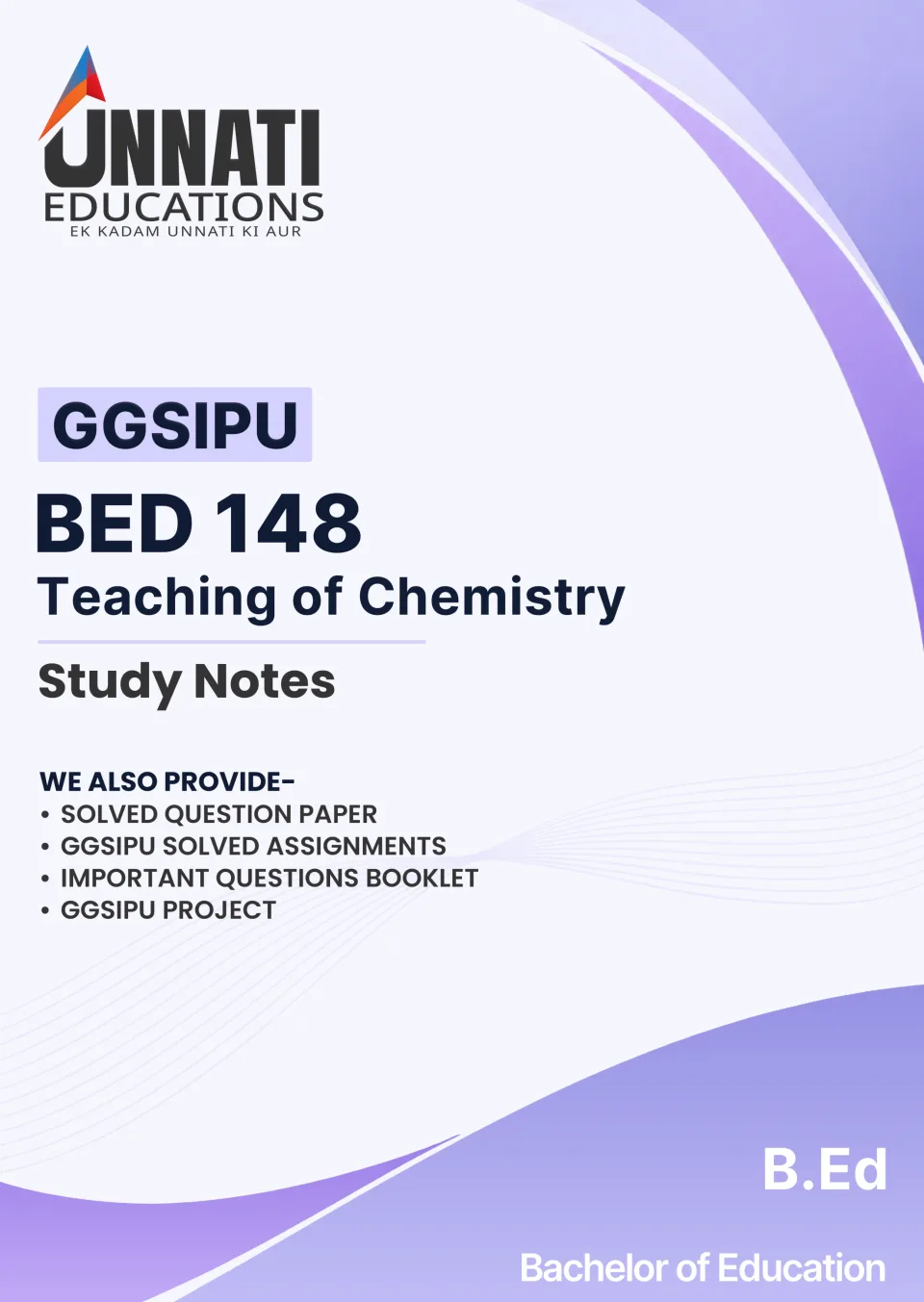
BED 148 Teaching of Chemistry Notes from Unnati Educations cover all 4 units of this GGSIPU B.Ed Semester 2 pedagogy paper in 89 printed pages: 33 topics, 13 exam tips, 11 step flows and 100 exam questions (64 short, 36 long). They follow the B.Ed curriculum for session 2023-24 onwards.
Written by Sheetal Kirola, Academic Head · Reviewed by Prateek Talwar, ACS (ICSI), B.Com (University of Delhi), B.Ed counselling since 2020 · Checked against the official B.Ed curriculum, 13 October 2026 · Updated 14 October 2026 · Editorial policy
Scheme: B.Ed Course Curriculum (Two Years), Session 2023-24 onwards | Applies to: batches admitted from session 2023-24 | Verified against: syllBEd210823.pdf, 13 October 2026
BED 148 Teaching of Chemistry at a glance: GGSIPU B.Ed Sem 2 credits, units and exam pattern
BED 148 fills one of the two "Pedagogy of School Subject" slots in Semester 2, so anyone after GGSIPU B.Ed Sem 2 Teaching of Chemistry notes takes a second pedagogy paper too. It is listed among the GGSIPU B.Ed Semester 2 papers.
Code and title | BED148 · Teaching of Chemistry |
|---|---|
Course and semester | B.Ed, Semester 2, Pedagogy of School Subject |
Credits | 4: 3 theory + 1 practical assignments or field work |
Marks | 100: 75 theory exam + 15 practical assignments / field engagement + 10 minors |
Pass mark | 40%, which is 40 out of 100 |
Applies to | Session 2023-24 onwards |
End-term pattern | 75-mark theory exam; paper-setter instructions not printed |
Paired lab | None; practical work sits in the 15-mark component |
The 15 practical marks need records such as five chemistry experiments and an action research plan, so Units 2 and 4 count twice. Re-appear rules sit in GGSIPU Ordinance 11.
BED 148 Teaching of Chemistry Notes unit-wise: 33 topics and 100 exam questions across 4 units
Notes for every other paper in the course: GGSIPU B.Ed notes.
BED 148 Unit 1: Chemistry in School Curriculum
Pages 4 to 22, 8 topics. Chemistry as the "central science", its nature as product, process and attitude, and acid rain on the Taj Mahal. Then Mager's three-part behavioural objective, correlation, inclusion for CWSN, textbook evaluation and a critique against NCF 2005 and NEP 2020.
Chemistry topic | Vocational skill |
|---|---|
Soaps and detergents | Soap, detergent and handwash making |
Acids, bases and salts | Phenyl and floor cleaner preparation |
Fermentation | Vinegar, pickle, bakery products |
Dyes and pigments | Tie-and-dye, natural dyes, paint making |
Quick look: chemistry topics as vocational skills (from page 12)
Chemistry topic
Soaps and detergents
Vocational skill
Soap, detergent and handwash making
Chemistry topic
Acids, bases and salts
Vocational skill
Phenyl and floor cleaner preparation
Chemistry topic
Fermentation
Vocational skill
Vinegar, pickle, bakery products
Chemistry topic
Dyes and pigments
Vocational skill
Tie-and-dye, natural dyes, paint making
BED 148 Unit 2: Planning, Designing and Transaction
Pages 23 to 46 (the longest unit), 8 topics. The 36-minute micro teaching cycle, a unit plan on acids, bases and salts, lesson plans on rusting and all ten official methods. Then a red cabbage indicator, PhET, science clubs, lab registers and first aid.
Class | Burning material | Use |
|---|---|---|
A | Wood, paper, cloth | Water, foam |
B | Oil, petrol, alcohol | Foam, CO₂, dry powder, sand; never water |
D | Na, K, Mg | Dry sand or special powder; never water |
Electrical | Equipment | CO₂ or dry powder after switching off |
Quick look: lab fire classes (from page 43)
Class
A
Burning material
Wood, paper, cloth
Use
Water, foam
Class
B
Burning material
Oil, petrol, alcohol
Use
Foam, CO₂, dry powder, sand; never water
Class
D
Burning material
Na, K, Mg
Use
Dry sand or special powder; never water
Class
Electrical
Burning material
Equipment
Use
CO₂ or dry powder after switching off
BED 148 Unit 3: Evaluation in Chemistry
Pages 47 to 66, 8 topics. Nine types of evaluation and practical marking (±0.2 mL, viva). A 40-mark blueprint for acids, bases and salts, diagnostic tests for formula-writing errors with remedies like "OIL RIG", then PARAKH and the CBSE pattern.
Quick look: item analysis in three steps (from page 59)
Upper group: 16 of 20 correct (Rᵤ = 16). Lower group: 6 of 20 correct (Rₗ = 6).
Difficulty P = (16 + 6) / 40 = 0.55, an average item.
Discrimination D = (16 − 6) / 20 = 0.50, very good, so the item is retained.
BED 148 Unit 4: Professional development of a Chemistry Teacher
Pages 67 to 89, 9 topics (the most). Shulman's pedagogical content knowledge, NCTE competencies, SWAYAM and DIKSHA, virtual labs, ANRF with AI and VR, AR and gamification, an action research plan on balancing equations, Schön's reflection types and NTeQ.
Quick look: first four NTeQ steps for a water-quality lesson (from page 85)
Objectives: analyse pH and hardness of water samples.
Computer functions: spreadsheet for graphs, internet for BIS standards.
Problem: "Is the water used in our homes safe to drink?"
Data: pH, TDS and hardness of 10 samples, sorted and compared.
Observation schedules and checklists in chemistry assessment: excerpt from page 52 of the BED 148 notes
Excerpt from page 52
3.1 Observation schedule
An observation schedule is a structured record form. The teacher uses it to watch and note specific student behaviours during an activity in a systematic way, deciding in advance what to observe, how often and how to record it.
Its features are pre-decided behaviours, fixed time intervals, recording in categories and objectivity. It is used to observe lab behaviour, group work, participation and scientific skills.
Behaviour observed | Always | Sometimes | Never |
|---|---|---|---|
Rinses the burette with the solution before filling | |||
Removes the air bubble from the burette nozzle | |||
Reads the lower meniscus at eye level | |||
Adds titrant drop-wise near the end point | |||
Records concordant readings honestly | |||
Follows safety rules (goggles, no mouth pipetting) |
Observation schedule for a titration lab session (page 52)
Behaviour observed
Rinses the burette with the solution before filling
Always
Sometimes
Never
Behaviour observed
Removes the air bubble from the burette nozzle
Always
Sometimes
Never
Behaviour observed
Reads the lower meniscus at eye level
Always
Sometimes
Never
Behaviour observed
Adds titrant drop-wise near the end point
Always
Sometimes
Never
Behaviour observed
Records concordant readings honestly
Always
Sometimes
Never
Behaviour observed
Follows safety rules (goggles, no mouth pipetting)
Always
Sometimes
Never
3.2 Checklist
A checklist is a list of specific traits, steps or behaviours. The observer marks each one "Yes" or "No", that is, present or absent. A checklist does not measure degree, only presence or absence.
Step | Yes | No |
|---|---|---|
Sets up the flask, thistle funnel and delivery tube correctly | ||
Takes marble chips (CaCO₃) in the flask | ||
Adds dilute HCl through the thistle funnel | ||
Dips the end of the thistle funnel in the acid | ||
Collects the gas by upward displacement of air | ||
Tests the gas with lime water (turns milky) | ||
Writes the balanced equation: CaCO₃ + 2HCl → CaCl₂ + H₂O + CO₂ |
Checklist for preparing CO₂ gas in the lab (page 52)
Step
Sets up the flask, thistle funnel and delivery tube correctly
Yes
No
Step
Takes marble chips (CaCO₃) in the flask
Yes
No
Step
Adds dilute HCl through the thistle funnel
Yes
No
Step
Dips the end of the thistle funnel in the acid
Yes
No
Step
Collects the gas by upward displacement of air
Yes
No
Step
Tests the gas with lime water (turns milky)
Yes
No
Step
Writes the balanced equation: CaCO₃ + 2HCl → CaCl₂ + H₂O + CO₂
Yes
No
Checklist versus rating scale
The two tools answer different questions. A checklist records a response of Yes or No, measures whether a trait or step is present, and reads like "Used safety goggles: Yes / No". A rating scale records a degree, for example on a 5-point scale from Excellent to Poor, measures the quality or extent of a trait, and reads like "Skill in handling the pipette: 1 2 3 4 5".
BED 148 exam corner: 64 two-to-five-mark and 36 ten-to-fifteen-mark questions by unit
Each unit ends with short ("2–5 Marks") and long ("10–15 Marks") exam-style questions, without printed model answers.
Unit | Short (2–5 Marks) | Long (10–15 Marks) | Exam tips |
|---|---|---|---|
1 | 16 | 8 | 4 |
2 | 16 | 11 | 3 |
3 | 16 | 8 | 3 |
4 | 16 | 9 | 3 |
BED 148 exam questions in the notes, by unit
Unit
1
Short (2–5 Marks)
16
Long (10–15 Marks)
8
Exam tips
4
Unit
2
Short (2–5 Marks)
16
Long (10–15 Marks)
11
Exam tips
3
Unit
3
Short (2–5 Marks)
16
Long (10–15 Marks)
8
Exam tips
3
Unit
4
Short (2–5 Marks)
16
Long (10–15 Marks)
9
Exam tips
3
Unit 1: State the six validities of a good science curriculum as per NCF 2005. Pointer: cognitive, content, process, historical, environmental, ethical (page 18).
Unit 2: Name the registers maintained in a chemistry laboratory. Pointer: permanent stock, consumable, breakage, issue and order (page 40).
Unit 3: Write the full form of PARAKH and any three of its functions. Pointer: norms for all boards, national surveys, Holistic Progress Card (page 62).
Unit 4: Differentiate between Augmented Reality and Virtual Reality. Pointer: phone overlay versus a fully virtual headset world (page 79).
The BED 148 notes list 64 short-answer and 36 long-answer exam questions across 4 units, backed by 13 exam tips and 11 step flows.
More practice sits in the BED 148 important questions.
Who writes and checks the BED 148 Teaching of Chemistry notes?
Sheetal Kirola, author: Academic Head, Unnati Educations · M.Ed. · 7 years of experience.
Prateek Talwar, reviewer: Founder, Unnati Educations · Associate Company Secretary (ACS), ICSI · B.Com, University of Delhi · B.Ed counselling since 2020.
Sheetal wrote the units against the 2023-24 curriculum with school-level examples: titration, salt analysis, rusting, water testing. Prateek reviewed them against the official topic list. These are Teaching of Chemistry notes in English.
The 2026-27 edition covers ANRF and PARAKH. Last updated 14 October 2026 under the editorial policy. The same team prepares GGSIPU important questions for every course.
Do the BED 148 notes cover the full GGSIPU syllabus?
Yes for all four units: each of the 33 official topics has its own section. Practical records are yours to prepare.
Official unit | Official topics | Where in the notes | Status |
|---|---|---|---|
Unit I | Nature, need and scope; daily life, social and environmental issues; aims, objectives, behavioural terms; correlation; democratizing learning; effective curriculum; text books; NCF-2005 and NEP-2020 | Sections 1 to 8, pp. 5 to 20 | Covered |
Unit II | Micro teaching; unit and lesson plan; concept map; teaching methods and approaches; instructional aids; extended experiences; laboratory organisation; lab safety | Sections 1 to 8, pp. 24 to 43 | Covered |
Unit III | Evaluation for theory and practical; assessment types; assessment tools; diagnostic tests and remedies; achievement test; creative expressions; PARAKH; CBSE uniform assessment | Sections 1 to 8, pp. 48 to 64 | Covered |
Unit IV | Qualities and competencies; professional growth; MOOCs, OERs, SWAYAM, DIKSHA; virtual lab; NRF; digital repository; action research; researcher and reflective practitioner; NTeQ | Sections 1 to 9, pp. 68 to 86 | Covered |
Practical assignments | Experiments, technology lessons, e-content, action research | Unit 2 sections 7 and 8; Unit 4 sections 7 and 9 | Partly covered: records are yours |
BED 148 official topics mapped to the notes
Official unit
Unit I
Official topics
Nature, need and scope; daily life, social and environmental issues; aims, objectives, behavioural terms; correlation; democratizing learning; effective curriculum; text books; NCF-2005 and NEP-2020
Where in the notes
Sections 1 to 8, pp. 5 to 20
Status
Covered
Official unit
Unit II
Official topics
Micro teaching; unit and lesson plan; concept map; teaching methods and approaches; instructional aids; extended experiences; laboratory organisation; lab safety
Where in the notes
Sections 1 to 8, pp. 24 to 43
Status
Covered
Official unit
Unit III
Official topics
Evaluation for theory and practical; assessment types; assessment tools; diagnostic tests and remedies; achievement test; creative expressions; PARAKH; CBSE uniform assessment
Where in the notes
Sections 1 to 8, pp. 48 to 64
Status
Covered
Official unit
Unit IV
Official topics
Qualities and competencies; professional growth; MOOCs, OERs, SWAYAM, DIKSHA; virtual lab; NRF; digital repository; action research; researcher and reflective practitioner; NTeQ
Where in the notes
Sections 1 to 9, pp. 68 to 86
Status
Covered
Official unit
Practical assignments
Official topics
Experiments, technology lessons, e-content, action research
Where in the notes
Unit 2 sections 7 and 8; Unit 4 sections 7 and 9
Status
Partly covered: records are yours
Official source: GGSIPU B.Ed Course Curriculum (Two Years), Session 2023-24 onwards, pages 79 to 81.
"Instructional Aids" splits into TLM and ICT-based TLM (pages 35 to 37). Every course in GGSIPU notes is mapped to its official PDF the same way.
How to write BED 148 answers: ten-to-fifteen-mark answers with lesson plans, blueprints and action research plans
A chemistry pedagogy paper rewards answers that show you can teach a Class IX or X topic to real students, not only define terms. The notes' exam tips repeat one habit: every theory point needs a chemistry example and, where possible, a table. For "nature of chemistry" the page 7 tip gives the order: definition, a table of 8 to 10 features, product-process-attitude, need in 8 points, scope as a table, and a closing line that chemistry is the central science.
Three answer types carry the heaviest questions:
Lesson plans (Unit 2): page 28 asks for a real plan in table form on one topic, such as rusting, with behavioural objectives, a presentation table and a blackboard summary.
Test construction (Unit 3): page 59 says to show weightage to objectives, content and question forms before the blueprint grid.
Action research (Unit 4): page 82 lists title, problem, causes, action hypotheses, plan, tools, data analysis and conclusion, with one full chemistry example.
Mistakes the notes flag: vague verbs such as "knows" in objectives (page 11), giving only theory tools when asked how practical work is evaluated (page 50), and quoting CBSE weightages without "as per the latest CBSE circular" (page 64).
Worked example: "Critically analyse the chemistry curriculum with reference to NCF 2005 and NEP 2020" (15 marks)
Introduction: why the school chemistry curriculum needs review.
NCF 2005 (Prof. Yash Pal): five guiding principles and the six validities in a table.
NEP 2020 (Dr K. Kasturirangan): a table of provisions such as 5+3+3+4, core essentials and PARAKH.
Strengths, weaknesses (rote learning of named reactions, neglected practicals) and suggestions (micro-scale experiments, virtual labs).
Conclusion linking chemistry to scientific temper and Article 51A(h).
Naming both chairs is the "easy extra marks" tip on page 20. Practise this format on GGSIPU B.Ed important questions.
BED 148 and the GGSIPU B.Ed Sem 2 papers it connects to
BED 148 has no separate lab paper; its practical records are listed in the GGSIPU B.Ed syllabus.
BED 102 Learning and Teaching: Piaget and Vygotsky behind the Unit 2 5E plans.
BED 104 Contemporary Perspectives in Education: NCF 2005 and NEP 2020 (Unit 1).
BED 106 Assessment of Learning: blueprint and item analysis theory (Unit 3).
BED 108 Experiential Learning and BED 110 Entrepreneurship in Education: science clubs and soap making.
BED 152 Reading and Reflecting on Texts and BED 154 PSE-II.
The second pedagogy paper, often BED 146 Teaching of Physics or BED 150 Teaching of Biology.
For records, Unit 2 sections 7 and 8 back the five experiments; NTeQ backs technology lessons.
BED 148 Teaching of Chemistry notes FAQs
How do I get the full BED 148 notes?
Message Unnati Educations on WhatsApp at 9899436384 with the code BED 148. The full notes come as a printed book of 89 pages covering all 4 units; they are not sold as a PDF. The book reaches you in a maximum of 5 to 7 days, depending on your location.
What is the passing mark for BED 148 Teaching of Chemistry?
BED 148 is marked out of 100: 75 for the theory exam, 15 for practical assignments or field engagement and 10 for minors. The B.Ed scheme of examination states pass marks as 40%, which is 40 out of 100. For end-term minimums, re-appear and result rules, read GGSIPU Ordinance 11 on ipu.ac.in, because the B.Ed curriculum PDF does not repeat them.
Is BED 148 a Semester 1 or Semester 2 paper?
BED 148 is a Semester 2 paper. The official scheme has two "Pedagogy of School Subject" slots in Semester 2, each worth 4 credits and 100 marks, filled by codes BED 116 to BED 150. Trainees who studied chemistry take BED 148 in one slot and another school subject, such as Physics or Biology, in the other.
Which BED 148 unit is the longest in the notes?
Unit 2, Planning, Designing and Transaction, runs 24 pages and has the most long questions (11). It packs micro teaching, lesson plans in three approaches, ten teaching methods, improvisation, ICT tools and two lab chapters. Unit 4 has the most topics (9) because the official list adds virtual labs, ANRF, AR and the NTeQ model.
Do the BED 148 notes help with the 15-mark practical component?
They help you plan it, but do not replace your own records. Unit 2 gives safe demonstrations and lab first aid, Unit 3 gives a titration observation schedule and a CO₂ checklist, and Unit 4 gives a full action research example on formula writing and an NTeQ water-quality lesson. You still perform the experiments and keep the records yourself.
Which syllabus version do the BED 148 notes follow?
The BED 148 notes follow the GGSIPU B.Ed Course Curriculum (Two Years) for session 2023-24 onwards, published on ipu.ac.in as syllBEd210823.pdf. Unit titles and topics match pages 79 to 81 of that PDF. If GGSIPU revises the curriculum, this page and the printed book are updated together and the date at the top of the page changes.
Get the full BED 148 Teaching of Chemistry Notes on WhatsApp
Unit | Pages | Topics | Exam questions |
|---|---|---|---|
1 | 19 | 8 | 24 |
2 | 24 | 8 | 27 |
3 | 20 | 8 | 24 |
4 | 23 | 9 | 25 |
Pages and exam questions per unit in the full BED 148 book
Unit
1
Pages
19
Topics
8
Exam questions
24
Unit
2
Pages
24
Topics
8
Exam questions
27
Unit
3
Pages
20
Topics
8
Exam questions
24
Unit
4
Pages
23
Topics
9
Exam questions
25
These BED 148 Teaching of Chemistry IPU notes come only as a printed 89-page book, delivered in 5 to 7 days at most, depending on location.
Get the full BED 148 notes on WhatsApp (4 units, 89 pages)
Unnati Educations is an independent education provider based in Vikaspuri, Delhi. We are not affiliated with, authorised by, or endorsed by Guru Gobind Singh Indraprastha University (GGSIPU). 'GGSIPU' and 'IPU' are used only to describe the syllabus our notes follow. For official information, visit ipu.ac.in.
Ready for the full notes?
Discuss coverage and delivery with our team.