
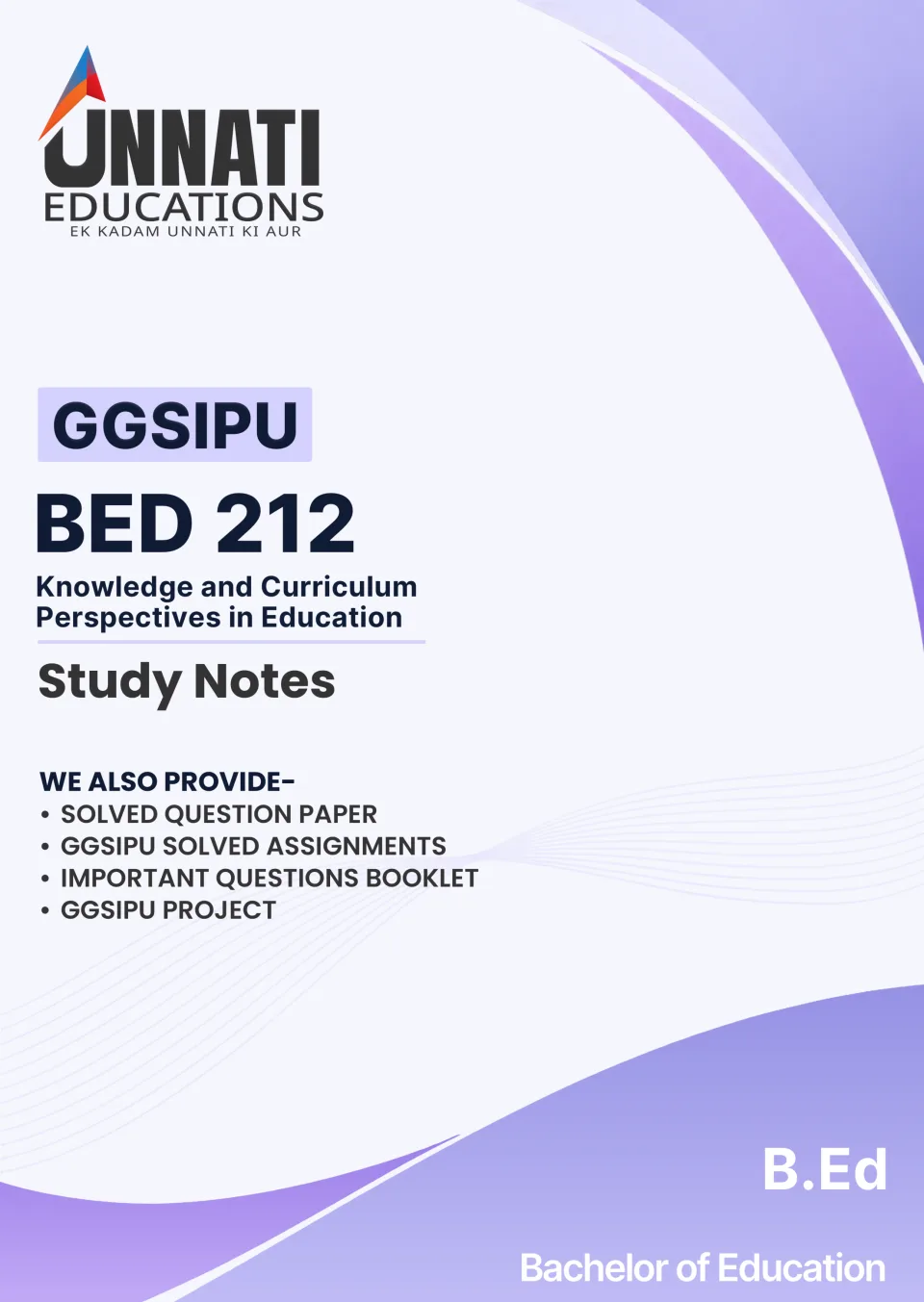
BED 212 Knowledge and Curriculum Perspectives in Education Notes are 77-page study notes for GGSIPU B.Ed Semester 4. They cover all 4 official units in 24 topics, with 25 diagrams, 9 definition boxes, 4 quick revision tables and 88 exam questions (60 short-answer, 28 long-answer), mapped to the B.Ed curriculum for session 2023-24 onwards.
Written by Sheetal Kirola, Academic Head, M.Ed. · Reviewed by Prateek Talwar, ACS (ICSI), B.Com, B.Ed counselling since 2020 · Checked against the B.Ed Course Curriculum (Two Years), session 2023-24 onwards · Updated 14 October 2026 · Editorial policy
Scheme: B.Ed Course Curriculum (Two Years) | Applies to: session 2023-24 onwards | Verified against: B.Ed Course Curriculum PDF on ipu.ac.in (syllBEd210823.pdf)
BED 212 Knowledge and Curriculum Perspectives in Education at a glance: GGSIPU B.Ed Sem 4 credits, units and exam pattern
BED 212 is a four-credit compulsory theory paper. Its marks cover a theory exam, an e-portfolio and minors, so the BED 212 Knowledge and Curriculum IPU notes have to serve more than the written paper.
Item | Official detail |
|---|---|
Code and title | BED212 · Knowledge and Curriculum Perspectives in Education |
Course and semester | B.Ed (two years), Semester IV, compulsory theory |
Credits | 4: 3 theory (1 credit = 1 hour) + 1 practical / field work (1 credit = 2 hours) |
Marks | 100: 75 theory exam + 15 practical assignments / field engagement + 10 minors |
Pass mark | 40% (40 out of 100); re-appear rules in GGSIPU Ordinance 11 |
Theory exam pattern | Paper-setter instructions not printed in the official PDF |
Field engagement | E-portfolio report on any two of five listed CDs/DVDs |
Paired lab | None |
BED 212 snapshot from the official B.Ed Course Curriculum
Item
Code and title
Official detail
BED212 · Knowledge and Curriculum Perspectives in Education
Item
Course and semester
Official detail
B.Ed (two years), Semester IV, compulsory theory
Item
Credits
Official detail
4: 3 theory (1 credit = 1 hour) + 1 practical / field work (1 credit = 2 hours)
Item
Marks
Official detail
100: 75 theory exam + 15 practical assignments / field engagement + 10 minors
Item
Pass mark
Official detail
40% (40 out of 100); re-appear rules in GGSIPU Ordinance 11
Item
Theory exam pattern
Official detail
Paper-setter instructions not printed in the official PDF
Item
Field engagement
Official detail
E-portfolio report on any two of five listed CDs/DVDs
Item
Paired lab
Official detail
None
It sits with four other compulsory theory papers and one elective in the GGSIPU B.Ed Semester 4 papers.
BED 212 Knowledge and Curriculum Perspectives in Education Notes unit-wise: 24 topics, 25 diagrams and 88 exam questions across 4 units
One numbered topic per syllabus bullet; each unit ends with a quick revision table and exam questions. Notes for every other B.Ed paper are on GGSIPU B.Ed notes. One page per unit is in the sample PDF above.
BED 212 Unit 1: Curriculum and School
Unit I (pages 5-25) starts from the Latin root currere and five definitions, then covers the three foundations, Tyler's four components, twelve principles of construction, and the pairs core vs hidden and centralised vs decentralised curriculum.
It closes with framework vs syllabus and NCF 2005's five principles against NEP 2020's 5+3+3+4 structure. 7 topics, 7 diagrams, 15 short-answer and 8 long-answer questions.
Basis | Curriculum | Syllabus |
|---|---|---|
Scope | Wide; includes the syllabus | Narrow; part of the curriculum |
Coverage | All subjects plus co-curricular activities | One subject only |
Time | A whole stage or course | A class, term or session |
Origin | Latin currere (race-course) | Greek sillybos (label or list) |
Quick look: curriculum vs syllabus (from page 18)
Basis
Scope
Curriculum
Wide; includes the syllabus
Syllabus
Narrow; part of the curriculum
Basis
Coverage
Curriculum
All subjects plus co-curricular activities
Syllabus
One subject only
Basis
Time
Curriculum
A whole stage or course
Syllabus
A class, term or session
Basis
Origin
Curriculum
Latin currere (race-course)
Syllabus
Greek sillybos (label or list)
BED 212 Unit 2: Construction of Knowledge
Unit II (pages 26-44) opens with epistemology and Plato's "justified true belief", then ten features of knowledge and the line between information, knowledge, belief and truth.
Empirical vs revealed knowledge, four types (Shulman's PCK, johads, Popper) and four contestations, from Macaulay's Minute to the Phules, follow. Dialogue is in the excerpt below. 6 topics, 6 diagrams, 15 short-answer and 7 long-answer questions.
Basis | Information | Knowledge | Belief | Truth |
|---|---|---|---|---|
Evidence | Not necessary | Necessary | Not necessary | Exists independently |
Can it be false? | Yes | No | Yes | No |
Example | Delhi's AQI is 400 today | Why AQI rises in winter | Pollution is God's will | The air is unsafe to breathe |
Quick look: information, knowledge, belief and truth (from page 31)
Basis
Evidence
Information
Not necessary
Knowledge
Necessary
Belief
Not necessary
Truth
Exists independently
Basis
Can it be false?
Information
Yes
Knowledge
No
Belief
Yes
Truth
No
Basis
Example
Information
Delhi's AQI is 400 today
Knowledge
Why AQI rises in winter
Belief
Pollution is God's will
Truth
The air is unsafe to breathe
BED 212 Unit 3: Curriculum Planning, Construction and Transaction (At School Level)
Unit III (pages 45-61) takes the three determinants, including SDG 4 and the Delors Report's four pillars. A timeline traces vocational bias from Nai Talim (1937) and SUPW (1977) to NEP 2020's vocational exposure from Class 6.
Four approaches, including the constructivist 5E model, are compared in one table, then eight steps of curriculum designing, the Bobbitt, Tyler and Taba models, and evaluation through CIPP and Stake's countenance model. 6 topics, 7 diagrams, 15 short-answer and 7 long-answer questions.
Basis | Bobbitt | Tyler | Taba |
|---|---|---|---|
Starting point | Adult life activities | Objectives | Diagnosis of learners' needs |
Steps | 5 | 4 | 7 |
Approach | Deductive, from life activities | Deductive (top-down) | Inductive (bottom-up) |
Quick look: the three curriculum models compared (from page 56)
Basis
Starting point
Bobbitt
Adult life activities
Tyler
Objectives
Taba
Diagnosis of learners' needs
Basis
Steps
Bobbitt
5
Tyler
4
Taba
7
Basis
Approach
Bobbitt
Deductive, from life activities
Tyler
Deductive (top-down)
Taba
Inductive (bottom-up)
BED 212 Unit 4: School: The site of Curriculum Engagement
Unit IV (pages 62-77) defines curriculum engagement through the intended, transacted and attained curriculum. It lists RTE Act 2009 school norms, six resource types and low-cost fixes such as BaLA.
The critical pedagogue topic draws on Freire, Giroux and bell hooks, with twelve teacher roles. Nai Talim, work education, Kolb's cycle and School Management Committees follow, then how NCERT, CBSE, NIOS and CIET support teachers. 5 topics, 5 diagrams, 15 short-answer and 6 long-answer questions.
Basis | NCERT | CBSE | NIOS | CIET |
|---|---|---|---|---|
Established | 1961 | 1929; reconstituted 1962 | 1989 (NOS); 2002 (NIOS) | 1984 |
Main role | Curriculum, textbooks, research | Affiliation, exams | Open schooling | Educational technology |
Teacher support | NISHTHA, learning outcomes | Capacity building via COEs | D.El.Ed via ODL | ICT training, e-content |
Quick look: apex bodies at a glance (from page 75)
Basis
Established
NCERT
1961
CBSE
1929; reconstituted 1962
NIOS
1989 (NOS); 2002 (NIOS)
CIET
1984
Basis
Main role
NCERT
Curriculum, textbooks, research
CBSE
Affiliation, exams
NIOS
Open schooling
CIET
Educational technology
Basis
Teacher support
NCERT
NISHTHA, learning outcomes
CBSE
Capacity building via COEs
NIOS
D.El.Ed via ODL
CIET
ICT training, e-content
BED 212 exam corner: 60 short-answer and 28 long-answer exam questions by unit
The notes label short answers "2–5 marks" and long answers "10–15 marks"; these labels are the notes' own, as the official PDF prints no pattern for the 75-mark exam. Questions come without model answers.
Unit | Short Answer (2–5 marks) | Long Answer (10–15 marks) | Diagrams |
|---|---|---|---|
I | 15 | 8 | 7 |
II | 15 | 7 | 6 |
III | 15 | 7 | 7 |
IV | 15 | 6 | 5 |
Total | 60 | 28 | 25 |
BED 212 exam questions and diagrams by unit
Unit
I
Short Answer (2–5 marks)
15
Long Answer (10–15 marks)
8
Diagrams
7
Unit
II
Short Answer (2–5 marks)
15
Long Answer (10–15 marks)
7
Diagrams
6
Unit
III
Short Answer (2–5 marks)
15
Long Answer (10–15 marks)
7
Diagrams
7
Unit
IV
Short Answer (2–5 marks)
15
Long Answer (10–15 marks)
6
Diagrams
5
Unit
Total
Short Answer (2–5 marks)
60
Long Answer (10–15 marks)
28
Diagrams
25
Unit I: What is hidden curriculum? Explain its positive and negative aspects and its significance in the Indian context. Pointer: the positive vs negative table on page 15.
Unit II: Compare empirical and revealed knowledge as sources of knowledge. What are their educational implications? Pointer: the nine-row comparison on page 33.
Unit III: Explain the need for integrating school curriculum with futuristic needs through vocational bias and skill development. Pointer: the policy timeline on page 48.
Unit IV: Discuss the contemporary relevance of Nai Talim and work education in the light of NEP 2020. Pointer: the six Nai Talim features on page 70.
The BED 212 notes list 60 short-answer and 28 long-answer exam questions across 4 units, backed by 25 diagrams and 4 quick revision tables.
More practice sits in the BED 212 important questions.
Knowledge construction through dialogue in curriculum studies: excerpt from page 38 of the BED 212 notes
Excerpt from page 38 (Unit II, Topic 05)
What dialogue means
Dialogue is a two-way, open and respectful conversation in which participants share ideas, ask questions, listen to each other and reach a new understanding together. In dialogue, knowledge is not handed over by the teacher. Teacher and students build it together. That makes dialogue the opposite of a monologue, where one person lectures and the rest listen.
The notes draw this as a five-step cycle of knowledge construction through dialogue: a question, then sharing experience, listening to others, reflecting and challenging, and finally constructing new meaning, which raises the next question.
Thinkers who support dialogue
Socrates taught by asking a series of questions so that the learner discovered the truth for himself. His "I know that I know nothing" sums up the humility the method needs.
Paulo Freire, in "Pedagogy of the Oppressed" (1970), rejected the banking concept of education, in which the teacher deposits knowledge into empty students. He proposed problem-posing education through dialogue, where the "teacher-student" and the "student-teacher" learn together. The aim is conscientisation, or critical awareness.
Lev Vygotsky held that knowledge is first built socially, through language and interaction, and only then internalised by the child. His Zone of Proximal Development and scaffolding by a more knowledgeable other explain why talk with others helps a learner go further than working alone.
John Dewey linked learning to shared experience and inquiry in a democratic classroom. J. Krishnamurti saw dialogue as joint inquiry without fear or authority, with learning through observation and questioning. Mikhail Bakhtin argued that meaning is "dialogic": it is created between voices and never by one voice alone.
Where the topic goes next
These thinkers are the base for the rest of the topic on the next page: why dialogue matters in class, how it differs from monologue, and which classroom strategies make it work. The Unit II long-answer bank asks for dialogue with reference to Socrates, Freire and Vygotsky, so one idea from each belongs in the answer.
Do the BED 212 notes cover the full GGSIPU syllabus?
Yes for all four units: every official BED 212 topic has its own numbered topic in the notes. Field engagement is partly covered: the notes give an e-portfolio report format, not reports on the listed CDs/DVDs.
Official unit | Official topics | Where in the notes | Status |
|---|---|---|---|
I: Curriculum and School | Meaning, nature, foundations, components; core, hidden, centralized, decentralized; framework, syllabus; NCF 2005, NPE 2020 | Topics 01-07, pages 6-23 | Covered (written as NEP 2020, explained on page 21) |
II: Construction of Knowledge | Nature; information, belief, truth; empirical vs revealed; four types; dialogue; contestations | Topics 01-06, pages 27-42 | Covered |
III: Curriculum Planning, Construction and Transaction (At School Level) | Determinants; vocational bias; four approaches; designing; Tyler, Taba, Bobbit; evaluation | Topics 01-06, pages 46-59 | Covered |
IV: School: The site of Curriculum Engagement | Curriculum engagement; curricular sites; critical pedagogue; Nai Talim, work education; NCERT, CBSE, NIOS, CIET | Topics 01-05, pages 63-75 | Covered |
Practical Assignments / Field Engagement | E-portfolio on any two CDs/DVDs | Report format, page 77 | Partly covered: no film reports |
BED 212 official syllabus mapped to the notes
Official unit
I: Curriculum and School
Official topics
Meaning, nature, foundations, components; core, hidden, centralized, decentralized; framework, syllabus; NCF 2005, NPE 2020
Where in the notes
Topics 01-07, pages 6-23
Status
Covered (written as NEP 2020, explained on page 21)
Official unit
II: Construction of Knowledge
Official topics
Nature; information, belief, truth; empirical vs revealed; four types; dialogue; contestations
Where in the notes
Topics 01-06, pages 27-42
Status
Covered
Official unit
III: Curriculum Planning, Construction and Transaction (At School Level)
Official topics
Determinants; vocational bias; four approaches; designing; Tyler, Taba, Bobbit; evaluation
Where in the notes
Topics 01-06, pages 46-59
Status
Covered
Official unit
IV: School: The site of Curriculum Engagement
Official topics
Curriculum engagement; curricular sites; critical pedagogue; Nai Talim, work education; NCERT, CBSE, NIOS, CIET
Where in the notes
Topics 01-05, pages 63-75
Status
Covered
Official unit
Practical Assignments / Field Engagement
Official topics
E-portfolio on any two CDs/DVDs
Where in the notes
Report format, page 77
Status
Partly covered: no film reports
Official source: B.Ed Course Curriculum (Two Years), session 2023-24 onwards; BED 212 is on its pages 93-94.
Every course in GGSIPU notes is mapped to its official PDF the same way.
Who writes and checks the BED 212 curriculum notes?
Sheetal Kirola, author · Academic Head, Unnati Educations · M.Ed. · 7 years of experience.
Prateek Talwar, reviewer · Founder, Unnati Educations · ACS, ICSI · B.Com, University of Delhi · B.Ed counselling since 2020.
The GGSIPU B.Ed Semester 4 Knowledge and Curriculum notes were matched against the official curriculum for session 2023-24 onwards, unit by unit. The 2026-27 edition includes NCF-SE 2023 and PARAKH. Last updated 14 October 2026; corrections follow the editorial policy.
The same team prepares GGSIPU important questions too.
BED 212 and the GGSIPU B.Ed Sem 4 papers it connects to
BED 212 has no paired lab; its practical credit is the e-portfolio, and every Sem 4 code is in the GGSIPU B.Ed syllabus.
Unit II marginalisation and Unit I hidden curriculum → BED210 Gender, School and Society.
Unit IV inclusive practice and RTE ramps → BED218 Creating an Inclusive School.
Unit I sociological foundation → BED216 Environmental Education.
Unit IV work education and the Unit III vocational timeline → elective BED228 Work Education.
Unit IV school as curricular site → practical BED252 Reflection on School Experience.
Also in Sem 4: BED214 Guidance and Counselling, BED254 Drama and Art in Education, electives BED220 Human Rights and Value Education to BED234 School Leadership.
How to write BED 212 answers: definition-led long answers with diagrams and comparison tables
The BED 212 notes give three exam tips. For a long answer on meaning and nature, page 8 sets the order: etymology, three or four definitions, analysis, the narrow vs broad table, eight to ten points with one example each, a conclusion, and Figure 1.1.
Page 47 adds Indian examples for each determinant, such as water conservation in Rajasthan. For short answers, open with the notes' one-line summaries, like "Philosophy tells WHY and WHAT; Psychology tells HOW and WHEN".
Worked example: "Discuss the recommendations of NCF 2005 and NEP 2020 regarding curriculum and schooling." Following page 23: NCF 2005's five principles and six to eight recommendations, then NEP 2020 in eight to ten points with the 5+3+3+4 diagram, then the comparison table. Write "NEP 2020 (National Education Policy, 2020)", as page 21 advises.
Practise this format on GGSIPU B.Ed important questions.
BED 212 curriculum notes FAQs
How do I get the full BED 212 notes?
Send a WhatsApp message to 9899436384 using the "Get Full Notes" button on this page. The full BED 212 notes come as a printed book of 77 pages, not as a PDF. Delivery takes a maximum of 5-7 days, depending on your location. Mention the code BED 212 in your message; the pre-filled WhatsApp text already includes it.
What is the passing mark for BED 212?
BED 212 is marked out of 100: 75 for the theory exam, 15 for practical assignments or field engagement, and 10 for minors. The B.Ed scheme of examination states pass marks as 40%, which is 40 out of 100. For any separate theory-exam minimum and for re-appear rules, check GGSIPU Ordinance 11 on ipu.ac.in, as the B.Ed PDF does not print them.
Why do the BED 212 notes say NEP 2020 when the syllabus says NPE 2020?
The official BED 212 syllabus prints "NPE 2020" in Unit I and the course objectives. The notes explain on page 21 that the correct name is the National Education Policy (NEP) 2020, approved on 29 July 2020 and replacing NPE 1986. In the exam, write "NEP 2020 (National Education Policy, 2020)" to show both the syllabus wording and the real name.
Which BED 212 unit is the longest in the notes?
Unit I, Curriculum and School, is the longest: 21 pages (pages 5-25), 7 topics, 7 diagrams and 8 long-answer questions. Unit II runs 19 pages, Unit III 17 and Unit IV 16. Unit IV has only five topics, but its apex-bodies topic on NCERT, CBSE, NIOS and CIET is dense with founding years to revise.
Which curriculum models does BED 212 Unit III cover?
Unit III covers the three development models the syllabus names: Franklin Bobbitt's activity analysis model (five steps), Ralph Tyler's objectives model (four questions, with sources and screens) and Hilda Taba's grassroots model (seven steps), compared on page 56. For curriculum evaluation, the notes add Stufflebeam's CIPP, Stake's countenance model and Scriven's goal-based vs goal-free evaluation.
Do the BED 212 notes help with the e-portfolio field engagement?
Partly. BED 212 field engagement asks you to screen any two of five listed CDs/DVDs and write an e-portfolio report. Page 77 of the notes gives a report format: title and year, summary, issues raised, link with the BED 212 units, personal reflection, classroom implications and conclusion. The notes have no ready reports on the films; you watch and write those yourself.
Get the full BED 212 Knowledge and Curriculum Perspectives in Education Notes on WhatsApp
The full BED 212 Knowledge and Curriculum Perspectives in Education Notes are a 77-page printed book: cover and index (pages 1-4) plus the four units below. It is not available as a PDF.
Unit | Pages | Topics | Exam questions (short + long) |
|---|---|---|---|
I Curriculum and School | 21 | 7 | 15 + 8 |
II Construction of Knowledge | 19 | 6 | 15 + 7 |
III Curriculum Planning, Construction and Transaction | 17 | 6 | 15 + 7 |
IV School: The site of Curriculum Engagement | 16 | 5 | 15 + 6 |
What the full BED 212 notes book contains
Unit
I Curriculum and School
Pages
21
Topics
7
Exam questions (short + long)
15 + 8
Unit
II Construction of Knowledge
Pages
19
Topics
6
Exam questions (short + long)
15 + 7
Unit
III Curriculum Planning, Construction and Transaction
Pages
17
Topics
6
Exam questions (short + long)
15 + 7
Unit
IV School: The site of Curriculum Engagement
Pages
16
Topics
5
Exam questions (short + long)
15 + 6
These Knowledge and Curriculum notes in English are delivered in a maximum of 5-7 days, depending on your location.
Get the full BED 212 notes on WhatsApp (4 units, 77 pages)
Unnati Educations is an independent education provider based in Vikaspuri, Delhi. We are not affiliated with, authorised by, or endorsed by Guru Gobind Singh Indraprastha University (GGSIPU). 'GGSIPU' and 'IPU' are used only to describe the syllabus our notes follow. For official information, visit ipu.ac.in.