
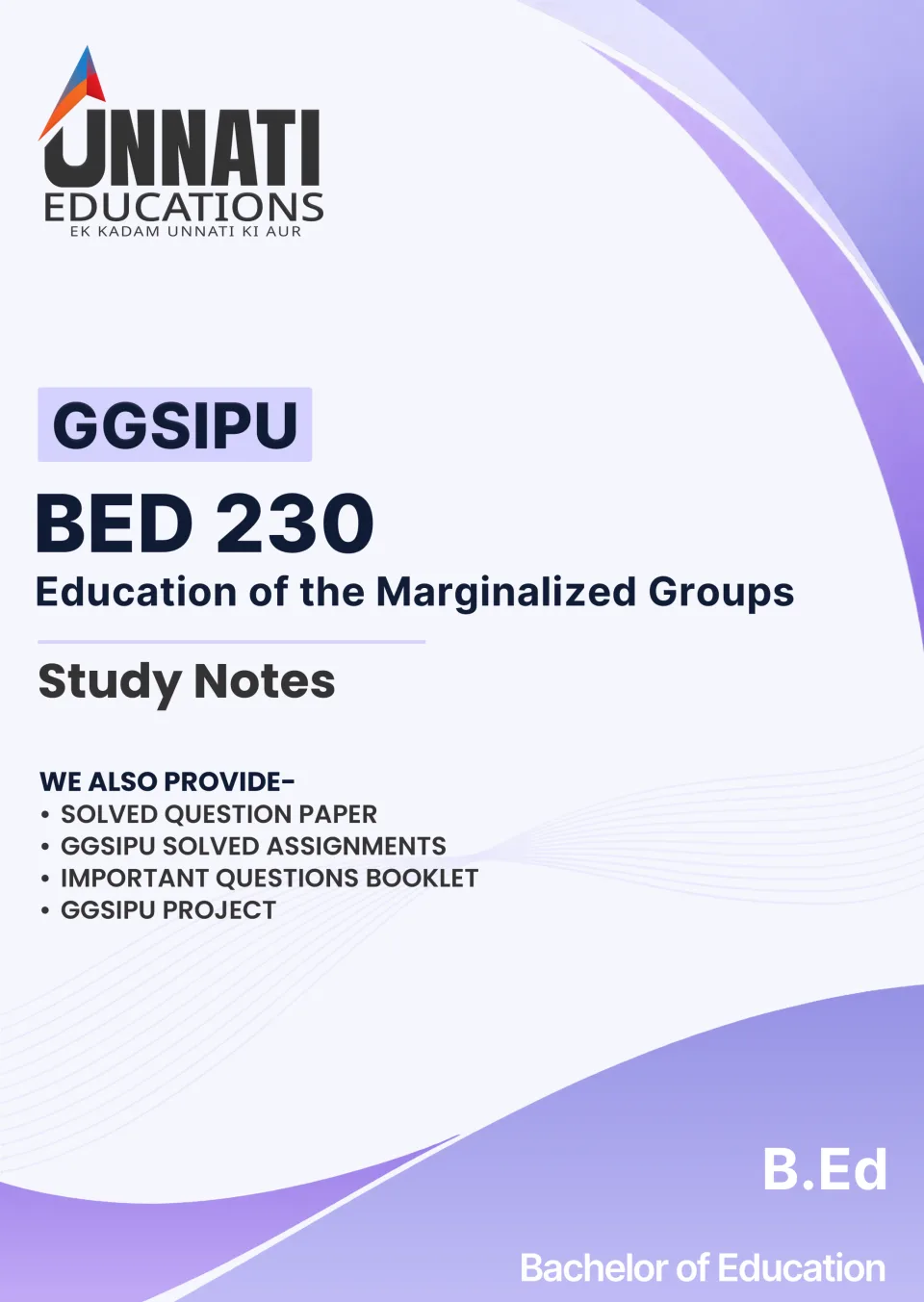
BED 230 Education of the Marginalized Groups Notes cover all 4 units of this GGSIPU B.Ed Semester 4 elective in 55 pages: 25 topics, 7 flow diagrams, 36 short and 24 long exam questions, 43 one-liners with answers and a field engagement guide. They follow the B.Ed curriculum for session 2023-24 onwards.
Written by Sheetal Kirola, Academic Head (M.Ed., 7 years of experience) · Reviewed by Prateek Talwar, Founder (B.Ed counselling since 2020) · Checked against B.Ed Course Curriculum, Session 2023-24 onwards · Updated 14 October 2026 · Editorial policy
Scheme: B.Ed Course Curriculum (Two Years) | Applies to: session 2023-24 onwards | Verified against: syllBEd210823.pdf, 13 October 2026
BED 230 Education of the Marginalized Groups at a glance: GGSIPU B.Ed Sem 4 credits, units and exam pattern
BED 230 is one of eight Elective 1 options; you choose one, next to the five compulsory theory papers on the GGSIPU B.Ed Semester 4 papers page.
| Course and semester | B.Ed (two years), Semester 4 |
|---|---|
| Category | Theory, Elective 1 (any one of BED 220 to BED 234) |
| Credits | 4: 3 theory (1 credit = 1 hour) + 1 practical or field work (1 credit = 2 hours) |
| Marks | 100: 75 theory exam + 15 practical assignments / field engagement + 10 minors |
| Pass mark | Minimum 40% (40 out of 100) |
| Applies to | Session 2023-24 onwards |
| End-term pattern | Not printed in the official PDF (no paper-setter instructions) |
| Paired lab | None; one field activity out of three counts in the 15 marks |
The official objectives stress the move from welfare to rights, so these GGSIPU B.Ed Semester 4 Education of the Marginalized Groups notes return to the RTE Act 2009 in three units.
BED 230 Education of the Marginalized Groups Notes unit-wise: 25 topics and 60 exam questions across 4 units
These Education of the Marginalized Groups notes in English follow the official unit order, and the sample PDF above shows one page per unit. Notes for other papers are under GGSIPU B.Ed notes.
BED 230 Unit 1: Marginalization in Indian Context
Unit 1 (pages 3 to 15) gives definitions by Peter Leonard (1984) and Gurung and Kollmair (2005), a vicious-circle diagram, and five types, with psychological marginalization explained through learned helplessness and stereotype threat.
It then separates marginalization from social exclusion (Lenoir, 1974), and discrimination from disadvantage via RTE Sec. 2(d). Reasons use the D-D-E-P trick. Exam set: 9 short, 6 long, 10 one-liners.
Quick look: marginalization vs discrimination vs disadvantage (from page 12)
| Basis | Marginalization | Discrimination | Disadvantage |
|---|---|---|---|
| Nature | Position or outcome | Act or behaviour | Condition |
| Caused by | Social structures over time | A person, group or institution | Birth, poverty, location |
| Example | Tribe left out of development | Dalit children seated apart | Migrant child with no study space |
| Remedy | Empowerment, rights | Laws, awareness | Scholarships, bridge courses |
Quick look: marginalization vs discrimination vs disadvantage (from page 12)
- Basis
- Nature
- Marginalization
- Position or outcome
- Discrimination
- Act or behaviour
- Disadvantage
- Condition
- Basis
- Caused by
- Marginalization
- Social structures over time
- Discrimination
- A person, group or institution
- Disadvantage
- Birth, poverty, location
- Basis
- Example
- Marginalization
- Tribe left out of development
- Discrimination
- Dalit children seated apart
- Disadvantage
- Migrant child with no study space
- Basis
- Remedy
- Marginalization
- Empowerment, rights
- Discrimination
- Laws, awareness
- Disadvantage
- Scholarships, bridge courses
BED 230 Unit 2: Educational Status of Marginalized Groups in India
Unit 2 (pages 16 to 29) starts with Gramsci's hegemony, then Phule, Periyar, Ambedkar and Lohia, ending in a comparison table. NEP 2020's Socio-Economically Disadvantaged Groups (SEDGs) frames the concept.
Identification is the heaviest part: SCs (Art. 341), STs (Art. 342, Lokur criteria), 75 PVTGs, OBCs from Kalelkar to Indra Sawhney, minorities, and EWS under the 103rd Amendment. Scheme, NGO and RTE tables follow, then MOOCs such as SWAYAM. Exam set: 9 short, 6 long, 12 one-liners.
Quick look: how a PVTG is identified (from page 20)
| Criterion | Meaning |
|---|---|
| Pre-agricultural technology | Hunting, food gathering, shifting cultivation |
| Stagnant or declining population | High death rate, poor health |
| Extremely low literacy | Very few children in school |
| Subsistence economy | Produce only for survival |
Quick look: criteria for Particularly Vulnerable Tribal Groups (from page 20)
- Criterion
- Pre-agricultural technology
- Meaning
- Hunting, food gathering, shifting cultivation
- Criterion
- Stagnant or declining population
- Meaning
- High death rate, poor health
- Criterion
- Extremely low literacy
- Meaning
- Very few children in school
- Criterion
- Subsistence economy
- Meaning
- Produce only for survival
BED 230 Unit 3: Important International Treatise and International Laws for Protection of Human Rights
Also covered as "International Treaties and Laws for Protection of Human Rights", Unit 3 (pages 30 to 42) defines human rights through the Protection of Human Rights Act, 1993 and tables bodies from the NHRC (1993) to the NCPCR.
A treaty table gives India's status for ICERD, ICCPR, ICESCR, CEDAW, CAT, UNCRC and UNCRPD, and the Vishaka case links treaties to Indian law. Fundamental Rights, writs, rights of women, minorities and SCs/STs, and the Tribal Sub-Plan follow. Exam set: 9 short, 6 long, 11 one-liners.
Quick look: three generations of human rights (Karel Vasak, 1977) (from page 31)
| Generation | Rights | Examples | Idea |
|---|---|---|---|
| First | Civil and political | Life, liberty, speech, vote | Liberty |
| Second | Economic, social, cultural | Work, education, health | Equality |
| Third | Collective | Development, environment, peace | Fraternity |
Quick look: three generations of human rights (from page 31)
- Generation
- First
- Rights
- Civil and political
- Examples
- Life, liberty, speech, vote
- Idea
- Liberty
- Generation
- Second
- Rights
- Economic, social, cultural
- Examples
- Work, education, health
- Idea
- Equality
- Generation
- Third
- Rights
- Collective
- Examples
- Development, environment, peace
- Idea
- Fraternity
BED 230 Unit 4: Issues, Concerns and Future Perspectives
Unit 4 (pages 43 to 55) is the longest, with 8 topics: social security from NSAP 1995 to e-Shram 2021, vocational avenues and the risk of tracking, a bamboo-measuring maths lesson for contextualization, and partnership through PESA and School Management Committees.
A flow diagram traces a child from irregular attendance to dropout, and remedies. Assimilation, equity, consequences, coping strategies, NEP 2020 directives and a field activity guide close it. Exam set: 9 short, 6 long, 10 one-liners.
Quick look: four approaches to tribal and minority cultures (from page 48)
| Approach | Meaning | Indian example |
|---|---|---|
| Isolation | Keep the group separate | Verrier Elwin's early view |
| Assimilation | Merge into the dominant culture | G. S. Ghurye |
| Integration | Join the mainstream, keep identity | Nehru's Tribal Panchsheel (1958) |
| Pluralism | All cultures respected equally | Art. 29, 30; NEP 2020 |
Quick look: isolation, assimilation, integration and pluralism (from page 48)
- Approach
- Isolation
- Meaning
- Keep the group separate
- Indian example
- Verrier Elwin's early view
- Approach
- Assimilation
- Meaning
- Merge into the dominant culture
- Indian example
- G. S. Ghurye
- Approach
- Integration
- Meaning
- Join the mainstream, keep identity
- Indian example
- Nehru's Tribal Panchsheel (1958)
- Approach
- Pluralism
- Meaning
- All cultures respected equally
- Indian example
- Art. 29, 30; NEP 2020
How schooling reproduces dominance in the sociology of education: excerpt from page 24 of the BED 230 notes
Education as a double-edged sword
Education can reproduce, that is repeat and strengthen, the dominance of powerful groups, or it can challenge marginalization and bring change. A teacher has to understand both sides before facing a classroom of mixed backgrounds.
How education reproduces dominance
- Cultural capital (Pierre Bourdieu): schools reward the language, manners and knowledge of upper-class homes, so children of dominant groups succeed easily while others are labelled "weak".
- Correspondence principle (Bowles and Gintis): schools prepare rich children to command and poor children to obey.
- Hidden curriculum: seating, duties such as cleaning given to certain children, and low teacher expectations teach inequality silently.
- Two-tier school system: costly English-medium private schools for the rich, under-resourced government schools for the poor.
- Language of power: English works as the gateway to higher education and jobs, which keeps vernacular learners behind.
- Curriculum bias: textbooks show the culture, festivals and heroes of dominant groups only.
- Exam system: it rewards rote memory and coaching that marginalized children cannot afford.
How education challenges marginalization
- Critical pedagogy: Paulo Freire's Pedagogy of the Oppressed (1968) rejects the "banking" model and uses dialogue and conscientization (critical awareness), so learners understand their reality and change it.
- Awareness of rights: educated people use laws and courts to claim justice.
- Social and economic mobility: jobs, income and status come through education and reservation.
- Leadership and voice: educated members of marginalized groups become teachers, officers, leaders and role models.
- Inclusive curriculum: NCF 2005 and NEP 2020 stress local knowledge, multilingualism and diversity.
Where the RTE Act 2009 fits
The Right of Children to Free and Compulsory Education Act came into force on 1 April 2010, giving effect to Article 21A. It makes education a legal, justiciable right of every child aged 6 to 14. The notes then map its sections, starting with Sec. 2(d) and 2(e), which define the "disadvantaged group" and the "weaker section", and Sec. 4 on age-appropriate admission with special training for children who are out of school.
Excerpt from page 24 of the BED 230 notes.
How to write BED 230 answers: classified Article tables, thinker comparisons and ten-to-fifteen-mark discussion answers
BED 230 questions ask you to differentiate, classify or discuss, so structure scores more than length. The notes' exam tips give this plan:
- Differentiation: draw the comparison table, then close with "Indian marginalization is mainly group-based (caste, tribe, gender)" (page 10).
- Reasons: D-D-E-P (Disadvantage, Deprivation, Economic, Political), each with an Indian example (page 13).
- Thinkers: an ideology paragraph, four headings with life dates, the comparison table, and education as the road to empowerment in the conclusion (page 19).
- SC/ST rights: classify under Social, Educational, Economic, Service, Political and Monitoring heads, not a plain list of Articles (page 38).
Worked example: Differentiate between equity and equality. Line 1: equality is the same treatment for all (Art. 14). Line 2: equity is support according to need (Art. 15(4), 16(4), 46). Line 3: a Braille book for a blind child. Line 4: "equality is the goal; equity is the means" (page 49).
Practise these structures on GGSIPU B.Ed important questions, where Unit 3's Article tables matter most.
BED 230 exam corner: 36 two-to-five-mark and 24 ten-to-fifteen-mark exam questions by unit
Each unit ends with short (2-5 Marks) and long (10-15 Marks) questions, without model answers, plus one-liners with answers.
| Unit | Short (2-5 Marks) | Long (10-15 Marks) | One-liners |
|---|---|---|---|
| Unit 1 | 9 | 6 | 10 |
| Unit 2 | 9 | 6 | 12 |
| Unit 3 | 9 | 6 | 11 |
| Unit 4 | 9 | 6 | 10 |
BED 230 exam questions per unit in the notes
- Unit
- Unit 1
- Short (2-5 Marks)
- 9
- Long (10-15 Marks)
- 6
- One-liners
- 10
- Unit
- Unit 2
- Short (2-5 Marks)
- 9
- Long (10-15 Marks)
- 6
- One-liners
- 12
- Unit
- Unit 3
- Short (2-5 Marks)
- 9
- Long (10-15 Marks)
- 6
- One-liners
- 11
- Unit
- Unit 4
- Short (2-5 Marks)
- 9
- Long (10-15 Marks)
- 6
- One-liners
- 10
- Unit 1: "Discuss the major reasons of marginalization in the Indian context." Pointer: D-D-E-P; add the Criminal Tribes Act 1871.
- Unit 2: "Critically examine the role of MOOCs in promoting student equity and social inclusion in India." Pointer: SWAYAM benefits vs the digital divide.
- Unit 3: "Discuss the constitutional rights of women, minorities and Scheduled Castes/Scheduled Tribes." Pointer: three Article tables.
- Unit 4: "Discuss the educational problems of marginalized groups (enrolment, dropout and low achievement) with suitable remedies." Pointer: dropout causes, NIPUN Bharat.
The BED 230 notes list 36 two-to-five-mark and 24 ten-to-fifteen-mark exam questions across 4 units, plus 43 one-liners with answers.
More practice on these units sits in the BED 230 important questions.
BED 230 and the GGSIPU B.Ed Sem 4 papers it connects to
BED 230 has no paired lab; its practical side is the field engagement, and every paper's credits are on the GGSIPU B.Ed syllabus page.
You take it in place of BED 220, 222, 224, 226, 228, 232 or 234. Its units meet the compulsory papers here:
- Units 1 and 4 (dropout, bridge courses) → BED 218 Creating an Inclusive School.
- Units 2 and 3 (women's status and rights) → BED 210 Gender, School and Society.
- Units 2 and 4 (curriculum bias, contextualization) → BED 212 Knowledge and Curriculum.
- Unit 4 (mentoring first-generation learners) → BED 214 Guidance and Counselling.
Who writes and checks the BED 230 marginalized groups notes?
- Sheetal Kirola, author: Academic Head · M.Ed. · 7 years of experience · profile
- Prateek Talwar, reviewer: Founder, Unnati Educations · B.Ed counselling since 2020 · ACS (ICSI) · B.Com, University of Delhi · profile
This 2026-27 edition of the BED 230 Marginalized Groups IPU notes cites the Women's Reservation Act 2023 and was checked on 13 October 2026 under our editorial policy.
The same two people check the Article and scheme facts in GGSIPU important questions for B.Ed papers like this one.
Do the BED 230 notes cover the full GGSIPU syllabus?
Yes. Every official BED 230 topic has its own section; the field engagement is covered as a how-to guide.
| Official unit | Official topics | Where in the notes | Status |
|---|---|---|---|
| Unit I | Concept, definitions, implications; five types; scope; social exclusion; discrimination and disadvantage; reasons | Topics 01-06, pages 4-13 | Covered |
| Unit II | Phule, Periyar, Ambedkar, Lohia; identification of groups; constitutional provisions and schemes; RTE Act 2009; MOOCs | Topics 01-06, pages 17-27 | Covered |
| Unit III | Human rights organizations; international commitment; legal framework; rights of women, minorities, SCs, STs; State plans | Topics 01-05, pages 31-40 | Covered |
| Unit IV | Social security, vocational courses; contextualization; governance; dropout; assimilation; equity; consequences; coping; policy | Topics 01-08, pages 44-52 | Covered |
| Field engagement | Case study; RTE EWS clause study; bridge course (any one) | Topic 09, page 53 | Covered as a guide |
BED 230 official syllabus mapped to the notes
- Official unit
- Unit I
- Official topics
- Concept, definitions, implications; five types; scope; social exclusion; discrimination and disadvantage; reasons
- Where in the notes
- Topics 01-06, pages 4-13
- Status
- Covered
- Official unit
- Unit II
- Official topics
- Phule, Periyar, Ambedkar, Lohia; identification of groups; constitutional provisions and schemes; RTE Act 2009; MOOCs
- Where in the notes
- Topics 01-06, pages 17-27
- Status
- Covered
- Official unit
- Unit III
- Official topics
- Human rights organizations; international commitment; legal framework; rights of women, minorities, SCs, STs; State plans
- Where in the notes
- Topics 01-05, pages 31-40
- Status
- Covered
- Official unit
- Unit IV
- Official topics
- Social security, vocational courses; contextualization; governance; dropout; assimilation; equity; consequences; coping; policy
- Where in the notes
- Topics 01-08, pages 44-52
- Status
- Covered
- Official unit
- Field engagement
- Official topics
- Case study; RTE EWS clause study; bridge course (any one)
- Where in the notes
- Topic 09, page 53
- Status
- Covered as a guide
Official source: B.Ed Course Curriculum (Two Years), Session 2023-24 onwards, printed pages 113-114.
Every course in GGSIPU notes is mapped to its official PDF the way BED 230's units are mapped above.
BED 230 marginalized groups notes FAQs
How do I get the full BED 230 notes?
The full BED 230 notes come as a printed book; they are not available as a PDF. Message us on WhatsApp at 9899436384 with the code BED 230 and the team shares the order details there. Delivery takes a maximum of 5 to 7 days, depending on your location. The book has all 55 pages, including 60 exam questions and 43 one-liners.
What is the passing mark for BED 230 in GGSIPU B.Ed?
BED 230 is marked out of 100: 75 for the theory exam, 15 for practical assignments or field engagement and 10 for minors. The B.Ed scheme of examination states pass marks as 40%, which is 40 out of 100. For re-appear rules, check GGSIPU Ordinance 11 on ipu.ac.in, as the curriculum PDF does not print them.
Is BED 230 compulsory in B.Ed Semester 4?
No. BED 230 is one of eight Elective 1 papers in Semester 4, numbered BED 220 to BED 234, and you take any one. Each carries 4 credits and 100 marks. The theory papers BED 210, 212, 214, 216 and 218, and the practicals BED 252 and BED 254, are compulsory for everyone in the semester.
Do the BED 230 notes help with the field engagement marks?
Yes, as a guide. Page 53 gives a format for each syllabus option: a seven-part case study of upliftment work, a study of the RTE 25% EWS clause in two or three private schools, and a five-step bridge course from baseline test to post-test report. You still visit, collect data and write the report yourself, since it carries 15 marks.
Do the BED 230 notes cover Phule, Periyar, Ambedkar and Lohia?
Yes. Unit 2 gives each thinker a section with life dates, key works and views on education: Phule's girls' school of 1848, Periyar's Self-Respect Movement, Ambedkar's Mahad Satyagraha and "Educate, Agitate, Organise", and Lohia's Saptakranti. A comparison table and a fifteen-mark answer plan on pages 18 and 19 help you write this long question in order.
Is BED 230 the same as BED 220 Human Rights and Value Education?
No. Both are Semester 4 Elective 1 options, so you study only one. BED 230 looks at human rights through marginalized groups: its Unit 3 covers treaties such as CEDAW and UNCRC, Fundamental Rights, writs and the rights of women, minorities, SCs and STs. Its other units cover marginalization, the educational status of these groups and future policy.
Get the full BED 230 Education of the Marginalized Groups Notes on WhatsApp
The full BED 230 book (55 pages) comes as a printed book only, not a PDF, delivered in a maximum of 5 to 7 days, depending on your location.
| Unit | Pages | Topics |
|---|---|---|
| Unit 1 | 3-15 | 6 |
| Unit 2 | 16-29 | 6 |
| Unit 3 | 30-42 | 5 |
| Unit 4 | 43-55 | 8 + field guide |
Pages and topics per unit in the full BED 230 notes
- Unit
- Unit 1
- Pages
- 3-15
- Topics
- 6
- Unit
- Unit 2
- Pages
- 16-29
- Topics
- 6
- Unit
- Unit 3
- Pages
- 30-42
- Topics
- 5
- Unit
- Unit 4
- Pages
- 43-55
- Topics
- 8 + field guide
Unnati Educations is an independent education provider based in Vikaspuri, Delhi. We are not affiliated with, authorised by, or endorsed by Guru Gobind Singh Indraprastha University (GGSIPU). 'GGSIPU' and 'IPU' are used only to describe the syllabus our notes follow. For official information, visit ipu.ac.in.