
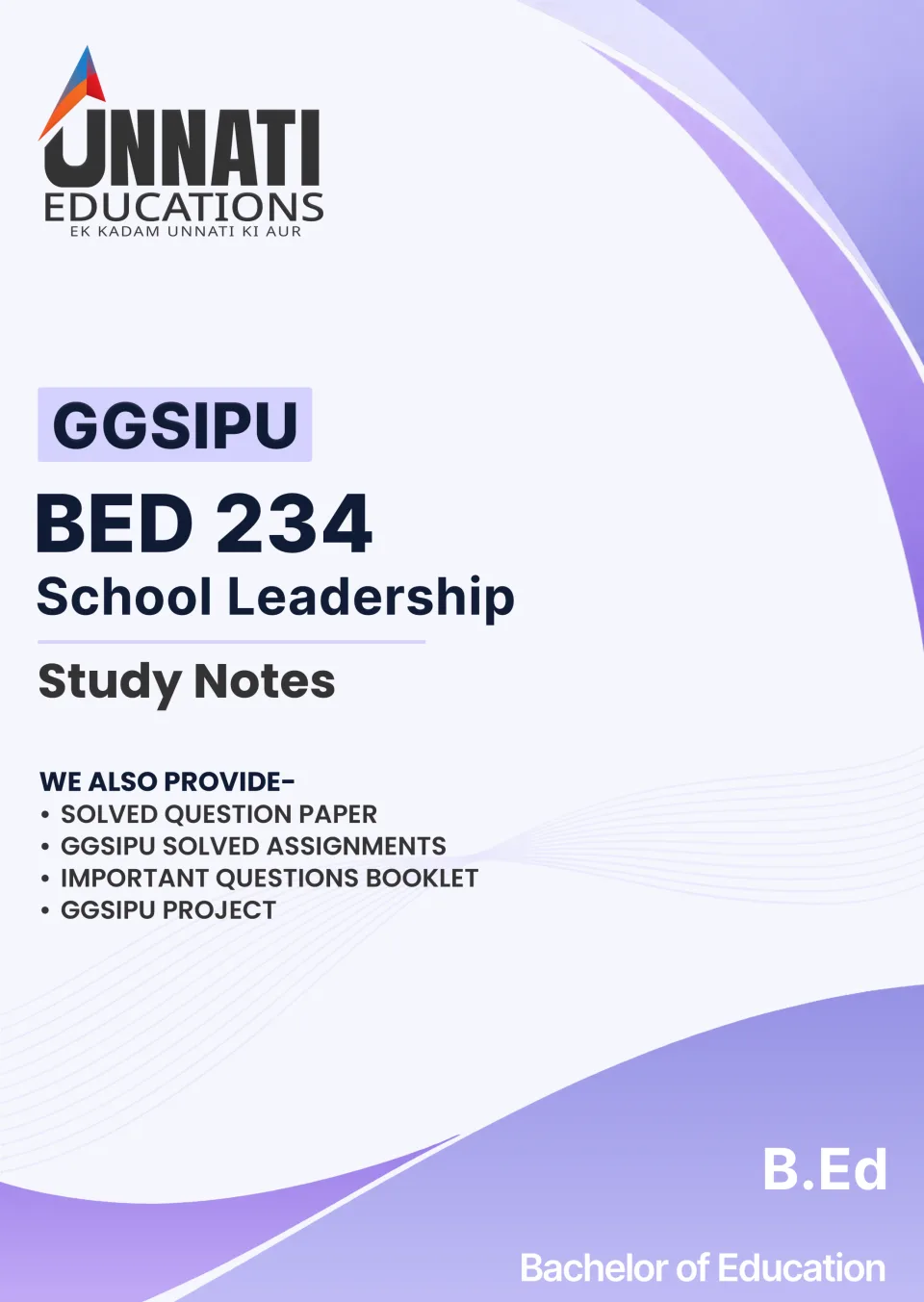
BED 234 School Leadership Notes cover all 4 units of this GGSIPU B.Ed Semester 4 elective in 91 pages: 25 topics, 21 figures, 25 exam tips and 104 exam questions (31 long, 42 short, 31 very short). They follow the official B.Ed curriculum for session 2023-24 onwards and come as a printed book.
Written by Sheetal Kirola, Academic Head, M.Ed., 7 years of experience · Reviewed by Prateek Talwar, Founder, Unnati Educations (B.Ed counselling since 2020) · Checked against B.Ed Course Curriculum (Two Years), session 2023-24 onwards (ipu.ac.in) · Updated 14 October 2026 · Editorial policy
Scheme: B.Ed Course Curriculum (Two Years) | Applies to: session 2023-24 onwards | Verified against: syllBEd210823.pdf, ipu.ac.in, 13 October 2026
BED 234 School Leadership at a glance: GGSIPU B.Ed Sem 4 credits, units and exam pattern
School Leadership is one of eight Elective 1 options in Semester 4 (BED220 to BED234); all figures below come from the official curriculum PDF.
| Code and title | BED234 · School Leadership |
|---|---|
| Course and semester | B.Ed (two years), Semester 4, Elective 1 (any one) |
| Credits and hours | 4 credits: 3 theory (3 teaching hours a week) + 1 practical (2 hours of engagement a week) |
| Marks | 100: 75 theory exam + 15 practical assignments / field engagement + 10 minors |
| Passing rule | Minimum 40% in any course (40 out of 100) |
| Applies to | Session 2023-24 onwards |
| End-term pattern | Paper-setter instructions are not printed in the official PDF |
| Field engagement (any one) | Study the role of supervisors and principals in a school, or prepare a school improvement plan |
| Paired lab | None (theory elective) |
It sits with five compulsory theory papers and two practicals in the GGSIPU B.Ed Semester 4 papers.
BED 234 School Leadership Notes unit-wise: 25 topics, 21 figures and 104 exam questions across 4 units
Each unit of these GGSIPU B.Ed Sem 4 School Leadership notes runs topic by topic and closes with a Quick Revision Table and exam questions; the sample PDF above shows the layout. Notes for every other B.Ed paper sit under GGSIPU B.Ed notes.
BED 234 Unit 1: Structures and Processes of the Indian Education System
Pages 3 to 25 explain who runs Indian schools, and under what rules. Six topics cover the six management types, the chain of functionaries from the Ministry to the SMC, governance rules, school finance and the bodies that affiliate, regulate and fund a school.
The last two read policy from Kothari to NEP 2020 and school culture through assemblies and annual days. The unit carries 6 figures, 6 exam tips, 8 long, 12 short and 7 very short questions.
Quick look: Schein's three levels of school culture (from page 21)
| Level | School example |
|---|---|
| Artifacts (visible) | Uniform, displays, assembly, ceremonies |
| Espoused values | Motto, vision statement, code of conduct |
| Basic assumptions (invisible) | "Every child can learn" or "weak students cannot improve" |
Quick look: Schein's levels of school culture (from page 21)
- Level
- Artifacts (visible)
- School example
- Uniform, displays, assembly, ceremonies
- Level
- Espoused values
- School example
- Motto, vision statement, code of conduct
- Level
- Basic assumptions (invisible)
- School example
- "Every child can learn" or "weak students cannot improve"
BED 234 Unit 2: School Effectiveness and School Standards
Pages 26 to 47 ask what makes one school more effective than another. It starts with value added, Edmonds' five factors and Sammons' eleven, then covers Shaala Siddhi, the seven steps for developing standards and Kounin's classroom management.
Later topics take up the 7 Cs of communication, Herzberg and Maslow on motivation, inclusive education and the causes and remedies of indiscipline. Count: 6 figures, 7 definitions, 7 long, 10 short and 8 very short questions.
Quick look: three concepts of discipline (from page 43)
| Concept | Discipline comes through |
|---|---|
| Repressionistic | Force, fear and punishment |
| Impressionistic | The teacher's personality and example |
| Emancipationistic | Freedom with self-control (Rousseau, Dewey, Montessori) |
Quick look: concepts of discipline (from page 43)
- Concept
- Repressionistic
- Discipline comes through
- Force, fear and punishment
- Concept
- Impressionistic
- Discipline comes through
- The teacher's personality and example
- Concept
- Emancipationistic
- Discipline comes through
- Freedom with self-control (Rousseau, Dewey, Montessori)
BED 234 Unit 3: School Leadership and Management
Pages 48 to 70 form the largest unit (seven topics). It separates administrative leadership (POSDCORB) from academic leadership, then covers Tuckman's team stages, Pondy's conflict stages, the Thomas-Kilmann modes and Fayol's functions.
The second half covers stress (Selye's GAS), TQM with Deming's PDCA cycle and time management. It carries 5 figures, 7 definitions, 5 memory tricks, 8 long, 10 short and 8 very short questions.
Quick look: the Eisenhower matrix for a principal (from pages 66-67)
| Quadrant | School example |
|---|---|
| Urgent, important: do now | An accident in school, board exam duties |
| Important, not urgent: plan | Teacher development, improvement plans |
| Urgent, not important: delegate | Routine requests, some meetings |
| Neither: eliminate | Gossip, time fillers |
Quick look: Eisenhower matrix (from pages 66-67)
- Quadrant
- Urgent, important: do now
- School example
- An accident in school, board exam duties
- Quadrant
- Important, not urgent: plan
- School example
- Teacher development, improvement plans
- Quadrant
- Urgent, not important: delegate
- School example
- Routine requests, some meetings
- Quadrant
- Neither: eliminate
- School example
- Gossip, time fillers
BED 234 Unit 4: Change Facilitation in Education
Pages 71 to 91 deal with reform and the institutions behind it. It sets out the change models of Lewin, Fullan, Rogers and Kotter, twelve reform issues in Indian schools and teacher education as the prime mover of change.
It then explains UGC, NCERT, NCTE, NIEPA, the SCERT-IASE-CTE-DIET network, Samagra Shiksha and the NCTE code of ethics. Count: 4 figures, 8 long, 10 short and 8 very short questions.
Quick look: Fullan's three phases of educational change (from page 72)
| Phase | What happens |
|---|---|
| Initiation | Decision to adopt; need, advocacy, resources |
| Implementation | First years of use; training, support, problems |
| Institutionalisation | The change becomes part of the system |
Quick look: Fullan's phases of change (from page 72)
- Phase
- Initiation
- What happens
- Decision to adopt; need, advocacy, resources
- Phase
- Implementation
- What happens
- First years of use; training, support, problems
- Phase
- Institutionalisation
- What happens
- The change becomes part of the system
BED 234 exam corner: 31 long-answer, 42 five-mark and 31 very short questions by unit
| Unit | Long (10–15 marks) | Short (5 marks) | Very short (1–2 marks) |
|---|---|---|---|
| 1. Indian education system | 8 | 12 | 7 |
| 2. Effectiveness and standards | 7 | 10 | 8 |
| 3. Leadership and management | 8 | 10 | 8 |
| 4. Change facilitation | 8 | 10 | 8 |
| Total | 31 | 42 | 31 |
BED 234 exam questions listed in the notes, by unit
- Unit
- 1. Indian education system
- Long (10–15 marks)
- 8
- Short (5 marks)
- 12
- Very short (1–2 marks)
- 7
- Unit
- 2. Effectiveness and standards
- Long (10–15 marks)
- 7
- Short (5 marks)
- 10
- Very short (1–2 marks)
- 8
- Unit
- 3. Leadership and management
- Long (10–15 marks)
- 8
- Short (5 marks)
- 10
- Very short (1–2 marks)
- 8
- Unit
- 4. Change facilitation
- Long (10–15 marks)
- 8
- Short (5 marks)
- 10
- Very short (1–2 marks)
- 8
- Unit
- Total
- Long (10–15 marks)
- 31
- Short (5 marks)
- 42
- Very short (1–2 marks)
- 31
One exam-style question per unit, with an answer pointer:
- Unit 1: Explain the relationship between the school and support organisations. Pointer: affiliating, regulating and financing headings, a "gives and expects" table, then autonomy with accountability.
- Unit 2: What is classroom management? Discuss its elements and strategies. Pointer: five elements plus Kounin's withitness and overlapping.
- Unit 3: What is stress? Suggest strategies for stress management. Pointer: eustress vs distress, the three GAS stages, then individual and organisational strategies.
- Unit 4: What is accountability in education? Pointer: seven types, then RTE Sections 17, 21-22, 24 and 28 as mechanisms.
The BED 234 notes list 31 long-answer, 42 short-answer and 31 very short questions across 4 units, with the answer in brackets for 29 of the very short ones.
More practice sits in the BED 234 important questions.
Who writes and checks the BED 234 leadership notes?
- Sheetal Kirola, author: Academic Head, Unnati Educations · M.Ed. · 7 years of experience · bio
- Prateek Talwar, reviewer: Founder, Unnati Educations · B.Ed counselling since 2020 · ACS (ICSI) · B.Com, University of Delhi · bio
These BED 234 School Leadership IPU notes were mapped to the official B.Ed Course Curriculum for session 2023-24 onwards, topic by topic. The 2026-27 edition has 25 topics in 91 pages with current policy facts (NEP 2020, NCF-SE 2023, PM SHRI). Last updated 14 October 2026; see our editorial policy.
The same team prepares GGSIPU important questions for every course.
How to write BED 234 answers: definition-led long answers with RTE sections, thinkers and flow charts
Every Quick Revision page repeats one rule: open with a definition, use headings and a table or chart, quote Acts, sections and years, add a school example and close briefly. Facts carry marks here: write "KVS 1963" or "RTE Section 21", not "a scheme" or "a law".
Worked example, from the exam tip on page 14: "Discuss the financial management of schools." A full-marks outline:
- Meaning: planning, raising, using, recording and controlling funds; the principal as Drawing and Disbursing Officer.
- Sources of funds in a type-wise table.
- The six-step flow: budget, approval, receipt, utilisation, records, audit.
- Principles, then a school example: a ₹75,000 composite grant, 10% of it on Swachhta.
Draw the chart first when a hierarchy or process is asked (functionaries, Lewin's model, the DIET network), and answer "differentiate" questions in a table. Practise this format on GGSIPU B.Ed important questions.
BED 234 and the GGSIPU B.Ed Sem 4 papers it connects to
BED 234 has no paired lab; its 15 practical marks come from the field engagement in the GGSIPU B.Ed syllabus.
- Unit 2 inclusive education (page 40) builds on BED 218 Creating an Inclusive School.
- Unit 3 stress and motivation pair with BED 214 Guidance & Counselling.
- Unit 1 policies (NCF 2005, NEP 2020) meet BED 212 Knowledge and Curriculum.
- The field study of a principal's role links to BED 252 Reflection on School Experience.
Other Semester 4 papers: BED 210 Gender, School and Society, BED 216 Environmental Education, BED 254 Drama and Art in Education and electives BED 220 to BED 232.
Lewin's three styles and transformational leadership in school administration: excerpt from page 52 of the BED 234 notes
Excerpt from page 52
Meaning of leadership style
A leadership style is the usual way a leader behaves while directing and motivating people: how decisions are taken, how much freedom staff get and how relationships are handled. No single style suits every situation, so a principal needs to know the main models and when each one fits.
Kurt Lewin's classical styles (1939)
| Basis | Autocratic | Democratic | Laissez-faire |
|---|---|---|---|
| Decisions | Leader alone | Leader with group | Group or individuals alone |
| Communication | One-way, top-down | Two-way | Little guidance |
| Strength | Quick decisions in emergencies | High morale, creativity, commitment | Suits skilled, self-motivated staff |
| Weakness | Low morale, fear, no initiative | Slower decisions | Confusion, no direction |
| School example | Principal assigns duties without asking | Staff meeting plans exams together | Principal leaves everything to teachers |
Lewin's three leadership styles in a school
- Basis
- Decisions
- Autocratic
- Leader alone
- Democratic
- Leader with group
- Laissez-faire
- Group or individuals alone
- Basis
- Communication
- Autocratic
- One-way, top-down
- Democratic
- Two-way
- Laissez-faire
- Little guidance
- Basis
- Strength
- Autocratic
- Quick decisions in emergencies
- Democratic
- High morale, creativity, commitment
- Laissez-faire
- Suits skilled, self-motivated staff
- Basis
- Weakness
- Autocratic
- Low morale, fear, no initiative
- Democratic
- Slower decisions
- Laissez-faire
- Confusion, no direction
- Basis
- School example
- Autocratic
- Principal assigns duties without asking
- Democratic
- Staff meeting plans exams together
- Laissez-faire
- Principal leaves everything to teachers
In schools the democratic style usually works best. A good principal still turns autocratic in an emergency such as a fire or an accident, and gives free rein to experienced, expert teachers.
Transactional and transformational leadership (Burns 1978; Bass 1985)
Transactional leadership runs on exchange: reward for performance, penalty for failure. It keeps the existing system going, focuses on tasks, rules and short-term goals, and motivates through extrinsic rewards.
Transformational leadership runs on inspiration. It changes the beliefs, values and goals of followers, brings innovation, and motivates from within by focusing on vision, people and long-term growth.
A transactional principal checks that lesson plans are submitted and rewards good results. A transformational principal makes teachers believe in a shared vision, so they try new methods on their own. Schools need both, but lasting improvement usually comes from the second.
The four I's of transformational leadership (Bass)
- Idealised influence: the leader is a role model who earns trust and respect.
- Inspirational motivation: the leader shares an inspiring vision and builds team spirit.
- Intellectual stimulation: the leader encourages creativity and questioning of old ways.
- Individualised consideration: the leader attends to each person's needs, coaching and mentoring.
Do the BED 234 notes cover the full GGSIPU syllabus?
Yes for all four units: every official BED 234 topic has its own section. The field engagement is only partly covered, because the notes give no report format for it.
| Official unit | Official topics | Where in the notes | Status |
|---|---|---|---|
| I: Structures and Processes of the Indian Education System | Types of schools, functionaries, governance and finance, support organisations, policies, school culture | Topics 1.01-1.06, pp. 4-23 | Covered |
| II: School Effectiveness and School Standards | Effectiveness, standards, classroom management, communication, motivation, learner-centred and inclusive education, discipline | Topics 2.01-2.06, pp. 27-45 | Covered |
| III: School Leadership and Management | Administrative and academic leadership, styles, team leadership, conflict, stress, TQM, time management | Topics 3.01-3.07, pp. 49-68 | Covered |
| IV: Change Facilitation in Education | Reform issues, teacher education, IASEs, DIETs, CTE, UGC, NCERT, NCTE, NUEPA, SCERT, Samagra Shiksha, accountability and ethics | Topics 4.01-4.06, pp. 72-89 | Covered |
| Field engagement (any one) | Role of supervisors and principals; school improvement plan | Principal's roles p. 10; improvement-plan steps p. 30 | Partly covered: no field report format |
BED 234 official syllabus mapped to the notes
- Official unit
- I: Structures and Processes of the Indian Education System
- Official topics
- Types of schools, functionaries, governance and finance, support organisations, policies, school culture
- Where in the notes
- Topics 1.01-1.06, pp. 4-23
- Status
- Covered
- Official unit
- II: School Effectiveness and School Standards
- Official topics
- Effectiveness, standards, classroom management, communication, motivation, learner-centred and inclusive education, discipline
- Where in the notes
- Topics 2.01-2.06, pp. 27-45
- Status
- Covered
- Official unit
- III: School Leadership and Management
- Official topics
- Administrative and academic leadership, styles, team leadership, conflict, stress, TQM, time management
- Where in the notes
- Topics 3.01-3.07, pp. 49-68
- Status
- Covered
- Official unit
- IV: Change Facilitation in Education
- Official topics
- Reform issues, teacher education, IASEs, DIETs, CTE, UGC, NCERT, NCTE, NUEPA, SCERT, Samagra Shiksha, accountability and ethics
- Where in the notes
- Topics 4.01-4.06, pp. 72-89
- Status
- Covered
- Official unit
- Field engagement (any one)
- Official topics
- Role of supervisors and principals; school improvement plan
- Where in the notes
- Principal's roles p. 10; improvement-plan steps p. 30
- Status
- Partly covered: no field report format
Official source: B.Ed Course Curriculum (Two Years), session 2023-24 onwards. The PDF prints "NUEPA"; the notes explain it on pages 79-80 and use its current name, NIEPA (renamed in 2017).
Every course in GGSIPU notes is mapped to its official PDF the same way.
BED 234 leadership notes FAQs
How do I get the full BED 234 notes?
Message us on WhatsApp at 9899436384 with the code BED 234. The full notes come only as a printed book, not a PDF. Delivery takes up to 5 to 7 days, depending on your location. The book has all 4 units in 91 pages, with 21 figures, 25 exam tips, 104 exam questions and a Quick Revision Table per unit.
What is BED 234 marked out of, and what is the passing mark?
BED 234 is marked out of 100: 75 for the theory exam, 15 for practical assignments or field engagement and 10 for minors. The B.Ed scheme of examination states that a minimum of 40% is needed to pass any course, which is 40 out of 100. For end-term minimums and re-appear rules, check Ordinance 11 on ipu.ac.in.
Is BED 234 compulsory in GGSIPU B.Ed Semester 4?
No. BED 234 is one of eight Elective 1 papers in Semester 4, and you choose any one of BED 220 to BED 234. All eight carry 4 credits and 100 marks, so the choice rests on interest. School Leadership suits students who want to know how principals, SMCs and education officers actually run schools.
Which unit of BED 234 has the most topics?
Unit 3, School Leadership and Management, is the largest: 7 topics on pages 48 to 70, with 7 definitions, 5 memory tricks and 26 exam questions. Units 1, 2 and 4 have 6 topics each. Unit 1 has the most short questions (12), many on RTE sections, SMCs and the composite school grant, so it rewards learning facts and years.
Do the BED 234 notes help with the field engagement task?
Partly. The syllabus asks for one task: a study of the role of supervisors and principals, or a school improvement plan. The notes give the principal's seven roles (page 10) and the six steps of an improvement plan (page 30), which make a sound base. They do not give a report format, so follow your college's guidelines for the write-up.
The BED 234 syllabus says NUEPA. Do the notes use NUEPA or NIEPA?
Both. The official PDF still lists NUEPA in Unit 4. The notes trace it from a 1962 UNESCO centre to NIEPA (1979), NUEPA (2006) and NIEPA again (2017), then explain its role in UDISE, Shaala Siddhi and the National Centre for School Leadership. Writing "NIEPA (earlier NUEPA)" in your exam answer covers both names safely.
Get the full BED 234 School Leadership Notes on WhatsApp
| Unit | Pages | Topics | Exam questions |
|---|---|---|---|
| 1. Indian education system | 3-25 (23) | 6 | 27 |
| 2. Effectiveness and standards | 26-47 (22) | 6 | 25 |
| 3. Leadership and management | 48-70 (23) | 7 | 26 |
| 4. Change facilitation | 71-91 (21) | 6 | 26 |
What the full BED 234 notes book contains
- Unit
- 1. Indian education system
- Pages
- 3-25 (23)
- Topics
- 6
- Exam questions
- 27
- Unit
- 2. Effectiveness and standards
- Pages
- 26-47 (22)
- Topics
- 6
- Exam questions
- 25
- Unit
- 3. Leadership and management
- Pages
- 48-70 (23)
- Topics
- 7
- Exam questions
- 26
- Unit
- 4. Change facilitation
- Pages
- 71-91 (21)
- Topics
- 6
- Exam questions
- 26
Format: a printed book of School Leadership notes in English (not available as a PDF), with 21 figures, 18 definitions and 17 memory tricks. Delivery: up to 5 to 7 days, depending on your location.
Get the full BED 234 notes book on WhatsApp (4 units, 91 pages)Unnati Educations is an independent education provider based in Vikaspuri, Delhi. We are not affiliated with, authorised by, or endorsed by Guru Gobind Singh Indraprastha University (GGSIPU). 'GGSIPU' and 'IPU' are used only to describe the syllabus our notes follow. For official information, visit ipu.ac.in.