
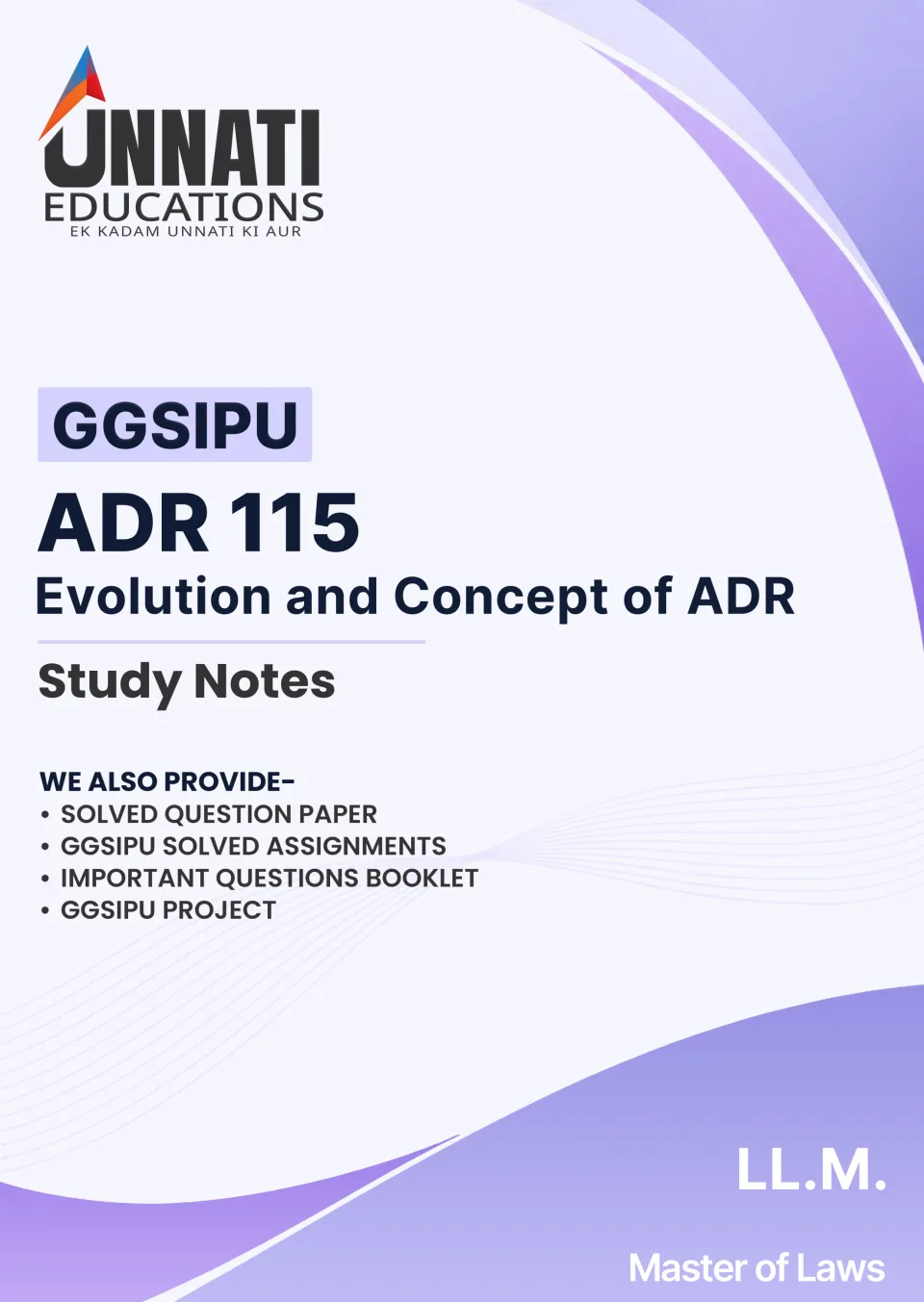
ADR 115 Evolution and Concept of ADR Notes cover all 4 units of the GGSIPU LL.M. (ADR) Semester 1 paper in a 54-page printed book: 31 sections, more than 50 case laws, 4 quick revision tables and 68 exam questions. They follow the LL.M. (One Year) scheme that applies from the 2022-23 session.
Written by Unnati Educations Editorial Team · Academic review by Sheetal Kirola, M.Ed., Academic Head · Checked against LL.M. (One Year) scheme and syllabus, ipu.ac.in · Updated 14 October 2026 · Editorial policy
Scheme: LL.M. (One Year), ADR specialisation | Applies to: batches from the 2022-23 session (cover reads w.e.f 2023 onwards) | Verified against: Master of Law (LL.M.) Regular One year Programme w.e.f 2022-23, ipu.ac.in
ADR 115 Evolution and Concept of ADR at a glance: GGSIPU LL.M. Sem 1 credits, units and exam pattern
ADR 115 is Paper IV of the ADR specialisation and the theory base of the track: arbitration, mediation, Lok Adalat and legal aid start here. It sits with four other GGSIPU LL.M. Semester 1 papers.
Item | Detail |
|---|---|
Code and title | ADR 115 Evolution and Concept of ADR (Paper IV) |
Course and semester | LL.M. (One Year), Alternate Dispute Resolution specialisation, Semester 1 |
Credits and weekly hours | 5 credits: 4 lecture hours + 2 RTDA hours (Research and Teaching Development Activities) |
Marks | 100: 25 internal (written test + RTDA) + 75 end-term written exam |
End-term pattern | Question pattern not printed in the official PDF |
Applies to | LL.M. batches from the 2022-23 session (cover reads w.e.f 2023 onwards) |
Units and lab | 4 units, 10 lectures each; no paired lab |
ADR 115 snapshot from the official LL.M. scheme and syllabus
Item
Code and title
Detail
ADR 115 Evolution and Concept of ADR (Paper IV)
Item
Course and semester
Detail
LL.M. (One Year), Alternate Dispute Resolution specialisation, Semester 1
Item
Credits and weekly hours
Detail
5 credits: 4 lecture hours + 2 RTDA hours (Research and Teaching Development Activities)
Item
Marks
Detail
100: 25 internal (written test + RTDA) + 75 end-term written exam
Item
End-term pattern
Detail
Question pattern not printed in the official PDF
Item
Applies to
Detail
LL.M. batches from the 2022-23 session (cover reads w.e.f 2023 onwards)
Item
Units and lab
Detail
4 units, 10 lectures each; no paired lab
Because the scheme prints no paper pattern for ADR 115, these ADR 115 Evolution and Concept of ADR IPU notes prepare you for both long answers and short notes.
ADR 115 Evolution and Concept of ADR Notes unit-wise: 68 exam questions and 50+ case laws across 4 units
These GGSIPU LL.M. Sem 1 Evolution and Concept of ADR notes give every unit its own cover page, then run through numbered sections with tables, and close with a quick revision table plus 7 long-answer and 10 short-answer exam questions. Notes for the other papers of this course sit under GGSIPU LL.M. notes. Sample pages open through "View Sample PDF" above.
ADR 115 Unit 1: Introduction to ADR-I
Pages 3 to 16, 7 sections. The unit builds the vocabulary of the paper: conflict vs dispute, Moore's Circle of Conflict and four ways to classify disputes, including justiciable and non-justiciable.
It then sets the adversarial system and India's court hierarchy (Articles 124 to 147, 214 to 231, Section 9 CPC) against ADR, explains the need for ADR and ends with the spectrum from negotiation to arbitration. Cases include Afcons (2010) and Patil Automation (2022).
Basis | Adversarial | Inquisitorial |
|---|---|---|
Origin | English common law (UK, USA, India) | Civil law (France, Germany) |
Role of judge | Passive umpire | Active investigator |
Control of case | Parties and lawyers | Judge or court |
Aim | Decide who has the better case | Find out the truth |
Quick look: adversarial vs inquisitorial system (from page 6)
Basis
Origin
Adversarial
English common law (UK, USA, India)
Inquisitorial
Civil law (France, Germany)
Basis
Role of judge
Adversarial
Passive umpire
Inquisitorial
Active investigator
Basis
Control of case
Adversarial
Parties and lawyers
Inquisitorial
Judge or court
Basis
Aim
Adversarial
Decide who has the better case
Inquisitorial
Find out the truth
ADR 115 Unit 2: Indian Perspective of ADR
Pages 17 to 28, 9 sections. It traces ADR from Kulani, Shreni and Puga to Article 39A, then covers each type of ADR in India: arbitration under the 1996 Act and its amendments, conciliation, the Mediation Act, 2023, Lok Adalat, judicial settlement and statutory forums.
Current trends and the case for and against acceptability finish the unit. Cases include BALCO, Vidya Drolia, CORE (2024) and Gayatri Balasamy (2025).
Part | Subject | Sections |
|---|---|---|
Part I | Domestic arbitration and international commercial arbitration seated in India | 2 to 43 |
Part IA | Arbitration Council of India (added 2019) | 43A to 43M |
Part II | Enforcement of foreign awards (New York and Geneva Conventions) | 44 to 60 |
Part III | Conciliation | 61 to 81 |
Quick look: structure of the Arbitration and Conciliation Act, 1996 (from page 19)
Part
Part I
Subject
Domestic arbitration and international commercial arbitration seated in India
Sections
2 to 43
Part
Part IA
Subject
Arbitration Council of India (added 2019)
Sections
43A to 43M
Part
Part II
Subject
Enforcement of foreign awards (New York and Geneva Conventions)
Sections
44 to 60
Part
Part III
Subject
Conciliation
Sections
61 to 81
ADR 115 Unit 3: Dispute Resolution at grass root level
Pages 29 to 43, 8 sections, the longest unit. Lok Adalats get two sections: evolution from Junagadh in 1982, Sections 19 to 22 of the Legal Services Authorities Act, 1987 and Permanent Lok Adalats under Sections 22A to 22E.
Nyaya Panchayats and why they declined lead into the Gram Nyayalayas Act, 2008. Legal aid is covered through Article 39A, the NALSA to Taluk structure and Section 12 eligibility, ending with preventive and strategic legal aid. Cases include Hussainara Khatoon and Bandhua Mukti Morcha.
Basis | Lok Adalat | Permanent Lok Adalat |
|---|---|---|
Provision | Sections 19 to 22 | Sections 22A to 22E |
Stage | Pending or pre-litigation | Pre-litigation only |
Decision on merits | No, compromise only | Yes, if conciliation fails |
Pecuniary limit | No limit | Up to ₹1 crore |
Quick look: ordinary Lok Adalat vs Permanent Lok Adalat (from page 33)
Basis
Provision
Lok Adalat
Sections 19 to 22
Permanent Lok Adalat
Sections 22A to 22E
Basis
Stage
Lok Adalat
Pending or pre-litigation
Permanent Lok Adalat
Pre-litigation only
Basis
Decision on merits
Lok Adalat
No, compromise only
Permanent Lok Adalat
Yes, if conciliation fails
Basis
Pecuniary limit
Lok Adalat
No limit
Permanent Lok Adalat
Up to ₹1 crore
ADR 115 Unit 4: ADR Application
Pages 44 to 54, 7 sections. Built on Frank Sander's "fit the forum to the fuss", it opens with a suitability matrix and applies ADR to five dispute types: commercial and financial, real estate and land (RERA), consumer, accident claims and matrimonial.
Each type is tied to its law, such as Section 12A of the Commercial Courts Act, Sections 74 to 81 of the Consumer Protection Act, 2019, Section 149 of the Motor Vehicles Act and Section 23(2) HMA. Cases include Emaar MGF, Sarla Verma and Shilpa Sailesh (2023).
Commission | Value of goods or services paid |
|---|---|
District Commission | Up to ₹50 lakh |
State Commission | Above ₹50 lakh up to ₹2 crore |
National Commission | Above ₹2 crore |
Quick look: consumer commission pecuniary limits (from page 49)
Commission
District Commission
Value of goods or services paid
Up to ₹50 lakh
Commission
State Commission
Value of goods or services paid
Above ₹50 lakh up to ₹2 crore
Commission
National Commission
Value of goods or services paid
Above ₹2 crore
Philosophy of ADR in Indian law: excerpt from page 10 of the ADR 115 notes
Excerpt from page 10 of the ADR 115 notes, rewritten for the web.
Characteristics of ADR
ADR is voluntary and consensual: it rests on the agreement of the parties, except where a court refers the case. A neutral third party, whether arbitrator, mediator or conciliator, helps them. The procedure is flexible; under Section 19 of the Arbitration and Conciliation Act, 1996, a tribunal is not strictly bound by the CPC or the Evidence Act.
Parties choose the method, the neutral, the venue, the language and the rules. Proceedings are private. Time limits keep it quick, for example an arbitral award within 12 months of completion of pleadings under Section 29A. And the approach is win-win: it looks at the interests of both sides and protects the relationship.
Philosophy of ADR
The core idea is that justice is not only what a court hands down. It can also come through dialogue, consent and compromise. The notes break this into eight foundations.
First, access to justice. Article 39A, added by the 42nd Amendment in 1976, directs the State to provide equal justice and free legal aid, and cheap, quick ADR serves that goal. Second, party autonomy: parties know their own interests best, so they design and accept their own solution.
Third, win-win instead of win-lose. Fisher and Ury's "Getting to Yes" (1981) asks negotiators to separate the people from the problem and to focus on interests, not positions. Fourth, preservation of relationships in family, business and community disputes. Fifth, restorative justice, which aims to repair harm rather than only assign blame.
Sixth, India's own roots. Kulani, Shreni, Puga and Panchayat bodies settled disputes long before formal courts, and the idea of "Panch Parmeshwar" treated five respected elders as the voice of fairness. Seventh, Gandhian thought: Gandhi wrote that a lawyer's true function is to unite parties who have fallen apart, and he settled most of his South African cases by compromise.
Eighth, constitutional and statutory support: Article 39A, Section 89 CPC, the 1996 Act, the Legal Services Authorities Act, 1987 and the Mediation Act, 2023. In exams, these eight points make a complete answer when each one is tied to a provision or a name.
How to write ADR 115 answers: section-and-case-law long answers and comparison-table short notes
ADR 115 rewards structure more than length. The five-step format at the end of Unit I works for every long answer: definition, the section or article, one or two case laws, a comparison table or flow, and a closing line on access to justice under Article 39A.
The notes also flag unit-wise traps. In Unit I, link each defect of the adversarial system (delay, cost, win-lose outcome) to a reason for ADR. In Unit II, quote section numbers exactly: Section 7 for the arbitration agreement, Section 16 for kompetenz-kompetenz, Section 34 for setting aside. In Unit III, Section 12 gives women and children free legal aid regardless of income.
For Unit IV, frame each answer as dispute type, best ADR method, governing law and one leading case, as in the matrix on page 45.
Worked example: short note on Section 89 CPC
Definition: Section 89 is the gateway for court-referred ADR, in force from 1 July 2002.
Provision: where settlement is possible, the court refers the case to arbitration, conciliation, Lok Adalat or mediation.
Case law: Salem Advocates Bar Association; Afcons (2010).
Conclusion: courts and ADR are partners, which serves Article 39A.
Practise this four-step format across other papers on GGSIPU LL.M. important questions.
ADR 115 exam corner: 28 long-answer and 40 short-answer questions by unit
Unit | Long answer (10 to 15 Marks) | Short answer (2 to 5 Marks) | Quick revision table |
|---|---|---|---|
Unit I | 7 | 10 | 1 |
Unit II | 7 | 10 | 1 |
Unit III | 7 | 10 | 1 |
Unit IV | 7 | 10 | 1 |
ADR 115 exam questions in the notes, by unit
Unit
Unit I
Long answer (10 to 15 Marks)
7
Short answer (2 to 5 Marks)
10
Quick revision table
1
Unit
Unit II
Long answer (10 to 15 Marks)
7
Short answer (2 to 5 Marks)
10
Quick revision table
1
Unit
Unit III
Long answer (10 to 15 Marks)
7
Short answer (2 to 5 Marks)
10
Quick revision table
1
Unit
Unit IV
Long answer (10 to 15 Marks)
7
Short answer (2 to 5 Marks)
10
Quick revision table
1
The ADR 115 notes list 28 long-answer and 40 short-answer exam-style questions across 4 units. Four of them, with pointers:
Unit I: Explain the adversary system, its merits and demerits, and how it led to ADR. Pointer: the features and defects on pages 6 and 7.
Unit II: What is conciliation? Explain its procedure under the 1996 Act and the effect of the Mediation Act, 2023. Pointer: Sections 62 to 81 (page 21), then the Sixth Schedule change.
Unit III: What is Nyaya Panchayat? Why did it fail, and what role do Gram Nyayalayas play? Pointer: reasons for decline (page 35) and the comparison table (page 36).
Unit IV: Explain the role of Lok Adalats in motor accident claims. Pointer: Section 149 insurer offer, Sarla Verma and Pranay Sethi (pages 50 and 51).
More practice for this paper will sit in the ADR 115 important questions.
ADR 115 and the GGSIPU LL.M. Sem 1 papers it connects to
ADR 115 has no paired lab; all course papers are listed on the GGSIPU LL.M. syllabus page.
In Semester 1 of the ADR track it runs alongside GEN 101 Research Methods and Legal Writing, GEN 103 System of Governance, GEN 105 Law and Justice in a Globalised World and ADR 117 Law of Arbitration. The arbitration section of Unit II is a short version of ADR 117, so read them together.
In Semester 2, Unit II's mediation sections feed ADR 128 Mediation, Conciliation and Negotiation, and Unit IV's dispute types prepare you for case work in ADR 134 Practical Training in ADR Skills.
Who writes and checks the ADR 115 Evolution and Concept of ADR notes?
Unnati Educations Editorial Team, writing team: unit structure, tables, case-law summaries and exam questions.
Sheetal Kirola, Academic Head, M.Ed., 7 years of experience: academic review of structure, clarity and syllabus coverage. This is an academic review, not a review by a practising lawyer.
The 2026-27 edition is mapped to the LL.M. (One Year) scheme on ipu.ac.in and covers the Mediation Act, 2023, BNS, BNSS and BSA section numbers and rulings up to Gayatri Balasamy (2025). Last updated 14 October 2026. See our editorial policy.
The same team prepares GGSIPU important questions for every course it covers.
Do the ADR 115 notes cover the full GGSIPU syllabus?
Yes. Every official ADR 115 topic has its own section in the notes; nothing is missing.
Official unit | Official topics | Where in the notes | Status |
|---|---|---|---|
Unit I: Introduction to ADR-I | Disputes: meaning and kinds; dispute resolution in adversary system; justiciable court structure and jurisdiction; ADR meaning and philosophy; need for ADR; overview of ADR processes | Sections 01 to 06, pages 4 to 15 | Covered |
Unit II: Indian Perspective of ADR | Types of ADR in India; current trends; acceptability | Sections 01 to 08, pages 18 to 26 | Covered |
Unit III: Dispute Resolution at grass root level | Lok Adalats; Nyaya Panchayath; legal aid; preventive and strategic legal aid | Sections 01 to 07, pages 30 to 41 | Covered |
Unit IV: ADR Application | Commercial and financial disputes; real estate and land disputes; consumer disputes; accident claims; matrimonial disputes | Sections 01 to 06, pages 45 to 53 | Covered |
ADR 115 official syllabus mapped to the notes
Official unit
Unit I: Introduction to ADR-I
Official topics
Disputes: meaning and kinds; dispute resolution in adversary system; justiciable court structure and jurisdiction; ADR meaning and philosophy; need for ADR; overview of ADR processes
Where in the notes
Sections 01 to 06, pages 4 to 15
Status
Covered
Official unit
Unit II: Indian Perspective of ADR
Official topics
Types of ADR in India; current trends; acceptability
Where in the notes
Sections 01 to 08, pages 18 to 26
Status
Covered
Official unit
Unit III: Dispute Resolution at grass root level
Official topics
Lok Adalats; Nyaya Panchayath; legal aid; preventive and strategic legal aid
Where in the notes
Sections 01 to 07, pages 30 to 41
Status
Covered
Official unit
Unit IV: ADR Application
Official topics
Commercial and financial disputes; real estate and land disputes; consumer disputes; accident claims; matrimonial disputes
Where in the notes
Sections 01 to 06, pages 45 to 53
Status
Covered
Check it yourself in the LL.M. (One Year) scheme and syllabus, w.e.f 2022-23 (Paper IV, ADR track).
Every course in GGSIPU notes is mapped to its official PDF in the same way.
ADR 115 Evolution and Concept of ADR notes FAQs
How do I get the full ADR 115 notes?
Tap "Get Full Notes" and send the pre-filled WhatsApp message. The full ADR 115 notes come only as a printed book; they are not sold as a PDF. Delivery takes a maximum of 5 to 7 days, depending on your location. Check the layout first through "View Sample PDF" at the top of this page.
What is the passing mark for ADR 115?
ADR 115 is marked out of 100: 25 internal marks (written test and RTDA evaluation) and 75 for the end-term written exam. The LL.M. scheme PDF does not state a pass percentage for individual papers. For pass rules, end-term minimums and re-appear, refer to GGSIPU Ordinance 11 and the latest result notices from the University School of Law and Legal Studies.
Do the ADR 115 notes follow the Mediation Act, 2023 and the new criminal laws?
Yes. Unit II has a full section on the Mediation Act, 2023, including the 120-day time limit and enforceable settlement agreements, and explains how its Sixth Schedule changes conciliation under the 1996 Act. Wherever the old IPC, CrPC or Evidence Act is cited, the ADR 115 notes add the matching BNS, BNSS or BSA, 2023 section.
Which ADR 115 unit is the longest in the notes?
Unit III, Dispute Resolution at grass root level, runs to 15 pages (pages 29 to 43). It covers Lok Adalats in two sections, Nyaya Panchayats and Gram Nyayalayas, legal aid under the 1987 Act and strategic legal aid. Unit I has 14 pages, Unit II has 12 and Unit IV has 11, so plan revision time to match.
How is ADR 115 different from ADR 117 Law of Arbitration?
ADR 115 is the broad paper: it explains disputes, the adversarial system and every ADR method, from negotiation to Lok Adalat and legal aid, then applies them to real dispute types. ADR 117 studies only arbitration in depth: agreements, tribunals, awards, setting aside and foreign awards. The arbitration section in ADR 115 Unit II is a useful starting point for ADR 117.
Are the ADR 115 exam questions solved in the notes?
Each ADR 115 unit ends with 7 long-answer and 10 short-answer exam-style questions, 68 in all, for practice. They are not written out as model answers; the answers come from the sections and the quick revision table of that unit, and the page numbers above show where. The five-step answer format on page 16 helps you build each one.
Get the full ADR 115 Evolution and Concept of ADR Notes on WhatsApp
Unit | Pages | Sections | Exam questions |
|---|---|---|---|
Unit I: Introduction to ADR-I | 14 | 7 | 17 |
Unit II: Indian Perspective of ADR | 12 | 9 | 17 |
Unit III: Dispute Resolution at grass root level | 15 | 8 | 17 |
Unit IV: ADR Application | 11 | 7 | 17 |
ADR 115 printed notes book: pages and questions per unit
Unit
Unit I: Introduction to ADR-I
Pages
14
Sections
7
Exam questions
17
Unit
Unit II: Indian Perspective of ADR
Pages
12
Sections
9
Exam questions
17
Unit
Unit III: Dispute Resolution at grass root level
Pages
15
Sections
8
Exam questions
17
Unit
Unit IV: ADR Application
Pages
11
Sections
7
Exam questions
17
The Evolution and Concept of ADR notes in English run to 54 pages with more than 50 case laws. They are sold only as a printed book, not as a PDF. Order on WhatsApp; delivery takes a maximum of 5 to 7 days, depending on your location.
Order the printed ADR 115 notes book on WhatsApp (4 units, 54 pages)
Unnati Educations is an independent education provider based in Vikaspuri, Delhi. We are not affiliated with, authorised by, or endorsed by Guru Gobind Singh Indraprastha University (GGSIPU). 'GGSIPU' and 'IPU' are used only to describe the syllabus our notes follow. For official information, visit ipu.ac.in.
Ready for the full notes?
Discuss coverage and delivery with our team.