
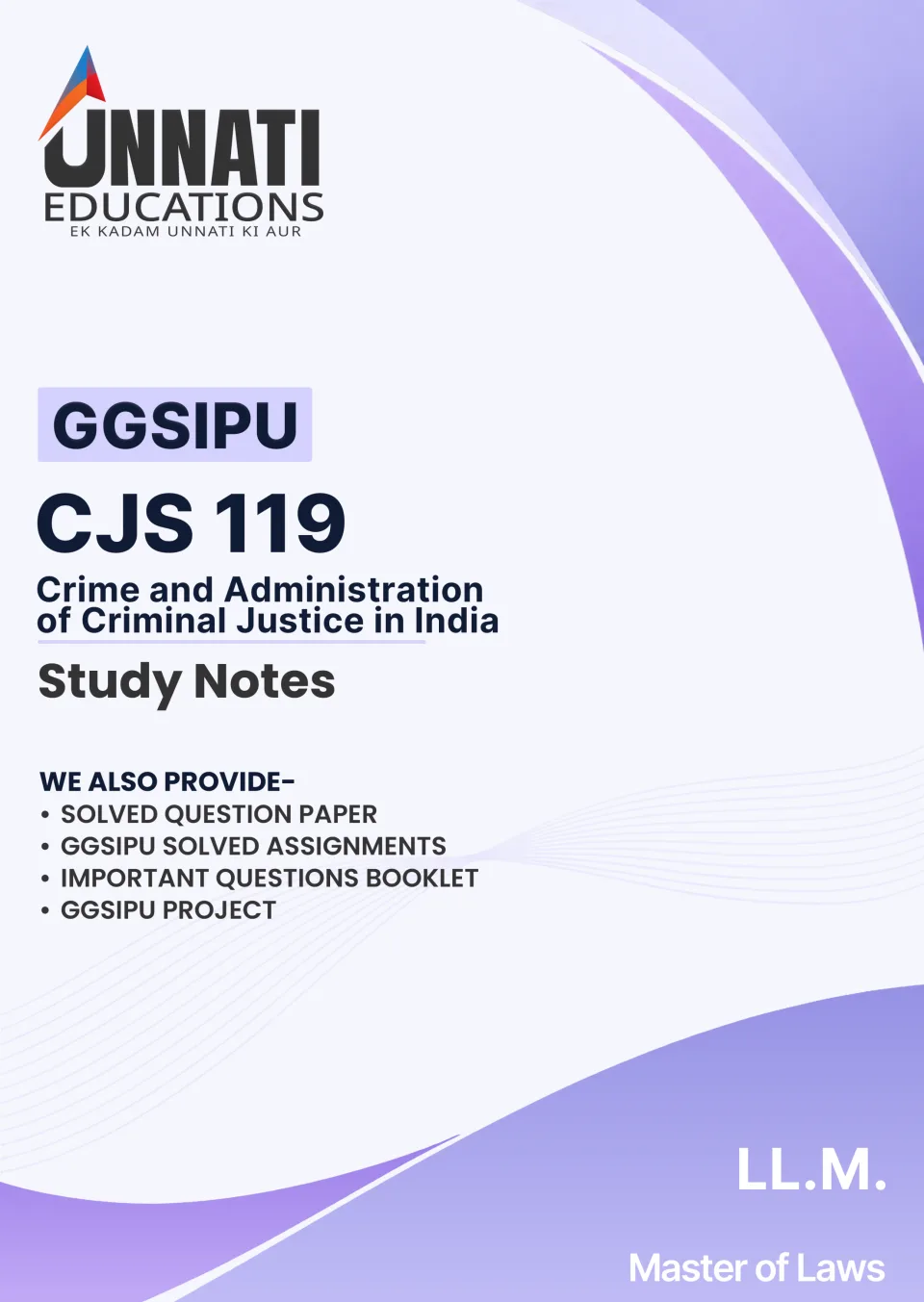
CJS 119 Crime and Administration of Criminal Justice in India Notes cover all 4 units of the GGSIPU LL.M. Criminal Justice System (CJS) Semester 1 paper in a 51-page printed book: 26 topics, 67 case-law entries, 4 quick revision tables and 53 exam questions, mapped to the LL.M. scheme approved for session 2022-23.
Written by Unnati Educations Editorial Team · Academic review by Sheetal Kirola, Academic Head, M.Ed., 7 years (structure, clarity, syllabus coverage) · Checked against Master of Law (LL.M.) Regular One Year Programme w.e.f 2022-23 (ipu.ac.in) · Updated 14 October 2026 · Editorial policy
Scheme: LL.M. (One Year) scheme and detailed syllabus | Applies to: LL.M. batches from session 2022-23 | Verified against: Master of Law (LL.M.) Regular One Year Programme w.e.f 2022-23, ipu.ac.in
CJS 119 Crime and Administration of Criminal Justice in India at a glance: GGSIPU LL.M. Sem 1 credits, units and exam pattern
Code and title | CJS 119 · Crime and Administration of Criminal Justice in India (Paper IV) |
|---|---|
Course and semester | LL.M. (One Year), CJS specialisation · Semester I |
Credits and weekly load | 5 credits · L 4 + RTDA 2 (Research and Teaching Development Activities) |
Marks | 100: 25 internal (written test and RTDA) + 75 end-term written exam |
Applies to | LL.M. batches from session 2022-23 (cover reads "w.e.f 2023 onwards") |
End-term pattern | 75-mark written paper; question-wise pattern not printed in the official PDF |
Units | 4 units, 10 lectures each |
Paired lab | None (theory paper) |
It shares the term with CJS 121 Law and Organized Crime and the three common GEN papers, all listed among the GGSIPU LL.M. Semester 1 papers.
CJS 119 Crime and Administration of Criminal Justice in India Notes unit-wise: 26 topics, 67 case-law entries and 53 exam questions across 4 units
Each unit opens on its own cover page and closes with a quick revision table and exam questions. Statutory points give the BNS, BNSS or BSA 2023 section with the old IPC, CrPC or Evidence Act section in brackets. Notes for the other papers sit under GGSIPU LL.M. notes.
CJS 119 Unit 1: Introduction
Pages 3-15 · 7 topics · 7 case-law entries · 15 exam questions. Covers the elements of crime and the maxim actus non facit reum nisi mens sit rea, sets strict liability (R v. Prince, M.H. George) against absolute liability, then runs from Beccaria to Lombroso, Merton and routine activity theory.
Quick look: strict versus absolute liability (from page 7)
Basis | Strict liability | Absolute liability |
|---|---|---|
Origin | Rylands v. Fletcher (1868) | M.C. Mehta v. Union of India (1987) |
Exceptions | Act of God, third party, consent | None at all |
Compensation | Normal | Linked to the enterprise's size and capacity |
Quick look: strict and absolute liability compared (from page 7)
Basis
Origin
Strict liability
Rylands v. Fletcher (1868)
Absolute liability
M.C. Mehta v. Union of India (1987)
Basis
Exceptions
Strict liability
Act of God, third party, consent
Absolute liability
None at all
Basis
Compensation
Strict liability
Normal
Absolute liability
Linked to the enterprise's size and capacity
CJS 119 Unit 2: Criminal Proceedings in India
Pages 16-28 · 8 topics · 17 case-law entries · 13 exam questions. Follows a case from Zero FIR and e-FIR under BNSS s. 173 (Lalita Kumari) through arrest rights (D.K. Basu, Arnesh Kumar), six kinds of bail, confessions, the Witness Protection Scheme 2018 and search and seizure. It ends with the Malimath Committee.
Quick look: confession rules under the BSA 2023 (from page 20)
Rule | BSA (IEA) |
|---|---|
Confession to a police officer cannot be proved | s. 23(1) (s. 25) |
Confession in police custody needs a Magistrate present | s. 23(2) (s. 26) |
Statement leading to discovery of a fact can be proved | Proviso to s. 23 (s. 27) |
Quick look: police confession rules with old Evidence Act sections (from page 20)
Rule
Confession to a police officer cannot be proved
BSA (IEA)
s. 23(1) (s. 25)
Rule
Confession in police custody needs a Magistrate present
BSA (IEA)
s. 23(2) (s. 26)
Rule
Statement leading to discovery of a fact can be proved
BSA (IEA)
Proviso to s. 23 (s. 27)
CJS 119 Unit 3: Criminal Judicial System and Social Defence
Pages 29-39 · 5 topics · 19 case-law entries · 13 exam questions. Traces PIL from Hussainara Khatoon to the Balwant Singh Chaufal safeguards, lists bail under BNSS ss. 478-483 and 187(3) with Moti Ram and Satender Kumar Antil, then prison justice, victim compensation and legal aid.
Quick look: who pays the victim (from page 35)
Source | Law | Key point |
|---|---|---|
Offender | BNSS s. 395 (CrPC s. 357) | From the fine or separately |
State scheme | BNSS s. 396 (CrPC s. 357A) | Even if the offender is untraced or acquitted |
Constitutional | Arts. 32 and 226 | Art. 21 violations by State officials |
Quick look: sources of victim compensation in India (from page 35)
Source
Offender
Law
BNSS s. 395 (CrPC s. 357)
Key point
From the fine or separately
Source
State scheme
Law
BNSS s. 396 (CrPC s. 357A)
Key point
Even if the offender is untraced or acquitted
Source
Constitutional
Law
Arts. 32 and 226
Key point
Art. 21 violations by State officials
CJS 119 Unit 4: Human Rights under Criminal Justice System
Pages 40-51 · 6 topics · 24 case-law entries · 12 exam questions. Reads communal violence through the Srikrishna and Nanavati commissions and BNS s. 103(2) on mob lynching, caste violence through the SC and ST (Prevention of Atrocities) Act and s. 18A, due process from A.K. Gopalan to Maneka Gandhi, and the UDHR, ICCPR and ICESCR.
Quick look: Dicey's three principles in India (from page 44)
Principle | Indian position |
|---|---|
Supremacy of law | Art. 20(1), Art. 21 |
Equality before law | Art. 14, with Art. 361 immunity |
Rights from courts | Written in Part III of the Constitution |
Quick look: Dicey's rule of law and the Indian position (from page 44)
Principle
Supremacy of law
Indian position
Art. 20(1), Art. 21
Principle
Equality before law
Indian position
Art. 14, with Art. 361 immunity
Principle
Rights from courts
Indian position
Written in Part III of the Constitution
CJS 119 exam corner: 53 exam questions and 4 short-note sets by unit
CJS 119 exam questions carry no year tags; answers come from each unit's topic notes.
Unit | Exam questions | Short-note sets | Case-law entries |
|---|---|---|---|
1 Introduction | 15 | 1 | 7 |
2 Criminal Proceedings in India | 13 | 1 | 17 |
3 Criminal Judicial System and Social Defence | 13 | 1 | 19 |
4 Human Rights under Criminal Justice System | 12 | 1 | 24 |
CJS 119 exam questions, short-note sets and case-law entries per unit
Unit
1 Introduction
Exam questions
15
Short-note sets
1
Case-law entries
7
Unit
2 Criminal Proceedings in India
Exam questions
13
Short-note sets
1
Case-law entries
17
Unit
3 Criminal Judicial System and Social Defence
Exam questions
13
Short-note sets
1
Case-law entries
19
Unit
4 Human Rights under Criminal Justice System
Exam questions
12
Short-note sets
1
Case-law entries
24
Unit 1: Distinguish between strict liability and absolute liability. Discuss M.C. Mehta v. Union of India.
Pointer: Rylands defences versus the Oleum gas rule (pages 6-7).Unit 2: Why is a confession made to a police officer not admissible? Explain the discovery exception.
Pointer: BSA s. 23 with IEA ss. 25-27, limited by Pulukuri Kottaya (pages 19-20).Unit 3: Discuss constitutional compensation with reference to Rudul Sah and Nilabati Behera.
Pointer: 14 years of illegal detention, then no sovereign immunity in public law (pages 35-36).Unit 4: 'Procedure established by law has become due process of law in India.' Discuss.
Pointer: Gopalan's narrow view, Maneka Gandhi's "right, just and fair" test, Mithu (page 45).
The CJS 119 notes list 53 exam questions across 4 units, including 4 short-note sets, and back the answers with 67 case-law entries.
More practice for this paper sits in the CJS 119 important questions.
Who writes and checks the CJS 119 criminal justice notes?
Unnati Educations Editorial Team · writes and updates the LL.M. notes from the official scheme and syllabus.
Sheetal Kirola · academic review: structure, clarity and syllabus coverage · Academic Head · M.Ed. · 7 years of experience.
Sheetal checks that every official CJS 119 topic has a section; it is an academic review, not legal advice. Read these CJS 119 criminal justice IPU notes alongside Ratanlal and Sarkar.
The 2026-27 edition uses the BNS, BNSS and BSA (in force from 1 July 2024) and adds 2024 rulings such as Sukanya Shantha on caste-based prison work and Suhas Chakma on open prisons. Last updated 14 October 2026, under our editorial policy.
The team also prepares GGSIPU important questions.
How to write CJS 119 answers: case-law-backed essays on FIR, bail, detention and criminology schools
CJS 119 answers reward structure and authority. Three habits from the notes:
Rule, exception, development. The tip on page 7: Nathulal for the rule, M.H. George for the exception, M.C. Mehta for the newest step.
New section first, old in brackets. Write "BNSS s. 173 (CrPC s. 154)". Older books still cite the old codes.
Theory tied to Indian law. Link a criminology school to a provision: neo-classical school to the BNS general exceptions (page 10).
Worked outline: "Explain strict liability. When can mens rea be excluded?"
Quote the maxim with Fowler v. Padget (1798).
State the presumption: Srinivas Mall Bairoliya and Nathulal.
Strict liability: mala prohibita, R v. Prince, Ranjit D. Udeshi.
Exclusion expressly or by necessary implication (M.H. George): language, object, punishment, enforcement.
Close with criticism and absolute liability.
Practise the same outline style with GGSIPU LL.M. important questions.
CJS 119 and the GGSIPU LL.M. Sem 1 papers it connects to
CJS 119 has no lab paper; each specialisation's paper list is on the GGSIPU LL.M. syllabus page.
These GGSIPU LL.M. Semester 1 criminal justice notes overlap with:
CJS 121 Law and Organized Crime: Unit 1's organised crime (BNS s. 111) and Unit 2's confessions under special laws (Kartar Singh).
GEN 101 Research Methods and Legal Writing: Unit 1's twin studies and NCRB data suit a non-doctrinal research design.
GEN 103 System of Governance and GEN 105 Law and Justice in a Globalised World: Unit 3's PIL, Unit 4's rule of law and the UDHR, ICCPR and ICESCR.
Punitive and preventive detention in Indian criminal law: excerpt from page 46 of the CJS 119 notes
Excerpt from page 46
What the two kinds of detention mean
Detention takes away personal liberty, so the Constitution treats its two forms very differently. Punitive detention is custody as punishment for an offence already committed, or custody while that offence is investigated and tried. Preventive detention locks a person up to stop a harmful act that has not yet happened, so the State acts on a forecast rather than on proof.
Basis | Punitive detention | Preventive detention |
|---|---|---|
Basis | Proof or accusation of an offence | Suspicion and the executive's subjective satisfaction |
Trial | Yes, by a court | No trial; review by an Advisory Board |
Constitution | Art. 22(1)-(2), Arts. 20 and 21 | Art. 22(3)-(7) |
Laws | BNS, BNSS | NSA 1980, COFEPOSA 1974, PITNDPS 1988, State laws |
Aim | Punishment, deterrence, reform | Security of State, public order, essential supplies |
Excerpt from page 46: punitive and preventive detention compared
Basis
Basis
Punitive detention
Proof or accusation of an offence
Preventive detention
Suspicion and the executive's subjective satisfaction
Basis
Trial
Punitive detention
Yes, by a court
Preventive detention
No trial; review by an Advisory Board
Basis
Constitution
Punitive detention
Art. 22(1)-(2), Arts. 20 and 21
Preventive detention
Art. 22(3)-(7)
Basis
Laws
Punitive detention
BNS, BNSS
Preventive detention
NSA 1980, COFEPOSA 1974, PITNDPS 1988, State laws
Basis
Aim
Punitive detention
Punishment, deterrence, reform
Preventive detention
Security of State, public order, essential supplies
The Supreme Court made the line clear in Haradhan Saha v. State of West Bengal (1975): preventive detention is not punishment. It rests on suspicion, so it can run side by side with a criminal prosecution for the same conduct.
Safeguards in punitive detention
Arrest only under law, and only when necessary (BNSS s. 35, Arnesh Kumar).
The arrested person must be told the grounds and may consult a lawyer (Art. 22(1)).
Production before a Magistrate within 24 hours (Art. 22(2), BNSS s. 58).
Police custody is capped at 15 days in total; judicial custody before a charge-sheet runs up to 60 or 90 days, after which default bail follows (BNSS s. 187).
Read together, the two columns show the trade-off the unit keeps returning to: punitive detention needs proof and a court, while preventive detention swaps both for executive judgment and an Advisory Board. That is why the safeguards in Art. 22(4) to (7) carry so much weight in exam answers.
Do the CJS 119 notes cover the full GGSIPU syllabus?
Yes. Every topic listed under the four official CJS 119 units has its own section in the notes.
Official unit | Official topics | Where in the notes | Status |
|---|---|---|---|
I: Introduction | Crime: concepts, principles, actus reus, mens rea, strict liability, absolute liability, exclusion of mens rea, classification, trends and prevention; crime and society; schools of criminology: neo-classical, biological, sociological, psychological; contemporary thoughts | Topics 01-07, pages 4-13 | Covered |
II: Criminal Proceedings in India | Police investigation: FIR, arrest, bail, confessions, statements of witnesses, witness protection, search, seizures; prosecutors and independent prosecution; police dilemma; Malimath Committee | Topics 01-08, pages 17-27 | Covered |
III: Criminal Judicial System and Social Defence | PIL; bail justice system; prison justice; compensation to victims of crime; legal aid and legal services | Topics 01-05, pages 30-38 | Covered |
IV: Human Rights under Criminal Justice System | Communal and caste violence; rule of law and due process; punitive and preventive detention; UDHR, ICCPR, ICESCR in the Indian context | Topics 01-06, pages 41-50 | Covered |
CJS 119 official syllabus mapped to the notes
Official unit
I: Introduction
Official topics
Crime: concepts, principles, actus reus, mens rea, strict liability, absolute liability, exclusion of mens rea, classification, trends and prevention; crime and society; schools of criminology: neo-classical, biological, sociological, psychological; contemporary thoughts
Where in the notes
Topics 01-07, pages 4-13
Status
Covered
Official unit
II: Criminal Proceedings in India
Official topics
Police investigation: FIR, arrest, bail, confessions, statements of witnesses, witness protection, search, seizures; prosecutors and independent prosecution; police dilemma; Malimath Committee
Where in the notes
Topics 01-08, pages 17-27
Status
Covered
Official unit
III: Criminal Judicial System and Social Defence
Official topics
PIL; bail justice system; prison justice; compensation to victims of crime; legal aid and legal services
Where in the notes
Topics 01-05, pages 30-38
Status
Covered
Official unit
IV: Human Rights under Criminal Justice System
Official topics
Communal and caste violence; rule of law and due process; punitive and preventive detention; UDHR, ICCPR, ICESCR in the Indian context
Where in the notes
Topics 01-06, pages 41-50
Status
Covered
Check the units yourself in the official GGSIPU LL.M. (One Year) scheme and syllabus, session 2022-23, where CJS 119 is Paper IV of the CJS specialisation.
Every course in GGSIPU notes is mapped to its official PDF the same way.
CJS 119 criminal justice notes FAQs
How do I get the full CJS 119 notes?
Tap "Get Full Notes" at the top or the order button below to open WhatsApp with a ready message for the CJS 119 book. The printed book reaches you within a maximum of 5 to 7 days, depending on your location. Before ordering, open the sample PDF in the page header to check the layout and tables.
Are the CJS 119 Crime and Administration of Criminal Justice in India notes available as a PDF?
No. The full CJS 119 notes are sold only as a printed book, not as a PDF. The only PDF on this page is the watermarked sample with six pages: the cover, the index and one page from each unit. Ordering through WhatsApp gets you the complete 51-page book with all four units, the revision tables and the exam question lists.
How many marks is CJS 119 out of, and what is the passing mark?
CJS 119 is marked out of 100: 25 internal marks, given by the subject teacher for a written test and RTDA work, and 75 marks in the end-term written exam. The LL.M. scheme PDF does not print a pass percentage for this paper, so check the end-term minimum and re-appear rules in GGSIPU Ordinance 11 on ipu.ac.in.
Do the CJS 119 notes use the new BNS, BNSS and BSA sections?
Yes. The CJS 119 notes quote the Bharatiya Nyaya Sanhita, the Bharatiya Nagarik Suraksha Sanhita and the Bharatiya Sakshya Adhiniyam, in force from 1 July 2024, with the old IPC, CrPC or Evidence Act section in brackets. For example, FIR appears as BNSS s. 173 (CrPC s. 154), so you can follow both newer and older reference books.
Which CJS 119 unit has the most case law?
Unit 4, Human Rights under Criminal Justice System, has the most, with 24 case-law entries across communal and caste violence, due process, preventive detention and international covenants. Unit 3 follows with 19, led by PIL, bail and victim compensation cases. Unit 1 has 7, because much of it is criminology theory, where thinkers matter more than judgments.
Is CJS 119 taken in every GGSIPU LL.M. specialisation?
No. CJS 119 belongs only to the Criminal Justice System (CJS) specialisation of the one-year LL.M. Students in the CL, IPR, ADR and GJWE specialisations take their own Semester 1 papers instead. All five specialisations share the common papers GEN 101, GEN 103 and GEN 105 in Semester 1 and the GEN 110 dissertation in Semester 2.
Get the full CJS 119 Crime and Administration of Criminal Justice in India Notes on WhatsApp
Unit | Pages | Topics |
|---|---|---|
1 Introduction | 3-15 | 7 |
2 Criminal Proceedings in India | 16-28 | 8 |
3 Criminal Judicial System and Social Defence | 29-39 | 5 |
4 Human Rights under Criminal Justice System | 40-51 | 6 |
Pages per unit in the full CJS 119 notes book
Unit
1 Introduction
Pages
3-15
Topics
7
Unit
2 Criminal Proceedings in India
Pages
16-28
Topics
8
Unit
3 Criminal Judicial System and Social Defence
Pages
29-39
Topics
5
Unit
4 Human Rights under Criminal Justice System
Pages
40-51
Topics
6
These criminal justice administration notes in English come as a printed book only, not a PDF, delivered within a maximum of 5 to 7 days, depending on your location.
Order the CJS 119 notes book on WhatsApp (4 units, 51 pages)
Unnati Educations is an independent education provider based in Vikaspuri, Delhi. We are not affiliated with, authorised by, or endorsed by Guru Gobind Singh Indraprastha University (GGSIPU). 'GGSIPU' and 'IPU' are used only to describe the syllabus our notes follow. For official information, visit ipu.ac.in.
Ready for the full notes?
Discuss coverage and delivery with our team.