
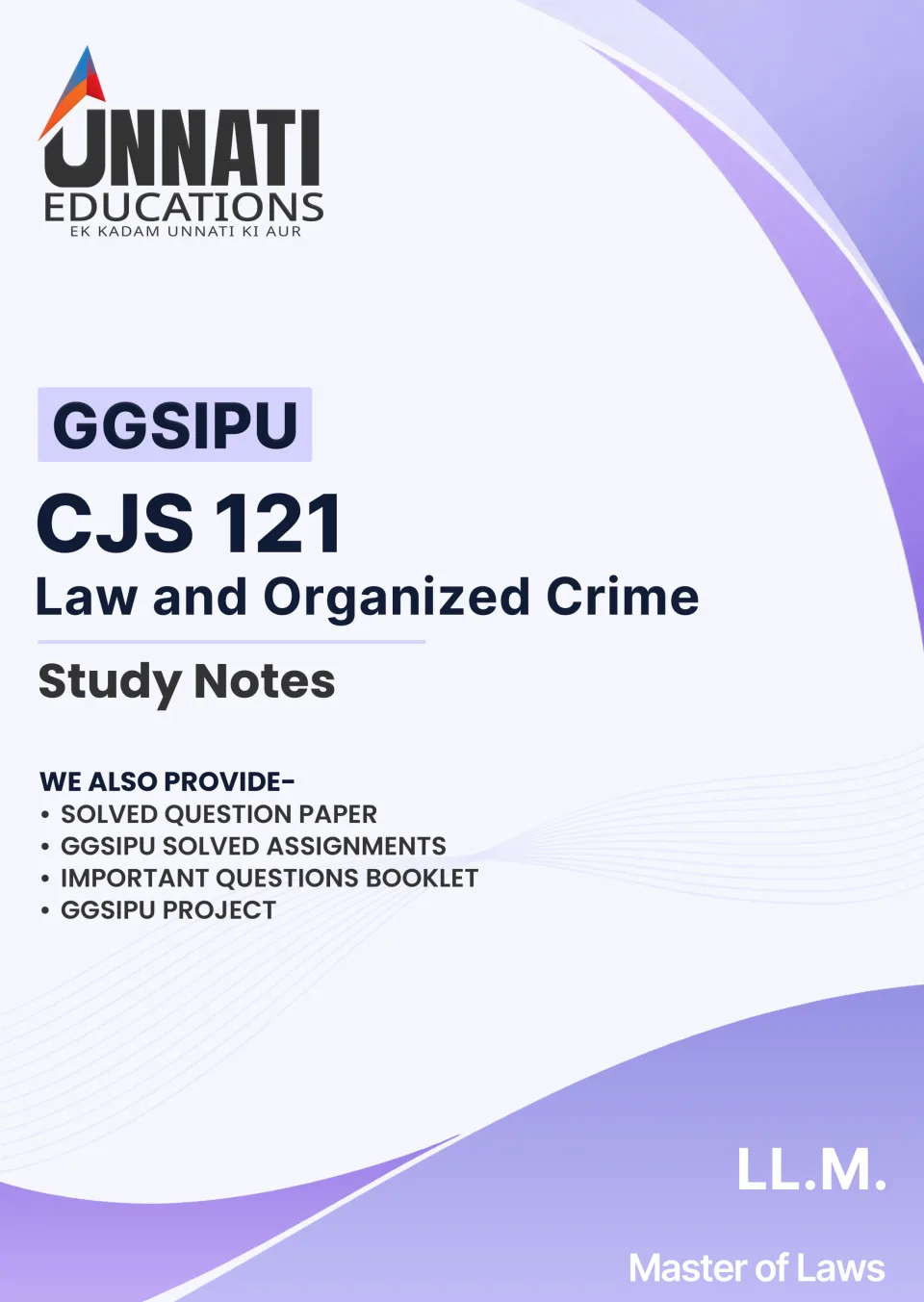
CJS 121 Law and Organized Crime Notes cover all 4 units of the GGSIPU LL.M. (Criminal Justice System) Semester 1 paper in a 39-page printed book: 50 named case laws, 20 long-answer questions, 24 short-note topics and a quick revision table at the end of every unit, mapped to the LL.M. scheme marked w.e.f. 2023 onwards.
Written by Unnati Educations Editorial Team · Reviewed by Sheetal Kirola, Academic Head, M.Ed. (academic review: structure, clarity, syllabus coverage) · Checked against the LL.M. (One Year) scheme and detailed syllabus PDF · Updated 14 October 2026 · Editorial policy
Scheme: LL.M. (One Year), CJS specialisation | Applies to: LL.M. batches from 2022-23 (PDF cover reads w.e.f. 2023 onwards) | Verified against: Master of Law (LL.M.) Regular One Year Programme PDF, ipu.ac.in, 13 October 2026
CJS 121 Law and Organized Crime at a glance: GGSIPU LL.M. Sem 1 credits, units and exam pattern
CJS 121 is Paper V of the LL.M. Criminal Justice System track, with 4 lecture hours and 2 hours of Research and Teaching Development Activities (RTDA) a week. It sits with four other GGSIPU LL.M. Semester 1 papers.
Code and title | CJS 121 Law and Organized Crime (Paper V) |
|---|---|
Programme and semester | LL.M. (One Year), CJS specialisation, Semester I |
Credits and hours | 5 credits: L 4 + RTDA 2 per week |
Marks | 100: 25 internal (written test + RTDA) + 75 end-semester written exam |
End-term question pattern | Not printed in the official PDF |
Units | 4 units, 10 lectures each |
Applies to | Batches from 2022-23 (cover: w.e.f. 2023 onwards) |
Paired lab | None (theory paper) |
Pass, re-appear and result rules sit in GGSIPU Ordinance 11 (examinations).
CJS 121 Law and Organized Crime Notes unit-wise: 50 case laws and 44 exam questions across 4 units
Each unit closes with a quick revision table and exam questions, and every section writes old IPC, CrPC and Evidence Act numbers beside the new BNS, BNSS and BSA ones. Other papers are under GGSIPU LL.M. notes.
CJS 121 Unit 1: Introduction to Organized Crime
Pages 3 to 11. Six definitions side by side (UNTOC Article 2(a), MCOCA Section 2(1)(e), BNS Section 111, the FBI, Cressey, Abadinsky), twelve characteristics, the five UNODC typologies, grouped causes and six theories from Merton to Dwight Smith. 2 case laws; 5 long-answer and 6 short-note questions.
Quick look: three kinds of crime compared (from page 9)
Basis | White-collar | Corporate | Organised |
|---|---|---|---|
Who commits | High-status professional | Company or its officers | Criminal syndicate |
Main aim | Personal gain | Benefit of the company | Money and power for the gang |
Violence | Generally none | No direct violence | Threat and fear are core tools |
Quick look: white-collar, corporate and organised crime (from page 9)
Basis
Who commits
White-collar
High-status professional
Corporate
Company or its officers
Organised
Criminal syndicate
Basis
Main aim
White-collar
Personal gain
Corporate
Benefit of the company
Organised
Money and power for the gang
Basis
Violence
White-collar
Generally none
Corporate
No direct violence
Organised
Threat and fear are core tools
CJS 121 Unit 2: Scope of Organized Crime in India
Pages 12 to 21, the longest unit. The NDPS Act with the 1961, 1971 and 1988 conventions, trafficking under the Palermo Protocol, ITPA and BNS Sections 143 and 144, PMLA, hawala, fake currency and the Vohra Committee. 19 case laws; 5 long-answer and 6 short-note questions.
Quick look: NDPS punishment depends on quantity (from page 13)
Quantity | Punishment |
|---|---|
Small | Up to 1 year RI, or fine up to ₹10,000, or both |
Above small, below commercial | Up to 10 years + fine up to ₹1 lakh |
Commercial | 10 to 20 years + fine of ₹1 to 2 lakh |
Quick look: NDPS Act punishment by quantity seized (from page 13)
Quantity
Small
Punishment
Up to 1 year RI, or fine up to ₹10,000, or both
Quantity
Above small, below commercial
Punishment
Up to 10 years + fine up to ₹1 lakh
Quantity
Commercial
Punishment
10 to 20 years + fine of ₹1 to 2 lakh
CJS 121 Unit 3: Legal Analysis, Investigation & Prosecution of Organized Crime
Pages 22 to 30. How the law reaches the boss who never fires a shot, a modus operandi table, agencies from State police to NIA and I4C, BNSS investigation steps, twin bail conditions, sentencing and an Evidence Act to BSA table. 22 case laws, the most of any unit; 5 long-answer and 6 short-note questions.
Quick look: old IPC to new BNS (from page 28)
Offence | Old IPC | BNS, 2023 |
|---|---|---|
Kidnapping for ransom | Sec. 364A | Sec. 140(2) |
Extortion | Sec. 383 to 389 | Sec. 308 |
Organised crime | No provision | Sec. 111 |
Petty organised crime | No provision | Sec. 112 |
Quick look: organised crime offences moved from IPC to BNS (from page 28)
Offence
Kidnapping for ransom
Old IPC
Sec. 364A
BNS, 2023
Sec. 140(2)
Offence
Extortion
Old IPC
Sec. 383 to 389
BNS, 2023
Sec. 308
Offence
Organised crime
Old IPC
No provision
BNS, 2023
Sec. 111
Offence
Petty organised crime
Old IPC
No provision
BNS, 2023
Sec. 112
CJS 121 Unit 4: Organized Crime, Threat to National Security & Preventive Action
Pages 31 to 39. The crime and terror nexus (UNSC Resolution 2482, Makarenko's continuum), MCOCA section by section, GCTOC, the National Security Act, and AFSPA with the Jeevan Reddy recommendations. 13 case laws; 5 long-answer and 6 short-note questions.
Quick look: MCOCA and GCTOC side by side (from page 34)
Basis | MCOCA | GCTOC |
|---|---|---|
Covers | Organised crime only | Terrorism + organised crime |
Confession to SP | Admissible (Sec. 18) | Admissible |
Status | In force since 1999 | Assent 2019, in force Dec 2019 |
Quick look: MCOCA, 1999 vs GCTOC, 2015 (from page 34)
Basis
Covers
MCOCA
Organised crime only
GCTOC
Terrorism + organised crime
Basis
Confession to SP
MCOCA
Admissible (Sec. 18)
GCTOC
Admissible
Basis
Status
MCOCA
In force since 1999
GCTOC
Assent 2019, in force Dec 2019
Criminal conspiracy under BNS Section 61 in organised crime law: excerpt from page 24 of the CJS 121 notes
Excerpt from page 24
Definition: BNS Section 61(1), old IPC Section 120A
A criminal conspiracy exists when two or more persons agree to do, or cause to be done, either an illegal act, or an act that is not illegal but is done by illegal means. The agreement is the core of the offence; nothing more is needed when the object is itself an offence.
The proviso
If the agreement is to commit an offence, the agreement alone completes the conspiracy. If the object is some other illegal act that is not an offence, the prosecution must also show an overt act: something done by one or more of the parties beyond the bare agreement.
Punishment: BNS Section 61(2), old IPC Section 120B
Where the target offence is punishable with death, life imprisonment or rigorous imprisonment of two years or more, each conspirator is punished as if he had abetted that offence. In all other cases the punishment is up to six months, a fine, or both.
Four ingredients to write in an answer
Two or more persons, since one person cannot conspire with himself.
An agreement between them, express or implied. This is the gist of the offence.
An object that is an illegal act, or a legal act pursued by illegal means.
An overt act, needed only when the object is not itself an offence.
Why it is the main weapon against gangs
Bosses and financiers rarely carry the weapon or the drugs. Conspiracy lets the court punish every person who joined the agreement, even one who took no part in the final act, and it is a continuing offence.
Under BSA Section 8 (old Evidence Act Section 10), what one conspirator says or does about the common design is relevant against all the others, which is often the only way to connect a carrier on the street to the person who planned the job.
The page ends by pointing to Kehar Singh v. State (Delhi Admn.) (1988), where the Supreme Court accepted that conspiracy is usually proved through circumstantial evidence, because direct proof of a secret agreement is rarely available.
Do the CJS 121 notes cover the full GGSIPU syllabus?
Yes. Every topic listed under the four CJS 121 units in the official LL.M. syllabus has its own section in the notes; we found no gap.
Official unit | Official topics | Where in the notes | Status |
|---|---|---|---|
I: Introduction to Organized Crime | Definition, types, causes; white-collar vs corporate vs organized crime | Sections 01 to 04, pages 4 to 10 | Covered |
II: Scope of Organized Crime in India | Drugs; trafficking of women and children; economic crime, hawala, counterfeiting; nexus with politics | Sections 01 to 04, pages 13 to 20 | Covered |
III: Legal Analysis, Investigation & Prosecution | Mens rea, conspiracy; police; judiciary and sentencing; IPC and Evidence Act issues | Sections 01 to 04, pages 23 to 29 | Covered |
IV: Threat to National Security & Preventive Action | Terrorism link, MCOCA, Gujarat bill 2015; NSA 1980; AFSPA 1958 | Sections 01 to 03, pages 32 to 37 | Covered |
CJS 121 official syllabus mapped to the notes
Official unit
I: Introduction to Organized Crime
Official topics
Definition, types, causes; white-collar vs corporate vs organized crime
Where in the notes
Sections 01 to 04, pages 4 to 10
Status
Covered
Official unit
II: Scope of Organized Crime in India
Official topics
Drugs; trafficking of women and children; economic crime, hawala, counterfeiting; nexus with politics
Where in the notes
Sections 01 to 04, pages 13 to 20
Status
Covered
Official unit
III: Legal Analysis, Investigation & Prosecution
Official topics
Mens rea, conspiracy; police; judiciary and sentencing; IPC and Evidence Act issues
Where in the notes
Sections 01 to 04, pages 23 to 29
Status
Covered
Official unit
IV: Threat to National Security & Preventive Action
Official topics
Terrorism link, MCOCA, Gujarat bill 2015; NSA 1980; AFSPA 1958
Where in the notes
Sections 01 to 03, pages 32 to 37
Status
Covered
Check each line yourself in the official LL.M. (One Year) syllabus PDF, w.e.f. 2022-23.
The syllabus still calls the Gujarat law a 2015 Bill; the notes record its 2019 assent. Every course in GGSIPU notes is mapped to its official PDF in the same way.
How to write CJS 121 answers: statute-first definitions, old and new section numbers, and case-backed conclusions
1. Open with the statutory definition. For "define organised crime", the notes quote UNTOC Article 2(a), MCOCA Section 2(1)(e) and BNS Section 111 together, then one scholar such as Cressey.
2. Write both section numbers. Write "criminal conspiracy, BNS Section 61 (old IPC 120A/120B)". The Unit 3 tables give the pairs, such as police confessions under BSA Section 23 (old Sections 25 and 26).
3. Back each claim with one case and close with a line of judgment. Drug answers tie the NDPS Act to the 1961, 1971 and 1988 conventions; AFSPA answers cite Naga People's Movement (1998).
Worked example (Unit 3, "legal issues" question). Five points, one paragraph each: no IPC definition, now BNS Sections 111 and 112; the police-confession bar and MCOCA Section 18; BSA Section 8 on conspirators' statements; electronic records under BSA Section 63 with Anvar P.V. (2014); and hostile witnesses with the 2018 Witness Protection Scheme.
Practise this format across papers on GGSIPU LL.M. important questions.
CJS 121 exam corner: 20 long-answer questions and 24 short notes by unit
Unit | Long-answer questions | Short-note topics | Case laws named |
|---|---|---|---|
1: Introduction | 5 | 6 | 2 |
2: Scope in India | 5 | 6 | 19 |
3: Investigation and prosecution | 5 | 6 | 22 |
4: National security | 5 | 6 | 13 |
CJS 121 exam questions and revision aids in the notes, by unit
Unit
1: Introduction
Long-answer questions
5
Short-note topics
6
Case laws named
2
Unit
2: Scope in India
Long-answer questions
5
Short-note topics
6
Case laws named
19
Unit
3: Investigation and prosecution
Long-answer questions
5
Short-note topics
6
Case laws named
22
Unit
4: National security
Long-answer questions
5
Short-note topics
6
Case laws named
13
Sample questions with answer pointers:
Unit 1: "Distinguish between white-collar crime, corporate crime and organized crime with suitable examples." Pointer: the nine-row table on pages 9 and 10 and the Iridium (2011) case.
Unit 2: "Define money laundering. Explain its stages and the main provisions of PMLA, 2002." Pointer: the three stages, PMLA Sections 3, 4 and 45, and Vijay Madanlal Choudhary (2022).
Unit 3: "What were the shortcomings of the IPC in dealing with organized crime? How has the BNS, 2023 addressed them?" Pointer: the act-centric gap, state laws, then BNS Sections 111 and 112.
Unit 4: "AFSPA is a necessary evil. Critically analyse." Pointer: Sections 3, 4 and 6, the 1998 safeguards and EEVFAM (2016).
The CJS 121 notes list 20 long-answer questions and 24 short-note topics across 4 units, plus 50 named case laws. These are exam-style questions without year tags. More practice sits in the CJS 121 important questions.
Who writes and checks the CJS 121 Organized Crime notes?
Unnati Educations Editorial Team, author. Written from the official syllabus, bare acts and the cases cited; credited to the team, not one named advocate.
Sheetal Kirola, reviewer. Academic Head, Unnati Educations; M.Ed.; 7 years of experience. Her academic review checks structure, clarity and syllabus coverage; it is not a legal opinion. Profile
The 2026-27 edition adds BNS, BNSS and BSA numbers beside the old ones, records GCTOC as an Act, and tracks AFSPA reductions since 2022. Last updated 14 October 2026. See our editorial policy.
The same team prepares GGSIPU important questions for every course.
CJS 121 and the GGSIPU LL.M. Sem 1 papers it connects to
CJS 121 has no lab; see the full GGSIPU LL.M. syllabus.
Its Semester I companions are GEN 101 Research Methods and Legal Writing, GEN 103 System of Governance, GEN 105 Law and Justice in a Globalised World and CJS 119 Crime and Administration of Criminal Justice in India. CJS 119 Unit II (FIR, arrest, bail) feeds CJS 121 Unit 3, and its preventive detention topic sets up the NSA section of Unit 4.
In Semester II, CJS 122 Privileged Class Deviance picks up the white-collar comparison, CJS 124 Crime and Investigation in ICT Era extends the cyber points, and CJS 126 Unit IV returns to transnational organised crime.
CJS 121 Organized Crime notes FAQs
How do I get the full CJS 121 notes?
Message us on WhatsApp at 9899436384 with the code CJS 121 and we will confirm your order. The full notes come only as a printed book, not as a PDF. Delivery takes 5 to 7 days at most, and the exact time depends on your location. You can check the watermarked sample pages first through the View Sample PDF button at the top of this page before you order.
Can I get the CJS 121 notes as a PDF?
No. The complete CJS 121 notes are sold only as a printed book of 39 pages covering all four units. The View Sample PDF button opens a short watermarked preview with the cover, the index and one page from each unit, so you can judge the writing style and depth. It is a preview only and is not for resale or circulation.
What is the passing mark for CJS 121?
CJS 121 is marked out of 100: 25 internal marks for a written test and RTDA work, and 75 for the end-semester written exam. The LL.M. scheme PDF does not print a pass percentage for the paper, so we do not quote one here. Minimum marks, re-appear and result rules come from GGSIPU Ordinance 11 on ipu.ac.in; check the current version there or with your school.
Do the CJS 121 notes follow the IPC or the new BNS?
Both. The CJS 121 syllabus still names the IPC and the Indian Evidence Act, but since 1 July 2024 the BNS, BNSS and BSA have replaced them. The notes write each section in both forms, for example criminal conspiracy as BNS Section 61 with old IPC Sections 120A and 120B, so your answer reads correctly whichever version the examiner expects.
Which CJS 121 unit has the most case law?
Unit 3 on investigation and prosecution, with 22 named cases, closely followed by Unit 2 with 19. Unit 3 gathers the conspiracy cases, the bail cases under twin conditions, the validity of TADA and MCOCA, and the evidence cases on electronic records and circumstantial proof. Across the CJS 121 book there are 50 distinct cases.
Is CJS 121 a Semester 1 or Semester 2 paper in the GGSIPU LL.M.?
Semester 1. The official LL.M. (One Year) scheme lists CJS 121 Law and Organized Crime as Paper V of the Criminal Justice System track in Semester I, with CJS 119 and the three common GEN papers. CJS 120 Penology, which students often confuse with it because of the close code, is a Semester II paper.
Get the full CJS 121 Law and Organized Crime Notes on WhatsApp
Unit | Pages in the book |
|---|---|
Cover and index | 1 to 2 |
1: Introduction to Organized Crime | 3 to 11 (9 pages) |
2: Scope in India | 12 to 21 (10 pages) |
3: Investigation and prosecution | 22 to 30 (9 pages) |
4: National security | 31 to 39 (9 pages) |
CJS 121 printed notes book: pages per unit
Unit
Cover and index
Pages in the book
1 to 2
Unit
1: Introduction to Organized Crime
Pages in the book
3 to 11 (9 pages)
Unit
2: Scope in India
Pages in the book
12 to 21 (10 pages)
Unit
3: Investigation and prosecution
Pages in the book
22 to 30 (9 pages)
Unit
4: National security
Pages in the book
31 to 39 (9 pages)
These Law and Organized Crime notes in English come only as a printed book; there is no PDF. Delivery takes 5 to 7 days at most; the rest depends on your location. Whether you searched for CJS 121 Law and Organized Crime IPU notes or GGSIPU LL.M. Sem 1 Law and Organized Crime notes, order with the button below.
Order the printed CJS 121 notes book on WhatsApp (4 units, 39 pages)
Unnati Educations is an independent education provider based in Vikaspuri, Delhi. We are not affiliated with, authorised by, or endorsed by Guru Gobind Singh Indraprastha University (GGSIPU). 'GGSIPU' and 'IPU' are used only to describe the syllabus our notes follow. For official information, visit ipu.ac.in.
Ready for the full notes?
Discuss coverage and delivery with our team.