
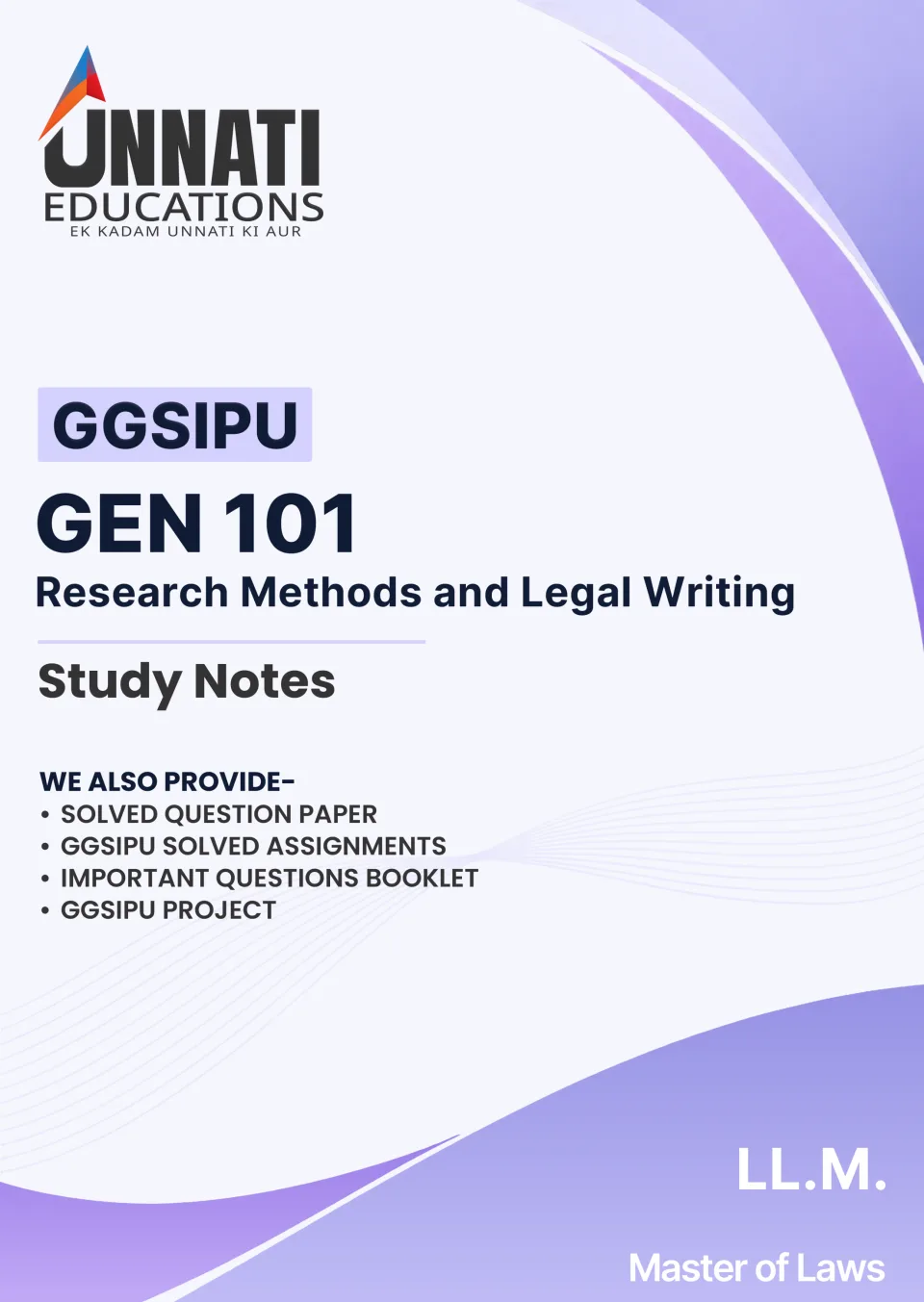
GEN 101 Research Methods and Legal Writing Notes are 52-page English notes for GGSIPU LL.M. (One Year), Semester I, the paper shared by all five specialisations. They cover all 4 units in 18 topics, with 24 solved short answers, 28 long-answer exam questions, 12 exam tips and a revision table per unit, mapped to the scheme applying from session 2022-23.
Written by Unnati Educations Editorial Team · Reviewed by Sheetal Kirola, Academic Head, M.Ed., research methodology review · Checked against the LL.M. (One Year) scheme and syllabus PDF (w.e.f 2022-23) · Updated 14 October 2026 · Editorial policy
Scheme: LL.M. (One Year) scheme and detailed syllabus | Applies to: LL.M. batches from academic session 2022-23 | Verified against: Master of Law (LL.M.) Regular One Year Programme w.e.f 2022-23 PDF, ipu.ac.in
GEN 101 Research Methods and Legal Writing at a glance: GGSIPU LL.M. Sem 1 credits, units and exam pattern
GEN 101 (GEN-101 on the syllabus page) is Paper I of the one-year LL.M., with Verma and Wani (ILI) and Goode and Hatt as text books. It sits with four other GGSIPU LL.M. Semester 1 papers.
Course and semester | LL.M. (One Year), Semester I, Paper I, common to all five specialisations |
|---|---|
Credits | 5: 4 lecture + 2 RTDA (Research and Teaching Development Activities) hours a week |
Marks | 100: 25 internal (written test and RTDA) + 75 end-term written exam |
Applies to | Batches from session 2022-23 (the cover reads "w.e.f 2023 onwards") |
End-term pattern | Paper-setter instructions not printed; 4 units, 10 lectures each |
Pass rules | Not printed in the LL.M. PDF; see Ordinance 11 on examinations |
Paired lab | None; GEN 110 Dissertation (10 credits, NUES) follows in Semester II |
GEN 101 Research Methods and Legal Writing Notes unit-wise: 18 topics and 24 solved short answers across 4 units
Each unit ends with a revision table and exam questions. Other papers' notes are under GGSIPU LL.M. notes; the sample PDF in the header shows one page per unit.
GEN 101 Unit 1: Precepts
Unit 1 separates research method from methodology, sets out seven features and nine objectives of legal research, explains six methods and ends with an 11-point doctrinal versus non-doctrinal table and the Brandeis Brief.
Pages 3 to 14 · nature and scope (p4) · methods (p6) · collaborative research (p8) · doctrinal and non-doctrinal (p10) · 6 solved, 7 long questions.
Form | Example in the notes |
|---|---|
Inter-disciplinary | Lawyers and doctors studying medical negligence |
Inter-institutional | A national law university and ILI joint project |
Academia and government | Law Commission consulting academics |
Quick look: forms of collaborative research (from page 9)
Form
Inter-disciplinary
Example in the notes
Lawyers and doctors studying medical negligence
Form
Inter-institutional
Example in the notes
A national law university and ILI joint project
Form
Academia and government
Example in the notes
Law Commission consulting academics
GEN 101 Unit 2: Research Designs
Unit 2 turns a vague topic into a synopsis: Kothari's five components of a problem, seven formulation steps, seven hypothesis types with Type I and II errors, a 15-part synopsis, and ten online databases.
Pages 15 to 26 · research problem (p16) · hypothesis (p18) · research design (p20) · databases (p22) · 6 solved, 7 long questions.
Characteristic | Meaning |
|---|---|
Reliability | Repeating the study gives similar results |
Validity | It measures what it claims to measure |
Ethical soundness | Consent, confidentiality and honesty built in |
Quick look: marks of a good research design (from page 21)
Characteristic
Reliability
Meaning
Repeating the study gives similar results
Characteristic
Validity
Meaning
It measures what it claims to measure
Characteristic
Ethical soundness
Meaning
Consent, confidentiality and honesty built in
GEN 101 Unit 3: Research Techniques
Unit 3, the longest unit, is the field-work toolkit: primary and secondary data (NCRB), a seven-step method for case material, Shodhganga, and historical and comparative sources. Census, survey, sampling (see the excerpt), observation and interview follow.
Pages 27 to 40 · data collection (p28) · census and survey (p30) · sampling (p32) · observation (p34) · interview and questionnaire (p35) · 6 solved, 7 long questions.
Basis | Questionnaire | Schedule |
|---|---|---|
Mode | Post, hand or online | Face-to-face |
Literacy needed | Yes | No |
Response rate | Low | High |
Quick look: questionnaire against schedule (from page 38)
Basis
Mode
Questionnaire
Post, hand or online
Schedule
Face-to-face
Basis
Literacy needed
Questionnaire
Yes
Schedule
No
Basis
Response rate
Questionnaire
Low
Schedule
High
GEN 101 Unit 4: Data Processing Report Writing
Unit 4 (also covered as "Data Processing and Report Writing") runs from editing, coding and tabulation to six types of analysis, then the report layout, OSCOLA citation, supervision, sixteen guidelines and research ethics.
Pages 41 to 52 · data analysis (p42) · report writing (p44) · supervision (p46) · guidelines (p48) · ethics (p49) · 6 solved, 7 long questions.
Similarity | Consequence for students |
|---|---|
Up to 10% | No penalty |
Above 10% to 40% | Revised script within up to 6 months |
Above 60% | Registration cancelled |
Quick look: UGC 2018 plagiarism levels (from page 50)
Similarity
Up to 10%
Consequence for students
No penalty
Similarity
Above 10% to 40%
Consequence for students
Revised script within up to 6 months
Similarity
Above 60%
Consequence for students
Registration cancelled
Sampling in legal research: excerpt from page 32 of the GEN 101 notes
Excerpt from page 32
Meaning of sampling
Sampling is the process of selecting a small, representative part (the sample) from the whole population (the universe), so that conclusions about the whole can be drawn by studying the part. We do not eat the whole pot of rice to check whether it is cooked; a few grains are enough. That is the idea of sampling.
Key terms
The universe or population is every unit under study, for example all undertrial prisoners in Tihar. The sample is the selected part, say 200 undertrials. The sampling frame is the list the sample is drawn from, such as the jail register. The sampling unit is each single item, one prisoner. Sample size is the number of units in the sample.
Characteristics of a good sample
A good sample is representative (it reflects the features of the universe), adequate in size (neither too small nor needlessly large), independent (choosing one unit does not affect another), homogeneous (units are comparable), free from bias (every unit has a fair chance) and practical (it can be studied within the time and budget).
Probability (random) sampling
In simple random sampling every unit has an equal chance, through the lottery method or random number tables; for example, 50 advocates picked by lottery from the Bar Association list. Systematic sampling takes every k-th unit after a random start, where k is the population divided by the sample size: every 10th file from a court register of 1,000 cases gives 100.
Stratified sampling divides the population into strata such as gender, age or type of crime, and picks randomly from each, for example convicts and undertrials separately. Cluster sampling randomly selects whole clusters, such as 5 police stations, and studies every FIR in them. Multi-stage sampling works in stages (State, districts, villages, households) and is used in large surveys like NFHS.
Do the GEN 101 notes cover the full GGSIPU syllabus?
Yes. Every topic under the four GEN 101 units has its own section, and CO2's legal referencing sits in Unit 4.
Official unit | Official topics | Where in the notes | Status |
|---|---|---|---|
I: Precepts | Nature, scope and objectives of legal research and methodology; methods; collaborative research; doctrinal and non-doctrinal | Sections 01 to 04, p4 to 12 | Covered |
II: Research Designs | Research problem; hypothesis and research design; database: legislations, judicial decisions, juristic writings, traditional and online | Sections 01 to 04, p16 to 25 | Covered |
III: Research Techniques | Tools and techniques for collection of data; census and survey; sampling; observation; interview, questionnaire | Sections 01 to 05, p28 to 38 | Covered |
IV: Data Processing Report Writing | Data analysis and interpretation; report writing; supervision; guidelines for researchers; research ethics | Sections 01 to 05, p42 to 50 | Covered |
GEN 101 official units and topics mapped to the notes
Official unit
I: Precepts
Official topics
Nature, scope and objectives of legal research and methodology; methods; collaborative research; doctrinal and non-doctrinal
Where in the notes
Sections 01 to 04, p4 to 12
Status
Covered
Official unit
II: Research Designs
Official topics
Research problem; hypothesis and research design; database: legislations, judicial decisions, juristic writings, traditional and online
Where in the notes
Sections 01 to 04, p16 to 25
Status
Covered
Official unit
III: Research Techniques
Official topics
Tools and techniques for collection of data; census and survey; sampling; observation; interview, questionnaire
Where in the notes
Sections 01 to 05, p28 to 38
Status
Covered
Official unit
IV: Data Processing Report Writing
Official topics
Data analysis and interpretation; report writing; supervision; guidelines for researchers; research ethics
Where in the notes
Sections 01 to 05, p42 to 50
Status
Covered
Official source: LL.M. (One Year) scheme and syllabus, w.e.f 2022-23.
Every course in GGSIPU notes is mapped to its official PDF the same way.
How to write GEN 101 answers: definition-led theory answers, comparison tables and correct legal citations
GEN 101 rewards structure and precision more than length. Almost every topic in the notes ends with an exam tip that fixes the order of a long answer, and the solved short answers show what a two-to-five-mark answer needs: a definition, one contrast and one legal example, in four or five lines. Long answers should open with the meaning, then move through features, types or steps in a table or numbered list, and close with a short conclusion that links the topic back to legal research in India.
Three habits make a research methods answer read like a law answer. Quote a named definition: Kothari for research problem, Lundberg for hypothesis, Kerlinger for research design. Draw the comparison table: doctrinal against non-doctrinal needs at least 8 points and ends with the line that the two are complementary. Cite correctly, such as AIR 1978 SC 597 for Maneka Gandhi; the database answer asks for at least three citations.
Worked example (ten-to-fifteen-mark question): "Explain the meaning, nature and scope of legal research. What are its objectives?" The plan on page 6 runs: meaning of research, meaning of legal research, method against methodology, five or six features of its nature, scope with examples, objectives, conclusion. Put Kothari's definition near the top and one Indian example, such as a Law Commission report, under scope.
The common-mistakes table on pages 48 and 49 lists what loses marks in the exam and the dissertation: description with no analysis, a conclusion not tied to findings, citing repealed law (IPC where the BNS now applies) and mixing citation styles. The fix is the same every single time: read the full judgment, link every conclusion to a finding, and use one citation style from the first footnote to the bibliography. Practise this format on GGSIPU LL.M. important questions.
GEN 101 exam corner: 24 solved two-to-five-mark answers and 28 ten-to-fifteen-mark practice questions by unit
Unit | Solved short answers (2-5 Marks) | Long-answer questions (10-15 Marks) |
|---|---|---|
I | 6 | 7 |
II | 6 | 7 |
III | 6 | 7 |
IV | 6 | 7 |
GEN 101 exam questions in the notes, by unit
Unit
I
Solved short answers (2-5 Marks)
6
Long-answer questions (10-15 Marks)
7
Unit
II
Solved short answers (2-5 Marks)
6
Long-answer questions (10-15 Marks)
7
Unit
III
Solved short answers (2-5 Marks)
6
Long-answer questions (10-15 Marks)
7
Unit
IV
Solved short answers (2-5 Marks)
6
Long-answer questions (10-15 Marks)
7
The GEN 101 notes solve 24 short-answer questions (2-5 Marks) and set 28 long-answer questions (10-15 Marks) across 4 units. Long-answer questions are for practice. Four with pointers:
Unit I: What is "law in books" and "law in action"? Written law (doctrinal) against law at work in society (non-doctrinal); the gap is the implementation gap (p13).
Unit II: Distinguish null and alternative hypothesis. H₀ states no relationship or difference; H₁ states one exists; research usually tries to reject H₀ (p26).
Unit III: Distinguish participant and non-participant observation. Inside the group against outside it: depth with bias risk, against objectivity (p39).
Unit IV: Explain "ibid." and "supra". Ibid. repeats the immediately preceding footnote; supra points to a source cited earlier (p51).
More practice sits in the GEN 101 important questions.
Who writes and checks the GEN 101 research methods notes?
Unnati Educations Editorial Team: writes the notes from the syllabus and its text books; credited to the team, not a named lawyer.
Sheetal Kirola: Academic Head, M.Ed., 7 years of experience; research methodology review (structure, clarity, syllabus coverage). Profile
The 2026-27 edition follows the scheme applying from session 2022-23 and uses the BNS, BNSS and BSA and the UGC 2018 and 2022 regulations. Last updated 14 October 2026; corrections follow the editorial policy.
The same team prepares GGSIPU important questions for each course it covers.
GEN 101 and the GGSIPU LL.M. Sem 1 papers it connects to
GEN 101 has no lab paper; the paper list for each specialisation is on the GGSIPU LL.M. syllabus page.
GEN 110 Dissertation (Semester II, 10 credits, NUES): judged on research writing, methodology, hypothesis, literature review and research questions, which is GEN 101 Units 2 and 4 applied to one topic.
GEN 103 System of Governance and GEN 105 Law and Justice in a Globalised World: the other common papers, which use the case-reading steps of Unit 3.
Specialisation papers: CRL 111, CRL 113, IPR 107, IPR 109, ADR 115, ADR 117, CJS 119, CJS 121, GJWE 111 and GJWE 113. CJS and GJWE field studies lean on Unit 3 sampling and Unit 4 consent rules.
GEN 101 research methods notes FAQs
How do I get the full GEN 101 notes?
Message us on WhatsApp at 9899436384 with the code GEN 101, using the button on this page. The full GEN 101 notes come as a printed book; they are not sold as a PDF. Once your order is confirmed on WhatsApp, the book is dispatched to your address, and delivery takes up to 5 to 7 days depending on your location.
Is GEN 101 the same paper for every LL.M. specialisation?
Yes. In the LL.M. (One Year) scheme, GEN 101 Research Methods and Legal Writing is Paper I in Semester I for all five specialisations: Corporate Law, IPR, ADR, CJS and GJWE. The units, credits and marks are identical, so one book serves every LL.M. student. GEN 103 and GEN 105 are the other two common papers.
What is the passing mark for GEN 101?
GEN 101 is marked out of 100: 25 internal marks from the subject teacher, covering a written test and RTDA work, and 75 marks in the end-term written exam. The LL.M. scheme PDF does not print a pass percentage; it only says a student must secure all 55 credits for the degree. For end-term minimums and re-appear rules, check Ordinance 11 on ipu.ac.in.
Do the GEN 101 notes teach legal citation and referencing?
Yes. CO2 of GEN 101 asks for correct methods of legal referencing, and Unit 4, section 2.6 covers it. The notes compare OSCOLA, the Bluebook, the ILI style and APA or MLA, give example citations for a case, statute, book, journal article, Law Commission report and website, and explain ibid., id., supra, infra, op. cit. and et al.
How do the GEN 101 notes help with the GEN 110 dissertation?
GEN 110 in Semester II is assessed on research writing, methodology, hypothesis, literature review and research questions. GEN 101 Unit 2 gives the 15-part synopsis, a worked problem statement and seven hypothesis types. Unit 4 gives the three-part report layout, citation rules, the supervisor's role at each stage, sixteen researcher guidelines and the UGC similarity levels for dissertations.
Do the GEN 101 notes use the new criminal laws in their examples?
Yes. Where GEN 101 examples touch criminal law, the notes use the Bharatiya Nyaya Sanhita, 2023, the BNSS and the BSA, which replaced the IPC, CrPC and Evidence Act from 1 July 2024. Examples include Section 528 BNSS alongside Section 482 CrPC for case searches, and Section 72 BNS (earlier Section 228A IPC) on not disclosing a victim's identity.
Get the full GEN 101 Research Methods and Legal Writing Notes on WhatsApp
The full GEN 101 Research Methods and Legal Writing Notes run to 52 pages: a cover, an index and four units. If you came looking for GEN 101 Research Methods and Legal Writing IPU notes, this is the whole paper in one book.
Unit | Pages |
|---|---|
I | 3 to 14 (12) |
II | 15 to 26 (12) |
III | 27 to 40 (14) |
IV | 41 to 52 (12) |
GEN 101 notes: pages per unit
Unit
I
Pages
3 to 14 (12)
Unit
II
Pages
15 to 26 (12)
Unit
III
Pages
27 to 40 (14)
Unit
IV
Pages
41 to 52 (12)
These GGSIPU LL.M. Sem 1 Research Methods and Legal Writing notes are sold as a printed book only, not as a PDF. Delivery takes 5 to 7 days at most, depending on location. The Research Methods and Legal Writing notes in English use plain language and tables.
Order the full GEN 101 notes book on WhatsApp (4 units, 52 pages)
Unnati Educations is an independent education provider based in Vikaspuri, Delhi. We are not affiliated with, authorised by, or endorsed by Guru Gobind Singh Indraprastha University (GGSIPU). 'GGSIPU' and 'IPU' are used only to describe the syllabus our notes follow. For official information, visit ipu.ac.in.
Ready for the full notes?
Discuss coverage and delivery with our team.