
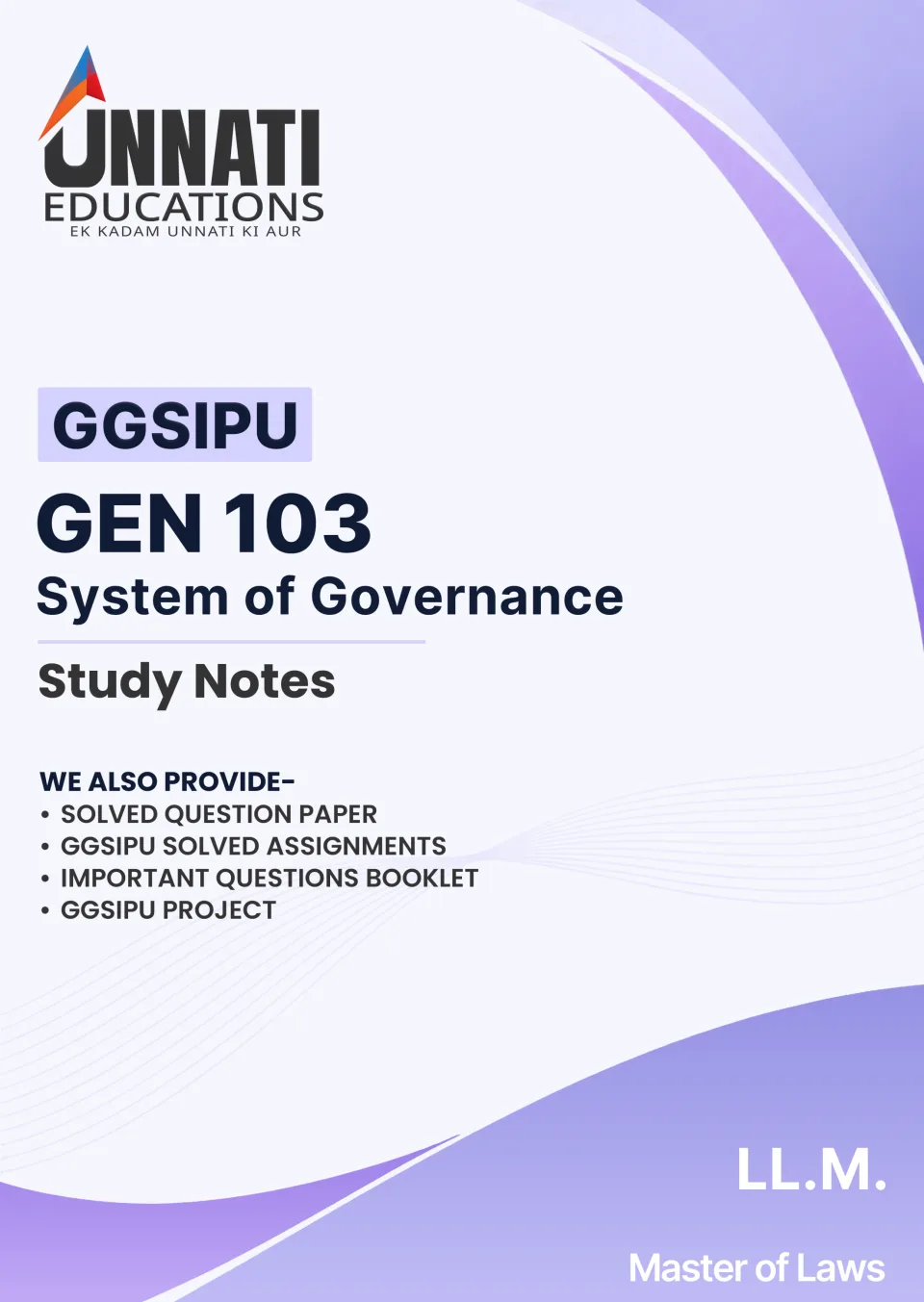
GEN 103 System of Governance Notes cover all 4 units of the GGSIPU LL.M. (One Year) Semester 1 paper in 59 pages, with 43 figures and tables, unit revision tables and 81 exam questions. They follow the LL.M. scheme printed as w.e.f. 2023 onwards, in which GEN 103 is common to all five specialisations.
Written by Unnati Educations Editorial Team · Reviewed by Sheetal Kirola, M.Ed., Academic Head (academic review) · Checked against the LL.M. (One Year) syllabus PDF on ipu.ac.in, 13 October 2026 · Updated 14 October 2026 · Editorial policy
Scheme: LL.M. (One Year), w.e.f. 2023 onwards | Applies to: all five specialisations | Verified against: Master of Law (LL.M.) Regular One year Programme PDF
GEN 103 System of Governance at a glance: GGSIPU LL.M. Sem 1 credits, units and exam pattern
GEN 103 is Paper II of LL.M. (One Year) Semester I, common to all five specialisations. It sits with GEN 101, GEN 105 and two specialisation papers in GGSIPU LL.M. Semester 1 papers.
Item | GEN 103 details |
|---|---|
Code and title | GEN-103 System of Governance |
Course and semester | LL.M. (One Year), Semester I, Paper II |
Credits | 5 credits: L 4 and RTDA 2 (Research and Teaching Development Activities) |
Marks | 100: 25 internal (written test + RTDA) + 75 end-term written exam |
Units | 4 units, 10 lectures each |
Paired lab | None (no practical paper) |
Official source |
GEN 103 snapshot from the official LL.M. (One Year) scheme
Item
Code and title
GEN 103 details
GEN-103 System of Governance
Item
Course and semester
GEN 103 details
LL.M. (One Year), Semester I, Paper II
Item
Credits
GEN 103 details
5 credits: L 4 and RTDA 2 (Research and Teaching Development Activities)
Item
Marks
GEN 103 details
100: 25 internal (written test + RTDA) + 75 end-term written exam
Item
Units
GEN 103 details
4 units, 10 lectures each
Item
Paired lab
GEN 103 details
None (no practical paper)
Item
Official source
GEN 103 details
The PDF prints no GEN 103 paper-setter instructions, so the 75-mark pattern is unstated. For pass rules, see Ordinance 11.
GEN 103 System of Governance Notes unit-wise: 43 figures and 81 exam questions across 4 units
The notes run 59 pages: cover, contents and four units of 14 to 15 pages, each ending with a quick revision table and exam questions. The System of Governance notes in English put comparisons into tables. Other LL.M. papers: GGSIPU LL.M. notes.
GEN 103 Unit 1: Introduction
Pages 3 to 17: definitions of governance, government vs governance, good governance, systems from Aristotle to presidential, then democracy, Dicey's rule of law, separation of powers and law in India.
Basis | Parliamentary | Presidential |
|---|---|---|
Executive | Dual: nominal head + real head (PM) | Single: President is the real head |
Tenure | Not fixed; depends on majority | Fixed term |
Removal | No-confidence motion | Only by impeachment |
Quick look: parliamentary vs presidential system (from page 8)
Basis
Executive
Parliamentary
Dual: nominal head + real head (PM)
Presidential
Single: President is the real head
Basis
Tenure
Parliamentary
Not fixed; depends on majority
Presidential
Fixed term
Basis
Removal
Parliamentary
No-confidence motion
Presidential
Only by impeachment
GEN 103 Unit 2: Federalism as a Pattern of Governance
Pages 18 to 31. Holding-together vs coming-together federations, layer-cake vs marble-cake federalism, the USA, Canada and India compared, then Union-State legislative, administrative and financial relations, the GST Council and Sarkaria and Punchhi reports.
Basis | USA | Canada | India |
|---|---|---|---|
Residuary powers | States (10th Amendment) | Federal (POGG clause) | Union (Art. 248) |
Citizenship | Dual | Single | Single |
Change of boundaries | Needs State consent | Needs provincial consent | Parliament alone (Art. 3) |
Quick look: USA, Canada and India compared (from page 23)
Basis
Residuary powers
USA
States (10th Amendment)
Canada
Federal (POGG clause)
India
Union (Art. 248)
Basis
Citizenship
USA
Dual
Canada
Single
India
Single
Basis
Change of boundaries
USA
Needs State consent
Canada
Needs provincial consent
India
Parliament alone (Art. 3)
GEN 103 Unit 3: Judicial Process and its Role in Governance
Pages 32 to 45. About 40 rulings: Marbury v. Madison beside the Indian model, judicial accountability, Nolan principles, Sita Soren (2024), PIL-led governance in rights, environment and health, and the Law Commission.
Case | Reform |
|---|---|
Hussainara Khatoon v. State of Bihar (1979) | Speedy trial is part of Art. 21; release of undertrials |
D.K. Basu v. State of W.B. (1997) | 11 guidelines on arrest and detention |
Prakash Singh v. UOI (2006) | 7 directives for police reform |
Quick look: three criminal justice rulings (from page 40)
Case
Hussainara Khatoon v. State of Bihar (1979)
Reform
Speedy trial is part of Art. 21; release of undertrials
Case
D.K. Basu v. State of W.B. (1997)
Reform
11 guidelines on arrest and detention
Case
Prakash Singh v. UOI (2006)
Reform
7 directives for police reform
GEN 103 Unit 4: Emerging Trends and Challenges to Governance
Pages 46 to 59. Corruption, criminalisation (Vohra Committee, Lily Thomas), caste, poverty and terrorism, State liability from Kasturi Lal to Nilabati Behera, PPP models, reservation, minority rights under Art. 29 and 30, and the media.
Quick look: how reservation law developed through five rulings (from pages 53 to 54)
Champakam Dorairajan (1951): led to Art. 15(4) via the 1st Amendment.
M.R. Balaji (1963): reservation should generally not exceed 50%.
Indra Sawhney (1992): 27% OBC quota upheld, creamy layer excluded, 50% ceiling.
State of Punjab v. Davinder Singh (2024): sub-classification of SCs and STs allowed (6:1).
Judicial review in Indian constitutional governance: excerpt from page 34 of the GEN 103 notes
Excerpt from page 34
Unlike the USA, the Indian Constitution expressly provides for judicial review through several Articles. Indian courts follow the 'procedure established by law' in Art. 21, a phrase taken from Japan, which at first allowed a narrower review than the American 'due process'. After Maneka Gandhi (1978), the procedure must also be fair, just and reasonable, which brings India close to substantive due process. This is why the notes call judicial review in India a constitutional mandate rather than a judicial creation.
Where the power comes from
Art. 13: laws inconsistent with or in derogation of Fundamental Rights are void.
Art. 32: the right to move the Supreme Court to enforce Fundamental Rights, which Ambedkar called the 'heart and soul' of the Constitution.
Art. 226: High Courts can issue writs for Fundamental Rights and 'any other purpose'.
Art. 131: original jurisdiction of the Supreme Court in Centre-State and inter-State disputes.
Art. 143: advisory jurisdiction on a reference from the President.
Art. 246, 251 and 254: courts decide legislative competence and repugnancy.
Grounds of judicial review in India
Lack of legislative competence: the law falls outside the list of the legislature that made it.
Violation of Fundamental Rights in Part III.
Violation of other constitutional provisions, for example freedom of trade under Art. 301.
Violation of the basic structure, which applies to constitutional amendments after Kesavananda Bharati (1973).
For executive action: illegality, irrationality and procedural impropriety (the GCHQ case, UK, 1985), plus proportionality.
How the cases shaped it
The power grew through a chain of rulings. A.K. Gopalan (1950) read Art. 21 narrowly. Shankari Prasad (1951) let Parliament amend Fundamental Rights, and Golaknath (1967) took that power away. Kesavananda Bharati (1973) settled the question: Parliament may amend any part of the Constitution but not its basic structure. Indira Gandhi v. Raj Narain (1975) then placed free and fair elections and judicial review inside that basic structure.
GEN 103 exam corner: 25 long-answer, 31 short-answer and 25 one-line questions by unit
Unit | Long answer (12–15 marks) | Short answer (5–6 marks) | Very short (1–2 marks) | Total |
|---|---|---|---|---|
Unit 1 | 6 | 8 | 8 | 22 |
Unit 2 | 6 | 8 | 7 | 21 |
Unit 3 | 6 | 8 | 6 | 20 |
Unit 4 | 7 | 7 | 4 | 18 |
Total | 25 | 31 | 25 | 81 |
GEN 103 exam questions per unit
Unit
Unit 1
Long answer (12–15 marks)
6
Short answer (5–6 marks)
8
Very short (1–2 marks)
8
Total
22
Unit
Unit 2
Long answer (12–15 marks)
6
Short answer (5–6 marks)
8
Very short (1–2 marks)
7
Total
21
Unit
Unit 3
Long answer (12–15 marks)
6
Short answer (5–6 marks)
8
Very short (1–2 marks)
6
Total
20
Unit
Unit 4
Long answer (12–15 marks)
7
Short answer (5–6 marks)
7
Very short (1–2 marks)
4
Total
18
Unit
Total
Long answer (12–15 marks)
25
Short answer (5–6 marks)
31
Very short (1–2 marks)
25
Total
81
The GEN 103 notes set 81 practice questions across 4 units (no model answers). Three with pointers:
Unit 1 (12–15 marks): Critically examine Dicey's concept of Rule of Law. How far is it applicable in India? Pointer: three principles, criticisms, Delhi Declaration (1959), Art. 14, 21 and Maneka Gandhi.
Unit 2 (5–6 marks): Explain the significance of S.R. Bommai v. Union of India (1994). Pointer: federalism and secularism are basic features; Art. 356 is reviewable; floor test.
Unit 4 (5–6 marks): Explain the 'creamy layer' concept. Pointer: Indra Sawhney (1992): 27% OBC quota upheld, creamy layer excluded; add the 'benefits captured' criticism.
More practice sits in the GEN 103 important questions.
Who writes and checks the GEN 103 governance notes?
Unnati Educations Editorial Team (author). No individual is named because the team does not yet include an LL.B. or LL.M. holder.
Sheetal Kirola (reviewer): Academic Head, Unnati Educations · M.Ed. · 7 years of experience. Role on GEN 103: academic review of structure, clarity and syllabus coverage. Profile
2026-27 edition, updated 14 October 2026, with 2024 rulings such as Sita Soren. See our editorial policy.
The same team prepares GGSIPU important questions, mapped unit by unit like GEN 103.
Do the GEN 103 notes cover the full GGSIPU syllabus?
Yes. Every GEN 103 topic printed in the official LL.M. PDF has its own section in the notes; the PDF's 'Corporative Federalism' is covered as cooperative federalism.
Official unit | Official topics | Where in the notes | Status |
|---|---|---|---|
Unit I: Introduction | Meaning and Concept of Governance; Systems of Governance; Constitutional Governance: Democracy, Rule of Law and Separation of Powers; Law and Governance in India | Sections 01 to 04, pages 4 to 15 | Covered |
Unit II: Federalism as a Pattern of Governance | Nature and Principles of Federal Governance: Classical and Modern; Comparative Analysis of American, Canadian and Indian Systems; Corporative Federalism in India: Legislative, Administrative and Financial Relations | Sections 01 to 03, pages 19 to 29 | Covered |
Unit III: Judicial process and its role in Governance | Judicial Review in India and USA; Judicial Accountability, Administrative and Parliamentary Ethics; Role of Judiciary: Human Rights, Criminal Justice System, Environment, Public Health; Research and Development in Governance | Sections 01 to 04, pages 33 to 43 | Covered |
Unit IV: Emerging Trends and Challenges to Governance | Corruption, Criminalization, Caste, Poverty, Terrorism; State Responsibility and PPP; Compensatory Discrimination, Religious and Linguistic Minorities; Role of Media | Sections 01 to 04, pages 47 to 57 | Covered |
GEN 103 official topics mapped to the notes
Official unit
Unit I: Introduction
Official topics
Meaning and Concept of Governance; Systems of Governance; Constitutional Governance: Democracy, Rule of Law and Separation of Powers; Law and Governance in India
Where in the notes
Sections 01 to 04, pages 4 to 15
Status
Covered
Official unit
Unit II: Federalism as a Pattern of Governance
Official topics
Nature and Principles of Federal Governance: Classical and Modern; Comparative Analysis of American, Canadian and Indian Systems; Corporative Federalism in India: Legislative, Administrative and Financial Relations
Where in the notes
Sections 01 to 03, pages 19 to 29
Status
Covered
Official unit
Unit III: Judicial process and its role in Governance
Official topics
Judicial Review in India and USA; Judicial Accountability, Administrative and Parliamentary Ethics; Role of Judiciary: Human Rights, Criminal Justice System, Environment, Public Health; Research and Development in Governance
Where in the notes
Sections 01 to 04, pages 33 to 43
Status
Covered
Official unit
Unit IV: Emerging Trends and Challenges to Governance
Official topics
Corruption, Criminalization, Caste, Poverty, Terrorism; State Responsibility and PPP; Compensatory Discrimination, Religious and Linguistic Minorities; Role of Media
Where in the notes
Sections 01 to 04, pages 47 to 57
Status
Covered
Verify GEN 103 (Paper II) in the official LL.M. (One Year) syllabus, w.e.f. 2023 onwards.
Every course in GGSIPU notes is mapped topic by topic, like this GEN 103 table.
How to write GEN 103 answers: case-backed essays, three-country comparison tables and Article-cited short notes
GEN 103 rewards structure more than length. The notes give two answer plans you can reuse. For a long answer on the concept of governance, they suggest two or three definitions, the government vs governance table, the three actors (State, market, civil society) and the eight features of good governance, closed with an Indian example such as RTI, the Lokpal or e-governance.
For Unit 2 comparisons, they advise a table of 8 to 10 bases for the USA, Canada and India, then a conclusion on why India chose a strong centre: Partition, princely States, diversity and planning.
Three habits lift marks across all four units:
Cite the Article with every constitutional point: Art. 75(3) for collective responsibility, Art. 254 for repugnancy, Art. 30(1) for minority institutions.
Give the case with its year, and one line on what it held, as the revision tables do.
End with a key-point line, such as "Democracy decides who governs, Rule of Law decides how they govern".
Worked example: Is there a strict separation of powers under the Indian Constitution?
Open with Montesquieu, The Spirit of the Laws (1748), and his line that liberty cannot survive when legislative and executive power are united.
State the three aspects of the doctrine, then show checks and balances: Art. 75(3), Art. 123 ordinances, Art. 124(4) removal of judges, Art. 72 pardons.
Cite Ram Jawaya Kapur (1955): no separation in absolute rigidity, but functions are sufficiently differentiated.
Add Kesavananda Bharati (1973) and Indira Nehru Gandhi (1975): separation of powers is part of the basic structure.
Conclude: India follows a functional separation with checks and balances, not a strict one.
Practise this format on GGSIPU LL.M. important questions, then time yourself on one GEN 103 long answer per unit.
GEN 103 and the GGSIPU LL.M. Sem 1 papers it connects to
Unit lists: GGSIPU LL.M. syllabus.
Because GEN 103 is common to every specialisation, the GGSIPU LL.M. Sem 1 System of Governance notes meet different papers for each student:
GEN 101 Research Methods and Legal Writing: Unit 3's research in governance.
GEN 105 Law and Justice in a Globalised World: Unit 4's ILC Articles on State Responsibility (2001).
CRL 111 Law of Corporate Management and Governance, CRL 113 Competition Law and Consumer Protection Laws: Unit 1's governance laws and Unit 4's PPP models.
ADR 115 Evolution and Concept of ADR, ADR 117 Law of Arbitration: Unit 1's Lok Adalats and mediation.
CJS 119 Crime and Administration of Criminal Justice in India, CJS 121 Law and Organized Crime: Unit 3's criminal justice rulings; Unit 4's UAPA and NIA.
GJWE 111 Gender Justice: Basic Concepts, GJWE 113 Gender Justice: A Historical Perspective: Vishaka (1997) and Art. 15(3).
IPR 107 Nature, Emergence and Development of IPR, IPR 109 Law of Copyright: Unit 3's writ base (Art. 32, 226).
GEN 103 governance notes FAQs
How do I get the full GEN 103 notes?
Send a WhatsApp message to 9899436384 using the Get Full Notes button on this page. The full GEN 103 notes come only as a printed book; they are not available as a PDF. The 59-page book reaches you within a maximum of 5 to 7 days, depending on your location. Price and payment are shared on WhatsApp.
Is GEN 103 the same paper in every GGSIPU LL.M. specialisation?
Yes. The official LL.M. (One Year) scheme lists GEN 103 System of Governance as Paper II of Semester I in all five specialisations: Corporate Law, IPR, ADR, Criminal Justice System, and Gender Justice and Women Empowerment. Code, title, 5 credits and four units are identical, so one set of GEN 103 notes serves every specialisation.
What is the passing mark for GEN 103?
GEN 103 is marked out of 100: 25 internal marks (a written test and RTDA evaluation by the subject teacher) and 75 marks in the end-term written exam. The LL.M. scheme PDF does not print a pass percentage, so we do not state one. For end-term minimums, re-appear and result rules, check Ordinance 11 on ipu.ac.in and your school's notices.
Which GEN 103 unit needs the most time?
Unit 1 is the longest in the GEN 103 notes at 15 pages and 14 figures, because it sets up governance, rule of law and separation of powers for the rest of the paper. Unit 3 is the most case-heavy, with about 40 rulings across judicial review, ethics, human rights, criminal justice and environment, so start it early.
Do the GEN 103 notes include recent Supreme Court rulings?
Yes. Alongside classics such as Kesavananda Bharati (1973) and S.R. Bommai (1994), the GEN 103 notes add 2024 rulings: Sita Soren on legislators' bribery immunity, State of Punjab v. Davinder Singh on SC/ST sub-classification, the Electoral Bonds judgment, M.K. Ranjitsinh on climate change and the AMU minority-status reference. Each sits in its syllabus unit.
Does GEN 103 have a practical or lab paper?
No. GEN 103 has no paired lab or practical paper. The scheme gives it L 4 and RTDA 2 (Research and Teaching Development Activities), for 5 credits in total. RTDA work is assessed inside the 25 internal marks with the written test, so a short research note on a GEN 103 topic, such as a governance index, suits it.
Get the full GEN 103 System of Governance Notes on WhatsApp
These GEN 103 System of Governance IPU notes come only as a printed book; they are not available as a PDF.
Unit | Pages | Figures and tables | Exam questions |
|---|---|---|---|
Unit 1 | 3 to 17 (15) | 14 | 22 |
Unit 2 | 18 to 31 (14) | 9 | 21 |
Unit 3 | 32 to 45 (14) | 9 | 20 |
Unit 4 | 46 to 59 (14) | 11 | 18 |
Total | 59 (with cover and contents) | 43 | 81 |
What the GEN 103 printed notes book contains
Unit
Unit 1
Pages
3 to 17 (15)
Figures and tables
14
Exam questions
22
Unit
Unit 2
Pages
18 to 31 (14)
Figures and tables
9
Exam questions
21
Unit
Unit 3
Pages
32 to 45 (14)
Figures and tables
9
Exam questions
20
Unit
Unit 4
Pages
46 to 59 (14)
Figures and tables
11
Exam questions
18
Unit
Total
Pages
59 (with cover and contents)
Figures and tables
43
Exam questions
81
Printed book in English. Delivery: maximum 5 to 7 days; the rest depends on your location.
Order the GEN 103 printed notes book on WhatsApp (4 units, 59 pages)
Unnati Educations is an independent education provider based in Vikaspuri, Delhi. We are not affiliated with, authorised by, or endorsed by Guru Gobind Singh Indraprastha University (GGSIPU). 'GGSIPU' and 'IPU' are used only to describe the syllabus our notes follow. For official information, visit ipu.ac.in.
Ready for the full notes?
Discuss coverage and delivery with our team.