
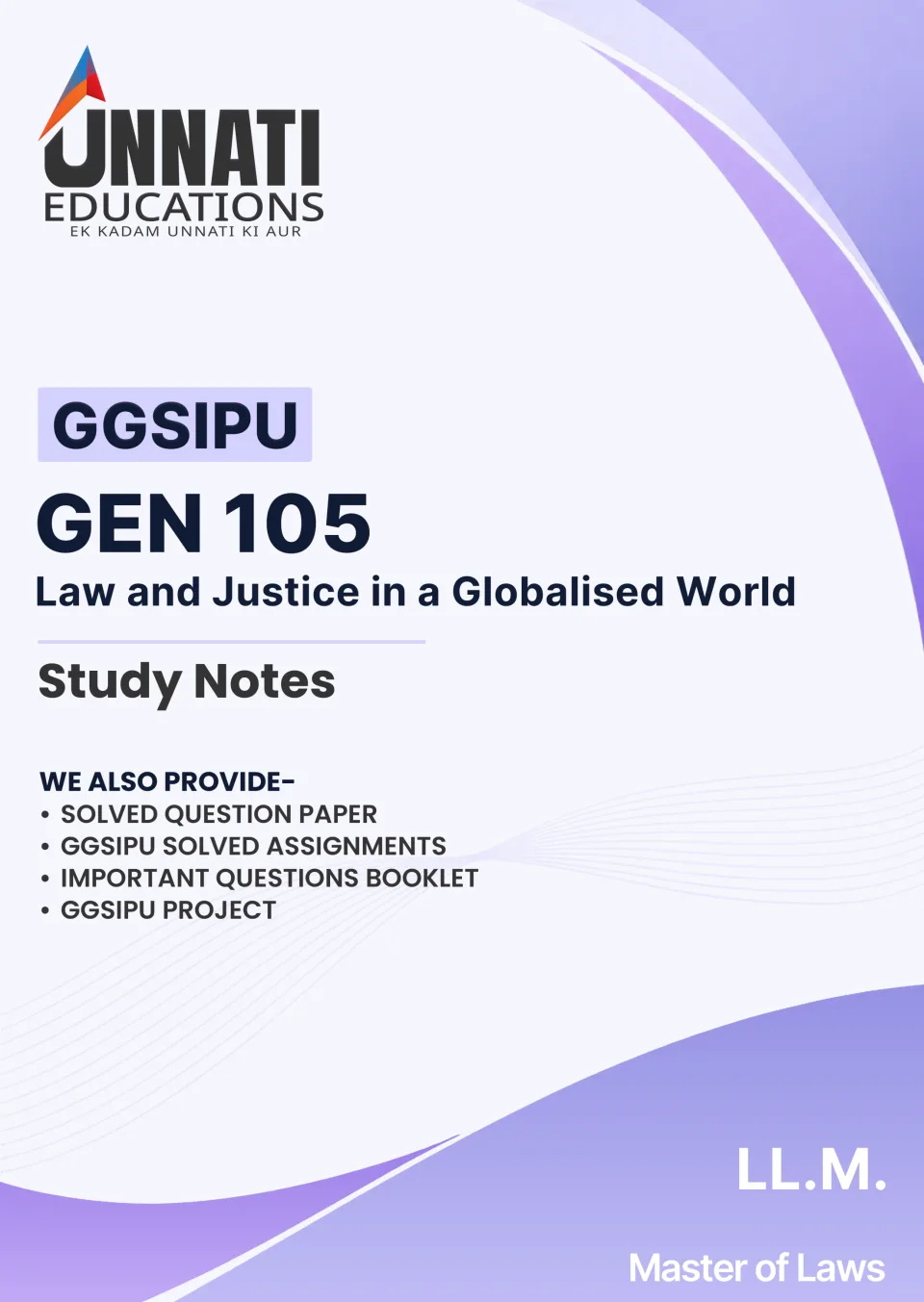
GEN 105 Law and Justice in a Globalised World Notes cover all 4 units of this GGSIPU LL.M. Semester 1 paper in 56 pages: 21 topics, 8 case-law boxes, 4 quick revision tables and 115 exam-style practice questions. They follow the LL.M. (One Year) syllabus marked "w.e.f 2023 onwards" and come as a printed book.
Written by Unnati Educations Editorial Team · Reviewed by Sheetal Kirola, Academic Head, M.Ed. (academic review) · Checked against USLLS LL.M. (One Year) Scheme and Syllabus, 31 October 2026 · Updated 31 October 2026 · Editorial policy
Scheme: LL.M. (One Year), w.e.f. 2023 onwards | Applies to: 2023 onwards, all specialisations | Verified against: USLLS LL.M. syllabus, 31 October 2026
GEN 105 Law and Justice in a Globalised World at a glance: GGSIPU LL.M. Sem 1 credits, units and exam pattern
Code and title | GEN 105, Law and Justice in a Globalised World, Paper III |
|---|---|
Course and semester | LL.M. (One Year), Semester 1; common to all five specialisations (CL, IPR, ADR, CJS, GJWE) |
Hours and credits | Lecture 4 + RTDA (Research and Teaching Development Activities) 2, 5 credits; no category label printed |
Marks | 100: 25 internal (written test + RTDA evaluation) + 75 end-term written exam |
End-term pattern | Not printed in the official PDF |
Units | 4 units, 10 lectures each |
Paired lab | None; GEN 110 Dissertation (NUES, 10 credits) follows in Semester 2 |
The course outcomes: understand globalisation in all its dimensions, then read law and justice through it. GEN 105 sits with GEN 101 and GEN 103 among the GGSIPU LL.M. Semester 1 papers. Pass and re-appear rules sit in Ordinance 11.
GEN 105 Law and Justice in a Globalised World Notes unit-wise: 21 topics and 115 practice questions across 4 units
The book moves from globalisation to world-order theory, then to international courts and treaties, and ends with issue-based regimes. Notes for the other papers sit under GGSIPU LL.M. notes. These GEN 105 Law and Justice IPU notes end each unit with a revision table and questions; see the sample PDF above.
GEN 105 Unit 1: Globalization: Meaning, Perspectives and Issues
Pages 3 to 12, 5 topics. Separates universalism, internationalism and globalisation, explains Simon Reich's four contexts, and profiles WHO, ILO, UNSC, UNHCR, the World Bank, the IMF and the WTO with structure and criticism. Questions: 8 long, 18 short; one case-law box (Shrimp/Turtle, Novartis).
Basis | Universalism | Internationalism | Globalisation |
|---|---|---|---|
Main unit | Humanity | Sovereign State | Markets, MNCs, networks |
Borders | Morally irrelevant | Respected | Porous |
Sovereignty | Above it | Fully kept | Shared |
Example | UDHR 1948 | UN, NAM | WTO, internet |
Quick look: universalism, internationalism and globalisation (from page 6)
Basis
Main unit
Universalism
Humanity
Internationalism
Sovereign State
Globalisation
Markets, MNCs, networks
Basis
Borders
Universalism
Morally irrelevant
Internationalism
Respected
Globalisation
Porous
Basis
Sovereignty
Universalism
Above it
Internationalism
Fully kept
Globalisation
Shared
Basis
Example
Universalism
UDHR 1948
Internationalism
UN, NAM
Globalisation
WTO, internet
GEN 105 Unit 2: Quest for Just World Order
Pages 13 to 24, 4 topics. Hobbes, Locke, Grotius and Vattel on the State, Wolff's civitas maxima, Scelle's monism and Vasudhaiva Kutumbakam; then the Eurocentric post-1945 order, the fall of the USSR, the China-Russia statement of 4 February 2022, the NIEO and India's 1991 reforms. Questions: 10 long, 20 short.
Year | Event | Why it matters |
|---|---|---|
1955 | Bandung Conference | Anti-colonial solidarity |
1962 | UNGA Res. 1803 | Sovereignty over natural resources |
1964 | UNCTAD, G-77 | Trade and development forum |
1974 | Res. 3201 | NIEO Declaration |
Quick look: Third World milestones behind the NIEO (from page 20)
Year
1955
Event
Bandung Conference
Why it matters
Anti-colonial solidarity
Year
1962
Event
UNGA Res. 1803
Why it matters
Sovereignty over natural resources
Year
1964
Event
UNCTAD, G-77
Why it matters
Trade and development forum
Year
1974
Event
Res. 3201
Why it matters
NIEO Declaration
GEN 105 Unit 3: Institutionalized Mechanisms for Law and Justice
Pages 25 to 43, 8 topics. After sources come jus cogens (VCLT Arts. 53 and 64), the General Assembly, the ILC, the ICJ Statute article by article, eight IHL principles, the Geneva Conventions with India's 1960 Act, and the Rome Statute with India's objections. Questions: 10 long, 20 short; 5 case-law boxes, North Sea to Jadhav.
Crime | Article | Key test |
|---|---|---|
Genocide | Art. 6 | Intent to destroy a protected group |
Crimes against humanity | Art. 7 | Widespread or systematic attack on civilians |
War crimes | Art. 8 | Grave breaches, serious violations |
Aggression | Art. 8 bis | Manifest Charter violation by a leader |
Quick look: the Rome Statute's core crimes (from page 39)
Crime
Genocide
Article
Art. 6
Key test
Intent to destroy a protected group
Crime
Crimes against humanity
Article
Art. 7
Key test
Widespread or systematic attack on civilians
Crime
War crimes
Article
Art. 8
Key test
Grave breaches, serious violations
Crime
Aggression
Article
Art. 8 bis
Key test
Manifest Charter violation by a leader
GEN 105 Unit 4: Issue based International Mechanisms for Justice
Pages 44 to 56, 4 topics. Ruggie's three-pillar UN Guiding Principles; Calvo against Hull, BITs, ICSID, UNCITRAL and India's Model BITs; MDGs versus SDGs; climate law up to the ICJ advisory opinion of 23 July 2025. Questions: 9 long, 20 short; 2 case-law boxes (White Industries, Urgenda).
Basis | 1993 | 2016 |
|---|---|---|
Investment | Asset-based | Enterprise-based |
MFN clause | Included | Excluded |
FET | Open-ended | Specific duties |
Local remedies | Not required | 5 years first |
Quick look: India's Model BIT 1993 versus 2016 (from page 50)
Basis
Investment
1993
Asset-based
2016
Enterprise-based
Basis
MFN clause
1993
Included
2016
Excluded
Basis
FET
1993
Open-ended
2016
Specific duties
Basis
Local remedies
1993
Not required
2016
5 years first
Article 38 sources in international law: excerpt from page 26 of the GEN 105 notes
Excerpt from page 26
Meaning of a source
A source of international law is the place or process from which a rule gets its legal force. There is no world parliament, so international law has no single law-maker. Its rules come from the consent and practice of States, the decisions of courts and the writings of scholars.
Sources are of two types. Formal sources are the methods by which a rule becomes binding, such as a treaty or custom. Material sources show where the content of a rule is found, such as a UNGA resolution or an ILC draft.
Article 38(1) of the ICJ Statute: the standard list
Article 38(1) is accepted as the most authoritative statement of sources. The Court applies (a) international conventions, general or particular, that set rules expressly recognised by the States in dispute; (b) international custom, as evidence of a general practice accepted as law; (c) general principles of law recognised by civilised nations; and (d) judicial decisions and the teachings of the most highly qualified publicists, as subsidiary means, subject to Article 59.
Article 38(2) lets the Court decide a case ex aequo et bono, on fairness and justice, if the parties agree. It has never been used in practice.
(a) Treaties
A treaty is a written agreement between States, or international organisations, governed by international law. The Vienna Convention on the Law of Treaties, 1969 codifies this area. Law-making treaties set general rules for many States (the UN Charter, the Geneva Conventions, UNCLOS), while treaty-contracts deal with one matter between a few States, such as a boundary deal or a bilateral investment treaty.
Under pacta sunt servanda (Art. 26 VCLT) every treaty in force binds the parties and must be performed in good faith. A treaty binds only its parties (Art. 34), but its rules can bind others once they become custom.
(b) International custom
Custom is the oldest source and has two elements: State practice that is general, consistent and uniform over time, and opinio juris, the belief that the practice is legally required rather than a habit or courtesy. Custom can be general, regional or even local. A State that objects clearly and consistently from the start may escape a custom under the persistent objector rule, but never a jus cogens norm.
How to write GEN 105 answers: article-backed long answers on courts and treaties, and two-line short notes on doctrines
GEN 105 mixes political theory with treaty law. For Units III and IV, the notes give this order: Introduction, Definition or Provision with the Article number, Explanation in points, Case law, Indian position, Criticism, Conclusion.
For Unit II theory, name the thinker, the book and the year, then end with relevance today: "Grotius, De Jure Belli ac Pacis, 1625" beats "Grotius said". For the Indian angle the notes point to Article 51, Panchsheel, NAM, the G20 2023 theme and the 1991 reforms.
Unit IV is date-heavy; page 56 suggests a climate timeline: 1988 IPCC, 1992 UNFCCC, 1997 Kyoto, 2015 Paris, 2025 ICJ opinion. The tip on page 36 asks you to quote Additional Protocol I articles and the Nuclear Weapons Advisory Opinion (1996) on IHL principles.
Worked example (Unit III): "Explain the principle of complementarity."
Introduction: the ICC as a permanent court of last resort, Rome Statute of 17 July 1998.
Provision: Arts. 1 and 17; a case is inadmissible while a State genuinely investigates or prosecutes it.
Explanation: the ICC steps in only if the State is unwilling or unable, and the case is grave enough.
Indian position: not a party; fears complementarity may still allow intrusion.
Conclusion: depends on State cooperation, yet a real step against impunity.
A short note (2–5 Marks) needs a definition, its source and one example: "Non-refoulement: Art. 33, Refugee Convention 1951; customary law; read into Art. 21 in NHRC v State of Arunachal Pradesh (1996)." Practise this format on GGSIPU LL.M. important questions.
GEN 105 exam corner: 78 two-to-five-mark and 37 ten-to-fifteen-mark practice questions by unit
Unit | Short (2–5 Marks) | Long (10–15 Marks) | Case-law boxes |
|---|---|---|---|
I | 18 | 8 | 1 |
II | 20 | 10 | 0 |
III | 20 | 10 | 5 |
IV | 20 | 9 | 2 |
GEN 105 practice questions and case-law boxes per unit
Unit
I
Short (2–5 Marks)
18
Long (10–15 Marks)
8
Case-law boxes
1
Unit
II
Short (2–5 Marks)
20
Long (10–15 Marks)
10
Case-law boxes
0
Unit
III
Short (2–5 Marks)
20
Long (10–15 Marks)
10
Case-law boxes
5
Unit
IV
Short (2–5 Marks)
20
Long (10–15 Marks)
9
Case-law boxes
2
The GEN 105 notes list 78 short-answer and 37 long-answer practice questions across 4 units, plus 8 case-law boxes. They come without model answers. One per unit:
Unit I: "Discuss the four contexts of globalization." Pointer: Reich (1998), four contexts, one critic each.
Unit II: "Discuss the political context of the fall of the Berlin Wall and the USSR." Pointer: glasnost, 9 November 1989, Belovezha Accords, unipolarity, India's 1991 crisis.
Unit III: "The jurisdiction of the ICJ is based on consent. Discuss." Pointer: Art. 34, Art. 36(1) and 36(2), forum prorogatum, India's reservation in Pakistan v India (2000).
Unit IV: "Distinguish between the MDGs and SDGs." Pointer: 8 goals against 17, developing countries against universal, SDG 16 on justice.
More practice sits in the GEN 105 important questions.
GEN 105 and the GGSIPU LL.M. Sem 1 papers it connects to
GEN 105 has no practical paper; how every paper in both semesters fits together is set out in the GGSIPU LL.M. syllabus.
Every LL.M. student takes GEN 105 with GEN 101 Research Methods and Legal Writing and GEN 103 System of Governance. The other two Semester 1 papers depend on the specialisation: CRL 111 and CRL 113 (Corporate Law), IPR 107 and IPR 109 (IPR), ADR 115 and ADR 117 (ADR), CJS 119 and CJS 121 (Criminal Justice System), GJWE 111 and GJWE 113 (Gender Justice and Women Empowerment).
Where topics meet: Unit I's TRIPS and Novartis material (p10) leads into IPR 107, which lists the TRIPS Agreement. Unit IV's ICSID pages (p48 to p49) return in Semester 2 in ADR 132 International Investment Arbitration and CRL 112.
Who writes and checks the GEN 105 Law and Justice notes?
Unnati Educations Editorial Team, author: wrote the 56-page book from the official syllabus and its recommended readings, such as Reich (1998), Chimni (2007) and Salacuse (2007).
Sheetal Kirola, reviewer: Academic Head, M.Ed., 7 years of experience. Her GEN 105 role is academic review of structure, clarity and syllabus coverage.
These GGSIPU LL.M. Semester 1 Law and Justice notes follow the scheme marked "w.e.f 2023 onwards". The 2026-27 edition includes the ICJ climate opinion of July 2025. Updated 31 October 2026 under our editorial policy. The same team prepares GGSIPU important questions for every course.
Do the GEN 105 notes cover the full GGSIPU syllabus?
Yes. All 15 official sub-topics of GEN 105 have a matching section in the notes.
Unit | Official topic | Notes | Status |
|---|---|---|---|
I | Universalism, Internationalism and Globalization | 01-03, p4-6 | Covered |
I | Contexts of Globalization | 04, p6-8 | Covered |
I | WHO, ILO, UNSC, UNHCR, World Bank, IMF, WTO | 05, p8-11 | Covered |
II | Meaning and Approaches to Global Justice | 01, p14-16 | Covered |
II | World Order after WW-II | 02, p16-17 | Covered |
II | Communist Approaches; Berlin Wall, USSR, China-Russia | 03, p18-20 | Covered |
II | Third World Perspectives, NIEO, LPG | 04, p20-22 | Covered |
III | Sources, Jus Cogens, UNGA, ILC | 01-04, p26-32 | Covered |
III | Statute of the ICJ 1945 | 05, p32-35 | Covered |
III | IHL Principles, Geneva Conventions 1949 | 06-07, p35-38 | Covered |
III | Rome Statute 1998 | 08, p38-41 | Covered |
IV | Human Rights, UN Guiding Principles | 01, p45-47 | Covered |
IV | Foreign Investors and ISDS, Model BIT 1993 and 2016 | 02, p47-51 | Covered |
IV | MDGs and SDGs | 03, p51-52 | Covered |
IV | Global Framework on Climate Change | 04, p52-55 | Covered |
GEN 105 official syllabus mapped to the notes
Unit
I
Official topic
Universalism, Internationalism and Globalization
Notes
01-03, p4-6
Status
Covered
Unit
I
Official topic
Contexts of Globalization
Notes
04, p6-8
Status
Covered
Unit
I
Official topic
WHO, ILO, UNSC, UNHCR, World Bank, IMF, WTO
Notes
05, p8-11
Status
Covered
Unit
II
Official topic
Meaning and Approaches to Global Justice
Notes
01, p14-16
Status
Covered
Unit
II
Official topic
World Order after WW-II
Notes
02, p16-17
Status
Covered
Unit
II
Official topic
Communist Approaches; Berlin Wall, USSR, China-Russia
Notes
03, p18-20
Status
Covered
Unit
II
Official topic
Third World Perspectives, NIEO, LPG
Notes
04, p20-22
Status
Covered
Unit
III
Official topic
Sources, Jus Cogens, UNGA, ILC
Notes
01-04, p26-32
Status
Covered
Unit
III
Official topic
Statute of the ICJ 1945
Notes
05, p32-35
Status
Covered
Unit
III
Official topic
IHL Principles, Geneva Conventions 1949
Notes
06-07, p35-38
Status
Covered
Unit
III
Official topic
Rome Statute 1998
Notes
08, p38-41
Status
Covered
Unit
IV
Official topic
Human Rights, UN Guiding Principles
Notes
01, p45-47
Status
Covered
Unit
IV
Official topic
Foreign Investors and ISDS, Model BIT 1993 and 2016
Notes
02, p47-51
Status
Covered
Unit
IV
Official topic
MDGs and SDGs
Notes
03, p51-52
Status
Covered
Unit
IV
Official topic
Global Framework on Climate Change
Notes
04, p52-55
Status
Covered
Verify it yourself in the LL.M. (One Year) syllabus, w.e.f. 2023 onwards, where GEN-105 is Paper III. The file name says 2022-23; the cover says 2023 onwards.
Every course in GGSIPU notes is mapped to its official PDF the same way.
GEN 105 Law and Justice notes FAQs
How do I get the full GEN 105 notes?
Tap "Get Full Notes" and send the pre-filled WhatsApp message to 9899436384. The full GEN 105 notes come only as a printed book, not as a PDF. Our team confirms your address on WhatsApp, and delivery takes up to 5 to 7 days, depending on your location. The sample PDF at the top shows the layout first.
Is GEN 105 the same paper in every LL.M. specialisation?
Yes. GEN 105 Law and Justice in a Globalised World is a common Semester 1 paper in all five one-year LL.M. specialisations: Corporate Law, IPR, ADR, Criminal Justice System, and Gender Justice and Women Empowerment. Its syllabus, credits and marks are identical in each, so one notes book works for every specialisation; only your other two Semester 1 papers change.
What is the passing mark for GEN 105?
GEN 105 is marked out of 100: 25 internal marks from continuous assessment and 75 marks in the semester-end written exam. The LL.M. scheme PDF on ipu.ac.in does not print a pass percentage for the paper, so we do not quote one. For minimum marks, re-appear chances and results, read Ordinance 11 on ipu.ac.in or ask your school's examination office.
Which GEN 105 unit is the longest in the notes?
Unit III, Institutionalized Mechanisms for Law and Justice, is the longest at 19 pages (pages 25 to 43). It has 8 topics, from sources of international law and jus cogens to the ICJ Statute, IHL, the Geneva Conventions and the Rome Statute, plus 5 of the 8 case-law boxes. Unit I is the shortest at 10 pages.
Are the GEN 105 practice questions solved in the notes?
No. Each GEN 105 unit ends with long and short exam-style questions, 115 in all, without model answers. The content to answer them sits in the topic pages of the same unit, and the final revision tips give a structure: definition, Article number, case law, Indian position, criticism and conclusion. Write your own answers from the notes and time yourself.
Do the GEN 105 notes cover recent events like the ICJ climate opinion?
Yes. The 2026-27 GEN 105 notes include the ICJ advisory opinion on climate change of 23 July 2025, COP-29's goal of at least US$300 billion a year by 2035, COP-30 at Belém, the WHO Pandemic Agreement of May 2025 and the 2024 ICC warrant for Benjamin Netanyahu, with dates and article numbers ready to quote.
Get the full GEN 105 Law and Justice in a Globalised World Notes on WhatsApp
Unit | Pages | Topics | Questions |
|---|---|---|---|
I | 3-12 (10) | 5 | 26 |
II | 13-24 (12) | 4 | 30 |
III | 25-43 (19) | 8 | 30 |
IV | 44-56 (13) | 4 | 29 |
Inside the full GEN 105 notes book
Unit
I
Pages
3-12 (10)
Topics
5
Questions
26
Unit
II
Pages
13-24 (12)
Topics
4
Questions
30
Unit
III
Pages
25-43 (19)
Topics
8
Questions
30
Unit
IV
Pages
44-56 (13)
Topics
4
Questions
29
These Law and Justice in a Globalised World notes in English run to 56 pages and are sold only as a printed book, not as a PDF. Delivery takes up to 5 to 7 days, and the rest depends on your location.
Order the GEN 105 notes book on WhatsApp (4 units, 56 pages)
Unnati Educations is an independent education provider based in Vikaspuri, Delhi. We are not affiliated with, authorised by, or endorsed by Guru Gobind Singh Indraprastha University (GGSIPU). 'GGSIPU' and 'IPU' are used only to describe the syllabus our notes follow. For official information, visit ipu.ac.in.
Ready for the full notes?
Discuss coverage and delivery with our team.