
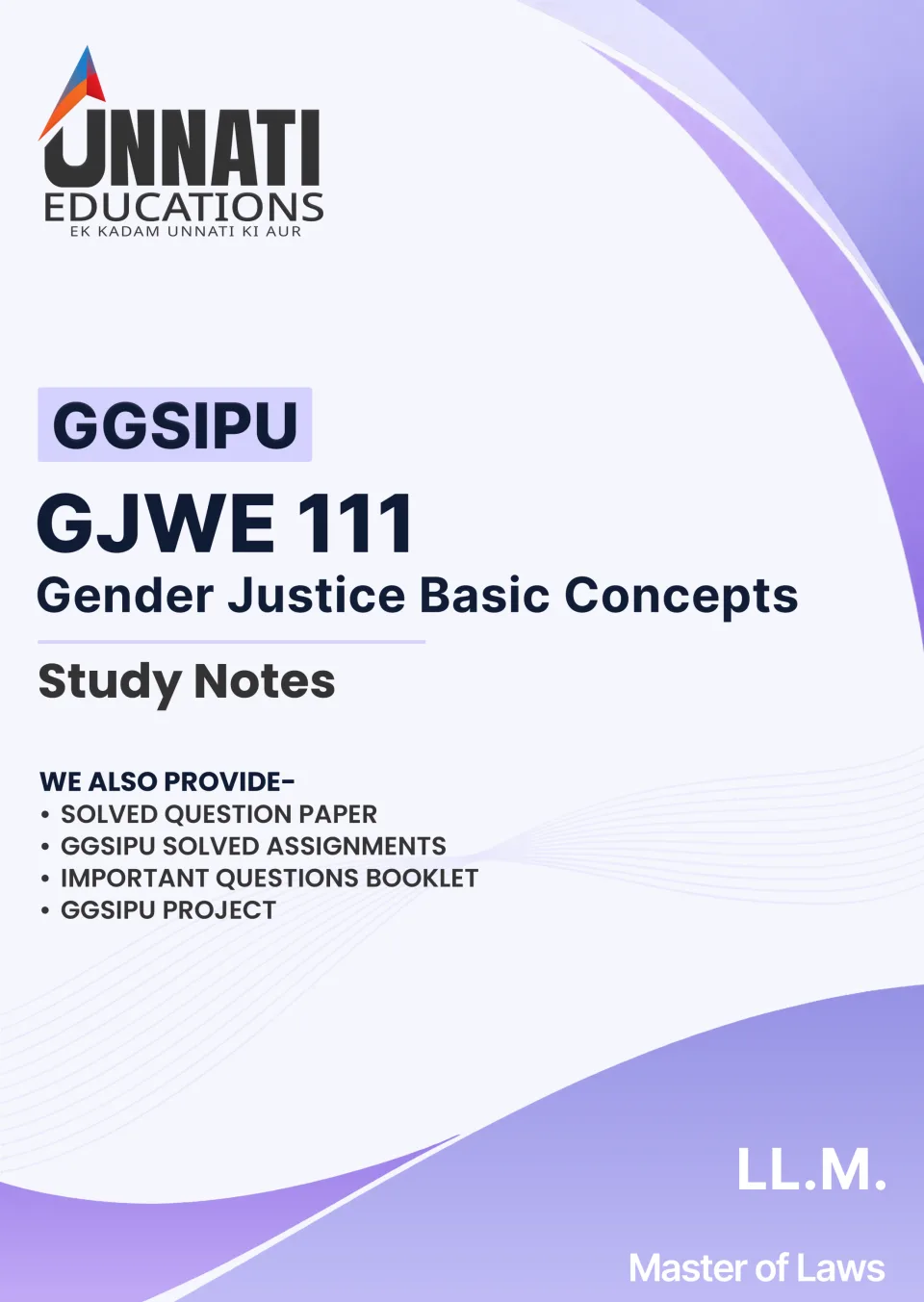
GJWE 111 Gender Justice Basic Concepts Notes cover all 4 units of the GGSIPU LL.M. (One Year) GJWE Semester 1 paper in a 46-page printed book: 30 tables, two case tables with 16 Indian judgments, and 72 exam-style questions (24 long, 48 short), mapped to the LL.M. syllabus printed w.e.f. 2023 onwards.
Written by Unnati Educations Editorial Team · Academic review by Sheetal Kirola, M.Ed., Academic Head · Checked against Master of Law (LL.M.) Regular One Year Programme w.e.f 2022-23 · Updated 14 October 2026 · Editorial policy
Scheme: LL.M. (One Year) Scheme of Examination and Detailed Syllabus, USLLS | Applies to: batches from 2022-23 (cover reads w.e.f. 2023 onwards) | Verified: 13 October 2026
GJWE 111 Gender Justice: Basic Concepts at a glance: GGSIPU LL.M. Sem 1 credits, units and exam pattern
GJWE 111 is Paper IV of the one-year LL.M. at USLLS, taught only in the Gender Justice and Women Empowerment (GJWE) specialisation. It is one of five GGSIPU LL.M. Semester 1 papers.
Code and title | GJWE 111 Gender Justice: Basic Concepts |
|---|---|
Course and semester | LL.M. (One Year), GJWE specialisation, Semester I, Paper IV |
Credits and weekly hours | 5 credits: 4 lecture hours + 2 hours of RTDA (Research and Teaching Development Activities) |
Marks | 100: 25 internal (written test and RTDA) + 75 end-term written exam |
End-term question pattern | Not printed in the official PDF |
Units | 4 units, 10 lectures each |
Applies to | Batches from session 2022-23 (syllabus cover reads w.e.f. 2023 onwards) |
Paired lab | None (theory paper) |
The LL.M. PDF prints no pass percentage; evaluation and re-appear rules sit in Ordinance 11.
GJWE 111 Gender Justice Basic Concepts Notes unit-wise: 30 tables and 72 exam questions across 4 units
Each unit follows the syllabus order and ends with a revision table and question bank. Notes for the other LL.M. papers sit under GGSIPU LL.M. notes. The sample PDF in the header shows one content page from every unit.
GJWE 111 Unit 1: Gender Justice
Pages 3 to 14, eight sections, 9 tables, a nine-case table and 18 practice questions. It defines gender justice (Goetz 2007, UN Women) and builds the constitutional base up to the 106th Amendment (2023).
Then: types of genders, sex versus gender, eleven reasons for gender injustice, the Yogyakarta Principles, stereotypes and Moser's triple roles.
Basis | Formal equality | Substantive equality |
|---|---|---|
Idea | Same treatment for everyone | Treatment that fits each person's situation so results come out equal |
Focus | Equal laws on paper | Equal outcomes in real life |
Example | One entry test for every job | Panchayat seats for women (Art. 243D), maternity benefit |
Quick look: formal vs substantive equality (from page 4)
Basis
Idea
Formal equality
Same treatment for everyone
Substantive equality
Treatment that fits each person's situation so results come out equal
Basis
Focus
Formal equality
Equal laws on paper
Substantive equality
Equal outcomes in real life
Basis
Example
Formal equality
One entry test for every job
Substantive equality
Panchayat seats for women (Art. 243D), maternity benefit
GJWE 111 Unit 2: Gender Inequality and Gender Stratification
Pages 15 to 26, nine sections, 7 tables, a seven-case table and 18 practice questions. It separates inequality from stratification, explains the GII and WEF Gender Gap Index, and covers socialization with Leela Dube's Indian study.
Five areas follow, from home to healthcare, each with NFHS-5 or Time Use Survey data and a law.
Term | What it means |
|---|---|
Glass ceiling | An unseen barrier that blocks women from top posts |
Sticky floor | Women held in low-paid jobs with little upward movement |
Glass cliff | Women handed leadership mainly during a crisis, when failure is likely |
Glass escalator | Men rising faster inside women-dominated jobs such as nursing |
Quick look: four workplace barriers (from page 22)
Term
Glass ceiling
What it means
An unseen barrier that blocks women from top posts
Term
Sticky floor
What it means
Women held in low-paid jobs with little upward movement
Term
Glass cliff
What it means
Women handed leadership mainly during a crisis, when failure is likely
Term
Glass escalator
What it means
Men rising faster inside women-dominated jobs such as nursing
GJWE 111 Unit 3: Femininity and Masculinity
Pages 27 to 36, seven sections, 7 tables and 18 practice questions. It treats both ideas as relational and socially built, then traces their origins through Moyer, Ortner, Lerner and Mrinalini Sinha's colonial masculinity.
A life-course table, Halberstam's female masculinity and the two ways of measurement follow.
Masculinity score | Femininity score | Category |
|---|---|---|
High | Low | Masculine |
Low | High | Feminine |
High | High | Androgynous (Bem's healthiest profile) |
Low | Low | Undifferentiated |
Quick look: BSRI categories (from page 34)
Masculinity score
High
Femininity score
Low
Category
Masculine
Masculinity score
Low
Femininity score
High
Category
Feminine
Masculinity score
High
Femininity score
High
Category
Androgynous (Bem's healthiest profile)
Masculinity score
Low
Femininity score
Low
Category
Undifferentiated
GJWE 111 Unit 4: Evolving Concept of Gender Justice
Pages 37 to 46, eight sections, 7 tables and 18 practice questions. It sets out four stages of the idea, WID to GAD, the Western story from Wollstonecraft to Dobbs, and a UN timeline up to SDG 5.
India gets three phases, from the 1829 Sati Regulation to 2023; other Asian countries close the unit.
Wave | Period | Main focus |
|---|---|---|
First | 1848 to 1920s | Vote, property, education |
Second | 1960s to 1980s | Work, family, sexuality, reproduction |
Third | 1990s to 2000s | Diversity, intersectionality, identity |
Fourth | 2012 onwards | Digital activism, #MeToo, inclusion |
Quick look: waves of feminism (from page 41)
Wave
First
Period
1848 to 1920s
Main focus
Vote, property, education
Wave
Second
Period
1960s to 1980s
Main focus
Work, family, sexuality, reproduction
Wave
Third
Period
1990s to 2000s
Main focus
Diversity, intersectionality, identity
Wave
Fourth
Period
2012 onwards
Main focus
Digital activism, #MeToo, inclusion
Connell's hierarchy of masculinities in gender studies: excerpt from page 29 of the GJWE 111 notes
Excerpt from page 29
Masculinity comes in more than one form
Femininity and masculinity are plural. Caste, class, religion, region, age and sexuality all produce different ways of being a man or a woman. They are also hierarchical: one version of masculinity is placed above other masculinities and above every femininity. Judith Butler adds that gender is performative, produced by repeated acts such as how we dress, walk and speak, rather than by an inner essence.
Connell's four masculinities (1995)
Type | Meaning | Example |
|---|---|---|
Hegemonic | The dominant, idealised way of being a man, used to justify power over women and other men | The tough, rich, heterosexual "real man" who keeps emotions in check |
Complicit | Men who fall short of the ideal but still gain from it, the "patriarchal dividend" | Ordinary men who back male dominance without being macho |
Subordinated | Forms looked down on as "feminine" | Gay men, gentle or so-called effeminate men |
Marginalised | Masculinity of men from oppressed class, caste or race groups | Dalit or working-class men kept out of the dominant ideal |
Connell's hierarchy of masculinities, rewritten from page 29
Type
Hegemonic
Meaning
The dominant, idealised way of being a man, used to justify power over women and other men
Example
The tough, rich, heterosexual "real man" who keeps emotions in check
Type
Complicit
Meaning
Men who fall short of the ideal but still gain from it, the "patriarchal dividend"
Example
Ordinary men who back male dominance without being macho
Type
Subordinated
Meaning
Forms looked down on as "feminine"
Example
Gay men, gentle or so-called effeminate men
Type
Marginalised
Meaning
Masculinity of men from oppressed class, caste or race groups
Example
Dalit or working-class men kept out of the dominant ideal
Emphasized femininity
In 1987 Connell also described emphasized femininity: the form of femininity built around going along with women's subordination and meeting men's wishes, through beauty, sociability, motherhood and sexual receptiveness. Connell does not speak of a "hegemonic femininity", because no form of femininity holds power over men.
Toxic masculinity and its opposite
"Toxic masculinity" is the popular label for the harmful side of traditional manhood: bottled-up emotions, violence, homophobia, sexual entitlement and risky behaviour. It hurts women through violence, and it hurts men too, through higher rates of accidents, addiction and suicide and a habit of avoiding doctors. The ideal on the other side is positive or caring masculinity, where men share care work and express feelings openly.
Do the GJWE 111 notes cover the full GGSIPU syllabus?
Yes. Every topic the official syllabus lists for GJWE 111 has its own section in the notes, in the same unit order.
Official unit | Official topics | Where in the notes | Status |
|---|---|---|---|
Unit I: Gender Justice | Meaning, Types of genders, Sex and Gender, Gender Injustice, Reasons associated, Gender Identity, Gender stereotype, Gender roles | Sections 01 to 07, pp. 4 to 12 | Covered |
Unit II: Gender Inequality and Gender Stratification | Gender and Socialization; Sociological Perspectives on Gender Stratification; Gender Stratification in home, education, workplace, politics, healthcare etc | Sections 01 to 08, pp. 16 to 24 | Covered (the five named areas) |
Unit III: Femininity and Masculinity | Meaning, Concept, nature; Ancestry and origin; Development and Expansion; Measuring Masculinity and Femininity: A Sociological and A Psychological view | Sections 01 to 06, pp. 28 to 35 | Covered |
Unit IV: Evolving Concept of Gender Justice | Evolving Concept of Gender Justice in West; in Asia | Sections 01 to 07, pp. 38 to 45 | Covered |
GJWE 111 official syllabus mapped to the notes
Official unit
Unit I: Gender Justice
Official topics
Meaning, Types of genders, Sex and Gender, Gender Injustice, Reasons associated, Gender Identity, Gender stereotype, Gender roles
Where in the notes
Sections 01 to 07, pp. 4 to 12
Status
Covered
Official unit
Unit II: Gender Inequality and Gender Stratification
Official topics
Gender and Socialization; Sociological Perspectives on Gender Stratification; Gender Stratification in home, education, workplace, politics, healthcare etc
Where in the notes
Sections 01 to 08, pp. 16 to 24
Status
Covered (the five named areas)
Official unit
Unit III: Femininity and Masculinity
Official topics
Meaning, Concept, nature; Ancestry and origin; Development and Expansion; Measuring Masculinity and Femininity: A Sociological and A Psychological view
Where in the notes
Sections 01 to 06, pp. 28 to 35
Status
Covered
Official unit
Unit IV: Evolving Concept of Gender Justice
Official topics
Evolving Concept of Gender Justice in West; in Asia
Where in the notes
Sections 01 to 07, pp. 38 to 45
Status
Covered
Source: LL.M. (One Year) syllabus, w.e.f. 2022-23 (ipu.ac.in), Paper IV.
CO2 in the syllabus asks for the judiciary's role in gender justice, so Units 1 and 2 end with case tables. The notes also draw on the reading list (Bem, Rege, Biernat, Faulkner). Every course in GGSIPU notes is mapped to its official PDF the same way, topic by topic.
How to write GJWE 111 answers: case-backed long answers, comparison tables and short notes
The notes label long questions "12–15 Marks" and short notes "4–5 Marks". Open long answers with a named definition (Goetz 2007 for gender justice, stressing that it covers every gender) and use the four WEF sub-indices as headings for stratification.
When a question lists areas (home, education, workplace, politics, healthcare), give each a heading with forms, one data point and one law or case, then link them.
Add two or three cases to every long answer: NALSA (2014) with the Transgender Persons Act 2019 for identity, Anuj Garg (2008) with Aparna Bhat (2021) for stereotypes. Comparison tables (sex vs gender, stereotype vs role) earn quick marks; the usual slip is that a stereotype is what society thinks a gender is like, while a role is what it expects that gender to do.
Worked example: short note on intersectionality
Line 1: Kimberlé Crenshaw coined it (1989). Line 2: gender combines with caste, class and disability, so harm multiplies. Line 3: Dalit and tribal women face double or triple discrimination. Line 4: link to Dalit feminism and legal remedies.
You can practise this structure on GGSIPU LL.M. important questions.
GJWE 111 exam corner: 24 long-answer and 48 short-answer exam-style questions by unit
Unit | Long questions (12–15 Marks) | Short notes (4–5 Marks) | Case table |
|---|---|---|---|
Unit 1: Gender Justice | 6 | 12 | 9 |
Unit 2: Stratification | 6 | 12 | 7 |
Unit 3: Femininity and Masculinity | 6 | 12 | None |
Unit 4: Evolving Concept of Gender Justice | 6 | 12 | None |
GJWE 111 question bank in the notes, by unit
Unit
Unit 1: Gender Justice
Long questions (12–15 Marks)
6
Short notes (4–5 Marks)
12
Case table
9
Unit
Unit 2: Stratification
Long questions (12–15 Marks)
6
Short notes (4–5 Marks)
12
Case table
7
Unit
Unit 3: Femininity and Masculinity
Long questions (12–15 Marks)
6
Short notes (4–5 Marks)
12
Case table
None
Unit
Unit 4: Evolving Concept of Gender Justice
Long questions (12–15 Marks)
6
Short notes (4–5 Marks)
12
Case table
None
The GJWE 111 notes carry 24 long-answer and 48 short-answer exam-style questions across 4 units, plus 16 Indian cases in two case tables. They are practice questions with no year tags.
Unit 1: Distinguish between sex and gender, and explain why it matters. Pointer: Oakley (1972), de Beauvoir; the difference table; Babita Puniya (2020), NALSA (2014).
Unit 2: "The workplace is a major site of gender stratification." Discuss. Pointer: FLFPR, pay gap, glass ceiling; Nergesh Meerza (1981), POSH Act 2013.
Unit 3: "Masculinity and femininity are socially constructed." Discuss with anthropological evidence. Pointer: Mead's three tribes (1935), Ortner (1974), Slocum (1975).
Unit 4: Trace the evolution of gender justice in India from the social reform movement to the present. Pointer: three phases; 1856 Widow Remarriage Act, Towards Equality (1974), Mathura and the 1983 Act, Vishaka, 2023.
More practice is planned in the GJWE 111 important questions.
Who writes and checks the GJWE 111 gender justice notes?
Unnati Educations Editorial Team, author. No single person is named because no current team member holds a law degree; a named author will be added when an LL.B. or LL.M. writer joins.
Sheetal Kirola, academic review. Academic Head, M.Ed., 7 years' experience; checks structure, clarity and syllabus coverage. Profile.
The 2026-27 edition was last updated on 14 October 2026. It is exam study material, not legal advice; see our editorial policy. The team also prepares GGSIPU important questions for every course.
GJWE 111 and the GGSIPU LL.M. Sem 1 papers it connects to
GJWE 111 has no lab; every LL.M. paper is listed on the GGSIPU LL.M. syllabus page.
In the GJWE track, GJWE 111 sits beside GEN 101 Research Methods and Legal Writing, GEN 103 System of Governance, GEN 105 Law and Justice in a Globalised World and GJWE 113 Gender Justice: A Historical Perspective.
Unit 4's feminist waves lead into GJWE 113 on feminism and women's movements.
Unit 1's Art. 15(3) material feeds GEN 103 Unit IV on compensatory discrimination.
Unit 4's UN timeline overlaps GEN 105 Unit IV on human rights frameworks.
Unit 3's GEM Scale is a worked example of GEN 101 Unit III questionnaires.
GJWE 111 gender justice notes FAQs
How do I get the full GJWE 111 notes?
Tap "Get Full Notes" or the WhatsApp button below and send the message. The GJWE 111 notes come only as a printed book, not as a PDF. Delivery takes a maximum of 5 to 7 days, and the exact time depends on your location. You can check the sample pages from the header before you order.
Is GJWE 111 a common LL.M. paper or only for the GJWE specialisation?
GJWE 111 is studied only in the Gender Justice and Women Empowerment specialisation, where it is Paper IV of Semester I. The papers common to all five LL.M. tracks are GEN 101, GEN 103 and GEN 105. GJWE students take GJWE 111 and GJWE 113 alongside those three, so the gender papers carry two of their five Semester I courses.
What is the passing mark for GJWE 111?
GJWE 111 is marked out of 100: 25 internal marks from a written test and RTDA work, and 75 marks in the end-term written exam. The LL.M. scheme and syllabus PDF does not print a pass percentage, so we do not state one. For minimum marks, evaluation and re-appear rules, read GGSIPU Ordinance 11 on ipu.ac.in or ask your department.
Which GJWE 111 unit has the most case law?
Unit 1 has the largest case table: nine Indian judgments from Vishaka (1997) to Aparna Bhat (2021), including NALSA, Navtej Singh Johar and Joseph Shine. Unit 2 adds seven more, such as Nergesh Meerza and Vineeta Sharma. Unit 4 places Western cases like Reed v. Reed, Roe and Bostock inside its timelines rather than in a separate table.
Do the GJWE 111 notes follow the 2022-23 or the 2023 LL.M. syllabus?
They are the same syllabus. The PDF on ipu.ac.in is filed as w.e.f. 2022-23, and the university's approval letter applies it from session 2022-23, while the cover inside reads w.e.f. 2023 onwards. The GJWE 111 notes follow the unit list in that PDF, and we recheck that PDF on ipu.ac.in before each new edition so any revision is caught early.
Does GJWE 111 cover the Transgender Persons Act, 2019?
Yes. GJWE 111 Unit 1 covers it twice: under types of genders, with the right to a certificate of identity and the National Council for Transgender Persons, and under gender identity, with Section 4 on self-perceived identity. The notes also record the main criticism, that needing a District Magistrate's certificate dilutes the self-identification upheld in NALSA (2014).
Get the full GJWE 111 Gender Justice Basic Concepts Notes on WhatsApp
Part | Pages | Sections |
|---|---|---|
Unit 1: Gender Justice | 3 to 14 (12 pages) | 8 |
Unit 2: Gender Inequality and Gender Stratification | 15 to 26 (12 pages) | 9 |
Unit 3: Femininity and Masculinity | 27 to 36 (10 pages) | 7 |
Unit 4: Evolving Concept of Gender Justice | 37 to 46 (10 pages) | 8 |
What is inside the GJWE 111 notes book (46 pages with cover and contents)
Part
Unit 1: Gender Justice
Pages
3 to 14 (12 pages)
Sections
8
Part
Unit 2: Gender Inequality and Gender Stratification
Pages
15 to 26 (12 pages)
Sections
9
Part
Unit 3: Femininity and Masculinity
Pages
27 to 36 (10 pages)
Sections
7
Part
Unit 4: Evolving Concept of Gender Justice
Pages
37 to 46 (10 pages)
Sections
8
One 46-page book with 30 tables and 72 practice questions, written as Gender Justice Basic Concepts notes in English. If you searched for GJWE 111 Gender Justice Basic Concepts IPU notes, this book follows the syllabus unit by unit.
Printed book only, not a PDF. Delivery: maximum 5 to 7 days, the rest depends on your location. As GGSIPU LL.M. Sem 1 Gender Justice Basic Concepts notes, it is rechecked against the ipu.ac.in PDF every edition.
Order the GJWE 111 notes book on WhatsApp (4 units, 46 pages)
Unnati Educations is an independent education provider based in Vikaspuri, Delhi. We are not affiliated with, authorised by, or endorsed by Guru Gobind Singh Indraprastha University (GGSIPU). 'GGSIPU' and 'IPU' are used only to describe the syllabus our notes follow. For official information, visit ipu.ac.in.
Ready for the full notes?
Discuss coverage and delivery with our team.