
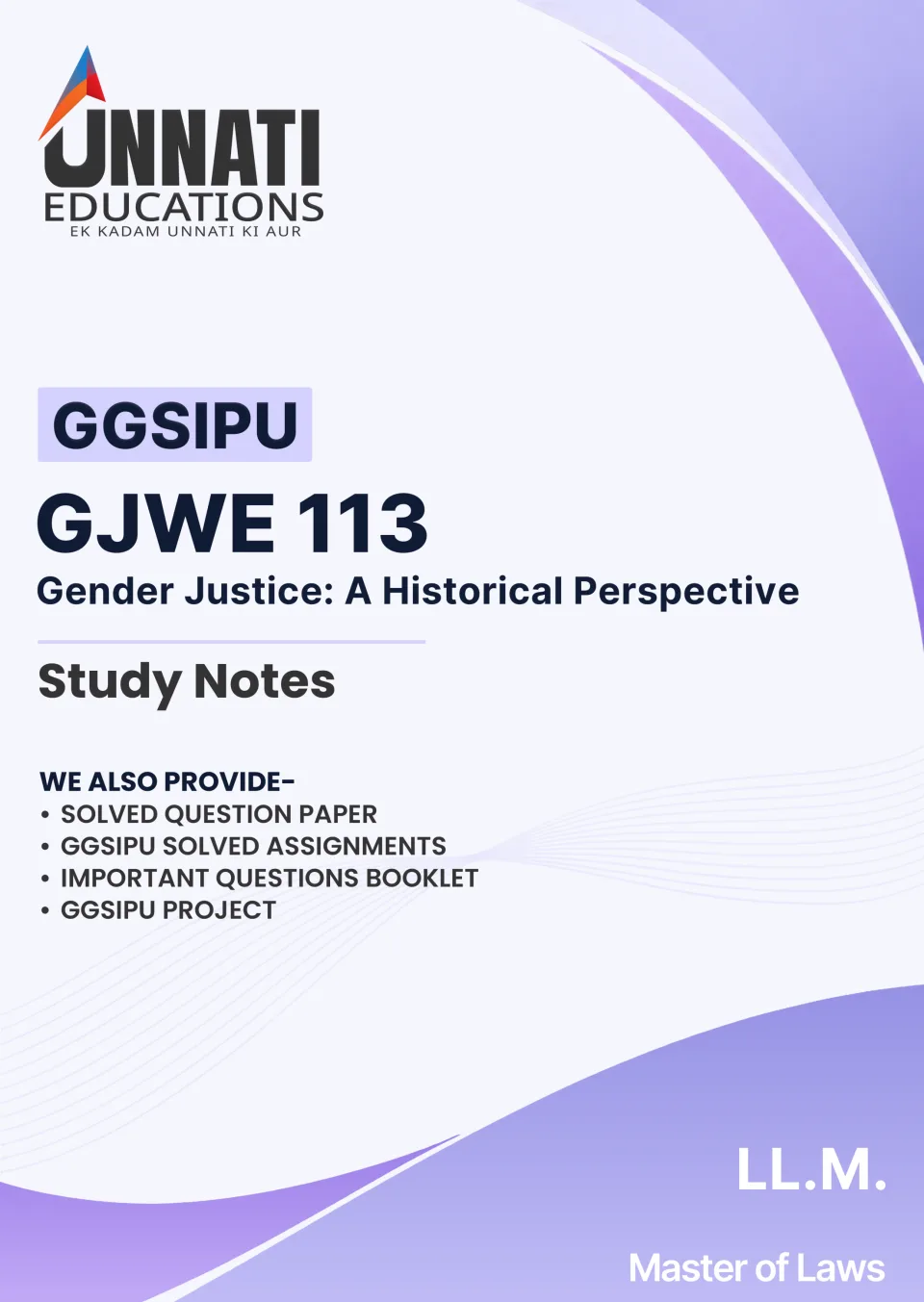
GJWE 113 Gender Justice: A Historical Perspective Notes cover all 4 units of this GGSIPU LL.M. Semester 1 paper in 49 pages: women and third gender history, feminist theory, women's movements and the four UN conferences. They include 47 revision tables and 92 practice questions, mapped to the LL.M. scheme from session 2022-23.
Written by Unnati Educations Editorial Team · Reviewed by Sheetal Kirola, M.Ed., Academic Head (academic review) · Checked against the LL.M. (One Year) scheme and detailed syllabus PDF · Updated 14 October 2026 · Editorial policy
Scheme: LL.M. (One Year), w.e.f. 2022-23 | Applies to: batches from session 2022-23 | Verified against: official LL.M. syllabus PDF, 13 October 2026
GJWE 113 Gender Justice: A Historical Perspective at a glance: GGSIPU LL.M. Sem 1 credits, units and exam pattern
GJWE 113 is the history paper of the Gender Justice and Women Empowerment (GJWE) specialisation in the one-year LL.M. run by USLLS.
Code and title | GJWE 113, Gender Justice: A Historical Perspective (the scheme table prints the code as "GJWE113") |
|---|---|
Course and semester | LL.M. (One Year), GJWE specialisation, Semester I, Paper V |
Credits and weekly hours | 5 credits: 4 lecture hours + 2 hours of Research and Teaching Development Activities (RTDA) |
Marks | 100: 25 internal (written test + RTDA evaluation by the subject teacher) + 75 semester-end written exam |
Applies to | Batches from session 2022-23 (approval letter of 13 September 2022) |
End-term pattern | Not printed in the official PDF |
Units | 4 units, 10 lectures each |
Paired lab | None |
GJWE 113 is studied alongside the other GGSIPU LL.M. Semester 1 papers such as GEN 101 and GJWE 111. Exam rules not printed in the syllabus are set by Ordinance 11 (examinations and evaluation).
GJWE 113 Gender Justice: A Historical Perspective Notes unit-wise: 47 tables and 92 practice questions across 4 units
Each unit ends with a quick revision table and a practice set. Notes for every other paper in the programme sit under GGSIPU LL.M. notes, and you can preview six pages through the sample PDF in the header above.
GJWE 113 Unit 1: Women and Third Gender through Different Periods
Pages 3-16 (14 pages). Unit 1 tracks how women's status rose and fell across the Rig Vedic, Later Vedic, Smriti, Buddhist, Mauryan, Gupta and Sangam periods, then through purdah, sati and the Bhakti saints of the medieval age. The modern section covers colonial laws, constitutional Articles, post-1947 statutes and seven judgments, and the third gender section runs to NALSA (2014) and the 2019 Act. Five sections, 14 tables, 15 practice questions, 12 one-line answers.
Kind | What it covers |
|---|---|
Adhyagni | Gifts given before the nuptial fire |
Adhyavahanika | Gifts given during the bridal procession |
Pritidatta | Gifts of affection from the in-laws |
Anvadheyaka | Gifts received after marriage from either family |
Quick look: four kinds of Stridhana under Smriti law (from page 5)
Kind
Adhyagni
What it covers
Gifts given before the nuptial fire
Kind
Adhyavahanika
What it covers
Gifts given during the bridal procession
Kind
Pritidatta
What it covers
Gifts of affection from the in-laws
Kind
Anvadheyaka
What it covers
Gifts received after marriage from either family
GJWE 113 Unit 2: Development of Feminism in India and Abroad
Pages 17-27 (11 pages). Unit 2 defines feminism (Kamla Bhasin, bell hooks), sets out sex vs gender, patriarchy and Sylvia Walby's six structures, then traces Western thought from Olympe de Gouges (1791) to Judith Butler (1990). Eleven theories follow, then Indian feminism in three phases, "Towards Equality" (1974), the Mathura case and 23 thinkers and activists. Four sections, 10 tables, 14 practice questions, 8 one-line answers.
Theory | Root cause | Solution |
|---|---|---|
Liberal | Unequal laws, no equal opportunity | Legal reform and education |
Radical | Patriarchy and male control of sexuality | Change family and sexual relations |
Marxist | Capitalism and private property | End class society |
Socialist | Capitalism and patriarchy together | Change both systems |
Quick look: four core feminist theories compared (from page 22)
Theory
Liberal
Root cause
Unequal laws, no equal opportunity
Solution
Legal reform and education
Theory
Radical
Root cause
Patriarchy and male control of sexuality
Solution
Change family and sexual relations
Theory
Marxist
Root cause
Capitalism and private property
Solution
End class society
Theory
Socialist
Root cause
Capitalism and patriarchy together
Solution
Change both systems
GJWE 113 Unit 3: Women Movements in India and World
Pages 28-38 (11 pages). Unit 3 starts with the 19th-century reform bodies (Brahmo Samaj to Karve's SNDT, 1916), the Phulmoni and Rukhmabai cases and women in each phase of the freedom struggle. Then come post-1947 campaigns, religious, peasant, tribal and Dalit movements, Chipko with three readings, and four waves of the international movement. Six sections, 10 tables, 14 practice questions, 8 one-line answers.
Wave | Period | Main focus |
|---|---|---|
First | c. 1848 to 1920s | Vote, property, education |
Second | 1960s to 1980s | Family, work, body, sexuality |
Third | 1990s to 2010s | Diversity, identity, intersectionality |
Quick look: the first three waves at a glance (from page 36)
Wave
First
Period
c. 1848 to 1920s
Main focus
Vote, property, education
Wave
Second
Period
1960s to 1980s
Main focus
Family, work, body, sexuality
Wave
Third
Period
1990s to 2010s
Main focus
Diversity, identity, intersectionality
GJWE 113 Unit 4: Global Conferences for the Progression of women
Pages 39-49 (11 pages). Unit 4 first explains the UN groundwork before 1975 (CSW 1946, the 1952 and 1967 instruments, Ester Boserup) and the WID, WAD and GAD approaches. Each World Conference gets a fact table, followed by the Beijing reviews to Beijing + 30 (2025) and an India timeline. Six sections, 13 tables, 13 practice questions, 8 one-line answers.
Conference | States | Main document |
|---|---|---|
Mexico City, 1975 | 133 | World Plan of Action |
Copenhagen, 1980 | 145 | Programme of Action for the second half of the Decade |
Nairobi, 1985 | 157 | Forward-Looking Strategies to the Year 2000 |
Beijing, 1995 | 189 | Beijing Declaration and Platform for Action |
Quick look: the four World Conferences on Women (from pages 45-46)
Conference
Mexico City, 1975
States
133
Main document
World Plan of Action
Conference
Copenhagen, 1980
States
145
Main document
Programme of Action for the second half of the Decade
Conference
Nairobi, 1985
States
157
Main document
Forward-Looking Strategies to the Year 2000
Conference
Beijing, 1995
States
189
Main document
Beijing Declaration and Platform for Action
Third gender from Mughal courts to the Criminal Tribes Act in Indian gender history: excerpt from page 11 of the GJWE 113 notes
Excerpt from page 11
Recognition in texts and myths
Ancient Indian tradition did not see gender as a strict two-way split. Ardhanarishvara, the half-male, half-female form of Shiva and Parvati, joins the masculine and the feminine in one body. In the Mahabharata, Shikhandi is born female, lives as a male warrior and causes Bhishma's fall, while Arjuna spends a year as Brihannala, a eunuch dance teacher at King Virata's court.
In Tamil tradition, Arjuna's son Aravan marries Krishna in the form of Mohini before he is sacrificed. The Koovagam festival at the Koothandavar temple in Villupuram marks this story, and transgender women (aravanis) see themselves as Aravan's brides. A Ramayana legend says hijras waited 14 years at the forest's edge because Rama had told only "men and women" to return home. Jain texts separate psychological sex from physical sex.
Medieval period: khwaja-saras in royal courts
Under the Delhi Sultanate and the Mughals, eunuchs (khwaja-saras) held posts of trust as harem guardians, advisers, generals and administrators. Malik Kafur, the general who led Alauddin Khalji's campaigns to South India, is the best-known example. Rulers trusted them because they had no family claim to the throne, and many grew wealthy. The guru-chela system, badhai (blessings at births and weddings) and community gharanas took shape as the hijra community's social structure.
Colonial period: criminalisation
British officials, shaped by Victorian morality, treated hijras as "immoral" and a threat to public order. Section 377 of the Indian Penal Code (1860) punished "carnal intercourse against the order of nature" and was used to harass transgender and homosexual persons.
Part II of the Criminal Tribes Act, 1871 dealt with "eunuchs": they had to register, could be arrested without warrant for wearing women's clothes or dancing in public, and could not adopt children or make gifts or wills. With royal patronage and land grants gone, the community was pushed into poverty, begging and sex work. The Act was repealed in 1949, replaced by habitual offenders laws in 1952, but the stigma stayed.
GJWE 113 exam corner: 27 fifteen-mark and 29 five-mark practice questions by unit
Marks labels are the notes' own; the official PDF prints no question pattern. Long and short questions come without model answers.
Unit | 15 marks (long) | 5 marks (short notes) | One-line self-test (with answers) |
|---|---|---|---|
Unit 1 (page 16) | 7 | 8 | 12 |
Unit 2 (page 27) | 7 | 7 | 8 |
Unit 3 (page 38) | 7 | 7 | 8 |
Unit 4 (page 49) | 6 | 7 | 8 |
GJWE 113 practice questions in the notes, unit by unit
Unit
Unit 1 (page 16)
15 marks (long)
7
5 marks (short notes)
8
One-line self-test (with answers)
12
Unit
Unit 2 (page 27)
15 marks (long)
7
5 marks (short notes)
7
One-line self-test (with answers)
8
Unit
Unit 3 (page 38)
15 marks (long)
7
5 marks (short notes)
7
One-line self-test (with answers)
8
Unit
Unit 4 (page 49)
15 marks (long)
6
5 marks (short notes)
7
One-line self-test (with answers)
8
The GJWE 113 notes list 27 fifteen-mark and 29 five-mark practice questions across 4 units, plus 36 one-line self-test questions with answers.
Unit 1: "Trace the evolution of the third gender in India... Critically examine NALSA v. Union of India (2014)." Pointer: pages 11-12, then the NALSA holdings on page 12.
Unit 2: "Discuss the role of the 'Towards Equality' report (1974) and the Mathura case..." Pointer: page 23.
Unit 3: "What is the Chipko movement? Analyse the role of women in it and its different interpretations." Pointer: pages 34-35.
Unit 4: "Critically examine the Beijing Declaration and Platform for Action (1995)..." Pointer: pages 44-45.
More practice for this paper will sit in the GJWE 113 important questions.
Who writes and checks the GJWE 113 Gender Justice notes?
Unnati Educations Editorial Team, writes the notes. The team does not yet include a law graduate, so no single author is named.
Sheetal Kirola, Academic Head, M.Ed., 7 years of experience, does the academic review: structure, clarity and syllabus coverage. The gender topics overlap with B.Ed BED 210, her own field. Profile
The 2026-27 edition is mapped to the 2022-23 LL.M. scheme, last checked 13 October 2026. It includes the 106th Amendment (2023), the Bharatiya Nyaya Sanhita and the Beijing + 30 review (2025). Read how we check facts in our editorial policy.
The same team prepares GGSIPU important questions for every course it covers.
Do the GJWE 113 notes cover the full GGSIPU syllabus?
Yes. Every topic in all four official units has its own section in the notes; no gaps were found.
Official unit | Official topics | Where in the notes | Status |
|---|---|---|---|
I. Women and Third Gender through Different Periods | Women in Ancient, Medieval, Modern Period; Evolution of Third Gender; Rights through different periods | Sections 01-05, pages 4-15 | Covered |
II. Development of Feminism in India and Abroad | Evolution, Meaning, Forms; Various Theories of Feminism; Feminism in India; Feminist Thinkers and Activists in Contemporary India | Sections 01-04, pages 18-26 | Covered |
III. Women Movements in India and World | Social Reform, National, Post Independent, Religious, Peasant, Tribal, Dalit and Chipko Movements; Three Waves | Sections 01-06, pages 29-37 | Covered |
IV. Global Conferences for the Progression of women | Mexico (1975), Copenhagen (1980), Nairobi (1985), Beijing (1995) | Sections 01-06, pages 40-48 | Covered |
GJWE 113 official units mapped to the notes
Official unit
I. Women and Third Gender through Different Periods
Official topics
Women in Ancient, Medieval, Modern Period; Evolution of Third Gender; Rights through different periods
Where in the notes
Sections 01-05, pages 4-15
Status
Covered
Official unit
II. Development of Feminism in India and Abroad
Official topics
Evolution, Meaning, Forms; Various Theories of Feminism; Feminism in India; Feminist Thinkers and Activists in Contemporary India
Where in the notes
Sections 01-04, pages 18-26
Status
Covered
Official unit
III. Women Movements in India and World
Official topics
Social Reform, National, Post Independent, Religious, Peasant, Tribal, Dalit and Chipko Movements; Three Waves
Where in the notes
Sections 01-06, pages 29-37
Status
Covered
Official unit
IV. Global Conferences for the Progression of women
Official topics
Mexico (1975), Copenhagen (1980), Nairobi (1985), Beijing (1995)
Where in the notes
Sections 01-06, pages 40-48
Status
Covered
Official source: GGSIPU LL.M. (One Year) Scheme of Examination and Detailed Syllabus, w.e.f. 2022-23 (ipu.ac.in).
Every paper we list in GGSIPU notes is checked against its official PDF in the same way.
How to write GJWE 113 answers: period, status, rights and limitations for fifteen-mark history questions
Most long questions here ask you to "trace" change over time. The notes give one structure on page 13: period, status, rights, limitations.
Worked example, "Rights of women and third gender in India have moved from scripture-based duties to constitution-based rights. Discuss." (Unit 1, Q7):
Open with the move from Smriti duties to constitutional rights (page 14 tip).
Draw the period-wise table from Rig Vedic to Post-Independence.
Add the property chain: Stridhana, 1937, 1956, 2005, Vineeta Sharma (2020).
Close with NALSA (2014), the 2019 Act, the 2023 reservation and the gap between law in books and in action.
For Unit 2 theory questions, give five theories with one thinker and one criticism each. For the waves, add that the metaphor is Western-centric. For conferences, use date, states, theme, document, outcome.
Practise this format across the programme with GGSIPU LL.M. important questions.
GJWE 113 and the GGSIPU LL.M. Sem 1 papers it connects to
GJWE 113 has no lab paper; its place in the programme is set out on the GGSIPU LL.M. syllabus page. In Semester 1 of the GJWE specialisation it sits with GEN 101 Research Methods and Legal Writing, GEN 103 System of Governance, GEN 105 Law and Justice in a Globalised World and GJWE 111 Gender Justice: Basic Concepts.
GJWE 111 Units III and IV (femininity, masculinity, gender justice in the West and Asia) pair with Unit 2 here.
GEN 105 Unit IV (human rights framework, SDGs) overlaps with Unit 4 on CEDAW and SDG 5.
GEN 103 Unit IV (compensatory discrimination) connects with Articles 15(3) and 243D in Unit 1.
In Semester 2, GJWE 116 builds on Unit 1's post-1947 laws and GJWE 114 returns to third gender issues.
GJWE 113 Gender Justice notes FAQs
How do I get the full GJWE 113 notes?
Message us on WhatsApp at 9899436384 with the paper code GJWE 113. The full notes are sold as a printed book only; they are not available as a PDF. Delivery takes a maximum of 5 to 7 days, and the rest depends on your location. Check six watermarked pages first through "View Sample PDF" at the top of this page.
Is GJWE 113 a Semester 1 or Semester 2 paper in the GGSIPU LL.M.?
GJWE 113 is Paper V of Semester I in the LL.M. (One Year) GJWE specialisation. Students of the CL, IPR, ADR and CJS streams do not take it. In the same semester you study GEN 101, GEN 103, GEN 105 and GJWE 111, and Semester 2 brings GJWE 112, 114, 116, 118 and the dissertation.
What is the passing mark for GJWE 113?
GJWE 113 is marked out of 100: 25 internal marks (written test plus RTDA work, assessed by the subject teacher) and 75 marks in the semester-end written exam. The LL.M. scheme and syllabus PDF does not state a pass percentage, so we do not quote one here. End-term minimums and re-appear rules come from Ordinance 11 on ipu.ac.in.
Do the GJWE 113 notes list all 12 Beijing critical areas of concern?
Yes. Unit 4 lists all 12 areas from A (Women and poverty) to L (The girl child) in one table on page 44, with a memory trick to recall them in order. Page 45 adds gender mainstreaming, the conferences from Rio (1992) to Cairo (1994) that led up to Beijing, and three criticisms of the Platform.
How is GJWE 113 different from GJWE 111?
GJWE 111 Gender Justice: Basic Concepts builds the vocabulary: sex and gender, stereotypes, gender stratification, femininity and masculinity. GJWE 113 is the history paper. It asks how women's and the third gender's status changed over time, which ideas and movements drove that change, and what the UN conferences added. Read GJWE 111 first for the terms, then use GJWE 113 for dates and events.
Are the GJWE 113 practice questions solved in the notes?
No. The 27 fifteen-mark and 29 five-mark questions are listed for practice without model answers; you write them from the topic sections they point to. Each unit also has a one-line self-test (36 questions in all) with answers, and most units end with an answer-writing tip that shows how to structure a long answer for this paper.
Get the full GJWE 113 Gender Justice: A Historical Perspective Notes on WhatsApp
The full book has 49 pages with all 47 tables and 92 practice questions. These Gender Justice: A Historical Perspective notes in English put dates, laws and cases in one place before the end-term.
Unit | Pages | Tables | Practice questions |
|---|---|---|---|
Unit 1 | 3-16 (14) | 14 | 27 |
Unit 2 | 17-27 (11) | 10 | 22 |
Unit 3 | 28-38 (11) | 10 | 22 |
Unit 4 | 39-49 (11) | 13 | 21 |
Pages per unit in the GJWE 113 notes
Unit
Unit 1
Pages
3-16 (14)
Tables
14
Practice questions
27
Unit
Unit 2
Pages
17-27 (11)
Tables
10
Practice questions
22
Unit
Unit 3
Pages
28-38 (11)
Tables
10
Practice questions
22
Unit
Unit 4
Pages
39-49 (11)
Tables
13
Practice questions
21
Format: printed book only; the notes are not available as a PDF. Delivery: a maximum of 5 to 7 days, and the rest depends on your location. Order GJWE 113 Gender Justice IPU notes early if your exam is close. If you need GGSIPU LL.M. Sem 1 Gender Justice notes for both specialisation papers, ask for GJWE 111 in the same order.
Order the GJWE 113 printed notes on WhatsApp (4 units, 49 pages)
Unnati Educations is an independent education provider based in Vikaspuri, Delhi. We are not affiliated with, authorised by, or endorsed by Guru Gobind Singh Indraprastha University (GGSIPU). 'GGSIPU' and 'IPU' are used only to describe the syllabus our notes follow. For official information, visit ipu.ac.in.
Ready for the full notes?
Discuss coverage and delivery with our team.