
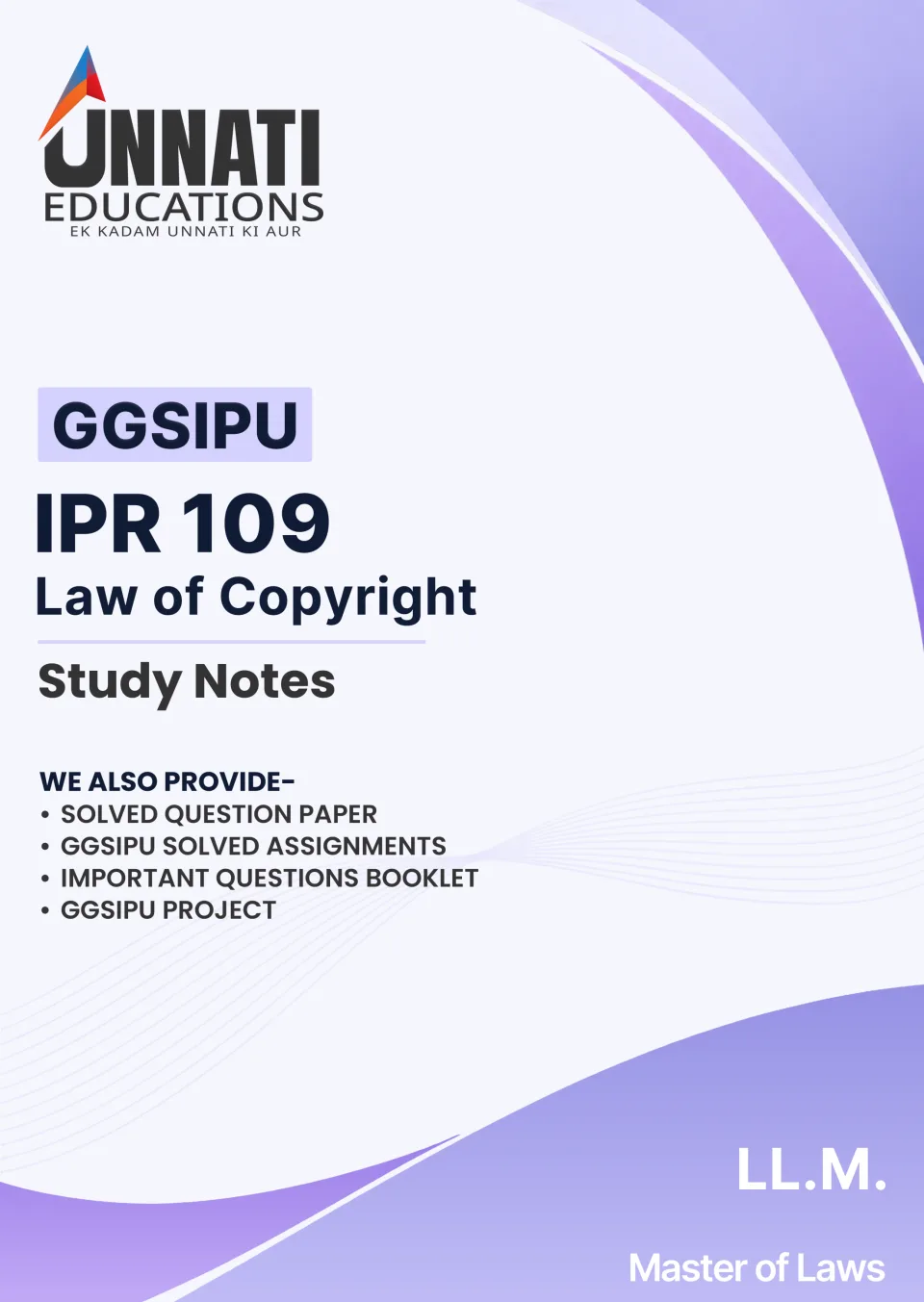
IPR 109 Law of Copyright Notes are a 78-page printed book for GGSIPU LL.M. (IPR specialisation) Semester 1. They cover all 4 official units, explain 40 case laws in boxed summaries, and close every unit with a quick revision table and exam questions (34 long-answer, 58 short-answer). They follow the LL.M. (One Year) syllabus w.e.f. 2023 onwards.
Written by Unnati Educations Editorial Team · Academic review by Sheetal Kirola, M.Ed., Academic Head · Checked against the official LL.M. (One Year) scheme and syllabus PDF on ipu.ac.in · Updated 14 October 2026 · Editorial policy
Scheme: LL.M. (One Year), IPR specialisation | Applies to: batches w.e.f. 2023 onwards (as printed on the PDF cover) | Verified against: Scheme of Examination & Detailed Syllabus for Master of Laws [LLM], USLLS
IPR 109 Law of Copyright at a glance: GGSIPU LL.M. Sem 1 credits, units and exam pattern
| Code and title | IPR 109 · Law of Copyright (Paper V) |
|---|---|
| Course and semester | LL.M. (One Year), Intellectual Property Right (IPR) specialisation · Semester I |
| Credits and hours | 5 credits · L 4 + RTDA 2 (Research and Teaching Development Activities) |
| Marks | 100: 25 internal (written test + RTDA) + 75 end-term |
| End-term exam | Written exam by the Examination Division; question pattern not printed in the official PDF |
| Units | 4 units, 10 lectures each |
| Applies to | Batches w.e.f. 2023 onwards (PDF cover; file name reads 2022-23) |
| Paired lab | None (theory paper) |
IPR 109 is Paper V of the IPR track and sits with four other GGSIPU LL.M. Semester 1 papers; it carries 5 of the programme's 55 credits.
With no paper-setter split printed, give all four units equal time. Pass and re-appear rules sit in Ordinance 11 on ipu.ac.in.
IPR 109 Law of Copyright Notes unit-wise: 40 case laws and 92 exam questions across 4 units
The GGSIPU LL.M. Sem 1 Law of Copyright notes follow the four official units in syllabus order. Notes for the other papers are listed under GGSIPU LL.M. notes; one page from each unit is in the sample PDF at the top.
IPR 109 Unit 1: Introduction to Copyright
Pages 4-22 (12 topics). Copyright under Section 14, the four justification theories, and Indian law from the Act of 1847 to the 2012 amendment and the end of IPAB in 2021. Then six treaties: Berne, UCC, TRIPS, WCT, the International Copyright Order, 1999 and Marrakesh. 8 case laws, 22 exam questions.
| Point | Berne, 1886 | UCC, 1952 |
|---|---|---|
| Run by | WIPO | UNESCO |
| Formalities | None; automatic | Met by the © notice |
| Minimum term | Life + 50 years | Life + 25 years |
| Moral rights | Yes, Art. 6bis | No |
Quick look: Berne Convention vs UCC (from page 16)
- Point
- Run by
- Berne, 1886
- WIPO
- UCC, 1952
- UNESCO
- Point
- Formalities
- Berne, 1886
- None; automatic
- UCC, 1952
- Met by the © notice
- Point
- Minimum term
- Berne, 1886
- Life + 50 years
- UCC, 1952
- Life + 25 years
- Point
- Moral rights
- Berne, 1886
- Yes, Art. 6bis
- UCC, 1952
- No
IPR 109 Unit 2: Subject Matters of Copyright
Pages 23-40 (10 topics). The six classes of work under Section 13, author versus first owner under Sections 2(d) and 17, economic rights work by work, moral rights under Section 57, duration, intermediary liability and dynamic injunctions, then assignment and licences including Sections 31C and 31D. Most cases of any unit: 14 case laws, 22 exam questions.
| Basis | Assignment | Licence |
|---|---|---|
| Nature | Transfer of ownership | Permission to do an act |
| Owner after | Assignee | Not the licensee |
| Right to sue | Assignee, in own name | Generally only an exclusive licensee |
| Form | Writing, signed (S. 19) | Writing, signed (S. 30) |
Quick look: assignment vs licence (from page 36)
- Basis
- Nature
- Assignment
- Transfer of ownership
- Licence
- Permission to do an act
- Basis
- Owner after
- Assignment
- Assignee
- Licence
- Not the licensee
- Basis
- Right to sue
- Assignment
- Assignee, in own name
- Licence
- Generally only an exclusive licensee
- Basis
- Form
- Assignment
- Writing, signed (S. 19)
- Licence
- Writing, signed (S. 30)
IPR 109 Unit 3: Enforcement of Copyright and Current Issues
Pages 41-60 (12 topics), the longest unit. Section 52 exceptions and the DU Photocopy case, fair dealing versus US fair use, infringement under Section 51, civil, criminal and border remedies, and enforcement under TRIPS Part III. Then AI, plagiarism, culture and human rights. 12 case laws, 25 exam questions.
| Section | Offence | Punishment |
|---|---|---|
| S. 63 | Knowing infringement | 6 months-3 years + ₹50,000-₹2 lakh |
| S. 63A | Repeat conviction | 1-3 years + ₹1-2 lakh |
| S. 63B | Using pirated software | 7 days-3 years + ₹50,000-₹2 lakh |
| S. 65A | Circumventing a TPM | Up to 2 years + fine |
Quick look: copyright offences (from page 49)
- Section
- S. 63
- Offence
- Knowing infringement
- Punishment
- 6 months-3 years + ₹50,000-₹2 lakh
- Section
- S. 63A
- Offence
- Repeat conviction
- Punishment
- 1-3 years + ₹1-2 lakh
- Section
- S. 63B
- Offence
- Using pirated software
- Punishment
- 7 days-3 years + ₹50,000-₹2 lakh
- Section
- S. 65A
- Offence
- Circumventing a TPM
- Punishment
- Up to 2 years + fine
IPR 109 Unit 4: Neighboring Rights
Also covered as "Neighbouring Rights". Pages 61-78 (14 topics, the most of any unit). Rationale, then Rome, Geneva, Brussels, TRIPS Article 14, WPPT and Beijing, followed by Sections 37 to 39 of the Indian Act and remedies. 6 case laws, 23 exam questions.
| Treaty | Performers covered | Moral rights | Term |
|---|---|---|---|
| Rome, 1961 | Audio and live | No | 20 years |
| TRIPS Art. 14 | Phonograms and live | No | 50 years |
| WPPT, 1996 | Audio only | Yes | 50 years |
| Beijing, 2012 | Audiovisual | Yes | 50 years |
Quick look: neighbouring rights treaties (from page 69)
- Treaty
- Rome, 1961
- Performers covered
- Audio and live
- Moral rights
- No
- Term
- 20 years
- Treaty
- TRIPS Art. 14
- Performers covered
- Phonograms and live
- Moral rights
- No
- Term
- 50 years
- Treaty
- WPPT, 1996
- Performers covered
- Audio only
- Moral rights
- Yes
- Term
- 50 years
- Treaty
- Beijing, 2012
- Performers covered
- Audiovisual
- Moral rights
- Yes
- Term
- 50 years
IPR 109 exam corner: 58 short-answer and 34 long-answer questions by unit
| Unit | Short-answer | Long-answer | Case laws |
|---|---|---|---|
| I | 14 | 8 | 8 |
| II | 14 | 8 | 14 |
| III | 16 | 9 | 12 |
| IV | 14 | 9 | 6 |
| Total | 58 | 34 | 40 |
IPR 109 exam questions and case laws per unit
- Unit
- I
- Short-answer
- 14
- Long-answer
- 8
- Case laws
- 8
- Unit
- II
- Short-answer
- 14
- Long-answer
- 8
- Case laws
- 14
- Unit
- III
- Short-answer
- 16
- Long-answer
- 9
- Case laws
- 12
- Unit
- IV
- Short-answer
- 14
- Long-answer
- 9
- Case laws
- 6
- Unit
- Total
- Short-answer
- 58
- Long-answer
- 34
- Case laws
- 40
The IPR 109 notes set 58 short-answer and 34 long-answer questions across 4 units, plus 40 boxed case laws and 159 quick-revision rows.
- Unit I: Trace the evolution of copyright law in India from 1847 to the 2012 amendment.
Pointer: 1847, 1911/1914, 1957, amendments 1983-2012, then IPAB 2017-2021. - Unit II: Discuss moral rights under Section 57 with Mannu Bhandari, Amar Nath Sehgal and Raj Rewal.
Pointer: paternity and integrity survive assignment; Raj Rewal shows the limit. - Unit III: Can a work generated by Artificial Intelligence be protected by copyright?
Pointer: output authorship (S. 2(d)(vi), Thaler v. Perlmutter), then training data (ANI v. OpenAI, pending). - Unit IV: Critically examine the Rome Convention, 1961. Why has India not joined it?
Pointer: three beneficiaries, Arts. 7, 10, 12, 13 and 19, the 20-year term, then India's position.
The other 88 questions stay in the printed book. More practice sits in the IPR 109 important questions.
Who writes and checks the IPR 109 copyright notes?
- Unnati Educations Editorial Team · writes the IPR 109 notes · content team, Vikaspuri, Delhi
- Sheetal Kirola · academic review: structure, clarity and syllabus coverage · Academic Head · M.Ed. · 7 years of experience · Profile
The review checks that all 48 topics sit under the right official unit and read simply; it is not legal advice. The Law of Copyright notes in English were mapped to the USLLS one-year LL.M. scheme and belong to the 2026-27 edition, last updated 14 October 2026, under our editorial policy.
The same team prepares GGSIPU important questions for every course it covers.
How to write IPR 109 answers: section-backed short notes and case-chain long answers
Back every claim with a section of the Copyright Act, 1957 or a decided case; the notes pair "Legal Provision" and "Case Law" boxes for this.
Short notes: one concept, one authority. Example: "Is registration of copyright compulsory?" No. Registration under Section 45 is optional and only for evidentiary convenience; in Satsang v. Kiron Chandra Mukhopadhyay (Cal 1972) the owner could sue without it.
Long answers: a chain of cases. On originality, write University of London Press (labour), Feist (creativity), CCH Canadian (skill and judgment), then Eastern Book Co. v. D.B. Modak for India. The chain shows how the law moved.
Big themes: fixed headings. Remedies go under civil (S. 55, 58, 62 and special injunctions), criminal (S. 63-70, Knit Pro) and administrative (S. 53 border measures). Exceptions run S. 52, Civic Chandran, DU Photocopy, the three-step test, then US fair use. AI splits into authorship, training and liability.
Treaties in Unit IV. Give year, beneficiaries, key articles and term, then India's position: outside Rome, in WPPT since 2018.
Practise this format on GGSIPU LL.M. important questions.
IPR 109 and the GGSIPU LL.M. Sem 1 papers it connects to
IPR 109 has no lab paper; every specialisation's paper list is on the GGSIPU LL.M. syllabus.
In the IPR track it is studied with GEN 101 Research Methods and Legal Writing, GEN 103 System of Governance, GEN 105 Law and Justice in a Globalised World and IPR 107 Nature, Emergence and Development of IPR.
- IPR 107 Unit III (Paris, Berne, TRIPS) → IPR 109 Unit I treaties.
- IPR 107 Unit II theories of IPR → IPR 109 Unit I copyright theories.
- IPR 107 Unit IV Internet and IPR → IPR 109 Unit II digital copyright.
- GEN 105 Unit IV human rights → IPR 109 Unit III copyright and human rights.
- GEN 101 Unit IV research ethics → IPR 109 Unit III plagiarism and UGC Regulations, 2018.
Originality from sweat of the brow to modicum of creativity in copyright law: excerpt from page 11 of the IPR 109 notes
Excerpt from page 11
How courts tested originality
The Copyright Act uses the word "original" but never defines it. Courts filled the gap, and the test moved from plain labour towards some degree of creativity.
Feist Publications v. Rural Telephone Service, 499 U.S. 340 (1991)
The US Supreme Court held that an alphabetical telephone directory was not original. Originality needs independent creation plus a "modicum of creativity". Hard work alone, the "sweat of the brow", is not enough, and facts cannot be copyrighted.
CCH Canadian Ltd. v. Law Society of Upper Canada (2004) SCC 13
The Canadian Supreme Court took a middle path. An original work must come from the author's skill and judgment, which is more than a mechanical exercise, but it need not be novel or unique.
Eastern Book Company v. D.B. Modak, (2008) 1 SCC 1
This is the leading Indian case. SCC claimed copyright in its copy-edited versions of Supreme Court judgments. The Supreme Court rejected the sweat of the brow doctrine and adopted the modicum of creativity standard. The judgments themselves are public domain, but SCC's paragraph numbering, internal cross-references and editorial additions, such as identifying the judge's opinion, showed enough skill and judgment to be protected. Headnotes are SCC's own work and are protected too.
Exam tip
Write the four cases in order: London Press (labour), Feist (creativity), CCH (skill and judgment), EBC v. Modak (India: modicum of creativity). This shows the examiner how the test has evolved.
Expression, not idea
Copyright protects the form in which an idea is expressed, not the idea itself. Two writers can produce two novels on the same theme; each gets its own copyright and neither infringes the other.
R.G. Anand v. Delux Films, (1978) 4 SCC 118
The play Hum Hindustani and the film New Delhi both dealt with provincialism and inter-state marriage. The Supreme Court found no infringement: there is no copyright in an idea, theme, plot or historical fact. The test is whether a viewer who has seen both works gets an unmistakable impression that one is a copy of the other.
- Doctrine of merger: when an idea can be expressed in only one or very few ways, idea and expression merge and the expression is not protected.
- Scènes à faire: stock elements that flow naturally from a theme, such as a chase in a thriller, are not protected.
Do the IPR 109 notes cover the full GGSIPU syllabus?
Yes. Every topic under the four official units of IPR 109 has its own section in the notes; no gap was found.
| Official unit | Official topics | Where in the notes | Status |
|---|---|---|---|
| Unit I: Introduction to Copyright | Theories of Copyright protection; Evolution of Copyright Law in India; Nature and Scope; Pre-requisites; relationship with other IPRs; Berne Convention, 1883; Universal Copyright Convention, 1952; TRIPS, 1994; WIPO Copyright Treaty, 1996; International Copyright Order, 1999; Marrakesh Treaty, 2013 | Sections 01-12, pages 5-19 | Covered |
| Unit II: Subject Matters of Copyright | Work in which Copyright Subsists; Authorship vis-a-vis Ownership; Economic and Moral Rights; Duration; Digital Copyright Law; Assignment and Licensing | Sections 01-10, pages 24-37 | Covered |
| Unit III: Enforcement of Copyright and Current Issues | Limitation and Exceptions; Infringement; Remedies; Enforcement at National and International Level; AI and Copyright Law; Infringement vis-a-vis Plagiarism; Culture and copyright; Copyright and Human Rights | Sections 01-12, pages 42-57 | Covered |
| Unit IV: Neighboring Rights | Origin and Development; Rationale; Copyright vis-a-vis Neighboring rights; Rome 1961, Geneva 1971, Brussels 1974, TRIPS 1994, WPPT 1996, Beijing 2012; Performers, Broadcasting organizations and Phonogram producers' rights; Economic and Moral Rights; Exceptions; Infringement and Remedies | Sections 01-14, pages 62-75 | Covered |
IPR 109 official syllabus topics mapped to the notes
- Official unit
- Unit I: Introduction to Copyright
- Official topics
- Theories of Copyright protection; Evolution of Copyright Law in India; Nature and Scope; Pre-requisites; relationship with other IPRs; Berne Convention, 1883; Universal Copyright Convention, 1952; TRIPS, 1994; WIPO Copyright Treaty, 1996; International Copyright Order, 1999; Marrakesh Treaty, 2013
- Where in the notes
- Sections 01-12, pages 5-19
- Status
- Covered
- Official unit
- Unit II: Subject Matters of Copyright
- Official topics
- Work in which Copyright Subsists; Authorship vis-a-vis Ownership; Economic and Moral Rights; Duration; Digital Copyright Law; Assignment and Licensing
- Where in the notes
- Sections 01-10, pages 24-37
- Status
- Covered
- Official unit
- Unit III: Enforcement of Copyright and Current Issues
- Official topics
- Limitation and Exceptions; Infringement; Remedies; Enforcement at National and International Level; AI and Copyright Law; Infringement vis-a-vis Plagiarism; Culture and copyright; Copyright and Human Rights
- Where in the notes
- Sections 01-12, pages 42-57
- Status
- Covered
- Official unit
- Unit IV: Neighboring Rights
- Official topics
- Origin and Development; Rationale; Copyright vis-a-vis Neighboring rights; Rome 1961, Geneva 1971, Brussels 1974, TRIPS 1994, WPPT 1996, Beijing 2012; Performers, Broadcasting organizations and Phonogram producers' rights; Economic and Moral Rights; Exceptions; Infringement and Remedies
- Where in the notes
- Sections 01-14, pages 62-75
- Status
- Covered
Official source: LL.M. (One Year) Scheme of Examination and Detailed Syllabus, USLLS (w.e.f. 2023 onwards). The PDF prints the Berne Convention year as 1883; the notes use 1886, the year it was signed.
Every course in GGSIPU notes is mapped to its official PDF the same way.
IPR 109 copyright notes FAQs
How do I get the full IPR 109 notes?
Message Unnati Educations on WhatsApp at 9899436384 with the code IPR 109. The full notes come only as a printed book, not as a PDF, and delivery takes up to 5 to 7 days depending on your location. The "View Sample PDF" button above shows seven watermarked pages, including one from each unit.
What is the passing mark for IPR 109 in GGSIPU LL.M.?
IPR 109 is marked out of 100: 25 internal marks (written test plus RTDA evaluation) and 75 in the semester-end written exam. The LL.M. scheme of examination does not print a pass percentage, so we do not quote one. End-term minimums and re-appear rules come from GGSIPU Ordinance 11 on ipu.ac.in.
Which IPR 109 unit is the longest and which has the most cases?
Unit III, Enforcement of Copyright and Current Issues, is the longest at 20 pages and has the most short-answer questions (16). Unit II, Subject Matters of Copyright, has the most case laws: 14, from Najma Heptulla on joint authorship to Tips v. Wynk on streaming licences. Unit IV has the most topics (14).
Do the IPR 109 notes include foreign case laws?
Yes, alongside Indian ones. Most of the 40 boxed cases are Indian Supreme Court and High Court decisions, such as R.G. Anand, Eastern Book Co. v. D.B. Modak, Amar Nath Sehgal and Knit Pro. Foreign cases appear for comparison: Feist and Google v. Oracle (US), CCH Canadian (Canada), Ladbroke v. William Hill (UK) and Thaler v. Perlmutter on AI authorship.
Which syllabus and batch do the IPR 109 notes follow?
They follow the USLLS Scheme of Examination and Detailed Syllabus for the one-year LL.M., IPR specialisation, where IPR 109 is Paper V of Semester I with 5 credits. The PDF cover says w.e.f. 2023 onwards, while the file name on ipu.ac.in says 2022-23. For a newer syllabus, compare its unit list with the coverage map above.
Are the IPR 109 exam questions answered in the notes?
The questions are for practice, and each one names the sections or cases it tests, so the matching topic section and case box give you the content to write. Six of the 34 long-answer questions also carry a key-point list. Four quick revision tables (159 rows) help on the last day.
Get the full IPR 109 Law of Copyright Notes on WhatsApp
These IPR 109 Law of Copyright IPU notes come as one 78-page printed book with a full index and a cover page for each unit.
| Unit | Pages | Topics | Case laws | Questions |
|---|---|---|---|---|
| I | 4-22 | 12 | 8 | 22 |
| II | 23-40 | 10 | 14 | 22 |
| III | 41-60 | 12 | 12 | 25 |
| IV | 61-78 | 14 | 6 | 23 |
What the printed IPR 109 book contains
- Unit
- I
- Pages
- 4-22
- Topics
- 12
- Case laws
- 8
- Questions
- 22
- Unit
- II
- Pages
- 23-40
- Topics
- 10
- Case laws
- 14
- Questions
- 22
- Unit
- III
- Pages
- 41-60
- Topics
- 12
- Case laws
- 12
- Questions
- 25
- Unit
- IV
- Pages
- 61-78
- Topics
- 14
- Case laws
- 6
- Questions
- 23
- Format: printed book only; the full notes are not sold as a PDF
- Delivery: maximum 5 to 7 days, depending on your location
- Order on WhatsApp 9899436384; price and payment details are shared on chat
Order the IPR 109 printed notes on WhatsApp (4 units, 78 pages)
Unnati Educations is an independent education provider based in Vikaspuri, Delhi. We are not affiliated with, authorised by, or endorsed by Guru Gobind Singh Indraprastha University (GGSIPU). 'GGSIPU' and 'IPU' are used only to describe the syllabus our notes follow. For official information, visit ipu.ac.in.
Ready for the full notes?
Discuss coverage and delivery with our team.