
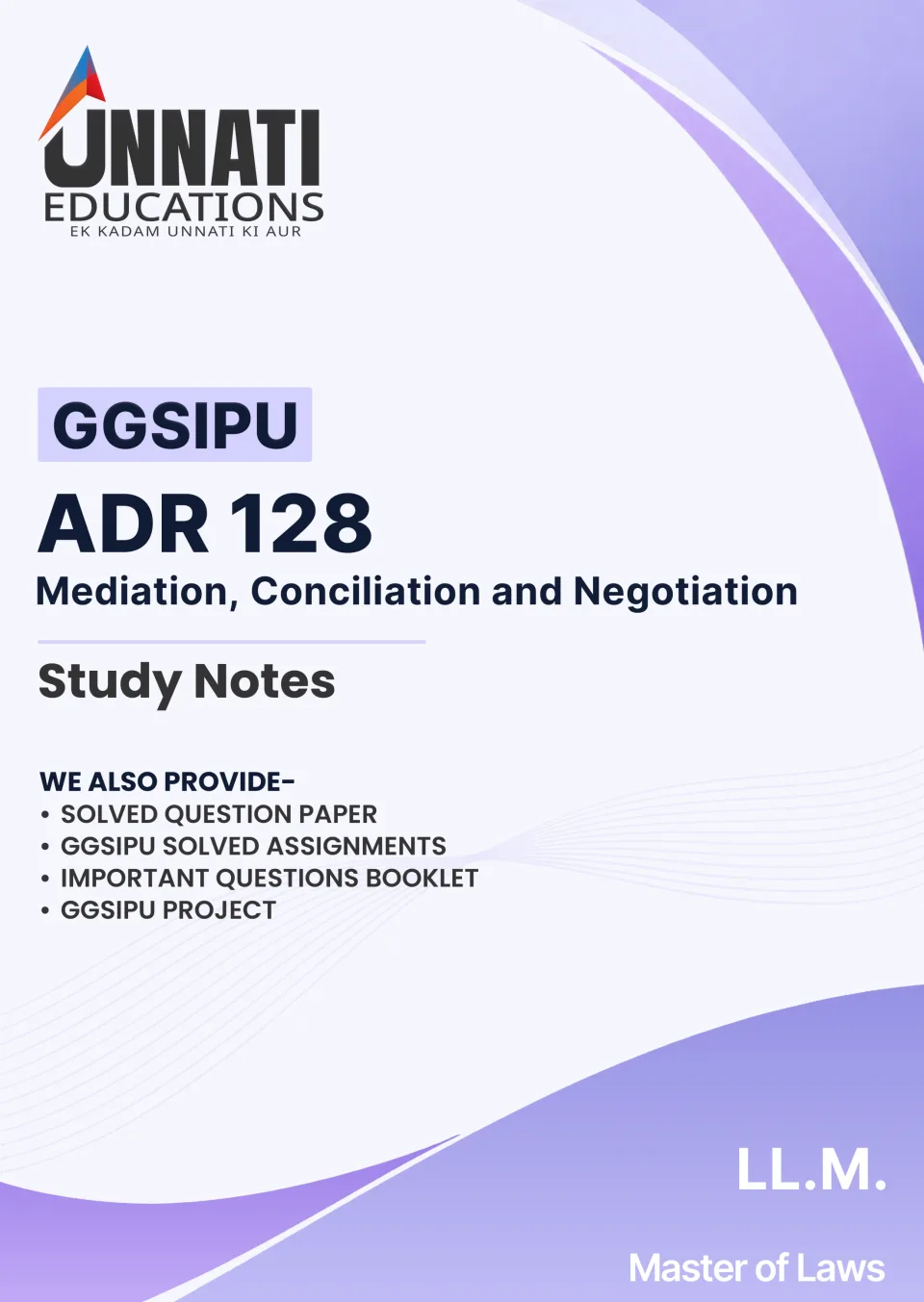
ADR 128 Mediation, Conciliation and Negotiation Notes cover all 4 units of this GGSIPU LL.M. (One Year) ADR paper in a 47-page printed book: 40 solved short-answer questions, 24 long-answer practice questions and 5 process flow charts. They follow the LL.M. syllabus that applies from academic session 2022-23.
Written by Unnati Educations Editorial Team · Reviewed by Sheetal Kirola, Academic Head, M.Ed. (academic review: structure, clarity, syllabus coverage) · Checked against the LL.M. (One Year) scheme and syllabus PDF (DAA notice of 13 Sep 2022) · Updated 14 Oct 2026 · Editorial policy
Scheme: LL.M. (One Year), ADR specialisation | Applies to: batches from 2022-23 (cover reads w.e.f. 2023 onwards) | Verified against: LL.M. Regular One Year Programme w.e.f. 2022-23, ipu.ac.in
ADR 128 Mediation, Conciliation and Negotiation at a glance: GGSIPU LL.M. ADR Sem 2 credits, units and exam pattern
Code and title | ADR 128, Mediation, Conciliation and Negotiation (Paper VI) |
|---|---|
Course and semester | LL.M. (One Year), Alternate Dispute Resolution (ADR) specialisation, Semester 2 |
Teaching and credits | 4 lecture hours + 2 RTDA (Research and Teaching Development Activities) = 5 credits |
Marks | 100: 25 internal (written test + RTDA) + 75 end-semester written exam |
Applies to | LL.M. batches from academic session 2022-23 |
End-term question pattern | Not printed in the official PDF (no paper-setter instructions for LL.M.) |
Units | 4 units, 10 lectures each |
Paired lab | None (theory paper) |
ADR 128's course outcomes: drafting enforceable mediated agreements, and a mediator's communication and negotiation skills. It sits with four other GGSIPU LL.M. Semester 2 papers on the ADR side.
The scheme prints no pass percentage for LL.M. papers; end-term rules sit in Ordinance 11 on examinations. Text books: Sriram Panchu's Mediation Practices and Law and S. Susheela's Mediation Readers Handbook.
ADR 128 Mediation, Conciliation and Negotiation Notes unit-wise: 40 solved short answers and 5 process charts across 4 units
These ADR 128 Mediation, Conciliation and Negotiation IPU notes close each unit with a revision table and exam questions. Notes for other papers sit under GGSIPU LL.M. notes.
ADR 128 Unit 1: Mediation I
Pages 3 to 15, the longest unit. It starts from Section 3(h) of the Mediation Act, 2023, then covers eight features, five types of mediation and the Afcons list of suitable and unsuitable disputes. A 15-row table sets adjudication against mediation, followed by the four MCPC stages, four mediator styles, reframing, BATNA and ten duties of a mediator. 10 solved short answers, 6 long-answer questions.
Quick look: adjudication vs mediation (from page 8)
Basis | Adjudication | Mediation |
|---|---|---|
Who decides | Judge or arbitrator | The parties themselves |
Outcome | Win-lose | Win-win |
Privacy | Generally public | Confidential under S. 22 |
Appeal | Appeal or revision lies | Only a narrow challenge under S. 28 |
Quick look: four differences between adjudication and mediation (from page 8)
Basis
Who decides
Adjudication
Judge or arbitrator
Mediation
The parties themselves
Basis
Outcome
Adjudication
Win-lose
Mediation
Win-win
Basis
Privacy
Adjudication
Generally public
Mediation
Confidential under S. 22
Basis
Appeal
Adjudication
Appeal or revision lies
Mediation
Only a narrow challenge under S. 28
ADR 128 Unit 2: Mediation II
Pages 16 to 26. It explains the MCPC mediation module of 2005 (40-hour training, referral judges), the civil route under Section 89 and Order X CPC, and commercial mediation with Patil Automation (2022). A drafting checklist for settlement agreements, family mediation (K. Srinivas Rao, Amardeep Singh, parenting plans) and victim-offender mediation complete it. 10 solved short answers, 6 long-answer questions.
Quick look: pre-institution mediation under Section 12A (from page 19)
Commercial suit of Rs 3 lakh and above, no urgent interim relief sought.
Pre-institution mediation first, run by the Legal Services Authority.
3 months, plus 2 with consent; excluded from limitation.
Settlement = arbitral award on agreed terms, S. 30(4) A&C Act.
ADR 128 Unit 3: Conciliation and Negotiation
Pages 27 to 38. Conciliation is read through a section-wise table of Part III (Sections 61 to 81) of the 1996 Act, eight modes, labour conciliation under the Industrial Relations Code, 2020, and Haresh Dayaram Thakur. Negotiation covers five stages, ZOPA with a flat-price example, Fisher and Ury's four principles and the Thomas-Kilmann styles. 10 solved short answers, 6 long-answer questions.
Quick look: conciliation procedure under Part III (from page 32)
Written invitation and acceptance (S. 62).
Appointment (Ss. 63 to 64) and written statements (S. 65).
Meetings; conciliator may propose terms (Ss. 67, 69).
Signed, authenticated settlement (S. 73) with award effect (S. 74).
ADR 128 Unit 4: International Practices
Pages 39 to 47. Mediation is compared across eight systems, from the USA and UK to Singapore and Japan, with Halsey (2004), Churchill (2023) and the Singapore Convention. Conciliation is traced through the UNCITRAL Rules, ICSID and UNCLOS Annex V. The last topic uses Article 33 of the UN Charter and four case studies, from the Indus Waters Treaty to Camp David. 10 solved short answers, 6 long-answer questions.
Quick look: forms of international negotiation (from page 44)
Form | Third party role | Example |
|---|---|---|
Bilateral | None, two States talk directly | Simla Agreement, 1972 |
Good offices | Brings States to the table only | UN Secretary-General |
Mediation | Actively suggests solutions | Tashkent Declaration, 1966 |
Track II | Unofficial experts and retired officials | Neemrana Dialogue |
Quick look: four forms of international negotiation with examples (from page 44)
Form
Bilateral
Third party role
None, two States talk directly
Example
Simla Agreement, 1972
Form
Good offices
Third party role
Brings States to the table only
Example
UN Secretary-General
Form
Mediation
Third party role
Actively suggests solutions
Example
Tashkent Declaration, 1966
Form
Track II
Third party role
Unofficial experts and retired officials
Example
Neemrana Dialogue
Victim-offender mediation and restorative justice: excerpt from page 23 of the ADR 128 notes
Excerpt from page 23
Where victim-offender mediation began
Modern victim-offender mediation (VOM) started in Kitchener, Ontario, Canada, in 1974. Two young offenders who had vandalised 22 properties were made to meet each victim, apologise and pay for the damage. This became the first Victim-Offender Reconciliation Program (VORP). Howard Zehr, known as the father of restorative justice, developed the theory in his book Changing Lenses (1990).
Retributive vs restorative justice
Basis | Retributive justice | Restorative justice (VOM) |
|---|---|---|
Crime seen as | Offence against the State | Harm to people and relationships |
Focus | Punishment of the offender | Repair of harm to the victim |
Role of victim | Only a witness | Central participant |
Role of offender | Passive; receives punishment | Takes responsibility; makes amends |
Process | Adversarial trial | Dialogue through a mediator |
Outcome | Jail or fine | Apology, restitution, compensation, reintegration |
How retributive justice and restorative justice (VOM) differ
Basis
Crime seen as
Retributive justice
Offence against the State
Restorative justice (VOM)
Harm to people and relationships
Basis
Focus
Retributive justice
Punishment of the offender
Restorative justice (VOM)
Repair of harm to the victim
Basis
Role of victim
Retributive justice
Only a witness
Restorative justice (VOM)
Central participant
Basis
Role of offender
Retributive justice
Passive; receives punishment
Restorative justice (VOM)
Takes responsibility; makes amends
Basis
Process
Retributive justice
Adversarial trial
Restorative justice (VOM)
Dialogue through a mediator
Basis
Outcome
Retributive justice
Jail or fine
Restorative justice (VOM)
Apology, restitution, compensation, reintegration
Process of victim-offender mediation
1. Referral. The police, prosecutor, court or juvenile board refers the case, usually after the offender admits responsibility.
2. Preparation. The mediator meets the victim and the offender separately and checks that both are willing, safe and ready. Participation must be voluntary for both, especially the victim.
3. Joint meeting. The victim tells how the crime affected him; the offender explains and accepts responsibility; questions are answered.
4. Agreement. A written plan of restitution is made: apology, money, repair work or community service.
5. Follow-up. The mediator or agency checks that the agreement is completed and reports to the referring authority.
Victim-offender mediation in India
India has no separate VOM statute, but several provisions make room for a settlement between victim and offender. Compounding of offences under Section 320 CrPC, now Section 359 of the BNSS, 2023, lets the victim and the accused settle compoundable offences, and the case ends in acquittal.
Plea bargaining under Chapter XXI-A CrPC, now Chapter XXIII (Sections 289 to 300) of the BNSS, includes a "mutually satisfactory disposition" that may involve compensation to the victim, worked out in meetings between the accused, the victim and the prosecutor.
ADR 128 exam corner: 40 solved short-answer and 24 long-answer practice questions by unit
Unit | Short answers (solved) | Long-answer questions (practice, no answers) |
|---|---|---|
1 Mediation I | 10 | 6 |
2 Mediation II | 10 | 6 |
3 Conciliation and Negotiation | 10 | 6 |
4 International Practices | 10 | 6 |
ADR 128 exam questions in the notes, unit by unit
Unit
1 Mediation I
Short answers (solved)
10
Long-answer questions (practice, no answers)
6
Unit
2 Mediation II
Short answers (solved)
10
Long-answer questions (practice, no answers)
6
Unit
3 Conciliation and Negotiation
Short answers (solved)
10
Long-answer questions (practice, no answers)
6
Unit
4 International Practices
Short answers (solved)
10
Long-answer questions (practice, no answers)
6
The ADR 128 notes solve 40 short-answer questions across 4 units, plus 24 long-answer questions for practice. They print no marks labels or year tags, so these are exam-style questions.
Unit 1: State the grounds for challenging a mediated settlement agreement. Pointer: Section 28, within 90 days: fraud, corruption, impersonation, or a dispute not fit for mediation.
Unit 2: What did the Supreme Court hold in K. Srinivas Rao v. D.A. Deepa (2013)? Pointer: matrimonial disputes go to pre-litigation mediation, through pre-litigation desks.
Unit 3: How are conciliation proceedings terminated? Pointer: the four modes in Section 76, from a signed settlement to a written declaration by one party.
Unit 4: What is the significance of Churchill v. Merthyr Tydfil (2023)? Pointer: English courts may order ADR and stay proceedings, if proportionate and fair.
More practice: the ADR 128 important questions.
Who writes and checks the ADR 128 Mediation notes?
Unnati Educations Editorial Team (author): writes the notes from the official syllabus. No individual is named because no team member holds a law degree yet.
Sheetal Kirola (reviewer), Academic Head, Unnati Educations, M.Ed., 7 years of experience: academic review of structure, clarity and syllabus coverage. Her review is not a legal opinion.
The 2026-27 edition maps all 15 official ADR 128 topics to pages and uses the Mediation Act, 2023 and the Industrial Relations Code, 2020. These GGSIPU LL.M. Sem 2 Mediation, Conciliation and Negotiation notes were last checked against the official PDF on 13 Oct 2026; corrections follow the editorial policy.
The team also prepares GGSIPU important questions for each course.
Do the ADR 128 notes cover the full GGSIPU syllabus?
Yes. All 15 official topics across the 4 units have their own section; no gaps found.
Official unit | Official topics | Where in the notes | Status |
|---|---|---|---|
Unit I: Mediation-I | Meaning, scope, importance; adjudication vs mediation; techniques; ethics | Topics 01 to 04, pp. 4, 7, 9, 11 | Covered |
Unit II: Mediation II | Supreme Court's module; civil and commercial; family; victim-offender | Topics 01 to 04, pp. 17, 18, 21, 22 | Covered |
Unit III: Conciliation and Negotiation | Conciliation: nature, modes, law; negotiation: meaning, techniques | Topics 01 to 04, pp. 28, 31, 33, 34 | Covered |
Unit IV: International Practices | Comparative mediation; comparative conciliation; international negotiation | Topics 01 to 03, pp. 40, 42, 43 | Covered |
ADR 128 official syllabus topics mapped to pages in the notes
Official unit
Unit I: Mediation-I
Official topics
Meaning, scope, importance; adjudication vs mediation; techniques; ethics
Where in the notes
Topics 01 to 04, pp. 4, 7, 9, 11
Status
Covered
Official unit
Unit II: Mediation II
Official topics
Supreme Court's module; civil and commercial; family; victim-offender
Where in the notes
Topics 01 to 04, pp. 17, 18, 21, 22
Status
Covered
Official unit
Unit III: Conciliation and Negotiation
Official topics
Conciliation: nature, modes, law; negotiation: meaning, techniques
Where in the notes
Topics 01 to 04, pp. 28, 31, 33, 34
Status
Covered
Official unit
Unit IV: International Practices
Official topics
Comparative mediation; comparative conciliation; international negotiation
Where in the notes
Topics 01 to 03, pp. 40, 42, 43
Status
Covered
Verify the topics yourself in the official LL.M. (One Year) syllabus, w.e.f. 2022-23 on ipu.ac.in. Page 20's drafting section answers course outcome 1.
Every course in GGSIPU notes is mapped to its official PDF the same way.
How to write ADR 128 answers: statute-first definitions, case law boxes and comparison tables
ADR 128 answers are scored on law, not opinion. Each topic in the notes follows one order that doubles as an answer plan: section, features, case, then a table or flow.
Open with the statute. For mediation, use the three key phrases of Section 3(h), Mediation Act, 2023: amicable settlement, third-person assistance, no authority to impose. For conciliation, cite Section 67(4) of the 1996 Act.
Bring in the right case. Afcons (2010) for Section 89 and referral consent; Patil Automation (2022) for Section 12A; Haresh Dayaram Thakur (2000) for conciliation settlements.
Show it visually. "Distinguish" questions suit a table; process questions suit a numbered flow, like the four MCPC stages.
Worked example: distinguish mediation and conciliation. Line 1: both are voluntary; neither neutral can impose a decision. Line 2: a conciliator may propose terms (S. 67(4)); a facilitative mediator does not. Line 3: under Afcons, court referral to conciliation needs consent; to mediation it does not. Line 4: a conciliation settlement acts as an arbitral award (S. 74); a mediated one is enforced like a decree (S. 27, 2023 Act).
Practise it on GGSIPU LL.M. important questions.
ADR 128 and the GGSIPU LL.M. ADR Sem 2 papers it connects to
ADR 128 has no lab paper; the full paper list for each specialisation is on the GGSIPU LL.M. syllabus page.
Same-semester ADR papers: ADR 130 International Commercial Arbitration, ADR 132 International Investment Arbitration, ADR 134 Practical Training in ADR Skills and GEN 110 Dissertation.
Units 1 and 2 (caucus, reframing, drafting) are put to work in ADR 134, where students process at least four cases.
Unit 4's Singapore Convention and Arb-Med-Arb lead into ADR 130's foreign awards.
Unit 4's ICSID conciliation is the non-binding twin of the ICSID arbitration in ADR 132.
Unit 3's Section 74 rule builds on ADR 117 Law of Arbitration.
ADR 128 Mediation notes FAQs
How do I get the full ADR 128 notes?
Tap "Get Full Notes" at the top or the WhatsApp button at the end and send the prefilled message. The ADR 128 notes come only as a printed book, not as a PDF. Delivery takes up to 5 to 7 days after the order is confirmed, depending on your location. The sample PDF in the header shows one page from each unit first.
Do the ADR 128 notes follow the current GGSIPU LL.M. syllabus?
Yes. The notes follow the LL.M. (One Year) scheme filed on ipu.ac.in as applying from academic session 2022-23, though the syllabus cover reads w.e.f. 2023 onwards. All 15 official ADR 128 topics across the 4 units are mapped to pages in the syllabus check above, with the official ipu.ac.in PDF linked there so you can compare.
What is the passing mark for ADR 128?
ADR 128 is marked out of 100: 25 internal marks (written test plus RTDA) and 75 marks in the end-semester written exam conducted by the university. The LL.M. scheme PDF prints no pass percentage, so no pass figure is given here. For end-term minimums and re-appear rules, check GGSIPU Ordinance 11 on ipu.ac.in or ask your school.
Do the ADR 128 notes cover the Mediation Act, 2023?
Yes. Unit 1 builds on the Mediation Act, 2023: the Section 3(h) definition, pre-litigation and online mediation, the 120-day limit with a 60-day extension, confidentiality and the narrow Section 28 challenge. Unit 2 adds drafting, authenticating and enforcing a settlement like a decree, and Unit 3 notes the Act's plan to fold Part III conciliation into mediation.
How is ADR 128 different from ADR 117 Law of Arbitration?
ADR 117 studies arbitration, where an arbitrator decides and the award binds the parties. ADR 128 studies the three methods where the parties decide: mediation, conciliation and negotiation. The two papers meet in Unit 3 of the ADR 128 notes, where a signed conciliation settlement under Section 74 gets the status of an arbitral award on agreed terms.
Which ADR 128 unit needs the most time?
Unit 1 is the longest at 13 pages, because the definition, types, techniques and ethics in it carry the rest of ADR 128. Unit 3 follows at 12 pages, with the Part III section table and the negotiation models. Unit 4 is the shortest at 9 pages but is dense with names, dates and treaties, so revise its quick revision table twice.
Get the full ADR 128 Mediation, Conciliation and Negotiation Notes on WhatsApp
Unit | Pages | Solved short answers | Long-answer questions |
|---|---|---|---|
Unit 1: Mediation I | 13 (pp. 3 to 15) | 10 | 6 |
Unit 2: Mediation II | 11 (pp. 16 to 26) | 10 | 6 |
Unit 3: Conciliation and Negotiation | 12 (pp. 27 to 38) | 10 | 6 |
Unit 4: International Practices | 9 (pp. 39 to 47) | 10 | 6 |
Total (with cover and index) | 47 | 40 | 24 |
What the full ADR 128 notes book contains, unit by unit
Unit
Unit 1: Mediation I
Pages
13 (pp. 3 to 15)
Solved short answers
10
Long-answer questions
6
Unit
Unit 2: Mediation II
Pages
11 (pp. 16 to 26)
Solved short answers
10
Long-answer questions
6
Unit
Unit 3: Conciliation and Negotiation
Pages
12 (pp. 27 to 38)
Solved short answers
10
Long-answer questions
6
Unit
Unit 4: International Practices
Pages
9 (pp. 39 to 47)
Solved short answers
10
Long-answer questions
6
Unit
Total (with cover and index)
Pages
47
Solved short answers
40
Long-answer questions
24
These are Mediation, Conciliation and Negotiation notes in English, sold as a printed book only, not as a PDF. Delivery takes up to 5 to 7 days after the WhatsApp order is confirmed, depending on your location.
Order the ADR 128 notes book on WhatsApp (4 units, 47 pages)
Unnati Educations is an independent education provider based in Vikaspuri, Delhi. We are not affiliated with, authorised by, or endorsed by Guru Gobind Singh Indraprastha University (GGSIPU). 'GGSIPU' and 'IPU' are used only to describe the syllabus our notes follow. For official information, visit ipu.ac.in.
Ready for the full notes?
Discuss coverage and delivery with our team.