
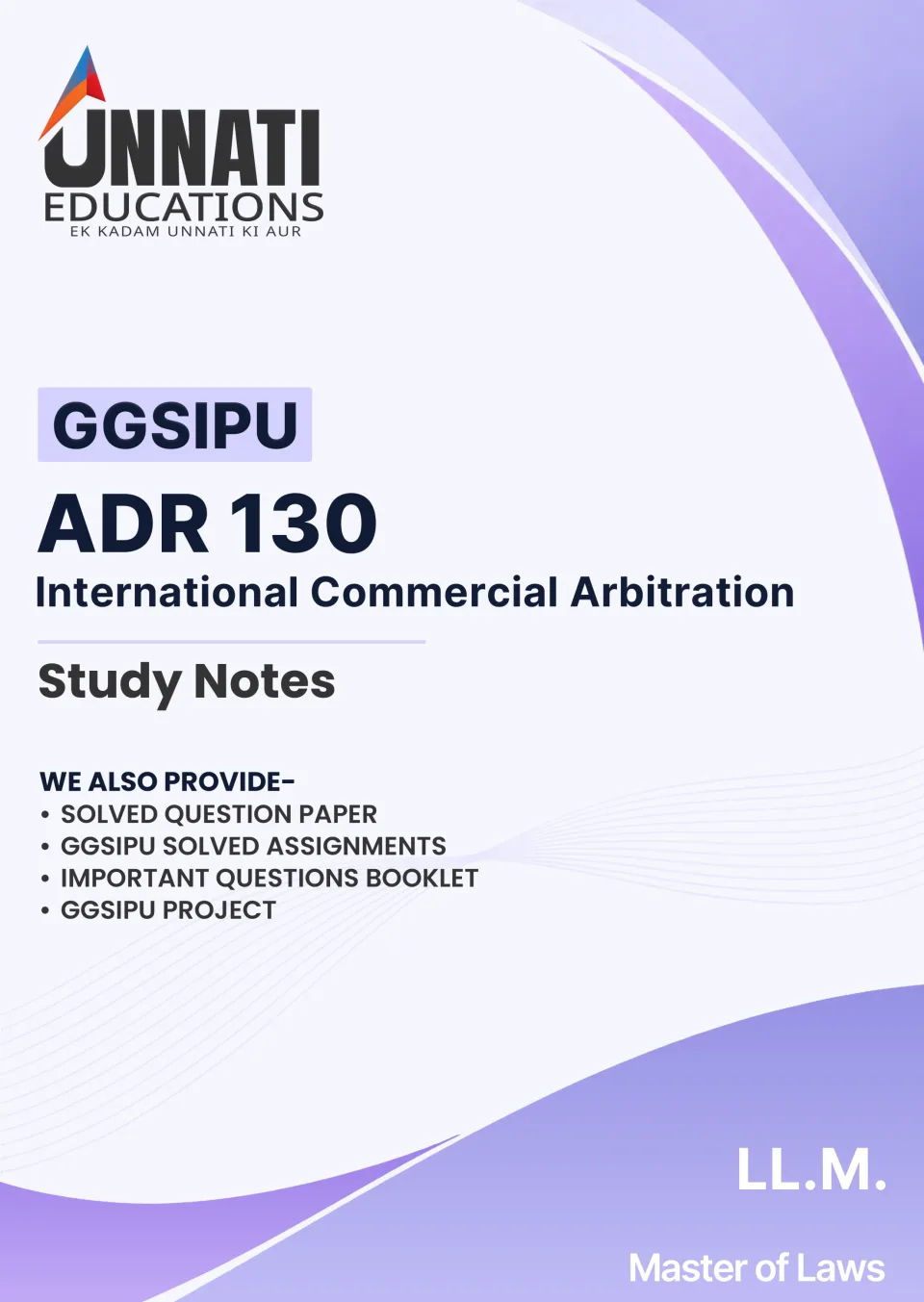
ADR 130 International Commercial Arbitration Notes are a 56-page English study book for GGSIPU LL.M. (One Year) ADR specialisation, Semester 2. They cover all 4 official units with 60 decided cases, 22 solved short-answer questions and 23 long-answer exam-style questions, mapped to the LL.M. scheme that applies from session 2022-23.
Written by Unnati Educations Editorial Team · Reviewed by Prateek Talwar, CS (ICSI), B.Com, business and finance concepts review · Checked against the GGSIPU LL.M. (One Year) Scheme of Examination and Detailed Syllabus, w.e.f. 2022-23 · Updated 14 October 2026 · Editorial policy
Scheme: LL.M. (One Year) Scheme of Examination & Detailed Syllabus, ADR specialisation | Applies to: LL.M. batches from session 2022-23 (cover reads w.e.f. 2023 onwards) | Verified against: official USLLS LL.M. syllabus PDF, checked 14 October 2026
ADR 130 International Commercial Arbitration at a glance: GGSIPU LL.M. Sem 2 credits, units and exam pattern
Code and title | ADR 130 · International Commercial Arbitration (Paper VII) |
|---|---|
Course and semester | LL.M. (One Year), Alternate Dispute Resolution (ADR) specialisation, Semester II |
Credits and weekly hours | 5 credits: L4 + RTDA2 (Research and Teaching Development Activities) |
Marks | 100: 25 internal (written test and RTDA) + 75 semester-end written exam |
Applies to | LL.M. batches from session 2022-23 |
End-term pattern | Not printed in the official LL.M. PDF |
Units | 4 units, 10 lectures each |
Paired lab | None |
Course outcomes: the Model Law in recent Supreme Court cases, and award enforceability. It sits with three other taught GGSIPU LL.M. Semester 2 papers in the ADR stream.
ADR 130 International Commercial Arbitration Notes unit-wise: 60 decided cases and 45 exam questions across 4 units
Each unit runs through its official topics in syllabus order and closes with a Quick Revision Table and questions. These International Commercial Arbitration notes in English keep each section and article next to the rule it states. Other papers of this course: GGSIPU LL.M. notes.
ADR 130 Unit 1: Introduction
Pages 3 to 16. What makes an arbitration "international" under Model Law Article 1(3) versus the party-based test of Section 2(1)(f), the wide reading of "commercial" (R.M. Investment v. Boeing), four theories of arbitration's nature,, a 1794 to 2019 timeline, trade dispute methods, a 24-term glossary, the ICC, LCIA, SIAC, HKIAC, PCA and ICSID and institutional versus ad-hoc arbitration. 6 solved short answers, 6 long-answer questions.
Basis | Institutional | Ad-hoc |
|---|---|---|
Appointment | Institution appoints if a party fails | Needs cooperation, else court under Section 11 |
Cost | Fixed schedule, higher but predictable | No institutional fee, arbitrator fees uncertain |
Emergency relief | Emergency arbitrator available | Must go to court under Section 9 |
Quality control | Award scrutiny (e.g. ICC) | No external check |
Quick look: institutional vs ad-hoc arbitration (from page 14)
Basis
Appointment
Institutional
Institution appoints if a party fails
Ad-hoc
Needs cooperation, else court under Section 11
Basis
Cost
Institutional
Fixed schedule, higher but predictable
Ad-hoc
No institutional fee, arbitrator fees uncertain
Basis
Emergency relief
Institutional
Emergency arbitrator available
Ad-hoc
Must go to court under Section 9
Basis
Quality control
Institutional
Award scrutiny (e.g. ICC)
Ad-hoc
No external check
ADR 130 Unit 2: Applicability of Laws
Pages 17 to 29. Five separate laws (capacity, the arbitration agreement, lex arbitri, lex causae, the enforcement State's law), Section 28 of the Indian Act against Model Law Article 28, and choice-of-law clauses (Vita Food, NTPC v. Singer, Enka v. Chubb). Party autonomy and the seat theory follow India's path from Bhatia International to BALCO, Indus Mobile and BGS SGS Soma, then conflict rules. 6 solved short answers, 6 long-answer questions.
Provision | Rule |
|---|---|
Sec. 28(1)(a) | India-seated domestic arbitration: Indian substantive law |
Sec. 28(1)(b)(i) | India-seated ICA: rules of law chosen by the parties |
Sec. 28(1)(b)(ii) | A country's law means its substantive law, not its conflict rules |
Sec. 28(1)(b)(iii) | No choice: tribunal applies the rules of law it finds appropriate |
Quick look: Section 28, Arbitration and Conciliation Act, 1996 (from page 21)
Provision
Sec. 28(1)(a)
Rule
India-seated domestic arbitration: Indian substantive law
Provision
Sec. 28(1)(b)(i)
Rule
India-seated ICA: rules of law chosen by the parties
Provision
Sec. 28(1)(b)(ii)
Rule
A country's law means its substantive law, not its conflict rules
Provision
Sec. 28(1)(b)(iii)
Rule
No choice: tribunal applies the rules of law it finds appropriate
ADR 130 Unit 3: Regulating International Commercial Arbitration
Pages 30 to 43. The UNCITRAL Model Law (8 chapters, 36 articles, 2006 amendments); judicial intervention from SBP and Section 11(6A) to Vidya Drolia and the 2023 seven-judge stamp ruling; Sections 8 and 45; interim measures under Sections 9 and 17 with Amazon v. Future Retail; and Part II policy on foreign awards from Renusagar to Vijay Karia. 5 solved short answers, 6 long-answer questions.
Stage | Indian Act | Model Law |
|---|---|---|
Refer parties to arbitration | Sec. 8 / 45 | Art. 8 |
Appoint arbitrators | Sec. 11 | Art. 11 |
Interim relief | Sec. 9 | Art. 9, 17J |
Set aside the award (seat courts only) | Sec. 34 | Art. 34 |
Quick look: where courts may step in (from page 34)
Stage
Refer parties to arbitration
Indian Act
Sec. 8 / 45
Model Law
Art. 8
Stage
Appoint arbitrators
Indian Act
Sec. 11
Model Law
Art. 11
Stage
Interim relief
Indian Act
Sec. 9
Model Law
Art. 9, 17J
Stage
Set aside the award (seat courts only)
Indian Act
Sec. 34
Model Law
Art. 34
ADR 130 Unit 4: Recognition or Enforcement of Foreign Arbitral Awards
Pages 44 to 56. The foreign award under New York Convention Article I(1) and Section 44, its six elements, and a domestic versus foreign award table (PASL Wind). Then the Geneva instruments, the New York Convention article by article, India's reciprocity and commercial reservations with the Section 44(b) notification rule, and Part II with a six-step enforcement procedure. 5 solved short answers, 5 long-answer questions.
Geneva Convention, 1927 | New York Convention, 1958 |
|---|---|
Award had to be "final" at the seat (double exequatur) | Award only needs to be "binding" |
Applicant proves every condition | Resisting party proves Art. V(1) grounds |
Many documents required | Only award and agreement (Art. IV) |
Quick look: what the New York Convention changed (from page 48)
Geneva Convention, 1927
Award had to be "final" at the seat (double exequatur)
New York Convention, 1958
Award only needs to be "binding"
Geneva Convention, 1927
Applicant proves every condition
New York Convention, 1958
Resisting party proves Art. V(1) grounds
Geneva Convention, 1927
Many documents required
New York Convention, 1958
Only award and agreement (Art. IV)
Enforcing annulled awards in international arbitration: excerpt from page 53 of the ADR 130 notes
Excerpt from page 53 (Unit 4, topic 05). This page is also in the sample PDF.
What is an annulled award?
An annulled award is an award that a court of the seat has set aside under its own arbitration law, for example under Article 34 of the Model Law. The practical question is simple: once the seat court has cancelled the award, can the winning party still enforce it in another country where the losing party has assets?
Article V(1)(e) of the New York Convention says recognition and enforcement "may be refused" if the award has been set aside by a competent authority of the country in which, or under the law of which, it was made. Two features keep the question open. The word is "may", not "shall".
And Article VII(1), the more-favourable-right provision, lets a party rely on any domestic law of the enforcing State that is kinder to awards. Different countries have read these two provisions in different ways.
Approach 1: the territorial view (an annulled award cannot be enforced)
This view rests on the seat theory. The award takes its legal life from the law of the seat, so when the seat court annuls it, the award stops existing. The Latin maxim used is ex nihilo nihil fit: nothing comes from nothing. Germany, most common-law countries and, in general, US courts follow this approach.
Baker Marine (Nig.) Ltd. v. Chevron (Nig.) Ltd. (1999, US 2nd Circuit): the court refused to enforce Nigerian awards that Nigerian courts had annulled. The parties had chosen Nigerian law, and the US court would not second-guess the Nigerian annulment.
TermoRio S.A. E.S.P. v. Electranta S.P. (2007, US D.C. Circuit): a Colombian award annulled in Colombia was not enforced. An award set aside at the seat generally does not exist to be enforced, unless the annulment itself violates basic notions of justice.
Approach 2: the French, delocalised view (annulment at the seat is irrelevant)
French law does not anchor an international award in any national legal order; it treats it as an "international decision". A French court applies only the French grounds of refusal, and annulment abroad is not one of them. So, relying on Article VII of the Convention, an award annulled at its seat can still be enforced in France.
How to write ADR 130 answers: case-led fifteen-mark essays and section-based short notes
Long answers (10 to 15 Marks). Follow the unit's exam-tip plan: statutory definition, the Model Law or Convention article it mirrors, then cases in time order. For seat theory: meaning, seat versus venue, Section 20, BALCO, Indus Mobile, BGS SGS Soma, the delocalisation contrast, conclusion.
Comparisons and short notes. Institutional versus ad-hoc needs a table of at least 8 points and one example clause of each. For 2 to 5 Marks: one definition, one section, one case.
Common slip. Misapplying the chosen law is usually only an error of law, not a ground to set aside a foreign award; refusing to apply it at all is an excess of mandate.
Worked example (Unit 4). "Explain the reciprocity reservation and the Indian position." Plan: Article I(3), meaning, India's double requirement (a Convention country plus a Section 44(b) notification), the civil-suit route for non-notified countries (Badat & Co., 1964), then a table of advantages and criticism.
Practise these plans on GGSIPU LL.M. important questions.
ADR 130 exam corner: 22 two-to-five-mark solved and 23 ten-to-fifteen-mark questions by unit
Unit | Short answers (2–5 Marks), solved | Long answers (10–15 Marks) |
|---|---|---|
1 Introduction | 6 | 6 |
2 Applicability of Laws | 6 | 6 |
3 Regulating ICA | 5 | 6 |
4 Foreign arbitral awards | 5 | 5 |
ADR 130 questions in the notes by unit (long answers have no model answers)
Unit
1 Introduction
Short answers (2–5 Marks), solved
6
Long answers (10–15 Marks)
6
Unit
2 Applicability of Laws
Short answers (2–5 Marks), solved
6
Long answers (10–15 Marks)
6
Unit
3 Regulating ICA
Short answers (2–5 Marks), solved
5
Long answers (10–15 Marks)
6
Unit
4 Foreign arbitral awards
Short answers (2–5 Marks), solved
5
Long answers (10–15 Marks)
5
The ADR 130 notes solve 22 short-answer questions and set 23 long-answer questions across 4 units, plus 60 decided cases. No year tags are printed, so these are exam-style questions.
Unit 1, short: "Difference between seat and venue?" Seat is the legal home; venue is only where hearings happen (BGS SGS Soma, 2019).
Unit 2, long: "What is a choice of law clause? How is it enforced?" Vita Food, NTPC v. Singer, limits from public policy.
Unit 3, short: "Effect of Section 17(2)?" A tribunal's interim order is deemed a court order, enforceable under the CPC.
Unit 4, long: "Can an award annulled at the seat be enforced elsewhere?" Article V(1)(e), Article VII, three approaches, Section 48(1)(e).
More practice sits in the ADR 130 important questions.
ADR 130 and the GGSIPU LL.M. Sem 2 papers it connects to
ADR 130 has no lab paper; the paper list for every specialisation is on the GGSIPU LL.M. syllabus page.
ADR 117 Law of Arbitration (Semester I): arbitration law in India under Part I. ADR 130 Unit 3 reuses Sections 8, 9 and 17.
ADR 132 International Investment Arbitration: its Unit III also covers enforcing foreign awards in India, the ground of ADR 130 Unit 4.
ADR 128 Mediation, Conciliation and Negotiation: ADR 130 Unit 1 places the Mediation Act, 2023 and the Singapore Convention, 2019 among trade dispute methods.
ADR 134 Practical Training in ADR Skills: internally evaluated on at least four processed cases; Unit 2 clauses feed that work.
Who writes and checks the ADR 130 arbitration notes?
Unnati Educations Editorial Team: writes the notes from the official ADR 130 units and the prescribed text books (Grenig; Kröll, Mistelis and others). Credited to the team, not a named lawyer.
Prateek Talwar: Founder, Unnati Educations; Associate Company Secretary (ACS), ICSI, since 2019; B.Com, University of Delhi. Reviews the business and finance concepts, not legal practice. Profile
The 2026-27 edition uses the Bharatiya Sakshya Adhiniyam, 2023, the Mediation Act, 2023, the SIAC Rules 2025 and the English Arbitration Act 2025. Updated 14 October 2026; corrections follow the editorial policy.
The same team prepares GGSIPU important questions for every course it covers.
Do the ADR 130 notes cover the full GGSIPU syllabus?
Yes. All 21 official topic lines in the four ADR 130 units have a matching section in the notes.
Official unit | Official topics | Where in the notes | Status |
|---|---|---|---|
I: Introduction | Concept and emergence; trade disputes; key terms; institutions; institutional vs ad-hoc | Topics 01–05, pages 4–14 | Covered |
II: Applicability of Laws | Types of laws; governing law; choice of law clause; party autonomy and seat theory; conflict rules | Topics 01–05, pages 18–27 | Covered |
III: Regulating ICA | Model Law; judicial intervention; reference; interim measures; foreign award policy in India | Topics 01–05, pages 31–41 | Covered |
IV: Recognition or enforcement of foreign arbitral awards | Foreign award; conventions; reciprocity and commercial reservation; Indian law; annulled awards | Topics 01–05, pages 45–55 | Covered |
ADR 130 official syllabus mapped to the notes
Official unit
I: Introduction
Official topics
Concept and emergence; trade disputes; key terms; institutions; institutional vs ad-hoc
Where in the notes
Topics 01–05, pages 4–14
Status
Covered
Official unit
II: Applicability of Laws
Official topics
Types of laws; governing law; choice of law clause; party autonomy and seat theory; conflict rules
Where in the notes
Topics 01–05, pages 18–27
Status
Covered
Official unit
III: Regulating ICA
Official topics
Model Law; judicial intervention; reference; interim measures; foreign award policy in India
Where in the notes
Topics 01–05, pages 31–41
Status
Covered
Official unit
IV: Recognition or enforcement of foreign arbitral awards
Official topics
Foreign award; conventions; reciprocity and commercial reservation; Indian law; annulled awards
Where in the notes
Topics 01–05, pages 45–55
Status
Covered
Official source: GGSIPU USLLS, Master of Laws (LL.M.) Regular One Year Programme, w.e.f. 2022-23 (ADR 130 is on printed page 44).
The ADR 130 International Commercial Arbitration IPU notes were checked against this PDF topic by topic. Every course in GGSIPU notes is mapped to its official PDF the same way.
ADR 130 arbitration notes FAQs
How do I get the full ADR 130 notes?
Message Unnati Educations on WhatsApp at 9899436384 using the "Get Full Notes" button on this page. The full ADR 130 notes are sold as a printed book only and are not available as a PDF. Delivery takes a maximum of 5 to 7 days, depending on your location. The team confirms your course and address on WhatsApp before dispatch.
How many marks is ADR 130 out of, and what is the passing mark?
ADR 130 is marked out of 100: 25 internal marks (a written test and RTDA, assessed by the subject teacher) and a 75-mark semester-end written exam set by the Examination Division. The official LL.M. PDF does not print a pass percentage, so none is quoted here. For end-term minimums and re-appear rules, read the university's Ordinance 11 on ipu.ac.in or ask your school office.
Which ADR 130 unit has the most case law?
Unit 3, Regulating International Commercial Arbitration, carries the most case law in the ADR 130 notes. It traces judicial intervention from SBP and Duro Felguera to Vidya Drolia and the 2023 stamp ruling, then the public policy line from Renusagar through Saw Pipes, Phulchand, Shri Lal Mahal and Ssangyong to Vijay Karia. The Unit 3 revision table lists every case by topic.
Is ADR 130 the same paper as ADR 117 Law of Arbitration?
No. ADR 117, a Semester I paper, studies arbitration law mainly as it works inside India under Part I of the 1996 Act. ADR 130 in Semester II deals with cross-border disputes: which law applies, the UNCITRAL Model Law, foreign-seated arbitration and the enforcement of foreign awards under Part II and the New York Convention. ADR 130 Unit 3 assumes the Part I basics.
Do the ADR 130 notes follow the scheme for my batch?
The ADR 130 notes follow the LL.M. (One Year) Scheme of Examination and Detailed Syllabus published by USLLS for batches from session 2022-23; the PDF cover reads "w.e.f 2023 onwards". All four units and their 21 topic lines match the notes. If a newer scheme is issued, compare its ADR 130 units with the coverage table above.
Are the ADR 130 long-answer questions solved in the notes?
Partly. The 22 short-answer questions (2 to 5 Marks) carry written answers. The 23 long-answer questions (10 to 15 Marks) are given without model answers; instead, each unit has exam-tip boxes with an answer plan, and the topic pages hold the material to build a full answer. Each ADR 130 unit ends with a Quick Revision Table.
Get the full ADR 130 International Commercial Arbitration Notes on WhatsApp
Unit | Pages | Solved short / long questions |
|---|---|---|
1 Introduction | 3–16 (14) | 6 / 6 |
2 Applicability of Laws | 17–29 (13) | 6 / 6 |
3 Regulating ICA | 30–43 (14) | 5 / 6 |
4 Foreign arbitral awards | 44–56 (13) | 5 / 5 |
What is inside the ADR 130 notes book
Unit
1 Introduction
Pages
3–16 (14)
Solved short / long questions
6 / 6
Unit
2 Applicability of Laws
Pages
17–29 (13)
Solved short / long questions
6 / 6
Unit
3 Regulating ICA
Pages
30–43 (14)
Solved short / long questions
5 / 6
Unit
4 Foreign arbitral awards
Pages
44–56 (13)
Solved short / long questions
5 / 5
This is the complete set of GGSIPU LL.M. Sem 2 International Commercial Arbitration notes: 56 pages with 60 decided cases. It is a printed book only, not available as a PDF. Delivery is a maximum of 5 to 7 days, depending on your location.
Order the ADR 130 notes book on WhatsApp (4 units, 56 pages)
Unnati Educations is an independent education provider based in Vikaspuri, Delhi. We are not affiliated with, authorised by, or endorsed by Guru Gobind Singh Indraprastha University (GGSIPU). 'GGSIPU' and 'IPU' are used only to describe the syllabus our notes follow. For official information, visit ipu.ac.in.
Ready for the full notes?
Discuss coverage and delivery with our team.