
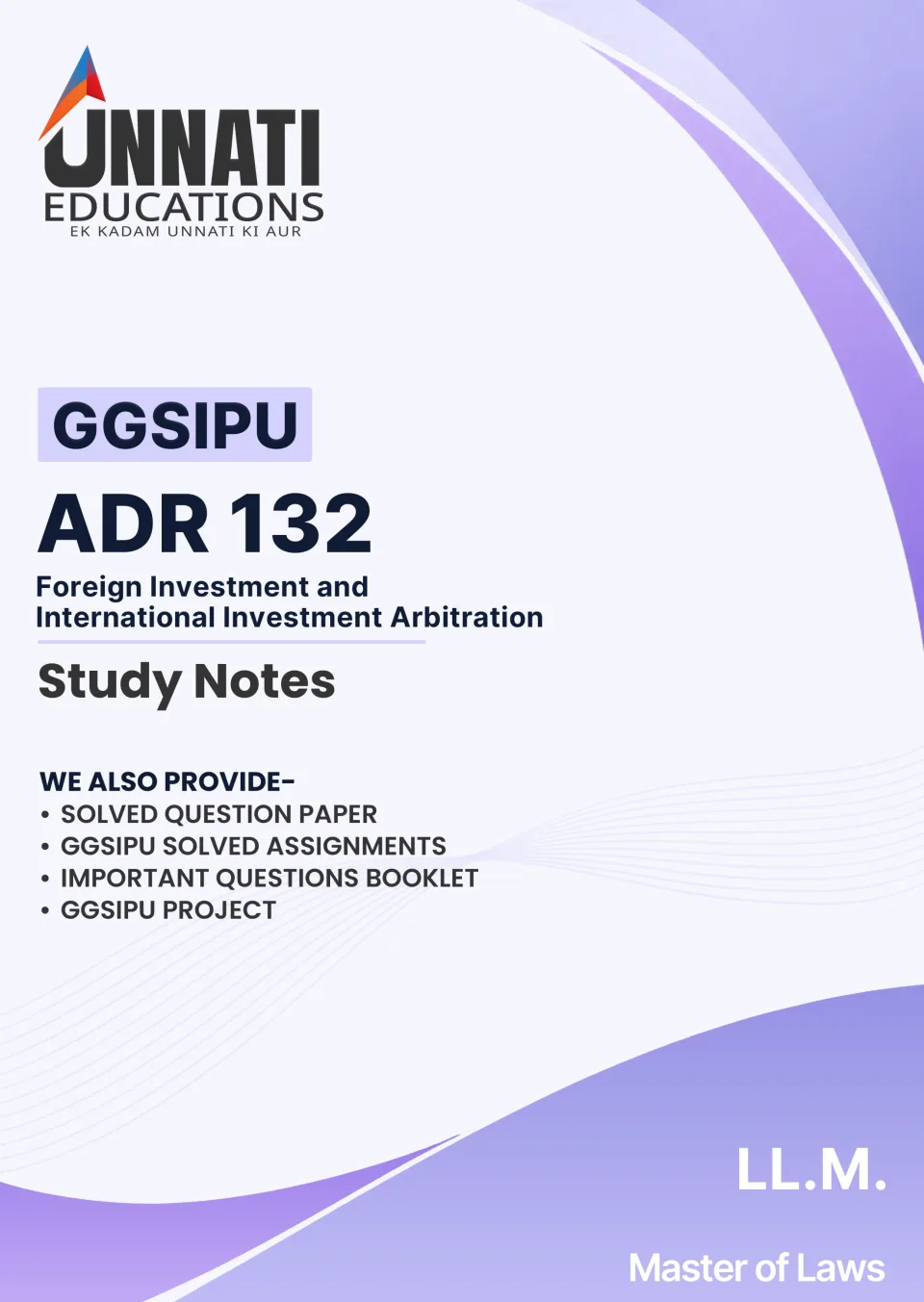
ADR 132 Foreign Investment and International Investment Arbitration Notes cover all 4 units of this GGSIPU LL.M. (ADR) Semester 2 paper in a 38-page printed book: 16 topic sections, 4 quick revision tables, more than 75 cases and awards, and 56 exam-style questions (31 short, 25 long). They follow the LL.M. (One Year) syllabus published by GGSIPU.
Written by Unnati Educations Editorial Team · Reviewed by Prateek Talwar, ACS (ICSI), business and finance concepts review · Checked against GGSIPU LL.M. (One Year) scheme and syllabus · Updated 13 October 2026 · Editorial policy
Scheme: LL.M. (One Year) scheme of examination and detailed syllabus | Applies to: LL.M. batches from 2022-23 (cover reads w.e.f. 2023 onwards) | Verified against: Master of Law (LL.M.) Regular One Year Programme w.e.f 2022-23, ipu.ac.in
ADR 132 Foreign Investment and International Investment Arbitration at a glance: GGSIPU LL.M. Sem 2 credits, units and exam pattern
ADR 132 is Paper VIII of the GGSIPU LL.M. (One Year) programme with the Alternate Dispute Resolution specialisation. It moves from FDI basics and treaty rights to ISDS remedies and the ICSID Convention, so it is the paper where arbitration meets public international law. It sits with three other GGSIPU LL.M. Semester 2 papers and the dissertation.
Code and title | ADR 132 Foreign Investment and International Investment Arbitration (scheme table lists it as "International Investment Arbitration") |
|---|---|
Course and semester | LL.M. (One Year), ADR specialisation, Semester 2, Paper VIII |
Credits and weekly hours | 5 credits: 4 lecture hours + 2 RTDA (Research and Teaching Development Activities) |
Marks | 100: 25 internal (written test + RTDA) + 75 semester-end written exam |
Applies to | LL.M. batches from 2022-23; the syllabus cover reads "w.e.f 2023 onwards" |
End-term pattern | Paper-setter instructions are not printed in the official PDF |
Units | 4 units, 10 lectures each |
Paired lab | None. ADR 134 Practical Training in ADR Skills is a separate paper in the same semester |
ADR 132 Foreign Investment and International Investment Arbitration Notes unit-wise: 56 exam questions and 75+ cases across 4 units
Each unit runs its four GGSIPU syllabus topics back to back and ends with a revision table and exam questions. Notes for every other paper in the programme sit under GGSIPU LL.M. notes. The sample PDF at the top shows one page per unit.
ADR 132 Unit 1: Introduction
Pages 3 to 10. FDI vs FPI (with India's 10% line), then the law across four eras: Calvo and Hull, UNGA Resolution 1803, the 1990s BIT boom and today's rebalancing. It closes with FDI flow trends, India's automatic and government routes, and whether FDI helps development. 7 short and 6 long questions.
View | Core idea | Policy result |
|---|---|---|
Liberal | FDI brings capital, technology and jobs | Open economy, strong BITs |
Dependency | Profits flow back to rich states | Nationalisation, Calvo doctrine |
Middle path | FDI helps only if regulated | Selective opening, right to regulate |
Quick look: three views on FDI and development (from page 8)
View
Liberal
Core idea
FDI brings capital, technology and jobs
Policy result
Open economy, strong BITs
View
Dependency
Core idea
Profits flow back to rich states
Policy result
Nationalisation, Calvo doctrine
View
Middle path
Core idea
FDI helps only if regulated
Policy result
Selective opening, right to regulate
ADR 132 Unit 2: Regulation of Foreign Investment
Pages 11 to 19, the most case-heavy unit. Minimum standard vs national treatment (Neer v. Mexico), FERA 1973 to FEMA 1999, BITs and regional treaties, and each treaty right: NT, MFN, FET, full protection and security, expropriation. It ends with investor duties on environment, human rights and corruption under India's Model BIT 2016. 8 short and 6 long questions.
Case | Result |
|---|---|
Metalclad v. Mexico (2000) | Permit denial = indirect expropriation; effect on investor decides |
Methanex v. USA (2005) | Bona fide public-purpose regulation is not expropriation |
Philip Morris v. Uruguay (2016) | Health warnings were valid police powers |
Quick look: when regulation becomes expropriation (from page 16)
Case
Metalclad v. Mexico (2000)
Result
Permit denial = indirect expropriation; effect on investor decides
Case
Methanex v. USA (2005)
Result
Bona fide public-purpose regulation is not expropriation
Case
Philip Morris v. Uruguay (2016)
Result
Health warnings were valid police powers
ADR 132 Unit 3: Remedies for Foreign Investors
Pages 20 to 28. Six routes to relief from local courts to treaty ISDS, the legitimacy problems with ISDS and India's own cases (White Industries, Vodafone, Cairn). Then seven arbitral institutions from ICSID to HKIAC, and enforcement in India under Part II of the 1996 Act, Renusagar to Gemini Bay. 8 short and 6 long questions.
Point | Fork in the road | Umbrella clause |
|---|---|---|
Purpose | Limits remedies to one forum | Lifts contract duties into the treaty |
Helps mainly | Host state | Investor |
Key cases | Vivendi, Pantechniki | SGS v. Pakistan, SGS v. Philippines |
India Model BIT 2016 | Replaced by 5-year local remedies | No umbrella clause |
Quick look: fork in the road vs umbrella clause (from page 24)
Point
Purpose
Fork in the road
Limits remedies to one forum
Umbrella clause
Lifts contract duties into the treaty
Point
Helps mainly
Fork in the road
Host state
Umbrella clause
Investor
Point
Key cases
Fork in the road
Vivendi, Pantechniki
Umbrella clause
SGS v. Pakistan, SGS v. Philippines
Point
India Model BIT 2016
Fork in the road
Replaced by 5-year local remedies
Umbrella clause
No umbrella clause
ADR 132 Unit 4: International Centre for Settlement of Investment Disputes
Pages 29 to 38, the longest unit. ICSID's organs, why India never signed, and the process from request (Art. 36) to award (Art. 48), with the five Art. 52 annulment grounds. It also covers preliminary objections and the Salini test with MHS, Biwater and Abaclat. 8 short and 7 long questions.
Objection | Question asked |
|---|---|
Ratione personae | Is the claimant a national of another Contracting State? |
Ratione materiae | Is there a legal dispute arising directly out of an investment? |
Ratione temporis | Did the dispute arise after the treaty came into force? |
Ratione voluntatis | Has the state given valid written consent? |
Quick look: four kinds of jurisdictional objection (from page 33)
Objection
Ratione personae
Question asked
Is the claimant a national of another Contracting State?
Objection
Ratione materiae
Question asked
Is there a legal dispute arising directly out of an investment?
Objection
Ratione temporis
Question asked
Did the dispute arise after the treaty came into force?
Objection
Ratione voluntatis
Question asked
Has the state given valid written consent?
ADR 132 exam corner: 31 five-mark and 25 ten-to-fifteen-mark practice questions by unit
Each unit ends with short-answer ("5 marks") and long-answer ("10–15 marks") questions, answered from that unit's sections and revision table.
Unit | Short answer (5 Marks) | Long answer (10–15 Marks) | Revision table |
|---|---|---|---|
1 Introduction | 7 | 6 | 13 rows |
2 Regulation of Foreign Investment | 8 | 6 | 15 rows |
3 Remedies for Foreign Investors | 8 | 6 | 15 rows |
4 ICSID | 8 | 7 | 15 rows |
ADR 132 exam questions in the notes, by unit
Unit
1 Introduction
Short answer (5 Marks)
7
Long answer (10–15 Marks)
6
Revision table
13 rows
Unit
2 Regulation of Foreign Investment
Short answer (5 Marks)
8
Long answer (10–15 Marks)
6
Revision table
15 rows
Unit
3 Remedies for Foreign Investors
Short answer (5 Marks)
8
Long answer (10–15 Marks)
6
Revision table
15 rows
Unit
4 ICSID
Short answer (5 Marks)
8
Long answer (10–15 Marks)
7
Revision table
15 rows
The ADR 132 notes list 31 short-answer and 25 long-answer questions across 4 units. Four of them, with where to find the answer:
Unit 1: "Foreign investment is a double-edged sword for developing countries." Answer from the benefits and problems lists on page 8, close with the Model BIT 2016 middle path on page 9.
Unit 2: Explain the conditions of a lawful expropriation and the police powers doctrine. Four conditions plus the Metalclad, Methanex and Philip Morris table on page 16.
Unit 3: What is an umbrella clause? Use the SGS v. Pakistan (narrow) and SGS v. Philippines (broad) split, then El Paso's middle view, on pages 23 and 24.
Unit 4: Compare enforcement of ICSID awards with New York Convention awards. The four-row comparison and Arts. 53 to 55 on pages 32 and 33.
More practice sits in the ADR 132 important questions.
Nationality of investors and patterns of consent in ICSID arbitration: excerpt from page 35 of the ADR 132 notes
Excerpt from page 35
Nationality rules under Article 25(2)
ICSID hears a dispute only between a Contracting State and a national of another Contracting State, so nationality is tested at the start of almost every case. For a natural person, the claimant must hold the nationality of another Contracting State on two dates: the date of consent and the date the request is registered. If the person also holds the host state's nationality on either date, the claim is barred. Dual nationals cannot sue their own state through ICSID.
Two cases show how strict this is. In Soufraki v. UAE (2004) the claimant had lost his Italian nationality under Italian law; an Italian passport was not enough, and the tribunal declined jurisdiction. In Champion Trading v. Egypt, US claimants who also held Egyptian nationality were excluded.
Companies and the foreign control limb
A company needs the nationality of another Contracting State only on the date of consent. The second limb of Art. 25(2)(b) adds a twist: a company incorporated in the host state can be treated as foreign if the parties agree to it because of foreign control. In Amco Asia v. Indonesia (1983) an Indonesian company controlled by foreign investors was treated as foreign by agreement. In Vacuum Salt v. Ghana (1994) a 20% foreign holding with no real control failed the test.
The hardest case is Tokios Tokelés v. Ukraine (2004). A Lithuanian company, 99% owned by Ukrainian nationals, sued Ukraine. The tribunal applied the place of incorporation test and accepted jurisdiction. Its president, Prosper Weil, dissented: ICSID, he said, was built for international capital, not domestic money routed abroad.
Five patterns of consent
Consent in writing is the cornerstone of ICSID jurisdiction, and it can be given five ways. The traditional route is an arbitration clause in an investment contract, as in Holiday Inns v. Morocco (1972), the first ICSID case. Parties can also sign a compromis after the dispute arises, though this is rare. A host state can offer ICSID arbitration in its investment law, as Egypt's Law No. 43 of 1974 did in SPP v. Egypt. Most claims today rest on a standing offer in a BIT, accepted when the investor files: the "arbitration without privity" route first used in AAPL v. Sri Lanka (1990). Finally, multilateral treaties such as Art. 26 of the Energy Charter Treaty carry the same kind of offer.
Do the ADR 132 notes cover the full GGSIPU syllabus?
Yes. All 16 topics in the four official ADR 132 units have their own section in the notes, and each unit adds a revision table and exam questions.
Official unit | Official topics | Where in the notes | Status |
|---|---|---|---|
I: Introduction | Issues and trends in foreign investments; historical context; trends in flow; foreign investments and development | Sections 01 to 04, pages 4 to 9 | Covered |
II: Regulation of Foreign Investment | Historical trends in regulation; bilateral, regional and multilateral treaties; rights of foreign investors; responsibilities vis-à-vis environment, human rights and host-state concerns | Sections 01 to 04, pages 12 to 18 | Covered |
III: Remedies for Foreign Investors | Treaty-based remedies; fork in the road and umbrella clauses; foreign arbitral institutions; recognition and enforcement of foreign awards with reference to India | Sections 01 to 04, pages 21 to 27 | Covered |
IV: ICSID | Overview of ICSID; Washington Convention 1965; preliminary jurisdictional issues; Article 25 jurisdiction, consent and meaning of foreign investment | Sections 01 to 04, pages 30 to 36 | Covered |
ADR 132 official syllabus mapped to the notes
Official unit
I: Introduction
Official topics
Issues and trends in foreign investments; historical context; trends in flow; foreign investments and development
Where in the notes
Sections 01 to 04, pages 4 to 9
Status
Covered
Official unit
II: Regulation of Foreign Investment
Official topics
Historical trends in regulation; bilateral, regional and multilateral treaties; rights of foreign investors; responsibilities vis-à-vis environment, human rights and host-state concerns
Where in the notes
Sections 01 to 04, pages 12 to 18
Status
Covered
Official unit
III: Remedies for Foreign Investors
Official topics
Treaty-based remedies; fork in the road and umbrella clauses; foreign arbitral institutions; recognition and enforcement of foreign awards with reference to India
Where in the notes
Sections 01 to 04, pages 21 to 27
Status
Covered
Official unit
IV: ICSID
Official topics
Overview of ICSID; Washington Convention 1965; preliminary jurisdictional issues; Article 25 jurisdiction, consent and meaning of foreign investment
Where in the notes
Sections 01 to 04, pages 30 to 36
Status
Covered
Verify the topics yourself in the official LL.M. (One Year) syllabus w.e.f. 2022-23 on ipu.ac.in. The scheme table names it "International Investment Arbitration"; the units are the same.
Every paper listed in GGSIPU notes is mapped to its official PDF the same way.
Who writes and checks the ADR 132 investment arbitration notes?
Unnati Educations Editorial Team wrote the notes: structure, unit summaries, revision tables and question sets, built from the official LL.M. syllabus and the textbooks it prescribes.
Prateek Talwar, Founder of Unnati Educations, Associate Company Secretary (ACS), ICSI, reviewed the business and finance concepts in ADR 132: FDI vs FPI, FEMA routes, BIT economics, tax disputes such as Vodafone and Cairn, and award enforcement. Reviewer profile.
The 2026-27 edition is mapped to the LL.M. (One Year) scheme of examination and covers India's Model BIT 2016, the ICSID 2022 Rules and the UNCITRAL Working Group III reform track. Last updated 13 October 2026. Read how we check content in our editorial policy.
The same team prepares GGSIPU important questions for each course it covers.
ADR 132 and the GGSIPU LL.M. Sem 2 papers it connects to
ADR 132 has no lab, so the full paper list sits in the GGSIPU LL.M. syllabus.
In the ADR specialisation, Semester 2 also has ADR 128 Mediation, Conciliation and Negotiation, ADR 130 International Commercial Arbitration, ADR 134 Practical Training in ADR Skills and GEN 110 Dissertation. ADR 130 Unit IV and ADR 132 Unit III both deal with foreign awards and the New York Convention, so reading them together saves revision time.
From Semester 1,
Law of Arbitration gives the 1996 Act background for Unit III, and GEN 105 touches BITs and ISDS in its Unit IV.
How to write ADR 132 answers: treaty clause, tribunal view and India's position in one structure
ADR 132 answers score when they move from rule to case to Indian position: the treaty article, two tribunal decisions that disagree, and where India stands under the Model BIT 2016. The notes build each section in that order.
Every unit carries an exam tip box with a ready answer path; Unit 4, for example, sets the Article 25 order: five essentials, nationality, consent, meaning of investment, Salini, then criticism.
Worked example (10-mark answer, from the Unit 3 tip on page 27): "Discuss enforcement of foreign awards in India."
New York Convention 1958 and India's two reservations: reciprocity and commercial.
Part II of the 1996 Act: Ss. 44 to 52, with S. 48 grounds and S. 49 deemed decree.
The 2015 public policy explanations: fraud or corruption, fundamental policy, basic notions of justice; no review on merits.
Cases in sequence: Renusagar, Bhatia, BALCO, Shri Lal Mahal, Vijay Karia.
Close on the open issue: BIT awards against India (India is outside ICSID; Vodafone and Khaitan rulings).
Common slip: applying the ONGC v. Saw Pipes test to foreign awards, which Shri Lal Mahal ruled out. Practise this format on GGSIPU LL.M. important questions.
ADR 132 investment arbitration notes FAQs
How do I get the full ADR 132 notes?
The full ADR 132 notes come as a printed book only; they are not available as a PDF. Tap "Get Full Notes" to message Unnati Educations on WhatsApp at 9899436384 with the paper code. The team confirms the order there, and the book reaches you in a maximum of 5 to 7 days, depending on your location. The sample PDF shows one page from each unit first.
Is ADR 132 the same paper as "International Investment Arbitration" in the LL.M. scheme?
Yes. The ADR specialisation table in the GGSIPU LL.M. scheme lists ADR 132 as International Investment Arbitration, while its detailed syllabus page names it Foreign Investment and International Investment Arbitration. Both carry the same code, Paper VIII, 5 credits and the same four units, so these notes fit whichever title your college uses on the date sheet.
How many marks is ADR 132 and what is the passing mark?
ADR 132 is marked out of 100: 25 internal (written test plus RTDA) and 75 in the semester-end written exam. The official LL.M. syllabus PDF does not print a pass percentage, so we do not state one. For end-term minimums and re-appear rules, check GGSIPU Ordinance 11 on ipu.ac.in. The degree needs all 55 programme credits.
Which ADR 132 unit is the longest in the notes?
Unit 4 on ICSID runs to 10 pages (29 to 38) and has the most long questions, 7. It goes article by article through the Washington Convention, the annulment grounds and Article 25. Units 2 and 3 have 9 pages each; Unit 2 carries the most treaty-right case law, from Maffezini to Urbaser, so plan extra revision time for both.
Do the ADR 132 notes cover enforcement of foreign awards in India?
Yes. ADR 132 Unit 3 covers the New York Convention grounds under Article V, Part II of the Arbitration and Conciliation Act 1996 section by section, the 2015 public policy explanations, eight Supreme Court rulings and two Delhi High Court rulings. It also explains why enforcing BIT awards against India is still unsettled, since India is not an ICSID member.
Does ADR 132 cover India's Model BIT 2016?
Yes, across three units of ADR 132. Unit 1 explains why India adopted it after White Industries, Unit 2 covers its FET wording in Art. 3.1, investor duties in Arts. 11 and 12 and general exceptions in Art. 32, and Unit 3 covers the five-year local remedies rule in Art. 15 and the missing umbrella clause.
Get the full ADR 132 Foreign Investment and International Investment Arbitration Notes on WhatsApp
Unit | Pages | Exam questions |
|---|---|---|
Unit 1: Introduction | 3 to 10 | 13 |
Unit 2: Regulation of Foreign Investment | 11 to 19 | 14 |
Unit 3: Remedies for Foreign Investors | 20 to 28 | 14 |
Unit 4: ICSID | 29 to 38 | 15 |
What the full ADR 132 notes book contains
Unit
Unit 1: Introduction
Pages
3 to 10
Exam questions
13
Unit
Unit 2: Regulation of Foreign Investment
Pages
11 to 19
Exam questions
14
Unit
Unit 3: Remedies for Foreign Investors
Pages
20 to 28
Exam questions
14
Unit
Unit 4: ICSID
Pages
29 to 38
Exam questions
15
The full notes are a 38-page printed book in English: 16 topic sections, 4 revision tables and 56 exam questions. They are not available as a PDF. Order on WhatsApp; delivery takes a maximum of 5 to 7 days, depending on your location.
Order the printed ADR 132 notes book on WhatsApp (4 units, 38 pages)
Unnati Educations is an independent education provider based in Vikaspuri, Delhi. We are not affiliated with, authorised by, or endorsed by Guru Gobind Singh Indraprastha University (GGSIPU). 'GGSIPU' and 'IPU' are used only to describe the syllabus our notes follow. For official information, visit ipu.ac.in.
Ready for the full notes?
Discuss coverage and delivery with our team.