
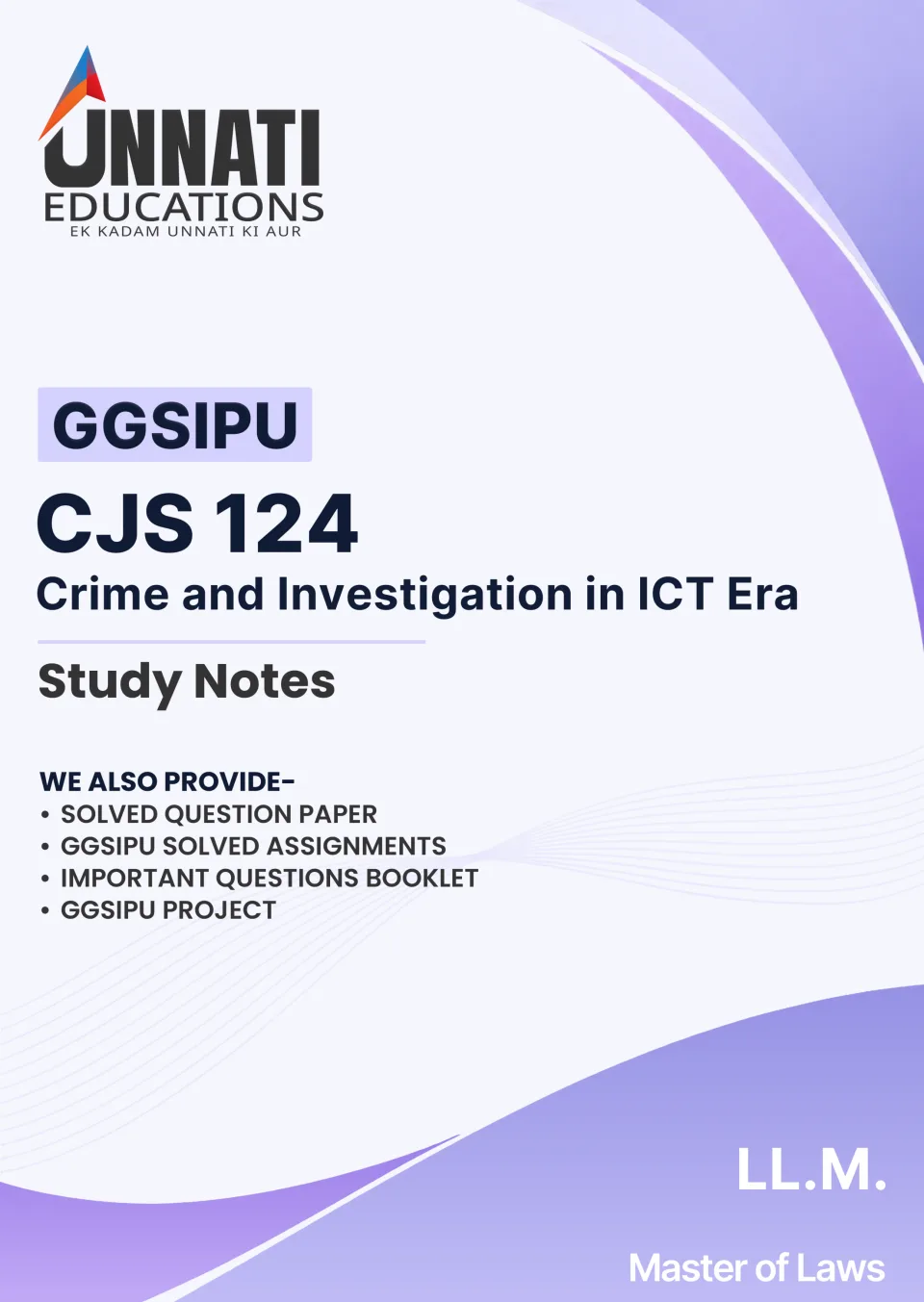
CJS 124 Crime and Investigation in ICT Era Notes cover all 4 units of this GGSIPU LL.M. Semester 2 paper (Criminal Justice System specialisation) in 57 pages: 24 topics, 23 case-law boxes, 4 quick revision tables and 65 practice questions. They follow the LL.M. (One Year) syllabus marked "w.e.f 2023 onwards" and come as a printed book.
Written by Unnati Educations Editorial Team · Reviewed by Ritik Rawat, B.Tech, Senior Full Stack Developer (technology and cyber concepts review) · Checked against USLLS LL.M. (One Year) Scheme of Examination and Detailed Syllabus, 31 October 2026 · Updated 31 October 2026 · Editorial policy
Scheme: LL.M. (One Year), w.e.f. 2023 onwards | Applies to: LL.M. batches from 2023, CJS specialisation | Verified against: USLLS LL.M. syllabus PDF, 31 October 2026
CJS 124 Crime and Investigation in ICT Era at a glance: GGSIPU LL.M. Sem 2 credits, units and exam pattern
Code and title | CJS 124, Crime and Investigation in ICT Era, Paper VIII |
|---|---|
Course and semester | LL.M. (One Year), Criminal Justice System (CJS) specialisation, Semester 2 |
Hours and credits | L 4 + RTDA 2, 5 credits; no category label printed |
Marks | 100: 25 internal (written test and RTDA, by the subject teacher) + 75 end-term |
End-term pattern | Written exam by the Examination Division; pattern not printed in the official PDF |
Units | 4 units, 10 lectures each |
Paired lab | None |
CJS 124 links ICT with traditional concepts of crime and studies the response to cyber crime. It is one of four taught GGSIPU LL.M. Semester 2 papers on the CJS track. Pass and re-appear rules sit in GGSIPU Ordinance 11.
CJS 124 Crime and Investigation in ICT Era Notes unit-wise: 24 topics and 23 case-law boxes across 4 units
The book moves from cyberspace (Unit I) to offences (Unit II), police and courts (Unit III) and treaties (Unit IV). Other papers sit under GGSIPU LL.M. notes.
CJS 124 Unit 1: Nature and Scope of ICT
Pages 3 to 16, 6 topics, 3 case-law boxes, 16 practice questions. IT versus ICT, the layers of cyberspace, the five syllabus platforms (social media, cloud, IoT, intermediaries under S. 79, virtual games), stakeholders and a cyber law timeline to the DPDP Act, 2023.
Quick look: the three roles of a computer in an offence (from page 10)
Role | Example |
|---|---|
Target: the computer or data is attacked | Ransomware, DDoS, data theft |
Tool: used to commit an old crime | Online cheating, cyber stalking |
Incidental: only stores evidence | Murder-planning chats on a laptop |
Quick look: computer as target, tool or incidental (from page 10)
Role
Target: the computer or data is attacked
Example
Ransomware, DDoS, data theft
Role
Tool: used to commit an old crime
Example
Online cheating, cyber stalking
Role
Incidental: only stores evidence
Example
Murder-planning chats on a laptop
CJS 124 Unit 2: Cyber Crime
Pages 17 to 32, 9 topics, 10 case-law boxes, 17 practice questions. From the Morris Worm (1988) to digital arrest scams, then crimes against women, children and society, cyber war and terrorism, and fraud, each with its IT Act and BNS section.
Quick look: three cyber frauds and how they work (from page 26)
Fraud | How it works |
|---|---|
SIM swap | A duplicate SIM sends the victim's OTPs to the fraudster |
UPI / QR code | The victim scans to "receive" money, but money is debited |
Quick look: how three cyber frauds work (from page 26)
Fraud
SIM swap
How it works
A duplicate SIM sends the victim's OTPs to the fraudster
Fraud
UPI / QR code
How it works
The victim scans to "receive" money, but money is debited
CJS 124 Unit 3: Criminal Justice System and Cyber Crime
Pages 33 to 46, 5 topics, 7 case-law boxes, 16 practice questions. Every provision is an old and new pair (CrPC with BNSS, Evidence Act with BSA): S. 4(2) BNSS with IT Act S. 77A to 80, investigation challenges, evidence tables and forensic computing.
Quick look: three authenticity safeguards (from page 42)
Method | What it does |
|---|---|
Hash value | Digital fingerprint (MD5, SHA-256) taken at seizure and again in court |
Chain of custody | Who handled the device; required in the charge-sheet, S. 193(3) BNSS |
Quick look: proving digital evidence is untouched (from page 42)
Method
Hash value
What it does
Digital fingerprint (MD5, SHA-256) taken at seizure and again in court
Method
Chain of custody
What it does
Who handled the device; required in the charge-sheet, S. 193(3) BNSS
CJS 124 Unit 4: International Response to Cybercrime
Pages 47 to 57, 4 topics, 3 case-law boxes, 16 practice questions. Cross-border cases, eight global problems, the Budapest and UN conventions, the Tallinn Manual and regional bodies from the EU to SAARC.
Quick look: the two cyber crime treaties (from page 52)
Basis | Budapest (2001) | UN (2024) |
|---|---|---|
Body | Council of Europe | United Nations |
India | Not a party | Signed, 26 September 2026 |
Quick look: Budapest Convention and UN Convention compared (from page 52)
Basis
Body
Budapest (2001)
Council of Europe
UN (2024)
United Nations
Basis
India
Budapest (2001)
Not a party
UN (2024)
Signed, 26 September 2026
CJS 124 exam corner: 40 short and 25 long practice questions from cyber stalking to the Hanoi Convention
Unit | Short (2–5 Marks) | Long (10–15 Marks) | Case-law boxes |
|---|---|---|---|
I | 10 | 6 | 3 |
II | 10 | 7 | 10 |
III | 10 | 6 | 7 |
IV | 10 | 6 | 3 |
CJS 124 practice questions and case-law boxes per unit
Unit
I
Short (2–5 Marks)
10
Long (10–15 Marks)
6
Case-law boxes
3
Unit
II
Short (2–5 Marks)
10
Long (10–15 Marks)
7
Case-law boxes
10
Unit
III
Short (2–5 Marks)
10
Long (10–15 Marks)
6
Case-law boxes
7
Unit
IV
Short (2–5 Marks)
10
Long (10–15 Marks)
6
Case-law boxes
3
The CJS 124 notes list 40 short-answer and 25 long-answer practice questions across 4 units, plus 23 case-law boxes. One per unit, with pointers:
Unit I: What was held in Shreya Singhal v. Union of India? S. 66A struck down as vague; S. 79(3)(b) read down to court or government orders.
Unit II: What was held in Sharat Babu Digumarti? Where S. 67 IT Act applies, the general IPC section cannot be added.
Unit III: What is an e-FIR and a Zero FIR under BNSS? An FIR sent electronically under S. 173 BNSS; a Zero FIR is lodged at any station.
Unit IV: Why has India not joined the Budapest Convention? No role in drafting, the Article 32(b) sovereignty worry, and a preference for a UN-led treaty.
More practice sits in the CJS 124 important questions.
Who writes and checks the CJS 124 Crime and ICT notes?
Unnati Educations Editorial Team, author: wrote the 57-page book from the official syllabus and its listed text books, such as Dasgupta, Chaturvedi and Dalal's Cyber Crime in India.
Ritik Rawat, reviewer: Senior Full Stack Developer; B.Tech. Technology and cyber concepts review (IP logs, hash values, forensic tools), not a legal review.
These CJS 124 Crime and Investigation in ICT Era IPU notes follow the "w.e.f 2023 onwards" scheme. The 2026-27 edition gives every offence its BNS, BNSS or BSA number and adds the Online Gaming Act, 2025. Updated 31 October 2026 under our editorial policy.
The same team prepares GGSIPU important questions for every course.
How to write CJS 124 answers: old and new section pairs, case journeys and cyber law timelines
The notes use one frame for every long answer: a definition, a body under headings with one table, then sections and cases, a short criticism and a way-forward conclusion. Their rule for a ten-mark answer is at least two sections and one case. A short answer stops at a definition, the section and one case, written in four or five lines.
Since the IPC, CrPC and Evidence Act were replaced on 1 July 2024, write both numbers: "S. 354D IPC (now S. 78 BNS)" or "S. 65B IEA (now S. 63 BSA)". In Unit IV the notes add that dates carry weight: 2001 for Budapest, 2013 and 2017 for the two Tallinn Manuals, 24 December 2024 for the UN adoption and 25 October 2025 for the Hanoi signing. End every Unit IV answer with India's position.
Some topics have a fixed order. Development of cyber law is a timeline: UNCITRAL 1996, IT Act 2000, the 2008 Amendment, Shreya Singhal 2015, Puttaswamy 2017, IT Rules 2021, DPDP Act 2023 and the new codes in 2024. Electronic evidence is a case journey from Navjot Sandhu (2005) to Arjun Panditrao Khotkar (2020). Forensics is a flow chart from identification to presentation.
Worked example: "Distinguish between cyber war and cyber terrorism." Open with one line each: cyber terrorism is a non-State group using cyber means to spread fear (S. 66F IT Act, up to life imprisonment); cyber war is one State attacking another. Add a four-row table (actor, aim, target, law) and close with an example of each: a terror attack on a power grid under S. 66F, and Stuxnet (2010) for cyber war.
Avoid three slips: citing struck-down S. 66A as live law, quoting only IPC numbers, and treating a bare screenshot as proof. Practise this format on GGSIPU LL.M. important questions.
CJS 124 and the GGSIPU LL.M. Sem 2 papers it connects to: CJS 120, CJS 122 and CJS 126
CJS 124 has no lab paper; for both semesters see the GGSIPU LL.M. syllabus.
GGSIPU LL.M. Sem 2 Crime and Investigation in ICT Era notes pair with CJS 120 Penology: Treatment of Offenders, CJS 122 Privileged Class Deviance, CJS 126 International Criminal Justice System and GEN 110 Dissertation.
Unit IV's Tallinn Manual (p53) leads into CJS 126.
Unit II's S. 111 BNS on organised cyber crime (p27) links back to CJS 121.
Section 65B and Section 63 BSA conditions for electronic evidence: excerpt from page 40 of the CJS 124 notes
Excerpt from page 40
A. Admissibility of electronic records
Admissibility means whether a court can legally accept a piece of evidence. Electronic evidence has to pass three checks: it must be relevant, it must follow the special procedure under Section 65B of the Indian Evidence Act (now Section 63 of the Bharatiya Sakshya Adhiniyam, 2023), and it must be authentic.
The four conditions
Any information in an electronic record that is printed, stored, recorded or copied in optical or magnetic media (the computer output) is treated as a document. It is admissible without proof of the original if four conditions are met:
The output was produced by the computer during the period it was regularly used to store or process information for activities regularly carried on.
During that period, information of the kind in the record was regularly fed into the computer in the ordinary course of those activities.
The computer was working properly throughout the material part of that period, or any defect did not affect the record.
The information in the record reproduces, or is derived from, information fed into the computer in the ordinary course.
The certificate
Under S. 65B(4) IEA, now S. 63(4) BSA, a certificate must identify the electronic record, describe how it was produced, give particulars of the device and deal with the conditions above. It is signed by a person holding a responsible official position in relation to the device.
What the BSA changed
Section 63 BSA applies to any device: a computer, a smartphone or any communication device, including one that sits in a network or a cloud. The certificate must now follow the format in the Schedule. Part A is filled by the party producing the record and Part B by an expert, and the certificate must carry the hash value of the record.
Where the case law began: State (NCT of Delhi) v. Navjot Sandhu (2005) 11 SCC 600
In the Parliament Attack case, the Supreme Court admitted printouts of call records even without a Section 65B certificate. It held that secondary evidence could also be led under the general provisions, Sections 63 and 65 of the Evidence Act, so Section 65B was not treated as the only route. Later benches revisited this view, and the notes follow that journey case by case.
Do the CJS 124 notes cover the full GGSIPU syllabus?
Yes. Every official CJS 124 topic has its own section, in syllabus order.
Official unit | Official topics | In the notes | Status |
|---|---|---|---|
I. Nature and Scope of ICT | Information Technology; cyberspace; platforms (social media, cloud computing, Internet of things, intermediaries, virtual games); misuse of ICT; stakeholders; cyber laws | Topics 01 to 06, pp 4 to 14 | Covered |
II. Cyber Crime | Evolution; characterization and classification (women, child, society, cyber war and terrorism, cyber fraud); challenges; legislative and judicial response | Topics 01 to 09, pp 18 to 30 | Covered |
III. Criminal Justice System and Cyber Crime | Applicability of Criminal Procedure Code; investigation challenges; evidentiary regime and the internet; admissibility, burden of proof and authenticity; forensic computing | Topics 01 to 05, pp 34 to 45 (read with BNSS) | Covered |
IV. International Response to Cybercrime | International cyber crimes; global problems; international law and cyber crime; regional cooperation | Topics 01 to 04, pp 48 to 56 | Covered |
CJS 124 official syllabus topics mapped to the notes
Official unit
I. Nature and Scope of ICT
Official topics
Information Technology; cyberspace; platforms (social media, cloud computing, Internet of things, intermediaries, virtual games); misuse of ICT; stakeholders; cyber laws
In the notes
Topics 01 to 06, pp 4 to 14
Status
Covered
Official unit
II. Cyber Crime
Official topics
Evolution; characterization and classification (women, child, society, cyber war and terrorism, cyber fraud); challenges; legislative and judicial response
In the notes
Topics 01 to 09, pp 18 to 30
Status
Covered
Official unit
III. Criminal Justice System and Cyber Crime
Official topics
Applicability of Criminal Procedure Code; investigation challenges; evidentiary regime and the internet; admissibility, burden of proof and authenticity; forensic computing
In the notes
Topics 01 to 05, pp 34 to 45 (read with BNSS)
Status
Covered
Official unit
IV. International Response to Cybercrime
Official topics
International cyber crimes; global problems; international law and cyber crime; regional cooperation
In the notes
Topics 01 to 04, pp 48 to 56
Status
Covered
Source: LL.M. (One Year) syllabus, w.e.f. 2023 onwards, Paper VIII (file name says 2022-23).
Every course in GGSIPU notes is mapped to its official PDF the same way.
CJS 124 Crime and ICT notes FAQs
How do I get the full CJS 124 notes?
Tap "Get Full Notes" and send the pre-filled WhatsApp message to 9899436384. The full CJS 124 notes come only as a printed book, not as a PDF. Our team confirms the edition and your address on WhatsApp, and delivery takes up to 5 to 7 days, depending on your location. Check the layout first in the sample PDF above.
Do the CJS 124 notes use the old CrPC and Evidence Act or the new BNSS and BSA?
Both. The CJS 124 syllabus still says "Criminal Procedure Code", but the BNSS, BSA and BNS replaced the CrPC, Evidence Act and IPC from 1 July 2024. So the notes write every provision as a pair, such as S. 65B IEA (now S. 63 BSA) or S. 91 CrPC (now S. 94 BNSS), with a full evidence-section table in Unit III.
What is the passing mark for CJS 124?
CJS 124 is marked out of 100: 25 internal marks from continuous assessment and 75 marks in the semester-end written exam. The LL.M. scheme PDF on ipu.ac.in does not print a pass percentage for the paper, so we do not quote one. For minimum marks and re-appear rules, read GGSIPU Ordinance 11 or ask your school's examination office.
Which CJS 124 unit is the longest in the notes?
Unit II, Cyber Crime, is the longest at 16 pages (pages 17 to 32). It has 9 topics, from the evolution of cyber crime to the legislative and judicial response, plus 10 of the book's 23 case-law boxes and a separate table of 12 rulings. Unit IV is the shortest at 11 pages, so plan revision around it.
Are the CJS 124 notes useful without a technical background?
Yes. CJS 124 is written for law students, so terms like IP address, DNS, packet switching, hash value and write blocker get one plain line before the law is applied, checked by our technology reviewer. Tables do most of the work, such as the four cyberspace layers, the cloud service models and the seven forensic stages, so concept and section are learnt together.
Is CJS 124 compulsory for every GGSIPU LL.M. student?
No. CJS 124 Crime and Investigation in ICT Era is Paper VIII in Semester 2 of the Criminal Justice System (CJS) specialisation only. Other LL.M. tracks study different Semester 2 papers listed in the scheme. On the CJS track it carries 5 credits, like CJS 120, CJS 122 and CJS 126, while GEN 110 Dissertation carries 10 credits.
Get the full CJS 124 Crime and Investigation in ICT Era Notes on WhatsApp
Unit | Pages | Topics |
|---|---|---|
I. Nature and Scope of ICT | 14 | 6 |
II. Cyber Crime | 16 | 9 |
III. Criminal Justice System and Cyber Crime | 14 | 5 |
IV. International Response to Cybercrime | 11 | 4 |
CJS 124 notes book: pages per unit
Unit
I. Nature and Scope of ICT
Pages
14
Topics
6
Unit
II. Cyber Crime
Pages
16
Topics
9
Unit
III. Criminal Justice System and Cyber Crime
Pages
14
Topics
5
Unit
IV. International Response to Cybercrime
Pages
11
Topics
4
These Crime and Investigation in ICT Era notes in English come only as a printed book, not a PDF. Delivery takes a maximum of 5 to 7 days; the rest depends on your location.
Order the printed CJS 124 notes on WhatsApp (4 units, 57 pages)
Unnati Educations is an independent education provider based in Vikaspuri, Delhi. We are not affiliated with, authorised by, or endorsed by Guru Gobind Singh Indraprastha University (GGSIPU). 'GGSIPU' and 'IPU' are used only to describe the syllabus our notes follow. For official information, visit ipu.ac.in.
Ready for the full notes?
Discuss coverage and delivery with our team.