
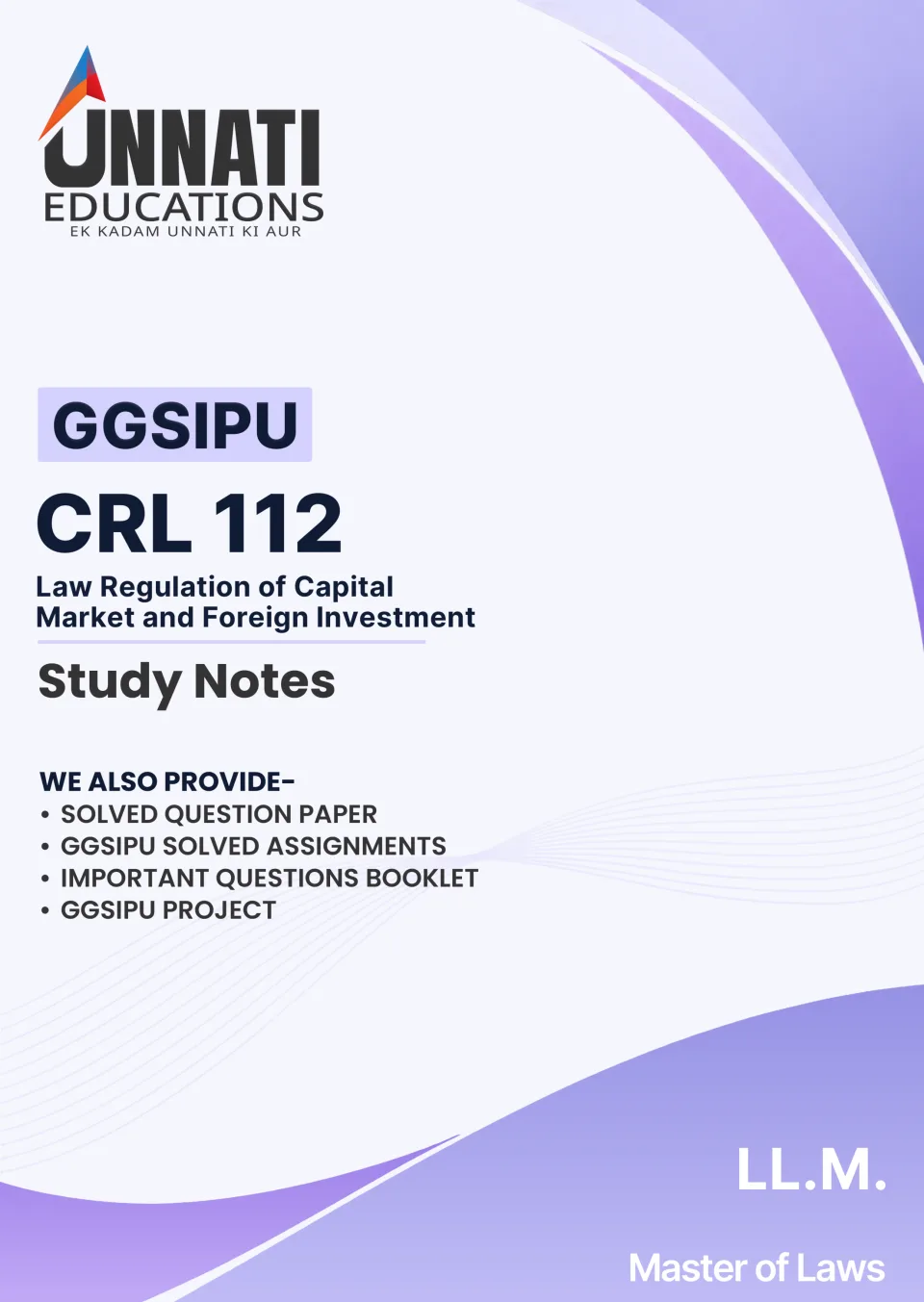
CRL 112 Law Regulation of Capital Market and Foreign Investment Notes are 47-page English notes for GGSIPU LL.M. (One Year) Corporate Law, Semester II. They cover all 4 units with 21 decided cases, 8 exam tips, a quick revision table per unit and 64 exam questions (24 long, 40 short notes), for LL.M. batches from session 2022-23.
Written by Unnati Educations Editorial Team · Reviewed by Prateek Talwar, ACS (ICSI), business and finance concepts review · Checked against the LL.M. (One Year) scheme and syllabus PDF on ipu.ac.in (USLLS Board of Studies, 30 Aug 2022) · Updated 14 October 2026 · Editorial policy
Scheme: LL.M. (One Year) scheme and detailed syllabus | Applies to: batches from session 2022-23 | Verified against: Master of Law (LL.M.) Regular One year Programme w.e.f 2022-23, ipu.ac.in
CRL 112 Law Regulation of Capital Market and Foreign Investment at a glance: GGSIPU LL.M. Sem 2 credits, units and exam pattern
CRL 112 is Paper VI of the Corporate Law (CL) specialisation in the one-year LL.M. of the University School of Law and Legal Studies. It sits with four other GGSIPU LL.M. Semester 2 papers.
Code and title | CRL 112 Law Regulation of Capital Market and Foreign Investment (scheme table: "Regulation of Capital market and Foreign Investment") |
|---|---|
Course and semester | LL.M. (One Year), Corporate Law, Semester II, Paper VI |
Credits | 5: 4 lecture + 2 RTDA hours a week |
Marks | 100: 25 internal (written test and RTDA) + 75 end-term written exam |
Applies to | Batches from session 2022-23 (PDF cover: "w.e.f 2023 onwards") |
End-term pattern | Paper-setter instructions not printed in the official PDF |
Units | 4, with 10 lectures each |
Lab paper | None |
CRL 112 Law Regulation of Capital Market and Foreign Investment Notes unit-wise: 64 exam questions and 21 decided cases across 4 units
These CRL 112 capital market and foreign investment IPU notes follow the official unit order: three topic sections per unit, then a revision table with six long questions and ten short notes. See the sample PDF above. Notes for every other paper are under GGSIPU LL.M. notes.
CRL 112 Unit 1: Overview of Capital Market
Pages 3 to 14. Unit 1 defines the capital market (funds over one year) and lists 12 roles in national development. A 12-row table traces the post-1991 reforms, from statutory SEBI to T+1 settlement. Eight challenges are set against prospects such as GIFT City. The last topic (p9) covers issue methods, Sahara v. SEBI and stock exchanges under SCRA Sections 2(j) and 4.
Basis | Primary | Secondary |
|---|---|---|
Parties | Company and investors | Investor and investor |
Money goes to | The company | The selling investor |
Main law | Companies Act 2013, SEBI ICDR 2018 | SCRA 1956, SEBI Act, Depositories Act |
Quick look: primary vs secondary market (from page 11)
Basis
Parties
Primary
Company and investors
Secondary
Investor and investor
Basis
Money goes to
Primary
The company
Secondary
The selling investor
Basis
Main law
Primary
Companies Act 2013, SEBI ICDR 2018
Secondary
SCRA 1956, SEBI Act, Depositories Act
CRL 112 Unit 2: Trends in Regulation of Capital Markets
Pages 15 to 25. SCRA, 1956 is taught section by section: recognition (Sections 3 to 5), control (6 to 12), void contracts under Section 13, listing and delisting, the 25% public shareholding rule (Rule 19A) and penalties. The SEBI Act part covers the nine-member Board, Section 11 powers, SEBI's three roles, SAT appeals and four cases such as Shriram Mutual Fund. The Depositories Act part explains NSDL, CDSL and the demat flow.
Point | Registered owner | Beneficial owner |
|---|---|---|
Who | The depository | The investor |
Purpose | Only to effect transfers | Real owner |
Voting, dividend, bonus | No rights | All rights and liabilities |
Quick look: registered vs beneficial owner, Section 10 (from page 23)
Point
Who
Registered owner
The depository
Beneficial owner
The investor
Point
Purpose
Registered owner
Only to effect transfers
Beneficial owner
Real owner
Point
Voting, dividend, bonus
Registered owner
No rights
Beneficial owner
All rights and liabilities
CRL 112 Unit 3: Policy framework for regulation of FDI
Pages 26 to 36. FDI is defined three ways, ending with the FEM (Non-Debt Instruments) Rules, 2019, and sorted by entry, activity and route. FERA, 1973 is compared with FEMA, 1999, followed by the key FEMA sections up to appeals. The policy topic covers entry routes, prohibited sectors, sectoral caps, Press Note 3 (2020) six roles of the RBI and LIC v. Escorts.
Basis | FDI | FPI |
|---|---|---|
Listed holding | 10% or more | Less than 10% |
Control | Management influence | None |
Extra regulator | DPIIT FDI Policy | SEBI (FPI) Regulations 2019 |
Quick look: FDI vs FPI (from page 28)
Basis
Listed holding
FDI
10% or more
FPI
Less than 10%
Basis
Control
FDI
Management influence
FPI
None
Basis
Extra regulator
FDI
DPIIT FDI Policy
FPI
SEBI (FPI) Regulations 2019
CRL 112 Unit 4: Bilateral and multilateral investment agreements
Pages 37 to 47. BITs are traced through five phases, from the 1959 Germany-Pakistan treaty to the post-2010 backlash, and India's record from its 1994 BIPA with the UK to the Model BIT, 2015. A table covers ICSID, MIGA and TRIMs. Later topics set out ten investor protection standards and the investor-State procedure under ICSID and UNCITRAL, with 15 cases, the most of any unit.
Basis | ICSID | UNCITRAL |
|---|---|---|
Review | Annulment, Article 52 | Courts of the seat |
Enforcement | Article 54 | New York Convention |
India | Not a member | Used in claims against India |
Quick look: ICSID vs UNCITRAL (from page 45)
Basis
Review
ICSID
Annulment, Article 52
UNCITRAL
Courts of the seat
Basis
Enforcement
ICSID
Article 54
UNCITRAL
New York Convention
Basis
India
ICSID
Not a member
UNCITRAL
Used in claims against India
CRL 112 exam corner: 24 long-answer questions and 40 short notes by unit
Each CRL 112 unit ends with an "Important Exam Questions" list for practice; each sample below carries a pointer to the pages that answer it.
Unit | Long | Short notes | Cases |
|---|---|---|---|
1 Capital market overview | 6 | 10 | 1 |
2 SCRA, SEBI, Depositories | 6 | 10 | 4 |
3 FDI and FEMA | 6 | 10 | 2 |
4 Investment treaties | 6 | 10 | 15 |
CRL 112 exam questions and cases by unit
Unit
1 Capital market overview
Long
6
Short notes
10
Cases
1
Unit
2 SCRA, SEBI, Depositories
Long
6
Short notes
10
Cases
4
Unit
3 FDI and FEMA
Long
6
Short notes
10
Cases
2
Unit
4 Investment treaties
Long
6
Short notes
10
Cases
15
Unit 1: "Explain the reforms introduced in the Indian capital market after 1991. What are the challenges and prospects?" Pointer: reforms table (p7), challenges and prospects (p8 to 9).
Unit 2: "Explain the adjudication and appellate mechanism under the SEBI Act." Pointer: Sections 15-I to 15JB, SAT, Section 15Z and Shriram Mutual Fund (p20 to 21).
Unit 3: "Discuss the role of RBI in the regulation of FDI in India." Pointer: six roles, FC-GPR within 30 days, LIC v. Escorts (p34).
Unit 4 (short note): "Salini test." Pointer: ICSID Article 25 and the four elements: contribution, duration, risk, development (p44).
The CRL 112 notes list 24 long-answer questions and 40 short notes across 4 units, backed by 21 decided cases.
More practice sits in the CRL 112 important questions.
Fair and equitable treatment and MFN in investment treaties: excerpt from page 41 of the CRL 112 notes
Excerpt from page 41 (Unit 4, topic 02: Substantive Rights of Foreign Investors under BIPAs)
An investor under a BIPA is a natural person with the nationality of a Contracting State, or a company incorporated there; some treaties also ask for real business activity. Investment is usually "every kind of asset": property, shares, debentures, claims to money, intellectual property and business concessions. India's new Model BIT uses a narrower, enterprise-based definition.
A denial of benefits clause lets a State refuse protection to a shell company with no real business in its home State that is owned by third-country investors.
National Treatment (NT)
The host State must treat foreign investors and their investments no less favourably than its own nationals in like circumstances. The aim is to stop discrimination based on nationality.
Most-Favoured-Nation Treatment (MFN)
The host State must treat investors of the other Contracting State no less favourably than investors of any third State, so a better right in one treaty can be claimed under another. In Maffezini v. Spain (ICSID, 2000), an Argentine investor used MFN to skip an 18-month local litigation rule by relying on the Chile-Spain BIT.
In White Industries v. India (2011), the tribunal used the MFN clause in the India-Australia BIPA to import the "effective means of asserting claims" duty from the India-Kuwait BIT.
Fair and Equitable Treatment (FET)
FET is the standard investors invoke most often. The host State must act in a transparent, consistent, non-arbitrary and non-discriminatory way, respect due process and protect the investor's legitimate expectations.
The Neer case (1926) set an older minimum standard that only outrageous, bad-faith conduct could breach. Tecmed v. Mexico (ICSID, 2003) went wider: the State must not upset the basic expectations the investor relied on. In Metalclad v. Mexico (NAFTA, 2000), lack of transparency and refusal of a permit after federal assurances breached FET.
Full Protection and Security (FPS)
The host State must use due diligence to protect the investment from physical harm by State forces or third parties, such as riots. Some tribunals extend this to legal security. In AAPL v. Sri Lanka (1990), a shrimp farm was destroyed in a security operation against rebels, and Sri Lanka was held liable for failing to exercise due diligence.
Do the CRL 112 notes cover the full GGSIPU syllabus?
Yes. All 12 official CRL 112 topics, three per unit, have their own section in the notes, in the same order.
Official unit | Official topics | Where in the notes | Status |
|---|---|---|---|
I: Overview of Capital Market | Role, relevance and significance in national development · Economic reforms: challenges and prospects · Primary and secondary market, stock exchanges | Unit I: p4, p6, p9 | Covered |
II: Trends in Regulation of Capital Markets | Securities Contract Regulation Act 1956 · SEBI Act 1992, role of SEBI · Depositories Act 1996 | Unit II: p16, p18, p21 | Covered |
III: Policy framework for regulation of FDI | Meaning and forms of FDI · Foreign Exchange Management Act · FDI Policy and role of RBI | Unit III: p27, p29, p32 | Covered |
IV: Bilateral and multilateral investment agreements | Trends of investment agreements · Rights of foreign investors under BIPAs · Dispute settlement under BITs: ICSID and UNCITRAL | Unit IV: p38, p40, p43 | Covered |
CRL 112 official syllabus mapped to the notes
Official unit
I: Overview of Capital Market
Official topics
Role, relevance and significance in national development · Economic reforms: challenges and prospects · Primary and secondary market, stock exchanges
Where in the notes
Unit I: p4, p6, p9
Status
Covered
Official unit
II: Trends in Regulation of Capital Markets
Official topics
Securities Contract Regulation Act 1956 · SEBI Act 1992, role of SEBI · Depositories Act 1996
Where in the notes
Unit II: p16, p18, p21
Status
Covered
Official unit
III: Policy framework for regulation of FDI
Official topics
Meaning and forms of FDI · Foreign Exchange Management Act · FDI Policy and role of RBI
Where in the notes
Unit III: p27, p29, p32
Status
Covered
Official unit
IV: Bilateral and multilateral investment agreements
Official topics
Trends of investment agreements · Rights of foreign investors under BIPAs · Dispute settlement under BITs: ICSID and UNCITRAL
Where in the notes
Unit IV: p38, p40, p43
Status
Covered
Verify the topics in the official GGSIPU LL.M. (One Year) scheme and syllabus, w.e.f. 2022-23, where CRL 112 is Paper VI.
Every course in GGSIPU notes is mapped to its official PDF the same way.
Who writes and checks the CRL 112 capital market notes?
Unnati Educations Editorial Team, author of all our LL.M. notes. No individual lawyer is named, as no one on the team holds an LL.B. or LL.M.
Prateek Talwar, reviewer (business and finance concepts review): Founder, Unnati Educations; Associate Company Secretary (ACS), ICSI, membership no. 58704, since 15 May 2019; B.Com, University of Delhi (SOL), 2012. He checks the SEBI, demat, FDI and RBI reporting content. Profile
The 2026-27 edition includes T+1 settlement, the NDI Rules, 2019, Press Note 3 (2020) and the 2022 ICSID Rules. Last updated 14 October 2026. See our editorial policy. The notes are study material, not legal advice.
The same team prepares GGSIPU important questions for every course.
CRL 112 and the GGSIPU LL.M. Sem 2 papers it connects to
CRL 112 has no lab paper; every specialisation's paper list is on the GGSIPU LL.M. syllabus page.
CRL 118 Law of Corporate Finance and Securities Regulations: its Unit III on SEBI and insider trading goes deeper into CRL 112 Unit 2 (Sections 11 and 12A).
CRL 116 Banking, Insolvency and Insurance Law: its Banking Regulation Act unit sits beside the RBI's FEMA role in CRL 112 Unit 3.
CRL 114 Corporate Taxation: its transfer pricing and tax treaty unit links to the Vodafone and Cairn disputes in CRL 112 Units 3 and 4.
GEN 110 Dissertation (NUES): Unit 4 topics such as ISDS reform can become a research problem.
If you are collecting GGSIPU LL.M. Semester 2 capital market and foreign investment notes alongside CRL 118, read CRL 112 Unit 2 first; CRL 118 assumes it.
How to write CRL 112 answers: section-by-section statute answers and case-backed short notes
CRL 112 mixes statute work with treaty law. The exam tip on page 18 gives this order for "Explain the main provisions of SCRA, 1956":
Background: Gorwala Committee (1951), in force 20 February 1957.
Objectives, then Section 2 definitions.
Recognition (Sections 3 to 5) and control (6 to 12).
Contracts (13 to 20), listing and delisting (21 to 22A).
Penalties (23 to 23L) and conclusion.
For the Unit 1 role answer, the page 6 tip asks for eight roles with headings and the SCRA Section 2(h) definition. In Unit 4, give seven or eight protection standards with one case each, then show how the Model BIT, 2015 narrows them.
Two mix-ups cost marks: treating the depository as the real owner, and calling FEMA breaches criminal. Practise this format on GGSIPU LL.M. important questions.
CRL 112 capital market notes FAQs
How do I get the full CRL 112 notes?
Message us on WhatsApp at 9899436384 with the code CRL 112, or use the button on this page. The full CRL 112 notes come as a printed book; they are not sold as a PDF. Once your order is confirmed, the book is dispatched to your address, and delivery takes up to 5 to 7 days depending on your location.
What is the passing mark for CRL 112?
CRL 112 is marked out of 100: 25 internal marks from the subject teacher (written test and RTDA) and 75 marks in the end-term written exam. The LL.M. scheme and syllabus PDF does not print a pass percentage for the paper. For end-term minimums and re-appear rules, see GGSIPU Ordinance 11 on ipu.ac.in and confirm with your school; we do not guess a pass figure.
Do the CRL 112 notes follow the 2014 FDI policy circular named in the syllabus?
The CRL 112 syllabus lists the Consolidated FDI Policy Circular of 2014 as a reference. The notes point this out and teach the current framework: the Consolidated FDI Policy, 2020 (effective 15 October 2020), the FEM (Non-Debt Instruments) Rules, 2019 and Press Note 3 of 2020. Sectoral caps change through Press Notes, so the notes ask you to check the latest one before the exam.
Which CRL 112 unit has the most case law?
Unit 4 of CRL 112, with 15 decided cases, including Maffezini v. Spain, Tecmed v. Mexico, Salini v. Morocco, Philip Morris v. Uruguay, White Industries v. India and the Cairn and Vodafone awards. Unit 2 has four SEBI cases, Unit 3 has LIC v. Escorts and Vodafone (2012), and Unit 1 has Sahara v. SEBI.
Is CRL 112 the same paper as "Regulation of Capital market and Foreign Investment"?
Yes. The LL.M. scheme table for the Corporate Law specialisation lists CRL 112 as "Regulation of Capital market and Foreign Investment", while the detailed syllabus page heads it "Law Regulation of Capital Market and Foreign Investment". Both carry the code CRL 112, Paper VI, Semester II, 5 credits. The notes use the detailed syllabus title.
Do the CRL 112 notes cover investment arbitration cases against India?
Yes. Unit 4 of the CRL 112 notes covers White Industries (2011), the first BIT award against India, the Vodafone and Cairn awards (2020) on retrospective tax, and Devas and Deutsche Telekom on the Antrix contract. It also explains why these claims ran under the UNCITRAL Rules: India has not signed the ICSID Convention, so it cannot be sued at ICSID.
Get the full CRL 112 Law Regulation of Capital Market and Foreign Investment Notes on WhatsApp
Part | Pages | Questions |
|---|---|---|
Cover and index | 2 | - |
Unit I | 12 (p3 to 14) | 16 |
Unit II | 11 (p15 to 25) | 16 |
Unit III | 11 (p26 to 36) | 16 |
Unit IV | 11 (p37 to 47) | 16 |
Pages per unit in the full CRL 112 notes
Part
Cover and index
Pages
2
Questions
-
Part
Unit I
Pages
12 (p3 to 14)
Questions
16
Part
Unit II
Pages
11 (p15 to 25)
Questions
16
Part
Unit III
Pages
11 (p26 to 36)
Questions
16
Part
Unit IV
Pages
11 (p37 to 47)
Questions
16
The book holds all 47 pages of capital market and foreign investment notes in English, with 21 decided cases and 8 exam tips. Printed book only, no PDF. Order on WhatsApp; delivery takes a maximum of 5 to 7 days after confirmation, depending on your location.
Get the full CRL 112 notes book on WhatsApp (4 units, 47 pages)
Unnati Educations is an independent education provider based in Vikaspuri, Delhi. We are not affiliated with, authorised by, or endorsed by Guru Gobind Singh Indraprastha University (GGSIPU). 'GGSIPU' and 'IPU' are used only to describe the syllabus our notes follow. For official information, visit ipu.ac.in.
Ready for the full notes?
Discuss coverage and delivery with our team.