
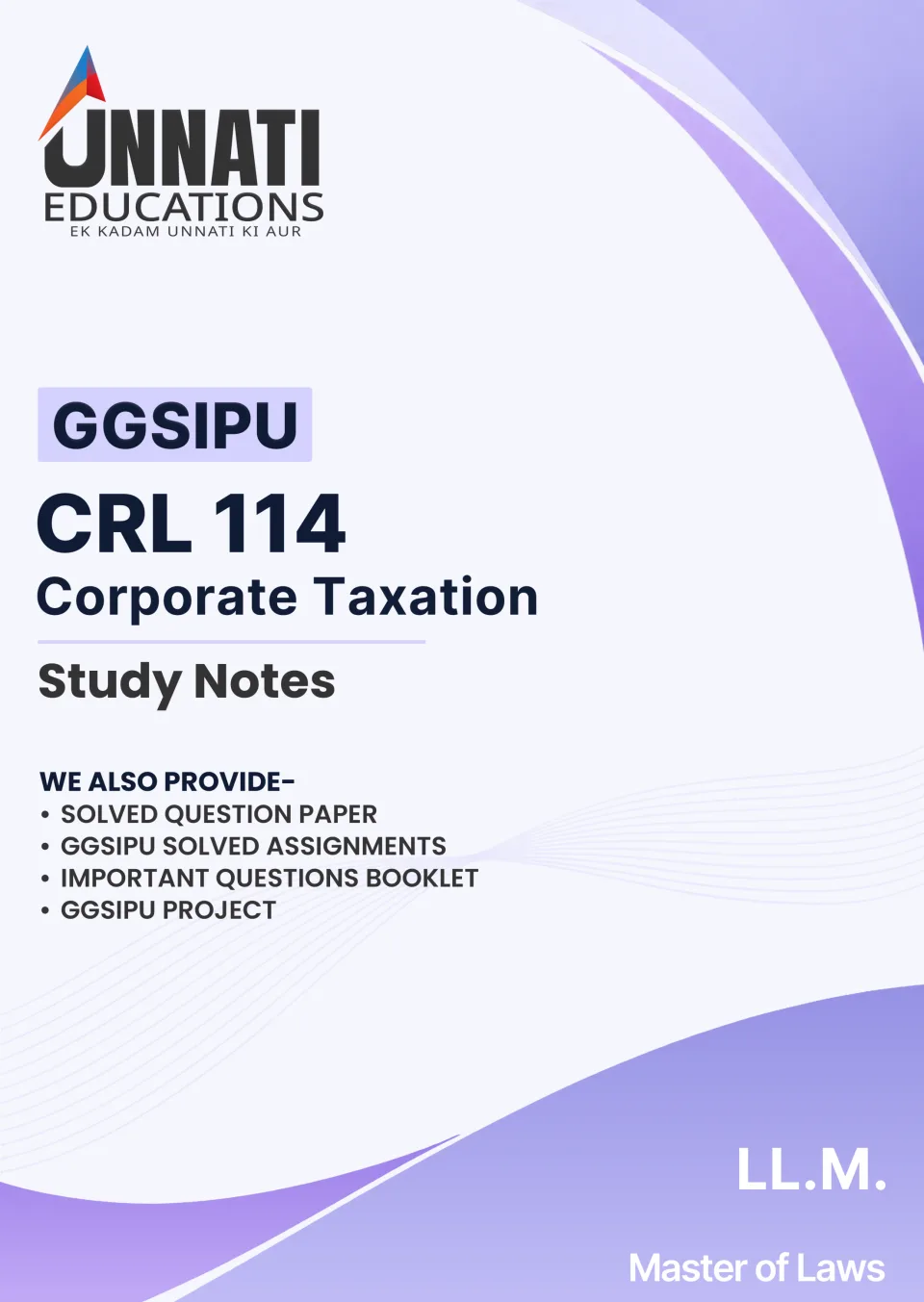
CRL 114 Corporate Taxation Notes are 65-page English notes for GGSIPU LL.M. (One Year) Corporate Law, Semester II, covering all 4 units (income and company tax, GST, customs, international taxation) with 11 worked illustrations, 19 case laws and 71 exam-style questions, mapped to the scheme for batches from 2022-23.
Written by Unnati Educations Editorial Team · Reviewed by Prateek Talwar, ACS (ICSI), business and finance concepts review · Checked against the official LL.M. syllabus PDF (w.e.f 2022-23) · Updated 14 October 2026 · Editorial policy
Scheme: LL.M. (One Year), USLLS | Applies to: batches from session 2022-23 | Verified against: Master of Law (LL.M.) Regular One Year Programme w.e.f 2022-23, ipu.ac.in
CRL 114 Corporate Taxation at a glance: GGSIPU LL.M. Sem 2 credits, units and exam pattern
CRL 114 is Paper VII of the Corporate Law (CL) specialisation in the one-year LL.M. at USLLS. Its four companion courses, including the GEN 110 dissertation, are listed under GGSIPU LL.M. Semester 2 papers.
Code and title | CRL 114 Corporate Taxation |
|---|---|
Course and semester | LL.M. (One Year), Corporate Law, Semester II, Paper VII |
Credits | 5: 4 lecture + 2 RTDA (Research and Teaching Development Activities) hours a week |
Marks | 100: 25 internal (written test and RTDA) + 75 end-term written exam |
Applies to | Session 2022-23 onwards (cover: "w.e.f 2023 onwards") |
End-term pattern | Paper-setter instructions not printed in the official PDF |
Units | 4, with 10 lectures each |
Paired lab | None |
Pass rules | Not printed in the LL.M. PDF; see GGSIPU Ordinance 11 |
CRL 114 Corporate Taxation Notes unit-wise: 11 worked illustrations and 19 case laws across 4 units
Each unit ends with a revision table and question bank. Notes for the other Corporate Law papers are on GGSIPU LL.M. notes. The sample PDF above has one page from each unit.
CRL 114 Unit 1: Introduction and Corporate Tax Planning
Pages 3 to 19, 8 sections. From Article 265 and the Income-tax Act, 2025 ("Tax Year"), Unit 1 covers definitions, capital versus revenue, residential status, rates and tax holidays, then entity-wise tax: individuals, HUFs, firms (AMT), AOPs, non-residents, political parties, trusts and companies (DDT, MAT, equalisation levy). Count: 6 illustrations, 4 case laws, 17 questions.
Item | Normal tax | MAT |
|---|---|---|
Tax base | Total income ₹2 crore | Book profit ₹10 crore |
Rate | 25% | 14% (15% before Finance Act 2026) |
With 7% surcharge and 4% cess | ₹55,64,000 | ₹1,55,79,200 |
Result | MAT is payable, now as a final tax | |
CRL 114 Unit 2: Goods and Service Tax
Pages 20 to 37, 9 sections (also covered as Goods and Services Tax). Unit 2 runs from the 101st Amendment, GST Council and transition through GST 2.0 rates, composition, reverse charge and supply, to ITC, returns, refund, GSTAT appeals and compensation. Count: 2 illustrations, 4 case laws, 18 questions.
Credit of | First against | Then against | Never against |
|---|---|---|---|
IGST | IGST | CGST and SGST/UTGST | None |
CGST | CGST | IGST | SGST/UTGST |
SGST/UTGST | SGST/UTGST | IGST, after CGST credit | CGST |
Quick look: ITC set-off under section 49 and Rule 88A (from page 29)
Credit of
IGST
First against
IGST
Then against
CGST and SGST/UTGST
Never against
None
Credit of
CGST
First against
CGST
Then against
IGST
Never against
SGST/UTGST
Credit of
SGST/UTGST
First against
SGST/UTGST
Then against
IGST, after CGST credit
Never against
CGST
CRL 114 Unit 3: Custom Law
Pages 38 to 51, 10 sections. Unit 3 sets out the Customs Act, 1962, the Customs Tariff Act, 1975 and every duty type from BCD to anti-dumping duty, then HS classification, valuation with Rule 10 additions, exemptions, bill of entry procedure, warehousing, drawback and Baggage Rules 2026. Count: 1 illustration, 4 case laws, 18 questions.
Quick look: duty on a CIF US$ 10,000 import (from page 42)
US$ 10,000 × ₹85 (assumed CBIC rate) = assessable value ₹8,50,000.
BCD at 10% = ₹85,000; SWS at 10% of BCD = ₹8,500.
IGST at 18% on ₹9,43,500 = ₹1,69,830.
Total duty ₹2,63,330 (IGST creditable).
CRL 114 Unit 4: International Taxation
Pages 52 to 65, 8 sections. Unit 4 moves from tax planning versus evasion to GAAR (section 96 tests, GAAR versus SAAR), then transfer pricing, APA, POEM, DTAA relief and the MLI, and ends with slump sale, amalgamation, buyback, share premium and sections 68 to 69D. Count: 2 illustrations, 7 case laws, 18 questions.
Method | How it works | Best for |
|---|---|---|
CUP | Price in comparable uncontrolled deals | Commodities, loan interest |
Resale Price | Resale price minus normal gross margin | Distributors |
Cost Plus | Production cost plus normal mark-up | Contract manufacturers |
TNMM | Net margin against similar companies | IT services, BPO |
Quick look: transfer pricing methods and where each fits (from page 57)
Method
CUP
How it works
Price in comparable uncontrolled deals
Best for
Commodities, loan interest
Method
Resale Price
How it works
Resale price minus normal gross margin
Best for
Distributors
Method
Cost Plus
How it works
Production cost plus normal mark-up
Best for
Contract manufacturers
Method
TNMM
How it works
Net margin against similar companies
Best for
IT services, BPO
CRL 114 exam corner: 40 two-to-five-mark and 31 ten-to-fifteen-mark practice questions by unit
Unit | 2–5 Marks | 10–15 Marks | Illustrations |
|---|---|---|---|
1 Income and company tax | 10 | 7 | 6 |
2 GST | 10 | 8 | 2 |
3 Customs | 10 | 8 | 1 |
4 International taxation | 10 | 8 | 2 |
CRL 114 questions per unit
Unit
1 Income and company tax
2–5 Marks
10
10–15 Marks
7
Illustrations
6
Unit
2 GST
2–5 Marks
10
10–15 Marks
8
Illustrations
2
Unit
3 Customs
2–5 Marks
10
10–15 Marks
8
Illustrations
1
Unit
4 International taxation
2–5 Marks
10
10–15 Marks
8
Illustrations
2
The CRL 114 notes give 40 two-to-five-mark and 31 ten-to-fifteen-mark questions across 4 units, plus 11 worked illustrations. They are practice questions (printed as "2–5 Marks" and "10–15 Marks") without model answers. Four, with the notes' pointers:
Unit 1: What is Alternate Minimum Tax? Sections 115JC to 115JF; 18.5% of adjusted total income for non-corporates; 15-year credit (page 13).
Unit 2: What is Reverse Charge Mechanism? Recipient pays under sections 9(3) to 9(5): GTA, advocates, directors, cab aggregators (page 25).
Unit 3: Explain duty drawback. Section 74: re-export within 2 years, 98% if unused; section 75: All Industry Rate or brand rate (page 46).
Unit 4: Distinguish GAAR and SAAR. Principle versus specific rule; Circular 7/2017 lets both apply (pages 55 and 56).
For timed practice by unit, use the CRL 114 important questions.
Who writes and checks the CRL 114 corporate tax notes?
Unnati Educations Editorial Team: author; the LL.M. notes are credited to the team as a whole.
Prateek Talwar: reviewer, business and finance concepts review. Founder, Unnati Educations; Associate Company Secretary (ACS), ICSI, membership no. 58704, since 15 May 2019; B.Com, University of Delhi (SOL), 2012. Profile of Prateek Talwar
The syllabus names the Income-tax Act, 1961, so the notes keep 1961 sections and flag 2026 changes (2025 Act, MAT at 14%, GST 2.0, buyback) in 8 "Latest Law Update" boxes. Updated 14 October 2026; see our editorial policy.
Question sets built the same way, unit by unit, are collected in GGSIPU important questions.
How to write CRL 114 answers: section-and-case-law theory answers and step-wise tax computations
CRL 114 mixes legal theory built on sections and case law with computations in rupees. The notes' exam tips give a fixed order for long answers. Taxation background: meaning of tax, constitutional basis, direct versus indirect, history, administration, Finance Bill. GAAR: meaning, the four tests of section 96, section 97, section 98 consequences, safeguards, then a GAAR versus SAAR table.
Short notes of two to five marks need less. A definition gets its section number, a one-line meaning and an example, so "Person" under section 2(31) lists all seven categories. A comparison such as capital versus revenue expenditure gets a two-column table and at least two cases (British Insulated, Empire Jute). Transitional provisions run migration, TRAN-1, stock held, job work and pending cases, citing Filco Trade Centre.
In computations, show every rate. A GST answer gives output tax head by head, ITC head by head, set-off with IGST first, then cash payable, and names any section 17(5) blocked credit. A section 68 answer states identity, creditworthiness and genuineness, ending with the 78% effective rate under section 115BBE. Revenue statistics change yearly, so write "approximately".
For a company question, compute tax at the normal rate and under section 115BAA side by side, then say which is better and what incentives are lost.
Worked example: value of supply under section 15 (from page 27)
List price ₹1,00,000 less 5% trade discount shown on the invoice = ₹95,000.
Add packing ₹2,000 and other tax ₹1,000: value ₹98,000.
GST at 18% = ₹17,640; the discount is excluded only because the invoice shows it.
Always say which law you apply: quote the 1961 section, then add one line if the Income-tax Act, 2025 or a 2026 Finance Act changes the answer, as the MAT and buyback rules do. Try one computation and one theory answer a day from GGSIPU LL.M. important questions.
CRL 114 and the GGSIPU LL.M. Sem 2 papers it connects to
CRL 114 is a theory-only paper; the GGSIPU LL.M. syllabus page shows where it sits in the CL track.
CRL 118 Law of Corporate Finance and Securities Regulations: buyback, share premium and amalgamation are the company law side of CRL 114 Unit 4.
CRL 112 Law Regulation of Capital Market and Foreign Investment: FDI and investment treaties sit beside Unit 4 transfer pricing and DTAA relief.
CRL 116 Banking, Insolvency and Insurance Law: its IBC unit meets Unit 3, where section 142A ranks customs dues subject to the IBC.
GEN 110 Dissertation (NUES, 10 credits): GAAR or POEM can anchor a topic.
Students looking for GGSIPU LL.M. Sem 2 Corporate Taxation notes usually prepare all four CL theory papers together.
Taxable event and rate of duty on imports in customs law: excerpt from page 41 of the CRL 114 notes
Excerpt from page 41, CRL 114 notes, Unit 3 (sections 2.3 and 2.4)
When is customs duty attracted?
For imports, the taxable event is the crossing of the customs barrier. Duty is attracted when the goods are cleared for home consumption by filing the bill of entry, as held in Garden Silk Mills Ltd. v. Union of India (SC, 1999). Import begins when the goods enter India's territorial waters, but it is complete only when the goods become part of the mass of goods within the country.
For warehoused goods, the taxable event shifts to the moment the goods are cleared from the warehouse for home consumption, as held in Kesoram Rayon v. Collector of Customs (SC, 1996). For exports, the taxable event is when the goods cross the territorial waters of India, and liability is fixed on the date of the let export order.
Which date fixes the rate? (sections 15 and 16)
Goods entered for home consumption: the date the bill of entry is presented or the date of entry inward of the vessel (or arrival of the aircraft), whichever is later.
Warehoused goods cleared for home consumption: the date the ex-bond bill of entry is presented.
Any other goods, such as baggage or postal articles: the date of payment of duty.
Export goods: the date of the let export order (section 16).
Which exchange rate applies?
A foreign-currency value is converted at the rate notified by CBIC every fortnight, as it stands on the date the bill of entry or shipping bill is filed (Explanation to section 14). The rate date and the exchange-rate date are therefore tied to the filing of the import or export document, not to the date of the contract or the invoice.
Latest law update on the same page
Budget 2025 removed seven tariff rates, leaving 8 BCD rates including nil, and exempted SWS on goods that attract AIDC. Budget 2026 continued duty cuts for sectors such as aviation parts, critical minerals and medical goods, and brought in the Baggage Rules, 2026. The same page then opens section 03 on classification under the First Schedule of the Customs Tariff Act.
Do the CRL 114 notes cover the full GGSIPU syllabus?
Yes. Every topic in the four official CRL 114 units has a matching section in the notes. Corporate tax planning sits in official Unit IV, not Unit I, and the notes follow that.
Official unit | Official topics | In the notes | Status |
|---|---|---|---|
Unit 1 Introduction and Corporate Tax Planning | Tax system, definitions, residential status, rates; entity-wise tax; company tax, MAT, equalisation levy | Sections 01 to 07, pages 4 to 18 | Covered |
Unit II Goods And Service Tax | Overview, transition, levy, supply, ITC, procedures, demand and appeals, IGST, compensation | Sections 01 to 08, pages 21 to 35 | Covered |
Unit III Custom Law | Levy, classification, valuation, procedures, warehousing, drawback, refund, baggage | Sections 01 to 09, pages 39 to 50 | Covered |
Unit IV International Taxation | Tax planning, GAAR, transfer pricing, POEM, treaties, share transactions, cash credits | Sections 01 to 07, pages 53 to 64 | Covered |
CRL 114 official units mapped to the notes
Official unit
Unit 1 Introduction and Corporate Tax Planning
Official topics
Tax system, definitions, residential status, rates; entity-wise tax; company tax, MAT, equalisation levy
In the notes
Sections 01 to 07, pages 4 to 18
Status
Covered
Official unit
Unit II Goods And Service Tax
Official topics
Overview, transition, levy, supply, ITC, procedures, demand and appeals, IGST, compensation
In the notes
Sections 01 to 08, pages 21 to 35
Status
Covered
Official unit
Unit III Custom Law
Official topics
Levy, classification, valuation, procedures, warehousing, drawback, refund, baggage
In the notes
Sections 01 to 09, pages 39 to 50
Status
Covered
Official unit
Unit IV International Taxation
Official topics
Tax planning, GAAR, transfer pricing, POEM, treaties, share transactions, cash credits
In the notes
Sections 01 to 07, pages 53 to 64
Status
Covered
Official source: Master of Law (LL.M.) Regular One Year Programme w.e.f 2022-23. These CRL 114 Corporate Taxation IPU notes add the 2025 Act wherever it changes an answer.
The same unit-by-unit check against ipu.ac.in is applied across GGSIPU notes.
CRL 114 corporate tax notes FAQs
How do I get the full CRL 114 notes?
WhatsApp 9899436384 with the code CRL 114, or tap the button on this page. The full CRL 114 notes come as a printed book; they are not sold as a PDF. Once the order is confirmed on WhatsApp, delivery takes up to 5 to 7 days, depending on your location. Check the sample PDF first.
Do the CRL 114 notes follow the Income-tax Act, 1961 or 2025?
Both. The CRL 114 syllabus names the 1961 Act, so the notes explain each concept with 1961 section numbers, which books and case law still use. The Income-tax Act, 2025 applies from 1 April 2026, so wherever it changes an answer, such as "Tax Year" replacing previous year and assessment year, a Latest Law Update box says so.
What is the passing mark for CRL 114?
CRL 114 is marked out of 100: 25 internal marks from the subject teacher (written test and RTDA) and 75 marks in the end-term written examination. The LL.M. scheme and syllabus PDF does not print a pass percentage for this paper. For minimum marks, re-appear and result rules, read GGSIPU Ordinance 11 on ipu.ac.in and your school's examination notices.
Which CRL 114 unit has the most case law?
Unit 4 of CRL 114 holds 7 of the 19 case laws: A. Raman, McDowell, Azadi Bachao Andolan, Vodafone, Tiger Global, Anarkali Sarabhai and Kartikeya Sarabhai. Units 1, 2 and 3 have 4 each, for example Empire Jute on capital expenditure, Mohit Minerals on the GST Council and Mafatlal on unjust enrichment in customs refunds.
Are the GST rates in the CRL 114 notes the GST 2.0 rates?
Yes. CRL 114 Unit 2 uses the structure in force from 22 September 2025: nil for essentials, 5% merit rate, 18% standard rate and 40% for luxury and sin goods, with 3% for gold and silver and 0.25% for rough diamonds. Individual life and health insurance became exempt, and compensation cess now applies mainly to tobacco.
Do the CRL 114 notes include answers to the question bank?
The CRL 114 question banks are practice questions without printed model answers under them. Each question maps to a numbered section of the same unit, and the four computation questions match worked illustrations: company tax (page 16), net GST payable (page 30), customs duty (page 42) and the transfer pricing adjustment (pages 57 and 58).
Get the full CRL 114 Corporate Taxation Notes on WhatsApp
Unit | Pages | Sections | Questions |
|---|---|---|---|
1 Introduction and Corporate Tax Planning | 3 to 19 | 8 | 17 |
2 Goods and Service Tax | 20 to 37 | 9 | 18 |
3 Custom Law | 38 to 51 | 10 | 18 |
4 International Taxation | 52 to 65 | 8 | 18 |
Pages per unit, CRL 114 notes
Unit
1 Introduction and Corporate Tax Planning
Pages
3 to 19
Sections
8
Questions
17
Unit
2 Goods and Service Tax
Pages
20 to 37
Sections
9
Questions
18
Unit
3 Custom Law
Pages
38 to 51
Sections
10
Questions
18
Unit
4 International Taxation
Pages
52 to 65
Sections
8
Questions
18
These Corporate Taxation notes in English come as a 65-page printed book, not a PDF. Delivery takes up to 5 to 7 days, depending on your location.
Get the full CRL 114 Corporate Taxation Notes on WhatsApp (4 units, 65 pages)
Unnati Educations is an independent education provider based in Vikaspuri, Delhi. We are not affiliated with, authorised by, or endorsed by Guru Gobind Singh Indraprastha University (GGSIPU). 'GGSIPU' and 'IPU' are used only to describe the syllabus our notes follow. For official information, visit ipu.ac.in.
Ready for the full notes?
Discuss coverage and delivery with our team.