
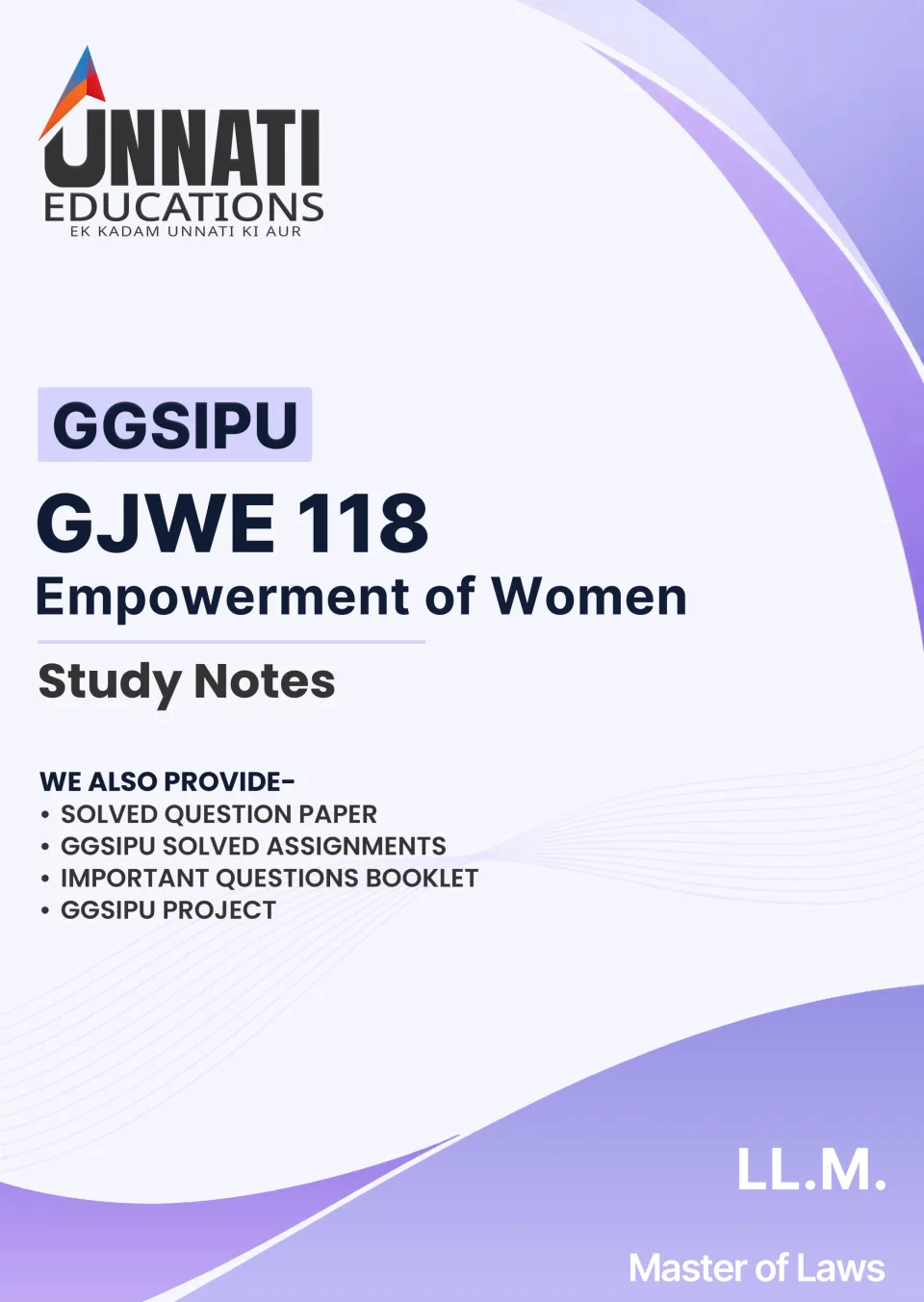
GJWE 118 Empowerment of Women Notes cover all 4 units of the GGSIPU LL.M. (One Year) GJWE Semester 2 paper in a 46-page printed book: 22 tables, a table of 8 landmark judgments and 68 exam-style questions (28 long, 40 short), mapped to the LL.M. syllabus printed w.e.f. 2023 onwards.
Written by Unnati Educations Editorial Team · Academic review by Sheetal Kirola, M.Ed., Academic Head · Checked against Master of Law (LL.M.) Regular One Year Programme w.e.f 2022-23 · Updated 14 October 2026 · Editorial policy
Scheme: LL.M. (One Year) Scheme of Examination and Detailed Syllabus, USLLS | Applies to: batches from 2022-23 (cover reads w.e.f. 2023 onwards) | Verified against: the LL.M. syllabus PDF on ipu.ac.in, 13 October 2026
GJWE 118 Empowerment of Women at a glance: GGSIPU LL.M. Sem 2 credits, units and exam pattern
GJWE 118 is Paper VIII of the one-year LL.M. at USLLS, taught only in the Gender Justice and Women Empowerment (GJWE) track. It is one of five GGSIPU LL.M. Semester 2 papers on that track.
Code and title | GJWE 118 Empowerment of Women |
|---|---|
Course and semester | LL.M. (One Year), GJWE specialisation, Semester II, Paper VIII |
Credits and weekly hours | 5 credits: 4 lecture hours + 2 hours of RTDA (Research and Teaching Development Activities) |
Marks | 100: 25 internal (written test and RTDA) + 75 end-term written exam |
End-term question pattern | Not printed in the official PDF |
Units | 4, with 10 lectures each |
Applies to | Batches from session 2022-23 (syllabus cover reads w.e.f. 2023 onwards) |
Paired lab | None (theory paper) |
The 75-mark end-term paper is set by the university's Examination Division. No pass percentage is printed, so check GGSIPU Ordinance 11 for evaluation and re-appear rules.
GJWE 118 Empowerment of Women Notes unit-wise: 22 tables and 68 exam questions across 4 units
Each unit follows the official order and ends with a Quick Revision Table and exam questions; the sample PDF in the header shows one page per unit. Other papers sit under GGSIPU LL.M. notes.
GJWE 118 Unit 1: Meaning of Empowerment
Pages 3 to 16, five topics and 8 tables, the longest unit. It defines empowerment through Batliwala and Kabeer, then runs from Gargi to the Towards Equality report (1974), the 2001 National Policy and eight groups of hurdles.
Plan | Approach |
|---|---|
1st to 5th (1951 to 1979) | Welfare: health, education, social welfare |
6th (1980 to 85) | Development: first separate chapter on women |
8th (1992 to 97) | Shift from development to empowerment |
10th (2002 to 07) | Gender budgeting and a rights-based approach |
Quick look: plan-wise approach towards women (from page 11)
Plan
1st to 5th (1951 to 1979)
Approach
Welfare: health, education, social welfare
Plan
6th (1980 to 85)
Approach
Development: first separate chapter on women
Plan
8th (1992 to 97)
Approach
Shift from development to empowerment
Plan
10th (2002 to 07)
Approach
Gender budgeting and a rights-based approach
GJWE 118 Unit 2: Education as a Device for Women Empowerment
Pages 17 to 25, five topics. It traces policy from the Durgabai Deshmukh Committee to NEP 2020, groups barriers under SECIG-P, and explains the leaky pipeline and schemes such as Pragati and Vigyan Jyoti.
Indicator | Position |
|---|---|
Female literacy, Census 1951 | About 9% (male about 27%) |
Female literacy, Census 2011 | 65.46% (male 82.14%) |
Higher education, AISHE 2021-22 | Female GER about 28.5%, slightly above male |
Quick look: women's education snapshot (from page 18)
Indicator
Female literacy, Census 1951
Position
About 9% (male about 27%)
Indicator
Female literacy, Census 2011
Position
65.46% (male 82.14%)
Indicator
Higher education, AISHE 2021-22
Position
Female GER about 28.5%, slightly above male
GJWE 118 Unit 3: Socio Cultural and Political Empowerment of Women
Pages 26 to 35, four topics and 5 tables. It holds 8 judgments from Shah Bano (1985) to Babita Puniya (2020), political power from Panchayats to the 18th Lok Sabha, and a UN timeline.
Amendment | Constitution (106th Amendment) Act, 2023 |
|---|---|
Reservation | One-third of seats in Lok Sabha, State Assemblies and the Delhi Assembly |
Starts | After the first census after the Act and the delimitation based on it |
Not covered | Rajya Sabha, State Legislative Councils, separate OBC sub-quota |
GJWE 118 Unit 4: Economic Empowerment of Women
Pages 36 to 46, five topics and 7 tables. It compares organised and unorganised work (over 90% of working women are informal), covers labour laws up to the 2025 Labour Codes, the 1991 LPG reforms, gender budgeting, eight NGOs and unpaid care work.
Gender-neutral | Gender-sensitive |
|---|---|
Measures only total GDP | Measures who benefits, women and men separately |
Ignores unpaid care work | Recognises and values unpaid care work |
Treats the household as one unit | Looks at power and resources inside the household |
May widen gender gaps | Actively works to reduce them |
Quick look: gender-neutral and gender-sensitive development (from page 44)
Gender-neutral
Measures only total GDP
Gender-sensitive
Measures who benefits, women and men separately
Gender-neutral
Ignores unpaid care work
Gender-sensitive
Recognises and values unpaid care work
Gender-neutral
Treats the household as one unit
Gender-sensitive
Looks at power and resources inside the household
Gender-neutral
May widen gender gaps
Gender-sensitive
Actively works to reduce them
From welfare to empowerment in women's development: excerpt from page 9 of the GJWE 118 notes
Excerpt from page 9
Women in Development (WID), 1970s
The WID label came after Ester Boserup's 1970 book on women's role in economic development, which showed that development projects often ignored women or even left them worse off. WID wanted to bring women into the existing development process through education, jobs and credit. Its weakness was that it added women to an unequal structure without changing that structure, and it often raised their workload.
Women and Development (WAD), late 1970s
WAD grew out of Marxist feminism. It argued that women had always been part of development, and that the problem was a global economic system that was unequal in itself. It backed women-only projects, but it said little about power relations inside the household.
Gender and Development (GAD), 1980s onwards
GAD moved the focus from women alone to gender relations, meaning the roles society builds for both men and women. Its aim is to change unequal power in the family, the market and the State, using tools such as gender analysis, gender mainstreaming and gender budgeting. Caroline Moser split women's needs into practical needs (water, food, health) and strategic needs (property rights, equal wages, freedom from violence).
Empowerment and rights-based approaches
The empowerment approach came from Third World feminists in the DAWN network and gained strength from the Beijing Platform for Action (1995). It treats women's own organising, through SHGs and movements, as the main engine of change. India's Eighth Plan (1992 to 97) adopted this language, and the Ninth Plan added the Women's Component Plan with at least 30% of funds for women.
The rights-based approach treats empowerment as a human right, not charity. It rests on CEDAW (ratified by India in 1993) and the Constitution: the State is the duty-bearer and women are rights-holders who can go to court, as in Vishaka v. State of Rajasthan (1997).
Two frameworks to quote
Naila Kabeer links three parts: resources, then agency, then achievements. Sara Longwe ranks five levels of equality in rising order: welfare, access, conscientisation, participation and control.
GJWE 118 exam corner: 28 ten-to-fifteen-mark and 40 two-to-five-mark questions by unit
Every unit ends with 7 long ("10–15 marks") and 10 short ("2–5 marks") questions, printed as practice lists without written answers.
Unit | Long (10–15 marks) | Short (2–5 marks) | Tables |
|---|---|---|---|
1 Meaning of Empowerment | 7 | 10 | 8 |
2 Education as a Device | 7 | 10 | 2 |
3 Socio-Cultural and Political | 7 | 10 | 5 |
4 Economic Empowerment | 7 | 10 | 7 |
GJWE 118 exam questions and tables by unit
Unit
1 Meaning of Empowerment
Long (10–15 marks)
7
Short (2–5 marks)
10
Tables
8
Unit
2 Education as a Device
Long (10–15 marks)
7
Short (2–5 marks)
10
Tables
2
Unit
3 Socio-Cultural and Political
Long (10–15 marks)
7
Short (2–5 marks)
10
Tables
5
Unit
4 Economic Empowerment
Long (10–15 marks)
7
Short (2–5 marks)
10
Tables
7
Unit 1: Critically examine the approaches to women's development. Pointer: time order (pages 8 to 10), one limitation each, end with Longwe.
Unit 2: What are the limitations faced by women in higher and professional education in India? Pointer: the six heads on pages 21 and 22, plus the leaky pipeline.
Unit 3: Explain the main features of the Nari Shakti Vandan Adhiniyam, 2023. Will it lead to real political empowerment? Pointer: page 30 features, then the census delay and missing OBC sub-quota.
Unit 4: What is gender budgeting? Explain its significance and limitations in India. Pointer: Parts A, B and C, then allocation versus outcome (pages 41 and 42).
The GJWE 118 notes list 28 long and 40 short exam-style questions across 4 units, backed by 22 tables. More practice sits in the GJWE 118 important questions.
Who writes and checks the GJWE 118 Empowerment of Women notes?
Unnati Educations Editorial Team, author, working from the official LL.M. syllabus.
Sheetal Kirola, Academic Head, M.Ed., 7 years of experience: academic review of structure, clarity and syllabus coverage; Unit 2 on education overlaps with the gender content she reviews for B.Ed (BED 210).
The 2026-27 edition follows the LL.M. scheme approved by the USLLS Board of Studies on 30 August 2022, and adds the November 2025 Labour Codes, the 18th Lok Sabha count and Part C of the Gender Budget Statement. Updated 14 October 2026 under our editorial policy.
The same team prepares GGSIPU important questions for every course it covers.
Do the GJWE 118 notes cover the full GGSIPU syllabus?
Yes. All four official units are covered in order, each named topic with its own section.
Official unit | Official topics | Where in the notes | Status |
|---|---|---|---|
I Meaning of Empowerment | Meaning, nature, significance; historical and social perspectives; approaches, indicators; national policy, trends; hurdles | Topics 01 to 05, pages 4 to 15 | Covered |
II Education as a Device | Hurdles to women's education; formal-system constraints; need for education; limits in higher and professional education; measures for growth | Topics 01 to 05, pages 18 to 24 | Covered |
III Socio Cultural and Political Empowerment | Socio-cultural and religious affairs; political sphere, local to national; international trends; trends, patterns, obstacles | Topics 01 to 04, pages 27 to 34 | Covered |
IV Economic Empowerment | Organised and unorganised sectors, labour laws; LPG impacts; emerging trends; gender budget; NGOs; gender-sensitive development | Topics 01 to 05, pages 37 to 45 | Covered |
GJWE 118 official syllabus mapped to the notes
Official unit
I Meaning of Empowerment
Official topics
Meaning, nature, significance; historical and social perspectives; approaches, indicators; national policy, trends; hurdles
Where in the notes
Topics 01 to 05, pages 4 to 15
Status
Covered
Official unit
II Education as a Device
Official topics
Hurdles to women's education; formal-system constraints; need for education; limits in higher and professional education; measures for growth
Where in the notes
Topics 01 to 05, pages 18 to 24
Status
Covered
Official unit
III Socio Cultural and Political Empowerment
Official topics
Socio-cultural and religious affairs; political sphere, local to national; international trends; trends, patterns, obstacles
Where in the notes
Topics 01 to 04, pages 27 to 34
Status
Covered
Official unit
IV Economic Empowerment
Official topics
Organised and unorganised sectors, labour laws; LPG impacts; emerging trends; gender budget; NGOs; gender-sensitive development
Where in the notes
Topics 01 to 05, pages 37 to 45
Status
Covered
Official source: GGSIPU LL.M. (One Year) Regular Programme syllabus, w.e.f. 2022-23.
Every course in GGSIPU notes is mapped to its official PDF the same way.
How to write GJWE 118 answers: definitions, articles, judgments and tables in fifteen-mark answers
GJWE 118 is a descriptive paper, so marks come from structure. Open every long answer with a one-line definition; the notes give a ready one on page 4, built on Batliwala and Kabeer. Then anchor the answer in law: Articles 14, 15(3), 39(d) and 243D, a statute, or one judgment from the Unit 3 case table.
Use a small table wherever the question asks you to compare or assess. Examiners read a two-column table faster than two paragraphs, and the notes already hold the ones you need: approaches to development, Five-Year Plans, organised versus unorganised work, and gender-neutral versus gender-sensitive policy.
For lists of hurdles, use the notes' grouping instead of loose points. SECIG-P (Social, Economic, Cultural, Institutional, Geographical, Psychological) gives six headings for any question on barriers to girls' education. Close with the "Conclusion (write in exams)" box printed at the end of each unit, changed into your own words.
Worked plan: "Critically examine the impact of Liberalization, Globalization and Privatization on women in India."
Meaning of each of the three terms and the New Economic Policy of 1991 (page 39).
Positive impacts: IT and BPO jobs, women entrepreneurs, microfinance, urban mobility.
Negative impacts: casual work, feminisation of labour and of agriculture, costlier health and education.
A four-row table by group of women: urban educated, poor rural, export workers, women farmers (page 40).
Conclusion: globalisation made winners and losers among women, so growth needs social security and skills.
For a five-mark short note, write a definition, three points and one example; for the Sarpanch-Pati question, the example is a husband using his elected wife's office, and the remedy is training of elected women (page 29).
Practise this format on GGSIPU LL.M. important questions.
GJWE 118 and the GGSIPU LL.M. Sem 2 papers it connects to
No lab paper is paired with GJWE 118; the full list of LL.M. papers by specialisation is on the GGSIPU LL.M. syllabus page.
In Semester 2, GJWE 118 sits beside GJWE 112 Gender Justice: Issues and Problems, GJWE 114 Gender Justice: Emerging Trends, GJWE 116 Gender Justice and Law and GEN 110 Dissertation. Where the units meet:
Unit 1's articles and CEDAW feed GJWE 116 Unit I.
Unit 3 practices like witch-hunting and the devadasi system return in GJWE 112.
Unit 4's women entrepreneurs link to GJWE 114 Unit IV, Women and Technology.
Unit 3's list of UN world conferences builds on GJWE 113 Unit IV from Semester 1.
Gender budget outcomes or Sarpanch-Pati rule suit a GEN 110 dissertation.
GJWE 118 Empowerment of Women notes FAQs
How do I get the full GJWE 118 notes?
Tap "Get Full Notes" to message the GGSIPU desk on WhatsApp at 9899436384. The GJWE 118 notes are sold only as a printed book, not as a PDF. Delivery takes at most 5 to 7 days, and the exact time depends on your location. Open the sample PDF in the header first to see one page from each unit.
Is GJWE 118 compulsory for every GGSIPU LL.M. student?
No. GJWE 118 is Paper VIII only for students in the Gender Justice and Women Empowerment specialisation of the one-year LL.M. It is taught in Semester 2 with GJWE 112, GJWE 114, GJWE 116 and the GEN 110 dissertation. Students in the Corporate Law, IPR, ADR or Criminal Justice tracks study different papers in that semester.
What is the passing mark for GJWE 118?
GJWE 118 is marked out of 100: 25 internal marks from a written test and RTDA work, and 75 marks in the end-term written exam. The LL.M. scheme PDF does not print a pass percentage. For end-term minimums, evaluation and re-appear rules, read GGSIPU Ordinance 11 on ipu.ac.in or ask the examination office at USLLS before your end-term exam.
Do the GJWE 118 notes cover the 2023 women's reservation law and the Labour Codes?
Yes. Page 30 sets out the Nari Shakti Vandan Adhiniyam, 2023 in a feature table: one-third seats, start after census and delimitation, 15 years, and what it leaves out. Page 38 explains the four Labour Codes that came into force in November 2025, including the OSH Code rule on women working at night with consent and safety.
How is GJWE 118 different from GJWE 116 Gender Justice and Law?
GJWE 118 studies how women gain power through education, politics, culture and the economy, so it leans on policy, data and schemes. GJWE 116 studies the law itself: family law across religions, IPC offences and special enactments such as the PCPNDT and POSH Acts. Some articles and acts appear in both, but the questions asked are different.
Do the GJWE 118 notes give model answers to the exam questions?
No. The 68 questions at the end of the units are practice lists without written answers. The unit sections hold the matter for each one, and the exam corner above shows how to point each answer to the right pages. The notes do print a model conclusion for every unit, which you can adapt in your own words.
Get the full GJWE 118 Empowerment of Women Notes on WhatsApp
Unit | Pages | Tables |
|---|---|---|
1 Meaning of Empowerment | 3 to 16 (14) | 8 |
2 Education as a Device | 17 to 25 (9) | 2 |
3 Socio-Cultural and Political | 26 to 35 (10) | 5 |
4 Economic Empowerment | 36 to 46 (11) | 7 |
GJWE 118 notes book: pages and tables per unit
Unit
1 Meaning of Empowerment
Pages
3 to 16 (14)
Tables
8
Unit
2 Education as a Device
Pages
17 to 25 (9)
Tables
2
Unit
3 Socio-Cultural and Political
Pages
26 to 35 (10)
Tables
5
Unit
4 Economic Empowerment
Pages
36 to 46 (11)
Tables
7
These are GJWE 118 Empowerment of Women IPU notes in a 46-page printed book, not a PDF, delivered in at most 5 to 7 days depending on your location.
These GGSIPU LL.M. Sem 2 Empowerment of Women notes end each unit with a Quick Revision Table, so last-night revision runs on 4 tables, and they are Empowerment of Women notes in English written in simple sentences.
Order the GJWE 118 notes book on WhatsApp (4 units, 46 pages)
Unnati Educations is an independent education provider based in Vikaspuri, Delhi. We are not affiliated with, authorised by, or endorsed by Guru Gobind Singh Indraprastha University (GGSIPU). 'GGSIPU' and 'IPU' are used only to describe the syllabus our notes follow. For official information, visit ipu.ac.in.
Ready for the full notes?
Discuss coverage and delivery with our team.