
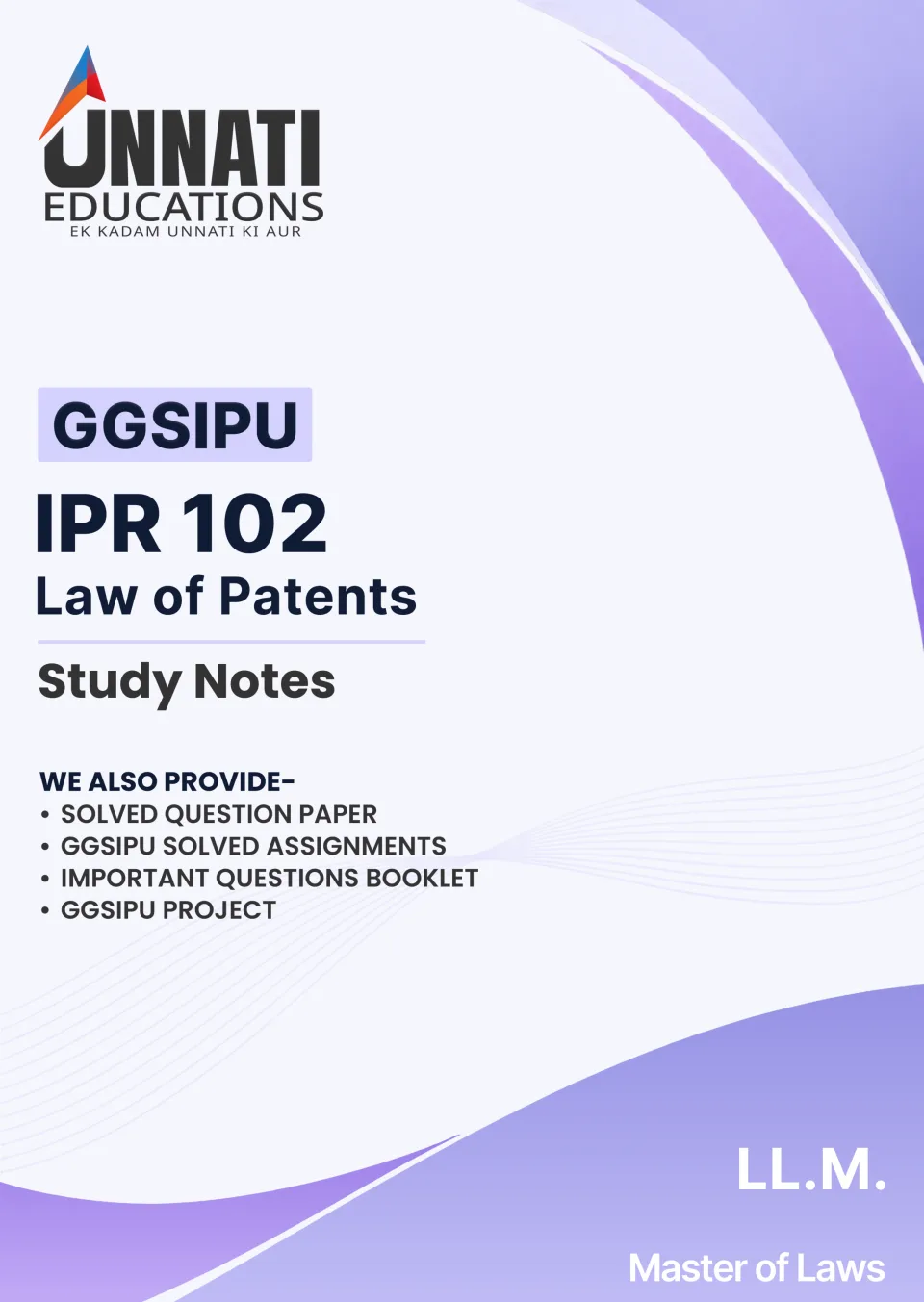
IPR 102 Law of Patents Notes for GGSIPU LL.M. (IPR specialisation, Semester II) cover all 4 official units in a 68-page printed book: 34 topics, 15 case-law boxes, 48 short-answer and 30 long-answer exam-style questions, with revision tables. They follow the LL.M. scheme w.e.f. 2022-23.
Written by Unnati Educations Editorial Team · Reviewed by Sheetal Kirola, M.Ed., Academic Head (academic review) · Checked against the official LL.M. syllabus PDF, 14 October 2026 · Updated 14 October 2026 · Editorial policy
Scheme: LL.M. (One Year) scheme of examination and detailed syllabus, w.e.f. 2022-23 | Applies to: LL.M. (One Year) batches from 2022-23 | Source: Master of Laws (LL.M.) Regular One Year Programme w.e.f 2022-23
IPR 102 Law of Patents at a glance: GGSIPU LL.M. Sem 2 credits, units and exam pattern
Code and title | IPR 102 · Law of Patents (Paper VI) |
|---|---|
Course and semester | LL.M. (One Year), IPR specialisation, Semester II |
Credits and weekly hours | 5 credits: L 4 + RTDA 2 (Research and Teaching Development Activities) |
Marks | 100: 25 internal (test and RTDA) + 75 end-term written exam |
End-term pattern | 75-mark written exam; paper-setter instructions not printed in the official PDF |
Units | 4 units, 10 lectures each |
Paired lab | None (IPR 102 is a theory paper) |
The LL.M. carries 55 credits in all; IPR 102 sits with IPR 104, 106, 108 and GEN 110 among the GGSIPU LL.M. Semester 2 papers.
IPR 102 Law of Patents Notes unit-wise: 34 topics, 15 case-law boxes and 78 exam questions across 4 units
Notes for other papers of the course sit under GGSIPU LL.M. notes. To check the layout before ordering, see the sample PDF above.
IPR 102 Unit 1: Introduction
Unit 1 asks why the law grants a 20-year monopoly at all: Locke's labour idea, reward, incentive, exchange-for-secrets, Kitch's prospect theory and Hegel. It then tracks Indian law from Act VI of 1856 and the Ayyangar Committee to the Patents Act, 1970 and the 1999, 2002 and 2005 amendments.
Pages 3-18 · 6 topics, ending with Paris, TRIPS, Budapest and PCT · 3 case-law boxes (Novartis, WTO dispute DS50, Dimminaco) · 12 short and 7 long questions.
Quick look: three patent treaties compared (from page 16)
Point | Paris Convention | PCT | Budapest Treaty |
|---|---|---|---|
Year | 1883 | 1970 | 1977 |
India joined | 7 Dec 1998 | 7 Dec 1998 | 17 Dec 2001 |
Main benefit | 12-month priority right | National filing delayed to 30/31 months | One deposit recognised everywhere |
Quick look: Paris Convention, PCT and Budapest Treaty (from page 16)
Point
Year
Paris Convention
1883
PCT
1970
Budapest Treaty
1977
Point
India joined
Paris Convention
7 Dec 1998
PCT
7 Dec 1998
Budapest Treaty
17 Dec 2001
Point
Main benefit
Paris Convention
12-month priority right
PCT
National filing delayed to 30/31 months
Budapest Treaty
One deposit recognised everywhere
IPR 102 Unit 2: Patentability and Procedures for Grant of Patents
Unit 2, the longest, follows an application from idea to grant: Section 3 and 4 exclusions, filing on Form 1, specifications, claim construction and equivalents, priority, the Section 25 oppositions, rights under Section 48, the 20-year term, revocation under Section 64 and the patent of addition.
Pages 19-38 · 12 topics · 5 case-law boxes (Bishwanath Prasad, Raj Prakash, Aloys Wobben) · 12 short and 8 long questions.
Quick look: key time limits in an Indian patent application (from page 25)
Event | Time limit |
|---|---|
Complete specification after provisional | 12 months |
Publication of application | 18 months from priority |
Request for examination | 31 months from priority (2024 Rules) |
Post-grant opposition | 1 year from publication of grant |
Quick look: IPR 102 filing and opposition time limits (from page 25)
Event
Complete specification after provisional
Time limit
12 months
Event
Publication of application
Time limit
18 months from priority
Event
Request for examination
Time limit
31 months from priority (2024 Rules)
Event
Post-grant opposition
Time limit
1 year from publication of grant
IPR 102 Unit 3: Limitations, Exceptions & Infringements
Unit 3 shows where a patentee's rights stop: voluntary licences (exclusive, sole, cross, FRAND), compulsory licensing under Sections 84 to 92A through Bayer v. Natco, assignment under Sections 68 and 69, the Bolar exception, government use, exhaustion, and infringement with Section 108 remedies.
Pages 39-52 · 6 topics · 4 case-law boxes (Bayer v. Union of India, Lexmark, Ericsson v. Lava) · 12 short and 7 long questions.
Quick look: the three exhaustion regimes (from page 47)
Type | Meaning | Example |
|---|---|---|
National | Only a sale inside the country exhausts rights; imports can be stopped | Earlier US position (before 2017) |
Regional | A sale anywhere in the region exhausts rights across it | European Union / EEA |
International | A sale anywhere in the world exhausts rights; imports allowed | India, Section 107A(b); USA after Lexmark (2017) |
Quick look: national, regional and international exhaustion (from page 47)
Type
National
Meaning
Only a sale inside the country exhausts rights; imports can be stopped
Example
Earlier US position (before 2017)
Type
Regional
Meaning
A sale anywhere in the region exhausts rights across it
Example
European Union / EEA
Type
International
Meaning
A sale anywhere in the world exhausts rights; imports allowed
Example
India, Section 107A(b); USA after Lexmark (2017)
IPR 102 Unit 4: Patent Authorities, Patent Agents & Emerging Issues
Unit 4 covers the Controller (Section 73), examiners (Sections 12 and 13) and patent agents (Sections 125 to 132), then the seven emerging issues: computer programs "per se", business methods and utility models, AI and DABUS, human rights, public health and the TRIPS waiver, traditional knowledge, and outer space.
Pages 53-68 · 10 topics · 3 case-law boxes (Alice v. CLS Bank, Yahoo v. Rediff) · 12 short and 8 long questions.
Quick look: Controller and examiner compared (from page 56)
Basis | Controller | Examiner |
|---|---|---|
Role | Decision-maker (quasi-judicial) | Technical examination and search |
Final authority to grant or refuse | Yes | No |
Powers of a civil court | Yes (Section 77) | No |
Quick look: Controller of Patents vs patent examiner (from page 56)
Basis
Role
Controller
Decision-maker (quasi-judicial)
Examiner
Technical examination and search
Basis
Final authority to grant or refuse
Controller
Yes
Examiner
No
Basis
Powers of a civil court
Controller
Yes (Section 77)
Examiner
No
IPR 102 exam corner: 48 two-to-five-mark and 30 ten-to-fifteen-mark exam-style questions by unit
Unit | Short answer (2-5 Marks) | Long answer (10-15 Marks) | Case-law boxes |
|---|---|---|---|
Unit 1 | 12 | 7 | 3 |
Unit 2 | 12 | 8 | 5 |
Unit 3 | 12 | 7 | 4 |
Unit 4 | 12 | 8 | 3 |
Total | 48 | 30 | 15 |
IPR 102 question sets and case-law boxes per unit
Unit
Unit 1
Short answer (2-5 Marks)
12
Long answer (10-15 Marks)
7
Case-law boxes
3
Unit
Unit 2
Short answer (2-5 Marks)
12
Long answer (10-15 Marks)
8
Case-law boxes
5
Unit
Unit 3
Short answer (2-5 Marks)
12
Long answer (10-15 Marks)
7
Case-law boxes
4
Unit
Unit 4
Short answer (2-5 Marks)
12
Long answer (10-15 Marks)
8
Case-law boxes
3
Unit
Total
Short answer (2-5 Marks)
48
Long answer (10-15 Marks)
30
Case-law boxes
15
The IPR 102 notes set 48 two-to-five-mark and 30 ten-to-fifteen-mark exam-style questions across 4 units, plus 15 case-law boxes. One per unit, with pointers:
Unit 1 (2-5 Marks): What is the "right of priority" under the Paris Convention? Article 4: a 12-month window in which later filings abroad keep the first filing date.
Unit 2 (10-15 Marks): Compare pre-grant and post-grant opposition in India. Section 25(1): any person, before grant. Section 25(2): only a "person interested", within one year of grant, with an Opposition Board.
Unit 3 (2-5 Marks): What are the grounds for grant of a compulsory licence under Section 84? After three years: public need unmet, price unaffordable, or not worked in India. Cite Bayer v. Natco (2012).
Unit 4 (2-5 Marks): What is TKDL? The Traditional Knowledge Digital Library (2001), used to find TK as prior art; add turmeric, neem and Section 3(p).
More practice for this paper sits in the IPR 102 important questions.
Novelty, prior art and anticipation in patent law: excerpt from page 22 of the IPR 102 notes
Excerpt from page 22
What "new" means under Section 2(1)(l)
A "new invention" is any invention or technology that has not been anticipated by publication in any document, or used in the country or elsewhere in the world, before the date of filing of the application with complete specification. In other words, the subject matter must not have fallen into the public domain or become part of the state of the art. India follows absolute (global) novelty: a prior publication or prior use anywhere in the world destroys novelty.
Prior art
Prior art is everything made available to the public before the priority date. It includes patents, journals, books, theses, websites, conference papers, product brochures, oral disclosures, public use and traditional knowledge. The Patent Office searches it through patent databases and the Traditional Knowledge Digital Library (TKDL).
Anticipation and the bar on mosaicing
An invention is anticipated when a single prior art document, or a single prior use, discloses every essential feature of the claimed invention so that a person skilled in the art could make it. Separate documents cannot be joined together ("mosaicing") to show lack of novelty. Mosaicing is allowed only when the question is inventive step.
What does not count as anticipation: Sections 29 to 34
Section | Exception |
|---|---|
29 | Publication without the applicant's consent, if the applicant files as soon as possible after learning of it |
30 | Communication of the invention to the Government or a person it authorises to investigate it |
31 | Display at a notified exhibition, a paper read before a learned society, or public working for reasonable trial, if filing follows within 12 months |
32 | Public working within one year before the priority date, only for reasonable trial where the invention needed it |
33 | Publication or use after the date of filing of the provisional specification |
34 | Mere publication or use is no anticipation unless the above limits are crossed |
Exceptions to anticipation under the Patents Act, 1970 (excerpt, page 22)
Section
29
Exception
Publication without the applicant's consent, if the applicant files as soon as possible after learning of it
Section
30
Exception
Communication of the invention to the Government or a person it authorises to investigate it
Section
31
Exception
Display at a notified exhibition, a paper read before a learned society, or public working for reasonable trial, if filing follows within 12 months
Section
32
Exception
Public working within one year before the priority date, only for reasonable trial where the invention needed it
Section
33
Exception
Publication or use after the date of filing of the provisional specification
Section
34
Exception
Mere publication or use is no anticipation unless the above limits are crossed
Moving to inventive step
Section 2(1)(ja) then sets a higher bar. Inventive step means a feature that involves technical advance over existing knowledge, or has economic significance, or both, and that makes the invention not obvious to a person skilled in the art. Something can be new and still obvious, for example swapping iron for steel in a known machine only to get the known advantage of steel.
Do the IPR 102 notes cover the full GGSIPU syllabus?
Yes. Every official IPR 102 topic, Unit I (a) to Unit IV (d)(vii), has its own section; no gap was found.
Official unit | Official topics | Where in the notes | Status |
|---|---|---|---|
Unit I: Introduction | Theories; evolution in India; Paris, TRIPS, Budapest, PCT | Topics 01-06, pages 4-16 | Covered |
Unit II: Patentability and Procedures for Grant of Patents | Patentability; pre-requisites; filing; specifications; claims; priority; opposition; grant; rights; term; revocation; patent of addition | Topics 01-12, pages 20-36 | Covered |
Unit III: Limitations, Exceptions & Infringements | Licensing; assignment; fair use; government use; exhaustion; infringement | Topics 01-06, pages 40-50 | Covered |
Unit IV: Patent Authorities, Patent Agents & Emerging Issues | Controller; examiners; agents; seven emerging issues | Topics 01-10, pages 54-67 | Covered |
IPR 102 official syllabus topics mapped to the notes
Official unit
Unit I: Introduction
Official topics
Theories; evolution in India; Paris, TRIPS, Budapest, PCT
Where in the notes
Topics 01-06, pages 4-16
Status
Covered
Official unit
Unit II: Patentability and Procedures for Grant of Patents
Official topics
Patentability; pre-requisites; filing; specifications; claims; priority; opposition; grant; rights; term; revocation; patent of addition
Where in the notes
Topics 01-12, pages 20-36
Status
Covered
Official unit
Unit III: Limitations, Exceptions & Infringements
Official topics
Licensing; assignment; fair use; government use; exhaustion; infringement
Where in the notes
Topics 01-06, pages 40-50
Status
Covered
Official unit
Unit IV: Patent Authorities, Patent Agents & Emerging Issues
Official topics
Controller; examiners; agents; seven emerging issues
Where in the notes
Topics 01-10, pages 54-67
Status
Covered
Official source: LL.M. (One Year) scheme and detailed syllabus, w.e.f. 2022-23, where IPR 102 is Paper VI with four course outcomes.
Every course listed in GGSIPU notes is mapped against its official PDF in the same way.
Who writes and checks the IPR 102 patents notes?
Unnati Educations Editorial Team (author): wrote the IPR 102 notes unit by unit against the official LL.M. syllabus.
Sheetal Kirola (reviewer): Academic Head · M.Ed. · 7 years of experience · academic review of structure, clarity and syllabus coverage · reviewer profile.
The review matched all 34 topics to official syllabus lines. These are exam notes, not legal advice. This 2026-27 edition is mapped to the LL.M. (One Year) scheme w.e.f. 2022-23, last updated 14 October 2026 (editorial policy).
The same team prepares GGSIPU important questions for each course it covers.
IPR 102 and the GGSIPU LL.M. Sem 2 papers it connects to
IPR 102 has no paired lab; the full IPR paper list and credits sit on the GGSIPU LL.M. syllabus page.
Semester II siblings: IPR 104 Law of Trademark, IPR 106 Law of Designs, Layout Designs and Geographical Indications, IPR 108 Protection of Plant Varieties & Traditional Knowledge, and GEN 110 Dissertation (10 credits, NUES).
Unit 1 Paris Convention and TRIPS → return in IPR 104 and IPR 106.
Unit 4 TK, TKDL and the turmeric and neem cases → base for IPR 108 Units III and IV.
AI inventions, compulsory licensing and Section 3(d) → common GEN 110 dissertation topics.
How to write IPR 102 answers: section-cited long answers, case-law short notes and comparison tables
The Unit 1 formula: introduction with the definition and year, main provisions with Article or Section numbers, the Indian position, case law, criticism, then conclusion. Unit 2 adds a "section-number power list" (2(1)(j), 3, 25, 48, 53, 64).
For Unit 3 infringement: Section 48, types, who can sue, Section 104 jurisdiction, Section 104A burden, defences (107, 107A, 111), Section 108 remedies, cases. Unit 4 issues run Indian position, international position, arguments, and a suggestion for India.
Draw the PCT time-line (0, 12, 16, 18, 22, 30/31 months) and put exhaustion in a table with the 2005 change in Section 107A(b), "by the patentee" to "under the law".
Worked example: short note on a patent of addition (2-5 Marks)
Meaning: a patent for an improvement in or modification of the main invention (Section 54). Term: the unexpired term of the main patent, no separate renewal fee (Section 55). Validity: not refused only because the main invention makes it obvious (Section 56).
Practise this structure on questions from other LL.M. papers in GGSIPU LL.M. important questions.
IPR 102 patents notes FAQs
How do I get the full IPR 102 notes?
Message us on WhatsApp at 9899436384 with the code IPR 102, or use the button on this page. The full IPR 102 notes are sold as a printed book only, not as a PDF. Once the order is confirmed, the book is posted to your address, and delivery takes up to 5 to 7 days depending on your location.
What is the passing mark for IPR 102?
IPR 102 is marked out of 100: 25 internal marks from the subject teacher for a written test and RTDA work, and 75 marks in the end-term written exam. The official LL.M. syllabus PDF does not print a pass percentage. For minimum marks, re-appear and result rules, read Ordinance 11 on ipu.ac.in and your school's exam notices.
Is IPR 102 studied in every LL.M. specialisation?
No. IPR 102 Law of Patents is a Semester II paper of the IPR specialisation only. Corporate Law, ADR, Criminal Justice and Gender Justice students take their own Semester II papers. All five specialisations share GEN 110 Dissertation, and GEN 101, GEN 103 and GEN 105 in Semester I. These IPR 102 notes follow the IPR syllabus alone.
Do the IPR 102 notes include the 2024 patent rule changes?
Yes. The IPR 102 notes use the Patents (Amendment) Rules, 2024 where they change an answer: request for examination within 31 months from priority, and the pre-grant opposition step where the Controller first checks for a prima facie case. They also cover High Court appeals under Section 117A after the Tribunals Reforms Act, 2021, and the Jan Vishwas Act, 2023.
Does IPR 102 Unit 4 cover AI inventions and the DABUS cases?
Yes. Page 61 of the IPR 102 notes covers DABUS country by country: Thaler v. Comptroller-General [2023] UKSC 49, the EPO ruling J 8/20, Thaler v. Vidal (2022) in the US, the Australian reversal and the South African grant. It also gives the Indian Patent Office objection that the "true and first inventor" must be a natural person.
Which IPR 102 cases appear across the most units?
Novartis AG v. Union of India (2013) is the most repeated case in the IPR 102 notes, appearing in Units 1, 2 and 4: evolution, Section 3(d), pre-grant opposition and human rights. Bayer v. Natco (2012) links Units 3 and 4, and Roche v. Cipla links claim construction in Unit 2 with infringement in Unit 3. Learn these three first.
Get the full IPR 102 Law of Patents Notes on WhatsApp
Unit | Pages | Topics |
|---|---|---|
Unit 1 | 16 (3-18) | 6 |
Unit 2 | 20 (19-38) | 12 |
Unit 3 | 14 (39-52) | 6 |
Unit 4 | 16 (53-68) | 10 |
IPR 102 printed book: pages and content per unit
Unit
Unit 1
Pages
16 (3-18)
Topics
6
Unit
Unit 2
Pages
20 (19-38)
Topics
12
Unit
Unit 3
Pages
14 (39-52)
Topics
6
Unit
Unit 4
Pages
16 (53-68)
Topics
10
68 pages with cover and index: 34 topics, 15 case-law boxes, 4 revision tables and 78 questions. Anyone searching for IPR 102 Law of Patents IPU notes gets the four official units in order.
It comes only as a printed book, not a PDF. Delivery takes a maximum of 5 to 7 days; the rest depends on your location. These GGSIPU LL.M. Sem 2 Law of Patents notes are written simply, for students who want Law of Patents notes in English.
Order the IPR 102 Law of Patents Notes book on WhatsApp (4 units, 68 pages)
Unnati Educations is an independent education provider based in Vikaspuri, Delhi. We are not affiliated with, authorised by, or endorsed by Guru Gobind Singh Indraprastha University (GGSIPU). 'GGSIPU' and 'IPU' are used only to describe the syllabus our notes follow. For official information, visit ipu.ac.in.
Ready for the full notes?
Discuss coverage and delivery with our team.