
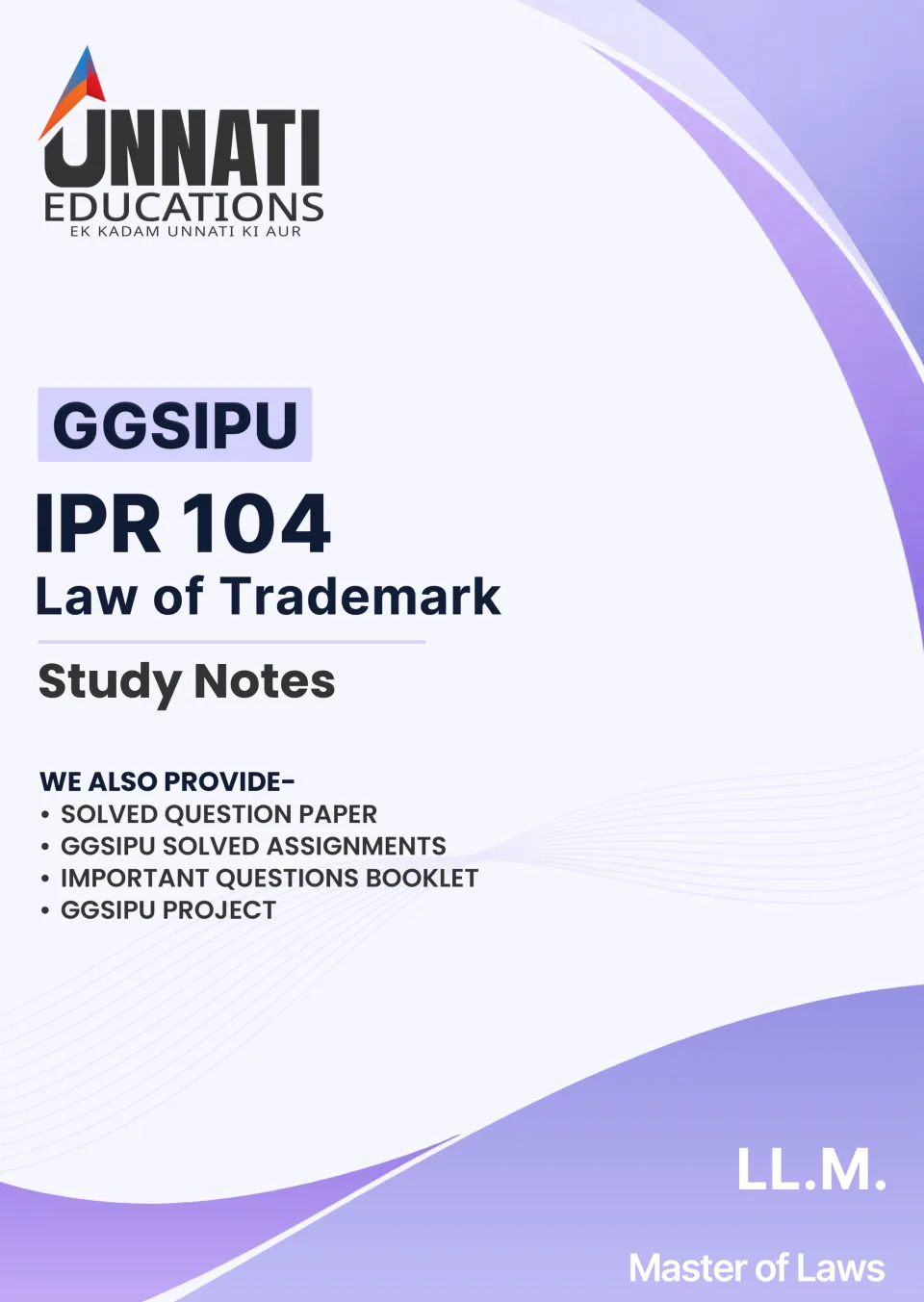
IPR 104 Law of Trademark Notes cover all 4 units of the GGSIPU LL.M. (IPR specialisation) Semester 2 paper in a 55-page printed book: 33 decided cases in case-law boxes, 29 comparison and revision tables, and 66 exam-style questions (26 long-answer, 40 short-note). The syllabus applies to LL.M. batches from academic session 2022-23.
Written by Unnati Educations Editorial Team · Reviewed by Sheetal Kirola, Academic Head, M.Ed. (academic review: structure, clarity, syllabus coverage) · Checked against the official LL.M. (One Year) scheme and syllabus PDF, DAA notice of 13 Sep 2022 · Updated 14 Oct 2026 · Editorial policy
Scheme: LL.M. (One Year) scheme and detailed syllabus, IPR specialisation | Applies to: LL.M. batches from academic session 2022-23 (syllabus cover reads w.e.f. 2023 onwards) | Verified against: Master of Laws (LL.M.) Regular One Year Programme w.e.f. 2022-23, ipu.ac.in
IPR 104 Law of Trademark at a glance: GGSIPU LL.M. IPR Sem 2 credits, units and exam pattern
Code and title | IPR 104, Law of Trademark (Paper VII) |
|---|---|
Course and semester | LL.M. (One Year), Intellectual Property Rights (IPR) specialisation, Semester 2 |
Teaching and credits | 4 lecture hours + 2 RTDA (Research and Teaching Development Activities) = 5 credits |
Marks | 100: 25 internal (written test + RTDA) + 75 end-semester written exam |
Applies to | LL.M. batches from academic session 2022-23 |
End-term question pattern | Not printed in the official PDF (no paper-setter instructions for LL.M.) |
Units | 4 units, 10 lectures each |
Paired lab | None. IPR 104 is a theory paper |
IPR 104 sits with the other GGSIPU LL.M. Semester 2 papers: four 5-credit theory papers plus the 10-credit GEN 110 dissertation.
IPR 104 Law of Trademark Notes unit-wise: 33 decided cases and 66 exam questions across 4 units
These GGSIPU LL.M. IPR Sem 2 Law of Trademark notes follow the Trade Marks Act, 1999 section by section, and close each unit with a Quick Revision Table and a question bank. Notes for every other LL.M. paper sit under GGSIPU LL.M. notes, and the sample PDF in the page header shows one page from each unit.
IPR 104 Unit 1: Introduction
Pages 3 to 19. Unit 1 traces Indian trademark law to the 1999 Act, sets out why marks are protected, then covers the Paris, Madrid, Nice, TLT, Singapore and TRIPS treaties and eight kinds of marks, ending with well-known marks under Section 11(6). Five case-law entries, 8 long-answer and 10 short-note questions.
Point | Agreement, 1891 | Protocol, 1989 |
|---|---|---|
Basis | Home registration needed | Home application is enough |
Refusal period | 12 months | 12 or 18 months |
Central attack | Registration simply dies | Transformation into national applications |
India | Not a member | Member from 8 July 2013 |
Quick look: Madrid Agreement vs Madrid Protocol (from page 9)
Point
Basis
Agreement, 1891
Home registration needed
Protocol, 1989
Home application is enough
Point
Refusal period
Agreement, 1891
12 months
Protocol, 1989
12 or 18 months
Point
Central attack
Agreement, 1891
Registration simply dies
Protocol, 1989
Transformation into national applications
Point
India
Agreement, 1891
Not a member
Protocol, 1989
Member from 8 July 2013
IPR 104 Unit 2: Registration of Trademarks
Pages 20 to 32. Unit 2 covers the pre-requisites, distinctiveness spectrum, refusal grounds in Sections 9 and 11, honest concurrent use (Section 12), deceptive similarity under Section 2(1)(h), and both the TM-A and Madrid filing routes. Eleven case-law entries, 6 long-answer and 10 short-note questions.
Stage | Section / form | Time limit |
|---|---|---|
Examination report reply | s. 18(4) | 1 month |
Opposition | s. 21, Form TM-O | 4 months from advertisement |
Counter-statement | s. 21(2) | 2 months from notice |
Renewal | s. 25, Form TM-R | Every 10 years |
Quick look: registration timeline (from page 29)
Stage
Examination report reply
Section / form
s. 18(4)
Time limit
1 month
Stage
Opposition
Section / form
s. 21, Form TM-O
Time limit
4 months from advertisement
Stage
Counter-statement
Section / form
s. 21(2)
Time limit
2 months from notice
Stage
Renewal
Section / form
s. 25, Form TM-R
Time limit
Every 10 years
IPR 104 Unit 3: Commercial Exploitation of Trademarks and IPAB
Pages 33 to 43. Unit 3 treats the mark as property: the proprietor's rights and their limits (Sections 28 to 37), assignment with or without goodwill, transmission, and registered users (Sections 48 to 55). The IPAB section runs from its set-up in 2003 to its abolition in 2021. Four case-law entries, 6 long-answer and 10 short-note questions.
Point | Assignment | Transmission |
|---|---|---|
Nature | Voluntary, by act of parties | By operation of law |
Definition | s. 2(1)(b) | s. 2(1)(zc) |
Example | Sale of a brand | Brand passes to heirs |
Quick look: assignment vs transmission (from page 38)
Point
Nature
Assignment
Voluntary, by act of parties
Transmission
By operation of law
Point
Definition
Assignment
s. 2(1)(b)
Transmission
s. 2(1)(zc)
Point
Example
Assignment
Sale of a brand
Transmission
Brand passes to heirs
IPR 104 Unit 4: Infringement and Passing off
Pages 44 to 55. Unit 4 reads Section 29 clause by clause, including dilution, then defences, goodwill and the classical trinity for passing off, civil and criminal remedies (Anton Piller, John Doe, Sections 103 to 105), and cyberspace: domain names, UDRP, INDRP and keyword ads. Fifteen case-law entries, 6 long-answer and 10 short-note questions.
Point | Infringement | Passing off |
|---|---|---|
Nature | Statutory (s. 29) | Common law (saved by s. 27(2)) |
Mark | Registered only | Registered and unregistered |
Goodwill | Need not be proved | Must be proved |
Added matter | No defence if essentials copied | Can remove confusion |
Quick look: infringement vs passing off (from page 49)
Point
Nature
Infringement
Statutory (s. 29)
Passing off
Common law (saved by s. 27(2))
Point
Mark
Infringement
Registered only
Passing off
Registered and unregistered
Point
Goodwill
Infringement
Need not be proved
Passing off
Must be proved
Point
Added matter
Infringement
No defence if essentials copied
Passing off
Can remove confusion
IPR 104 exam corner: 26 long-answer and 40 short-note questions by unit
Unit | Long-answer | Short notes | Case-law entries |
|---|---|---|---|
Unit 1: Introduction | 8 | 10 | 5 |
Unit 2: Registration | 6 | 10 | 11 |
Unit 3: Commercial exploitation and IPAB | 6 | 10 | 4 |
Unit 4: Infringement and passing off | 6 | 10 | 15 |
Total | 26 | 40 | 35 (33 distinct cases) |
IPR 104 exam-style questions and case law in the notes, unit by unit
Unit
Unit 1: Introduction
Long-answer
8
Short notes
10
Case-law entries
5
Unit
Unit 2: Registration
Long-answer
6
Short notes
10
Case-law entries
11
Unit
Unit 3: Commercial exploitation and IPAB
Long-answer
6
Short notes
10
Case-law entries
4
Unit
Unit 4: Infringement and passing off
Long-answer
6
Short notes
10
Case-law entries
15
Unit
Total
Long-answer
26
Short notes
40
Case-law entries
35 (33 distinct cases)
The IPR 104 notes list 26 long-answer and 40 short-note questions across 4 units, backed by 33 decided cases. They are answered through the unit text, not as separate model answers. One per unit:
Unit 1: Explain the Madrid System and what "central attack" means. Pointer: one application, 5-year dependency on the basic mark, transformation.
Unit 2: What is deceptive similarity? Discuss the tests with reference to Cadila Health Care v. Cadila Pharmaceuticals. Pointer: Section 2(1)(h), the imperfect-recollection buyer, the Cadila factors.
Unit 3: "Licensing without quality control amounts to trafficking in trademarks." Discuss. Pointer: quality control, American Home Products v. Mac Laboratories (1986).
Unit 4: Distinguish infringement from passing off with reference to Durga Dutt Sharma v. Navaratna. Pointer: statutory vs common law; added matter does not save an infringer.
More practice sits in the IPR 104 important questions.
Who writes and checks the IPR 104 trademark notes?
Unnati Educations Editorial Team: writes the LL.M. notes and checks section numbers against the Trade Marks Act, 1999 and the 2017 Rules. How we write and check notes
Sheetal Kirola, Academic Head, Unnati Educations · M.Ed. · 7 years of experience · role on these notes: academic review of structure, clarity and syllabus coverage (not a legal review). Profile
The 2026-27 edition of the IPR 104 Law of Trademark IPU notes is mapped to the LL.M. (One Year) scheme for batches from 2022-23. It includes the IPAB's abolition in 2021, sound marks and Rule 124 under the 2017 Rules, and Google LLC v. DRS Logistics (2023). Last updated 14 Oct 2026.
The same team prepares GGSIPU important questions for every course it covers.
How to write IPR 104 answers: section-plus-case-law answers on registration, infringement and passing off
A strong trademark answer rests on three things: the right section, a correct test, and a decided case that applies it. The notes run in that order (meaning, section, CASE LAW box, KEY POINT), so a long answer can follow it: define, cite, explain the test, apply a case, conclude.
For a short note on Section 27, state its two limbs (no infringement suit for unregistered marks, passing off saved) and cite N.R. Dongre v. Whirlpool. The comparison tables become "distinguish between" answers.
Worked outline: "Discuss the absolute grounds for refusal under Section 9"
Section 9(1): non-distinctive, descriptive and customary marks; acquired distinctiveness proviso (Godfrey Phillips).
Section 9(2): deceptive, religious, obscene marks and the Emblems Act (Lal Babu Priyadarshi, "Ramayan").
Section 9(3): shape marks; close by noting only 9(1) can be cured by use.
Avoid calling the IPAB the present appeal forum (the High Court took over in 2021) and the old 7-year term from the 1958 Act. Practise this format on GGSIPU LL.M. important questions.
IPR 104 and the GGSIPU LL.M. IPR Sem 2 papers it connects to
IPR 104 has no lab paper; the full paper list for each specialisation is on the GGSIPU LL.M. syllabus page.
Semester 2 IPR papers alongside it: IPR 102 Law of Patents, IPR 106 Law of Designs, Layout Designs and Geographical Indications, IPR 108 Protection of Plant Varieties and Traditional Knowledge, and GEN 110 Dissertation.
Unit 1's Paris and TRIPS provisions return in IPR 102 and IPR 106.
Unit 2's Section 9(3) shape bar points to IPR 106 for designs and to IPR 102 for technical shapes.
Section 11(3)(b) builds on IPR 109 Law of Copyright from Semester 1.
Absolute grounds and secondary meaning in trademark law: excerpt from page 22 of the IPR 104 notes
Excerpt from page 22
Absolute grounds are objections that come from the mark itself: its nature, meaning or effect on the public. They do not depend on any other person's mark. The Registrar raises them on his own during examination. They are given in Section 9.
Section 9(1): marks lacking distinctiveness
(a) Devoid of any distinctive character. Marks which cannot distinguish one trader's goods from another's, such as a single letter, a simple shape, a common surname, or a plain laudatory word like "Best" or "Perfect".
(b) Descriptive marks. Marks which consist exclusively of words or signs that show the kind, quality, quantity, intended purpose, value, geographical origin or time of production of goods or services. Examples: "Fresh" for bread, "Delhi" for sweets, "Cough Relief" for a syrup. These words must remain free for all traders.
(c) Customary or generic marks. Marks which have become customary in the current language or in bona fide and established trade practice. "Aspirin", "Thermos" and "Escalator" became generic in many countries.
Proviso: acquired distinctiveness (secondary meaning)
A mark will not be refused under Section 9(1) if, before the date of application, it has acquired a distinctive character as a result of use, or is a well-known trademark. This is called secondary meaning: the public links the descriptive word with one particular trader.
Case law
Godfrey Phillips India Ltd. v. Girnar Food and Beverages (2004, SC): a descriptive word can get protection if it has acquired secondary meaning through long use ("Super Cup" for tea).
J.R. Kapoor v. Micronix India (1994, SC): "Micro" is a common descriptive word for micro-technology, so nobody can claim an exclusive right over it. "Microtel" was held not to infringe "Micronix".
Imperial Tobacco Co. v. Registrar of Trade Marks (1977, Cal): "SIMLA" for cigarettes was refused as a geographical name, and no distinctiveness was proved.
Do the IPR 104 notes cover the full GGSIPU syllabus?
Yes. Every topic in the four official IPR 104 units has its own section; no gaps. Its "Singapore Law Treaty" is covered as the Singapore Treaty, 2006.
Official unit | Official topics | Where in the notes | Status |
|---|---|---|---|
Unit I: Introduction | Evolution of Trademark in India; Justification; International Treaties (Paris, Madrid Agreement and Protocol, NICE, Trademark Law Treaty, Singapore Law Treaty, TRIPS); Kinds of Trademarks | Sections 01 to 09, pages 4 to 17 | Covered |
Unit II: Registration of Trademarks | Pre-requisites; Absolute and Relative Grounds for Refusal; Deceptive Similarity and its Applicability in Registration; Procedure for Registration; National and International Registration | Sections 01 to 06, pages 21 to 30 | Covered |
Unit III: Commercial Exploitation of Trademarks and IPAB | Rights of Proprietor; Assignment, Licensing and Transmission of Trademark; IPAB | Sections 01 to 05, pages 34 to 42 | Covered |
Unit IV: Infringement and Passing off | Infringement; Goodwill and Passing off; Remedies; Trademark Issues in Cyberspace | Sections 01 to 04, pages 45 to 53 | Covered |
IPR 104 official syllabus mapped to the notes
Official unit
Unit I: Introduction
Official topics
Evolution of Trademark in India; Justification; International Treaties (Paris, Madrid Agreement and Protocol, NICE, Trademark Law Treaty, Singapore Law Treaty, TRIPS); Kinds of Trademarks
Where in the notes
Sections 01 to 09, pages 4 to 17
Status
Covered
Official unit
Unit II: Registration of Trademarks
Official topics
Pre-requisites; Absolute and Relative Grounds for Refusal; Deceptive Similarity and its Applicability in Registration; Procedure for Registration; National and International Registration
Where in the notes
Sections 01 to 06, pages 21 to 30
Status
Covered
Official unit
Unit III: Commercial Exploitation of Trademarks and IPAB
Official topics
Rights of Proprietor; Assignment, Licensing and Transmission of Trademark; IPAB
Where in the notes
Sections 01 to 05, pages 34 to 42
Status
Covered
Official unit
Unit IV: Infringement and Passing off
Official topics
Infringement; Goodwill and Passing off; Remedies; Trademark Issues in Cyberspace
Where in the notes
Sections 01 to 04, pages 45 to 53
Status
Covered
Official source: GGSIPU LL.M. (One Year) scheme and syllabus, w.e.f. 2022-23 (USLLS, ipu.ac.in). It also carries the marks scheme.
Unit III still names the IPAB, so the notes teach its old role and the present High Court position. Every course in GGSIPU notes is mapped to its official PDF the same way.
IPR 104 trademark notes FAQs
How do I get the full IPR 104 notes?
Tap "Get Full Notes" on this page to open WhatsApp with a pre-filled message, or send a message to 9899436384. The IPR 104 notes come as a printed book of 55 pages covering all 4 units, delivered within 5 to 7 days at most; the exact time depends on your location. You can check the sample PDF in the page header first.
Are the IPR 104 Law of Trademark notes available as a PDF?
No. The full IPR 104 notes are sold only as a printed book, not as a PDF or e-book file. The only PDF here is the watermarked sample: cover, index and one page from each unit, to judge the layout before ordering the book on WhatsApp. The printed book reaches you within 5 to 7 days.
How many marks is IPR 104 out of, and what is the passing mark?
IPR 104 is marked out of 100: 25 internal marks (written test and RTDA work) and 75 marks in the end-semester written exam conducted by the university. The LL.M. scheme PDF does not print a pass percentage, so we do not state one. For end-term minimums and re-appear rules, check GGSIPU Ordinance 11 on ipu.ac.in.
Which IPR 104 unit needs the most case law?
Unit 4 (Infringement and Passing off) has the most case-law entries, 15, followed by Unit 2 (Registration) with 11. Unit 2 carries the deceptive similarity cases from Corn Products (1960) to Cadila (2001). Unit 1 is the longest unit at 17 pages because it covers the international treaties from Paris to TRIPS, so plan extra revision time for it.
Do the IPR 104 notes explain that the IPAB has been abolished?
Yes. The syllabus still lists the IPAB in Unit III, so the notes cover its set-up under Section 83 in 2003, its composition and powers. They then explain its abolition by the Tribunals Reforms Act, 2021: appeals under Section 91 and rectification under Section 57 now go to the High Court, with the Delhi High Court's IP Division since 2021.
Do the IPR 104 notes follow the Trade Marks Act, 1999?
Yes. The IPR 104 notes are built on the Trade Marks Act, 1999 (in force from 15 September 2003) and the Trade Marks Rules, 2017. The 1958 Act appears only in Unit 1, in a side-by-side table showing what the 1999 Act changed: service marks, a 10-year term, a single register, well-known marks and collective marks.
Get the full IPR 104 Law of Trademark Notes on WhatsApp
Unit | Pages | Sections | Exam questions |
|---|---|---|---|
Unit 1: Introduction | 3 to 19 (17) | 10 | 18 |
Unit 2: Registration of Trademarks | 20 to 32 (13) | 7 | 16 |
Unit 3: Commercial Exploitation and IPAB | 33 to 43 (11) | 6 | 16 |
Unit 4: Infringement and Passing off | 44 to 55 (12) | 5 | 16 |
What the IPR 104 notes book contains, unit by unit
Unit
Unit 1: Introduction
Pages
3 to 19 (17)
Sections
10
Exam questions
18
Unit
Unit 2: Registration of Trademarks
Pages
20 to 32 (13)
Sections
7
Exam questions
16
Unit
Unit 3: Commercial Exploitation and IPAB
Pages
33 to 43 (11)
Sections
6
Exam questions
16
Unit
Unit 4: Infringement and Passing off
Pages
44 to 55 (12)
Sections
5
Exam questions
16
These Law of Trademark notes in English run to 55 pages with a Quick Revision Table in every unit. They come as a printed book only and are not available as a PDF. Delivery takes 5 to 7 days at most, depending on your location.
Get the IPR 104 Law of Trademark Notes book on WhatsApp (4 units, 55 pages)
Unnati Educations is an independent education provider based in Vikaspuri, Delhi. We are not affiliated with, authorised by, or endorsed by Guru Gobind Singh Indraprastha University (GGSIPU). 'GGSIPU' and 'IPU' are used only to describe the syllabus our notes follow. For official information, visit ipu.ac.in.
Ready for the full notes?
Discuss coverage and delivery with our team.