
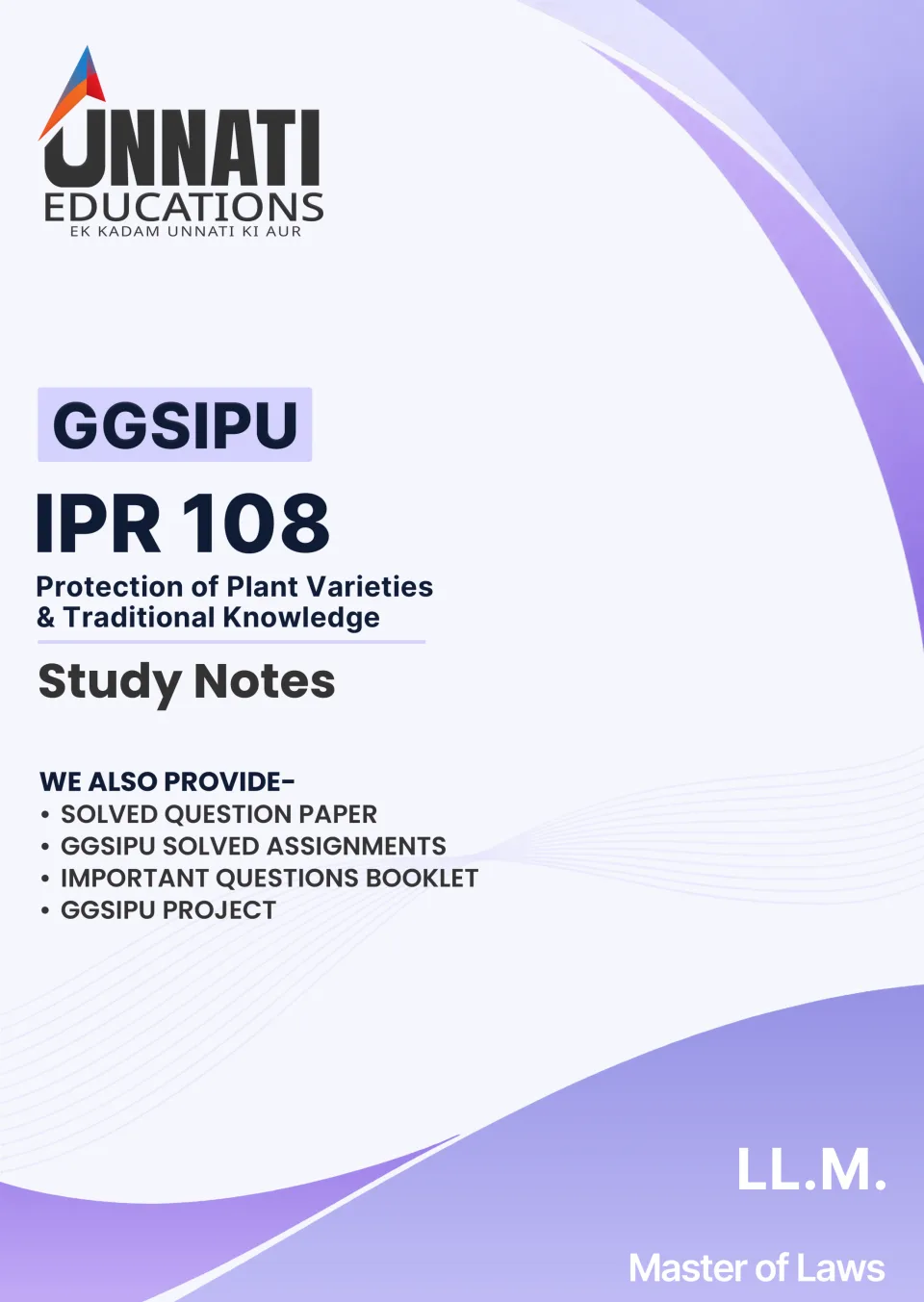
IPR 108 Protection of Plant Varieties & Traditional Knowledge Notes are a 44-page printed book for GGSIPU LL.M. IPR Semester 2. They cover all 4 official units: plant varieties and UPOV, breeders' and farmers' rights, international TK instruments, and TK under Indian IP law, with 62 exam-style practice questions, for the LL.M. scheme w.e.f. 2023.
Written by Unnati Educations Editorial Team · Reviewed by Sheetal Kirola, M.Ed., Academic Head (academic review: structure, clarity, syllabus coverage) · Checked against the GGSIPU LL.M. (One Year) scheme and syllabus PDF · Updated 14 October 2026 · Editorial policy
Scheme: LL.M. (One Year), w.e.f. 2023 onwards | Applies to: LL.M. IPR batches under the revised scheme (approved for session 2022-23) | Verified against: Master of Law (LL.M.) Regular One Year Programme PDF, 13 October 2026
IPR 108 Protection of Plant Varieties & Traditional Knowledge at a glance: GGSIPU LL.M. IPR Sem 2 credits, units and exam pattern
IPR 108 is Paper IX of the LL.M. (One Year) IPR specialisation and the last of four IPR papers in Semester II. These GGSIPU LL.M. IPR Semester 2 Plant Varieties & Traditional Knowledge notes follow the official unit order exactly. It sits with the other GGSIPU LL.M. Semester 2 papers.
Code and title | IPR 108 · Protection of Plant Varieties & Traditional Knowledge (Paper IX) |
|---|---|
Course and semester | LL.M. (One Year), Intellectual Property Rights specialisation, Semester II |
Credits and hours | 5 credits: 4 lecture + 2 RTDA hours |
Marks | 100: 25 internal (written test + RTDA assessment) + 75 end-term written exam |
End-term pattern | Question pattern not printed in the official PDF |
Units | 4 units, 10 lectures each |
Applies to | LL.M. (One Year) scheme, cover reads w.e.f. 2023 onwards |
Paired lab | None. Semester II also carries GEN 110 Dissertation (10 credits) |
Re-appear and end-term minimum rules are not printed in the LL.M. PDF; they sit in GGSIPU Ordinance 11.
IPR 108 Protection of Plant Varieties & Traditional Knowledge Notes unit-wise: 22 topics and 62 exam questions across 4 units
The book runs from plant breeding law to community knowledge, with definition boxes and exam tips. Notes for every other paper of the programme sit under GGSIPU LL.M. notes.
IPR 108 Unit 1: Introduction
Pages 3 to 13, seven topics. Plant variety in science and law (PPV&FR Act S.2(za)), protection from the US Plant Patent Act 1930 and Diamond v. Chakrabarty to India's 2001 Act, UPOV 1978 vs 1991, NDUS under Section 15, kinds of varieties and registration. 10 short and 7 long questions.
Kind of variety | Initial certificate | Maximum term |
|---|---|---|
Trees and vines | 9 years, renewable | 18 years from registration |
Extant (notified under Seeds Act) | - | 15 years from Seeds Act notification |
Other crops | 6 years, renewable | 15 years from registration |
Quick look: term of protection under Section 24(6) (from page 10)
Kind of variety
Trees and vines
Initial certificate
9 years, renewable
Maximum term
18 years from registration
Kind of variety
Extant (notified under Seeds Act)
Initial certificate
-
Maximum term
15 years from Seeds Act notification
Kind of variety
Other crops
Initial certificate
6 years, renewable
Maximum term
15 years from registration
IPR 108 Unit 2: Rights, Limitations & Infringement
Pages 14 to 22, six topics. Section 28 rights and EDV consent, breeders' vs farmers' rights, compulsory licence under Section 47 against Section 84 of the Patents Act, benefit sharing and the National Gene Fund, and infringement under Section 64 with the PepsiCo FL-2027 dispute. 9 short and 6 long questions.
Section | Offence | Punishment |
|---|---|---|
70 | False denomination | 3 months to 2 years, or Rs 50,000 to 5 lakh fine |
71 | Selling falsely named varieties | 6 months to 2 years, or Rs 1 to 5 lakh |
72 | Falsely claiming registration | 6 months to 3 years, or Rs 1 to 5 lakh |
73 | Repeat offence | 1 to 3 years and Rs 2 to 20 lakh |
Quick look: offences under the PPV&FR Act (from page 20)
Section
70
Offence
False denomination
Punishment
3 months to 2 years, or Rs 50,000 to 5 lakh fine
Section
71
Offence
Selling falsely named varieties
Punishment
6 months to 2 years, or Rs 1 to 5 lakh
Section
72
Offence
Falsely claiming registration
Punishment
6 months to 3 years, or Rs 1 to 5 lakh
Section
73
Offence
Repeat offence
Punishment
1 to 3 years and Rs 2 to 20 lakh
IPR 108 Unit 3: Traditional Knowledge (TK)
Pages 23 to 34, the longest unit. Eight characteristics of TK, the turmeric, neem and basmati biopiracy cases, six reasons for protection, all 13 international instruments from Rio 1992 to TRIPS-Plus, and the bodies that handle TK, from WIPO's IGC to the WHO centre at Jamnagar. 9 short and 6 long questions.
Article | What it requires |
|---|---|
Art. 5 | Fair benefit sharing on mutually agreed terms, including from associated TK |
Art. 6 | Access with prior informed consent of the provider country |
Art. 7 | Community TK accessed only with its consent or involvement |
Art. 12 | Customary laws and community protocols taken into account |
Quick look: Nagoya Protocol articles that touch TK (from page 30)
Article
Art. 5
What it requires
Fair benefit sharing on mutually agreed terms, including from associated TK
Article
Art. 6
What it requires
Access with prior informed consent of the provider country
Article
Art. 7
What it requires
Community TK accessed only with its consent or involvement
Article
Art. 12
What it requires
Customary laws and community protocols taken into account
IPR 108 Unit 4: Traditional Knowledge and IPR
Pages 35 to 44, five topics. Positive vs defensive protection, seven IP modes tested against TK, PIC and ABS under the Biological Diversity Act and its 2023 amendment, India's "web of laws" with the Niyamgiri case, TKDL, and a sui generis model with six foreign examples. 9 short and 6 long questions.
Section | Effect |
|---|---|
3(p) | Traditional knowledge, or a mix of its known properties, is not an invention |
10(4)(d)(ii)(D) | Applicant must disclose source and geographical origin of biological material |
25(1)(j), (k) | Opposition for non-disclosure or anticipation by community knowledge |
64(1)(p), (q) | Revocation on the same two grounds |
Quick look: Patents Act provisions that block TK patents (from page 39)
Section
3(p)
Effect
Traditional knowledge, or a mix of its known properties, is not an invention
Section
10(4)(d)(ii)(D)
Effect
Applicant must disclose source and geographical origin of biological material
Section
25(1)(j), (k)
Effect
Opposition for non-disclosure or anticipation by community knowledge
Section
64(1)(p), (q)
Effect
Revocation on the same two grounds
Farmers' rights under Section 39 in plant variety law: excerpt from page 17 of the IPR 108 notes
Excerpt from page 17
Why India wrote Farmers' Rights into the statute
Under UPOV 1991, saving seed is only an optional "farmers' privilege", an exception a country may allow. India rejected that model. The PPV&FR Act, 2001 makes Farmers' Rights a legal right of their own under Section 39.
Researcher's rights: Section 30
Nothing in the Act stops anyone from using a registered variety (a) for experiment or research, or (b) as an initial source for creating other varieties. There is one limit: if a registered variety has to be used again and again as a parental line for commercial production of a new variety, the breeder's authorisation is needed.
Hybrid seed production, where the protected variety is a parent every season, is the typical case. The provision works like UPOV's breeder's exemption and keeps crop improvement open.
Farmers' rights: Section 39(1)
Registration: a farmer who breeds or develops a new variety can register and protect it like any other breeder.
Farmers' variety: it can be registered if the application carries the required declarations.
Recognition and reward: a farmer who conserves land races and wild relatives of economic plants, and improves them by selection and preservation, is entitled to recognition and reward from the National Gene Fund when the material is used as a gene donor in a registrable variety.
Save, use and sell seed: a farmer may save, use, sow, re-sow, exchange, share or sell farm produce, including seed of a protected variety, as before the Act. The one bar is branded seed: seed packed and labelled as a protected variety.
Other farmer-friendly provisions on the same page
Section 39(2): compensation if the propagating material fails to give the performance the breeder disclosed.
Section 41: compensation for the contribution of village and local communities.
Section 42: a farmer who did not know of the right at the time is protected from liability for innocent infringement.
Section 44: farmers pay no fee before the Authority, Registrar, Tribunal or High Court.
IPR 108 exam corner: 37 two-to-five-mark and 25 ten-to-fifteen-mark practice questions by unit
Unit | Short answer (2–5 Marks) | Long answer (10–15 Marks) | Cases and case studies cited |
|---|---|---|---|
1 Introduction | 10 | 7 | 3 (Chakrabarty, Hibberd, J.E.M.) |
2 Rights, Limitations & Infringement | 9 | 6 | 1 (PepsiCo FL-2027) |
3 Traditional Knowledge | 9 | 6 | 4 (turmeric, neem, basmati, Kani) |
4 TK and IPR | 9 | 6 | 3 (Kani, Novartis, Niyamgiri) |
IPR 108 practice questions and cases in the notes, by unit
Unit
1 Introduction
Short answer (2–5 Marks)
10
Long answer (10–15 Marks)
7
Cases and case studies cited
3 (Chakrabarty, Hibberd, J.E.M.)
Unit
2 Rights, Limitations & Infringement
Short answer (2–5 Marks)
9
Long answer (10–15 Marks)
6
Cases and case studies cited
1 (PepsiCo FL-2027)
Unit
3 Traditional Knowledge
Short answer (2–5 Marks)
9
Long answer (10–15 Marks)
6
Cases and case studies cited
4 (turmeric, neem, basmati, Kani)
Unit
4 TK and IPR
Short answer (2–5 Marks)
9
Long answer (10–15 Marks)
6
Cases and case studies cited
3 (Kani, Novartis, Niyamgiri)
The IPR 108 notes list 37 short-answer and 25 long-answer exam-style questions across 4 units, without written model answers.
Unit 1: Explain the meaning of 'novelty' for a plant variety. Pointer: Section 15(3)(a); one year in India, four years abroad (six for trees and vines); commercial, not absolute, novelty.
Unit 2: When can a compulsory licence be granted under the PPV&FR Act? Pointer: Section 47, after three years, public need unmet or seed not at a reasonable price; adjournment under Section 48.
Unit 3: What does paragraph 19 of the Doha Ministerial Declaration say about TK? Pointer: review of Art. 27.3(b), TRIPS-CBD link, TK and folklore; Art. 29bis proposal.
Unit 4: What is meant by 'sui generis' protection? Pointer: "of its own kind", why existing IP fails TK, Peru's Law No. 27811.
More practice sits in the IPR 108 important questions.
Who writes and checks the IPR 108 Plant Varieties & TK notes?
Unnati Educations Editorial Team: wrote the notes and mapped each topic to the official IPR 108 units.
Sheetal Kirola, Academic Head, M.Ed., 7 years of experience: academic review of structure, clarity and syllabus coverage. This is a teaching review, not a legal opinion.
The 2026-27 edition is mapped to the LL.M. (One Year) scheme and includes the Biological Diversity (Amendment) Act 2023, the 2024 WIPO Treaty on genetic resources and TK, and COP-16 Cali. Last updated 14 October 2026; see our editorial policy.
The same team prepares GGSIPU important questions course by course.
Do the IPR 108 notes cover the full GGSIPU syllabus?
Yes. Every topic listed under the four official IPR 108 units has its own section in the notes; we found no gap.
Official unit | Official topics | Where in the notes | Status |
|---|---|---|---|
I Introduction | Law and science; evolution; justification; UPOV; NDUS; kinds; registration | Topics 01-07, pp. 4-11 | Covered |
II Rights, Limitations & Infringement | Exclusive rights; breeders' v. farmers' rights; researcher's and community rights; compulsory licence; benefit sharing; infringement | Topics 01-06, pp. 15-21 | Covered |
III Traditional Knowledge (TK) | Meaning and nature; need for protection; 13 international initiatives; international bodies | Topics 01-04, pp. 24-32 | Covered |
IV Traditional Knowledge and IPR | IPR-TK interface; PIC and ABS; legislative protection; TKDL; sui generis | Topics 01-05, pp. 36-42 | Covered |
IPR 108 official syllabus mapped to the notes
Official unit
I Introduction
Official topics
Law and science; evolution; justification; UPOV; NDUS; kinds; registration
Where in the notes
Topics 01-07, pp. 4-11
Status
Covered
Official unit
II Rights, Limitations & Infringement
Official topics
Exclusive rights; breeders' v. farmers' rights; researcher's and community rights; compulsory licence; benefit sharing; infringement
Where in the notes
Topics 01-06, pp. 15-21
Status
Covered
Official unit
III Traditional Knowledge (TK)
Official topics
Meaning and nature; need for protection; 13 international initiatives; international bodies
Where in the notes
Topics 01-04, pp. 24-32
Status
Covered
Official unit
IV Traditional Knowledge and IPR
Official topics
IPR-TK interface; PIC and ABS; legislative protection; TKDL; sui generis
Where in the notes
Topics 01-05, pp. 36-42
Status
Covered
Check it yourself: GGSIPU LL.M. (One Year) Programme syllabus, w.e.f. 2023 onwards.
Every course in GGSIPU notes is mapped to its official PDF the same way.
How to write IPR 108 answers: section-cited short notes and critical ten-to-fifteen-mark law answers
Good answers in this paper need two things: the exact section or article, and a balanced view. The IPR 108 Plant Varieties & Traditional Knowledge IPU notes build both into their exam tips, so use them as answer templates.
Short notes (2–5 marks): a one-line definition plus the provision, like the notes' line "TKDL is a CSIR-AYUSH digital database (2001) shared with foreign patent offices to stop wrongful patents".
Justification questions: theory (Locke, incentive) plus criticism (seed saving, biopiracy), then how the PPV&FR Act balances both.
Infringement: Section 64, exceptions (Sections 30, 39, 42), civil remedies, penalties, then PepsiCo.
International instruments: group the 13 into environmental, agricultural, indigenous-rights and trade instruments.
Worked outline: "India's PPV&FR Act strikes a balance between breeders' rights and farmers' rights. Discuss critically." Section 28 rights, then the four Section 39 rights, India's choice of a legal right over a UPOV-style exception, the 2021 PepsiCo FL-2027 revocation, and the branded-seed limit as the point of balance.
A common slip: writing that plant varieties are patentable in India. Section 3(j) of the Patents Act excludes them, which is why India chose the sui generis route under TRIPS Art. 27.3(b). Practise this format on GGSIPU LL.M. important questions.
IPR 108 and the GGSIPU LL.M. IPR Sem 2 papers it connects to
IPR 108 has no lab; the full paper list for every specialisation is in the GGSIPU LL.M. syllabus.
IPR 102 Law of Patents: Unit 4 of IPR 108 uses Patents Act Sections 3(j), 3(p), 25 and 64; IPR 102 covers them in depth.
IPR 104 Law of Trademark: collective and certification marks in the Unit 4 IP table.
IPR 106 Law of Designs, Layout Designs and Geographical Indications: the GI Act 1999 notes in Unit 4 lead into its two GI units.
GEN 110 Dissertation: farmers' rights, TKDL and a sui generis TK law are natural starting points for a dissertation research question.
From Semester I, IPR 107 Nature, Emergence and Development of IPR gives the TRIPS base Unit 1 builds on.
IPR 108 Plant Varieties & TK notes FAQs
How do I get the full IPR 108 notes?
Message us on WhatsApp using the "Get Full Notes" button. The IPR 108 notes come as a 44-page printed book only; they are not available as a PDF. Delivery takes a maximum of 5-7 days, and the exact time depends on your location. Open the sample PDF at the top of this page first to check the layout and tables.
Is IPR 108 a Semester 1 or Semester 2 paper in the GGSIPU LL.M. IPR?
IPR 108 is a Semester II paper. The official scheme lists it as Paper IX of the LL.M. (One Year) IPR specialisation, alongside IPR 102, IPR 104, IPR 106 and the GEN 110 Dissertation. It carries 5 credits, made up of 4 lecture hours and 2 RTDA hours. The notes cover does not print a semester, so go by the scheme.
How is IPR 108 marked, and what is the passing mark?
IPR 108 is marked out of 100: 25 internal, from a written test and RTDA assessment by the subject teacher, and 75 in the end-term written exam held by the University's Examination Division. The LL.M. scheme PDF does not print a pass percentage, so we do not quote one. End-term minimums, re-appear and grace rules are set by GGSIPU Ordinance 11.
Do the IPR 108 notes explain India's PPV&FR Act or only UPOV?
Both, and the Indian Act gets more space. Units 1 and 2 work through the PPV&FR Act section by section, from definitions in Section 2 and NDUS in Section 15 to rights in Sections 28 to 39, compulsory licence and penalties. UPOV appears only as the comparison point, with a full 1978 vs 1991 table.
Which IPR 108 unit is the longest in the notes?
Unit 3 on Traditional Knowledge, at 12 pages. It covers all 13 international instruments named in the syllabus, from the Rio Declaration and CBD to UNDRIP, the Nagoya Protocol and TRIPS-Plus agreements, with a table giving each one's year and legal nature. Unit 1 follows at 11 pages, then Unit 4 at 10 and Unit 2 at 9.
Do the IPR 108 notes have model answers to the exam questions?
No. Each unit ends with a quick revision table and a set of practice questions: 37 short-answer (2–5 marks) and 25 long-answer (10–15 marks) in all. They have no written model answers, so practise writing them. The topic notes, legal definition boxes and exam tips give you the content and the order to write each answer yourself.
Get the full IPR 108 Protection of Plant Varieties & Traditional Knowledge Notes on WhatsApp
Part | Pages | Practice questions |
|---|---|---|
Cover and contents | 2 | - |
Unit 1 Introduction | 11 (pp. 3-13) | 17 |
Unit 2 Rights, Limitations & Infringement | 9 (pp. 14-22) | 15 |
Unit 3 Traditional Knowledge | 12 (pp. 23-34) | 15 |
Unit 4 TK and IPR | 10 (pp. 35-44) | 15 |
Pages per unit in the IPR 108 notes book
Part
Cover and contents
Pages
2
Practice questions
-
Part
Unit 1 Introduction
Pages
11 (pp. 3-13)
Practice questions
17
Part
Unit 2 Rights, Limitations & Infringement
Pages
9 (pp. 14-22)
Practice questions
15
Part
Unit 3 Traditional Knowledge
Pages
12 (pp. 23-34)
Practice questions
15
Part
Unit 4 TK and IPR
Pages
10 (pp. 35-44)
Practice questions
15
These Plant Varieties & Traditional Knowledge notes in English come only as a printed book, not as a PDF. Delivery takes a maximum of 5-7 days; the rest depends on your location.
Order the IPR 108 notes book on WhatsApp (4 units, 44 pages)
Unnati Educations is an independent education provider based in Vikaspuri, Delhi. We are not affiliated with, authorised by, or endorsed by Guru Gobind Singh Indraprastha University (GGSIPU). 'GGSIPU' and 'IPU' are used only to describe the syllabus our notes follow. For official information, visit ipu.ac.in.
Ready for the full notes?
Discuss coverage and delivery with our team.