
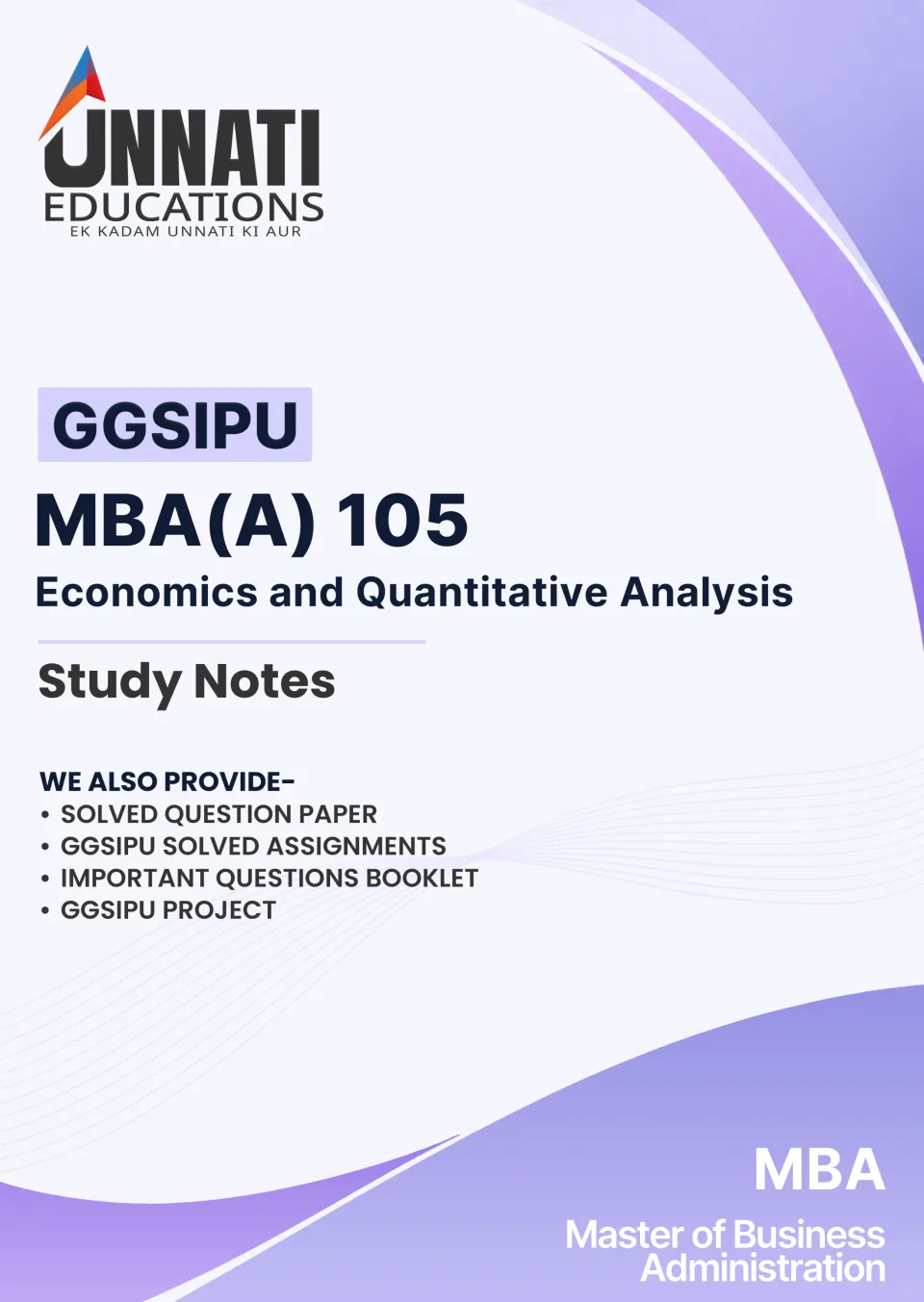
MBA(A) 105 Economics and Quantitative Analysis Notes from Unnati Educations cover all 4 units of this GGSIPU MBA (Analytics) Semester 1 core paper in 69 pages, with 36 worked illustrations, 32 solved short-answer questions, 28 long-answer exam questions and 19 diagrams, mapped to the Scheme and Syllabus 2022-24 onwards.
Written by Prateek Talwar, Founder, Unnati Educations · Reviewed by Sheetal Kirola, Academic Head, M.Ed., 7 years of experience · Checked against syllMBAAnalytics180225.pdf (Sem 1 and 2 approved 22 March 2023) · Updated 14 October 2026 · Editorial policy
Scheme: MBA (Analytics) Scheme and Syllabus 2022-24 onwards | Applies to: batches from 2022-24 onwards | Verified against: syllMBAAnalytics180225.pdf, 13 October 2026
MBA(A) 105 Economics and Quantitative Analysis at a glance: GGSIPU MBA (Analytics) Sem 1 credits, units and exam pattern
Code and title | MBA(A) 105 · Economics and Quantitative Analysis (printed as MBA (A) - 105L) |
|---|---|
Course and semester | MBA (Analytics), First Semester |
Category and credits | Core · 3 credits · L 3, T/P nil |
Teaching hours | 10 + 10 + 12 + 10 = 42 hours |
Internal assessment | 25 marks: Class Test-I 15 + presentation, viva-voce or group discussion 10 |
End-term and total marks | Not printed in the official PDF |
End-term pattern | Paper-setter instructions not printed; the scheme follows GGSIPU Ordinance 11 |
Applies to | Scheme and Syllabus 2022-24 onwards |
Units | 4 |
Paired lab | None (the Sem 1 labs 151, 153 and 155 go with 107, 113 and 115) |
Units I and II are managerial economics; Units III and IV are business statistics. It is one of eight theory papers among the GGSIPU MBA (Analytics) Semester 1 papers, worth 3 of the semester's 25 credits.
MBA(A) 105 Economics and Quantitative Analysis Notes unit-wise: 36 worked illustrations and 32 solved short answers across 4 units
Below, these GGSIPU MBA (Analytics) Sem 1 Economics and Quantitative Analysis notes are summarised unit by unit, each with one quick look. Other papers sit under GGSIPU MBA (Analytics) notes.
MBA(A) 105 Unit 1: Introduction
Also covered as "Introduction to Managerial Economics & Consumer Behaviour" (pages 4 to 20): nature, scope and links of managerial economics, and opportunity cost through an MBA fee example costing ₹22 lakh.
The PPC, incremental concept and consumer equilibrium follow. Counts: 13 sections, 5 worked illustrations, 4 diagrams, 8 solved short answers, 7 long-answer questions.
Purchase plan (X and Y at ₹1 each) | Total utility |
|---|---|
4 units of X + 2 units of Y (MU per rupee equal at 14) | 98 utils |
3 units of X + 3 units of Y | 96 utils |
Quick look: spending ₹6 by the equi-marginal rule (from page 15)
Purchase plan (X and Y at ₹1 each)
4 units of X + 2 units of Y (MU per rupee equal at 14)
Total utility
98 utils
Purchase plan (X and Y at ₹1 each)
3 units of X + 3 units of Y
Total utility
96 utils
MBA(A) 105 Unit 2: Demand Analysis and Market Structures
Pages 21 to 37 start with the demand function Qx = f(Px, Pr, Y, T, A, E, N, D, G) and four ways to measure price elasticity. Forecasting covers Delphi, least-squares trend and moving averages.
Price-output decisions follow for all four market structures, including the kinked demand curve. Counts: 11 sections, 7 worked illustrations, 6 diagrams, 8 solved short answers, 8 long-answer questions.
Quick look: profit-maximising output from demand and cost functions (from page 30)
P = 100 − 2QgivesMR = 100 − 4Q;TC = 200 + 20QgivesMC = 20.Set MR = MC:
100 − 4Q = 20, so Q = 20 units and P = ₹60.Profit = TR ₹1,200 − TC ₹600 = ₹600.
MBA(A) 105 Unit 3: Measures of Central Tendency
Also covered as "Measures of Central Tendency, Dispersion, Correlation & Regression" (pages 38 to 54). One 40-outlet sales table is reused from mean to kurtosis.
Correlation uses Pearson's r and Spearman's rank; regression covers both lines, OLS, standardised beta and R². Counts: 7 sections, 12 worked illustrations, 4 diagrams, 8 solved short answers, 7 long-answer questions.
Firm | Mean wage | SD | CV |
|---|---|---|---|
A | ₹5,000 | ₹500 | 10% (more uniform) |
B | ₹4,500 | ₹600 | 13.33% |
Quick look: which firm pays more uniform wages? (from page 44)
Firm
A
Mean wage
₹5,000
SD
₹500
CV
10% (more uniform)
Firm
B
Mean wage
₹4,500
SD
₹600
CV
13.33%
MBA(A) 105 Unit 4: Probability Analysis
Pages 55 to 68 cover four approaches to probability, the probability theorems and Bayes' theorem on three machines' defect rates.
Binomial, Poisson and normal are worked through quality control, a call centre and a stock decision, then EMV, EVPI and decision trees. Counts: 7 sections, 12 worked illustrations, 5 diagrams, 8 solved short answers, 6 long-answer questions.
Action | High demand (0.6) | Low demand (0.4) | EMV |
|---|---|---|---|
Large plant | 200 | −50 | 100 |
Small plant | 120 | 40 | 88 |
Quick look: plant-size decision by EMV, ₹ lakh (from page 65)
Action
Large plant
High demand (0.6)
200
Low demand (0.4)
−50
EMV
100
Action
Small plant
High demand (0.6)
120
Low demand (0.4)
40
EMV
88
Incremental principle and the special-order decision in managerial economics: excerpt from page 12 of the MBA(A) 105 notes
Excerpt from page 12
Illustration: accepting a special order
A firm produces 10,000 units at a total cost of ₹5,00,000, made up of ₹2,00,000 fixed cost and a variable cost of ₹30 per unit. Its normal selling price is ₹60. A buyer offers to take 2,000 extra units at ₹40 per unit, and the firm has spare capacity.
Full (average) cost per unit is ₹5,00,000 ÷ 10,000 = ₹50. By "full cost" logic, the order at ₹40 looks unprofitable.
Incremental analysis tells a different story. Incremental revenue = 2,000 × ₹40 = ₹80,000. Incremental cost = 2,000 × ₹30 = ₹60,000, because the fixed cost does not change. Incremental profit = ₹80,000 − ₹60,000 = ₹20,000, so the order should be accepted, provided it does not disturb normal sales or the regular price.
Precautions while applying the incremental principle
Only relevant (future, differential) costs are considered; sunk costs, already incurred and not recoverable, are ignored.
Opportunity costs must be included.
Long-run effects should be considered, for example a low-price order may spoil the regular market or the brand image.
Non-monetary factors such as goodwill and customer relationships should also be weighed.
Marginal concept vs incremental concept
Basis | Marginal concept | Incremental concept |
|---|---|---|
Unit of change | One unit change in output | Change due to a whole decision of any size |
Nature | Theoretical, used in economic models | Practical, used in actual business decisions |
Measurement | MR, MC, MU | Incremental revenue and incremental cost |
Example | Cost of producing the 101st unit | Cost of adding a new product line |
Marginal and incremental concepts compared (excerpt, page 12)
Basis
Unit of change
Marginal concept
One unit change in output
Incremental concept
Change due to a whole decision of any size
Basis
Nature
Marginal concept
Theoretical, used in economic models
Incremental concept
Practical, used in actual business decisions
Basis
Measurement
Marginal concept
MR, MC, MU
Incremental concept
Incremental revenue and incremental cost
Basis
Example
Marginal concept
Cost of producing the 101st unit
Incremental concept
Cost of adding a new product line
Consumer behaviour: cardinal and ordinal approaches
The theory of consumer behaviour explains how a consumer allocates limited income among various goods to get maximum satisfaction (utility). Utility is the want-satisfying power of a commodity. It is subjective, relative and has no ethical meaning: even harmful goods like cigarettes have utility for a smoker.
There are two main approaches to measuring it: the cardinal utility approach of Marshall, where utility is measured in numbers (utils) through the law of DMU and the equi-marginal principle, and the ordinal utility approach of Hicks and Allen, where utility can only be ranked through indifference curve analysis.
How to write MBA(A) 105 answers: diagram-led ten-to-fifteen-mark theory answers and step-wise statistics numericals
Economics units reward a diagram plus a rule; statistics units reward a full working table plus a one-line business meaning.
Economics answers. For "scope of managerial economics", the page 6 tip asks for the tree of operational versus environmental issues and five operational areas, each with an example such as Amul forecasting festival demand. For market structures, the page 36 tip: diagram, both equilibrium conditions (MR = MC; MC cutting MR from below), then short-run and long-run profit.
Statistics numericals. The page 53 tip for regression is four steps: full working table, both regression equations, the cross-check r = √(byx × bxy), and one line interpreting b and r². For Unit IV, the page 66 tip is to name the distribution first: fixed n with success or failure is binomial, rare events per interval is Poisson, continuous data with μ and σ is normal, converted to Z with a shaded sketch.
Worked example (page 63). Sales are normal with μ = 500 and σ = 50; find P(sales > 600). Z = (600 − 500) ÷ 50 = 2. Area from 0 to 2 is 0.4772, so P = 0.5 − 0.4772 = 0.0228, about 2.28% of months.
Practise both answer types on GGSIPU MBA (Analytics) important questions.
MBA(A) 105 exam corner: 32 solved short-answer and 28 ten-to-fifteen-mark questions by unit
Unit | Short answers (solved) | Long Answer Questions (10–15 marks) | Worked illustrations | Practical problems |
|---|---|---|---|---|
I: Economics and consumer behaviour | 8 | 7 + 6 Short Notes (5 marks) | 5 | 0 |
II: Demand and markets | 8 | 8 | 7 | 4 |
III: Statistics and regression | 8 | 7 | 12 | 5 |
IV: Probability | 8 | 6 | 12 | 6 |
MBA(A) 105 question bank by unit, as printed in the notes
Unit
I: Economics and consumer behaviour
Short answers (solved)
8
Long Answer Questions (10–15 marks)
7 + 6 Short Notes (5 marks)
Worked illustrations
5
Practical problems
0
Unit
II: Demand and markets
Short answers (solved)
8
Long Answer Questions (10–15 marks)
8
Worked illustrations
7
Practical problems
4
Unit
III: Statistics and regression
Short answers (solved)
8
Long Answer Questions (10–15 marks)
7
Worked illustrations
12
Practical problems
5
Unit
IV: Probability
Short answers (solved)
8
Long Answer Questions (10–15 marks)
6
Worked illustrations
12
Practical problems
6
One question per unit from the notes:
Unit I: Why is the PPC concave to the origin? Increasing opportunity cost: MRT climbs 0.2, 0.6, 1.0, 3.0.
Unit II: What is the shut-down point? Minimum AVC; below it a perfectly competitive firm stops even in the short run.
Unit III: Why are there two regression lines? Y on X minimises errors in Y, X on Y in X; they coincide only when r = ±1.
Unit IV: Mutually exclusive vs independent events? P(A ∩ B) = 0 versus P(A ∩ B) = P(A) × P(B).
The MBA(A) 105 notes answer 32 short questions, list 28 long-answer questions of 10 to 15 marks and work through 36 illustrations across 4 units. More practice sits in the MBA(A) 105 important questions.
MBA(A) 105 and the GGSIPU MBA (Analytics) Sem 1 papers it connects to
MBA(A) 105 has no paired lab; every paper is listed on the GGSIPU MBA (Analytics) syllabus page.
MBA(A) 105 unit | Other paper | Shared ground |
|---|---|---|
Units III and IV | MBA(A) 113 Introduction to Analytics and R | Its Unit III runs these statistics and distributions in R |
Unit III correlation | MBA(A) 115 Data Preparation and Exploration | Its Unit IV uses scatter diagrams |
Unit I incremental concept | MBA(A) 103 Accounting for Management | Its Unit IV covers CVP analysis |
Unit III OLS and R² | MBA(A) 108 Econometrics (Sem 2) | Its Unit I adds tests of significance and adjusted R² |
Where MBA(A) 105 topics reappear
MBA(A) 105 unit
Units III and IV
Other paper
MBA(A) 113 Introduction to Analytics and R
Shared ground
Its Unit III runs these statistics and distributions in R
MBA(A) 105 unit
Unit III correlation
Other paper
MBA(A) 115 Data Preparation and Exploration
Shared ground
Its Unit IV uses scatter diagrams
MBA(A) 105 unit
Unit I incremental concept
Other paper
MBA(A) 103 Accounting for Management
Shared ground
Its Unit IV covers CVP analysis
MBA(A) 105 unit
Unit III OLS and R²
Other paper
MBA(A) 108 Econometrics (Sem 2)
Shared ground
Its Unit I adds tests of significance and adjusted R²
The other Sem 1 papers are MBA(A) 101 Management Process and Organisational Behaviour, MBA(A) 107 Information Technology for Management, MBA(A) 109 Communication in Organizations, MBA(A) 111 Marketing Management and the labs 151, 153 and 155.
Who writes and checks the MBA(A) 105 Economics and Quant Analysis notes?
Prateek Talwar, author: Founder, Unnati Educations; Associate Company Secretary (ACS), ICSI, membership no. 58704, since 15 May 2019; B.Com, University of Delhi (School of Open Learning), 2012. Author profile
Sheetal Kirola, reviewer: Academic Head, Unnati Educations; M.Ed.; 7 years of experience. Reviewer profile
The MBA(A) 105 Economics and Quantitative Analysis IPU notes are mapped unit by unit to the 2022-24 onwards scheme. The 2026-27 edition has 69 pages, 19 figures and four Indian case studies: IndiGo fares (page 7), Blinkit and Zepto demand forecasting (page 29), cost estimation by regression (page 53) and a pharmacy's vaccine stock (page 66). Last updated 14 October 2026 under our editorial policy.
The same team prepares GGSIPU important questions for each course it covers.
Do the MBA(A) 105 notes cover the full GGSIPU syllabus?
Yes for all four units: every listed topic has its own section. One note: course outcome CO1 mentions cost and production, which no unit lists; the notes touch them only under "scope".
Official unit | Official topics | Where in the notes | Status |
|---|---|---|---|
I: Introduction (10 hours) | Nature, scope, opportunity cost, PPC, incremental concept, DMU, equi-marginal, indifference curves | Sections 1 to 13, pages 4 to 19 | Covered |
II: Demand Analysis and Market Structures (10 hours) | Demand function, determinants, elasticity, forecasting; four market structures | Sections 2 to 11, pages 21 to 36 | Covered |
III: Measures of Central Tendency (12 hours) | Central tendency, dispersion, skewness, kurtosis, correlation, regression lines, OLS, standardized coefficients | Sections 2 to 7, pages 38 to 53 | Covered |
IV: Probability Analysis (10 hours) | Addition, multiplication, Bayes' theorem; binomial, Poisson, normal; probability in decision making | Sections 1 to 7, pages 55 to 66 | Covered |
MBA(A) 105 official units mapped to the notes
Official unit
I: Introduction (10 hours)
Official topics
Nature, scope, opportunity cost, PPC, incremental concept, DMU, equi-marginal, indifference curves
Where in the notes
Sections 1 to 13, pages 4 to 19
Status
Covered
Official unit
II: Demand Analysis and Market Structures (10 hours)
Official topics
Demand function, determinants, elasticity, forecasting; four market structures
Where in the notes
Sections 2 to 11, pages 21 to 36
Status
Covered
Official unit
III: Measures of Central Tendency (12 hours)
Official topics
Central tendency, dispersion, skewness, kurtosis, correlation, regression lines, OLS, standardized coefficients
Where in the notes
Sections 2 to 7, pages 38 to 53
Status
Covered
Official unit
IV: Probability Analysis (10 hours)
Official topics
Addition, multiplication, Bayes' theorem; binomial, Poisson, normal; probability in decision making
Where in the notes
Sections 1 to 7, pages 55 to 66
Status
Covered
Source: GGSIPU MBA (Analytics) Scheme and Syllabus 2022-24 onwards on ipu.ac.in.
Every course in GGSIPU notes is mapped to its official PDF the same way.
MBA(A) 105 Economics and Quant Analysis notes FAQs
How do I get the full MBA(A) 105 notes?
Send a WhatsApp message to 9899436384 with the code MBA(A) 105. The full notes come only as a printed book of 69 pages; there is no PDF edition. Delivery takes a maximum of 5 to 7 days, depending on your location.
What is the passing mark for MBA(A) 105 Economics and Quantitative Analysis?
The official syllabus prints only the internal assessment for MBA(A) 105: 25 marks, split as Class Test-I 15 and a presentation, viva-voce or group discussion 10. It does not print end-term marks, the total or a pass percentage. It states the scheme follows GGSIPU Ordinance 11, so take end-term minimums and re-appear rules from Ordinance 11 on ipu.ac.in.
Which MBA(A) 105 unit has the most numericals?
Units III and IV are the numerical half of MBA(A) 105, with 12 worked illustrations each against 5 in Unit I and 7 in Unit II. Unit IV adds 6 practical problems, 5 with answer keys, on Bayes' theorem, binomial, Poisson and normal questions. Unit III's 5 problems cover a frequency table, skewness, correlation and means from two regression lines.
Do the MBA(A) 105 notes follow the 2022-24 onwards GGSIPU syllabus?
Yes. The MBA(A) 105 notes were checked unit by unit against syllMBAAnalytics180225.pdf, the GGSIPU MBA (Analytics) Scheme and Syllabus 2022-24 onwards, whose first-semester part was approved by the Academic Council on 22 March 2023. Every topic listed under the four units has its own section, and the syllabus map above links the official PDF for checking.
Is there a lab paper with MBA(A) 105?
No. MBA(A) 105 is a 3-credit core theory paper with three lecture hours a week and no practical component. The three Sem 1 labs, MBA(A) 151, 153 and 155, go with Information Technology for Management, Introduction to Analytics and R, and Data Preparation and Exploration. The statistics of Units III and IV reappear in R in MBA(A) 113.
Do I need a maths background for MBA(A) 105?
Not beyond school algebra. The MBA(A) 105 notes show every formula with a step-by-step illustration, such as the 40-outlet sales table reused for mean, median, mode, SD, skewness and kurtosis. Calculus appears in only a few places, mainly finding MR = MC from demand and cost functions on page 30, and each step is written out in full.
Get the full MBA(A) 105 Economics and Quantitative Analysis Notes on WhatsApp
Part | Pages | Illustrations | Solved short answers |
|---|---|---|---|
Cover and index | 1 to 3 | - | - |
Unit I | 4 to 20 | 5 | 8 |
Unit II | 21 to 37 | 7 | 8 |
Unit III | 38 to 54 | 12 | 8 |
Unit IV | 55 to 68 | 12 | 8 |
What is inside the MBA(A) 105 printed notes book
Part
Cover and index
Pages
1 to 3
Illustrations
-
Solved short answers
-
Part
Unit I
Pages
4 to 20
Illustrations
5
Solved short answers
8
Part
Unit II
Pages
21 to 37
Illustrations
7
Solved short answers
8
Part
Unit III
Pages
38 to 54
Illustrations
12
Solved short answers
8
Part
Unit IV
Pages
55 to 68
Illustrations
12
Solved short answers
8
Format: these Economics and Quantitative Analysis notes in English come only as a 69-page printed book; they are not sold as a PDF. Delivery: a maximum of 5 to 7 days, depending on your location.
Order the MBA(A) 105 notes book on WhatsApp (4 units, 69 pages)
Unnati Educations is an independent education provider based in Vikaspuri, Delhi. We are not affiliated with, authorised by, or endorsed by Guru Gobind Singh Indraprastha University (GGSIPU). 'GGSIPU' and 'IPU' are used only to describe the syllabus our notes follow. For official information, visit ipu.ac.in.
Ready for the full notes?
Discuss coverage and delivery with our team.