
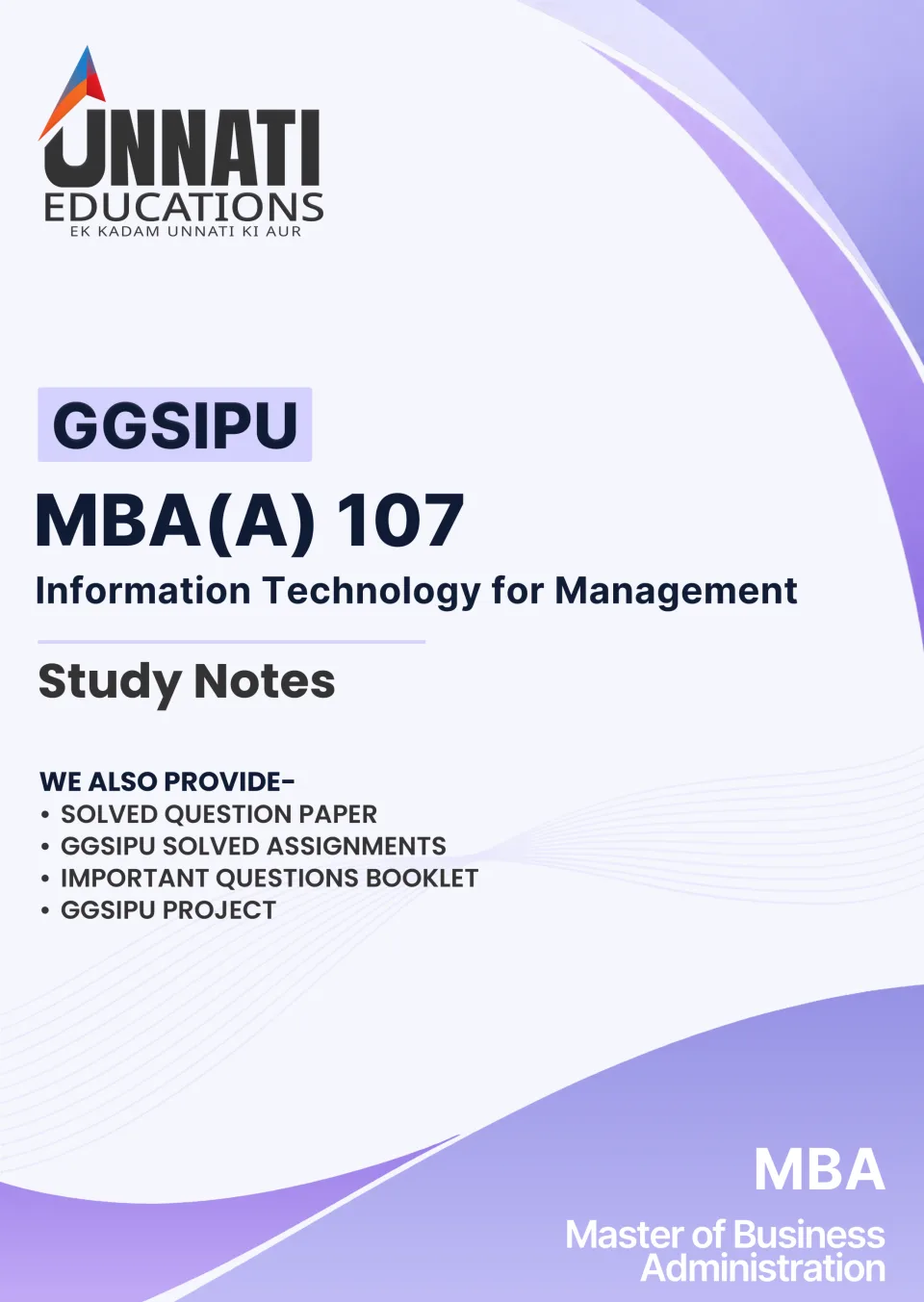
MBA(A) 107 Information Technology for Management Notes cover all 4 units of the GGSIPU MBA (Analytics) Semester 1 paper in 69 pages, with 27 diagrams, 35 SQL statements, 6 HTML examples, 20 solved revision questions and 77 exam-style practice questions. They follow the official Scheme and Syllabus 2022-24 onwards.
Written by Prateek Talwar, Founder, Unnati Educations · Reviewed by Ritik Rawat, B.Tech, Senior Full Stack Developer · Checked against syllMBAAnalytics180225.pdf · Updated 14 October 2026 · Editorial policy
Scheme: MBA (Analytics) 2022-24 onwards | Applies to: batches under this scheme | Verified against: syllMBAAnalytics180225.pdf (approved 22.03.2023)
MBA(A) 107 Information Technology for Management at a glance: GGSIPU MBA (Analytics) Sem 1 credits, units and exam pattern
Code and title | MBA(A) 107 Information Technology for Management (printed "MBA (A) - 107L - 3" on the syllabus page) |
|---|---|
Course and semester | MBA (Analytics), First Semester |
Category and credits | Core, 3 credits, L 3 (no tutorial or practical) |
Teaching hours | Unit I 6 · Unit II 14 · Unit III 12 · Unit IV 10 = 42 |
Internal assessment | 25 marks: Class Test-I 15 + presentation, viva-voce or group discussion 10 |
End-term marks and pattern | Not printed in the official PDF; the scheme follows Ordinance 11 of the University |
Paired lab | MBA(A) 151 IT for Management Lab: Skill Enhancement, P 2, 1 credit |
Units II and III take 26 of the 42 hours; CO4 (SQL) and CO6 (HTML) expect written code. The paper sits with ten others in the GGSIPU MBA (Analytics) Semester 1 papers, 25 credits in all.
MBA(A) 107 Information Technology for Management Notes unit-wise: 20 solved questions, 35 SQL statements and 6 HTML examples across 4 units
The official PDF opens each unit with a lead phrase, not a title; the headings use that phrase. Notes for other papers of this course are under GGSIPU MBA (Analytics) notes.
MBA(A) 107 Unit 1: Information Technology
Covers IT system components, classifying computers, the Von Neumann block diagram and machine cycle, the memory hierarchy and storage up to RAID, NAS and SAN. Cloud computing (IaaS, PaaS, SaaS, a Netflix on AWS case) leads into data centres (see the excerpt).
In the notes: pages 5 to 18 · 7 sections · 6 figures · 5 solved · 10 short (2.5 Marks) · 7 long (12.5 Marks)
Basis | HDD | SSD |
|---|---|---|
Technology | Magnetic spinning platters | Flash memory chips |
Moving parts | Yes | No |
Speed | About 100 to 200 MB/s | 500 to 7000+ MB/s (NVMe) |
Cost per GB | Lower | Higher |
Quick look: HDD vs SSD (from page 13)
Basis
Technology
HDD
Magnetic spinning platters
SSD
Flash memory chips
Basis
Moving parts
HDD
Yes
SSD
No
Basis
Speed
HDD
About 100 to 200 MB/s
SSD
500 to 7000+ MB/s (NVMe)
Basis
Cost per GB
HDD
Lower
SSD
Higher
MBA(A) 107 Unit 2: Computer Software
Titled "Computer Software, Excel and DBMS" in the notes. It runs from the operating system (nine functions, 11 types) and 1GL to 5GL languages to Excel syntax with Pivot Table, Goal Seek and Solver, then keys, ER diagrams, constraints and SQL on one sample Employee table.
In the notes: pages 19 to 38 · 12 sections · 7 figures · 35 SQL statements · 5 solved · 12 short · 8 long
Quick look: GROUP BY with HAVING (from page 35)
SELECT Dept_ID, AVG(Salary) FROM Employee
GROUP BY Dept_ID
HAVING AVG(Salary) > 60000;On the page 34 sample table this returns D2 (67500) and D3 (91000); D1 drops out at 51500.
MBA(A) 107 Unit 3: Data Communication and Networks
Covers data communication components, transmission modes, PAN to WAN, guided and wireless media and six topologies, then the OSI model with a TCP/IP comparison, 11 devices from NIC to firewall, intranet and extranet examples from Indian firms, and HTML.
In the notes: pages 39 to 54 · 10 sections · 6 figures · 6 HTML examples · 5 solved · 12 short · 8 long
Quick look: what happens when you open a website (from page 50)
You type a URL such as www.ipu.ac.in.
DNS turns the name into an IP address.
The browser sends an HTTP GET request to the web server.
The server returns the HTML page.
The browser renders text, images and links.
MBA(A) 107 Unit 4: Functional and Enterprise Systems
Links IT to decisions: the DIKW pyramid, Simon's model and Anthony's management levels. Systems run from TPS and MIS to DSS, EIS and KMS, then ERP, SCM and CRM with an Asian Paints case. Security (CIA triad, seven malware types) and blockchain, AI, ML and IoT close it.
In the notes: pages 55 to 68 · 6 sections · 8 figures · 5 solved · 12 short · 8 long
Type | Level | Example | System |
|---|---|---|---|
Structured | Operational | Reorder stock below 100 units | TPS |
Semi-structured | Middle | Annual budget, credit approval | MIS, DSS |
Unstructured | Strategic | Entering a new market, merger | EIS / ESS, AI |
Quick look: types of decisions (from page 57)
Type
Structured
Level
Operational
Example
Reorder stock below 100 units
System
TPS
Type
Semi-structured
Level
Middle
Example
Annual budget, credit approval
System
MIS, DSS
Type
Unstructured
Level
Strategic
Example
Entering a new market, merger
System
EIS / ESS, AI
MBA(A) 107 exam corner: 20 solved questions plus 46 two-and-a-half-mark and 31 twelve-and-a-half-mark practice questions by unit
Each unit ends with five model answers and exam-style questions; no year tags are printed.
Unit | Solved | Short (2.5 Marks) | Long (12.5 Marks) |
|---|---|---|---|
Unit I | 5 | 10 | 7 |
Unit II | 5 | 12 | 8 |
Unit III | 5 | 12 | 8 |
Unit IV | 5 | 12 | 8 |
Total | 20 | 46 | 31 |
MBA(A) 107 exam questions in the notes by unit
Unit
Unit I
Solved
5
Short (2.5 Marks)
10
Long (12.5 Marks)
7
Unit
Unit II
Solved
5
Short (2.5 Marks)
12
Long (12.5 Marks)
8
Unit
Unit III
Solved
5
Short (2.5 Marks)
12
Long (12.5 Marks)
8
Unit
Unit IV
Solved
5
Short (2.5 Marks)
12
Long (12.5 Marks)
8
Unit
Total
Solved
20
Short (2.5 Marks)
46
Long (12.5 Marks)
31
Unit II: "Explain integrity constraints. Write SQL queries to create an Employee table with constraints and perform SELECT, UPDATE, DELETE, GROUP BY and JOIN operations." Start from the annotated CREATE TABLE (page 33), then queries from pages 34 to 36.
Unit III: "Explain the OSI reference model with the functions of each layer. Compare it with the TCP/IP model." Use the seven-layer table (page 45) and the TCP/IP mapping (page 46).
Unit IV: "What is blockchain? Explain its features, types and business applications." Draw the four-block hash chain (page 63), then the applications table (page 64).
The MBA(A) 107 notes answer 20 revision questions and list 46 short-answer (2.5 Marks) and 31 long-answer (12.5 Marks) exam-style questions across 4 units, plus 35 SQL statements and 6 HTML examples.
More practice sits in the MBA(A) 107 important questions.
Data centre tiers and challenges in IT management: excerpt from page 16 of the MBA(A) 107 notes
Excerpt from page 16
Types of data centres
An enterprise data centre is owned and run by a company for its own use, as SBI or Infosys do. In a colocation data centre, a company rents space, power and cooling but keeps its own servers there. Cloud or hyperscale data centres are huge facilities run by AWS, Microsoft and Google with thousands of servers. Edge data centres are small sites placed close to users to cut latency, which matters for IoT, 5G and OTT services.
Data centre tiers (Uptime Institute)
Tier | Feature | Availability (approx.) |
|---|---|---|
Tier I | Basic capacity, single path for power and cooling, no redundancy | 99.671% |
Tier II | Redundant components, single path | 99.741% |
Tier III | Concurrently maintainable, multiple paths | 99.982% |
Tier IV | Fault tolerant, fully redundant | 99.995% |
Data centre tiers and approximate availability (page 16)
Tier
Tier I
Feature
Basic capacity, single path for power and cooling, no redundancy
Availability (approx.)
99.671%
Tier
Tier II
Feature
Redundant components, single path
Availability (approx.)
99.741%
Tier
Tier III
Feature
Concurrently maintainable, multiple paths
Availability (approx.)
99.982%
Tier
Tier IV
Feature
Fault tolerant, fully redundant
Availability (approx.)
99.995%
Challenges of data centres
High energy use. Servers and cooling draw huge power, measured by PUE (Power Usage Effectiveness) = total facility power ÷ IT equipment power. The ideal value is 1.0.
Cooling and heat. Dense racks run hot, and a cooling failure can damage hardware.
Security threats. Physical (theft, unauthorised entry) and cyber (hacking, ransomware, DDoS attacks).
High capital and running cost. Land, building, equipment, power and skilled staff all cost money.
Downtime and business continuity. Any outage stops business, so backup power, redundancy and disaster recovery sites are needed.
Scalability and capacity planning. Data grows fast, and future space, power and network needs are hard to predict.
Environmental impact. A high carbon and water footprint pushes firms towards green data centres running on renewable energy.
Compliance and data localisation. India's DPDP Act 2023 and RBI rules on storing payment data locally.
Shortage of skilled people in networking, virtualisation and cyber-security.
Fast obsolescence. Hardware dates in three to five years and needs regular upgrades.
Do the MBA(A) 107 notes cover the full GGSIPU syllabus?
Yes. Every topic in the four official units has its own section in the notes; our unit check found no gaps. The notes also add the TCP/IP model and the DPDP Act 2023.
Official unit | Official topics | Where in the notes | Status |
|---|---|---|---|
Unit I | IT system components; characteristics and classification of computers; architecture; memory, storage devices, mass storage; cloud computing; data centres and challenges | Pages 5 to 16 | Covered |
Unit II | Types of software; operating systems; GUI; compiler, interpreter, assembler; programming languages; application software; good software and trends; spreadsheet, presentation, Excel analysis; file concepts; DBMS; data models; ER modelling; integrity constraints; SQL queries | Pages 19 to 36 | Covered |
Unit III | Data communication; network types; communications media; computer networks; topologies; OSI model; inter-networking devices; Internet, intranet, extranet and services; WWW; HTML web pages | Pages 39 to 53 | Covered |
Unit IV | Data, information, knowledge; decision-making process; classification of information systems; security issues; blockchain, AI, ML, IoT and applications | Pages 55 to 67 | Covered |
MBA(A) 107 official syllabus mapped to the notes
Official unit
Unit I
Official topics
IT system components; characteristics and classification of computers; architecture; memory, storage devices, mass storage; cloud computing; data centres and challenges
Where in the notes
Pages 5 to 16
Status
Covered
Official unit
Unit II
Official topics
Types of software; operating systems; GUI; compiler, interpreter, assembler; programming languages; application software; good software and trends; spreadsheet, presentation, Excel analysis; file concepts; DBMS; data models; ER modelling; integrity constraints; SQL queries
Where in the notes
Pages 19 to 36
Status
Covered
Official unit
Unit III
Official topics
Data communication; network types; communications media; computer networks; topologies; OSI model; inter-networking devices; Internet, intranet, extranet and services; WWW; HTML web pages
Where in the notes
Pages 39 to 53
Status
Covered
Official unit
Unit IV
Official topics
Data, information, knowledge; decision-making process; classification of information systems; security issues; blockchain, AI, ML, IoT and applications
Where in the notes
Pages 55 to 67
Status
Covered
Verify every row in the official MBA (Analytics) Scheme and Syllabus 2022-24 onwards (ipu.ac.in PDF), pages 15 and 16.
Every course in GGSIPU notes is mapped to its official PDF the same way.
Who writes and checks the MBA(A) 107 IT for Management notes?
Prateek Talwar, author: Founder, Unnati Educations; Associate Company Secretary (ACS), ICSI, membership no. 58704, since 15 May 2019; B.Com, University of Delhi (SOL), 2012. Author profile
Ritik Rawat, subject reviewer: B.Tech; Senior Full Stack Developer, Unnati Educations; checked the SQL, HTML and networking tables. Reviewer profile
The 2026-27 edition (69 pages, 35 sections) follows the 2022-24 onwards scheme, last updated 14 October 2026 under our editorial policy.
The review is how these MBA(A) 107 Information Technology for Management IPU notes keep every Excel formula and closing tag exam-correct. The same team prepares GGSIPU important questions for every course.
MBA(A) 107 and the MBA(A) 151 IT for Management lab (SQL, HTML and Excel work), plus other GGSIPU MBA (Analytics) Sem 1 papers
Paired lab: MBA(A) 151 IT for Management lab notes: 1 credit, P 2, "based on Paper MBA (A) -107" per the scheme. Units that feed it:
Unit II operating systems (pages 20 to 22) → OS utilities
Unit II SQL (pages 34 to 36) → SQL queries
Unit III HTML (pages 50 to 53) → basic HTML tags
Unit II Excel tools (pages 26 and 27) → What-If, Goal Seek, Solver, Pivot Tables
Other Sem 1 papers: MBA(A) 101 Management Process and Organisational Behaviour, MBA(A) 103 Accounting for Management, MBA(A) 105 Economics and Quantitative Analysis, MBA(A) 109 Communication in Organizations, MBA(A) 111 Marketing Management, MBA(A) 113 Introduction to Analytics and R, MBA(A) 115 Data Preparation and Exploration, and the MBA(A) 153 and 155 labs.
Beyond the lab, these GGSIPU MBA (Analytics) Sem 1 Information Technology for Management notes connect most with MBA(A) 115, whose data import topics follow Unit II's Excel import and clean steps (page 27).
How to write MBA(A) 107 answers: diagram-led long answers, SQL queries and HTML pages
MBA(A) 107 mixes theory with code, and the notes give a method for each answer type. Hardware, network and information-system answers are built around a diagram; database questions ask you to write SQL; web questions ask for HTML; Excel questions need exact formula syntax with a business case. Short 2.5-mark answers stay to a definition plus one example or a two-column difference.
Long theory answers (12.5 Marks). Draw first: the block diagram (Input, CPU with CU, ALU and registers, memory, output) for architecture, a small sketch of each topology with two merits and two demerits, or the IS pyramid for information systems. Close with the comparison table the notes give, such as Bus vs Star vs Ring vs Mesh on page 45.
SQL answers. Write CREATE TABLE with constraints first, then each query, in the clause order SELECT, FROM, WHERE, GROUP BY, HAVING, ORDER BY. Remember that WHERE cannot hold an aggregate and HAVING can.
HTML answers. Write the full skeleton (<!DOCTYPE html>, <html>, <head>, <title>, <body>) before adding the asked table, list, form or link. The notes stress that correct structure earns marks even without the drawn output.
Excel answers. Give syntax plus a business case. Worked example from page 26: a 10% bonus goes only to sales above ₹5,00,000, so D2 holds =IF(C2>500000, C2*10%, 0). Sales of ₹6,20,000 earn ₹62,000; sales of ₹4,80,000 earn 0. Then name the tools the topic needs: Pivot Table, Goal Seek, Solver and Analysis ToolPak.
Practise this format on GGSIPU MBA (Analytics) important questions.
MBA(A) 107 IT for Management notes FAQs
How do I get the full MBA(A) 107 notes?
Message us on WhatsApp at 9899436384 using the "Get Full Notes" button. The full MBA(A) 107 notes come as a printed book only and are not available as a PDF. Delivery takes up to 5 to 7 days, depending on your location.
Do the MBA(A) 107 notes include SQL and HTML code for the exam?
Yes. Unit II has 35 SQL statements in seven code blocks, covering DDL, DML, SELECT with WHERE, GROUP BY and HAVING, joins, sub-queries, views, GRANT, REVOKE, COMMIT and ROLLBACK on one sample Employee table. Unit III has 6 HTML examples, from the basic page structure to a registration form and a company home page, matching CO4 and CO6 of the syllabus.
Which unit of MBA(A) 107 needs the most study time?
Unit II. The official syllabus gives it 14 of the paper's 42 teaching hours, and it runs to 20 pages in the notes, from page 19 to page 38. It packs three topics into one unit: software and operating systems, Excel data analysis, and DBMS with ER modelling and SQL. Unit III follows with 12 hours.
Are the MBA(A) 107 notes based on the current MBA (Analytics) scheme?
Yes. They follow the MBA (Analytics) Scheme and Syllabus 2022-24 onwards, published on ipu.ac.in as syllMBAAnalytics180225.pdf, in which the Academic Council approved the Semester 1 papers on 22.03.2023. If your institute hands out a different syllabus copy, compare its MBA(A) 107 unit list with the syllabus map on this page before you order the book.
How many marks is MBA(A) 107 and what is the passing mark?
The official MBA (Analytics) syllabus PDF prints the internal assessment for MBA(A) 107 as 25 marks: a 15-mark Class Test-I plus 10 marks for a presentation, viva-voce or group discussion. It does not print the end-term marks or a pass percentage. The scheme says it follows the University's Ordinance 11, which sets the examination, pass and re-appear rules, so check that ordinance on ipu.ac.in.
What is the difference between MBA(A) 107 and the MBA(A) 151 lab?
MBA(A) 107 is the 3-credit core theory paper, four units taught in 42 lecture hours. MBA(A) 151 is the 1-credit lab with 2 practical hours a week, and the scheme says it is based on MBA(A) 107. In the lab you practise OS utilities, SQL queries, HTML pages and Excel What-If, Goal Seek, Solver and Pivot Table exercises, with a signed lab file.
Get the full MBA(A) 107 Information Technology for Management Notes on WhatsApp
Part | Pages |
|---|---|
Cover and index | 1 to 4 |
Unit I | 5 to 18 (14 pages) |
Unit II | 19 to 38 (20 pages) |
Unit III | 39 to 54 (16 pages) |
Unit IV | 55 to 68 (14 pages) |
MBA(A) 107 notes book: pages per unit
Part
Cover and index
Pages
1 to 4
Part
Unit I
Pages
5 to 18 (14 pages)
Part
Unit II
Pages
19 to 38 (20 pages)
Part
Unit III
Pages
39 to 54 (16 pages)
Part
Unit IV
Pages
55 to 68 (14 pages)
These are Information Technology for Management notes in English: 20 solved and 77 practice questions, 27 figures. Printed book only, not available as a PDF; delivery in up to 5 to 7 days, depending on your location.
Get the full MBA(A) 107 notes on WhatsApp (4 units, 69 pages)
Unnati Educations is an independent education provider based in Vikaspuri, Delhi. We are not affiliated with, authorised by, or endorsed by Guru Gobind Singh Indraprastha University (GGSIPU). 'GGSIPU' and 'IPU' are used only to describe the syllabus our notes follow. For official information, visit ipu.ac.in.
Ready for the full notes?
Discuss coverage and delivery with our team.