
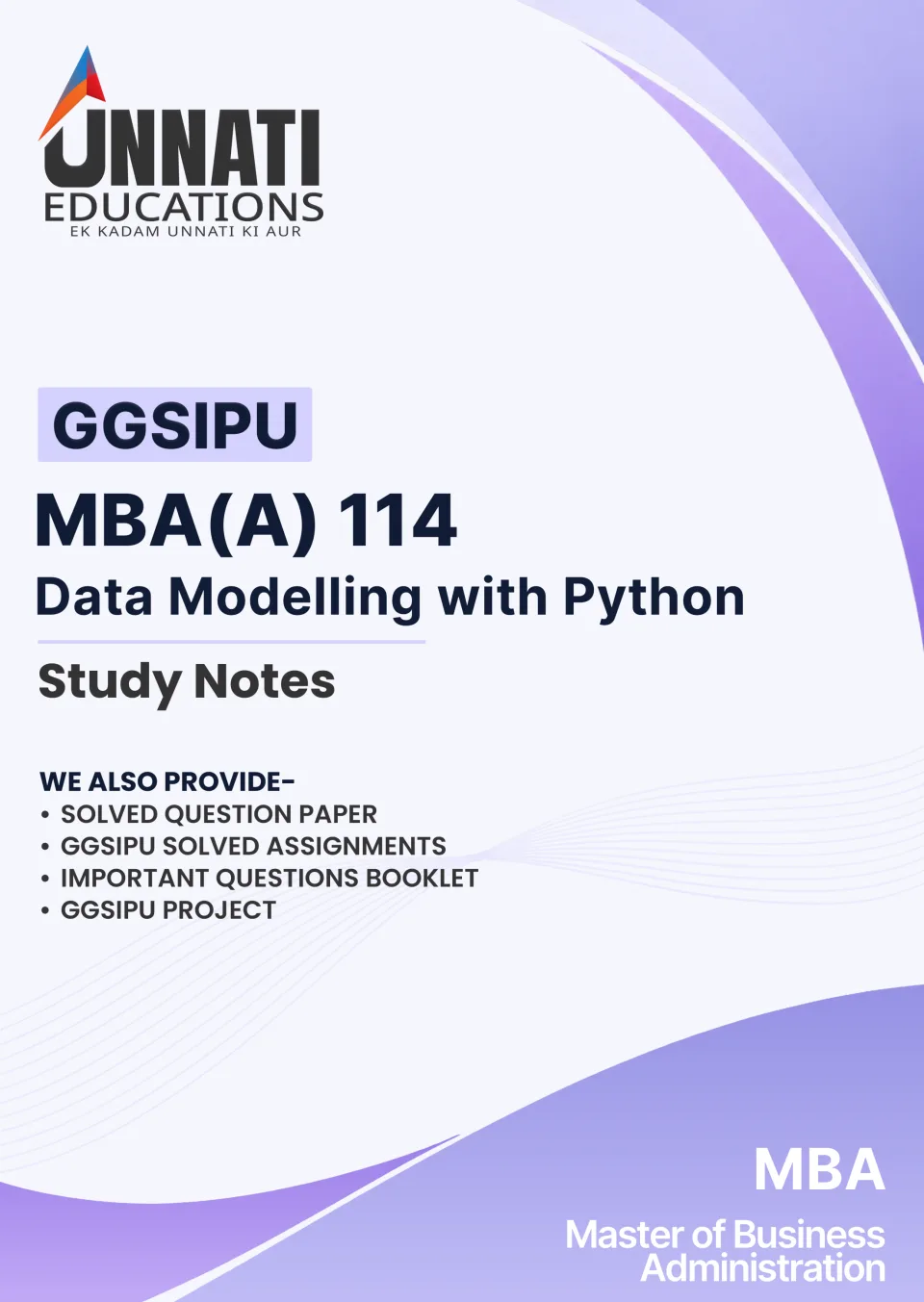
MBA(A) 114 Data Modelling with Python Notes cover all 4 units of the GGSIPU MBA (Analytics) Semester 2 paper in one 75-page printed book: 71 Python programs, 3 text-mining case studies, 26 figures and 71 practice questions, mapped to the official Scheme and Syllabus 2022-24 onwards.
Written by Prateek Talwar, Founder, Unnati Educations · Reviewed by Ritik Rawat, B.Tech, Senior Full Stack Developer · Checked against MBA (Analytics) Scheme and Syllabus 2022-24 onwards (syllMBAAnalytics180225.pdf) · Updated 26 October 2026 · Editorial policy
Scheme: MBA (Analytics) Scheme and Syllabus 2022-24 onwards | Applies to: batches admitted 2022-24 onwards | Verified against: syllMBAAnalytics180225.pdf, Sem 1-2 approved by the Academic Council on 22.03.2023
MBA(A) 114 Data Modelling with Python at a glance: GGSIPU MBA (Analytics) Sem 2 credits, units and exam pattern
All values below come from the official scheme PDF. MBA(A) 114 sits with ten other GGSIPU MBA (Analytics) Semester 2 papers.
Item | Official detail |
|---|---|
Code and title | MBA(A) 114 Data Modelling with Python (notes cover: MBA (A)-114L) |
Course and semester | MBA (Analytics), Second Semester |
Category and credits | Skill Enhancement · 2 credits · L 2, no T/P · 7 hours per unit |
Marks and end-term pattern | Internal assessment 25: Class Test-I 15 + presentation, viva-voce or group discussion 10. End-term marks, total and paper-setter instructions: not printed in the official PDF |
Applies to | Scheme and Syllabus 2022-24 onwards (Sem 1-2 approved 22.03.2023) |
Units | 4 (topics listed, no separate unit titles) |
Paired lab | MBA(A) 154 Data Modelling with Python Lab · Skill Enhancement · P 2 · 1 credit |
MBA(A) 114 snapshot from the official MBA (Analytics) scheme
Item
Code and title
Official detail
MBA(A) 114 Data Modelling with Python (notes cover: MBA (A)-114L)
Item
Course and semester
Official detail
MBA (Analytics), Second Semester
Item
Category and credits
Official detail
Skill Enhancement · 2 credits · L 2, no T/P · 7 hours per unit
Item
Marks and end-term pattern
Official detail
Internal assessment 25: Class Test-I 15 + presentation, viva-voce or group discussion 10. End-term marks, total and paper-setter instructions: not printed in the official PDF
Item
Applies to
Official detail
Scheme and Syllabus 2022-24 onwards (Sem 1-2 approved 22.03.2023)
Item
Units
Official detail
4 (topics listed, no separate unit titles)
Item
Paired lab
Official detail
MBA(A) 154 Data Modelling with Python Lab · Skill Enhancement · P 2 · 1 credit
Unit titles here are the notes' own. The scheme follows GGSIPU Ordinance 11 for examinations. These GGSIPU MBA (Analytics) Sem 2 Data Modelling with Python notes follow the official topic order.
MBA(A) 114 Data Modelling with Python Notes unit-wise: 71 Python programs and 3 text-mining case studies across 4 units
These MBA(A) 114 Data Modelling with Python IPU notes run on pages 5 to 74; one file, sales.csv with 12 orders, runs through Unit II. Other papers sit under GGSIPU MBA (Analytics) notes.
MBA(A) 114 Unit 1: Introduction to Python for Data Science
Pages 5 to 22, 20 sections. Spyder basics (os.chdir(), %reset), a Python vs Excel vs R table, operators and every data type up to NumPy arrays. 19 programs with output; 12 short and 6 long practice questions.
Operation | Code | Business meaning |
|---|---|---|
Union |
| All customers of product A or B |
Intersection |
| Bought both products (cross-sell worked) |
Difference |
| Bought A but not B (cross-sell target) |
Quick look: set operations on two customer lists (from page 19)
Operation
Union
Code
A | BBusiness meaning
All customers of product A or B
Operation
Intersection
Code
A & BBusiness meaning
Bought both products (cross-sell worked)
Operation
Difference
Code
A - BBusiness meaning
Bought A but not B (cross-sell target)
MBA(A) 114 Unit 2: Jupyter Notebook, Pandas, EDA and Data Visualisation
Pages 23 to 41, 8 sections. Jupyter, Pandas read_csv(), four-step EDA, median imputation, one-hot encoding, the IQR fence and five Matplotlib charts. 20 programs (5 draw a chart), 10 figures; 12 short and 6 long practice questions.
Method | Formula | Result |
|---|---|---|
Min-max normalisation | (x − min) ÷ (max − min) | (12 − 8) ÷ (40 − 8) = 0.12 |
Standardisation (z-score) | (x − mean) ÷ standard deviation | −0.71 (below average) |
Quick look: two ways to scale Units = 12 from sales.csv (from page 33)
Method
Min-max normalisation
Formula
(x − min) ÷ (max − min)
Result
(12 − 8) ÷ (40 − 8) = 0.12
Method
Standardisation (z-score)
Formula
(x − mean) ÷ standard deviation
Result
−0.71 (below average)
MBA(A) 114 Unit 3: Control Structures, Statistical Analysis and Regression
Pages 42 to 60, 13 sections. A grading ladder, a while loop doubling ₹1 lakh, SciPy t-tests and chi-square, statsmodels regression and a loan-default logistic model. 19 programs with output, 7 figures; 12 short and 6 long practice questions.
Variable | Coefficient | Meaning, others held constant |
|---|---|---|
Ad (₹ 000) | +3.04 | ₹1,000 more advertising adds about 3 units |
Price (₹) | −1.34 | ₹1 higher price cuts about 1.3 units |
Outlets | +2.41 | One more outlet adds about 2.4 units |
Quick look: multiple regression of sales on three drivers, 15 territories (from page 54)
Variable
Ad (₹ 000)
Coefficient
+3.04
Meaning, others held constant
₹1,000 more advertising adds about 3 units
Variable
Price (₹)
Coefficient
−1.34
Meaning, others held constant
₹1 higher price cuts about 1.3 units
Variable
Outlets
Coefficient
+2.41
Meaning, others held constant
One more outlet adds about 2.4 units
MBA(A) 114 Unit 4: Introductory Overview of Text Mining
Pages 61 to 74, 10 sections. Cleaning text with re and NLTK, TF-IDF, Naïve Bayes, ten problems with remedies, and three case studies: 30 phone reviews, 16 SMS, 12 complaints. 13 programs, 5 figures; 11 short and 6 long practice questions.
Quick look: a Document-Term Matrix from three short reviews (from page 65)
from sklearn.feature_extraction.text import CountVectorizer

docs = ["good phone good battery", "bad battery", "good camera bad price"]

cv = CountVectorizer()
X = cv.fit_transform(docs)

print(cv.get_feature_names_out())
print(X.toarray())Output: columns bad, battery, camera, good, phone, price; review 1 becomes [0 1 0 2 1 0] as "good" appears twice.
MBA(A) 114 exam corner: 47 short-answer and 24 long-answer practice questions by unit
Each unit ends with "Short Answer Questions (2–5 marks)" and "Long Answer Questions (10–15 marks)", without model answers.
Unit | Short answer (2–5 Marks) | Long answer (10–15 Marks) | Python programs |
|---|---|---|---|
Unit 1 | 12 | 6 | 19 |
Unit 2 | 12 | 6 | 20 |
Unit 3 | 12 | 6 | 19 |
Unit 4 | 11 | 6 | 13 + 3 case studies |
MBA(A) 114 practice questions and Python programs per unit
Unit
Unit 1
Short answer (2–5 Marks)
12
Long answer (10–15 Marks)
6
Python programs
19
Unit
Unit 2
Short answer (2–5 Marks)
12
Long answer (10–15 Marks)
6
Python programs
20
Unit
Unit 3
Short answer (2–5 Marks)
12
Long answer (10–15 Marks)
6
Python programs
19
Unit
Unit 4
Short answer (2–5 Marks)
11
Long answer (10–15 Marks)
6
Python programs
13 + 3 case studies
The MBA(A) 114 notes list 47 short-answer and 24 long-answer practice questions across 4 units, plus 71 Python programs and 3 text-mining case studies. One per unit, with a pointer:
Unit 1: Explain the difference between
/,//and%operators with examples. Pointer: with 17 and 5 they give 3.4, 3 and 2.Unit 2: Differentiate between
locandiloc. Pointer: label vs integer position.Unit 3: Differentiate between covariance and correlation. Pointer: covariance shows direction only; r is unit-free, −1 to +1.
Unit 4: Discuss the major problems and challenges in text mining with suitable remedies. Pointer: heading, one line, example, remedy; Hinglish reviews are the Indian example.
More practice for this paper sits in the MBA(A) 114 important questions.
Who writes and checks the MBA(A) 114 Python notes?
Prateek Talwar, author. Founder, Unnati Educations; Associate Company Secretary (ACS), ICSI, membership no. 58704, since 15 May 2019; B.Com, University of Delhi (School of Open Learning), 2012. Management, commerce and finance are his core area, so examples here are business ones: GST, loan default, cross-selling. Author profile
Ritik Rawat, subject reviewer. Senior Full Stack Developer, Unnati Educations; B.Tech. His review covers the code, outputs and library syntax of the 71 programs. Reviewer profile
The 2026-27 edition, mapped to the 2022-24 onwards scheme, includes hand checks such as the chi-square working on page 49. Last updated 26 October 2026; see our editorial policy. The same team prepares GGSIPU important questions for every course.
How to write MBA(A) 114 answers: code with output, a dry run and a business conclusion
A good answer here has three parts: the concept in words, a short program with output, and what the result means for a manager. The notes' exam tips repeat this in every unit.
Loops: show the dry run. The page 46 tip: marks go to tracing values step by step, not only the final line.
Preprocessing: one function per step. Cleaning, transformation, encoding, scaling, outliers, integration, each with one Pandas function and a reason (median over mean for skewed data).
Hypothesis tests: end in business words. "p is low, H0 must go", then say what it means for the business.
Text mining case study: seven points. Objective, data set, pre-processing, representation (BoW or TF-IDF), technique, result and business action.
Worked example from page 44: daily units [18, 25, 30, 22, 35, 40, 28], target 100.
cum = 0

for day, units in enumerate(daily, start=1):
    cum += units
    if cum >= target:
        print("Target reached on day", day, "with", cum, "units")
breakDry run: 18 → 43 → 73 → 95 → 130, giving "Target reached on day 5 with 130 units"; days 6 and 7 never run. Practise the same format on GGSIPU MBA (Analytics) important questions.
MBA(A) 114 and the MBA(A) 154 Python lab (P 2, 1 credit), plus other GGSIPU MBA (Analytics) Sem 2 papers
The paired practical is MBA(A) 154 Python lab notes, with a lab file signed by the faculty.
The official lab outline names Jupyter, Matplotlib charts, text mining and machine learning models: Unit 2 → notebook and chart exercises; Unit 3 regression → the models; Unit 4 → text mining.
Other Semester 2 papers: MBA(A) 102 Corporate Finance, MBA(A) 104 Business Research, MBA(A) 106 Data Visualization, MBA(A) 108 Econometrics, MBA(A) 110 Business Performance Modelling, MBA(A) 112 Risk Assessment and Mitigation, MBA(A) 116 MOOCs/Open Elective, MBA(A) 118 Minor Project and MBA(A) 152 Data Visualization Lab.
Hypothesis testing steps, p-value and Type I and II errors for managers: excerpt from page 47 of the MBA(A) 114 notes
Excerpt from page 47
A hypothesis is a claim about a population parameter, such as a mean, a proportion or a relationship. Hypothesis testing is the statistical procedure that uses sample data to decide whether there is enough evidence to reject that claim. Managers use it to test statements like "the new ad campaign increased sales" or "delivery time is 30 minutes".
Key concepts
Null hypothesis (H0): the statement of no effect or no difference, assumed true until the evidence says otherwise, for example μ = 30.
Alternative hypothesis (H1): what the researcher wants to show, that a difference or effect exists, for example μ ≠ 30 or μ > 30.
Level of significance (α): the highest probability of rejecting a true H0 that we accept, usually 5% (0.05) or 1%.
Test statistic: the value worked out from the sample, such as t, z, χ² or F.
p-value: the probability of getting a result at least as extreme as the sample result if H0 were true.
Decision rule: if the p-value is below α, reject H0; if it is α or above, do not reject H0.
One-tailed vs two-tailed: a direction is stated (> or <) versus any difference (≠).
Two possible errors
If H0 is true and we do not reject it, the decision is correct (confidence 1 − α). If H0 is true but we reject it, that is a Type I error (α), a false alarm. If H0 is false but we fail to reject it, that is a Type II error (β), a missed effect. If H0 is false and we reject it, the decision is correct, and 1 − β is the power of the test.
Steps in hypothesis testing
State H0 and H1, for example H0: μ = 30 minutes and H1: μ ≠ 30 minutes.
Choose α, usually 0.05.
Select the test: t-test, z-test, chi-square or ANOVA, depending on the data and the question.
Compute the test statistic and p-value using
scipy.statsin Python.Decide: if p < α, reject H0; otherwise do not reject it.
Conclude in business terms, for example "average delivery time is significantly more than 30 minutes".
Do the MBA(A) 114 notes cover the full GGSIPU syllabus?
Yes, every unit topic has its own section. One gap: course outcome CO3 (object-oriented applications) has no unit topic, and the notes mention object orientation only on page 6.
Official unit | Official topics | Where in the notes | Status |
|---|---|---|---|
Unit I | Features of Python, Python as a data science platform, Spyder, working directory, script files, file execution, clearing console and environment, commenting, variables, operators, strings, lists, arrays, tuples, dictionary, sets, range, NumPy | Sections 2 to 19, pages 5 to 21 | Covered |
Unit II | Jupyter notebook, environment setup, Pandas dataframe, reading files, exploratory data analysis, data preparation and preprocessing, Matplotlib scatter, line, box, bar and histogram | Sections 1 to 7, pages 23 to 40 | Covered |
Unit III | if-else family, for loop, for loop with if break, while loop, descriptive statistics, hypothesis testing, correlation and covariance, linear and multiple regression, classification, logistic regression | Sections 1 to 12, pages 42 to 59 | Covered |
Unit IV | Data mining vs text mining, text characteristics, predictive text analytics, text mining problems, case studies using different data sets | Sections 1 to 9, pages 61 to 73 | Covered |
MBA(A) 114 official topics mapped to the notes
Official unit
Unit I
Official topics
Features of Python, Python as a data science platform, Spyder, working directory, script files, file execution, clearing console and environment, commenting, variables, operators, strings, lists, arrays, tuples, dictionary, sets, range, NumPy
Where in the notes
Sections 2 to 19, pages 5 to 21
Status
Covered
Official unit
Unit II
Official topics
Jupyter notebook, environment setup, Pandas dataframe, reading files, exploratory data analysis, data preparation and preprocessing, Matplotlib scatter, line, box, bar and histogram
Where in the notes
Sections 1 to 7, pages 23 to 40
Status
Covered
Official unit
Unit III
Official topics
if-else family, for loop, for loop with if break, while loop, descriptive statistics, hypothesis testing, correlation and covariance, linear and multiple regression, classification, logistic regression
Where in the notes
Sections 1 to 12, pages 42 to 59
Status
Covered
Official unit
Unit IV
Official topics
Data mining vs text mining, text characteristics, predictive text analytics, text mining problems, case studies using different data sets
Where in the notes
Sections 1 to 9, pages 61 to 73
Status
Covered
Official source: GGSIPU MBA (Analytics) Scheme and Syllabus 2022-24 onwards. Every course in GGSIPU notes is mapped to its official PDF in the same way.
MBA(A) 114 Python notes FAQs
How do I get the full MBA(A) 114 notes?
Send a WhatsApp message to 9899436384 with the "Get Full Notes" button on this page. The full MBA(A) 114 notes come only as a 75-page printed book covering all 4 units; there is no PDF version. Delivery takes a maximum of 5 to 7 days, and the rest depends on your location. Price and payment details are shared on WhatsApp.
Is MBA(A) 114 a coding paper or a theory paper?
MBA(A) 114 is a theory paper with heavy Python use. The scheme lists it as Skill Enhancement with 2 lecture hours a week and 2 credits, while hands-on work sits in the separate MBA(A) 154 lab (P 2, 1 credit). So the notes pair each concept with a short program and its output, because answers need both.
Which unit of MBA(A) 114 has the most Python programs?
Unit 2 has the most: 20 programs on Jupyter, Pandas, exploratory data analysis and Matplotlib, 5 of which draw a chart. Units 1 and 3 have 19 programs each, all with printed output. Unit 4 has 13, and most of them sit inside the three text-mining case studies on product reviews, SMS spam and customer complaints.
Do the MBA(A) 114 notes match the 2022-24 onwards scheme?
Yes. The MBA(A) 114 notes follow the MBA (Analytics) Scheme and Syllabus 2022-24 onwards (syllMBAAnalytics180225.pdf on ipu.ac.in), whose first two semesters were approved by the Academic Council on 22.03.2023. Each topic in the four official units has its own section, as the syllabus map shows. A revised scheme means updated notes and a new date here.
What is the passing mark for MBA(A) 114?
The official MBA (Analytics) PDF prints only the internal assessment for MBA(A) 114: 25 marks, from Class Test-I (15) and a presentation, viva-voce or group discussion (10). It does not print end-term marks, the total or a pass percentage. The scheme follows GGSIPU Ordinance 11, so check that ordinance on ipu.ac.in for minimum marks and re-appear rules.
Do the MBA(A) 114 notes give answers to the practice questions?
The 71 practice questions in the MBA(A) 114 notes sit at the end of each unit without separate model answers. Each one maps to a numbered section of the same unit, where the text, code and output give you the answer material, and the exam tips show how to order a long answer, such as a 15-mark logistic regression answer.
Get the full MBA(A) 114 Data Modelling with Python Notes on WhatsApp
Printed copy only, no PDF. These Data Modelling with Python notes in English keep each program beside its output.
Part | Pages | Python programs | Practice questions |
|---|---|---|---|
Cover and index | 1 to 4 (4 pages) | - | - |
Unit 1 | 5 to 22 (18 pages) | 19 | 18 |
Unit 2 | 23 to 41 (19 pages) | 20 | 18 |
Unit 3 | 42 to 60 (19 pages) | 19 | 18 |
Unit 4 | 61 to 74 (14 pages) | 13 + 3 case studies | 17 |
What the printed MBA(A) 114 book contains, unit by unit
Part
Cover and index
Pages
1 to 4 (4 pages)
Python programs
-
Practice questions
-
Part
Unit 1
Pages
5 to 22 (18 pages)
Python programs
19
Practice questions
18
Part
Unit 2
Pages
23 to 41 (19 pages)
Python programs
20
Practice questions
18
Part
Unit 3
Pages
42 to 60 (19 pages)
Python programs
19
Practice questions
18
Part
Unit 4
Pages
61 to 74 (14 pages)
Python programs
13 + 3 case studies
Practice questions
17
Format: printed book, 75 pages, 26 figures, 6 exam tips. Delivery: maximum 5 to 7 days; the rest depends on your location.
Order the printed MBA(A) 114 Data Modelling with Python Notes book on WhatsApp (4 units, 75 pages)
Unnati Educations is an independent education provider based in Vikaspuri, Delhi. We are not affiliated with, authorised by, or endorsed by Guru Gobind Singh Indraprastha University (GGSIPU). 'GGSIPU' and 'IPU' are used only to describe the syllabus our notes follow. For official information, visit ipu.ac.in.
Ready for the full notes?
Discuss coverage and delivery with our team.