
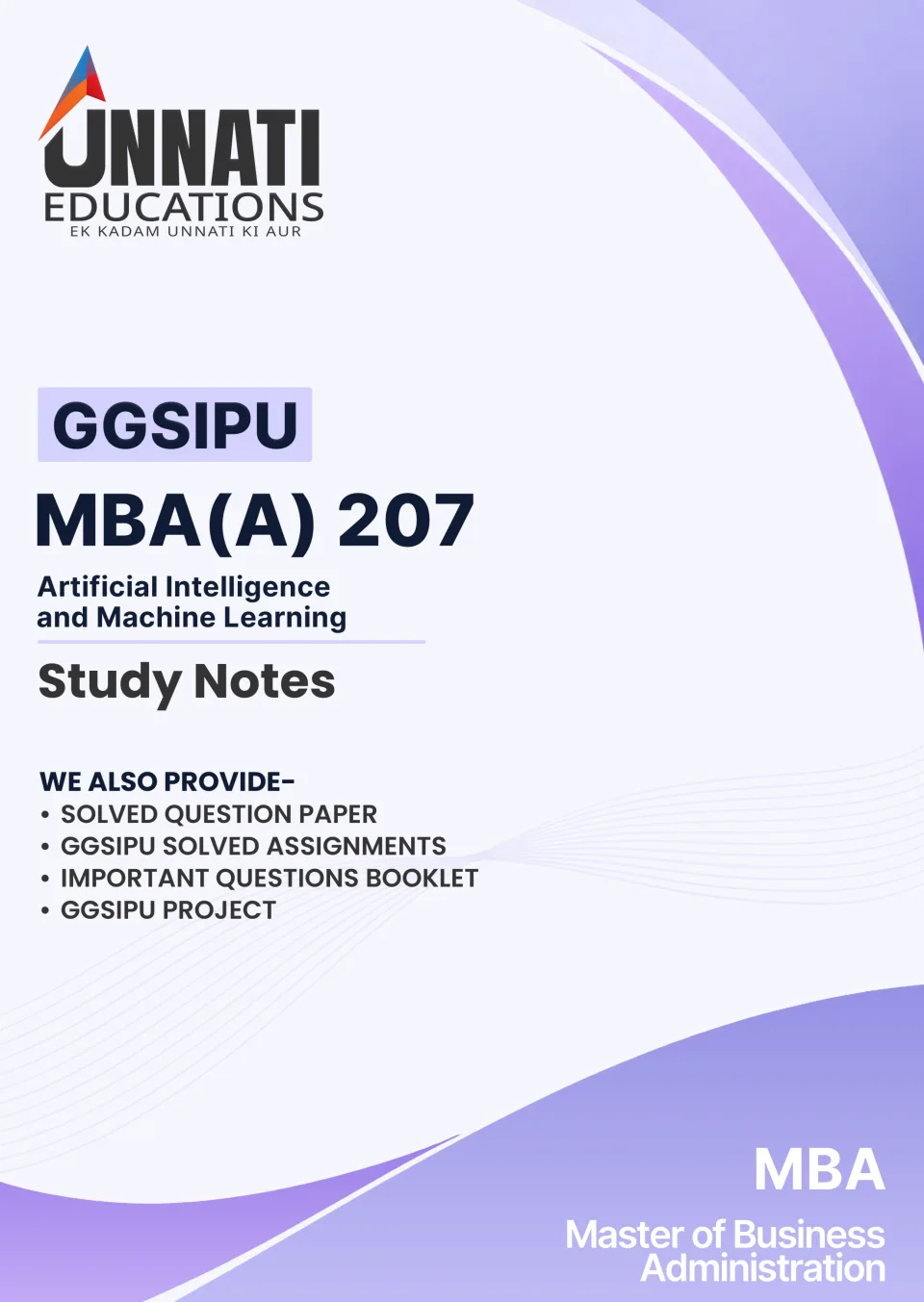
MBA(A) 207 Artificial Intelligence and Machine Learning Notes from Unnati Educations cover all 4 units of this GGSIPU MBA (Analytics) Semester 3 skill enhancement paper in 51 pages, with 7 worked illustrations, 5 code examples with output, 16 numbered figures and 70 exam questions, mapped to the Scheme and Syllabus 2022-24 onwards.
Written by Prateek Talwar, Founder, Unnati Educations · Reviewed by Ritik Rawat, B.Tech, Senior Full Stack Developer · Checked against syllMBAAnalytics180225.pdf (Semesters 3 and 4 approved 19 July 2023) · Updated 26 October 2026 · Editorial policy
Scheme: MBA (Analytics) Scheme and Syllabus 2022-24 onwards | Applies to: batches from 2022-24 onwards | Verified against: syllMBAAnalytics180225.pdf, 26 October 2026
MBA(A) 207 Artificial Intelligence and Machine Learning at a glance: GGSIPU MBA (Analytics) Sem 3 credits, units and exam pattern
Code and title | MBA(A) 207 · Artificial Intelligence and Machine Learning |
|---|---|
Course and semester | MBA (Analytics), Third Semester |
Category and credits | Skill Enhancement · 3 credits · L 3, T/P nil |
Teaching hours | 8 + 6 + 6 + 8 = 28 hours |
Internal assessment | 25 marks: Class Test-I 15 + presentation, viva-voce or group discussion 10 |
End-term and total marks | Not printed in the official PDF |
End-term pattern | Paper-setter instructions not printed; exams follow GGSIPU Ordinance 11 |
Applies to | Scheme and Syllabus 2022-24 onwards (Sem 3 and 4 approved 19.07.2023) |
Paired lab | None (the Sem 3 lab MBA(A) 255 goes with MBA(A) 209) |
The paper runs from AI strategy and problem solving (Units I and II) to regression and neural networks (Units III and IV). It carries 3 of the 30 credits among the GGSIPU MBA (Analytics) Semester 3 papers.
MBA(A) 207 Artificial Intelligence and Machine Learning Notes unit-wise: 7 worked illustrations and 5 code examples across 4 units
Each unit of these GGSIPU MBA (Analytics) Semester 3 AI and ML notes is summarised below. Other papers are under GGSIPU MBA (Analytics) notes.
MBA(A) 207 Unit 1: Introduction to Artificial Intelligence
Pages 4 to 14 cover AI types, growth from the 1950 Turing Test to the 2024 IndiaAI Mission, Davenport and Ronanki's three AI types, a seven-step AI strategy with a value vs feasibility matrix, and 11 risks from bias to vendor lock-in. Includes a banking case study.
Option | When it suits |
|---|---|
Build in-house | AI is a core advantage and the firm owns unique data |
Buy SaaS or APIs | Common needs such as chatbots, OCR or translation |
Partner | Moderate complexity where speed and expertise matter |
Quick look: build, buy or partner for an AI project (from page 11)
Option
Build in-house
When it suits
AI is a core advantage and the firm owns unique data
Option
Buy SaaS or APIs
When it suits
Common needs such as chatbots, OCR or translation
Option
Partner
When it suits
Moderate complexity where speed and expertise matter
MBA(A) 207 Unit 2: Understanding the AI Problem
Pages 15 to 27 cover computerised reasoning (eight reasoning types and a loan-approval rule chain), Rich and Knight's seven problem characteristics, state space search through the water jug and 8-puzzle with BFS, DFS and A*, AND-OR graphs with AO*, and Smalltalk with two programs. It has 4 figures.
Basis | Forward chaining | Backward chaining |
|---|---|---|
Direction | Facts to conclusion | Goal back to facts |
Suits | Monitoring, planning | Diagnosis, advisory systems |
Classic system | XCON | MYCIN |
Quick look: forward vs backward chaining (from page 16)
Basis
Direction
Forward chaining
Facts to conclusion
Backward chaining
Goal back to facts
Basis
Suits
Forward chaining
Monitoring, planning
Backward chaining
Diagnosis, advisory systems
Basis
Classic system
Forward chaining
XCON
Backward chaining
MYCIN
MBA(A) 207 Unit 3: Introduction to Machine Learning
Pages 28 to 38 apply Mitchell's definition to a spam filter, then cover features, labels, data splits, cross-validation, bias-variance and four learning types. An advertising and sales numerical runs through OLS, MAE, RMSE and R², then gradient descent, Ridge and Lasso. Includes a food-delivery case study.
Quick look: the same regression line in scikit-learn (from page 36)
import numpy as np
from sklearn.linear_model import LinearRegression

X = np.array([[2],[4],[5],[7],[8],[10]]); y = np.array([20,26,30,36,40,52])
m = LinearRegression().fit(X, y)
print('b0 =', round(m.intercept_,3), '| b1 =', round(m.coef_[0],3))
print('Sales at Rs 12 lakh:', round(m.predict([[12]])[0],2))Output: b0 = 10.857 | b1 = 3.857 and Sales at Rs 12 lakh: 57.14.
MBA(A) 207 Unit 4: Introduction to Neural Networks
Pages 39 to 50 build a neuron from z = Σwᵢxᵢ + b, compare six activation functions and trace early models from McCulloch-Pitts (1943) to backpropagation (1986). A perceptron learns AND in three epochs, fails on XOR in Python, and one backpropagation step cuts loss from 0.0714 to 0.0698. It has 6 figures.
Method | Variance of weights | Suits |
|---|---|---|
Zero | All weights 0 | Biases only (symmetry problem) |
Xavier / Glorot | 2 ÷ (nin + nout) | Sigmoid and tanh |
He / Kaiming | 2 ÷ nin | ReLU |
Quick look: choosing a weight initialisation (from page 46)
Method
Zero
Variance of weights
All weights 0
Suits
Biases only (symmetry problem)
Method
Xavier / Glorot
Variance of weights
2 ÷ (nin + nout)
Suits
Sigmoid and tanh
Method
He / Kaiming
Variance of weights
2 ÷ nin
Suits
ReLU
MBA(A) 207 exam corner: 46 two-to-five-mark and 24 ten-to-fifteen-mark questions by unit
Unit | Short Answer Questions (2–5 marks) | Long Answer Questions (10–15 marks) | Worked illustrations | Code with output |
|---|---|---|---|---|
I | 12 | 6 | 0 | 0 |
II | 12 | 6 | 2 | 2 |
III | 11 | 6 | 2 | 1 |
IV | 11 | 6 | 3 | 2 |
MBA(A) 207 question bank by unit, as printed in the notes
Unit
I
Short Answer Questions (2–5 marks)
12
Long Answer Questions (10–15 marks)
6
Worked illustrations
0
Code with output
0
Unit
II
Short Answer Questions (2–5 marks)
12
Long Answer Questions (10–15 marks)
6
Worked illustrations
2
Code with output
2
Unit
III
Short Answer Questions (2–5 marks)
11
Long Answer Questions (10–15 marks)
6
Worked illustrations
2
Code with output
1
Unit
IV
Short Answer Questions (2–5 marks)
11
Long Answer Questions (10–15 marks)
6
Worked illustrations
3
Code with output
2
One question per unit, with pointers:
Unit I: Explain the challenges and risks in executing an AI strategy. Data, technology, people, financial, ethical, legal and security; close with Responsible AI.
Unit II: Explain state space with the water jug problem. State (x, y), 8 rules, path (0,0) → (0,3) → (3,0) → (3,3) → (4,2) → (0,2) → (2,0).
Unit III: Explain the bias-variance trade-off. High bias underfits, high variance overfits.
Unit IV: Train a perceptron for the AND gate. Apply
w = w + η(t − y)x; it converges in epoch 3 to 0.3x₁ + 0.2x₂ − 0.5 ≥ 0.
The MBA(A) 207 notes list 46 short-answer questions of 2 to 5 marks and 24 long-answer questions of 10 to 15 marks across 4 units, plus 7 worked illustrations and 5 programs with output. They are practice questions; the unit text holds the answers. More practice sits in the MBA(A) 207 important questions.
Problem representation and production systems in AI: excerpt from page 18 of the MBA(A) 207 notes
Excerpt from page 18
Problem representation means describing a problem in a formal, structured way that a computer can manipulate: specifying the situations (states), the possible actions and the goal. A good representation makes a hard problem easy; a poor one can make an easy problem impossible to solve.
Components of a well-defined problem
Component | Meaning | Delivery route example |
|---|---|---|
Initial state | The situation in which the agent starts | Delivery van at the warehouse in Vikaspuri |
Actions (operators) | Set of moves possible in a state | Drive to an adjacent area or customer |
Transition model | The result of each action (successor state) | Driving from A to B puts the van at B |
Goal test | Checks whether a state is a goal | All parcels delivered and van back at the warehouse |
Path cost | Numeric cost of a path (time, distance, money) | Total kilometres or fuel cost |
Russell and Norvig's five components, with a delivery-route example (excerpt, page 18)
Component
Initial state
Meaning
The situation in which the agent starts
Delivery route example
Delivery van at the warehouse in Vikaspuri
Component
Actions (operators)
Meaning
Set of moves possible in a state
Delivery route example
Drive to an adjacent area or customer
Component
Transition model
Meaning
The result of each action (successor state)
Delivery route example
Driving from A to B puts the van at B
Component
Goal test
Meaning
Checks whether a state is a goal
Delivery route example
All parcels delivered and van back at the warehouse
Component
Path cost
Meaning
Numeric cost of a path (time, distance, money)
Delivery route example
Total kilometres or fuel cost
A solution is a sequence of actions that leads from the initial state to a goal state; an optimal solution has the lowest path cost among all solutions.
Methods of problem representation
State space representation: the problem as a set of states connected by operators; solving means searching for a path. Best for puzzles, games and route planning.
Problem reduction (AND-OR graph): break the problem into sub-problems, solve each and combine. Best for planning, symbolic integration and theorem proving.
Logic (propositional or predicate): facts and rules as logical statements, used for reasoning, proofs and expert systems.
Production rules: IF-THEN rules acting on a working memory, used in expert systems and diagnosis.
Semantic networks and frames: concepts as nodes or slot-filler structures, used in knowledge representation and NLP.
Production system
A common way to represent and solve AI problems is a production system. It has four parts: a set of production rules (condition → action); a knowledge base or working memory describing the current state; a control strategy that decides which rule to apply next and resolves conflicts; and a rule applier. A good control strategy must cause motion, meaning it leads towards the goal, and must be systematic, meaning it avoids repeating the same states.
Do the MBA(A) 207 notes cover the full GGSIPU syllabus?
Yes for all four units: every listed topic has its own section. The official PDF says "Perception Learning" in Unit IV; the notes cover it as perceptron learning, and treat "small talk programming" as the Smalltalk language.
Official unit | Official topics | Where in the notes | Status |
|---|---|---|---|
Unit I: Introduction to Artificial Intelligence (8 hours) | Growth of AI in business, impact of AI in transforming organizations, challenges and risks in executing AI strategy | Sections 1 to 5, pages 4 to 12 | Covered |
Unit II: Understanding the AI Problem (6 hours) | Computerized reasoning, characteristics of an AI problem, problem representation, state space representation, problem reduction, concept of small talk programming | Sections 2 to 7, pages 15 to 25 | Covered |
Unit III: Introduction to Machine Learning (6 hours) | Basic concepts, types of machine learning, examples of ML applications, linear models for regression | Sections 1 to 5, pages 28 to 37 | Covered |
Unit IV: Introduction to Neural Networks (8 hours) | Early models, perception learning, backpropagation, initialization, training and validation, future of AI and ML | Sections 1 to 7, pages 39 to 49 | Covered |
MBA(A) 207 official units mapped to the notes
Official unit
Unit I: Introduction to Artificial Intelligence (8 hours)
Official topics
Growth of AI in business, impact of AI in transforming organizations, challenges and risks in executing AI strategy
Where in the notes
Sections 1 to 5, pages 4 to 12
Status
Covered
Official unit
Unit II: Understanding the AI Problem (6 hours)
Official topics
Computerized reasoning, characteristics of an AI problem, problem representation, state space representation, problem reduction, concept of small talk programming
Where in the notes
Sections 2 to 7, pages 15 to 25
Status
Covered
Official unit
Unit III: Introduction to Machine Learning (6 hours)
Official topics
Basic concepts, types of machine learning, examples of ML applications, linear models for regression
Where in the notes
Sections 1 to 5, pages 28 to 37
Status
Covered
Official unit
Unit IV: Introduction to Neural Networks (8 hours)
Official topics
Early models, perception learning, backpropagation, initialization, training and validation, future of AI and ML
Where in the notes
Sections 1 to 7, pages 39 to 49
Status
Covered
Source: GGSIPU MBA (Analytics) Scheme and Syllabus 2022-24 onwards (ipu.ac.in), page 56. Every course in GGSIPU notes is mapped to its official PDF this way.
Who writes and checks the MBA(A) 207 AI and ML notes?
Prateek Talwar, author: Founder, Unnati Educations; Associate Company Secretary (ACS), ICSI, membership no. 58704, since 15 May 2019; B.Com, University of Delhi (School of Open Learning), 2012. Author profile
Ritik Rawat, subject reviewer (technical content and code): Senior Full Stack Developer, Unnati Educations; B.Tech. Reviewer profile
The MBA(A) 207 AI and ML IPU notes follow the 2022-24 onwards scheme unit by unit. The 2026-27 edition has 51 pages, 16 figures, two Indian case studies (pages 9 and 33) and code in Smalltalk and Python. Updated 26 October 2026 under our editorial policy.
The same team prepares GGSIPU important questions for each course.
MBA(A) 207 and the GGSIPU MBA (Analytics) Sem 3 papers it connects to
MBA(A) 207 has no paired lab; see the MBA (Analytics) course syllabus page.
MBA(A) 207 unit | Other paper | Shared ground |
|---|---|---|
Units III and IV | Unit II: regression, neural networks, model evaluation | |
Unit III regression in Python | Unit III: linear, multiple and logistic regression in Python | |
Unit IV neural networks | MBA(A) 223 Retail Analytics (Sem 3 elective) | Unit IV: neural networks, deep learning in retailing |
Where MBA(A) 207 topics reappear in other MBA (Analytics) papers (official syllabus)
MBA(A) 207 unit
Units III and IV
Shared ground
Unit II: regression, neural networks, model evaluation
MBA(A) 207 unit
Unit III regression in Python
Shared ground
Unit III: linear, multiple and logistic regression in Python
MBA(A) 207 unit
Unit IV neural networks
Other paper
MBA(A) 223 Retail Analytics (Sem 3 elective)
Shared ground
Unit IV: neural networks, deep learning in retailing
Other third-semester papers: MBA(A) 201 Strategic Management, MBA(A) 203 Entrepreneurial Development and Start-Ups, MBA(A) 209 Database Management System, MBA(A) 211 Design Thinking and Innovation, MBA(A) 213 Summer Training Project Report, 255 DBMS Lab, two electives and 233 MOOCs II. Read 207 before 205's Unit II.
How to write MBA(A) 207 answers: fifteen-mark AI strategy essays, regression numericals and perceptron tables
Units I and II reward a diagram plus classification; Units III and IV reward a full working table and a business meaning.
Essays. For a fifteen-mark question on AI challenges, the page 13 tip asks for an introduction, the tree diagram, six to eight challenges with examples, remedies and Responsible AI. For types of AI (page 5), give both the capability and functionality classifications with one example each.
Numericals. For regression (page 37): calculation table, b₁ then b₀, equation, slope in business terms, prediction, then R² if asked. For training and validation (page 48): data split, training terms, learning curves, overfitting remedies.
Worked example (page 47). A fraud model on 1,000 transactions gives TP 40, FN 10, FP 20, TN 930. Accuracy = 970 ÷ 1,000 = 97%; precision = 40 ÷ 60 = 66.7%; recall = 40 ÷ 50 = 80%; F1 = 0.727. End by noting accuracy looks high only because most transactions are genuine.
A trap from page 24: Smalltalk reads binary messages left to right, so 3 + 4 * 2 gives 14, not 11. Practise on GGSIPU MBA (Analytics) important questions.
MBA(A) 207 AI and ML notes FAQs
How do I get the full MBA(A) 207 notes?
Send a WhatsApp message to 9899436384 with the code MBA(A) 207. The full notes come only as a printed book of 51 pages; there is no PDF edition. Delivery takes a maximum of 5 to 7 days, depending on your location.
What is the passing mark for MBA(A) 207 Artificial Intelligence and Machine Learning?
The official MBA (Analytics) syllabus prints only the internal assessment for MBA(A) 207: 25 marks, split as Class Test-I 15 and a presentation, viva-voce or group discussion 10. It does not print the end-term marks, total or pass percentage. It states the scheme follows GGSIPU Ordinance 11, so take end-term minimums and re-appear rules from Ordinance 11 on ipu.ac.in.
Do I need coding skills for MBA(A) 207?
No. The MBA(A) 207 syllabus asks for the concept of Smalltalk programming, not coding tasks, and the paper has no lab. The notes still include five short programs with printed output, two in Smalltalk and three in Python with scikit-learn, showing a regression line, a perceptron and a trained network at work. Reading the output is enough for theory answers.
What does "small talk programming" in MBA(A) 207 Unit II mean?
The MBA(A) 207 notes treat it as Smalltalk, the pure object-oriented language built at Xerox PARC in the 1970s, where everything is an object and objects work by sending messages. Pages 23 to 25 cover its features, unary, binary and keyword messages, an Account class and its link to AI frames. A side box explains chatbot "small talk", as in ELIZA.
Which MBA(A) 207 unit has the most numericals?
Unit IV has the most worked numericals in MBA(A) 207: a perceptron trained on the AND gate over three epochs, one full backpropagation step with sigmoid units, and precision, recall and F1 from a fraud-detection confusion matrix. Unit III has the main regression numerical with the full OLS table, MAE, RMSE and R². Units I and II are mostly theory.
Is MBA(A) 207 a core paper, and which syllabus does it follow?
No. The scheme lists MBA(A) 207 as a Skill Enhancement paper, not Core, with 3 credits, three lecture hours a week and 28 teaching hours. These notes were checked unit by unit against syllMBAAnalytics180225.pdf, the MBA (Analytics) Scheme and Syllabus 2022-24 onwards, whose third and fourth semesters were approved by the Academic Council on 19 July 2023.
Get the full MBA(A) 207 Artificial Intelligence and Machine Learning Notes on WhatsApp
Part | Pages | Worked and practice content |
|---|---|---|
Unit I | 4 to 14 | Case study, 18 questions |
Unit II | 15 to 27 | 2 illustrations, 2 programs, 18 questions |
Unit III | 28 to 38 | 2 illustrations, 1 program, 17 questions |
Unit IV | 39 to 50 | 3 illustrations, 2 programs, 17 questions |
Inside the MBA(A) 207 notes book
Part
Unit I
Pages
4 to 14
Worked and practice content
Case study, 18 questions
Part
Unit II
Pages
15 to 27
Worked and practice content
2 illustrations, 2 programs, 18 questions
Part
Unit III
Pages
28 to 38
Worked and practice content
2 illustrations, 1 program, 17 questions
Part
Unit IV
Pages
39 to 50
Worked and practice content
3 illustrations, 2 programs, 17 questions
Format: these Artificial Intelligence and Machine Learning notes in English come only as a 51-page printed book, not a PDF. Delivery: a maximum of 5 to 7 days, depending on your location.
Order the MBA(A) 207 notes book on WhatsApp (4 units, 51 pages)
Unnati Educations is an independent education provider based in Vikaspuri, Delhi. We are not affiliated with, authorised by, or endorsed by Guru Gobind Singh Indraprastha University (GGSIPU). 'GGSIPU' and 'IPU' are used only to describe the syllabus our notes follow. For official information, visit ipu.ac.in.
Ready for the full notes?
Discuss coverage and delivery with our team.