
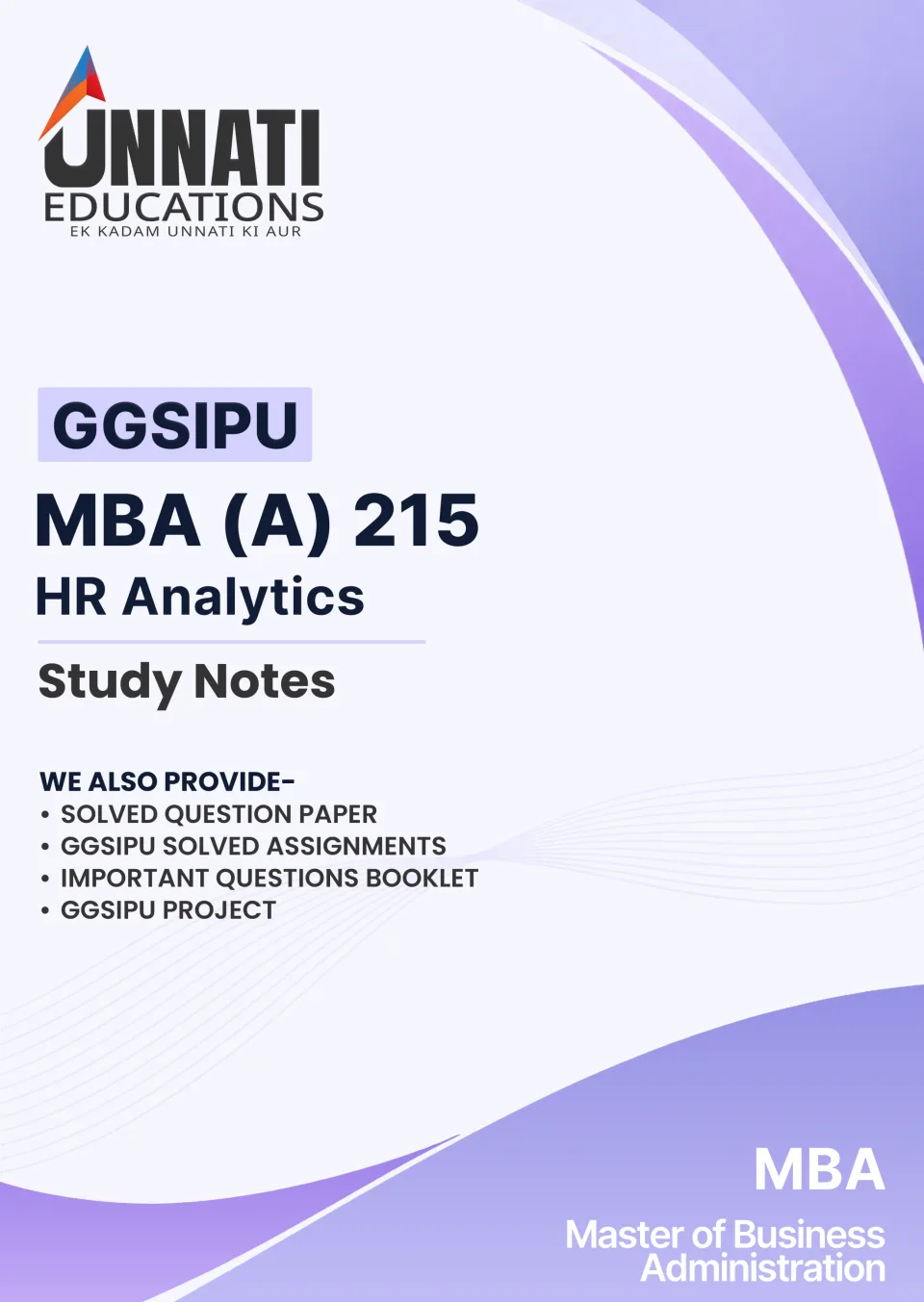
MBA(A) 215 HR Analytics Notes from Unnati Educations cover all 4 units of this MBA (Analytics) Semester 3 HR elective in 56 pages of study content, with 18 case studies, 13 worked illustrations, 18 figures and 69 exam-style questions. They follow the Scheme and Syllabus 2022-24 onwards.
Written by Prateek Talwar, Founder, Unnati Educations · Reviewed by Sheetal Kirola, Academic Head, M.Ed. · Checked against MBA (Analytics) Scheme and Syllabus 2022-24 onwards · Updated 26 October 2026 · Editorial policy
Scheme: MBA (Analytics) Scheme and Syllabus 2022-24 onwards | Applies to: batches admitted 2022-24 onwards | Verified against: syllMBAAnalytics180225.pdf, 26 October 2026
MBA(A) 215 HR Analytics at a glance: GGSIPU MBA (Analytics) Sem 3 credits, units and exam pattern
Item | Detail |
|---|---|
Code and title | MBA(A) 215 HR Analytics |
Course and semester | MBA (Analytics), Semester 3, Electives of HR |
Category and credits | Elective slot (Skill Enhancement); L 3, 3 credits; 42 hours (8 + 8 + 12 + 14) |
Marks | Internal assessment 25: Class Test-I 15 + presentation, viva-voce or group discussion 10. End-term marks are not printed in the official PDF. |
Applies to | Scheme and Syllabus 2022-24 onwards (Semesters 3 and 4 approved 19.07.2023) |
End-term pattern | Not printed; the PDF says the scheme follows Ordinance 11 |
Units | 4 |
Paired lab | None |
MBA(A) 215 HR Analytics: facts from the official MBA (Analytics) scheme and syllabus
Item
Code and title
Detail
MBA(A) 215 HR Analytics
Item
Course and semester
Detail
MBA (Analytics), Semester 3, Electives of HR
Item
Category and credits
Detail
Elective slot (Skill Enhancement); L 3, 3 credits; 42 hours (8 + 8 + 12 + 14)
Item
Marks
Detail
Internal assessment 25: Class Test-I 15 + presentation, viva-voce or group discussion 10. End-term marks are not printed in the official PDF.
Item
Applies to
Detail
Scheme and Syllabus 2022-24 onwards (Semesters 3 and 4 approved 19.07.2023)
Item
End-term pattern
Detail
Not printed; the PDF says the scheme follows Ordinance 11
Item
Units
Detail
4
Item
Paired lab
Detail
None
Students pick two electives from their stream, so this paper sits beside the core GGSIPU MBA (Analytics) Semester 3 papers.
MBA(A) 215 HR Analytics Notes unit-wise: 18 case studies and 13 worked illustrations across 4 units
These GGSIPU MBA (Analytics) Sem 3 HR Analytics notes run to 61 pages, with study content on pages 5 to 60. Each unit ends with a quick-revision table and an exam question list. Notes for other papers: GGSIPU MBA (Analytics) notes.
MBA(A) 215 Unit 1: Understanding the Fundamentals
Pages 5 to 18, 6 sections. It separates HR metrics from HR analytics, explains the four types (descriptive to prescriptive), then adoption through Bersin's maturity model and Davenport's DELTA model. Business value is shown through Ulrich's four roles, the HR value chain and formulas such as HCROI; decisions through evidence-based HR and six cognitive biases. Counts: 2 case studies, 1 worked illustration, 5 figures, 17 questions.
Quick look: Human Capital ROI (from page 12)
Formula | [Revenue − (Operating expense − Employee cost)] ÷ Employee cost |
Figures | Revenue ₹500 cr, operating expenses ₹400 cr, employee cost ₹150 cr |
Result | (500 − 250) ÷ 150 = 1.67, so each ₹1 spent on people returns ₹1.67 |
MBA(A) 215 Unit 2: Establishing an Analytics Culture
Pages 19 to 30, 5 sections. It contrasts a HiPPO culture with a data-driven one, teaches analytical thinking through hypotheses, 5 Whys, fishbone and CRISP-DM. Leadership uses Schein's embedding mechanisms; resistance uses Kotter and Schlesinger's six approaches and the DPDP Act, 2023. Pages 26 to 29 are excerpted below. Counts: 4 case studies, 3 figures, 17 questions.
Quick look: Lewin's model for people analytics (from page 25)
Unfreeze | Show the cost of attrition and build urgency |
Change | Train managers, launch dashboards, run pilots |
Refreeze | Put data into HR policies, KPIs and rewards |
MBA(A) 215 Unit 3: Understanding Data and Basic Analytic Tools
Pages 31 to 45, 8 sections. It covers a data dictionary, seven data quality dimensions, the nominal to ratio scales, internal and external HR data sources, and governance roles from data owner to DPO. The tools part gives 10 dashboard KPIs with formulas, Excel functions like COUNTIFS and DATEDIF, pivot table steps and an eight-step Tableau dashboard. Counts: 2 case studies, 1 worked illustration, 6 figures, 17 questions.
Quick look: cleaning HR data in Excel (from page 34)
Extra spaces |
|
Duplicate employees | Data → Remove Duplicates |
Blank cells |
|
Invalid entries | Data → Data Validation |
MBA(A) 215 Unit 4: Analytics in Various Functions and Processes
Pages 46 to 60, 8 sections, the most numerical unit. Staffing covers yield ratios and the four-fifths rule; manpower planning ends in a Markov matrix; training uses Kirkpatrick and Phillips' ROI; performance uses the 9-box grid; engagement uses eNPS; absenteeism and turnover end in a predictive attrition model. Counts: 10 case studies, 11 worked illustrations, 4 figures, 18 questions.
Quick look: the Bradford Factor (from page 55)
Employee | Spells | B |
|---|---|---|
A | 1 | 1² × 10 = 10 |
B | 5 | 5² × 10 = 250 |
Quick look: B = S² × D for two employees with 10 days off (from page 55)
Employee
A
Spells
1
B
1² × 10 = 10
Employee
B
Spells
5
B
5² × 10 = 250
The five-step HR data story in people analytics: excerpt from page 27 of the MBA(A) 215 notes
Excerpt from page 27 (Unit II, sections 5.2 to 5.4), rewritten for the web.
Why storytelling matters in HR analytics
A clean analysis can still fail if the people who must act on it do not understand it. Storytelling turns analysis into something a non-technical manager can follow. People remember stories far better than isolated numbers, and a story connects the data to real employees and their experiences.
A good story also ends with a recommendation and next steps, which is what makes leaders act. Done well, it builds the credibility of HR with business heads and reduces resistance, because it explains why the finding matters and what is in it for the audience.
The structure of an HR data story
A useful HR data story follows a beginning, middle and end, much like a classic story arc:
Context or setting: what is the business situation and why should the audience care?
Problem or conflict: what is going wrong, for example 30% attrition in sales?
Insight or discovery: what did the data reveal about key drivers and patterns?
Resolution or recommendation: what should we do, and what are the costs and benefits?
Call to action: which decision is needed now, who owns it and by when?
Other frameworks worth knowing
SCQA (Barbara Minto, Pyramid Principle): Situation, Complication, Question, Answer.
What, So What, Now What: what happened, why it matters, what we should do.
Big Idea (Cole Nussbaumer Knaflic): sum up the whole message in one sentence before building any slides.
Principles of effective data storytelling
Principle | What it means |
|---|---|
Know your audience | The CEO wants business impact, line managers want team-level actions, HR wants process detail |
Start with the key message | Lead with the conclusion, then support it with data |
Keep it simple | Show only the data that supports the message |
Use business language | Talk in cost, revenue and productivity, not statistical jargon |
Humanise the data | Add employee quotes, personas or examples |
Use the right visual | Pick the chart type that best shows the message |
End with action | Give a clear recommendation, owner, cost and expected benefit |
Seven principles of an HR data story (excerpt from page 27)
Principle
Know your audience
What it means
The CEO wants business impact, line managers want team-level actions, HR wants process detail
Principle
Start with the key message
What it means
Lead with the conclusion, then support it with data
Principle
Keep it simple
What it means
Show only the data that supports the message
Principle
Use business language
What it means
Talk in cost, revenue and productivity, not statistical jargon
Principle
Humanise the data
What it means
Add employee quotes, personas or examples
Principle
Use the right visual
What it means
Pick the chart type that best shows the message
Principle
End with action
What it means
Give a clear recommendation, owner, cost and expected benefit
How to write MBA(A) 215 answers: formula-plus-numerical metric answers and diagram-led ten-to-fifteen-mark answers
Metric questions (turnover, absenteeism, training ROI, eNPS) need the formula, a small numerical and one line of interpretation. Concept questions (analytics culture, resistance, governance) need a definition, a diagram or table, a named model and a company example.
The notes' exam tip boxes give answer orders. For HR's contribution to business value (page 13): meaning, ways HR adds value, Ulrich's roles, the value chain diagram, measures with formulas, then the Service-Profit Chain. For data governance (page 37): meaning, objectives, the six-box framework, roles table and DPDP Act points.
Worked example (page 54): 200 employees, 25 working days, 400 man-days lost. Absenteeism rate = 400 ÷ (200 × 25) × 100 = 8%. Show formula, substitution, then meaning.
A common slip is calling a metric analytics: 18% attrition is a metric; finding that long-commute employees with no promotion in three years are 2.5 times more likely to leave is analytics (page 6). Practise this format on GGSIPU MBA (Analytics) important questions.
MBA(A) 215 exam corner: 40 two-to-five-mark and 29 ten-to-fifteen-mark questions by unit
Each unit closes with "Short Answer Questions (2–5 Marks)" and "Long Answer Questions (10–15 Marks)". These are practice questions; the answer material sits in that unit's sections.
Unit | 2–5 Marks | 10–15 Marks | Case studies | Illustrations |
|---|---|---|---|---|
I | 10 | 7 | 2 | 1 |
II | 10 | 7 | 4 | 0 |
III | 10 | 7 | 2 | 1 |
IV | 10 | 8 | 10 | 11 |
MBA(A) 215 exam questions, case studies and worked illustrations by unit
Unit
I
2–5 Marks
10
10–15 Marks
7
Case studies
2
Illustrations
1
Unit
II
2–5 Marks
10
10–15 Marks
7
Case studies
4
Illustrations
0
Unit
III
2–5 Marks
10
10–15 Marks
7
Case studies
2
Illustrations
1
Unit
IV
2–5 Marks
10
10–15 Marks
8
Case studies
10
Illustrations
11
Unit I (10–15 Marks): Discuss Dave Ulrich's HR roles model and how analytics strengthens each role. Pointer: four roles, each with one analytics use (page 11).
Unit II (2–5 Marks): What is the HiPPO effect? Pointer: decisions follow the highest paid person's opinion, not data (pages 19 and 20).
Unit III (2–5 Marks): Differentiate between nominal, ordinal, interval and ratio data. Pointer: department, rating, engagement index, salary (page 35).
Unit IV (2–5 Marks): Opening staff 900, closing 1,100, separations 150; calculate turnover rate. Pointer: 150 ÷ 1,000 × 100 = 15% (page 56).
The MBA(A) 215 notes list 40 two-to-five-mark and 29 ten-to-fifteen-mark exam questions across 4 units, plus 18 case studies and 13 worked illustrations.
More practice sits in the MBA(A) 215 important questions.
MBA(A) 215 and the GGSIPU MBA (Analytics) Sem 3 papers it connects to
MBA(A) 215 has no lab; for every paper see the GGSIPU MBA (Analytics) syllabus.
MBA(A) 217 Organizational Analytics and MBA(A) 219 Talent Management are the other HR electives; Talent Management's competency-based hiring and performance link to Unit 4 staffing and the 9-box grid. MBA(A) 205 Predictive Analytics and Big Data teaches the logistic regression used for attrition scoring (page 57). MBA(A) 209 Database Management System and MBA(A) 255 DBMS Lab cover the data dictionary and metadata behind Unit 3.
Other Semester 3 papers: MBA(A) 201 Strategic Management, MBA(A) 203 Entrepreneurial Development & Start-Ups, MBA(A) 207 Artificial Intelligence and Machine Learning, MBA(A) 211 Design Thinking and Innovation, MBA(A) 213 Summer Training Project Report and MBA(A) 233 MOOCs II/Open Elective.
Who writes and checks the MBA(A) 215 HR Analytics study notes?
Prateek Talwar, author: Founder, Unnati Educations; Associate Company Secretary (ACS), ICSI, membership no. 58704, since 15 May 2019; B.Com, University of Delhi (School of Open Learning), 2012. Author profile
Sheetal Kirola, reviewer: Academic Head, Unnati Educations; M.Ed.; 7 years of experience. Reviewer profile
The 2026-27 edition of the MBA(A) 215 HR Analytics IPU notes is mapped to the Scheme and Syllabus 2022-24 onwards and includes the DPDP Act, 2023 and Excel 365 functions such as XLOOKUP (page 39). Last updated 26 October 2026; see our editorial policy.
The same team prepares GGSIPU important questions for every course.
Do the MBA(A) 215 notes cover the full GGSIPU syllabus?
Yes. Every official MBA(A) 215 topic has its own section in the notes; the unit check found no gaps.
Official unit | Official topics | Where in the notes | Status |
|---|---|---|---|
I: Understanding the Fundamentals | Why People Analytics? Adoption of Analytics, HR's Contribution to Business Value, HR Decision Making and Analytics, HR Business Process and Analytics | Sections 2 to 6, pages 6 to 17 | Covered |
II: Establishing an Analytics Culture | Enable Analytical Thinking, Role of Leader in creating analytic culture, Overcoming Resistance to People Analytics, Communicate with Storytelling and Visualization | Sections 2 to 5, pages 20 to 29 | Covered |
III: Understanding Data and Basic Analytic Tools | Know Your Data, A Pragmatic View of Data, Solving Data Quality Challenges, Data Types and Sources, Data Governance, Creating HR Dashboards using Microsoft Excel, Applying Pivot Tables to HR data, Application of Tableau in HR Data Visualization | Sections 1 to 8, pages 31 to 44 | Covered |
IV: Analytics in Various Functions and Processes | Staffing Analytics, Analytics in Manpower Planning, Training and Development Analytics, Analytics in Performance Management, Engagement Analytics, Analytics in Absenteeism, Turnover, Case Studies on various analytics | Sections 1 to 8, pages 46 to 59 | Covered |
MBA(A) 215 official syllabus topics mapped to the notes
Official unit
I: Understanding the Fundamentals
Official topics
Why People Analytics? Adoption of Analytics, HR's Contribution to Business Value, HR Decision Making and Analytics, HR Business Process and Analytics
Where in the notes
Sections 2 to 6, pages 6 to 17
Status
Covered
Official unit
II: Establishing an Analytics Culture
Official topics
Enable Analytical Thinking, Role of Leader in creating analytic culture, Overcoming Resistance to People Analytics, Communicate with Storytelling and Visualization
Where in the notes
Sections 2 to 5, pages 20 to 29
Status
Covered
Official unit
III: Understanding Data and Basic Analytic Tools
Official topics
Know Your Data, A Pragmatic View of Data, Solving Data Quality Challenges, Data Types and Sources, Data Governance, Creating HR Dashboards using Microsoft Excel, Applying Pivot Tables to HR data, Application of Tableau in HR Data Visualization
Where in the notes
Sections 1 to 8, pages 31 to 44
Status
Covered
Official unit
IV: Analytics in Various Functions and Processes
Official topics
Staffing Analytics, Analytics in Manpower Planning, Training and Development Analytics, Analytics in Performance Management, Engagement Analytics, Analytics in Absenteeism, Turnover, Case Studies on various analytics
Where in the notes
Sections 1 to 8, pages 46 to 59
Status
Covered
Check it in the official MBA (Analytics) Scheme and Syllabus 2022-24 onwards PDF (MBA(A) 215 is on page 63).
Every course in GGSIPU notes is mapped to its official PDF the same way.
MBA(A) 215 HR Analytics study notes FAQs
How do I get the full MBA(A) 215 notes?
Tap "Get Full Notes" on this page to message us on WhatsApp at 9899436384. The MBA(A) 215 notes are sold only as a printed book, not as a PDF, so share your delivery address in the chat. Delivery takes a maximum of 5 to 7 days, and the rest depends on your location. Price and payment details are shared on WhatsApp.
Is MBA(A) 215 HR Analytics compulsory in MBA (Analytics) Semester 3?
No, MBA(A) 215 is an elective. The Semester 3 scheme lists it under "Electives of HR" with MBA(A) 217 Organizational Analytics and MBA(A) 219 Talent Management, and asks students to select any two electives from their stream for the Elective I and Elective II slots, each worth 3 credits. Ask your institute which electives it offers this year.
What is the passing mark for MBA(A) 215?
The official MBA (Analytics) PDF prints only the internal assessment for MBA(A) 215: 25 marks, from Class Test-I (15) and a presentation, viva-voce or group discussion (10). It does not print the end-term marks, the total or a pass percentage. It says the scheme follows the university's Ordinance 11, which sets end-term minimums and re-appear rules, so check that or ask your institute.
Do the MBA(A) 215 notes teach Excel dashboards, pivot tables and Tableau step by step?
Yes, in writing. Unit 3 gives a nine-step Excel dashboard build with 10 HR KPIs and their formulas, functions like COUNTIFS and NETWORKDAYS, eight pivot table steps with seven HR analyses, and an eight-step Tableau dashboard flow with a calculated attrition field. Figures show each tool, but there are no software files, so practise on your own data.
Which MBA(A) 215 unit has the most numericals?
Unit 4, clearly. It holds 11 of the 13 worked illustrations in the MBA(A) 215 notes, including yield ratios, cost per hire, workload analysis, a Markov matrix, training ROI, eNPS, the Bradford Factor, turnover rate and cost of turnover. Units 1 and 3 have one each (Human Capital ROI and a pivot-table attrition study), and Unit 2 has none.
Are the MBA(A) 215 exam questions in the notes answered one by one?
No. The 69 MBA(A) 215 questions at the end of the units are a practice list, not a question-and-answer bank. You build each answer from that unit's definitions, tables, diagrams, formulas, case studies and worked illustrations. Seven exam tip boxes show the order for longer answers, for example on business value, data governance and turnover.
Get the full MBA(A) 215 HR Analytics Notes on WhatsApp
Unit | Book pages | Case studies | Illustrations | Questions |
|---|---|---|---|---|
I | 5 to 18 (14) | 2 | 1 | 17 |
II | 19 to 30 (12) | 4 | 0 | 17 |
III | 31 to 45 (15) | 2 | 1 | 17 |
IV | 46 to 60 (15) | 10 | 11 | 18 |
What the printed MBA(A) 215 notes contain, by unit
Unit
I
Book pages
5 to 18 (14)
Case studies
2
Illustrations
1
Questions
17
Unit
II
Book pages
19 to 30 (12)
Case studies
4
Illustrations
0
Questions
17
Unit
III
Book pages
31 to 45 (15)
Case studies
2
Illustrations
1
Questions
17
Unit
IV
Book pages
46 to 60 (15)
Case studies
10
Illustrations
11
Questions
18
Format: HR Analytics notes in English, printed as a 61-page book with 18 figures; not available as a PDF. Delivery: maximum 5 to 7 days; the rest depends on your location.
Order the MBA(A) 215 HR Analytics Notes book on WhatsApp (4 units, 61 pages)
Unnati Educations is an independent education provider based in Vikaspuri, Delhi. We are not affiliated with, authorised by, or endorsed by Guru Gobind Singh Indraprastha University (GGSIPU). 'GGSIPU' and 'IPU' are used only to describe the syllabus our notes follow. For official information, visit ipu.ac.in.
Ready for the full notes?
Discuss coverage and delivery with our team.