
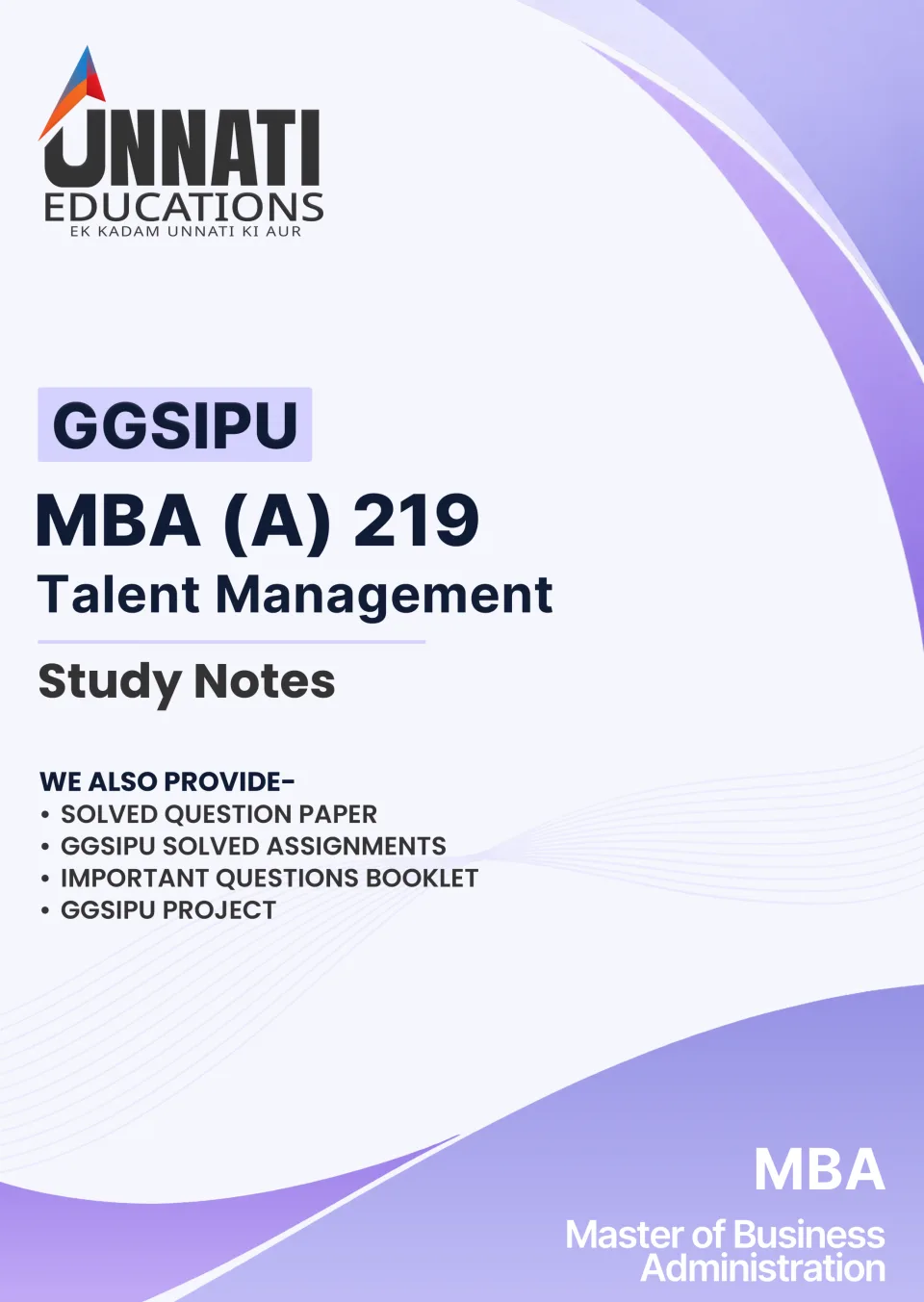
MBA(A) 219 Talent Management Notes cover all 4 units of the GGSIPU MBA (Analytics) Semester 3 HR elective in one 60-page printed book: 7 worked illustrations, 5 case studies, 18 figures and 68 end-of-unit exam questions, mapped to the Scheme and Syllabus 2022-24 onwards.
Written by Prateek Talwar, Founder, Unnati Educations · Reviewed by Sheetal Kirola, Academic Head, M.Ed. · Checked against syllMBAAnalytics180225.pdf · Updated 14 October 2026 · Editorial policy
Scheme: MBA (Analytics) Scheme and Syllabus 2022-24 onwards | Applies to: batches on this scheme (Semesters 3 and 4 approved 19.07.2023) | Verified against: syllMBAAnalytics180225.pdf, ipu.ac.in
MBA(A) 219 Talent Management at a glance: GGSIPU MBA (Analytics) Sem 3 credits, units and exam pattern
Code and title | MBA(A) 219 Talent Management (notes print "MBA (A)-219") |
|---|---|
Course and semester | MBA (Analytics), Semester 3, HR stream elective |
Category and credits | Elective, Skill Enhancement · L 3, no T/P · 3 credits |
Units and hours | 4 units, 42 hours (8, 12, 10, 12) |
Internal assessment | Out of 25: Class Test-I 15 + presentation, viva-voce or group discussion 10 |
End-term marks and pattern | Not printed in the official PDF |
Applies to | Scheme and Syllabus 2022-24 onwards (Agenda Item 56.52) |
Paired lab | None |
Units II and IV carry 24 of the 42 hours. The scheme follows GGSIPU Ordinance 11 for examinations.
It is listed with the other GGSIPU MBA (Analytics) Semester 3 papers.
MBA(A) 219 Talent Management Notes unit-wise: 7 worked illustrations, 5 case studies and 68 exam questions across 4 units
In these GGSIPU MBA (Analytics) Sem 3 Talent Management notes, the competency model built in Unit II drives hiring and training in Unit III and appraisal and succession in Unit IV.
Other papers are under GGSIPU MBA (Analytics) notes.
MBA(A) 219 Unit 1: Introduction
Pages 4 to 15, also covered as "Introduction to Talent Management". It moves from Ulrich's Competence × Commitment × Contribution to the nine building blocks of a talent management system, the nine-box grid and a 10-step build ending in seven TM metrics. Forces are split into ten external, eight internal and a PESTLE box. Counts: 4 sections, 5 figures, 1 case study (HUL), 17 exam questions.
Category | TM action |
|---|---|
Superkeepers (far above expectations) | Highest investment, accelerated development, backups for key roles |
Keepers (exceed) | Develop, reward well, groom as successors |
Solid Citizens (meet) | Develop in current roles, fair rewards |
Misfits (below) | Improvement plan, redeployment or exit |
Quick look: Berger's four talent categories and the TM action for each (from page 8)
Category
Superkeepers (far above expectations)
TM action
Highest investment, accelerated development, backups for key roles
Category
Keepers (exceed)
TM action
Develop, reward well, groom as successors
Category
Solid Citizens (meet)
TM action
Develop in current roles, fair rewards
Category
Misfits (below)
TM action
Improvement plan, redeployment or exit
MBA(A) 219 Unit 2: Building block of Talent Management
Pages 16 to 31. After KSAO, threshold versus differentiating and a five-level proficiency scale, a competency model is built in 10 steps from BEI, critical incidents and the repertory grid, ending in a retail-bank Branch Manager model.
Nine assessment methods, assessment centre exercises and a 10-item Team Leader instrument follow. Counts: 5 sections, 5 figures, 1 worked illustration (gap analysis), 1 case study, 17 exam questions.
Scale | Format | Example item |
|---|---|---|
Likert | 1 Strongly disagree to 5 Strongly agree | "Shares information with team members" |
Frequency (BOS) | 1 Never to 5 Always | How often does the person coach juniors? |
Proficiency | 1 Basic to 5 Expert | Level of financial analysis skill |
BARS | Each point anchored to a behaviour | 5 "Resolves complex complaints"; 1 "Argues with customers" |
Quick look: four rating scales for a competency instrument (from page 28)
Scale
Likert
Format
1 Strongly disagree to 5 Strongly agree
Example item
"Shares information with team members"
Scale
Frequency (BOS)
Format
1 Never to 5 Always
Example item
How often does the person coach juniors?
Scale
Proficiency
Format
1 Basic to 5 Expert
Example item
Level of financial analysis skill
Scale
BARS
Format
Each point anchored to a behaviour
Example item
5 "Resolves complex complaints"; 1 "Argues with customers"
MBA(A) 219 Unit 3: Managing Talent using competency (1)
Pages 32 to 45. Hiring covers talent acquisition, EVP, eight sourcing channels and a 10-step process with a Business Analyst job description, STAR questions and the Schmidt and Hunter validity table (work samples 0.54).
Training covers an 8-step cycle, three-level TNA, 70-20-10, GROW coaching and cross-cultural training. Counts: 6 sections, 3 figures, 3 worked illustrations (cost per hire, selection matrix, training ROI), 1 case study (Infosys), 17 exam questions.
Level | Evidence in the notes' example |
|---|---|
1 Reaction | Participants rate the workshop 4.5 / 5 |
2 Learning | Pre-test 52%, post-test 81% |
3 Behaviour | 360-degree "negotiation" rating rises from 2.3 to 3.4 in 3 months |
4 Results | Average discount falls by 2%, deal size grows |
Quick look: Kirkpatrick's four levels on one negotiation workshop (from page 43)
Level
1 Reaction
Evidence in the notes' example
Participants rate the workshop 4.5 / 5
Level
2 Learning
Evidence in the notes' example
Pre-test 52%, post-test 81%
Level
3 Behaviour
Evidence in the notes' example
360-degree "negotiation" rating rises from 2.3 to 3.4 in 3 months
Level
4 Results
Evidence in the notes' example
Average discount falls by 2%, deal size grows
MBA(A) 219 Unit 4: Managing Talent using competency (2)
Pages 46 to 59. Performance is rated as results (what) plus competencies (how) through an 8-step cycle with calibration. Careers use Super's stages, Schein's eight anchors and the dual ladder.
Succession covers HiPo traits, readiness levels, the six-passage Leadership Pipeline and SEBI LODR, 2015. Counts: 4 sections, 5 figures, 3 worked illustrations (appraisal score, replacement chart, bench strength), 2 case studies (Deloitte, GE), 17 exam questions.
Candidate | Score | Readiness | Level |
|---|---|---|---|
A. Mehta, GM Plant 1 | 29 | 90.6% | Ready now |
B. Rao, GM Supply Chain | 25 | 78.1% | Ready in 1-2 years |
C. Khan, Senior Manager Quality | 20 | 62.5% | Ready in 3-5 years |
Quick look: replacement chart for a retiring VP Operations, scored out of 32 (from page 56)
Candidate
A. Mehta, GM Plant 1
Score
29
Readiness
90.6%
Level
Ready now
Candidate
B. Rao, GM Supply Chain
Score
25
Readiness
78.1%
Level
Ready in 1-2 years
Candidate
C. Khan, Senior Manager Quality
Score
20
Readiness
62.5%
Level
Ready in 3-5 years
MBA(A) 219 exam corner: 40 short (two to five marks) and 28 long (ten to fifteen marks) questions by unit
Unit | Short (2–5 Marks) | Long (10–15 Marks) | Worked illustrations / case studies |
|---|---|---|---|
I | 10 | 7 | 0 / 1 |
II | 10 | 7 | 1 / 1 |
III | 10 | 7 | 3 / 1 |
IV | 10 | 7 | 3 / 2 |
MBA(A) 219 exam questions and worked material per unit, as printed in the notes
Unit
I
Short (2–5 Marks)
10
Long (10–15 Marks)
7
Worked illustrations / case studies
0 / 1
Unit
II
Short (2–5 Marks)
10
Long (10–15 Marks)
7
Worked illustrations / case studies
1 / 1
Unit
III
Short (2–5 Marks)
10
Long (10–15 Marks)
7
Worked illustrations / case studies
3 / 1
Unit
IV
Short (2–5 Marks)
10
Long (10–15 Marks)
7
Worked illustrations / case studies
3 / 2
These exam-style questions close each unit. One per unit:
Unit I: Explain the Build-Buy-Borrow approach. Build (develop internally), buy (hire from outside), borrow (contract or gig talent); some add Bind and Bounce (page 10).
Unit II: What is BARS? Give an example. Smith and Kendall (1963); for teamwork, 5 "proactively helps colleagues", 1 "blames others" (pages 28 and 30).
Unit III: Calculate training ROI if benefits are ₹12 lakh and cost is ₹4 lakh. Net benefit ₹8 lakh, so ROI = 200% and BCR = 3 : 1 (formula on page 44).
Unit IV: What is bench strength? How is it calculated? Key positions with a ready-now successor ÷ total key positions × 100: 26 of 40 = 65% (page 56).
The MBA(A) 219 notes list 40 short-answer and 28 long-answer exam questions across 4 units, plus 7 worked illustrations and 5 case studies.
More practice sits in the MBA(A) 219 important questions.
Who writes and checks the MBA(A) 219 TM notes?
Prateek Talwar, author: Founder, Unnati Educations · ACS, ICSI (membership no. 58704, since 15 May 2019) · B.Com, University of Delhi (SOL), 2012 · bio
Sheetal Kirola, reviewer: Academic Head, Unnati Educations · M.Ed. · 7 years of experience · checks the HR concepts, definitions and examples · bio
These Talent Management notes in English follow the 2022-24 onwards scheme. The 2026-27 edition cites the Labour Codes, POSH Act 2013, DPDP Act 2023 and SEBI LODR 2015, with Indian cases from HUL and Infosys. Last updated 14 October 2026; see our editorial policy.
The same team prepares GGSIPU important questions for every course it covers.
How to write MBA(A) 219 answers: diagram-led ten-mark theory answers, competency instruments and HR metric numericals
The MBA(A) 219 Talent Management IPU notes show three answer shapes. For long theory answers, follow the exam-tip chain: meaning, comparison table, step diagram, a sample form, then benefits and challenges. For "forces impacting talent management", write external and internal forces apart, add the PESTLE box and end with how firms respond.
For an instrument design question, write the 10 steps, a poor-versus-good item table, the rating scale (BARS), reliability (Cronbach's alpha 0.70 or above) and validity, then draw 8 to 10 items. Numericals need the formula, each line and the meaning:
Worked answer: competency gap of an Assistant Manager, Sales (from page 26)
Required levels total 18 and actual levels 15 across five competencies, so fit = 15 ÷ 18 × 100 = 83.3%. Negotiation has the biggest gap (4 − 2 = 2): workshop plus coaching. Capping each actual score at its required level gives 14 ÷ 18 = 77.8%, so a surplus cannot hide a gap.
The same weighted logic picks Candidate B (4.05) in Unit III and rates a Sales Manager 3.85 in Unit IV. Practise these shapes on GGSIPU MBA (Analytics) important questions.
MBA(A) 219 and the GGSIPU MBA (Analytics) Sem 3 papers it connects to
MBA(A) 219 has no paired lab. All papers and electives sit in the GGSIPU MBA (Analytics) syllabus.
It shares the HR stream with MBA(A) 215 HR Analytics and MBA(A) 217 Organizational Analytics; students choose two. Unit IV leads into the Semester 4 elective MBA(A) 214 Performance and Compensation Management, which covers competency-based compensation and succession planning.
Rest of Sem 3: MBA(A) 201 Strategic Management, MBA(A) 203 Entrepreneurial Development & Start-Ups, MBA(A) 205 Predictive Analytics and Big Data, MBA(A) 207 Artificial Intelligence and Machine Learning, MBA(A) 209 Database Management System, MBA(A) 211 Design Thinking and Innovation, MBA(A) 213 Summer Training Project Report, 255 DBMS Lab and 233 MOOCs II/Open Elective.
The iceberg model of competency in talent management: excerpt from page 17 of the MBA(A) 219 notes
Excerpt from page 17
A competency always shows up as observable behaviour. "Customer Focus", for example, is seen when a person listens carefully to customer needs, responds to complaints within 24 hours and suggests solutions that add value for the customer.
The iceberg model (Spencer and Spencer)
Spencer and Spencer compare competencies to an iceberg. A small part sits above the water: visible, easy to see and easy to develop. The larger part sits below: hidden, hard to develop, but with a stronger effect on long-term performance.
Above the surface
Skills are the ability to perform a physical or mental task. Knowledge is the information a person has in a specific area. Both are easy to build through training.
Below the surface
Self-concept covers attitudes, values and self-image, such as confidence; it changes moderately, through coaching and experience. Traits are physical characteristics and consistent responses, such as self-control or reaction time, and are difficult to change. Motives sit deepest: the things a person consistently thinks about or wants, such as the need for achievement, which drive behaviour. They are the most difficult to develop.
The practical lesson
It is cheaper to select people for the hidden competencies and train them for the visible ones. Hence the popular saying: "Hire for attitude, train for skills."
Types of competencies by scope
Core or organisational competencies are needed by every employee and reflect the firm's values and culture: integrity, customer focus, teamwork, quality orientation. Functional or technical competencies belong to a job family: financial analysis in Finance, SEO in Marketing, Python in Analytics, payroll processing in HR.
Behavioural competencies describe how a person behaves and interacts at work: communication, adaptability, initiative, problem solving. Leadership or managerial competencies are needed by those who manage people and strategy: strategic thinking, developing others, decision making and change leadership.
Do the MBA(A) 219 notes cover the full GGSIPU syllabus?
Yes. Every topic under the four official units of MBA(A) 219 has its own section in the notes; the unit check found no gap.
Official unit | Official topics | Where in the notes | Status |
|---|---|---|---|
I: Introduction | Creating a Talent Management System for organization excellence; steps to creating a talent management system; forces impacting talent management | Sections 2-4, pages 6-14 | Covered |
II: Building block of Talent Management | Competency mapping: concept of competency, developing a competency model; Competency Assessment: principal approaches, designing an instrument | Sections 1-5, pages 16-30 | Covered |
III: Managing Talent using competency (1) | Competency-based recruitment and selection, competency-based training and development | Sections 1-6, pages 32-44 | Covered (plus talent acquisition and global training) |
IV: Managing Talent using competency (2) | Competency-based performance management; competency-based career and succession planning | Sections 1-4, pages 46-58 | Covered |
MBA(A) 219 official syllabus mapped to the notes
Official unit
I: Introduction
Official topics
Creating a Talent Management System for organization excellence; steps to creating a talent management system; forces impacting talent management
Where in the notes
Sections 2-4, pages 6-14
Status
Covered
Official unit
II: Building block of Talent Management
Official topics
Competency mapping: concept of competency, developing a competency model; Competency Assessment: principal approaches, designing an instrument
Where in the notes
Sections 1-5, pages 16-30
Status
Covered
Official unit
III: Managing Talent using competency (1)
Official topics
Competency-based recruitment and selection, competency-based training and development
Where in the notes
Sections 1-6, pages 32-44
Status
Covered (plus talent acquisition and global training)
Official unit
IV: Managing Talent using competency (2)
Official topics
Competency-based performance management; competency-based career and succession planning
Where in the notes
Sections 1-4, pages 46-58
Status
Covered
Verify the topics in the official GGSIPU MBA (Analytics) Scheme and Syllabus 2022-24 onwards (PDF), printed page 67. Page 58 adds a table linking all four units into one talent cycle.
Each paper in GGSIPU notes is checked against its official syllabus PDF in the same way.
MBA(A) 219 TM notes FAQs
How do I get the full MBA(A) 219 notes?
Message Unnati Educations on WhatsApp at 9899436384 with the "Get Full Notes" button. The MBA(A) 219 notes come only as a 60-page printed book, not as a PDF. Delivery takes a maximum of 5 to 7 days, depending on your location. The button pre-fills your message with the paper code and a reference number, so the order is quick.
How are MBA(A) 219 marks split, and what is the passing mark?
The official MBA (Analytics) PDF prints internal assessment for MBA(A) 219 out of 25: Class Test-I for 15 and a presentation, viva-voce or group discussion for 10. It does not print the end-term marks, the total or a pass percentage. The scheme follows GGSIPU Ordinance 11, which sets end-term minimums and re-appear rules, so check those on ipu.ac.in.
Is MBA(A) 219 a compulsory Semester 3 paper?
No. MBA(A) 219 is one of three HR stream electives in Semester 3, with MBA(A) 215 HR Analytics and MBA(A) 217 Organizational Analytics, and the scheme asks students to select any two from their stream. It is a Skill Enhancement elective with 3 lecture hours a week and 3 credits, taught over 42 hours in four units.
Which MBA(A) 219 units have numericals?
Units III and IV carry six of the seven worked illustrations in the MBA(A) 219 notes. Unit III works out cost per hire (₹50,000), a weighted selection matrix and a training ROI of 150%; Unit IV works an appraisal score of 3.85, a replacement chart and 65% bench strength. Unit II has one competency gap analysis.
Do the MBA(A) 219 notes match the 2022-24 onwards scheme?
Yes. The MBA(A) 219 notes follow the GGSIPU MBA (Analytics) Scheme and Syllabus 2022-24 onwards, whose Semester 3 papers were approved by the Academic Council on 19.07.2023. Each official unit and every topic under it has a matching section in the notes, from creating a talent management system in Unit I to succession planning in Unit IV.
Are the MBA(A) 219 exam questions answered in the notes?
The 68 MBA(A) 219 exam questions are listed at the end of each unit without separate model answers; each is answered by that unit's sections. For example, the Unit II question on designing a Sales Team Leader instrument is answered by the 10 design steps, the rating-scale table and the sample instrument on pages 27 to 29.
Get the full MBA(A) 219 Talent Management Notes on WhatsApp
Unit | Pages | Page count |
|---|---|---|
I | 4-15 | 12 |
II | 16-31 | 16 |
III | 32-45 | 14 |
IV | 46-59 | 14 |
Pages per unit in the MBA(A) 219 printed book
Unit
I
Pages
4-15
Page count
12
Unit
II
Pages
16-31
Page count
16
Unit
III
Pages
32-45
Page count
14
Unit
IV
Pages
46-59
Page count
14
60 pages with cover, index and closing page: 7 worked illustrations, 5 case studies, 18 figures and a quick-revision table per unit. Printed book only, not available as a PDF; delivery takes a maximum of 5 to 7 days, depending on your location.
Order the printed MBA(A) 219 book on WhatsApp (4 units, 60 pages)
Unnati Educations is an independent education provider based in Vikaspuri, Delhi. We are not affiliated with, authorised by, or endorsed by Guru Gobind Singh Indraprastha University (GGSIPU). 'GGSIPU' and 'IPU' are used only to describe the syllabus our notes follow. For official information, visit ipu.ac.in.
Ready for the full notes?
Discuss coverage and delivery with our team.