
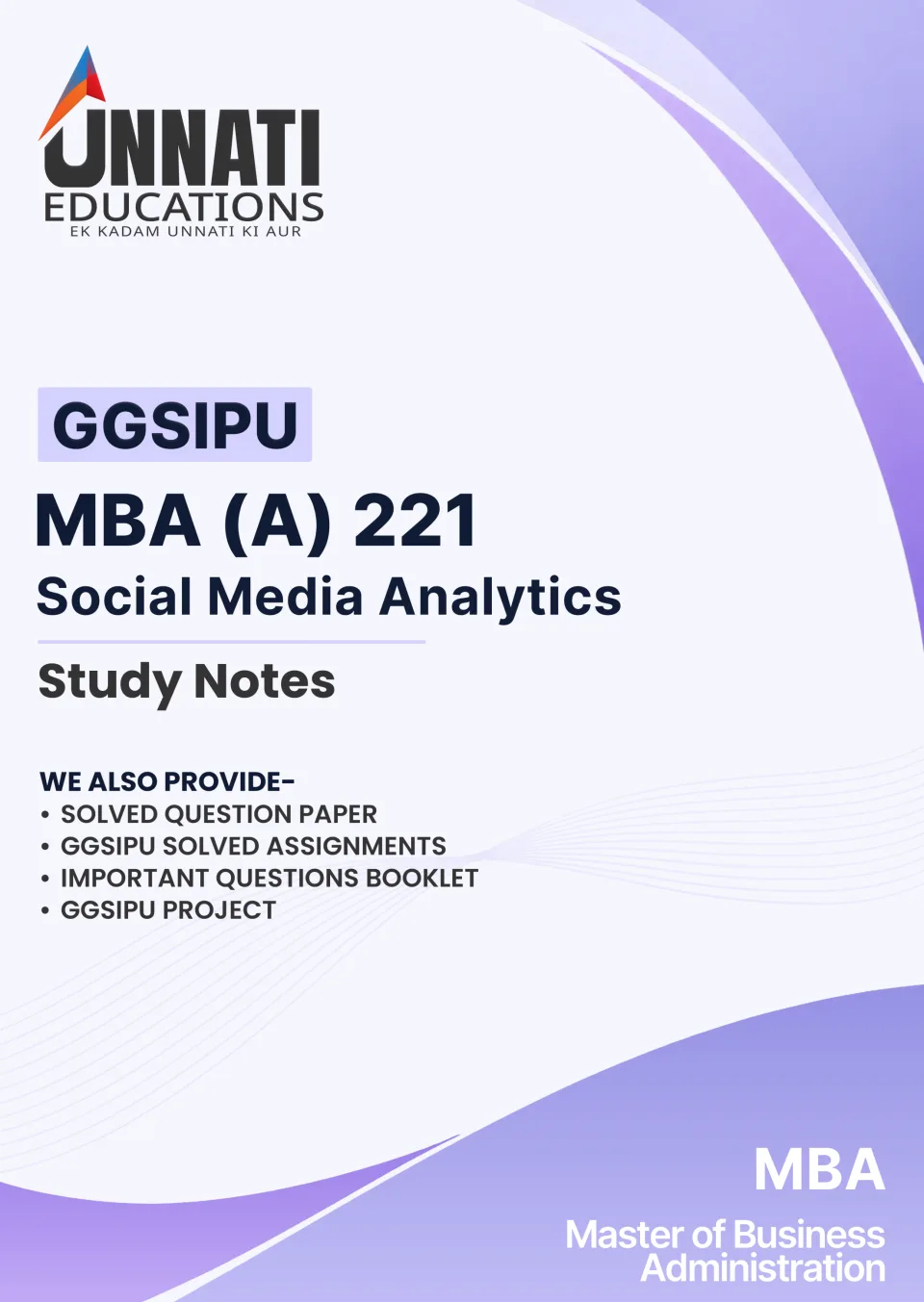
MBA(A) 221 Social Media Analytics Notes cover all 4 units of this GGSIPU MBA (Analytics) Semester 3 marketing elective in one 55-page printed book: 12 worked illustrations, 21 figures, 3 case studies and 66 end-of-unit exam questions, mapped to the Scheme and Syllabus 2022-24 onwards.
Written by Prateek Talwar, Founder, Unnati Educations · Reviewed by Ritik Rawat, B.Tech, Senior Full Stack Developer · Checked against syllMBAAnalytics180225.pdf · Updated 14 October 2026 · Editorial policy
Scheme: MBA (Analytics) Scheme and Syllabus 2022-24 onwards | Applies to: batches on this scheme (Semesters 3 and 4 approved 19.07.2023) | Verified against: syllMBAAnalytics180225.pdf, ipu.ac.in
MBA(A) 221 Social Media Analytics at a glance: GGSIPU MBA (Analytics) Sem 3 credits, units and exam pattern
Code and title | MBA(A) 221 Social Media Analytics (notes print "MBA (A)-221") |
|---|---|
Course and semester | MBA (Analytics), Semester 3 |
Category and credits | Marketing stream elective (Elective I or II, Skill Enhancement) · L 3, no T/P · 3 credits |
Units and hours | 4 units, 42 hours (8, 8, 12, 14) |
Internal assessment | 25: Class Test-I 15 + presentation/viva-voce/GD 10 |
End-term marks and pattern | Not printed in the official PDF |
Applies to | Scheme and Syllabus 2022-24 onwards (Agenda Item 56.52) |
Paired lab | None |
Unit IV alone takes 14 of the 42 hours. Examinations follow GGSIPU Ordinance 11, as the scheme notes.
Students pick it alongside the other GGSIPU MBA (Analytics) Semester 3 papers.
MBA(A) 221 Social Media Analytics Notes unit-wise: 12 worked illustrations, 21 figures and 66 exam questions across 4 units
These GGSIPU MBA (Analytics) Sem 3 Social Media Analytics notes follow the official units.
Other papers: GGSIPU MBA (Analytics) notes.
MBA(A) 221 Unit 1: Understanding the Basics
Pages 4 to 16. Websites, webapps, apps and seven kinds of social platforms; usability by ISO 9241-11 and Nielsen, UX by Morville's honeycomb, CX by NPS. Then sentiment analysis, conversion funnels, ROI and ROAS, reputation (a Zomato case) and Kaushik's Web Analytics 2.0. Counts: 3 worked illustrations, 6 figures, 17 exam questions.
Metric | Formula |
|---|---|
Click-through rate (CTR) | Clicks ÷ Impressions × 100 |
Cost per click (CPC) | Total ad cost ÷ Clicks |
Cost per acquisition (CPA) | Total cost ÷ Conversions |
Average order value (AOV) | Revenue ÷ Number of orders |
Quick look: four conversion metrics and their formulas (from page 11)
Metric
Click-through rate (CTR)
Formula
Clicks ÷ Impressions × 100
Metric
Cost per click (CPC)
Formula
Total ad cost ÷ Clicks
Metric
Cost per acquisition (CPA)
Formula
Total cost ÷ Conversions
Metric
Average order value (AOV)
Formula
Revenue ÷ Number of orders
MBA(A) 221 Unit 2: Measuring User Experience
Pages 17 to 30. Structured, semi-structured and unstructured data, four kinds of metadata, the 5 Vs and Berners-Lee's linked data principles. Then experiment design, A/B testing with a z-test (z ≈ 2.38) and the Obama 2008 case, and Tullis and Albert's five metric families with lostness and a 7-step study plan. Counts: 3 worked illustrations, 7 figures, 17 exam questions.
Quick look: scoring the System Usability Scale (from page 27)
The user rates all 10 items from 1 (strongly disagree) to 5 (strongly agree).
Odd items are positive statements: score = response − 1.
Even items are negative statements: score = 5 − response.
Add the ten scores and multiply by 2.5 to get a score out of 100; about 68 is average and above 80 is excellent.
MBA(A) 221 Unit 3: Web Analytics
Pages 31 to 41, built on the 2010 Google paper by Rodden, Hutchinson and Fu. PULSE letter by letter with Core Web Vitals and stickiness, HEART by category, on-site analytics with the GA4 engaged-session rule and a funnel drop-off, and off-site share of voice and buzz. Counts: 4 worked illustrations, 4 figures, 16 exam questions.
Uptime | Downtime per year | Downtime per month |
|---|---|---|
99% ("two nines") | 3.65 days | 7.3 hours |
99.9% ("three nines") | 8.76 hours | 43.8 minutes |
99.99% ("four nines") | 52.6 minutes | 4.4 minutes |
99.999% ("five nines") | 5.26 minutes | 26 seconds |
Quick look: what each uptime level allows as downtime (from page 32)
Uptime
99% ("two nines")
Downtime per year
3.65 days
Downtime per month
7.3 hours
Uptime
99.9% ("three nines")
Downtime per year
8.76 hours
Downtime per month
43.8 minutes
Uptime
99.99% ("four nines")
Downtime per year
52.6 minutes
Downtime per month
4.4 minutes
Uptime
99.999% ("five nines")
Downtime per year
5.26 minutes
Downtime per month
26 seconds
MBA(A) 221 Unit 4: Social Media Analytics
Pages 42 to 54. Owned versus earned data, monitoring versus listening and four analytics types. KPIs come by journey stage with formulas, Kaushik's conversation, amplification and applause rates, and a reel worked to 8% engagement by reach. Sterne's five-stage cycle adds UTM tags and an Amul case; social reports close the unit. Counts: 2 worked illustrations, 4 figures, 16 exam questions.
Goal | KPIs | Baseline → target |
|---|---|---|
Awareness | Reach, follower growth rate, SOV | SOV 18% → 25% in 6 months |
Engagement | Engagement rate, saves, shares | 3% → 5% |
Lead generation | CTR, leads, cost per lead | ₹180 → ₹120 per lead |
Customer service | Response time, response rate, CSAT | 6 hours → 1 hour |
Quick look: goals turned into KPIs with a baseline and target (from page 47)
Goal
Awareness
KPIs
Reach, follower growth rate, SOV
Baseline → target
SOV 18% → 25% in 6 months
Goal
Engagement
KPIs
Engagement rate, saves, shares
Baseline → target
3% → 5%
Goal
Lead generation
KPIs
CTR, leads, cost per lead
Baseline → target
₹180 → ₹120 per lead
Goal
Customer service
KPIs
Response time, response rate, CSAT
Baseline → target
6 hours → 1 hour
Dashboard types and the Social Links tool in social media analytics: excerpt from page 49 of the MBA(A) 221 notes
Excerpt from page 49
A social media dashboard is only useful if it is built for the person reading it. The notes sort dashboards into four types by user, content and how often they refresh.
Four types of dashboards
A strategic (executive) dashboard serves top management with high-level KPIs such as ROI, share of voice and revenue from social, updated monthly or quarterly.
An operational dashboard serves the social media and support teams with real-time mentions, responses due and post performance, refreshed in real time or daily. An analytical dashboard gives analysts detailed trends, segments and drill-downs, weekly or as needed. A campaign dashboard tracks one campaign's reach, CTR, leads and cost per lead while the campaign runs.
Six components of a social media dashboard
KPI cards show big numbers with the change against the last period. Trend charts plot reach and engagement as lines. A top-posts block lists the best and worst performing content. The audience panel shows age, gender, location and active hours. A sentiment panel gives the positive and negative share with a word cloud. A competitor panel shows share of voice and benchmarks.
What the Social Links tool is
Social Links is a social-data and open-source intelligence (OSINT) platform. It collects and connects publicly available data from social networks, messengers, websites and other online sources, and shows the results as visual graphs that link people, accounts, groups, posts and keywords, and as dashboards. It also works as a set of add-ons inside Maltego, a graph-analysis program. Typical uses are social media monitoring, investigations, brand protection and research.
Key features
It pulls data from social networks, messengers, the web and public records into one place. Link (graph) analysis draws accounts, groups, hashtags and posts as nodes and edges, which helps find influencers and communities. Keyword and hashtag monitoring tracks mentions of a brand, product or topic over time. Visual widgets include charts, maps of geo-located posts, timelines and tables, and results can be exported for presentations and reports.
Do the MBA(A) 221 notes cover the full GGSIPU syllabus?
Yes. Every official MBA(A) 221 topic has its own section in the notes; the unit check found no gap.
Official unit | Official topics | Where in the notes | Status |
|---|---|---|---|
I: Understanding the Basics | Web and social media: websites, webapps, mobile apps, social media; Usability: user experience, customer experience, customer sentiments, web marketing, conversion rates, ROI, brand reputation; Web analytics 2.0 framework | Sections 1-6, pages 4-15 | Covered |
II: Measuring user experience | Data understanding: structured, unstructured, metadata, big data and linked data; Lab testing and experiment design: selecting participants, counterbalancing, A/B testing, controlled experiments; Usability metrics; Planning and performing usability study | Sections 1-6, pages 17-29 | Covered |
III: Web Analytics | PULSE metrics (page views, uptime, latency, seven day active user); HEART metrics (happiness, engagement, adoption, retention, task success); On-site and off-site web analytics; the goal signal metric process | Sections 1-6, pages 31-40 | Covered (notes add Earnings) |
IV: Social Media Analytics | What and why of social media analytics; Social media KPIs; Performing social media analytics: business goals, KPIs, data gathering, measurement and feedback; Dashboards using Social Links tool; Social Reports | Sections 1-5, pages 42-53 | Covered (no tool screenshots) |
MBA(A) 221 official syllabus mapped to the notes
Official unit
I: Understanding the Basics
Official topics
Web and social media: websites, webapps, mobile apps, social media; Usability: user experience, customer experience, customer sentiments, web marketing, conversion rates, ROI, brand reputation; Web analytics 2.0 framework
Where in the notes
Sections 1-6, pages 4-15
Status
Covered
Official unit
II: Measuring user experience
Official topics
Data understanding: structured, unstructured, metadata, big data and linked data; Lab testing and experiment design: selecting participants, counterbalancing, A/B testing, controlled experiments; Usability metrics; Planning and performing usability study
Where in the notes
Sections 1-6, pages 17-29
Status
Covered
Official unit
III: Web Analytics
Official topics
PULSE metrics (page views, uptime, latency, seven day active user); HEART metrics (happiness, engagement, adoption, retention, task success); On-site and off-site web analytics; the goal signal metric process
Where in the notes
Sections 1-6, pages 31-40
Status
Covered (notes add Earnings)
Official unit
IV: Social Media Analytics
Official topics
What and why of social media analytics; Social media KPIs; Performing social media analytics: business goals, KPIs, data gathering, measurement and feedback; Dashboards using Social Links tool; Social Reports
Where in the notes
Sections 1-5, pages 42-53
Status
Covered (no tool screenshots)
Check the topics in the official GGSIPU MBA (Analytics) Scheme and Syllabus 2022-24 onwards (PDF), printed page 68. The notes also add Core Web Vitals, UTM tags and platform-wise KPIs.
The same paper-to-PDF mapping runs across all GGSIPU notes.
How to write MBA(A) 221 answers: KPI formula numericals, framework diagrams and ten-to-fifteen-mark theory answers
MBA(A) 221 answers fall into three shapes, and the exam tips in these MBA(A) 221 Social Media Analytics IPU notes show each one. Numericals come from about a dozen formulas: NPS, net sentiment, conversion rate, ROI and ROAS, uptime, stickiness, retention, lostness, SUS and the engagement rates. Write the formula, substitute the figures, state the result with its unit, then add one line of meaning.
Worked answer: Net Promoter Score (from page 8)
200 customers are surveyed: 110 promoters (9-10), 50 passives (7-8) and 40 detractors (0-6). % promoters = 110 ÷ 200 × 100 = 55%; % detractors = 40 ÷ 200 × 100 = 20%. NPS = 55 − 20 = +35. Close with the reading: NPS runs from −100 to +100, and a positive score means promoters outnumber detractors. Passives count in the base but not in the subtraction.
Framework answers need the diagram. For Web Analytics 2.0, draw the five-box figure, then add the Trinity model and the 10/90 rule. For PULSE and HEART, expand both acronyms, give one metric per letter and end with the comparison table. For counterbalancing, show AB, BA and a small Latin square.
Long theory answers open with a sourced definition (ISO 9241-11 for usability, Stephen Few for dashboards), then a classification table, an Indian example and the challenges. Keep reach apart from impressions, and never present total likes as a KPI: the notes call it a vanity metric.
Practise these formats on GGSIPU MBA (Analytics) important questions.
MBA(A) 221 exam corner: 40 short (two to five marks) and 26 long (ten to fifteen marks) questions by unit
Unit | Short (2–5 Marks) | Long (10–15 Marks) | Worked illustrations / case studies |
|---|---|---|---|
I | 10 | 7 | 3 / 1 |
II | 10 | 7 | 3 / 1 |
III | 10 | 6 | 4 / 0 |
IV | 10 | 6 | 2 / 1 |
MBA(A) 221 exam questions and worked material per unit
Unit
I
Short (2–5 Marks)
10
Long (10–15 Marks)
7
Worked illustrations / case studies
3 / 1
Unit
II
Short (2–5 Marks)
10
Long (10–15 Marks)
7
Worked illustrations / case studies
3 / 1
Unit
III
Short (2–5 Marks)
10
Long (10–15 Marks)
6
Worked illustrations / case studies
4 / 0
Unit
IV
Short (2–5 Marks)
10
Long (10–15 Marks)
6
Worked illustrations / case studies
2 / 1
The unit's sections hold the answers. One per unit, with pointers:
Unit I: What is Kaushik's 10/90 rule? Of every ₹100, spend ₹10 on tools and ₹90 on analysts, because people turn data into insight (page 15).
Unit II: Explain the 5 Vs of big data. Laney's three Vs plus veracity and value, each with a social example (page 19).
Unit III: State the three steps of the goal–signal–metric process. Goals, signals, metrics, ideally shown on the HEART grid (pages 38-39).
Unit IV: A post reached 40,000 people and got 2,000 engagements. Calculate the engagement rate. 2,000 ÷ 40,000 × 100 = 5% by reach (formula on page 44).
The MBA(A) 221 notes list 40 short-answer and 26 long-answer exam questions across 4 units, plus 12 worked illustrations, 21 figures and 3 case studies.
More practice sits in the MBA(A) 221 important questions.
Who writes and checks the MBA(A) 221 Social Media notes?
Prateek Talwar, author: Founder, Unnati Educations · ACS, ICSI (membership no. 58704, since 15 May 2019) · B.Com, University of Delhi (SOL), 2012 · bio
Ritik Rawat, subject reviewer: Senior Full Stack Developer, Unnati Educations · B.Tech · checks the formulas, worked calculations and tool descriptions · bio
These Social Media Analytics notes in English follow the 2022-24 onwards scheme and three of its readings: Kaushik, Tullis and Albert, and Sterne. The 2026-27 edition uses GA4 terms and INP among Core Web Vitals. Last updated 14 October 2026; see our editorial policy.
For revision across courses, the same writers prepare GGSIPU important questions.
MBA(A) 221 and the GGSIPU MBA (Analytics) Sem 3 papers it connects to
MBA(A) 221 has no paired lab; GA4 and Social Links are explained inside Units III and IV. Electives by stream are in the GGSIPU MBA (Analytics) syllabus.
Unit II's 5 Vs overlap with Unit III of MBA(A) 205 Predictive Analytics and Big Data; its structured data and SQL lead to MBA(A) 209 Database Management System. Unit I's sentiment analysis uses machine learning MBA(A) 207 Artificial Intelligence and Machine Learning, and its funnel matches the consumer journey map in MBA(A) 225 Consumer Behaviour.
Also in Sem 3: MBA(A) 201 Strategic Management, MBA(A) 203 Entrepreneurial Development & Start-Ups, MBA(A) 211 Design Thinking and Innovation, MBA(A) 213 Summer Training Project Report, MBA(A) 255 DBMS Lab, MBA(A) 233 MOOCs II/Open Elective and MBA(A) 223 Retail Analytics.
MBA(A) 221 Social Media notes FAQs
How do I get the full MBA(A) 221 notes?
Message Unnati Educations on WhatsApp at 9899436384 using the "Get Full Notes" button. The MBA(A) 221 notes come only as a 55-page printed book; they are not available as a PDF. Delivery takes a maximum of 5 to 7 days, depending on your location. The button pre-fills your message with the paper code and a reference number.
How are MBA(A) 221 marks split, and what is the passing mark?
The official MBA (Analytics) PDF prints internal assessment for MBA(A) 221 out of 25: Class Test-I for 15 and a presentation, viva-voce or group discussion for 10. It does not print the end-term marks, the total or a pass percentage. The scheme follows GGSIPU Ordinance 11, which sets end-term minimums and re-appear rules, so check those on ipu.ac.in.
Is MBA(A) 221 a compulsory paper in GGSIPU MBA (Analytics) Sem 3?
No. MBA(A) 221 is one of three Marketing stream electives in Semester 3, with MBA(A) 223 Retail Analytics and MBA(A) 225 Consumer Behaviour. The scheme lists Elective I and Elective II as Skill Enhancement papers of 3 credits each and asks students to "select any two from respective streams". Confirm your institute's elective offer before you choose.
Which MBA(A) 221 unit has the most numericals?
Unit III, with 4 worked illustrations in the MBA(A) 221 notes: uptime against a 99.9% SLA, the stickiness ratio, an 86% retention rate and a funnel converting 6% overall. Unit IV has the most formulas, though: awareness, engagement, conversion and customer service KPIs each get a formula table, and one reel is worked through them.
Do I need Google Analytics or the Social Links tool to study MBA(A) 221?
No. The MBA(A) 221 notes explain the tools in words, tables and diagrams: GA4 metrics and reports in Unit III, and Social Links features with an 8-step dashboard build in Unit IV. There are no tool screenshots. Opening GA4 or Meta Business Suite for a page you run helps, but nothing must be installed to follow them.
Are the MBA(A) 221 exam questions answered in the notes?
The 66 MBA(A) 221 exam questions are listed at the end of each unit without separate model answers; each is answered by that unit's sections. For example, the Unit III short question on uptime for a site down 3 hours in a 30-day month follows the same method as the worked 6-hour example on page 33.
Get the full MBA(A) 221 Social Media Analytics Notes on WhatsApp
Unit | Pages | Page count |
|---|---|---|
I | 4-16 | 13 |
II | 17-30 | 14 |
III | 31-41 | 11 |
IV | 42-54 | 13 |
Pages per unit in the MBA(A) 221 printed book
Unit
I
Pages
4-16
Page count
13
Unit
II
Pages
17-30
Page count
14
Unit
III
Pages
31-41
Page count
11
Unit
IV
Pages
42-54
Page count
13
55 pages with cover, index and closing page, plus a quick-revision table per unit. Sold as a printed book only, not as a PDF; it reaches you within 5 to 7 days at most, depending on your location.
Order the printed MBA(A) 221 book on WhatsApp (4 units, 55 pages)
Unnati Educations is an independent education provider based in Vikaspuri, Delhi. We are not affiliated with, authorised by, or endorsed by Guru Gobind Singh Indraprastha University (GGSIPU). 'GGSIPU' and 'IPU' are used only to describe the syllabus our notes follow. For official information, visit ipu.ac.in.
Ready for the full notes?
Discuss coverage and delivery with our team.