
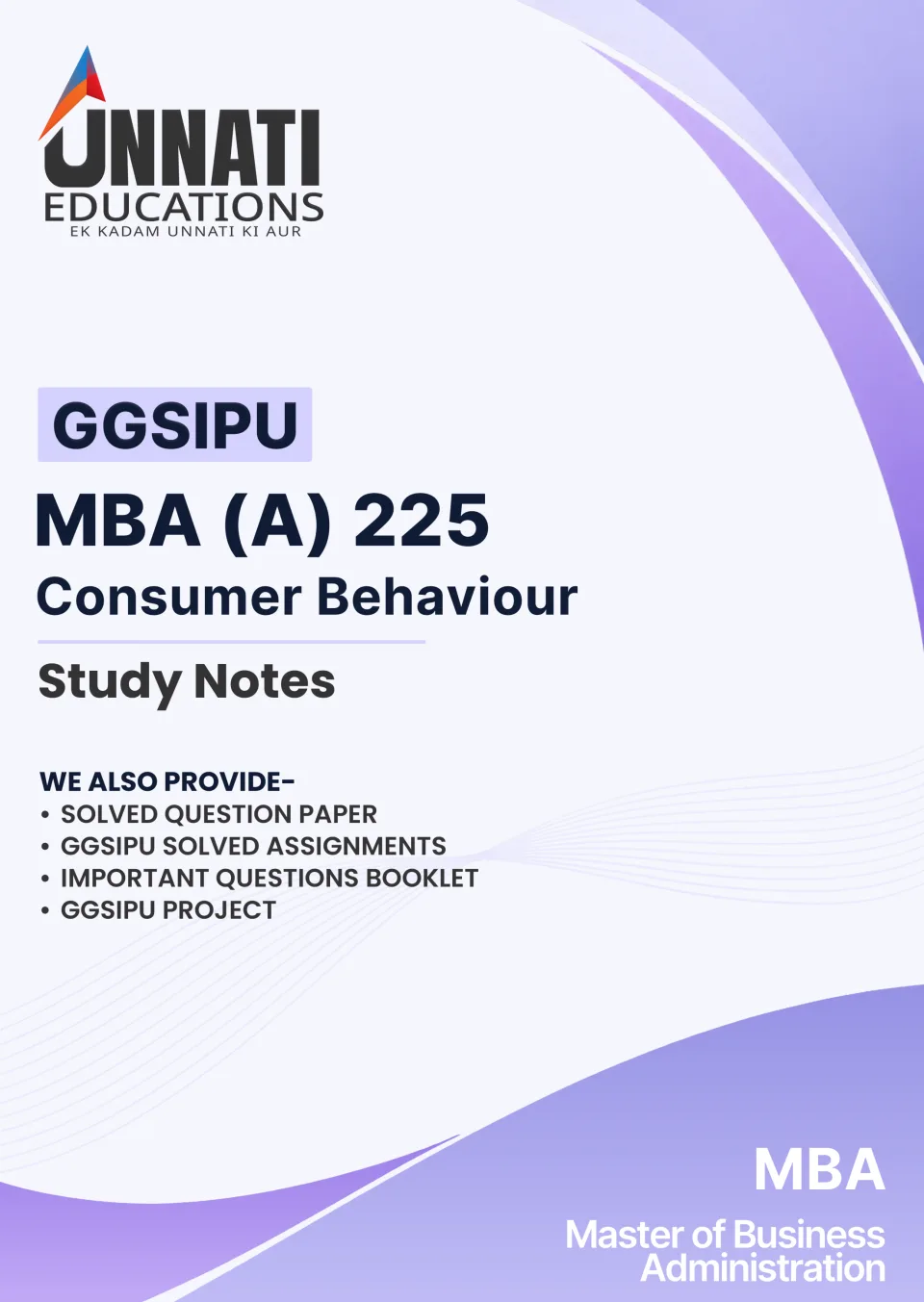
MBA(A) 225 Consumer Behaviour Notes by Unnati Educations cover all 4 units of this MBA (Analytics) Semester 3 marketing elective in 77 pages, with 39 labelled diagrams, 9 worked numerical illustrations, 8 Indian case studies and 76 exam-style practice questions. They follow the MBA (Analytics) scheme and syllabus for batches from 2022-24 onwards.
Written by Prateek Talwar, Founder, Unnati Educations · Reviewed by Sheetal Kirola, M.Ed., Academic Head · Checked against MBA (Analytics) Scheme and Syllabus 2022-24 onwards · Updated 26 October 2026 · Editorial policy
Scheme: MBA (Analytics) Scheme and Syllabus 2022-24 onwards | Applies to: batches from 2022-24 onwards | Verified against: syllMBAAnalytics180225.pdf
MBA(A) 225 Consumer Behaviour at a glance: GGSIPU MBA (Analytics) Sem 3 credits, units and exam pattern
MBA(A) 225 is a Marketing-stream elective; students pick any two electives from one stream. It is listed with the other GGSIPU MBA (Analytics) Semester 3 papers.
Course and semester | MBA (Analytics), Semester 3, Elective I or II |
|---|---|
Category and credits | Skill Enhancement · L-3 · 3 credits (10 + 12 + 10 + 10 = 42 hours) |
Internal assessment | 25: Class Test-I 15 + presentation, viva or GD 10 |
End-term marks and pattern | Not printed in the official PDF; it refers to Ordinance 11 |
Applies to | Scheme 2022-24 onwards; Sem 3 and 4 approved 19.07.2023 |
Units and lab | 4 units with official titles · no paired lab |
MBA(A) 225 Consumer Behaviour Notes unit-wise: 39 diagrams and 9 worked numericals across 4 units
These MBA(A) 225 Consumer Behaviour IPU notes run from page 5 to page 76, and each unit closes with a quick revision table and short and long exam questions. Other papers' notes sit under GGSIPU MBA (Analytics) notes.
MBA(A) 225 Unit 1: Introduction to Consumer Behavior
Pages 5-24. Starts with consumer versus customer, the five buying roles and the positivist and interpretivist approaches, then walks the consumer journey from problem recognition to decision rules, outlet selection and post-purchase dissonance. Assael's four buying types, the FCB grid, the Nicosia, Howard-Sheth and EKB models and TAM for online buyers close it. 14 diagrams, 2 illustrations, Meesho and McKinsey cases.
Quick look: one smartphone, four decision rules (from page 13)
Rule | How it works | Choice |
|---|---|---|
Weighted additive | A 7.2, B 7.5, C 7.0 | B |
Lexicographic | Best camera wins | A |
Conjunctive | Cut-off 6 on all; A fails on price | B or C |
Elimination by aspects | Camera at least 7, then battery at least 8 | B |
Quick look: how the decision rule changes the chosen phone (from page 13)
Rule
Weighted additive
How it works
A 7.2, B 7.5, C 7.0
Choice
B
Rule
Lexicographic
How it works
Best camera wins
Choice
A
Rule
Conjunctive
How it works
Cut-off 6 on all; A fails on price
Choice
B or C
Rule
Elimination by aspects
How it works
Camera at least 7, then battery at least 8
Choice
B
MBA(A) 225 Unit 2: Individual Determinants of Consumer Behaviour
Pages 25-43. The psychology unit: Maslow, McClelland and motivational conflict; thresholds and Gestalt organisation; classical, instrumental and observational learning with the Atkinson-Shiffrin memory model; Freudian, Horney and trait theories, Aaker's brand personality and five kinds of self-image; the ABC model, TPB and ELM for attitudes; Rokeach values, AIO and VALS. 11 diagrams, 2 illustrations, jingle and Royal Enfield cases.
Quick look: Fishbein's model on two laptops (from page 37)
Attribute (evaluation) | Laptop A | Laptop B |
|---|---|---|
Battery (+3) / Weight (+2) | 6 / 4 | 4 / 6 |
Price (+2) / Brand (+1) | 3 / 5 | 6 / 3 |
Attitude score | 37 | 39 |
Quick look: Fishbein attitude score, belief x evaluation (from page 37)
Attribute (evaluation)
Battery (+3) / Weight (+2)
Laptop A
6 / 4
Laptop B
4 / 6
Attribute (evaluation)
Price (+2) / Brand (+1)
Laptop A
3 / 5
Laptop B
6 / 3
Attribute (evaluation)
Attitude score
Laptop A
37
Laptop B
39
MBA(A) 225 Unit 3: External Determinants of Consumer Behaviour
Pages 44-61. Culture through enculturation, norms, Indian core values and Hofstede's six dimensions, then subcultures; social class with Warner's six classes and India's New SEC grid; opinion leaders, market mavens and the two-step flow; eight family buying roles and the family life cycle; eWOM, influencer tiers and brand communities. 7 diagrams, 1 illustration, McDonald's India and Zomato cases.
Quick look: weighted average star rating (from page 59)
Stars | Ratings | Stars x ratings |
|---|---|---|
5 / 4 / 3 | 120 / 40 / 20 | 600 + 160 + 60 |
2 / 1 | 8 / 12 | 16 + 12 |
Average | 200 | 848 ÷ 200 = 4.24 |
Quick look: average of 200 product ratings (from page 59)
Stars
5 / 4 / 3
Ratings
120 / 40 / 20
Stars x ratings
600 + 160 + 60
Stars
2 / 1
Ratings
8 / 12
Stars x ratings
16 + 12
Stars
Average
Ratings
200
Stars x ratings
848 ÷ 200 = 4.24
MBA(A) 225 Unit 4: Consumer Behaviour: Related and Emerging Issues
Pages 62-76. Rogers' adopter categories and the Bass forecast; the six-step research process with netnography, Likert scales and A/B testing; CSAT, NPS, SERVQUAL and Kano; the Consumer Protection Act, 2019 and the CCPA; the dark side from compulsive buying to wardrobing; shaping through nudges, Cialdini and the Hook model. 7 diagrams, 4 illustrations, UPI and Swiggy/Zomato cases.
Quick look: SERVQUAL gaps for a hospital (from page 69)
Dimension | E / P | Gap |
|---|---|---|
Responsiveness | 6.4 / 4.9 | -1.5 |
Reliability | 6.5 / 5.2 | -1.3 |
Tangibles | 5.5 / 6.0 | +0.5 |
Quick look: gap = perception minus expectation, 7-point scale (from page 69)
Dimension
Responsiveness
E / P
6.4 / 4.9
Gap
-1.5
Dimension
Reliability
E / P
6.5 / 5.2
Gap
-1.3
Dimension
Tangibles
E / P
5.5 / 6.0
Gap
+0.5
Reference group types and the three ways groups sway a buyer: excerpt from page 51 of the MBA(A) 225 notes
Excerpt from page 51 (Unit 3, sections 3.2 and 3.3)
3.2 Types of reference groups
A reference group is any person or group a consumer uses as a point of comparison. Groups are classified by how often members meet, how they are organised and whether the consumer belongs to them.
Type | Meaning | Example |
|---|---|---|
Primary | Small group with frequent, face-to-face contact | Family, close friends, roommates |
Secondary | Larger group with less frequent contact | Professional associations, clubs, alumni |
Formal / informal | Clear rules and roles / loose, friendship-based | Rotary Club / gym buddies, WhatsApp group |
Membership | Group the person already belongs to | A student's class, an office team |
Aspirational | Group the person wishes to join | Sportspersons, film stars |
Dissociative | Group the person wants to avoid | Teenagers avoiding products used by "older people" |
Virtual | Online communities and followers | Instagram followers, Reddit forums |
Types of reference groups with examples (page 51)
Type
Primary
Meaning
Small group with frequent, face-to-face contact
Example
Family, close friends, roommates
Type
Secondary
Meaning
Larger group with less frequent contact
Example
Professional associations, clubs, alumni
Type
Formal / informal
Meaning
Clear rules and roles / loose, friendship-based
Example
Rotary Club / gym buddies, WhatsApp group
Type
Membership
Meaning
Group the person already belongs to
Example
A student's class, an office team
Type
Aspirational
Meaning
Group the person wishes to join
Example
Sportspersons, film stars
Type
Dissociative
Meaning
Group the person wants to avoid
Example
Teenagers avoiding products used by "older people"
Type
Virtual
Meaning
Online communities and followers
Example
Instagram followers, Reddit forums
Common consumer-related groups include friendship groups (the most important informal group after the family), shopping groups who shop together for fun or to reduce risk, work groups who shape dress and gadgets, virtual communities, consumer-action groups such as consumer forums, and brand communities such as Harley Owners Group or Royal Enfield riders.
3.3 Types of reference group influence
C. Whan Park and V. Parker Lessig (1977) identified three forms of influence. Informational influence works when a consumer accepts advice from experts or experienced people as evidence: "My doctor friend recommends this toothpaste, so it must be good."
Utilitarian (normative) influence works when the consumer conforms to gain rewards or avoid disapproval: "My colleagues expect me to wear branded formals." Value-expressive influence works when the consumer copies a group to express or lift his self-image: "Successful people use this brand; I want to be like them."
Factors affecting reference group influence
Influence is stronger when the consumer has little information or experience, when the group is credible, attractive or powerful, and when the product is conspicuous: clothes, cars and phones are seen by others, toothpaste and mattresses are not. Luxury versus necessity matters too, as do personality (other-directed, less confident people conform more) and how badly the person wants to belong.
How to write MBA(A) 225 answers: brand-example theory, labelled models and Fishbein or NPS numericals
Consumer Behaviour answers score on three things: a definition with its author (Schiffman and Kanuk, Festinger 1957, Oliver 1980), a labelled diagram, and an Indian brand example for each point. The notes' exam tips turn this into formats for the long questions labelled "10–15 Marks":
Models: Black Box briefly, then Howard-Sheth and EKB in detail with diagrams, ending with a comparison table.
Perception: a Weber's law numerical, the three selective processes, Gestalt principles and consumer imagery with brands.
Attitude: the ABC diagram, a Fishbein numerical, attitude-change strategies with Indian examples, and TPB.
Research: the six-step process, a qualitative versus quantitative table, and analytics tools such as A/B testing.
Worked example (page 22, online buying funnel). 50,000 visitors, 4,000 add to cart, 1,000 buy, revenue ₹15,00,000. Conversion = 1,000 ÷ 50,000 x 100 = 2%. Cart abandonment = (1 - 1,000 ÷ 4,000) x 100 = 75%. Average order value = ₹1,500. Then interpret: 75% abandonment points to a checkout problem such as hidden delivery charges.
The common slip is stopping at the arithmetic. Most illustrations in the notes end with a "Lesson" or a marketing action, and that line turns a calculation into a management answer. Practise it on GGSIPU MBA (Analytics) important questions.
MBA(A) 225 exam corner: 44 two-to-five-mark and 32 ten-to-fifteen-mark practice questions by unit
Unit | Short (2–5 Marks) | Long (10–15 Marks) | Illustrations |
|---|---|---|---|
Unit 1 | 11 | 9 | 2 |
Unit 2 | 11 | 9 | 2 |
Unit 3 | 11 | 7 | 1 |
Unit 4 | 11 | 7 | 4 |
MBA(A) 225 practice questions by unit
Unit
Unit 1
Short (2–5 Marks)
11
Long (10–15 Marks)
9
Illustrations
2
Unit
Unit 2
Short (2–5 Marks)
11
Long (10–15 Marks)
9
Illustrations
2
Unit
Unit 3
Short (2–5 Marks)
11
Long (10–15 Marks)
7
Illustrations
1
Unit
Unit 4
Short (2–5 Marks)
11
Long (10–15 Marks)
7
Illustrations
4
The MBA(A) 225 notes list 44 short-answer and 32 long-answer practice questions across 4 units, plus 9 worked numerical illustrations and 8 Indian case studies. The notes carry no year tags.
Unit 1: Explain evoked set, inert set and inept set with examples. Pointer: considered, indifferent and rejected brands (Narayana and Markin), with Figure 1.4.
Unit 2: The JND for a ₹500 product is 8%. What is the minimum price cut that will be noticed? Pointer: ΔI = 0.08 x 500 = ₹40, so the price must fall to ₹460 or lower.
Unit 3: Explain the New SEC system of social classification in India. Pointer: chief earner's education plus ownership of 11 durables gives 12 grades, A1 to E3.
Unit 4: Discuss the forms, causes and remedies of the dark side of consumer behaviour. Pointer: misbehaviour, harmful consumption and marketer-driven harm.
The remaining questions are in the full notes; more practice is planned on the MBA(A) 225 important questions page.
MBA(A) 225 and the GGSIPU MBA (Analytics) Sem 3 papers it connects to
MBA(A) 225 has no paired lab; see the MBA (Analytics) course syllabus.
Two fellow electives build on it: MBA(A) 221 Social Media Analytics on Unit 3 (eWOM and engagement rate, pages 58-59) and MBA(A) 223 Retail Analytics on Unit 1 (outlet selection, page 13). Unit 4's Bass model and A/B testing feed MBA(A) 205 Predictive Analytics and Big Data.
The rest of Semester 3: MBA(A) 201 Strategic Management, MBA(A) 203 Entrepreneurial Development & Start-Ups, MBA(A) 207 Artificial Intelligence and Machine Learning, MBA(A) 209 Database Management System, MBA(A) 211 Design Thinking and Innovation, MBA(A) 255 DBMS Lab, MBA(A) 213 Summer Training Project Report and MBA(A) 233 MOOCs II/Open Elective.
Who writes and checks the MBA(A) 225 Consumer Behaviour notes?
Prateek Talwar, author. Founder, Unnati Educations; Associate Company Secretary (ACS), ICSI, membership no. 58704, since 15 May 2019; B.Com, University of Delhi (School of Open Learning), 2012. Management, commerce and finance are his core areas. Author profile
Sheetal Kirola, reviewer. Academic Head, Unnati Educations; M.Ed.; 7 years of experience. Reviewer profile
These GGSIPU MBA (Analytics) Sem 3 Consumer Behaviour notes are mapped to the 2022-24 onwards scheme. Alongside the official topics, the 2026-27 edition covers the CCPA's 2023 dark-pattern guidelines, BIS IS 19000:2022 on online reviews and ASCI's 2021 influencer disclosure rules. Updated 26 October 2026; see our editorial policy.
The same team prepares GGSIPU important questions for each course.
Do the MBA(A) 225 notes cover the full GGSIPU syllabus?
Yes. Every topic in the 4 official units of MBA(A) 225 has its own section in the notes; the unit check found no gaps.
Official unit | Official topics | In the notes | Status |
|---|---|---|---|
I: Introduction to Consumer Behavior | Scope; approaches; journey map and decision rules; outlet selection; post-purchase; buying types, involvement; models; online behaviour | Sections 1-6, pages 5-22 | Covered |
II: Individual Determinants | Motivation; perception and imagery; learning and memory; personality and self concept; attitudes; values and lifestyles | Sections 1-6, pages 25-41 | Covered |
III: External Determinants | Culture, subculture; social class; reference groups, WOM, opinion leadership; family; eWom | Sections 1-6, pages 44-60 | Covered |
IV: Related and Emerging Issues | Diffusion of innovation; researching consumer behaviour; customer satisfaction; public policy; dark side; shaping | Sections 1-6, pages 62-75 | Covered |
MBA(A) 225 syllabus map
Official unit
I: Introduction to Consumer Behavior
Official topics
Scope; approaches; journey map and decision rules; outlet selection; post-purchase; buying types, involvement; models; online behaviour
In the notes
Sections 1-6, pages 5-22
Status
Covered
Official unit
II: Individual Determinants
Official topics
Motivation; perception and imagery; learning and memory; personality and self concept; attitudes; values and lifestyles
In the notes
Sections 1-6, pages 25-41
Status
Covered
Official unit
III: External Determinants
Official topics
Culture, subculture; social class; reference groups, WOM, opinion leadership; family; eWom
In the notes
Sections 1-6, pages 44-60
Status
Covered
Official unit
IV: Related and Emerging Issues
Official topics
Diffusion of innovation; researching consumer behaviour; customer satisfaction; public policy; dark side; shaping
In the notes
Sections 1-6, pages 62-75
Status
Covered
Official source: MBA (Analytics) Scheme and Syllabus 2022-24 onwards (PDF, ipu.ac.in). Unit IV is printed as "Diffusion of Innovation: Researching Consumer Behaviour"; the notes treat these as two topics.
Every course in GGSIPU notes is mapped to its official PDF this way.
MBA(A) 225 Consumer Behaviour notes FAQs
How do I get the full MBA(A) 225 notes?
Send a WhatsApp message to 9899436384 using the button on this page. The full MBA(A) 225 notes are sold only as a printed book of 77 pages covering all 4 units; they are not available as a PDF. The book is delivered within 5 to 7 days at most, and the exact time depends on your location. The team shares order details on WhatsApp.
Is MBA(A) 225 Consumer Behaviour compulsory in MBA (Analytics) Semester 3?
No. MBA(A) 225 is an elective in the Marketing stream of Semester 3, listed with MBA(A) 221 Social Media Analytics and MBA(A) 223 Retail Analytics. The scheme asks each student to select any two electives from the respective stream as Elective I and Elective II. It is a Skill Enhancement paper with 3 lecture hours a week and 3 credits.
What are the passing marks for MBA(A) 225?
The MBA (Analytics) scheme prints the internal assessment of MBA(A) 225 as 25 marks: Class Test-I for 15 marks and an individual presentation, viva-voce or group discussion for 10. It does not print the end-term marks or a pass percentage for theory papers. It says the scheme follows the university's Ordinance 11, so check that ordinance on ipu.ac.in for end-term minimums and re-appear rules.
Which MBA(A) 225 unit has the most numericals?
Unit 4 has the most, with 4 worked illustrations: the Bass model forecast for a fitness app, an A/B test of a product page, NPS and CSAT scores, and SERVQUAL gap scores for a hospital. Units 1 and 2 have 2 each and Unit 3 has 1, so MBA(A) 225 has 9 in all. Unit 1 has the most diagrams, with 14 labelled figures.
Do the MBA(A) 225 notes cover the Consumer Protection Act, 2019 and dark patterns?
Yes. Unit 4 of the MBA(A) 225 notes covers consumerism and JFK's four rights, the six rights under the Consumer Protection Act, 2019, the CCPA, the three-tier commissions with their 2021 pecuniary limits, product liability and the E-Commerce Rules, 2020. The dark side section explains the CCPA's 2023 guidelines, which ban 13 specified dark patterns.
Which scheme and language do the MBA(A) 225 notes follow?
The MBA(A) 225 notes are written in English and follow the MBA (Analytics) Scheme and Syllabus 2022-24 onwards, whose third and fourth semesters were approved by the Academic Council on 19 July 2023. The four unit titles and every listed topic match that PDF. If your institute uses a later revision, compare its Consumer Behaviour units with the syllabus map above.
Get the full MBA(A) 225 Consumer Behaviour Notes on WhatsApp
These Consumer Behaviour notes in English come as one printed 77-page book, not as a PDF. Delivery takes at most 5 to 7 days; the rest depends on your location.
Unit | Pages | Diagrams | Questions |
|---|---|---|---|
Unit 1 | 5-24 (20) | 14 | 20 |
Unit 2 | 25-43 (19) | 11 | 20 |
Unit 3 | 44-61 (18) | 7 | 18 |
Unit 4 | 62-76 (15) | 7 | 18 |
MBA(A) 225 notes book by unit
Unit
Unit 1
Pages
5-24 (20)
Diagrams
14
Questions
20
Unit
Unit 2
Pages
25-43 (19)
Diagrams
11
Questions
20
Unit
Unit 3
Pages
44-61 (18)
Diagrams
7
Questions
18
Unit
Unit 4
Pages
62-76 (15)
Diagrams
7
Questions
18
Order the full MBA(A) 225 Consumer Behaviour Notes book on WhatsApp (4 units, 77 pages)
Unnati Educations is an independent education provider based in Vikaspuri, Delhi. We are not affiliated with, authorised by, or endorsed by Guru Gobind Singh Indraprastha University (GGSIPU). 'GGSIPU' and 'IPU' are used only to describe the syllabus our notes follow. For official information, visit ipu.ac.in.
Ready for the full notes?
Discuss coverage and delivery with our team.