
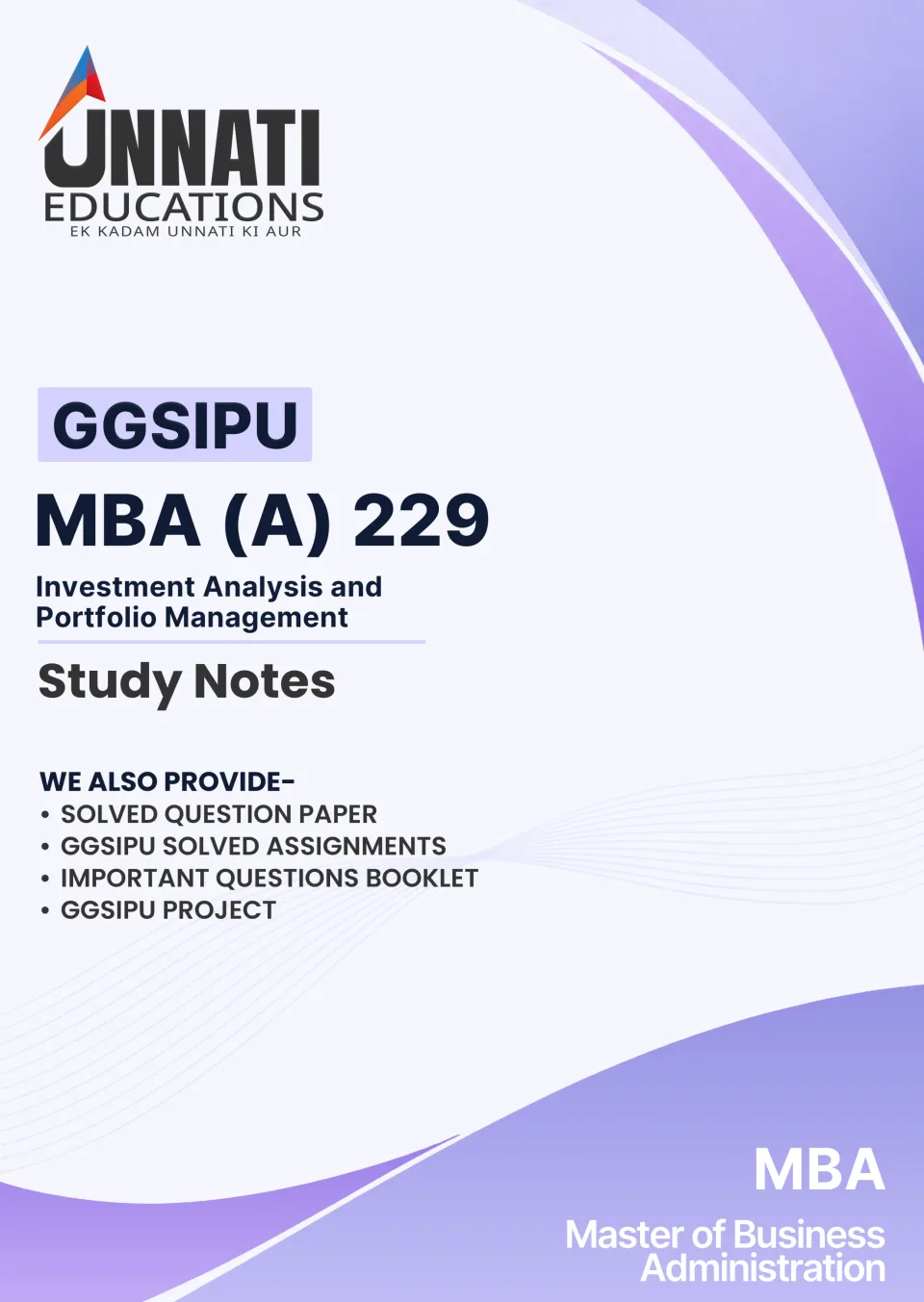
MBA(A) 229 Investment Analysis and Portfolio Management Notes from Unnati Educations cover all 4 units of this GGSIPU MBA (Analytics) Semester 3 finance elective in an 83-page printed book, with 31 solved illustrations, 32 diagrams and 72 exam questions, mapped to the official Scheme and Syllabus 2022-24 onwards.
Written by Prateek Talwar, Founder, Unnati Educations · Reviewed by Sheetal Kirola, M.Ed., Academic Head · Checked against syllMBAAnalytics180225.pdf (ipu.ac.in) · Updated 26 October 2026 · Editorial policy
Scheme: MBA (Analytics) Scheme and Syllabus 2022-24 onwards | Applies to: batches under the 2022-24 onwards scheme | Verified against: syllMBAAnalytics180225.pdf (Semesters 3 and 4 approved on 19.07.2023)
MBA(A) 229 Investment Analysis and Portfolio Management at a glance: GGSIPU MBA (Analytics) Sem 3 credits, units and exam pattern
Code and title | MBA(A) 229 Investment Analysis and Portfolio Management |
|---|---|
Course and semester | MBA (Analytics), Semester 3, Finance elective |
Category and credits | Elective I or II slot, typed "Skill Enhancement" · L 3 · 3 credits |
Marks | Internal assessment 25 (Class Test-I 15 + presentation, viva or group discussion 10). End-term marks and paper pattern are not printed in the official PDF. |
Applies to | Scheme and Syllabus 2022-24 onwards |
Units | 4 units, 42 teaching hours (12 + 10 + 12 + 8) |
Paired lab | None (theory paper) |
Students pick two of the three Finance electives (MBA(A) 227, 229, 231), listed with the core GGSIPU MBA (Analytics) Semester 3 papers.
MBA(A) 229 Investment Analysis and Portfolio Management Notes unit-wise: 31 solved illustrations and 72 exam questions across 4 units
These are Investment Analysis and Portfolio Management notes in English, with a table, formula box or worked example on most pages. Notes for the other papers of this programme sit on GGSIPU MBA (Analytics) notes.
MBA(A) 229 Unit 1: Introduction to Investment Environment
Pages 5 to 26 (22 pages). Investment versus speculation, the investment process, SEBI's cap ranks (1 to 100, 101 to 250, 251 onwards), penny stocks and regulators, then beta, HPR, standard deviation, covariance, R², bond value, YTM, duration, DDM, FCFE and P/E valuation. Count: 13 solved illustrations, 7 figures, 18 exam questions.
Step | Working |
|---|---|
Data | D0 = ₹4, g = 6%, ke = 14%, market price ₹48 |
Next dividend | D1 = 4 × 1.06 = ₹4.24 |
Intrinsic value | P0 = 4.24 ÷ (0.14 − 0.06) = ₹53 |
Decision | ₹53 is above ₹48: under-valued, buy |
Quick look: Gordon's constant-growth model (from page 22)
Step
Data
Working
D0 = ₹4, g = 6%, ke = 14%, market price ₹48
Step
Next dividend
Working
D1 = 4 × 1.06 = ₹4.24
Step
Intrinsic value
Working
P0 = 4.24 ÷ (0.14 − 0.06) = ₹53
Step
Decision
Working
₹53 is above ₹48: under-valued, buy
MBA(A) 229 Unit 2: Fundamental and Technical Analysis
Pages 27 to 47 (21 pages). The E-I-C route (economic factors, indicators, Grodinsky's life cycle, Porter's Five Forces, management style, ratios with DuPont), then line, bar, candlestick and point and figure charts, eight candlestick patterns, reversal and continuation patterns, Dow Theory and Elliott waves. Count: 3 solved illustrations, 10 figures, 21 exam questions.
Stage | What happens | Investment view |
|---|---|---|
Pioneering | New product, many entrants, high failure rate | High risk |
Rapid growth | Demand rises fast, leaders emerge | Best stage to invest |
Maturity | Stable profits, high dividends | Safe, income-oriented |
Decline | Substitutes take demand, profits fall | Avoid or exit |
Quick look: industry life cycle and the investor's view (from page 31)
Stage
Pioneering
What happens
New product, many entrants, high failure rate
Investment view
High risk
Stage
Rapid growth
What happens
Demand rises fast, leaders emerge
Investment view
Best stage to invest
Stage
Maturity
What happens
Stable profits, high dividends
Investment view
Safe, income-oriented
Stage
Decline
What happens
Substitutes take demand, profits fall
Investment view
Avoid or exit
MBA(A) 229 Unit 3: Portfolio Management
Pages 48 to 67 (20 pages). The official PDF opens this unit with "Portfolio Management" and gives no separate title. It runs from the Markowitz model to the efficient frontier, U = E(R) − ½Aσ², indifference curves, the Single Index Model with cut-off rate, CML, CAPM, APT, Fama and French, performance ratios and formula plans. Count: 12 solved illustrations, 8 figures, 18 exam questions.
Fund | Sharpe | Treynor | Jensen's alpha |
|---|---|---|---|
P (18%, σ 22%, β 1.3) | 0.545 | 9.23 | +1.6% |
Q (16%, σ 16%, β 1.0) | 0.625 | 10.00 | +2.0% |
R (13%, σ 12%, β 0.6) | 0.583 | 11.67 | +2.2% |
Market (14%, σ 18%) | 0.444 | 8.00 | 0 |
Quick look: ranking three funds (from page 62; Rf 6%, Rm 14%)
Fund
P (18%, σ 22%, β 1.3)
Sharpe
0.545
Treynor
9.23
Jensen's alpha
+1.6%
Fund
Q (16%, σ 16%, β 1.0)
Sharpe
0.625
Treynor
10.00
Jensen's alpha
+2.0%
Fund
R (13%, σ 12%, β 0.6)
Sharpe
0.583
Treynor
11.67
Jensen's alpha
+2.2%
Fund
Market (14%, σ 18%)
Sharpe
0.444
Treynor
8.00
Jensen's alpha
0
MBA(A) 229 Unit 4: Capital Market Efficiency
Pages 68 to 82 (15 pages). Random walk, the three forms of efficiency, tests (serial correlation, runs test, filter rules, event studies with AR and CAR), Indian evidence, January, Monday and Muhurat anomalies, momentum, the Adaptive Market Hypothesis, prospect theory and 19 behavioural biases. Count: 3 solved illustrations, 7 figures, 15 exam questions.
Quick look: runs test for weak-form efficiency (from page 73)
Twenty daily price changes: 11 rises, 9 falls, 13 actual runs.
Expected runs = (2 × 11 × 9) ÷ 20 + 1 = 10.9.
σR = √4.637 = 2.15.
Z = (13 − 10.9) ÷ 2.15 = 0.98, below 1.96: the changes are random.
MBA(A) 229 exam corner: 40 two-to-five-mark and 32 ten-to-fifteen-mark practice questions by unit
Each unit ends with practice questions marked 2–5 Marks or 10–15 Marks. The notes carry no year tags, so we make no "asked in" claims.
Unit | Short (2–5 Marks) | Long (10–15 Marks) | Solved illustrations |
|---|---|---|---|
1. Investment Environment | 10 | 8 | 13 |
2. Fundamental and Technical Analysis | 12 | 9 | 3 |
3. Portfolio Management | 10 | 8 | 12 |
4. Capital Market Efficiency | 8 | 7 | 3 |
Total | 40 | 32 | 31 |
MBA(A) 229 exam questions and solved illustrations by unit
Unit
1. Investment Environment
Short (2–5 Marks)
10
Long (10–15 Marks)
8
Solved illustrations
13
Unit
2. Fundamental and Technical Analysis
Short (2–5 Marks)
12
Long (10–15 Marks)
9
Solved illustrations
3
Unit
3. Portfolio Management
Short (2–5 Marks)
10
Long (10–15 Marks)
8
Solved illustrations
12
Unit
4. Capital Market Efficiency
Short (2–5 Marks)
8
Long (10–15 Marks)
7
Solved illustrations
3
Unit
Total
Short (2–5 Marks)
40
Long (10–15 Marks)
32
Solved illustrations
31
Unit 1: Share bought at ₹150, ₹6 dividend, sold at ₹168: find the HPR. Pointer: (6 + 18) ÷ 150 = 16%.
Unit 2: Explain the Dow Theory in detail. What are its limitations? Pointer: three trends, three phases, confirmation; late signals.
Unit 3: Distinguish between the CML and the SML. Pointer: CML uses σ for efficient portfolios; SML uses β for every security.
Unit 4: Explain the January effect and the weekend effect. Pointer: January small-cap gains; lower Monday returns (French, 1980).
The MBA(A) 229 notes list 40 short-answer and 32 long-answer exam questions across 4 units, plus 31 solved illustrations. More practice sits in the MBA(A) 229 important questions.
Who writes and checks the MBA(A) 229 Investment Analysis notes?
Prateek Talwar, author: Founder, Unnati Educations; Associate Company Secretary (ACS), ICSI, membership no. 58704, since 15 May 2019; B.Com, University of Delhi (School of Open Learning), 2012. Author profile
Sheetal Kirola, reviewer: Academic Head, Unnati Educations; M.Ed.; 7 years of experience. She checks clarity and exam fit. Reviewer profile
These GGSIPU MBA (Analytics) Sem 3 investment analysis and portfolio management notes are mapped to the Scheme and Syllabus 2022-24 onwards. The 2026-27 edition was updated on 26 October 2026 with current Indian market facts. The same team prepares GGSIPU important questions for each course it covers.
How to write MBA(A) 229 answers: formula-led numericals and diagram-backed ten-to-fifteen-mark theory answers
This paper mixes two kinds of answers, and the notes coach both. Numericals such as HPR, beta, bond value, Gordon's model, portfolio risk, CAPM, Sharpe and Treynor, the runs test and CAR are scored for method and meaning. Theory answers on industry analysis, chart patterns, Dow and Elliott theories, market efficiency and biases are scored for structure and diagrams.
The three-line rule for numericals
The exam tip on page 17 sets the pattern: write the formula first, show the working in a table, then add a one-line interpretation. The notes stress that the interpretation of standard deviation, CV and correlation earns marks, not only the final number.
Worked example: CAPM and valuation (page 58)
Rf = 7%, E(Rm) = 13%. Share X has β = 1.3 and analysts expect 16%. Formula: E(R) = Rf + β(Rm − Rf). Working: 7 + 1.3 × 6 = 14.8%. Interpretation: the expected 16% is above the required 14.8%, so X lies above the SML and is under-valued: buy.
Structure for long theory answers
Industry analysis (page 32): need, classification, life cycle with diagram, economic factors, Porter's Five Forces.
Technical analysis (page 46): sketch each pattern, even roughly, and write its signal.
Efficiency tests (page 75): go form by form, with event-study steps and the AR and CAR formulas.
Behavioural biases (page 81): cognitive versus emotional or social, at least 8 biases with examples, prospect theory with its diagram, then remedies.
For fund comparisons, page 65 advises one table with Sharpe, Treynor and alpha for every fund, a ranking under each, and one line on why Sharpe and Treynor disagree. A two-line answer to a ten-mark numerical rarely shows enough working, so give every step a line of its own. Practise this format on GGSIPU MBA (Analytics) important questions.
MBA(A) 229 and the GGSIPU MBA (Analytics) Sem 3 papers it connects to
MBA(A) 229 has no lab; the full paper list with credits is in the GGSIPU MBA (Analytics) syllabus.
Other Finance electives: MBA(A) 227 Financial Risk Analytics extends our Unit 1 Value at Risk and Unit 3 efficient portfolios. MBA(A) 231 Financial Modelling reuses Unit 1 dividend discount and P/E methods and Unit 3 CAPM and APT.
Semester 3 core papers: MBA(A) 201 Strategic Management, MBA(A) 203 Entrepreneurial Development & Start-Ups, MBA(A) 205 Predictive Analytics and Big Data, MBA(A) 207 Artificial Intelligence and Machine Learning, MBA(A) 209 Database Management System, MBA(A) 211 Design Thinking and Innovation, MBA(A) 213 Summer Training Project Report, MBA(A) 255 DBMS Lab and 233 MOOCs II/Open Elective.
Correlation and two-security portfolio risk in Markowitz theory: excerpt from page 50 of the MBA(A) 229 notes
Excerpt from page 50
Portfolio return and risk
The expected return of a portfolio is the weighted average of the expected returns of its securities. Portfolio risk is not a simple weighted average, because it also depends on how the returns of the securities move together, measured by covariance or correlation.
For two securities A and B with weights wA and wB:
E(Rp) = wAE(RA) + wBE(RB)
σ²p = w²Aσ²A + w²Bσ²B + 2wAwBρABσAσB
For n securities, portfolio variance is the double sum of wiwjCov(i, j) over every pair.
Illustration: effect of correlation on portfolio risk
Security A has an expected return of 12% and a standard deviation of 15%. Security B has an expected return of 18% and a standard deviation of 25%. The investor puts 60% in A and 40% in B.
Expected return = 0.6 × 12 + 0.4 × 18 = 14.4%. This stays the same whatever the correlation. Portfolio variance = 0.36 × 225 + 0.16 × 625 + 2 × 0.6 × 0.4 × 15 × 25 × ρ, which simplifies to 181 + 180ρ.
Correlation (ρ) | Variance | Portfolio SD | Comment |
|---|---|---|---|
+1 | 361 | 19.00% | No benefit: SD equals the weighted average of 15% and 25% |
+0.3 | 235 | 15.33% | Some benefit |
0 | 181 | 13.45% | Good benefit |
−1 | 1 | 1.00% | Maximum benefit; risk can be fully removed with the right weights |
Portfolio risk of 60% A and 40% B at four correlations (excerpt, page 50)
Correlation (ρ)
+1
Variance
361
Portfolio SD
19.00%
Comment
No benefit: SD equals the weighted average of 15% and 25%
Correlation (ρ)
+0.3
Variance
235
Portfolio SD
15.33%
Comment
Some benefit
Correlation (ρ)
0
Variance
181
Portfolio SD
13.45%
Comment
Good benefit
Correlation (ρ)
−1
Variance
1
Portfolio SD
1.00%
Comment
Maximum benefit; risk can be fully removed with the right weights
Conclusion
Return stays at 14.4%, but risk falls from 19% to 1% as correlation moves from +1 to −1. Lower correlation means a greater diversification benefit. This is why Markowitz looked at how securities move together, not only at the risk of each one, and why a portfolio of two risky shares can be safer than either share alone.
Do the MBA(A) 229 notes cover the full GGSIPU syllabus?
Yes. Every topic printed for the four units of MBA(A) 229 in the official syllabus has a matching section in the notes; our unit check found no gap. These MBA(A) 229 portfolio management IPU notes include newer topics such as Fama and French.
Official unit | Official topics | Where in the notes | Status |
|---|---|---|---|
I: Introduction to Investment Environment | Investment concept, process, avenues (small, mid, large cap, penny stocks), environment, systematic and unsystematic risk, beta, risk-return trade-off, variance, SD, covariance, coefficient of determination, bond and equity valuation | Sections 1 to 7, pages 5 to 24 | Covered |
II: Fundamental and Technical Analysis | Economic, industry (need, classification, life cycle) and company analysis, ratio analysis, line, bar, point and figure, candlestick charts, reversal and continuation patterns, Dow Theory, Elliott wave theory | Sections 1 to 6, pages 27 to 45 | Covered |
III: Portfolio Management (no separate title) | Meaning and process, Modern Portfolio Theory, efficient frontier, utility, indifference curve, equilibrium, Single Index Model, CAPM, APT, Fama and French, Sharpe and Treynor, alpha, active and passive revision | Sections 1 to 8, pages 48 to 65 | Covered |
IV: Capital Market Efficiency | EMH, forms of efficiency, measurement of efficiency, anomalies and diversion from efficiency, behavioural biases | Sections 1 to 5, pages 68 to 81 | Covered |
MBA(A) 229 official topics mapped to the notes
Official unit
I: Introduction to Investment Environment
Official topics
Investment concept, process, avenues (small, mid, large cap, penny stocks), environment, systematic and unsystematic risk, beta, risk-return trade-off, variance, SD, covariance, coefficient of determination, bond and equity valuation
Where in the notes
Sections 1 to 7, pages 5 to 24
Status
Covered
Official unit
II: Fundamental and Technical Analysis
Official topics
Economic, industry (need, classification, life cycle) and company analysis, ratio analysis, line, bar, point and figure, candlestick charts, reversal and continuation patterns, Dow Theory, Elliott wave theory
Where in the notes
Sections 1 to 6, pages 27 to 45
Status
Covered
Official unit
III: Portfolio Management (no separate title)
Official topics
Meaning and process, Modern Portfolio Theory, efficient frontier, utility, indifference curve, equilibrium, Single Index Model, CAPM, APT, Fama and French, Sharpe and Treynor, alpha, active and passive revision
Where in the notes
Sections 1 to 8, pages 48 to 65
Status
Covered
Official unit
IV: Capital Market Efficiency
Official topics
EMH, forms of efficiency, measurement of efficiency, anomalies and diversion from efficiency, behavioural biases
Where in the notes
Sections 1 to 5, pages 68 to 81
Status
Covered
Official source: GGSIPU MBA (Analytics) Scheme and Syllabus 2022-24 onwards (PDF, ipu.ac.in). The scheme refers examination rules to GGSIPU Ordinance 11 (PDF, ipu.ac.in).
Every course in GGSIPU notes is mapped to its official PDF in the same way.
MBA(A) 229 Investment Analysis notes FAQs
How do I get the full MBA(A) 229 notes?
Tap "Get Full Notes" and send the pre-filled WhatsApp message. The full MBA(A) 229 notes come as a printed book only, not as a PDF. Our team confirms the order on WhatsApp, and delivery takes up to 5 to 7 days, depending on your location.
Are the MBA(A) 229 notes a PDF or a printed book?
They are a printed book. The 83-page MBA(A) 229 book is not sold or sent as a PDF. You can judge the writing and diagrams before you order on WhatsApp.
Which MBA(A) 229 unit has the most numericals?
Unit 1 has the most: 13 solved illustrations on market capitalisation, beta, holding period return, risk measures, bond value, YTM, duration and share valuation. Unit 3 follows with 12, covering portfolio risk, the minimum variance portfolio, SIM, the cut-off rate, CML, CAPM, APT, Fama and French, and Sharpe, Treynor and alpha. Units 2 and 4 have 3 each.
Do the MBA(A) 229 notes follow the current GGSIPU MBA (Analytics) scheme?
Yes. They follow the MBA (Analytics) Scheme and Syllabus 2022-24 onwards on ipu.ac.in, where Semesters 3 and 4 were approved by the Academic Council on 19.07.2023. All four MBA(A) 229 units and their printed topics map to sections in the book, and the syllabus map on this page gives the matching pages for each unit.
How is MBA(A) 229 marked, and what is the passing mark?
The official MBA (Analytics) PDF prints only the internal assessment for MBA(A) 229: 25 marks, made of Class Test-I (15) and an individual presentation, viva-voce or group discussion (10). It does not print the end-term marks or a pass percentage, so we do not state one. For end-term minimums and re-appear rules, check GGSIPU Ordinance 11 on ipu.ac.in.
Is MBA(A) 229 compulsory in MBA (Analytics) Semester 3?
No. MBA(A) 229 is one of three Finance electives in Semester 3, with MBA(A) 227 Financial Risk Analytics and MBA(A) 231 Financial Modelling. The scheme asks students to select any two electives from their stream, each worth 3 credits. In the Finance stream, MBA(A) 229 is the paper on valuation, portfolio theory and market efficiency.
Get the full MBA(A) 229 Investment Analysis and Portfolio Management Notes on WhatsApp
Unit | Pages | Solved illustrations | Exam questions |
|---|---|---|---|
1. Investment Environment | 22 | 13 | 18 |
2. Fundamental and Technical Analysis | 21 | 3 | 21 |
3. Portfolio Management | 20 | 12 | 18 |
4. Capital Market Efficiency | 15 | 3 | 15 |
Whole book (with cover and index) | 83 | 31 | 72 |
What the MBA(A) 229 book contains, unit by unit
Unit
1. Investment Environment
Pages
22
Solved illustrations
13
Exam questions
18
Unit
2. Fundamental and Technical Analysis
Pages
21
Solved illustrations
3
Exam questions
21
Unit
3. Portfolio Management
Pages
20
Solved illustrations
12
Exam questions
18
Unit
4. Capital Market Efficiency
Pages
15
Solved illustrations
3
Exam questions
15
Unit
Whole book (with cover and index)
Pages
83
Solved illustrations
31
Exam questions
72
Printed book only, not available as a PDF. Delivery: up to 5 to 7 days, depending on your location.
Unnati Educations is an independent education provider based in Vikaspuri, Delhi. We are not affiliated with, authorised by, or endorsed by Guru Gobind Singh Indraprastha University (GGSIPU). 'GGSIPU' and 'IPU' are used only to describe the syllabus our notes follow. For official information, visit ipu.ac.in.
Ready for the full notes?
Discuss coverage and delivery with our team.