
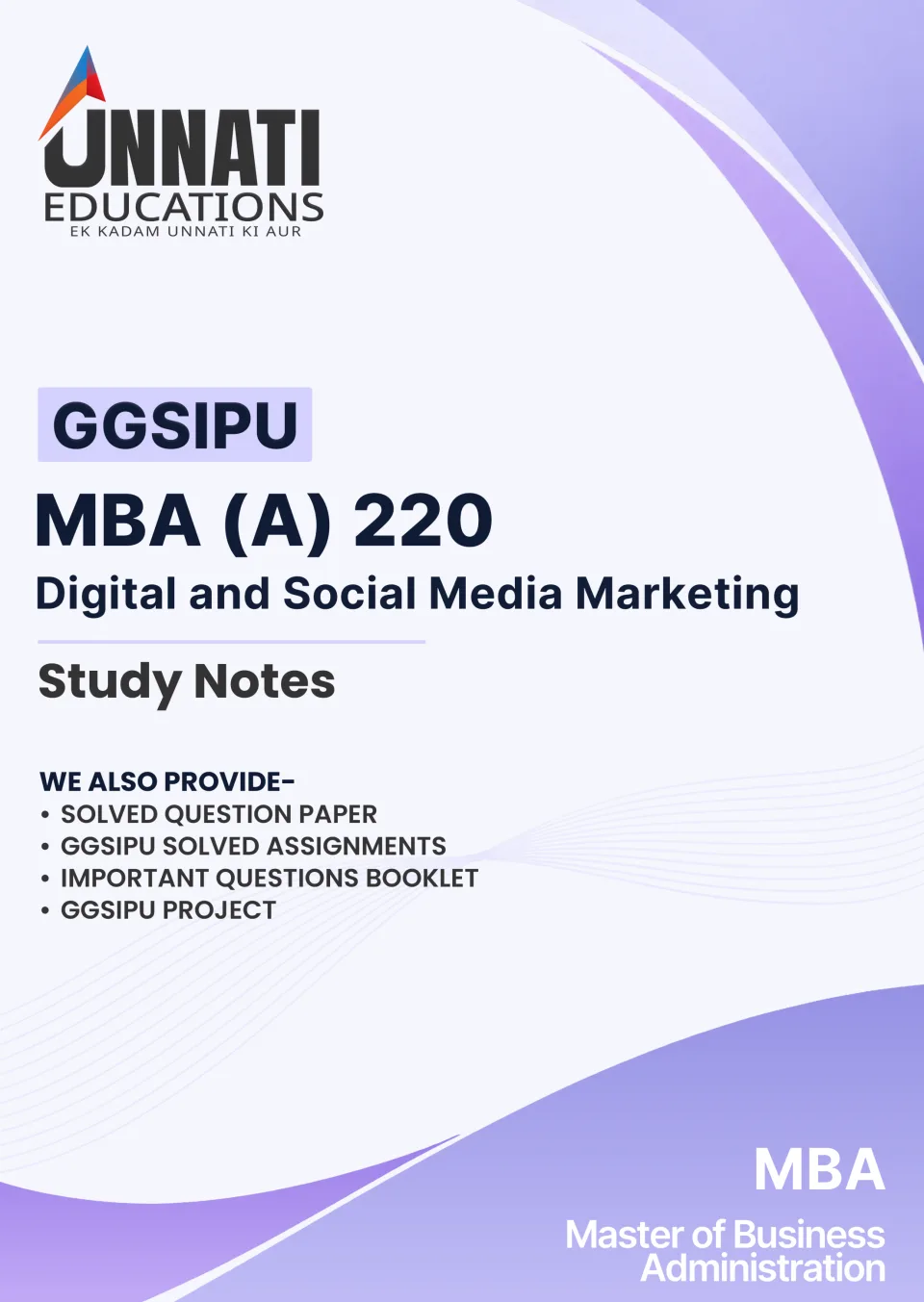
MBA(A) 220 Digital and Social Media Marketing Notes cover all 4 units of the GGSIPU MBA (Analytics) Semester 4 marketing elective in 83 pages, with 22 solved numerical illustrations, 9 case studies, 29 figures and 84 exam questions. They follow the MBA (Analytics) Scheme and Syllabus 2022-24 onwards, the scheme printed on the official university PDF.
Written by Prateek Talwar, Founder, Unnati Educations · Reviewed by Sheetal Kirola, Academic Head, M.Ed. · Checked against syllMBAAnalytics180225.pdf · Updated 14 October 2026 · Editorial policy
Scheme: MBA (Analytics) Scheme and Syllabus 2022-24 onwards | Applies to: students under this scheme (Semesters 3 and 4 approved 19.07.2023) | Verified against: syllMBAAnalytics180225.pdf
MBA(A) 220 Digital and Social Media Marketing at a glance: GGSIPU MBA (Analytics) Sem 4 credits, units and exam pattern
MBA(A) 220 is one of three marketing electives in the fourth semester, beside MBA(A) 216 and MBA(A) 218; students pick any two from their stream. It sits with the other GGSIPU MBA (Analytics) Semester 4 papers.
| Code and title | MBA(A) 220 Digital & Social Media Marketing |
|---|---|
| Course and semester | MBA (Analytics), Semester 4, marketing elective (Elective III / IV slot) |
| Category and credits | Skill Enhancement · L-3 · 3 credits · 42 hours (Unit I 10, II 8, III 12, IV 12) |
| Marks | Internal 25 (Class Test-I 15 + presentation / viva / GD 10); end-term marks not printed (see GGSIPU Ordinance 11) |
| Applies to | Scheme and Syllabus 2022-24 onwards |
| End-term pattern | Paper-setter instructions not printed in the official PDF |
| Units | 4 |
| Paired lab | None (theory elective) |
MBA(A) 220 Digital and Social Media Marketing Notes unit-wise: 22 solved illustrations and 9 case studies across 4 units
Each unit ends with a Quick Revision table and its own exam questions. The official PDF gives no unit titles, so headings follow the notes. Other papers are under GGSIPU MBA (Analytics) notes.
MBA(A) 220 Unit 1: Introduction to Digital Marketing
Pages 5 to 22, 8 sections: digital vs e-commerce and e-business, milestones from 1971 e-mail to AI, Chaffey's six channels and 5Ss, the 6 Is, the internet microenvironment, B2C vs B2B, e-marketing research, and strategy through SOSTAC®, RACE, POEM and the OVP.
3 illustrations (including an A/B test with a z-test), Amul, IndiaMART and Nykaa case studies, 6 figures, 11 short and 8 long questions.
| Basis | Traditional | Internet |
|---|---|---|
| Measurement | Estimates (TRP, readership) | Exact clicks, conversions, ROI |
| Cost | High fixed cost | Pay per click or result |
| Feedback | Slow, through surveys | Instant comments and reviews |
| Control of message | Company | Shared with customers |
Quick look: traditional vs internet marketing communication (from page 11)
- Basis
- Measurement
- Traditional
- Estimates (TRP, readership)
- Internet
- Exact clicks, conversions, ROI
- Basis
- Cost
- Traditional
- High fixed cost
- Internet
- Pay per click or result
- Basis
- Feedback
- Traditional
- Slow, through surveys
- Internet
- Instant comments and reviews
- Basis
- Control of message
- Traditional
- Company
- Internet
- Shared with customers
MBA(A) 220 Unit 2: Online Buyer Behaviour and Customer Experience
Pages 23 to 41, 9 sections, opening with "Online buyer behaviour and Models": perceived risks, TAM, TRA/TPB, S-O-R, AISAS, Kotler's 5A, ZMOT and the conversion funnel, then the online 7Ps, website planning, user requirements (personas, WCAG), site structure, content testing and e-service quality.
4 illustrations (including a fashion-store funnel), Lenskart and IRCTC case studies, 8 figures, 12 short and 9 long questions.
| Dimension | What it checks | Example |
|---|---|---|
| Efficiency | Ease and speed of use | Fast checkout |
| System availability | Correct technical functioning | No crash during a sale |
| Fulfilment | Delivery promises kept | On time, as described |
| Privacy | Safety of customer data | Secure payment |
Quick look: the four E-S-QUAL dimensions (from page 38)
- Dimension
- Efficiency
- What it checks
- Ease and speed of use
- Example
- Fast checkout
- Dimension
- System availability
- What it checks
- Correct technical functioning
- Example
- No crash during a sale
- Dimension
- Fulfilment
- What it checks
- Delivery promises kept
- Example
- On time, as described
- Dimension
- Privacy
- What it checks
- Safety of customer data
- Example
- Secure payment
MBA(A) 220 Unit 3: Interactive Marketing Communications
Pages 42 to 62, 10 sections, the longest unit: Chaffey's new-media changes, IIMC and its 4Cs, measurement through DAGMAR, ROAS and attribution, display and interactive ads, search engine marketing (see the excerpt), online PR, affiliates, viral marketing with STEPPS, opt-in e-mail (CRITICAL checklist), offline support and e-CRM.
8 illustrations, Cadbury's 2021 "Not Just a Cadbury Ad" and Amazon Prime case studies, 7 figures, 12 short and 9 long questions.
| Model | Credit across 5 touchpoints |
|---|---|
| Last click | Paid search ₹10,000 |
| First click | Display ad ₹10,000 |
| Linear | ₹2,000 each |
| Position-based (40/20/40) | ₹4,000 first and last, ₹666.67 to each middle one |
Quick look: one ₹10,000 sale under four attribution models (from page 47)
- Model
- Last click
- Credit across 5 touchpoints
- Paid search ₹10,000
- Model
- First click
- Credit across 5 touchpoints
- Display ad ₹10,000
- Model
- Linear
- Credit across 5 touchpoints
- ₹2,000 each
- Model
- Position-based (40/20/40)
- Credit across 5 touchpoints
- ₹4,000 first and last, ₹666.67 to each middle one
MBA(A) 220 Unit 4: Social Media Marketing
Pages 63 to 82, 10 sections: SMM scope, the honeycomb, an SMM plan with SMART goals, POST and Groundswell, engagement rules and ethics (ASCI, dark patterns), blogs and webinars, video, social networks vs microblogging, geofencing, monitoring, Kaushik's metrics, and GA4 web analytics.
7 illustrations (including influencer CPE and social ROI), Cambridge Analytica and Zomato case studies, 8 figures, 13 short and 10 long questions.
| Brand | Mentions | Share of voice |
|---|---|---|
| Our brand | 4,500 | 30% |
| Competitor A | 6,000 | 40% |
| Competitor B | 3,000 | 20% |
| Competitor C | 1,500 | 10% |
Quick look: share of voice from one month of mentions (from page 76)
- Brand
- Our brand
- Mentions
- 4,500
- Share of voice
- 30%
- Brand
- Competitor A
- Mentions
- 6,000
- Share of voice
- 40%
- Brand
- Competitor B
- Mentions
- 3,000
- Share of voice
- 20%
- Brand
- Competitor C
- Mentions
- 1,500
- Share of voice
- 10%
Search engine optimisation in digital marketing: excerpt from page 50 of the MBA(A) 220 notes
Excerpt from page 50 (Unit 3, sections 5.2 and 5.3)
How a search engine works
A search engine works in four steps. Crawling: bots such as Googlebot discover pages by following links and sitemaps. Indexing: the pages are analysed and stored in a huge index. Ranking: an algorithm orders them by relevance and quality for each query. SERP display: the results page shows paid ads, organic results, the local pack, images, videos and direct answers.
What SEO means
Search engine optimisation is the process of improving a website's position in the organic, unpaid results by making it more relevant, useful, technically sound and authoritative for its target keywords. Done well, it brings free, continuous and high-intent traffic.
Keyword research
Short-tail keywords have one or two words, high volume and high competition ("shoes"). Long-tail keywords have three or more words, lower volume and better conversion ("running shoes for flat feet under 3000"). Keywords are also grouped by intent: informational ("what is SIP"), navigational ("Zerodha login"), commercial ("best mutual fund app") and transactional ("buy iPhone 16 online"). Common tools are Google Keyword Planner, Google Trends, Search Console, SEMrush and Ahrefs.
Four types of SEO activity
On-page SEO optimises each page: title tag, meta description, H1 to H3 headings, keywords in content and URL, image alt text, internal links and schema. Off-page SEO builds authority from outside through quality backlinks, digital PR, guest articles, brand mentions and reviews.
Technical SEO makes the site easy to crawl and use: fast loading, mobile-first design, HTTPS, XML sitemap, robots.txt, clean URLs and Core Web Vitals. Local SEO targets map results through a Google Business Profile, consistent name, address and phone, and local reviews.
Quality signals and penalties
Google judges content quality through E-E-A-T (Experience, Expertise, Authoritativeness, Trustworthiness), most strictly on "Your Money or Your Life" topics. White-hat SEO relies on original content and earned links; black-hat tactics such as keyword stuffing, bought links, cloaking and doorway pages risk a penalty. Panda (2011) hit thin content, Penguin (2012) spammy links, and the Helpful Content updates from 2022 reward people-first pages.
How to write MBA(A) 220 answers: framework diagrams, Indian brand examples and short marketing numericals
MBA(A) 220 answers are mostly theory, and the notes' exam tips push three habits. Draw the framework: for the internet microenvironment, sketch Chaffey's diagram (organisation in the centre, customers, competitors, suppliers and intermediaries around it), then add dis-, re- and countermediation with examples such as boAt, MakeMyTrip and PolicyBazaar.
Name authors and years: write TAM (Davis, 1989) with its diagram as the main model, then add TRA/TPB, S-O-R, AISAS, the 5A path, ZMOT and the McKinsey journey briefly. Compare in a table: the Unit 4 tip sets social networks (Facebook, LinkedIn) against microblogging (X, Threads), with two or three Indian brands on each side, which turns a vague essay into a clear 10–15 Marks answer.
For a long search engine marketing answer, the Unit 3 tip gives the order: meaning of SEM, how search engines work, SEO types, PPC (auction, Quality Score, Ad Rank, match types), an SEO vs PPC table, and a small Ad Rank calculation to close.
Worked example: Google Ads auction (from page 51)
- Ad Rank = maximum CPC bid × Quality Score. A: ₹40 × 5 = 200. B: ₹30 × 8 = 240. C: ₹50 × 3 = 150. D: ₹20 × 6 = 120.
- Positions follow Ad Rank: B, A, C, D.
- Actual CPC = Ad Rank of the advertiser below ÷ own Quality Score + ₹0.01. B pays 200 ÷ 8 + 0.01 = ₹25.01; A pays 150 ÷ 5 + 0.01 = ₹30.01.
- Insight: B takes the top slot at the lowest cost because its Quality Score is highest.
End with that managerial line, as the notes do: better ad relevance and landing pages lower the cost per click. Practise the format on GGSIPU MBA (Analytics) important questions.
MBA(A) 220 exam corner: 48 short-answer and 36 long-answer practice questions by unit
| Unit | Short (2–5 Marks) | Long (10–15 Marks) | Solved illustrations |
|---|---|---|---|
| Unit 1 | 11 | 8 | 3 |
| Unit 2 | 12 | 9 | 4 |
| Unit 3 | 12 | 9 | 8 |
| Unit 4 | 13 | 10 | 7 |
MBA(A) 220 questions and illustrations by unit
- Unit
- Unit 1
- Short (2–5 Marks)
- 11
- Long (10–15 Marks)
- 8
- Solved illustrations
- 3
- Unit
- Unit 2
- Short (2–5 Marks)
- 12
- Long (10–15 Marks)
- 9
- Solved illustrations
- 4
- Unit
- Unit 3
- Short (2–5 Marks)
- 12
- Long (10–15 Marks)
- 9
- Solved illustrations
- 8
- Unit
- Unit 4
- Short (2–5 Marks)
- 13
- Long (10–15 Marks)
- 10
- Solved illustrations
- 7
The MBA(A) 220 notes list 48 short-answer and 36 long-answer exam-style questions across 4 units, plus 22 solved numerical illustrations. Answers are in the unit text. One per unit:
- Unit 1 (10–15 Marks): Explain the SOSTAC® framework and key strategic decisions. Pointer: six stages with key questions, then Chaffey's seven decisions (page 18).
- Unit 2 (2–5 Marks): Calculate NPS when 55% are promoters and 15% are detractors. Pointer: 55 − 15 = +40.
- Unit 3 (2–5 Marks): Calculate CLV: AOV ₹1,000, 4 orders a year, margin 25%, lifespan 5 years. Pointer: 1,000 × 4 × 0.25 × 5 = ₹5,000 (page 59 formula).
- Unit 4 (2–5 Marks): Engagement rate for reach 50,000 with 2,000 likes, 300 comments, 200 shares and 500 saves. Pointer: 3,000 ÷ 50,000 × 100 = 6%.
More practice: MBA(A) 220 important questions.
MBA(A) 220 and the GGSIPU MBA (Analytics) Sem 4 papers it connects to
MBA(A) 220 has no paired lab; every paper is listed on the GGSIPU MBA (Analytics) syllabus page.
- Units 3 and 4 (SEM, viral marketing, web analytics) → MBA(A) 216 Marketing Analytics, Unit IV (web metrics, SEO and SEM, viral marketing).
- Unit 3 e-CRM and customer lifetime value → MBA(A) 216, Unit III (CLV meaning and calculation).
- Unit 1 A/B testing and Unit 4 KPIs → MBA(A) 221 Social Media Analytics (Semester 3).
- Unit 1 SOSTAC® and RACE → a digital marketing topic for MBA(A) 202 Major Project Report.
Other Semester 4 papers: MBA(A) 204 Project Management, MBA(A) 206 Ancient Management Philosophy and Indian Ethos (NUES), MBA(A) 208 Multivariate Data Analysis and MBA(A) 218 Supply Chain Analytics.
Who writes and checks the MBA(A) 220 digital marketing notes?
- Prateek Talwar, author · Founder, Unnati Educations · ACS (ICSI, membership no. 58704, since 15 May 2019) · B.Com, University of Delhi (School of Open Learning), 2012 · profile
- Sheetal Kirola, subject reviewer · Academic Head, Unnati Educations · M.Ed. · 7 years of experience · profile
The 2026-27 edition of these MBA(A) 220 Digital and Social Media Marketing IPU notes is mapped unit by unit to the 2022-24 onwards scheme, with examples from Amul, Nykaa, IRCTC and Zomato. Updated 14 October 2026 under our editorial policy.
The same team prepares GGSIPU important questions from each official syllabus.
Do the MBA(A) 220 notes cover the full GGSIPU syllabus?
Yes. Every topic the official syllabus lists for MBA(A) 220 Units I to IV has its own section in the notes; the unit check found no gap.
| Official unit | Official topics | Where in the notes | Status |
|---|---|---|---|
| Unit I | Meaning, origin, scope, importance, applications; internet vs traditional communication; internet microenvironment; B2C and B2B; e-marketing research; strategy | Sections 1 to 8, pages 5 to 20 | Covered |
| Unit II | Online buyer behaviour and models; online marketing mix; customer experience: website planning, user requirements, site structure, content testing, e-service quality | Sections 1 to 9, pages 23 to 39 | Covered |
| Unit III | Interactive communications; IIMC; objectives and measurement; display, SEM and SEO, online PR, interactive ads, partnerships, viral, opt-in e-mail, offline; e-CRM | Sections 1 to 10, pages 42 to 60 | Covered |
| Unit IV | SMM meaning, scope, importance; SMM plan; engagement rules and ethics; blogs, webinars; videos, images; social networks; microblogging; mobile and location; monitoring; KPIs; web analytics | Sections 1 to 10, pages 63 to 80 | Covered |
MBA(A) 220 official syllabus topics mapped to the notes
- Official unit
- Unit I
- Official topics
- Meaning, origin, scope, importance, applications; internet vs traditional communication; internet microenvironment; B2C and B2B; e-marketing research; strategy
- Where in the notes
- Sections 1 to 8, pages 5 to 20
- Status
- Covered
- Official unit
- Unit II
- Official topics
- Online buyer behaviour and models; online marketing mix; customer experience: website planning, user requirements, site structure, content testing, e-service quality
- Where in the notes
- Sections 1 to 9, pages 23 to 39
- Status
- Covered
- Official unit
- Unit III
- Official topics
- Interactive communications; IIMC; objectives and measurement; display, SEM and SEO, online PR, interactive ads, partnerships, viral, opt-in e-mail, offline; e-CRM
- Where in the notes
- Sections 1 to 10, pages 42 to 60
- Status
- Covered
- Official unit
- Unit IV
- Official topics
- SMM meaning, scope, importance; SMM plan; engagement rules and ethics; blogs, webinars; videos, images; social networks; microblogging; mobile and location; monitoring; KPIs; web analytics
- Where in the notes
- Sections 1 to 10, pages 63 to 80
- Status
- Covered
Verify it yourself: GGSIPU MBA (Analytics) Scheme and Syllabus 2022-24 onwards (PDF), pages 95 and 96 (marks rule on page 3).
Unit IV lists eleven topics, the most of any unit; the notes cover them in 10 sections. Every paper in GGSIPU notes is mapped to its official PDF this way.
MBA(A) 220 digital marketing notes FAQs
How do I get the full MBA(A) 220 notes?
Message us on WhatsApp at 9899436384 with the code MBA(A) 220. The full notes come as a printed book; they are not sold as a PDF. Delivery takes up to 5 to 7 days, and the exact time depends on your location. The book has all 4 units in 83 pages, with 22 solved illustrations and 84 questions.
Which MBA(A) 220 unit has the most numericals?
Unit 3, Interactive Marketing Communications, has 8 of the 22 solved illustrations: channel comparison, attribution models, CPM vs CPC buying, the Google Ads auction, affiliate programme cost, viral coefficient, e-mail campaign metrics and customer lifetime value. Unit 4 follows with 7, mostly social media KPIs and ROI, and both units end with a calculation question.
Is MBA(A) 220 compulsory in MBA (Analytics) Semester 4?
No. MBA(A) 220 is an elective. The fourth-semester scheme asks students to select any two electives from their stream, and the marketing stream offers MBA(A) 216 Marketing Analytics, MBA(A) 218 Supply Chain Analytics and MBA(A) 220. It carries 3 credits (L-3) in the Skill Enhancement category, so check with your institute which two electives it actually runs.
How is MBA(A) 220 marked, and what is the passing mark?
For MBA(A) 220 the official scheme prints only the internal part: 25 marks, made up of Class Test-I (15) and an individual presentation, viva-voce or group discussion (10). It does not print the end-term marks or a pass percentage for theory papers, so check your institute's notice and GGSIPU Ordinance 11 on ipu.ac.in for end-term minimums and re-appear rules.
Which MBA(A) 220 answers need a diagram?
The MBA(A) 220 notes include 29 figures you can reproduce in the exam. The most useful are the internet microenvironment and RACE (Unit 1), TAM and S-O-R (Unit 2), the IIMC planning process and how a search engine works (Unit 3), and the honeycomb and SMM plan steps (Unit 4). A neat labelled box diagram is enough.
How is MBA(A) 220 different from MBA(A) 216 Marketing Analytics?
MBA(A) 220 explains how digital and social media marketing is planned and run: strategy, online buyer behaviour, website experience, promotion techniques and SMM plans. MBA(A) 216 is about analysing marketing data, with segmentation, marketing mix modelling and pricing analytics. The two papers overlap on web metrics, SEO and SEM, viral marketing and customer lifetime value.
Get the full MBA(A) 220 Digital and Social Media Marketing Notes on WhatsApp
| Unit | Pages | Figures | Case studies |
|---|---|---|---|
| Unit 1 | 5 to 22 (18) | 6 | 3 |
| Unit 2 | 23 to 41 (19) | 8 | 2 |
| Unit 3 | 42 to 62 (21) | 7 | 2 |
| Unit 4 | 63 to 82 (20) | 8 | 2 |
Inside the full MBA(A) 220 notes book
- Unit
- Unit 1
- Pages
- 5 to 22 (18)
- Figures
- 6
- Case studies
- 3
- Unit
- Unit 2
- Pages
- 23 to 41 (19)
- Figures
- 8
- Case studies
- 2
- Unit
- Unit 3
- Pages
- 42 to 62 (21)
- Figures
- 7
- Case studies
- 2
- Unit
- Unit 4
- Pages
- 63 to 82 (20)
- Figures
- 8
- Case studies
- 2
The full MBA(A) 220 book adds the complete text, all 22 illustrations step by step, 29 figures, unit revision tables and 84 questions. We print these Digital and Social Media Marketing notes in English, as a book, not a PDF; delivery takes up to 5 to 7 days depending on your location.
Order the full MBA(A) 220 notes book on WhatsApp (4 units, 83 pages)
Unnati Educations is an independent education provider based in Vikaspuri, Delhi. We are not affiliated with, authorised by, or endorsed by Guru Gobind Singh Indraprastha University (GGSIPU). 'GGSIPU' and 'IPU' are used only to describe the syllabus our notes follow. For official information, visit ipu.ac.in.
Ready for the full notes?
Discuss coverage and delivery with our team.