
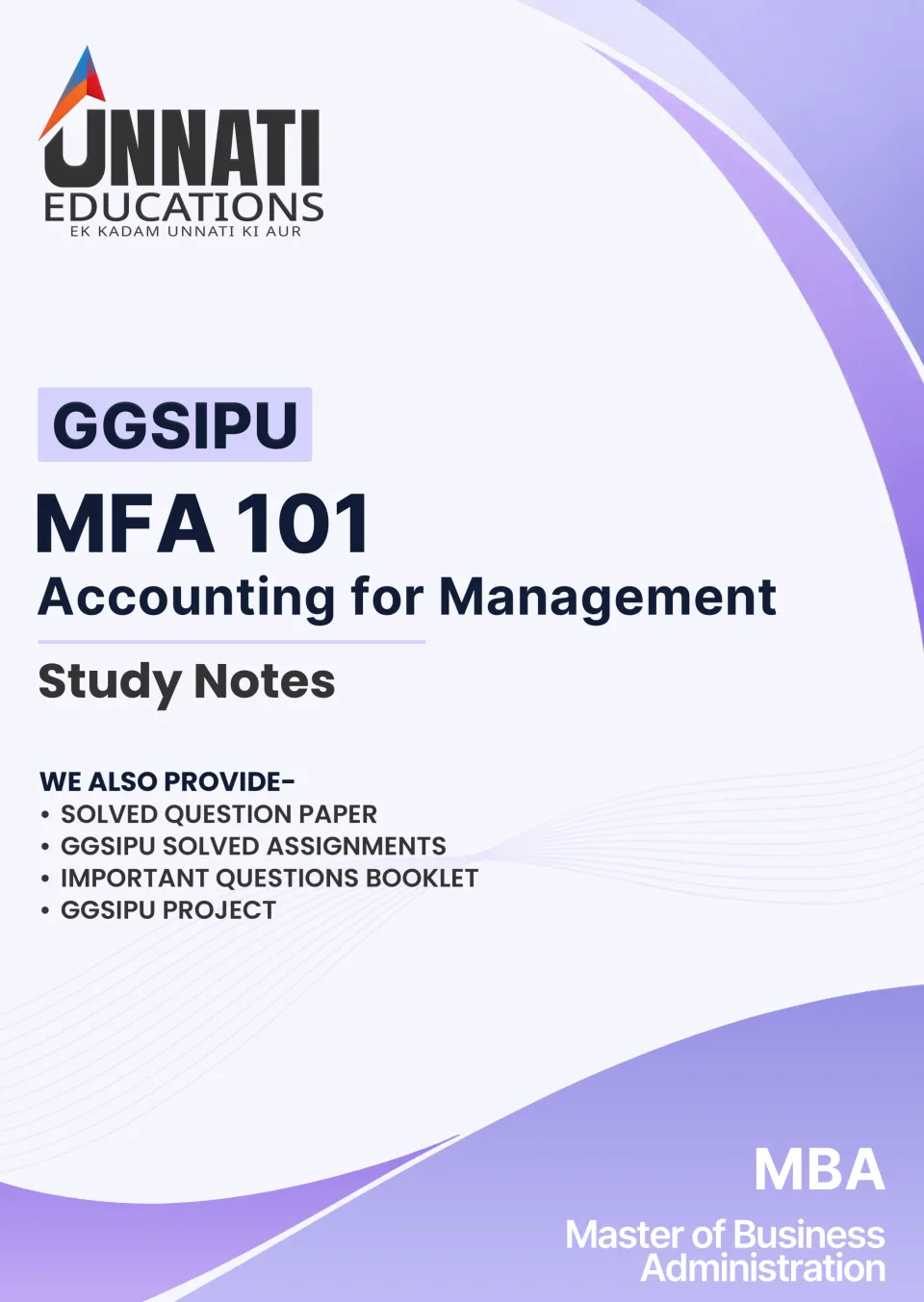
MFA-101 Accounting for Management Notes from Unnati Educations cover all 4 units of the GGSIPU MBA (Financial Analysis) Semester 1 paper in a 63-page printed book: 35 solved illustrations, 23 figures, 82 exam-style questions and a revision table per unit, mapped to the MBA (FA) scheme that applies from the 2021-22 session onwards.
Written by Prateek Talwar, Founder, Unnati Educations (ACS, ICSI) · Reviewed by Sheetal Kirola, Academic Head, M.Ed. (academic review) · Checked against the MBA (FA) Scheme and Syllabus 2021-22 onwards · Updated 28 October 2026 · Editorial policy
Scheme: MBA (FA) 2021-22 | Applies to: 2021-22 batch onwards | Verified against: MBA (FA) Scheme and Syllabus, 28 October 2026
MFA-101 Accounting for Management at a glance: GGSIPU MBA (FA) Sem 1 credits, units and exam pattern
MFA-101 is a Core paper that sits with nine other GGSIPU MBA (FA) Semester 1 papers.
| Course and semester | MBA (Financial Analysis), Semester 1 |
|---|---|
| Category and credits | Core · L 3, no T/P · 3 credits |
| Teaching hours | Unit I 12 · Units II to IV 10 each (42) |
| Marks | 100: 50 internal + 50 end-term |
| End-term pattern | 50-mark written exam by the University; paper-setter instructions not printed in the official PDF |
| Pass rules | Not printed in the MBA (FA) PDF; see GGSIPU Ordinance 11 |
| Paired lab | None (MFA-119 is the lab of MFA-107) |
MFA-101 Accounting for Management Notes unit-wise: 35 solved illustrations and 82 exam questions across 4 units
These MFA-101 Accounting for Management IPU notes follow the official unit order. Notes for every other paper are on the GGSIPU MBA (FA) notes page.
MFA-101 Unit 1: Financial Accounting
Pages 4 to 22 (19 pages). It covers concepts and conventions, AS vs Ind AS, journal, subsidiary books, ledger, trial balance, rectification through a Suspense Account, capital vs revenue items, depreciation and final accounts with adjustments. It has 9 solved illustrations, including a Rahul Traders chain from journal to trial balance, plus 12 short-answer and 8 long-answer questions.
| Year | SLM | WDV at 20% | SYD |
|---|---|---|---|
| 1 | ₹18,000 | ₹20,000 | ₹30,000 |
| 3 | ₹18,000 | ₹12,800 | ₹18,000 |
| 5 | ₹18,000 | ₹8,192 | ₹6,000 |
| Total | ₹90,000 | ₹67,232 | ₹90,000 |
Quick look: one ₹1,00,000 machine, three depreciation methods (from page 16)
- Year
- 1
- SLM
- ₹18,000
- WDV at 20%
- ₹20,000
- SYD
- ₹30,000
- Year
- 3
- SLM
- ₹18,000
- WDV at 20%
- ₹12,800
- SYD
- ₹18,000
- Year
- 5
- SLM
- ₹18,000
- WDV at 20%
- ₹8,192
- SYD
- ₹6,000
- Year
- Total
- SLM
- ₹90,000
- WDV at 20%
- ₹67,232
- SYD
- ₹90,000
MFA-101 Unit 2: Cost Accounting
Pages 23 to 37 (15 pages). It builds the cost sheet from prime cost to sales, then covers material control and perpetual inventory, FIFO, LIFO and weighted average pricing, EOQ, ABC analysis, stock levels, Halsey and Rowan plans, labour turnover and overhead absorption. It has 11 solved illustrations, the most of any unit, plus 12 short-answer and 8 long-answer questions.
Quick look: Wilson's EOQ in four steps (from page 29)
- Demand 4,800 units; ordering cost ₹150; carrying cost 10% of ₹40 = ₹4 a unit.
- EOQ = √(2 × 4,800 × 150 ÷ 4) = 600 units.
- 8 orders a year, so ordering cost = ₹1,200.
- Carrying cost = 300 × ₹4 = ₹1,200, equal to ordering cost at EOQ.
MFA-101 Unit 3: Performance Evaluation Techniques
Pages 38 to 49 (12 pages). It explains budgetary control, performance budgeting, functional and master budgets, fixed vs flexible budgets, zero based budgeting, standard costing and variance analysis, the Balanced Scorecard and responsibility centres. It has 5 solved illustrations plus 12 short-answer and 8 long-answer questions.
| Variance | Working | Result |
|---|---|---|
| Rate | 3,200 × (₹40 − ₹42) | ₹6,400 A |
| Idle time | 100 × ₹40 | ₹4,000 A |
| Efficiency | ₹40 × (3,000 − 3,100) | ₹4,000 A |
| Cost | ₹1,20,000 − ₹1,34,400 | ₹14,400 A |
Quick look: labour variances of Product Z (from page 45)
- Variance
- Rate
- Working
- 3,200 × (₹40 − ₹42)
- Result
- ₹6,400 A
- Variance
- Idle time
- Working
- 100 × ₹40
- Result
- ₹4,000 A
- Variance
- Efficiency
- Working
- ₹40 × (3,000 − 3,100)
- Result
- ₹4,000 A
- Variance
- Cost
- Working
- ₹1,20,000 − ₹1,34,400
- Result
- ₹14,400 A
MFA-101 Unit 4: Decision Making Techniques
Pages 50 to 62 (13 pages). Sigma Ltd runs through common size statements, five ratio groups and a Du Pont split of its 30% ROE. Marginal costing is then applied to special orders, make or buy and product mix, ending with EVA, activity based, target, life cycle and uniform costing. It has 10 solved illustrations plus 13 short-answer and 9 long-answer questions.
| Per unit | A | B | C |
|---|---|---|---|
| Contribution | ₹40 | ₹30 | ₹50 |
| Machine hours | 4 | 2 | 2.5 |
| Per machine hour | ₹10 | ₹15 | ₹20 |
| Rank | III | II | I |
Quick look: ranking products when machine hours are scarce (from page 56)
- Per unit
- Contribution
- A
- ₹40
- B
- ₹30
- C
- ₹50
- Per unit
- Machine hours
- A
- 4
- B
- 2
- C
- 2.5
- Per unit
- Per machine hour
- A
- ₹10
- B
- ₹15
- C
- ₹20
- Per unit
- Rank
- A
- III
- B
- II
- C
- I
Break-even point and margin of safety in management accounting: excerpt from page 54 of the MFA-101 notes
Excerpt from page 54
Marginal costing vs absorption costing
Under marginal costing only variable costs are charged to products. Fixed production costs are period costs, written off in full against the contribution of the period. Under absorption costing, fixed production overheads are absorbed into product cost through overhead rates, so part of them is carried forward in closing stock.
| Basis | Marginal costing | Absorption costing |
|---|---|---|
| Stock valuation | At variable cost | At full production cost |
| Profit when production is more than sales | Lower | Higher (part of fixed cost sits in closing stock) |
| Accepted for financial reporting | No (AS 2 requires full production cost) | Yes |
| Best used for | Short-term decisions, CVP, pricing | External reporting, long-term pricing |
Marginal and absorption costing compared (excerpt, page 54)
- Basis
- Stock valuation
- Marginal costing
- At variable cost
- Absorption costing
- At full production cost
- Basis
- Profit when production is more than sales
- Marginal costing
- Lower
- Absorption costing
- Higher (part of fixed cost sits in closing stock)
- Basis
- Accepted for financial reporting
- Marginal costing
- No (AS 2 requires full production cost)
- Absorption costing
- Yes
- Basis
- Best used for
- Marginal costing
- Short-term decisions, CVP, pricing
- Absorption costing
- External reporting, long-term pricing
Why the two profits differ
Selling price is ₹100, variable cost ₹60 a unit and fixed production overheads ₹4,00,000 at a normal capacity of 16,000 units (₹25 a unit). The firm makes 16,000 units and sells 15,000, with no opening stock.
Marginal costing profit = 15,000 × ₹40 − ₹4,00,000 = ₹2,00,000, with closing stock at 1,000 × ₹60 = ₹60,000. Absorption costing profit = ₹15,00,000 − (16,000 × ₹85 − 1,000 × ₹85) = ₹2,25,000, with closing stock at ₹85,000. The gap of ₹25,000 is the fixed overhead locked in closing stock (1,000 × ₹25).
Cost volume profit formulas
BEP (units)          = Fixed cost ÷ Contribution per unit
BEP (₹)              = Fixed cost ÷ P/V ratio
Margin of safety     = Actual sales − BEP sales
Profit               = Margin of safety × P/V ratio
Sales for target = (Fixed cost + Target profit) ÷ Contribution per unitWorked CVP illustration
With the same figures and actual sales of 15,000 units, contribution is ₹40 a unit and the P/V ratio is 40%. BEP = ₹4,00,000 ÷ ₹40 = 10,000 units, or ₹10,00,000 of sales. Profit = 15,000 × ₹40 − ₹4,00,000 = ₹2,00,000.
Margin of safety = 5,000 units, or ₹5,00,000, which is 33.33% of sales. Check: ₹5,00,000 × 40% = ₹2,00,000. To earn a profit of ₹3,00,000, the firm must sell (₹4,00,000 + ₹3,00,000) ÷ ₹40 = 17,500 units.
Do the MFA-101 notes cover the full GGSIPU syllabus?
Yes. Every MFA-101 topic in the official MBA (FA) syllabus, from "Scope and Nature of Accounting" to "Uniform Costing", has its own section in the notes. We found no gap.
| Official unit | Official topics | In the notes | Status |
|---|---|---|---|
| I Financial Accounting | Scope and nature, concepts, principles and standards, accounting cycle, journalisation, subsidiary books, ledger posting, trial balance, rectification of errors, capital and revenue expenditure and income, fixed assets and depreciation, final accounts with manufacturing, trading and P&L account and balance sheet (with adjustments) | Sections 1 to 8, pages 4 to 21 | Covered |
| II Cost Accounting | Objectives, classification of cost, cost sheet, material cost accounting, perpetual inventory control, inventory valuation, EOQ, ABC analysis, reorder, maximum and minimum levels, labour costing, overhead allocations, over and under absorption | Sections 1 to 8, pages 23 to 35 | Covered |
| III Performance Evaluation Techniques | Budgeting and budgetary control, performance budgeting, classification of budget, fixed and flexible budgets, zero based budgeting, standard costing and variance analysis, balanced scorecard, responsibility accounting | Sections 1 to 8, pages 38 to 48 | Covered |
| IV Decision Making Techniques | Financial statement analysis, ratio analysis, common size statements, Du Pont, marginal costing and its use in decisions, CVP, profit planning, management accounting for decisions and control, EVA, activity based, target, life cycle and uniform costing | Sections 1 to 8, pages 50 to 61 | Covered |
MFA-101 official syllabus mapped to the notes
- Official unit
- I Financial Accounting
- Official topics
- Scope and nature, concepts, principles and standards, accounting cycle, journalisation, subsidiary books, ledger posting, trial balance, rectification of errors, capital and revenue expenditure and income, fixed assets and depreciation, final accounts with manufacturing, trading and P&L account and balance sheet (with adjustments)
- In the notes
- Sections 1 to 8, pages 4 to 21
- Status
- Covered
- Official unit
- II Cost Accounting
- Official topics
- Objectives, classification of cost, cost sheet, material cost accounting, perpetual inventory control, inventory valuation, EOQ, ABC analysis, reorder, maximum and minimum levels, labour costing, overhead allocations, over and under absorption
- In the notes
- Sections 1 to 8, pages 23 to 35
- Status
- Covered
- Official unit
- III Performance Evaluation Techniques
- Official topics
- Budgeting and budgetary control, performance budgeting, classification of budget, fixed and flexible budgets, zero based budgeting, standard costing and variance analysis, balanced scorecard, responsibility accounting
- In the notes
- Sections 1 to 8, pages 38 to 48
- Status
- Covered
- Official unit
- IV Decision Making Techniques
- Official topics
- Financial statement analysis, ratio analysis, common size statements, Du Pont, marginal costing and its use in decisions, CVP, profit planning, management accounting for decisions and control, EVA, activity based, target, life cycle and uniform costing
- In the notes
- Sections 1 to 8, pages 50 to 61
- Status
- Covered
Official source: MBA (Financial Analysis) Scheme and Syllabus, 2021-22 onwards (ipu.ac.in). MFA-101 is on page 11 of that PDF.
Every course in GGSIPU notes is mapped to its official PDF the same way.
How to write MFA-101 answers: journal entries, cost sheets, variance workings and long-answer theory
MFA-101 marks reward clean format as much as the final figure. These rules come from the exam-tip boxes in the notes:
- Journal entries: write a narration under each entry, and show each debit of a compound entry on its own line so debits visibly equal credits.
- Rectification: ask which account is wrong, by how much, and whether the error is one-sided. Only one-sided errors pass through the Suspense Account.
- Final accounts: if closing stock sits inside the trial balance, show it only in the Balance Sheet, and add working notes for provisions and depreciation.
- Cost sheets: show a total column and a per-unit column, as the notes do, and add or subtract WIP and finished stock at the right stage.
- Flexible budgets: split semi-variable costs first, using the high-low method when two levels are given.
- Variances: mark each one F or A and prove that sub-variances add up to the cost variance.
- Overheads and BEP: label results "Over-absorbed" or "Under-absorbed", and round BEP in units up.
Worked example: the profit condition on a cost sheet (from page 26)
Neel Ltd's cost of sales is ₹4,90,000 for 10,000 units. At 20% on cost, profit = 20/100 × ₹4,90,000 = ₹98,000 and sales = ₹5,88,000, or ₹58.80 a unit. At 20% on sales, profit is 20/80, or 25%, of cost: ₹1,22,500, and sales become ₹6,12,500. Two words change the answer by ₹24,500, so underline "on cost" or "on sales" before you start, and show the fraction you used in a working note.
For long theory answers on budgetary control, ZBB, the Balanced Scorecard or EVA, copy the notes' pattern: a one-line definition with its source (CIMA, Kaplan and Norton, Stern Stewart), a comparison table, then advantages and limitations side by side. Practise this format on GGSIPU MBA (FA) important questions.
MFA-101 exam corner: 49 short-answer and 33 long-answer questions by unit
Each unit ends with short-answer (2–5 Marks) and long-answer (10–15 Marks) practice questions, without written answers; the method sits in the solved illustrations.
| Unit | Short (2–5 Marks) | Long (10–15 Marks) | Solved illustrations |
|---|---|---|---|
| I | 12 | 8 | 9 |
| II | 12 | 8 | 11 |
| III | 12 | 8 | 5 |
| IV | 13 | 9 | 10 |
| Total | 49 | 33 | 35 |
MFA-101 exam questions and solved illustrations per unit
- Unit
- I
- Short (2–5 Marks)
- 12
- Long (10–15 Marks)
- 8
- Solved illustrations
- 9
- Unit
- II
- Short (2–5 Marks)
- 12
- Long (10–15 Marks)
- 8
- Solved illustrations
- 11
- Unit
- III
- Short (2–5 Marks)
- 12
- Long (10–15 Marks)
- 8
- Solved illustrations
- 5
- Unit
- IV
- Short (2–5 Marks)
- 13
- Long (10–15 Marks)
- 9
- Solved illustrations
- 10
- Unit
- Total
- Short (2–5 Marks)
- 49
- Long (10–15 Marks)
- 33
- Solved illustrations
- 35
The MFA-101 notes list 49 short-answer and 33 long-answer exam questions across 4 units, plus 35 solved illustrations.
- Unit I: Calculate the WDV rate for an asset costing ₹2,00,000 with a residual value of ₹20,000 after 5 years. Pointer: r = 1 − (0.1)1/5, about 36.9%.
- Unit II: Calculate earnings under Halsey and Rowan plans: S = 10 hrs, T = 8 hrs, R = ₹50. Pointer: Halsey ₹450, Rowan ₹480.
- Unit III: Distinguish between ROI and Residual Income. Pointer: a 16% project can lower an 18% ROI yet add positive RI.
- Unit IV: Distinguish between current ratio and quick ratio. Pointer: Sigma Ltd shows 2.5 : 1 against 1.25 : 1.
More practice sits in the MFA-101 important questions.
Who writes and checks the MFA-101 Accounting notes?
- Prateek Talwar, author · Founder, Unnati Educations · Associate Company Secretary (ACS), ICSI, membership no. 58704, since 15 May 2019 · B.Com, University of Delhi (SOL), 2012 · profile
- Sheetal Kirola, academic reviewer · Academic Head, Unnati Educations · M.Ed. · 7 years of experience · checks structure, clarity and syllabus order · profile
The 2026-27 edition maps MFA-101 to the 2021-22 scheme and uses AS 2, AS 10, Ind AS 16 and Schedule III in its examples. Updated 28 October 2026 under our editorial policy.
The same team prepares GGSIPU important questions the same way.
MFA-101 and the GGSIPU MBA (FA) Sem 1 papers it connects to
MFA-101 has no lab; all papers are listed in the GGSIPU MBA (FA) syllabus.
These GGSIPU MBA (FA) Sem 1 Accounting for Management notes connect with:
- MFA-103 Quantitative Techniques: high-low split and key-factor product mix.
- MFA-105 Managerial Economics: cost behaviour and opportunity cost.
- MFA-111 Financial Markets and Institutions: Unit 4's EPS, P/E and dividend yield.
- Also in Sem 1: MFA-107, MFA-109, MFA-113, MFA-115, MFA-117 and MFA-119.
Unit 4 also leads into MFA-102 Financial Management in Semester 2.
MFA-101 Accounting notes FAQs
How do I get the full MFA-101 notes?
Tap "Get Full Notes" or the WhatsApp button at the end of this page and send the pre-filled message. The full MFA-101 notes come as a printed book with all 4 units on 63 pages, and our team shares the order details on WhatsApp. Delivery takes a maximum of 5 to 7 days; the exact time depends on your location.
Are the MFA-101 notes available as a PDF?
No. The full MFA-101 notes are sold only as a printed book, not as a PDF.
What is the passing mark for MFA-101?
MFA-101 is marked out of 100: 50 internal and 50 end-term. The MBA (FA) scheme and syllabus PDF does not print a pass percentage, so we do not quote one. Minimum end-term marks, credit rules and re-appear options are set by the university's Ordinance 11, which is on ipu.ac.in and linked in the snapshot table above.
How are the 50 internal marks of MFA-101 given?
The MBA (FA) scheme splits the 50 internal marks of every theory paper, MFA-101 included, into Class Test I (15), Class Test II (15) and 20 marks for assignments, presentation, viva-voce, group discussion and class participation. Both class tests are written and compulsory, so the revision table at the end of each unit helps before each test.
Which MFA-101 unit has the most numericals?
Unit 2, Cost Accounting, has the most, with 11 solved illustrations on the cost sheet, stores ledger pricing, EOQ, ABC analysis, stock levels, wage plans and overheads. Unit 4 follows with 10, built around one company, Sigma Ltd, so ratios, Du Pont and EVA reuse the same figures. Unit 3 leans most towards theory, with 5 illustrations.
Do the MFA-101 notes match my batch's syllabus?
The MFA-101 notes follow the MBA (Financial Analysis) scheme and syllabus that applies from the 2021-22 academic session, and all four official units match topic for topic. If your institute has issued a newer MBA (FA) scheme, send its MFA-101 page on WhatsApp before ordering and we will tell you honestly whether any topic differs.
Get the full MFA-101 Accounting for Management Notes on WhatsApp
These are Accounting for Management notes in English, with tables, flowcharts and ₹ figures in Indian format.
| Unit | Pages | Solved illustrations | Exam questions |
|---|---|---|---|
| I Financial Accounting | 19 | 9 | 20 |
| II Cost Accounting | 15 | 11 | 20 |
| III Performance Evaluation | 12 | 5 | 20 |
| IV Decision Making | 13 | 10 | 22 |
| Book total (with cover and index) | 63 | 35 | 82 |
What is inside the MFA-101 printed notes book
- Unit
- I Financial Accounting
- Pages
- 19
- Solved illustrations
- 9
- Exam questions
- 20
- Unit
- II Cost Accounting
- Pages
- 15
- Solved illustrations
- 11
- Exam questions
- 20
- Unit
- III Performance Evaluation
- Pages
- 12
- Solved illustrations
- 5
- Exam questions
- 20
- Unit
- IV Decision Making
- Pages
- 13
- Solved illustrations
- 10
- Exam questions
- 22
- Unit
- Book total (with cover and index)
- Pages
- 63
- Solved illustrations
- 35
- Exam questions
- 82
Format: printed book only, not available as PDF. Order on WhatsApp; delivery takes a maximum of 5 to 7 days, depending on your location.
Order the full MFA-101 notes book on WhatsApp (4 units, 63 pages)Unnati Educations is an independent education provider based in Vikaspuri, Delhi. We are not affiliated with, authorised by, or endorsed by Guru Gobind Singh Indraprastha University (GGSIPU). 'GGSIPU' and 'IPU' are used only to describe the syllabus our notes follow. For official information, visit ipu.ac.in.
Ready for the full notes?
Discuss coverage and delivery with our team.